oil Seat Mii 2014 Owner's Guide
[x] Cancel search | Manufacturer: SEAT, Model Year: 2014, Model line: Mii, Model: Seat Mii 2014Pages: 219, PDF Size: 4.19 MB
Page 150 of 219
Advice
Checking the engine oil level and
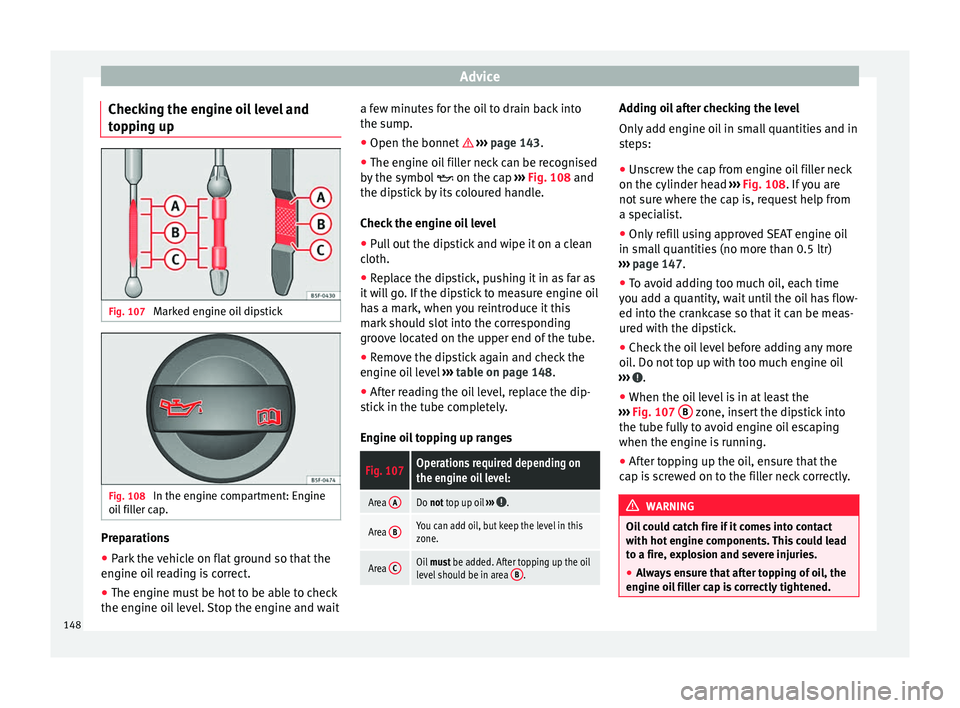
topping up Fig. 107
Marked engine oil dipstick Fig. 108
In the engine compartment: Engine
oil filler cap. Preparations
● Park the vehicle on flat ground so that the
engine oil reading is correct.
● The engine must be hot to be able to check
the engine oil level. Stop the engine and wait a few minutes for the oil to drain back into
the sump.
●
Open the bonnet ››› page 143.
● The engine oil filler neck can be recognised
by the symbol on the cap
›
›› Fig. 108 and
the dipstick by its coloured handle.
Check the engine oil level
● Pull out the dipstick and wipe it on a clean
cloth.
● Replace the dipstick, pushing it in as far as
it will go. If the dipstick to measure engine oil
has a mark, when you reintroduce it this
mark should slot into the corresponding
groove located on the upper end of the tube.
● Remove the dipstick again and check the
engine oil level ››› table on page 148.
● After reading the oil level, replace the dip-
stick in the tube completely.
Engine oil topping up ranges
Fig. 107Operations required depending on
the engine oil level:
Area ADo not top up oil
››› .
Area BYou can add oil, but keep the level in this
zone.
Area COil
must be added. After topping up the oil
level should be in area B. Adding oil after checking the level
Only add engine oil in small quantities and in
steps:
●
Unscrew the cap from engine oil filler neck
on the cylinder head ››› Fig. 108 . If you are
not s
ure where the cap is, request help from
a specialist.
● Only refill using approved SEAT engine oil
in small quantities (no more than 0.5 ltr)
››› page 147.
● To av
oid adding too much oil, each time
you add a quantity, wait until the oil has flow-
ed into the crankcase so that it can be meas-
ured with the dipstick.
● Check the oil level before adding any more
oil. Do not top up with too much engine oil
››› .
● When the oil level is in at least the
››› Fig. 107 B zone, insert the dipstick into
the tube fully to avoid engine oil escaping
when the engine is running.
● After topping up the oil, ensure that the
cap is screwed on to the filler neck correctly. WARNING
Oil could catch fire if it comes into contact
with hot engine components. This could lead
to a fire, explosion and severe injuries.
● Always ensure that after topping of oil, the
engine oil filler cap is correctly tightened. 148
Page 151 of 219

Checking and refilling levels
This will avoid engine oil spilling onto hot
engine parts when the engine is running.
CAUTION
● If the engine oil level is above the area Ado not start the engine. Seek specialist assis-
tance. Otherwise catalytic converter and en-
gine damage may occur.
● When refilling or changing service liquids,
ensure that you put the liquids into the right
tank. Making a mistake when refilling could
cause serious malfunctions and damage the
engine! For the sake of the environment
The oil level must never be above area A .
Otherwise oil can be drawn in through the
crankcase breather and escape into the at-
mosphere via the exhaust system. Engine oil consumption
The consumption of engine oil can be differ-
ent from one engine to another and can vary
during the useful life of the engine.
Depending on how you drive and the condi-
tions in which the vehicle is used, oil con-
sumption can be up to 1 ltr./2000 km. In the
case of new vehicles, the consumption can
exceed this figure over 5,000 kilometres. For
this reason the engine oil level must be checked at regular intervals, preferably when
filling the tank and before a journey.
When the engine is working hard, for in-
stance during sustained high-speed motor-
way cruising in summer or when climbing
mountain passes, the oil level should pref-
erably be kept within area
››› Fig. 107 A .
Changing the engine oil The engine oil must be changed regularly ac-
cording to the specifications of the Mainte-
nance Programme.
Due to the problems linked with disposing of
used oil and the need for suitable tools and
special knowledge, always visit a specialised
workshop to have the engine oil and filter
changed. SEAT recommends taking your car
in for technical service.
Detailed information on the service intervals
is shown in the Maintenance Programme.
Engine oil additives make new oil darker after
the engine has been running for a short peri-
od. This is normal and does not mean more
frequent oil changes are required.
WARNING
If, in exceptional circumstances, you must
change the engine oil yourself, please note
the following: ●
Wear eye protection.
● Always wait until the engine has complete-
ly cooled to avoid being burned.
● Always keep your arms horizontal when un-
screwing the oil drainage bolt so that it does
not run down your arms.
● Use a suitable container large enough to
collect all of the used oil in the engine.
● Never collect engine oil in empty food con-
tainers, cans, bottles or other containers as
not all people are able to identify engine oil.
● Oil is toxic and must be kept out of the
reach of children. For the sake of the environment
Before changing the engine oil, find a suita-
ble location or service for proper disposal. For the sake of the environment
Always dispose of engine oil with the utmost
respect for the environment. Never dispose of
used engine oil in places such as a garden,
woods, drains, roads, paths, rivers and drain-
age systems. 149Technical specifications
Advice
Operation
Safety
Page 152 of 219
Advice
Engine coolant Introduction WARNING
Engine coolant is toxic!
● Only keep engine coolant in its original
container, tightly shut and in a safe place.
● Never store engine coolant in empty food
containers or bottles as other people may ac-
cidentally drink it.
● Always keep engine coolant out of reach of
children.
● Ensure that the proportion of engine cool-
ant additive corresponds to the lowest out-
side temperature to which the vehicle will be
exposed.
● If the outside temperature is extremely low,
the engine coolant could freeze causing the
vehicle to stop. As this would also cause the
heating to stop working, vehicle occupants
without warm clothing could freeze. For the sake of the environment
Coolants and additives can contaminate the
environment. Collect any spilt fluids in suita-
ble containers and dispose of them in accord-
ance with legislation and with the utmost re-
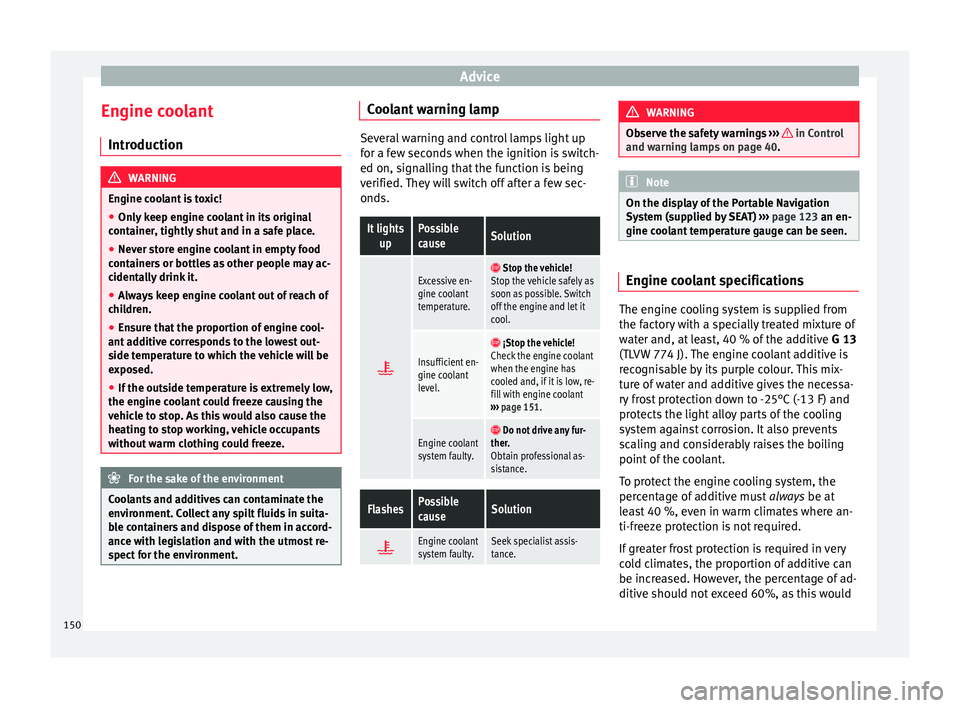
spect for the environment. Coolant warning lamp
Several warning and control lamps light up
for a few seconds when the ignition is switch-
ed on, signalling that the function is being
verified. They will switch off after a few sec-
onds.It lights
upPossible
causeSolution
Excessive en-
gine coolant
temperature. Stop the vehicle!
Stop the vehicle safely as
soon as possible. Switch
off the engine and let it
cool.
Insufficient en-
gine coolant
level.
¡Stop the vehicle!
Check the engine coolant
when the engine has
cooled and, if it is low, re-
fill with engine coolant
››› page 151.
Engine coolant
system faulty. Do not drive any fur-
ther.
Obtain professional as-
sistance.
FlashesPossible
causeSolution
Engine coolant
system faulty.Seek specialist assis-
tance. WARNING
Observe the safety warnings ››› in Control
and warning lamps on page 40. Note
On the display of the Portable Navigation
System (supplied by SEAT) ››› page 123 an en-
gine coolant temperature gauge can be seen. Engine coolant specifications
The engine cooling system is supplied from
the factory with a specially treated mixture of
water and, at least, 40 % of the additive
G 13
(TLVW 774 J). The engine coolant additive is
recognisable by its purple colour. This mix-
ture of water and additive gives the necessa-
ry frost protection down to -25°C (-13 F) and
protects the light alloy parts of the cooling
system against corrosion. It also prevents
scaling and considerably raises the boiling
point of the coolant.
To protect the engine cooling system, the
percentage of additive must always be at
l e
ast 40 %, even in warm climates where an-
ti-freeze protection is not required.
If greater frost protection is required in very
cold climates, the proportion of additive can
be increased. However, the percentage of ad-
ditive should not exceed 60%, as this would
150
Page 155 of 219
Checking and refilling levels
In the course of time, the brake fluid absorbs
water from the ambient air. If there is too
much water in the brake fluid, the brake sys-
tem could be damaged. In addition, the boil-
ing point of the brake fluid is significantly
lowered. When the brake fluid contains too
much water and the brakes are subject to
considerable forces, bubbles of water vapour
can form in the system. These bubbles can
significantly reduce braking power, notably
increasing braking distance, and could even
result in the total failure of the brake system.
Ensuring that the brake system is always
functioning correctly is essential for your own
safety and the safety of other road users
››› .
Brake fluid specifications
SEAT have developed a special brake fluid
optimised for the brake systems of their vehi-
cles. To ensure the optimum working of the
brake system, SEAT recommends the use of
brake fluid in accordance with the VW 501 14
standard . If this brake fluid is not available or
another br ak
e fluid is used for different rea-
sons, use a brake fluid that complies with the
United States standard FMVSS 116 DOT 4 or
the German standard DIN ISO 4925 CLASS 4
››› .
Brake fluids conforming to the standard
VW 501 14, fulfil the American requirements
of the FMVSS 116 DOT 4 standard and the
German DIN ISO 4925 CLASS 4 standard. However, fluids that comply with the Ameri-
can FMVSS 116 DOT 4 standard or the Ger-
man DIN ISO 4925 CLASS 4 standard do not
necessarily comply with the VW 501 14
standard. Always check the information on
the brake fluid container and ensure that you
are using suitable brake fluid.
A suitable brake fluid can be obtained from
SEAT dealerships.
Brake fluid level
The level of the brake fluid should always be
between the MIN and MAX marks, or above
the MIN mark
››› .
It is not always possible to check the level of
the brake fluid, as in some models the en-
gine components make it difficult to see the
brake fluid reservoir. If you cannot read the
exact brake fluid level, consult a specialist.
The brake fluid level drops slightly when the
vehicle is being used due to wear of the
brake pads and the automatic readjustment
of the brake.
Changing the brake fluid
The brake fluid should be changed in accord-
ance with the instructions given in the Main-
tenance Programme. Have the brake fluid
changed by a specialised workshop. SEAT
recommends taking your car in for technical
service. This means that only brake fluid complying with the required specifications
will be used. WARNING
If the brake fluid level is low or unsuita-
ble/old brake fluid is used, the brake system
may fail or braking power may be reduced.
● Check the brake system and the brake fluid
level regularly!
● The brake fluid should be changed regular-
ly in accordance with the instructions given
in the Maintenance Programme.
● When the brake fluid is used and brakes
are subjected to extreme braking forces, bub-
bles of vapour form in the brake system.
These bubbles can significantly reduce brak-
ing power, notably increasing braking dis-
tance, and could result in the total failure of
the brake system.
● Always ensure that you use suitable brake
fluid. Only used brake fluid that conforms to
the VW 501 14 standard, FMVSS 116 DOT 4
standard or even the DIN ISO 4925 CLASS 4
standard. Other types of brake fluid could af-
fect brake operation and reduce braking pow-
er. Do not use a brake fluid if the container
does not specify compliance with the
VW 501 14, FMVSS 116 DOT 4 or
DIN ISO 4925 CLASS 4 standards.
● The replacement brake fluid must be new. WARNING
Brake fluid is poisonous. » 153
Technical specifications
Advice
Operation
Safety
Page 161 of 219
Wheels and tyres
Note
For technical reasons, it is not generally pos-
sible to use the wheels from other vehicles.
In some cases, this may also be true for the
same model of wheel. Please refer to the ve-
hicle documentation or ask at a technical
service. About your tyres and wheels
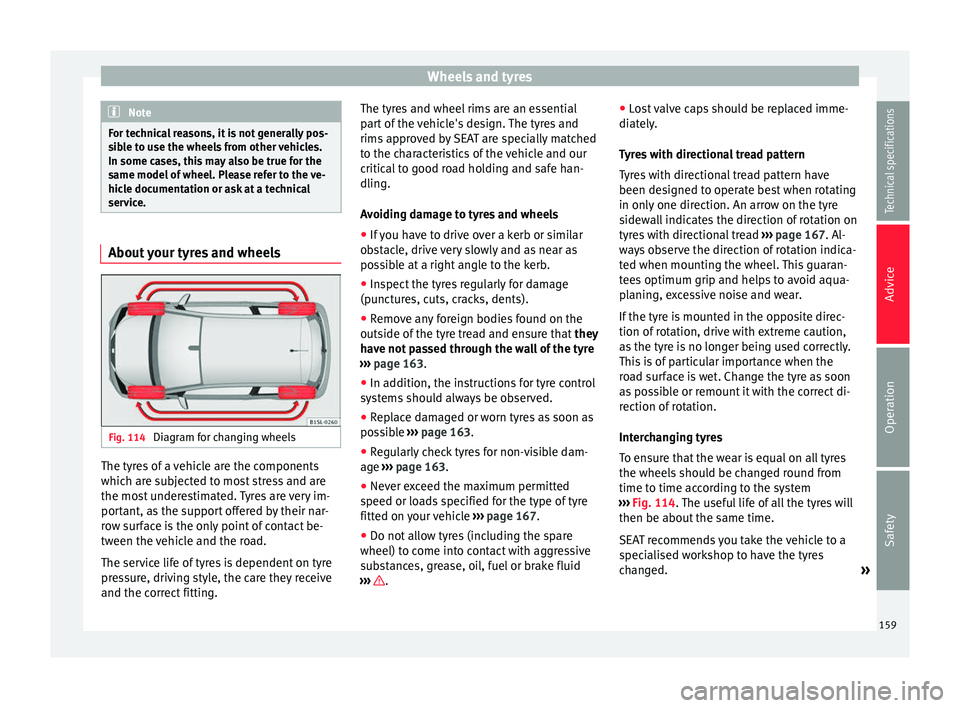
Fig. 114
Diagram for changing wheels The tyres of a vehicle are the components
which are subjected to most stress and are
the most underestimated. Tyres are very im-
portant, as the support offered by their nar-
row surface is the only point of contact be-
tween the vehicle and the road.
The service life of tyres is dependent on tyre
pressure, driving style, the care they receive
and the correct fitting. The tyres and wheel rims are an essential
part of the vehicle's design. The tyres and
rims approved by SEAT are specially matched
to the characteristics of the vehicle and our
critical to good road holding and safe han-
dling.
Avoiding damage to tyres and wheels
● If you have to drive over a kerb or similar
obstacle, drive very slowly and as near as
possible at a right angle to the kerb.
● Inspect the tyres regularly for damage
(punctures, cuts, cracks, dents).
● Remove any foreign bodies found on the
outside of the tyre tread and ensure that they
have not passed through the wall of the tyre
››› page 163 .
● In a d
dition, the instructions for tyre control
systems should always be observed.
● Replace damaged or worn tyres as soon as
possible ››› page 163.
● Re
gularly check tyres for non-visible dam-
age ››› page 163
.
● Never exceed the maximum permitted
speed or loads specified for the type of tyre
fitted on your vehicle ››› page 167.
● Do not allow tyres (including the spare
wheel) to come into contact with aggressive
substances, grease, oil, fuel or brake fluid
››› .●
Lost valve caps should be replaced imme-
diately.
Tyres with directional tread pattern
Tyres with directional tread pattern have
been designed to operate best when rotating
in only one direction. An arrow on the tyre
sidewall indicates the direction of rotation on
tyres with directional tread ››› page 167. Al-
ways observe the direction of rotation indica-
ted when mounting the wheel. This guaran-
tees optimum grip and helps to avoid aqua-
planing, excessive noise and wear.
If the tyre is mounted in the opposite direc-
tion of rotation, drive with extreme caution,
as the tyre is no longer being used correctly.
This is of particular importance when the
road surface is wet. Change the tyre as soon
as possible or remount it with the correct di-
rection of rotation.
Interchanging tyres
To ensure that the wear is equal on all tyres
the wheels should be changed round from
time to time according to the system
››› Fig. 114 . The useful life of all the tyres will
then be about the s
ame time.
SEAT recommends you take the vehicle to a
specialised workshop to have the tyres
changed. »
159
Technical specifications
Advice
Operation
Safety
Page 162 of 219
Advice
Tyres that are over 6 years old
Tyres are subject to an ageing process as a
result of physical and chemical processes.
This may affect their performance. Tyres
which are stored for long periods of time
without being used, harden and become
more fragile than tyres which are in constant
use.
SEAT recommends that tyres over six years
old are replaced with new tyres. This also ap-
plies to tyres (including the spare wheel)
which appear to be in perfect condition on
the outside and which have a tread depth
within the values stipulated by the Law ››› .
The date of manufacture, part of the tyre
identification number (TIN), indicates the age
of the tyre ( ) ››› page 167 .
St orin
g tyres
Mark tyres when you remove them to indicate
the direction of rotation (left, right, forwards,
backwards). This ensures you will be able to
mount them correctly when you replace
them. When removed, the wheels and/or
tyres should be stored in a cool, dry and pref-
erably dark location. Do not place tyres
mount
ed on the wheel in a vertical position.
Protect tyres not mounted on wheels from
dirt by storing them in suitable bags and
standing them on the ground on their tread. WARNING
Aggressive fluids or substances could result
in visible or invisible damage with the conse-
quent risks.
● Always ensure that tyres do not come into
contact with chemical products, oil, grease,
fuel, brake fluid or other aggressive substan-
ces. WARNING
Old tyres, even if they have never been used,
may lose air or burst unexpectedly while driv-
ing, resulting in serious accident or damage.
● If tyres are over six years old, they should
only be used in an emergency and with ex-
treme caution. For the sake of the environment
Old tyres must be disposed of by qualified
personnel according to the laws in the coun-
try concerned. Wheel rims
The design of wheel bolts is matched to the
rims. If different rims are fitted, the correct
wheel bolts with the right length and correct-
ly shaped bolt heads must be used. This en-
sures that wheels are fitted securely and that
the brake system functions correctly
››› page 174 . F
or t
echnical reasons, it is not generally pos-
sible to use the wheels from other vehicles.
In some cases, this may also be true for the
same model of wheel.
The tyres and rims approved by SEAT are spe-
cially matched to the characteristics of the
vehicle and are critical to good road holding
and safe handling.
Note for Italy:
A SEAT Service Centre should
be consulted whether different sized wheels
or tyres to those originally fitted by SEAT may
be fitted, as well as the combinations al-
lowed between the front axle (axle 1) and
back axle (axle 2).
Wheel bolts
Wheel bolts must be tightened to the correct
torque ››› page 174
.
Beadlock wheel rims
Beadlock wheel rims have various compo-
nents. These are joined together by special
bolts using a special procedure. This ensures
good performance, a better seal, improved
safety and wheel run out. Therefore, worn
rims should always be replaced and must on-
ly be repaired in a specialised workshop.
SEAT recommends visiting a technical service
››› .
160
Page 178 of 219
Advice
If the wheel bolt is very tight, you may be
able to loosen it by pushing down on the end
of the wheel brace carefully with your foot.
Hold on to the vehicle for support and take
care not to slip.
Loosening wheel bolts
● Fit the wheel brace as far as it will go over
the wheel bolt ››› Fig. 127 .
● Ho l
d the wheel brace at the end and rotate
the bolt approximately one turn anticlockwise
››
› .
Loosening anti-theft wheel bolts
For wheels with full hubcap, the anti-theft
wheel lock must be threaded into position
››› Fig. 128 2 before mounting the hubcap.
Otherwise it will not be possible to mount the
entire hubcap.
● Take the adapter for anti-theft wheel bolts
out of the vehicle tool kit.
● Insert the adapter onto the wheel bolt
››› Fig. 128 . Push it on as far as it will go.
● Fit the wheel
brace onto the adapter as far
as possible.
● Hold the wheel brace at the end and rotate
the bolt approximately one turn anticlockwise
››
› . Important information about wheel bolts
The wheel rims and bolts have been de-
signed to be fitted to factory options. If differ-
ent rims are fitted, the correct wheel bolts
with the right length and correctly shaped
bolt heads must be used. This ensures that
wheels are fitted securely and that the brake
system functions correctly.
In some circumstances, wheel bolts from the
same model vehicle should not be used.
Wheel bolt tightening torque
The prescribed tightening torque for wheel
bolts for steel and alloy wheels is
110 Nm
.
Hav e the tight
ening torque of the wheel bolts
checked as soon as possible with a reliable
torque wrench.
If wheel bolts are rusty and it is difficult to
tighten them, the threads should be replaced
and cleaned before checking the tightening
tor
que.
Never grease or lubricate wheel bolts or the
wheel hub threads. Although they have been
tightened to the prescribed torque, they
could come loose while driving. WARNING
If the wheel bolts are not fitted correctly they
could be released while driving leading to
loss of vehicle control and serious damage. ●
Only use wheel bolts which correspond to
the wheel rims in question.
● Never use different wheel bolts.
● The bolts and threads should be clean, free
of oil and grease and easy to thread.
● To loosen and tighten the wheel bolts, al-
ways use the wheel brace supplied with the
vehicle.
● Loosen the wheel bolts only about one turn
before raising the vehicle with the jack.
● Never grease or lubricate wheel bolts or the
wheel hub threads. Although they have been
tightened to the prescribed torque, they
could come loose while driving.
● Never loosen the bolted joints of wheel
rims with bolted ring trims.
● If the wheel bolts are not tightened to the
correct torque, they may come loose while
driving, and the bolts and rims may come
out. If the tightening torque is too high, the
wheel bolts and threads can be damaged. 176
Page 180 of 219

Advice
Changing a wheel Fig. 131
Changing a wheel: loosen wheel
bolts with the socket at the end of the wheel
brace Removing the wheel
● Loosen the wheel bolts ››› page 175 .
● Jacking up the vehicle ››› page 177.
● Using the hexagonal socket in the wheel
brace ››› Fig. 131 , unscrew the slackened
wheel bo
lts and place them on a clean sur-
face.
● Take off the wheel.
How to use the spare wheel or temporary
spare wheel
Check the direction of rotation of the tyre
››› page 167, Tyre code.
● Plac
e the spare wheel or temporary spare
wheel into position. ●
Replace the wheel bolts and tighten slight-
ly using the hexagonal socket on the end of the wheel br
ace.
● To tighten the anti-theft locking wheel bolts
use the corresponding adaptor.
● Lower the car with the jack.
● Tighten all of the wheel bolts clockwise
››› . Tighten the bolts in diagonal pairs (not
in a circle).
● Put the caps, trim or full hubcap back on
››› page 174 . WARNING
If the wheel bolts are not treated suitably or
not tightened to the correct torque then this
could lead to loss of vehicle control and to a
serious accident.
● All the wheel bolts and hub threads should
be clean and free of oil and grease. The wheel
bolts should be easily tightened to the cor-
rect torque.
● The hexagonal socket in the wheel brace
should be used for turning wheel bolts only.
Do not use it to loosen or tighten the wheel
bolts. After changing the wheel
●
Clean the vehicle tools, if necessary and
put them away in the luggage compartment
foam holder ›››
page 172 . ●
St or
e the spare wheel, the temporary spare
wheel or the changed wheel securely in the
luggage compartment.
● Have the tightening torque of the wheel
bolts checked as soon as possible with a tor-
que wrench ››› page 176
.
● Have the flat tyre replaced as quickly as
possible.
Tyre repair
TMS (Tyre Mobility System)* The Anti-puncture kit* (Tyre Mobility System)
will reliably seal punctures caused by the
penetration of a foreign body of up to about
4 mm
in diameter.
Do not remove foreign ob-
j
ects, e.g. screws or nails, from the tyre.
After inserting the sealant residue in the tyre,
you must again check the tyre pressure about
10 minutes after starting the engine.
You should only use the tire mobility set if
the vehicle is parked in a safe place, you are
familiar with the procedure and you have the
necessary tire mobility set! Otherwise, you
should seek professional assistance.
The tyre sealant must not be used in the
following cases: ● If the wheel rim has been damaged.
178
Page 208 of 219
Index
Bonnet Closing . . . . . . . . . . . . . . . . . . . . . . . . . . . . . . . 145
Opening . . . . . . . . . . . . . . . . . . . . . . . . . . . . . . 145
Boot variable floor extend below . . . . . . . . . . . . . . . . . . . . . . . . . . . 76
extend forwards . . . . . . . . . . . . . . . . . . . . . . . . . 76
Brake Brake servo . . . . . . . . . . . . . . . . . . . . . . . . . . . . . 92
Brake assist systems . . . . . . . . . . . . . . . . . . . . . . 103
Brake assist system (BAS) . . . . . . . . . . . . . . . . . . 104
Brake fluid . . . . . . . . . . . . . . . . . . . . . . . . . . . . . . 152 Specification . . . . . . . . . . . . . . . . . . . . . . . . . . . 153
Brakes . . . . . . . . . . . . . . . . . . . . . . . . . . . . . . . . . . . 89 Brake assist systems . . . . . . . . . . . . . . . . . . . . 103
Brake fluid . . . . . . . . . . . . . . . . . . . . . . . . . . . . . 152
Brake fluid level . . . . . . . . . . . . . . . . . . . . . . . . 153
Brake pads . . . . . . . . . . . . . . . . . . . . . . . . . . . . . 91
Changing the brake fluid . . . . . . . . . . . . . . . . . 153
Control lamp . . . . . . . . . . . . . . . . . . . . . . . . . . . . 89
Emergency brake indicator in case of suddenbraking . . . . . . . . . . . . . . . . . . . . . . . . . . . . . 172
Handbrake . . . . . . . . . . . . . . . . . . . . . . . . . . . . . 90
Running-in brake pads . . . . . . . . . . . . . . . . . . . . 91
Warning lamp . . . . . . . . . . . . . . . . . . . . . . . . . . . 89
Brake servo . . . . . . . . . . . . . . . . . . . . . . . . . . 92, 103
Brake system Malfunction . . . . . . . . . . . . . . . . . . . . . . . . . . . . . 92
Brake systems . . . . . . . . . . . . . . . . . . . . . . . . . . . 103
Breakdown Securing the vehicle . . . . . . . . . . . . . . . . . . . . . 171
Bulb fault See changing bulbs . . . . . . . . . . . . . . . . . . . . . 191
C Capacities Fuel tank . . . . . . . . . . . . . . . . . . . . . . . . . . . . . . 203 Care
See "Care of your vehicle" . . . . . . . . . . . . . . . . 125
Vehicle interior . . . . . . . . . . . . . . . . . . . . . . . . . 131
Care of your vehicle Exterior . . . . . . . . . . . . . . . . . . . . . . . . . . . . . . . 125
Caring for paintwork . . . . . . . . . . . . . . . . . . . . . . . 129
Carrier system . . . . . . . . . . . . . . . . . . . . . . . . . . . . . 77
Catalytic converter . . . . . . . . . . . . . . . . . . . . . . . . 102 Control lamp . . . . . . . . . . . . . . . . . . . . . . . . . . . 101
Malfunctions . . . . . . . . . . . . . . . . . . . . . . . . . . . 102
CCS . . . . . . . . . . . . . . . . . . . . . . . . . . . . . . . . . . . . 107
Central locking . . . . . . . . . . . . . . . . . . . . . . . . . . . . 45 Central locking button . . . . . . . . . . . . . . . . . . . . 48
locking and unlocking from the exterior . . . . . . 46
locking and unlocking from the inside . . . . . . . 48
Central locking system After airbag deployment . . . . . . . . . . . . . . . . . . 46
Description . . . . . . . . . . . . . . . . . . . . . . . . . . . . . 46
Opening doors individually . . . . . . . . . . . . . . . . 46
Changing Windscreen wiper blades . . . . . . . . . . . . . . . . . 188
Changing a wheel . . . . . . . . . . . . . . . . . . . . . . . . 174 Changing a wheel . . . . . . . . . . . . . . . . . . . . . . . 178
Raising the vehicle . . . . . . . . . . . . . . . . . . . . . . 177
Wheel bolts . . . . . . . . . . . . . . . . . . . . . . . . . . . . 175
Changing bulbs . . . . . . . . . . . . . . . . . . . . . . . . . . 191 Front bumper . . . . . . . . . . . . . . . . . . . . . . . . . . 193
in the headlights . . . . . . . . . . . . . . . . . . . . . . . 192
Number plate light . . . . . . . . . . . . . . . . . . . . . . 195
Rear lights . . . . . . . . . . . . . . . . . . . . . . . . . . . . . 194
Sea changing bulbs . . . . . . . . . . . . . . . . . . . . . 191
Changing gear . . . . . . . . . . . . . . . . . . . . . . . . . . . . 93 Automatic gearbox . . . . . . . . . . . . . . . . . . . . . . . 95
Engaging gears (automatic gearbox) . . . . . . . . 95
Engaging gears (manual gearbox) . . . . . . . . . . 94
Manual gearbox . . . . . . . . . . . . . . . . . . . . . . . . . 94 Warning and control lamps . . . . . . . . . . . . . . . . 93
with Tiptronic . . . . . . . . . . . . . . . . . . . . . . . . . . . 96
Changing gears Gear recommendation . . . . . . . . . . . . . . . . . . . . 98
Changing the bulbs Side turn signal . . . . . . . . . . . . . . . . . . . . . . . . 196
Changing the wheel After changing the wheel . . . . . . . . . . . . . . . . . 178
Chassis number . . . . . . . . . . . . . . . . . . . . . . . . . . 197
Checking Tyre pressures . . . . . . . . . . . . . . . . . . . . . . . . . . 162
Checking the oil level . . . . . . . . . . . . . . . . . . . . . . 148
Child safety . . . . . . . . . . . . . . . . . . . . . . . . . . . . . . . 25
Child safety seat Securing with seat belt . . . . . . . . . . . . . . . . . . . 30
Child seat . . . . . . . . . . . . . . . . . . . . . . . . . . . . . . . . 25 Fix with ISOFIX . . . . . . . . . . . . . . . . . . . . . . . . . . 31
ISOFIX child seat on rear seats . . . . . . . . . . . . . 29
Mounting child seats . . . . . . . . . . . . . . . . . . . . . 28
Mounting systems . . . . . . . . . . . . . . . . . . . . . . . 28
On rear seats . . . . . . . . . . . . . . . . . . . . . . . . . . . . 29
On the front passenger seat . . . . . . . . . . . . . . . 28
Regulations . . . . . . . . . . . . . . . . . . . . . . . . . . . . . 27
Securing using a Top Tether retaining strap . . . 32
Transporting children in the vehicle . . . . . . . . . 27
Weight categories . . . . . . . . . . . . . . . . . . . . . . . . 27
Child seats Disabling the front passenger front airbag . . . . 24
Chromework care . . . . . . . . . . . . . . . . . . . . . . . . . 129
Cigarette lighter . . . . . . . . . . . . . . . . . . . . . . . . . . . 72
City Safety Assist function . . . . . . . . . . . . . . . . . . 110 Control lamp . . . . . . . . . . . . . . . . . . . . . . . . . . . 111
Function . . . . . . . . . . . . . . . . . . . . . . . . . . . . . . 113
Sensor . . . . . . . . . . . . . . . . . . . . . . . . . . . . . . . . 112
Special driving situations . . . . . . . . . . . . . . . . 113
Warning lamp . . . . . . . . . . . . . . . . . . . . . . . . . . 111
206
Page 209 of 219
Index
Cleaning dash panel . . . . . . . . . . . . . . . . . . . . . . . . . . . . 133
Engine compartment . . . . . . . . . . . . . . . . . . . . 131
Seat belts . . . . . . . . . . . . . . . . . . . . . . . . . . . . . 134
See "Care of your vehicle" . . . . . . . . . . . . . . . . 125
wheels . . . . . . . . . . . . . . . . . . . . . . . . . . . . . . . . 130
Windscreen wiper blades . . . . . . . . . . . . . . . . . 188
Clock . . . . . . . . . . . . . . . . . . . . . . . . . . . . . . . . . . . . 36
Closing Doors . . . . . . . . . . . . . . . . . . . . . . . . . . . . . . . . . . 49
from the exterior . . . . . . . . . . . . . . . . . . . . . . . . . 46
from the inside . . . . . . . . . . . . . . . . . . . . . . . . . . 48
Rear lid . . . . . . . . . . . . . . . . . . . . . . . . . . . . . . . . 51
Sliding/tilting electric panoramic sunroof . . . . 53
windows . . . . . . . . . . . . . . . . . . . . . . . . . . . . . . . 52
Coat hooks . . . . . . . . . . . . . . . . . . . . . . . . . . . . . . . 70
Cockpit . . . . . . . . . . . . . . . . . . . . . . . . . . . . . . . . . . 35
Code number . . . . . . . . . . . . . . . . . . . . . . . . . . . . 173
Collection of end-of-life vehicles . . . . . . . . . . . . . 136
Compartments boot variable floor . . . . . . . . . . . . . . . . . . . . . . . 76
Centre console . . . . . . . . . . . . . . . . . . . . . . . . . . 68
Glove compartment . . . . . . . . . . . . . . . . . . . 68, 69
Other storage compartments . . . . . . . . . . . . . . . 70
Passenger side . . . . . . . . . . . . . . . . . . . . . . . 68, 69
Sunglasses storage compartment . . . . . . . . . . . 68
Components . . . . . . . . . . . . . . . . . . . . . . . . . . . . . 118
Conformity certification . . . . . . . . . . . . . . . . . . . . 136
Consumption How it is determined . . . . . . . . . . . . . . . . . . . . 198
Information . . . . . . . . . . . . . . . . . . . . . . . . . . . . 198
control lamp on the driver door . . . . . . . . . . . . . . . . . . . . . . . . 49
Vehicle key . . . . . . . . . . . . . . . . . . . . . . . . . . . . . 44
Control lamp Airbag system . . . . . . . . . . . . . . . . . . . . . . . . . . . 23
Brake pad wear warning . . . . . . . . . . . . . . . . . . 89 Brake system . . . . . . . . . . . . . . . . . . . . . . . . . . . 89
Catalytic converter . . . . . . . . . . . . . . . . . . . . . . 101
Checking the engine oil level . . . . . . . . . . . . . 147
City Safety Assist function . . . . . . . . . . . . . . . . 111
Cruise control system (CCS) . . . . . . . . . . . . . . . 108
Emission control system . . . . . . . . . . . . . . . . . 101
Engine coolant . . . . . . . . . . . . . . . . . . . . . . . . . 150
Engine management . . . . . . . . . . . . . . . . . . . . 101
Engine oil sensor . . . . . . . . . . . . . . . . . . . . . . . 147
ESC . . . . . . . . . . . . . . . . . . . . . . . . . . . . . . . . . . . 89
Fuel level . . . . . . . . . . . . . . . . . . . . . . . . . . . . . . 140
Hill hold . . . . . . . . . . . . . . . . . . . . . . . . . . . . . . . 115
Overview . . . . . . . . . . . . . . . . . . . . . . . . . . . . . . . 39
Steering column lock . . . . . . . . . . . . . . . . . . . . . 85
Control lamps Lights . . . . . . . . . . . . . . . . . . . . . . . . . . . . . . . . . 55
Controlling function Electric exterior mirrors . . . . . . . . . . . . . . . . . . . 63
Control units . . . . . . . . . . . . . . . . . . . . . . . . . . . . . 121 Reprogramming . . . . . . . . . . . . . . . . . . . . . . . . 121
Convenience functions Reprogramming . . . . . . . . . . . . . . . . . . . . . . . . 121
Coolant See engine coolant . . . . . . . . . . . . . . . . . . . . . . 150
Correct sitting position for vehicle occupants . . . . 6
Crossing a river Salt water . . . . . . . . . . . . . . . . . . . . . . . . . . . . . 103
Cruise control system . . . . . . . . . . . . . . . . . . . . . . 107
Cruise control system (CCS) Control lamp . . . . . . . . . . . . . . . . . . . . . . . . . . . 108
Operations . . . . . . . . . . . . . . . . . . . . . . . . . . . . 109
Curb weight . . . . . . . . . . . . . . . . . . . . . . . . . . . . . 198
D Damaged tyres . . . . . . . . . . . . . . . . . . . . . . . . . . . 163
Dangers in not using the seat belt . . . . . . . . . . . . 14 Dash panel . . . . . . . . . . . . . . . . . . . . . . . . . . . . . . . 35
Airbag system . . . . . . . . . . . . . . . . . . . . . . 21, 133
Data link connector (DLC) . . . . . . . . . . . . . . . . . . 122
Data registry . . . . . . . . . . . . . . . . . . . . . . . . . . . . . 121
Data storage during the journey . . . . . . . . . . . . . 121
Data stored by the control units . . . . . . . . . . . . . 121
Daytime driving light . . . . . . . . . . . . . . . . . . . . . . . 57
De-icing the door lock cylinder . . . . . . . . . . . . . . 130
De-icing the locks . . . . . . . . . . . . . . . . . . . . . . . . . 130
Deadlock "Safe" security system . . . . . . . . . . . . . . . . . . . . 48
Device disconnection . . . . . . . . . . . . . . . . . . . . . . 157
Diagnostics connection . . . . . . . . . . . . . . . . . . . . 122
Differential lock See "Brake assist systems" . . . . . . . . . . . . . . . 104
Digital clock . . . . . . . . . . . . . . . . . . . . . . . . . . . . . . 36
Dimensions . . . . . . . . . . . . . . . . . . . . . . . . . . . . . . 203
Dipped beam headlights . . . . . . . . . . . . . . . . . . . . 56
Dipstick . . . . . . . . . . . . . . . . . . . . . . . . . . . . . . . . . 148
Display . . . . . . . . . . . . . . . . . . . . . . . . . . . . . . . . . . 37 Instrument panel . . . . . . . . . . . . . . . . . . . . . . . . 37
Disposal Airbag system . . . . . . . . . . . . . . . . . . . . . . . . . . 136
Belt tensioner . . . . . . . . . . . . . . . . . . . . . . . . . . . 17
End-of-life vehicle . . . . . . . . . . . . . . . . . . . . . . . 136
Door release lever interior . . . . . . . . . . . . . . . . . . . . . . . . . . . . . . . . . 35
Doors . . . . . . . . . . . . . . . . . . . . . . . . . . . . . . . . . . . . 49 Childproof locks . . . . . . . . . . . . . . . . . . . . . . . . . 50
Emergency locking and unlocking . . . . . . . . . . 186
Drink holders . . . . . . . . . . . . . . . . . . . . . . . . . . . . . 70 Centre console . . . . . . . . . . . . . . . . . . . . . . . . . . 71
Drinks bottles see Drink holders . . . . . . . . . . . . . . . . . . . . . . . . 70
Driving Data storage . . . . . . . . . . . . . . . . . . . . . . . . . . . 121
Driving abroad . . . . . . . . . . . . . . . . . . . . . . . . . 102
207