ignition Seat Mii 2016 Repair Manual
[x] Cancel search | Manufacturer: SEAT, Model Year: 2016, Model line: Mii, Model: Seat Mii 2016Pages: 232, PDF Size: 4.9 MB
Page 194 of 232
Advice
should be collected and correctly disposed
of, w
ith r
espect to the environment. Coolant warning lamp
Several warning and control lamps light up
for a f
ew sec
onds when the ignition is switch-
ed on, signalling that the function is being
verified. They will switch off after a few sec-
onds.
It lights up red
Excessive engine
coolant temperature.
Stop the vehicle!
Stop the vehicle safely as soon
as possible. Switch off the en-
gine and let it cool.
Insufficient engine
coolant level.
¡Stop the vehicle!
Check the engine coolant
when the engine has cooled
and, if it is low, refill with en-
gine coolant ››› page 192.
Engine coolant sys-
tem faulty. Do not drive any further.
Obtain professional assis-
tance.
Flashes red
Engine coolant sys-
tem faulty.Seek specialist assistance.
It lights up blue
The temperature of
the natural gas en-
gine coolant is too
low. The engine has
not reached the oper-
ating temperature.Avoid high engine speeds and
pushing the engine too hard
while the warning lamp re-
mains lit.
WARNING
Observe the safety warnings ›››
in On the
ins trument
panel on page 26. Checking the coolant level and top-
pin
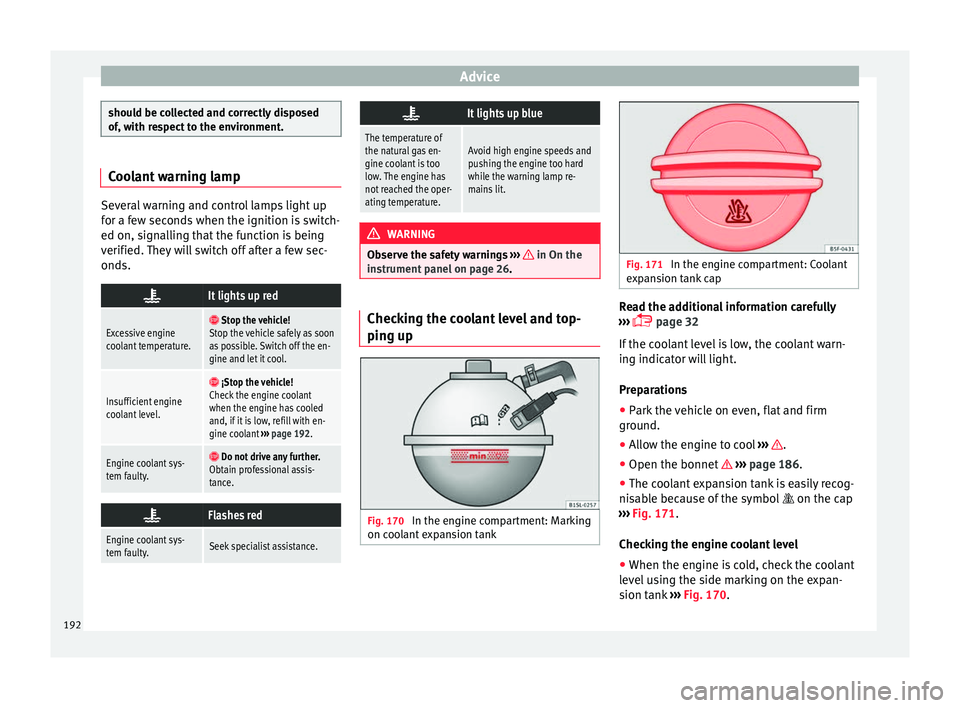
g up Fig. 170
In the engine compartment: Marking
on c oo
l
ant expansion tank Fig. 171
In the engine compartment: Coolant
exp an
sion tank cap Read the additional information carefully
› ›
›
page 32
If the coolant level is low, the coolant warn-
ing indicator will light.
Preparations
● Park the vehicle on even, flat and firm
ground.
● A
llow the engine to cool ›››
.
● Open the bonnet › ›
›
page 186.
● The coolant expansion tank is easily recog-
nisab
le because of the symbol on the cap
››› Fig. 171.
Checking the engine coolant level ● When the engine is cold, check the coolant
level
using the side marking on the expan-
sion tank ››› Fig. 170.
192
Page 198 of 232
Advice
Vehicle battery Intr oduction Read the additional information carefully
›› ›
page 33.
The battery is a component of the vehicle's
electrical system.
Never work on the electrical system without
fully understanding the operations required,
the applicable safety standards and without
the correct tools ››› ! If required, have any
w ork
c
arried out by a specialised workshop.
SEAT recommends taking your car in for tech-
nical service. Negligent work can cause seri-
ous injury.
Location of the vehicle battery
The battery is located in the engine compart-
ment.
Explanation of the warning indications on
the vehicle's battery
SymbolMeaning
Wear eye protection!
Battery acid is very corrosive and caustic.
Always wear protective gloves and eye
protection!
Fires, sparks, open flames and smoking
are prohibited.
SymbolMeaning
A highly explosive mixture of gases is re-
leased when the battery is under charge.
Keep children away from acid and batter-
ies!
WARNING
Working on the vehicle battery and the elec-
trica l
system can cause corrosion, fire and
electric shocks. Always read and take into ac-
count the following warnings and safety
standards before carrying out any work:
● Before working on the battery, switch off
the engine, the ignition and al
l electrical de-
vices then disconnect the negative connec-
tion on the battery.
● Keep children away from acid and the bat-
tery
itself!
● Wear eye protection.
● Battery acid is very corrosive and caustic. It
can burn sk
in and cause blindness. When
handling the battery, protect yourself from
splashes of acids, above all your hands, arms
and face.
● Do not smoke and never work close to pla-
ces
exposed to flames or sparks.
● Avoid sparks and electrostatic discharges
when workin
g with cables and electrical devi-
ces.
● Never short the battery terminals. ●
Never u se a d
amaged battery. It can ex-
plode. Replace a damaged battery immedi-
ately.
● Replaced damaged or frozen batteries as
soon as po
ssible. A flat battery can also
freeze at temperatures close to 0 °C (+32 °F). CAUTION
● Nev er di s
connect the battery if the ignition
is switched on or if the engine is running.
This could damage the electrical system or
electronic components.
● Do not expose the battery to direct sunlight
over a lon
g period of time, as the intense ul-
traviolet radiation can damage the battery
housing.
● If the car is left standing for long periods,
protect
the battery from extreme cold temper-
ature so that it does not “freeze up” and be-
come damaged. Warning lamp
It lights up
Faulty generator.
Contact a specialised workshop.
Have the electrical system checked.
Disconnect any unnecessary elec-
trical devices. The generator does
not charge the battery while the ve-
hicle is in motion.
196
Page 199 of 232
Checking and refilling levels
Several warning and control lamps light up
f or a f
ew sec
onds when the ignition is switch-
ed on, signalling that the function is being
verified. They will switch off after a few sec-
onds. WARNING
Observe the safety warnings ›››
in On the
ins trument
panel on page 26. Checking the electrolyte level of the
vehic
l
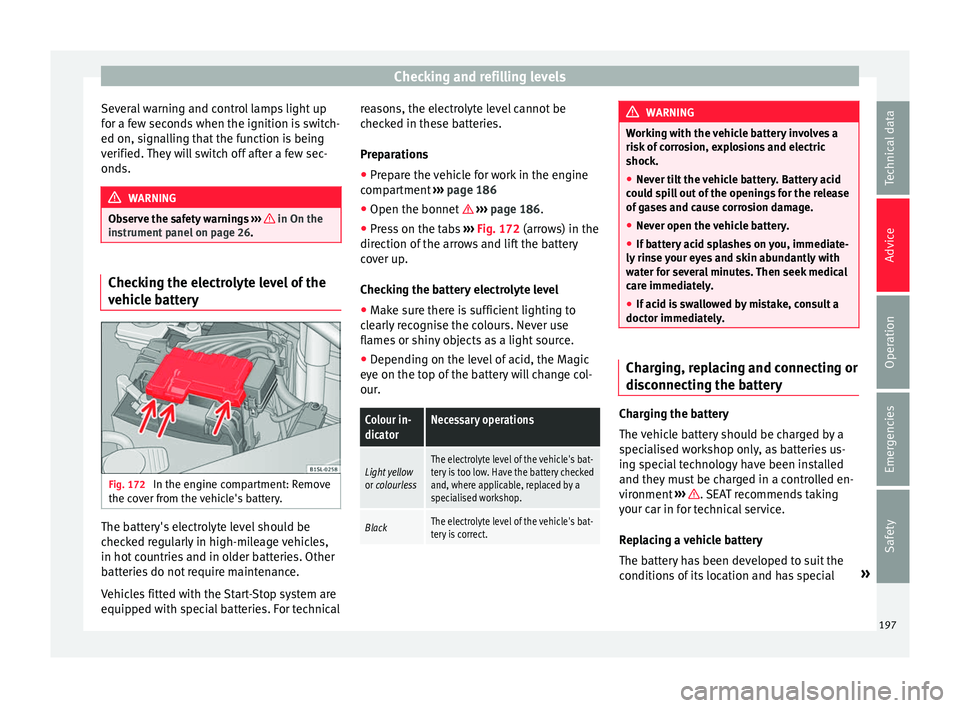
e battery Fig. 172
In the engine compartment: Remove
the c o
v
er from the vehicle's battery. The battery's electrolyte level should be
c
hec
k
ed regularly in high-mileage vehicles,
in hot countries and in older batteries. Other
batteries do not require maintenance.
Vehicles fitted with the Start-Stop system are
equipped with special batteries. For technical reasons, the electrolyte level cannot be
check
ed in these batteries.
Preparations ● Prepare the vehicle for work in the engine
compar
tment ››› page 186
● Open the bonnet ›››
page 186.
● Press on the tabs ›››
Fig. 172 (arrows) in the
direction of the arrows and lift the battery
cover up.
Checking the battery electrolyte level
● Make sure there is sufficient lighting to
cle
arly recognise the colours. Never use
flames or shiny objects as a light source.
● Depending on the level of acid, the Magic
eye on the top of
the battery will change col-
our.
Colour in-
dicatorNecessary operations
Light yellow
or colourlessThe electrolyte level of the vehicle's bat-
tery is too low. Have the battery checked
and, where applicable, replaced by a
specialised workshop.
BlackThe electrolyte level of the vehicle's bat-
tery is correct. WARNING
Working with the vehicle battery involves a
risk of
corrosion, explosions and electric
shock.
● Never tilt the vehicle battery. Battery acid
coul
d spill out of the openings for the release
of gases and cause corrosion damage.
● Never open the vehicle battery.
● If battery acid splashes on you, immediate-
ly rinse
your eyes and skin abundantly with
water for several minutes. Then seek medical
care immediately.
● If acid is swallowed by mistake, consult a
doctor immediat
ely. Charging, replacing and connecting or
di
s
c
onnecting the battery Charging the battery
The
v
ehic
le battery should be charged by a
specialised workshop only, as batteries us-
ing special technology have been installed
and they must be charged in a controlled en-
vironment ››› . SEAT recommends taking
y our c
ar in f
or technical service.
Replacing a vehicle battery
The battery has been developed to suit the
conditions of its location and has special »
197
Technical data
Advice
Operation
Emergencies
Safety
Page 200 of 232
Advice
safety features. If the battery must be re-
p l
ac
ed, consult a technical service for infor-
mation on electromagnetic compatibility, the
size and maintenance, performance and
safety requirements of the new battery in
your vehicle before you purchase one. SEAT
recommends you have the battery replaced
by a technical service.
Use only maintenance-free genuine batteries
conforming to TL 825 06 and VW 7 50 73
Standards. These standards must be dated
April 2008 or later.
Vehicles fitted with the Start-Stop system are
equipped with a special battery. Therefore,
this battery must only be replaced by another
with the same specifications.
Disconnecting the vehicle's battery
If you must disconnect the battery from the
electrical system, please note the following:
● Switch off the ignition and all electrical
equipment.
● The v
ehicle must be unlocked before dis-
connecting the b
attery, otherwise the alarm
will be triggered.
● First disconnect the negative cable and
then the positiv
e ››› .
C onnectin
g the
vehicle's battery
● Before reconnecting the battery, switch off
the engine and all
electrical devices. ●
First
reconnect the positive cable and then
the negative ››› .
Diff er
ent
control lamps may light up after
connecting the battery and switching the ig-
nition on. They will be turned off after a short
trip at a speed of between 15-20 km/h
(10-12 mph). If the warning indicators remain
lit, please visit a specialised workshop to
have the vehicle checked.
If the battery has been disconnected for a
long time, it is possible that the next service
date is not displayed or calculated correctly
››› page 88. Respect the maximum service in-
tervals permitted ››› Booklet Maintenance
Programme.
Automatic device disconnection
The intelligent vehicle electrical system auto-
matically implements a range of measures to
prevent the battery from discharging when
high demands are made on it:
● The idling speed is increased so that the al-
ternat
or provides more electricity.
● Where necessary, the power to the most
power
ful devices is reduced or even com-
pletely disconnected.
● On starting the engine, the power supply
from the 12-v
olt power sockets and the ciga-
rette lighter may be interrupted for a short
time. The on-board management program cannot
alway
s prevent the battery from running flat.
For example, if the ignition is left on for a
long period with the engine off or if the side
lights or parking lights are left on while the
vehicle is stationary.
Why the battery runs flat:
● When stationary for a long time without
star
ting the engine, particularly if the ignition
is switched on.
● Use of electrical devices with the engine
switc
hed off. WARNING
Incorrectly securing the battery or using the
wron g b
attery can cause short-circuits, fire
and serious injuries.
● Always use only maintenance-free batter-
ies, prot
ected to prevent a leak, and whose
properties, specifications and size corre-
spond to the standard battery. WARNING
A highly explosive mixture of gases is re-
le a
sed when the battery is under charge.
● The batteries should be charged in a well-
ventil
ated room only.
● Never charge a frozen or recently thawed
batter
y. A flat battery can also freeze at tem-
peratures close to 0 °C (+32 °F).
● Always replace a battery which has frozen. 198
Page 201 of 232
Wheels and tyres
●
Batt er
y cables not correctly connected may
cause a short circuit. Reconnect first the posi-
tive cable and then the negative cable. CAUTION
● Nev er di s
connect the battery if the ignition
is switched on or if the engine is running.
This could damage the electrical system or
electronic components.
● Never plug accessories that supply current,
such a
s solar panels or a battery charger, to
the 12-volt power socket or the cigarette
lighter. This could damage the vehicle's elec-
trical system. For the sake of the environment
Dispose of the battery in an environment-
friendly m anner
. Batteries contain toxic sub-
stances such as sulphuric acid and lead. For the sake of the environment
Battery acid can contaminate the environ-
ment. C o
llect any spilt service fluids and dis-
pose of them correctly. Wheels and tyres
T y
r
es
Introduction SEAT recommend that all work on tyres and
wheels
i
s carried out by a specialised work-
shop. These workshops have the necessary
special tools and replacement parts, trained
personnel and facilities for disposing of the
old tyres while respecting the environment.
SEAT recommends taking your car in for tech-
nical service. WARNING
The vehicle cannot be totally controlled or
brak ed if
the tyres (new or used) are worn or
damaged.
● Incorrect use of wheels and tyres could
make driv
ing more dangerous and result in
serious accidents and damage.
● All four wheels must be fitted with radial
tyre
s of the same type, size (rolling circumfer-
ence) and the same tread pattern.
● New tyres do not give maximum grip and
wil
l not have reached their maximum braking
capacity to start with, and therefore need
running in. To prevent accidents and major
damage, extreme caution should be taken for
the first 600 km. ●
Check ty
re pressures regularly and ensure
they are maintained at the pressures indica-
ted. If the tyre pressure is too low, they could
overheat, resulting in tread detachment or
even burst tyres.
● Never drive on damaged (punctured, cut,
crac
ked or dented) or worn tyres. Driving on
damaged or worn tyres could result in burst
tyres, serious accidents or damage. Worn or
damaged tyres must be replaced immediate-
ly.
● Never exceed the maximum permitted
speed or loa
ds specified for the type of tyre
fitted on your vehicle.
● The effectiveness of driver and brake assist
syst
ems also depends on the grip of the
tyres.
● If you notice unusual vibration or if the ve-
hicle p
ulls to one side when driving, stop the
car immediately and check the tyres and
wheels for damage.
● To minimise the risk of losing control of the
vehicl
e or causing a serious accident, never
undo the bolted joints of beadlock wheels.
● Never mount used tyres or wheels if you are
not sur
e of their previous history. They may
be damaged, although the damage is not im-
mediately visible.
● Old tyres, even if they have never been
used, ma
y lose air or burst unexpectedly
while driving, especially at high speeds, re-
sulting in serious accident and injury. If tyres
are over six years old, they should only be » 199
Technical data
Advice
Operation
Emergencies
Safety
Page 207 of 232
Wheels and tyres
Foreign bodies in the tyre
● Do not remove foreign bodies if they have
penetr at
ed thr
ough the tyre wall!
● You should obtain professional assistance
immediately
.
Tyre wear
The wear of tyres depends on a number of
factors, for example:
● Driving style.
● Unbalanced wheels.
● Running gear settings.
Driving
style: Driving round bends quickly or
sudden acceleration or braking speed accel-
erates tyre wear. When the driving style is
normal, if the tyres wear too quickly, have the
running gear settings checked at a special-
ised workshop.
Wheel run-out: The wheels on new vehicles
are balanced. However, certain circumstan-
ces may lead to imbalance (run-out), which is
detected as vibrations in the steering wheel.
Run-out leads to wear of the steering and
suspension. In the event of run out, the
wheels should be balanced again. When a
new wheel is fitted, it should be balanced
again.
Running gear settings : an incorrectly posi-
tioned running gear increases the wear of
tyres and affects your safety while driving. If tyres wear too quickly, have the wheel align-
ment chec
ked at a specialised workshop. WARNING
If you notice unusual vibration or the car pulls
to one s ide whi
le driving, this may indicate
that one of the tyres is damaged.
● Reduce speed immediately and stop, while
obser
ving the highway code.
● Check the wheels and tyres for damage.
● Never carry on driving on worn tyres or
wheels. Reque
st qualified assistance immedi-
ately.
● If there is no visible exterior damage, drive
slowly
and carefully to the nearest special-
ised workshop and have the vehicle checked. Tyre monitor system*
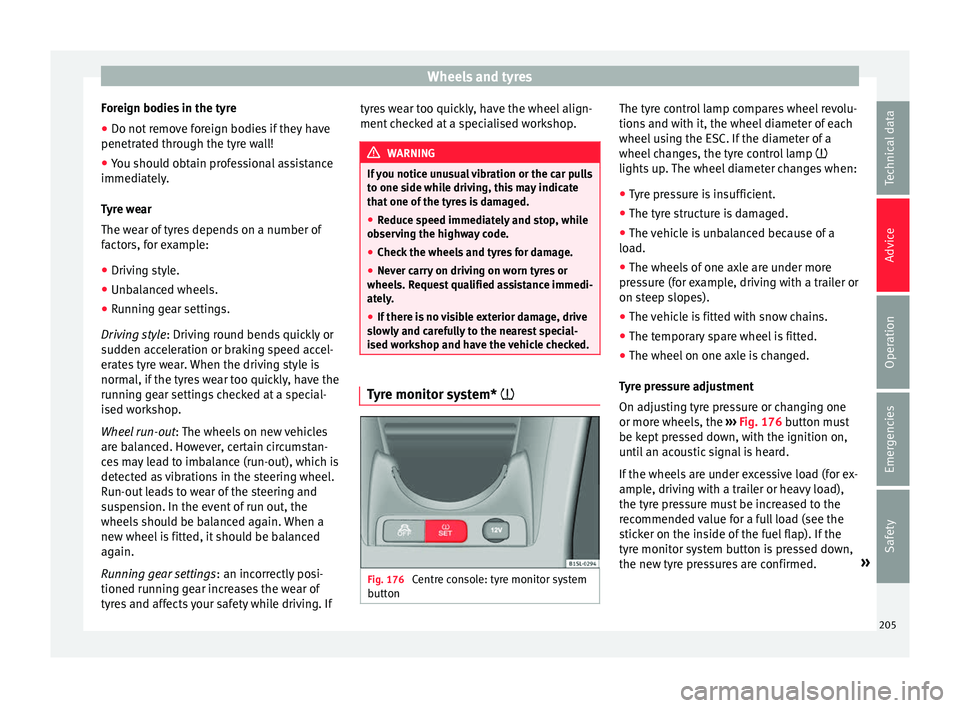
Fig. 176
Centre console: tyre monitor system
b utt
on The tyre control lamp compares wheel revolu-
tion
s
and w
ith it, the wheel diameter of each
wheel using the ESC. If the diameter of a
wheel changes, the tyre control lamp
lights up. The wheel diameter changes when:
● Tyre pressure is insufficient.
● The tyre structure is damaged.
● The vehicle is unbalanced because of a
load.
● The wheel
s of one axle are under more
pres
sure (for example, driving with a trailer or
on steep slopes).
● The vehicle is fitted with snow chains.
● The temporary spare wheel is fitted.
● The wheel on one axle is changed.
Tyr
e pressure adjustment
On adjusting tyre pressure or changing one
or more wheels, the ››› Fig. 176 button must
be kept pressed down, with the ignition on,
until an acoustic signal is heard.
If the wheels are under excessive load (for ex-
ample, driving with a trailer or heavy load),
the tyre pressure must be increased to the
recommended value for a full load (see the
sticker on the inside of the fuel flap). If the
tyre monitor system button is pressed down,
the new tyre pressures are confirmed. »
205
Technical data
Advice
Operation
Emergencies
Safety
Page 208 of 232

Advice
The tyre pressure control lamp lights
up
If the tyre pressure of a wheel is much lower
than the value set by the driver, then the tyre
pressure control lamp ››› will light up.
WARNING
● When the tyr e pr
essure control lamp lights
up, reduce speed immediately and avoid any
sudden turning or braking manoeuvre. Stop
when possible, and check the tyre pressure
and status.
● The driver is responsible for maintaining
correct
tyre pressures. For this reason, tyre
pressure must be regularly checked.
● Under certain circumstances (e.g. when
driving in a s
porty manner, in winter condi-
tions or on a dirt track) the tyre control lamp
may light up belatedly or may function incor-
rectly. Note
If the battery is disconnected, the yellow
warnin g l
amp lights up after turning the
ignition on. This should turn off after a brief
journey. Spare wheel or temporary spare
wheel*
Fig. 177
In the luggage compartment: hand
c ontr
o
lled wheel for securing the spare wheel Removing the spare wheel
● Open the rear lid and lift the luggage com-
p ar
tment
shelf ››› page 123.
● If necessary, remove the boot variable floor
›››
page 123.
● Lift up the carpet from the recess and re-
move it
from the luggage compartment.
● If necessary, take out the vehicle tool kit
with the cont
ainer.
● Completely remove the hand controlled
wheel from the c
entre of the spare wheel
››› Fig. 177 by turning it in an anticlockwise
direction, and take out the spare wheel. Storing the replaced wheel
● Pull back the carpet.
● With the wheel rim facing downwards, sit-
uate the rep
laced wheel in the spare wheel
well so that the wheel rim central hole coin-
cides with the opening.
● Turn the hand controlled wheel with the
shank s
crewed clockwise until the replaced
wheel is secured.
● If necessary, store the vehicle tool in the
container
, inside the boot.
● Replace the carpet on the boot floor.
● Lower the rear shelf.
● Close the rear lid.
If the sp
are wheel is different to the rest of
the vehicle tyres
If the spare tyre is not the same as the tyres
that are mounted on the vehicle - for example
with winter tyres or the temporary spare
wheel - you should only use the spare tyre for
a short period of time and drive with extra
care ››› .
R efit
the norm
al road wheel as soon as possi-
ble.
Please observe driving advice:
● Do not drive faster than 80 km/h (50 mph).
● Avoid heavy acceleration, hard braking and
fas
t cornering.
206
Page 219 of 232
Index
Index
A
Abr o
a
d
extended stay abroad with your vehicle . . . . . 179
sale of vehicle . . . . . . . . . . . . . . . . . . . . . . . . . . 179
ABS see Anti-lock brake system . . . . . . . . . . . . . . . 139
Accessories . . . . . . . . . . . . . . . . . . . . . . . . . . . . . . 164
Acoustic alarm seatbelt unfastened . . . . . . . . . . . . . . . . . . . . . . 54
Adjust front seat . . . . . . . . . . . . . . . . . . . . . . . . . . . . . . 112
Adjusting lights . . . . . . . . . . . . . . . . . . . . . . . . . . . . . . . . . 107
rear head restraints . . . . . . . . . . . . . . . . . 51, 112
seats . . . . . . . . . . . . . . . . . . . . . . . . . . . . . . . . . . 48
Adjusting the head restraints rear head restraints . . . . . . . . . . . . . . . . . . . . . 112
Advice for driving spare wheel or temporary spare wheel . . . . . . 206
Airbag covers . . . . . . . . . . . . . . . . . . . . . . . . . . . . . 14
Airbags . . . . . . . . . . . . . . . . . . . . . . . . . . . . . . . . . . 59 description . . . . . . . . . . . . . . . . . . . . . . . . . . . . . 60
Airbag system . . . . . . . . . . . . . . . . . . . . . . . . . . 14, 59 activation . . . . . . . . . . . . . . . . . . . . . . . . . . . . . . 61
cleaning dash panel . . . . . . . . . . . . . . . . . . . . . 178
control lamp . . . . . . . . . . . . . . . . . . . . . . . . . . . . 63
description . . . . . . . . . . . . . . . . . . . . . . . . . . . . . 60
front airbags . . . . . . . . . . . . . . . . . . . . . . . . . 14, 62
functioning . . . . . . . . . . . . . . . . . . . . . . . . . . . . . 61
locking the vehicle after deployment . . . . . . . . 95
repairs . . . . . . . . . . . . . . . . . . . . . . . . . . . . . . . . 166
side airbags . . . . . . . . . . . . . . . . . . . . . . . . . . . . 16
use of child seats . . . . . . . . . . . . . . . . . . . . . . . . 15
vehicle care . . . . . . . . . . . . . . . . . . . . . . . . . . . . 178 Air conditioner . . . . . . . . . . . . . . . . . . . . . . . . . . . 130
air recir culation . . . . . . . . . . . . . . . . . . . . . . . . . 130
air vents . . . . . . . . . . . . . . . . . . . . . . . . . . . . . . 131
application tips . . . . . . . . . . . . . . . . . . . . . . . . . 132
instructions for use . . . . . . . . . . . . . . . . . . . . . 132
water under the vehicle . . . . . . . . . . . . . . . . . . 133
Air conditioning climatronic . . . . . . . . . . . . . . . . . . . . . . . . 27, 130
malfunction in the operation . . . . . . . . . . . . . . 132
Air recirculation . . . . . . . . . . . . . . . . . . . . . . . . . . 130 climatronic . . . . . . . . . . . . . . . . . . . . . . . . . . . . . 28
connect . . . . . . . . . . . . . . . . . . . . . . . . . . . . . . . 130
disconnecting . . . . . . . . . . . . . . . . . . . . . . . . . . 130
functioning . . . . . . . . . . . . . . . . . . . . . . . . . . . . 130
Air vents . . . . . . . . . . . . . . . . . . . . . . . . . . . . . . . . 131
Antenna . . . . . . . . . . . . . . . . . . . . . . . . . . . 166, 180
Anti-freeze . . . . . . . . . . . . . . . . . . . . . . . . . . . . . . . 32
Anti-lock brake system . . . . . . . . . . . . . . . . . . . . . 139
Anti-lock system . . . . . . . . . . . . . . . . . . . . . . . . . . 139
Anti-puncture . . . . . . . . . . . . . . . . . . . . . . . . . . 35, 72
Anti-puncture kit . . . . . . . . . . . . . . . . . . . . . . . . 35, 72 check after 10 minutes . . . . . . . . . . . . . . . . . . . . 74
Anti-puncture set . . . . . . . . . . . . . . . . . . . . . . . . . . 72
Anti-theft security system . . . . . . . . . . . . . . . . . . . 97
Ashtray . . . . . . . . . . . . . . . . . . . . . . . . . . . . . . . . . 120
Aspects to take into account before starting the vehicle . . . . . . . . . . . . . . . . . . . . . . . . . . . . . . . . . 47
ASR see Traction control system . . . . . . . . . . . . . . . 139
Assistance systems brake assist system (BAS) . . . . . . . . . . . . . . . . 140
cruise control . . . . . . . . . . . . . . . . . . . . . . . . . . 155
electronic differential lock (EDS) . . . . . . . . . . . 140
optical parking system (OPS) . . . . . . . . . . . . . 155
parking aid . . . . . . . . . . . . . . . . . . . . . . . . . . . . 154
parking distance warning system . . . . . . . . . . 154
safety Assist . . . . . . . . . . . . . . . . . . . . . . . . . . . 156
Assisted starting . . . . . . . . . . . . . . . . . . . . . . . . . . 43 Assist systems
traction contr ol (ASR) . . . . . . . . . . . . . . . . . . . . 140
traction control (TC) . . . . . . . . . . . . . . . . . . . . . 140
Audible warning lights . . . . . . . . . . . . . . . . . . . . . . . . . . . . . . . . . 104
Audible warnings control and warning lamps . . . . . . . . . . . . . . . . 24
speed . . . . . . . . . . . . . . . . . . . . . . . . . . . . . . . . . 24
Automatic belt retractor . . . . . . . . . . . . . . . . . . . . . 58
Automatic device disconnection battery . . . . . . . . . . . . . . . . . . . . . . . . . . . . . . . . 198
Automatic dipped beam control . . . . . . . . . . . . . 104
Automatic gearbox driving tips . . . . . . . . . . . . . . . . . . . . . . . . . . . . 147
ignition key removal lock . . . . . . . . . . . . . . . . . 136
kick-down . . . . . . . . . . . . . . . . . . . . . . . . . . . . . 147
malfunction . . . . . . . . . . . . . . . . . . . . . . . . . . . . 147
starting on a slope . . . . . . . . . . . . . . . . . . . . . . 147
stopping on a slope . . . . . . . . . . . . . . . . . . . . . 147
Automatic gear change . . . . . . . . . . . . . . . . . . . . 145
Axle loads . . . . . . . . . . . . . . . . . . . . . . . . . . . . . . . 211
B Bag support . . . . . . . . . . . . . . . . . . . . . . . . . . . . . 118
BAS see Brake assist systems . . . . . . . . . . . . . . . . . 140
Battery changing in the vehicle key . . . . . . . . . . . . . . . . 93
Battery acid . . . . . . . . . . . . . . . . . . . . . . . . . . . . . . 197
Before starting the vehicle . . . . . . . . . . . . . . . . . . 47
Belt tension device service and disposal . . . . . . . . . . . . . . . . . . . . . 58
Belt tensioner . . . . . . . . . . . . . . . . . . . . . . . . . . . . . 58
Belt tension limiter . . . . . . . . . . . . . . . . . . . . . . . . . 58
Belt tightening . . . . . . . . . . . . . . . . . . . . . . . . . . . . 58
Bonnet . . . . . . . . . . . . . . . . . . . . . . . . . . . . . 10, 186
217
Page 222 of 232
Index
tyre pressure . . . . . . . . . . . . . . . . . . . . . . . . . . . 203
w ind
s
creen washer bottle . . . . . . . . . . . . . . . . 173
Driving safety . . . . . . . . . . . . . . . . . . . . . . . . . . . . . 47
Driving through water . . . . . . . . . . . . . . . . . . . . . 153
Driving tips for a loaded vehicle . . . . . . . . . . . . . . . . . . . . . 114
Duplicate keys . . . . . . . . . . . . . . . . . . . . . . . . . . . . 92
Dust filter . . . . . . . . . . . . . . . . . . . . . . . . . . . . . . . 133
Dynamic headlight range control . . . . . . . . . . . . 107
E E10 see Ethanol (fuel) . . . . . . . . . . . . . . . . . . . . . . . 181
EDL see Electronic differential lock . . . . . . . . . . . . . 139
EDS see "Brake assist systems" . . . . . . . . . . . . . . . 140
Electric windows . . . . . . . . . . . . . . . . . . . . . . . . . . . . . . . 11
Electrical devices . . . . . . . . . . . . . . . . . . . . 121, 122
Electric windows . . . . . . . . . . . . . . . . . . . . . . . . . . . 11 buttons . . . . . . . . . . . . . . . . . . . . . . . . . . . . . . . 101
closing . . . . . . . . . . . . . . . . . . . . . . . . . . . . . . . . 101
opening . . . . . . . . . . . . . . . . . . . . . . . . . . . . . . . 101
see Windows . . . . . . . . . . . . . . . . . . . . . . . . . . . 101
Electronic differential lock . . . . . . . . . . . . . . . . . . 139
Electronic immobiliser . . . . . . . . . . . . . . . . . . . . . 137 operating fault . . . . . . . . . . . . . . . . . . . . . . . . . 135
Electronic Stability Control (ESC) . . . . . . . . . . . . 139
Emergencies . . . . . . . . . . . . . . . . . . . . . . . . . . . . . . 70 bulbs . . . . . . . . . . . . . . . . . . . . . . . . . . . . . . . . . . 35
changing a wheel . . . . . . . . . . . . . . . . . . . . . . . . 36
emergency towing of the vehicle . . . . . . . . . . . . 42
fire extinguishers . . . . . . . . . . . . . . . . . . . . . . . . 70
first aid kit . . . . . . . . . . . . . . . . . . . . . . . . . . . . . . 70
fuses . . . . . . . . . . . . . . . . . . . . . . . . . . . . . . . . . . 34
hazard warning lights . . . . . . . . . . . . . . . . . . . 106 Jump leads . . . . . . . . . . . . . . . . . . . . . . . . . . . . . 43
punct
ure . . . . . . . . . . . . . . . . . . . . . . . . . . . . . . . 35
replacing a blown fuse . . . . . . . . . . . . . . . . . . . . 34
vehicle tool kit . . . . . . . . . . . . . . . . . . . . . . . . . . 70
warning triangle . . . . . . . . . . . . . . . . . . . . . . . . . 70
Emergency closing or opening driver door . . . . . . . . . . . . . . . . . . . . . . . . . . . . . . 8
passenger door . . . . . . . . . . . . . . . . . . . . . . . . . . . 9
Emergency locking and unlocking . . . . . . . . . . . . 77
Emergency unlocking boot hatch . . . . . . . . . . . . . . . . . . . . . . . . . . . . . . 10
Emergency unlocking the boot hatch boot hatch . . . . . . . . . . . . . . . . . . . . . . . . . . . . . . 10
Emission control system control and warning lamps . . . . . . . . . . . . . . . 151
Emissions data . . . . . . . . . . . . . . . . . . . . . . . . . . . 210
Engine assisted starting . . . . . . . . . . . . . . . . . . . . . . . . . 43
noises . . . . . . . . . . . . . . . . . . . . . . . . . . . . . . . . 136
running in . . . . . . . . . . . . . . . . . . . . . . . . . . . . . 148
start-Stop system . . . . . . . . . . . . . . . . . . . . . . . 161
Engine and ignition . . . . . . . . . . . . . . . . . . . . . . . 135 12 Volt sockets . . . . . . . . . . . . . . . . . . . . . . . . . 122
ignition lock . . . . . . . . . . . . . . . . . . . . . . . . . . . 135
immobiliser . . . . . . . . . . . . . . . . . . . . . . . . . . . . 137
starting the engine . . . . . . . . . . . . . . . . . . . . . . 135
stopping the engine . . . . . . . . . . . . . . . . . . . . . 136
unauthorised vehicle key . . . . . . . . . . . . . . . . . 135
Engine compartment . . . . . . . . . . . . . . . . . . 10, 186 battery . . . . . . . . . . . . . . . . . . . . . . . . . . . . 33, 196
brake fluid . . . . . . . . . . . . . . . . . . . . . . . . . 33, 194
coolant . . . . . . . . . . . . . . . . . . . . . . . . . . . 32, 191
engine oil . . . . . . . . . . . . . . . . . . . . . 31, 190, 191
windscreen washer reservoir . . . . . . . . . . 33, 195
Engine coolant . . . . . . . . . . . . . . . . . . . . . . . . . . . . 32 checking the level . . . . . . . . . . . . . . . . . . . . . . . 191
G 12 plus-plus . . . . . . . . . . . . . . . . . . . . . . . . . . 32 G 13 . . . . . . . . . . . . . . . . . . . . . . . . . . . . . . . . . . . 32
specific
ations . . . . . . . . . . . . . . . . . . . . . . . . . . . 32
temperature display . . . . . . . . . . . . . . . . . . . . . 192
Engine data . . . . . . . . . . . . . . . . . . . . . . . . . . . . . . 213
Engine management . . . . . . . . . . . . . . . . . . . . . . 151 control lamps . . . . . . . . . . . . . . . . . . . . . . . . . . 151
Engine oil . . . . . . . . . . . . . . . . . . . . . . . . . . . 31, 188 changing . . . . . . . . . . . . . . . . . . . . . . . . . . . . . . 188
checking oil level . . . . . . . . . . . . . . . . . . . . . . . 190
consumption . . . . . . . . . . . . . . . . . . . . . . . . . . . 190
control and warning lamps . . . . . . . . . . . . . . . 189
dipstick . . . . . . . . . . . . . . . . . . . . . . . . . . . . . . . 190
oil properties . . . . . . . . . . . . . . . . . . . . . . . . . . . 32
specifications . . . . . . . . . . . . . . . . . . . . . . . . . . 189
topping up . . . . . . . . . . . . . . . . . . . . . . . . . . . . 191
Environment environmental compatibility . . . . . . . . . . . . . . 149
Environmental ecological driving . . . . . . . . . . . . . . . . . . . . . . . 149
Environmental tips refuelling . . . . . . . . . . . . . . . . . . . . . . . . . . . . . . 185
Equipment . . . . . . . . . . . . . . . . . . . . . . . . . . . . . . 164 safety . . . . . . . . . . . . . . . . . . . . . . . . . . . . . . . . . . 60
ESC electronic stability control . . . . . . . . . . . . . . . . 139
Ethanol (fuel) . . . . . . . . . . . . . . . . . . . . . . . . . . . . 181
Event Data Recorder . . . . . . . . . . . . . . . . . . . . . . . 167
Exhaust gas purification system . . . . . . . . . . . . . 151
Exterior mirrors adjusting . . . . . . . . . . . . . . . . . . . . . . . . . . . . . . . 13
vehicle care . . . . . . . . . . . . . . . . . . . . . . . . . . . . 172
Exterior rear view mirrors control of the function . . . . . . . . . . . . . . . . . . . 112
electric exterior mirrors . . . . . . . . . . . . . . . . . . 112
exterior . . . . . . . . . . . . . . . . . . . . . . . . . . . . . . . 111
Exterior view . . . . . . . . . . . . . . . . . . . . . . . . . . . . . 5, 6
220
Page 223 of 232
Index
F F abric
s: c
leaning . . . . . . . . . . . . . . . . . . . . . . . . . 176
Fastening rings . . . . . . . . . . . . . . . . . . . . . . . . . . . 126
Fault parking distance warning system . . . . . . . . . . 154
Fault memory connector . . . . . . . . . . . . . . . . . . . . . . . . . . . . . 168
reading . . . . . . . . . . . . . . . . . . . . . . . . . . . . . . . 168
Filling the tank . . . . . . . . . . . . . . . . . . . . . . 182, 185
Fire extinguisher . . . . . . . . . . . . . . . . . . . . . . . . . . . 70
First-aid kit storage . . . . . . . . . . . . . . . . . . . . . . . . . . . . . . . . 70
Floor mats . . . . . . . . . . . . . . . . . . . . . . . . . . . . . . . . 52
Fluid Level control . . . . . . . . . . . . . . . . . . . . . . . . . 31
Fog light . . . . . . . . . . . . . . . . . . . . . . . . . . . . . . . . . 21
Front airbags . . . . . . . . . . . . . . . . . . . . . . . . . . 14, 62
Front passenger front airbag control lamp . . . . . . . . . . . . . . . . . . . . . . . . . . . . 63
disabling . . . . . . . . . . . . . . . . . . . . . . . . . . . . . . . 15
disconnection . . . . . . . . . . . . . . . . . . . . . . . . . . . 63
Front seat manual adjustment . . . . . . . . . . . . . . . . . . . . . 112
manually adjusting . . . . . . . . . . . . . . . . . . . . . . . 12
Front wiper blades change . . . . . . . . . . . . . . . . . . . . . . . . . . . . . . . . 46
cleaning . . . . . . . . . . . . . . . . . . . . . . . . . . . . . . . 46
Fuel . . . . . . . . . . . . . . . . . . . . . . . . . . . . . . . . 31, 181 natural gas . . . . . . . . . . . . . . . . . . . . . . . . . . . . 182
refuelling . . . . . . . . . . . . . . . . . . . . . . . . . . . . . . 181
savings . . . . . . . . . . . . . . . . . . . . . . . . . . . . . . . 149
Fuel gauge control lamp . . . . . . . . . . . . . . . . . . . . . . . . . . . 184
petrol . . . . . . . . . . . . . . . . . . . . . . . . . . . . . . . . . 184
Fuel tank cap opening and closing . . . . . . . . . . . . . . . . . . . . . 31
Fuel tank flap opening and closing . . . . . . . . . . . . . . . . . . . . . 31 Fuses . . . . . . . . . . . . . . . . . . . . . . . . . . . . . . . . . 34, 78
fuse bo x . . . . . . . . . . . . . . . . . . . . . . . . . . . . . . . . 79
identifying blown fuses . . . . . . . . . . . . . . . . . . . 34
identifying by colours . . . . . . . . . . . . . . . . . . . . . 34
preparation before replacing . . . . . . . . . . . . . . . 34
replacing . . . . . . . . . . . . . . . . . . . . . . . . . . . . . . . 34
G
Gearbox lever . . . . . . . . . . . . . . . . . . . . . . . . . . . . . 26
Gear change . . . . . . . . . . . . . . . . . . . . . . . . . . . . . . 26 automatic gearbox . . . . . . . . . . . . . . . . . . . . . . . 26
changing gears manually . . . . . . . . . . . . . . . . . 145
gear recommendation . . . . . . . . . . . . . . . . . . . 148
manual gear change . . . . . . . . . . . . . . . . . . . . . . 26
putting the vehicle in gear (manual gearbox) 145
Gear engaged . . . . . . . . . . . . . . . . . . . . . . . . . . . . . 26
General instrument panel instrument panel . . . . . . . . . . . . . . . . . . . . . . . . 87
General view control and warning lamps . . . . . . . . . . . . . . . . 24
Generator . . . . . . . . . . . . . . . . . . . . . . . . . . . . . . . 196
Glove compartment . . . . . . . . . . . . . . . . . . 117, 118
H
Handbrake . . . . . . . . . . . . . . . . . . . . . . . . . . . . . . 141
Hazard warning lights . . . . . . . . . . . . . . . . . 21, 106
Head-on collisions and the laws of physics . . . . . 55
Headlight range control . . . . . . . . . . . . . . . . . . . . 107
Headlights driving abroad . . . . . . . . . . . . . . . . . . . . . . . . . 107
Head rest adjustment . . . . . . . . . . . . . . . . . . . . . . . . . . . . 112
Head restraints adjusting . . . . . . . . . . . . . . . . . . . . . . . . . . . . . . 112
rear head restraints . . . . . . . . . . . . . . . . . . . . . . 51
Heating and fresh air controls . . . . . . . . . . . . . . . . . . . . . . . . . . . . . . . . 29 Heating and fresh air system . . . . . . . . . . . . . . . . 130
Heating of
the rear window . . . . . . . . . . . . . . . 28, 30
Hill driving assistant . . . . . . . . . . . . . . . . . . . . . . 160
Hill hold control and warning lamps . . . . . . . . . . . . . . . 161
start-Stop system . . . . . . . . . . . . . . . . . . . . . . . 161
Horn . . . . . . . . . . . . . . . . . . . . . . . . . . . . . . . . . . . . 87
How to jump start . . . . . . . . . . . . . . . . . . . . . . . . . . 43 description . . . . . . . . . . . . . . . . . . . . . . . . . . . . . 44
Hubcaps . . . . . . . . . . . . . . . . . . . . . . . . . . . . . . . . . 37
I
Identifying letters on engine . . . . . . . . . . . . . . . . 210
Ignition . . . . . . . . . . . . . . . . . . . . . . . . . . . . . . . . . . 20 see "Engine and ignition" . . . . . . . . . . . . . . . . 135
Ignition lock . . . . . . . . . . . . . . . . . . . . . . . . . . . . . . 20 removal lock . . . . . . . . . . . . . . . . . . . . . . . . . . . 136
unauthorised vehicle key . . . . . . . . . . . . . . . . . 135
In case of emergency . . . . . . . . . . . . . . . . . . . . . . . 70
Indications on the display . . . . . . . . . . . . . . . . . . . 89 odometer . . . . . . . . . . . . . . . . . . . . . . . . . . . . . . . 89
recommended gear . . . . . . . . . . . . . . . . . . . . . . 90
reminder . . . . . . . . . . . . . . . . . . . . . . . . . . . . . . . 90
seat belt status . . . . . . . . . . . . . . . . . . . . . . . . . . 90
selector lever positions . . . . . . . . . . . . . . . . . . . 90
start-Stop . . . . . . . . . . . . . . . . . . . . . . . . . . . . . . 90
temperature . . . . . . . . . . . . . . . . . . . . . . . . . . . . 89
Instrument panel . . . . . . . . . . . . . . . . . . . . . . . . . . 88 control and warning lamps . . . . . . . . . . . . . . . . 24
display . . . . . . . . . . . . . . . . . . . . . . . . . . . . . . 88, 89
general instrument panel . . . . . . . . . . . . . . . . . . 87
instruments . . . . . . . . . . . . . . . . . . . . . . . . . . . . . 88
menus . . . . . . . . . . . . . . . . . . . . . . . . . . . . . . . . . 23
service intervals . . . . . . . . . . . . . . . . . . . . . . . . . 90
symbols . . . . . . . . . . . . . . . . . . . . . . . . . . . . . . . . 24
Instrument panel lighting . . . . . . . . . . . . . . . . . . 107
Instruments . . . . . . . . . . . . . . . . . . . . . . . . . . . . . . 88
221