steering wheel Seat Mii 2017 Owner's Guide
[x] Cancel search | Manufacturer: SEAT, Model Year: 2017, Model line: Mii, Model: Seat Mii 2017Pages: 232, PDF Size: 4.91 MB
Page 138 of 232
Operation
may engage and lock the steering wheel mak-
ing the
v
ehicle impossible to control.
● Always park your vehicle so that no part of
the exhau
st system can come in contact with
flammable materials (such as wood, leaves,
dried grass, spilled fuel, etc.).
● Always apply the handbrake when you
leav
e your vehicle and when you park.
● Never leave children or disabled people
alone in the v
ehicle. They could release the
electronic parking brake, activate the selec-
tor lever or gear stick and start the vehicle
moving. This could result in a serious acci-
dent.
● Always take all the keys with you whenever
you le
ave the vehicle. The engine could acci-
dentally be started and electrical equipment
such as the windows could accidentally be
operated resulting in serious injury.
● Never leave children or disabled people
alone in the car
. They could be trapped in the
car in an emergency and will not be able to
get themselves to safety. For example, de-
pending on the time of the year, tempera-
tures inside a locked and closed vehicle can
be extremely high or extremely low resulting
in serious injuries and illness or even death,
particularly for young children. CAUTION
● Spec i
al care should be taken when parking
in areas with high kerbs or fixed barriers. Ob-
jects protruding from the ground may dam- age the bumper or other parts of the vehicle
during m
anoeu
vres. To avoid damage, stop
before the wheels touch the barrier or kerb.
● Special attention is required when driving
through entranc
es, over ramps, kerbs or oth-
er objects. The vehicle underbody, bumpers,
mudguards and running gear, and the engine
and exhaust system could be damaged as
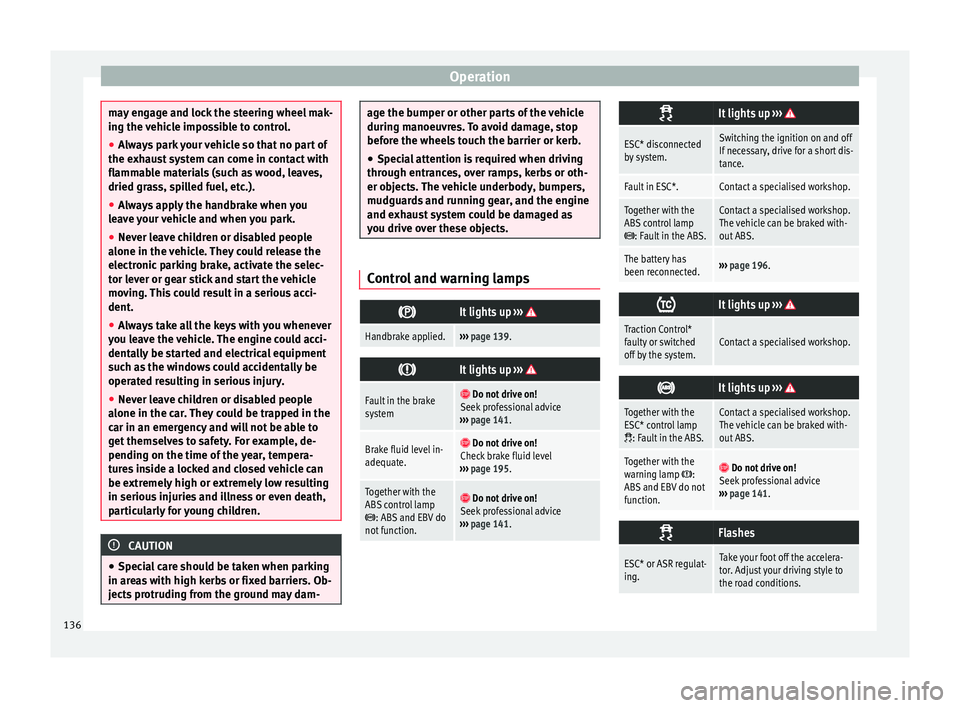
you drive over these objects. Control and warning lamps
It lights up
›››
Handbrake applied.››› page 139.
It lights up
›››
Fault in the brake
system Do not drive on!
Seek professional advice
››› page 141.
Brake fluid level in-
adequate. Do not drive on!
Check brake fluid level
››› page 195.
Together with the
ABS control lamp
: ABS and EBV do
not function.
Do not drive on!
Seek professional advice
››› page 141.
It lights up
›››
ESC* disconnected
by system.Switching the ignition on and off
If necessary, drive for a short dis-
tance.
Fault in ESC*.Contact a specialised workshop.
Together with the
ABS control lamp
: Fault in the ABS.
Contact a specialised workshop.
The vehicle can be braked with-
out ABS.
The battery has
been reconnected.››› page 196.
It lights up
›››
Traction Control*
faulty or switched
off by the system.Contact a specialised workshop.
It lights up
›››
Together with the
ESC* control lamp
: Fault in the ABS.
Contact a specialised workshop.
The vehicle can be braked with-
out ABS.
Together with the
warning lamp :
ABS and EBV do not
function. Do not drive on!
Seek professional advice
››› page 141.
Flashes
ESC* or ASR regulat-
ing.Take your foot off the accelera-
tor. Adjust your driving style to
the road conditions. 136
Page 139 of 232
Driving
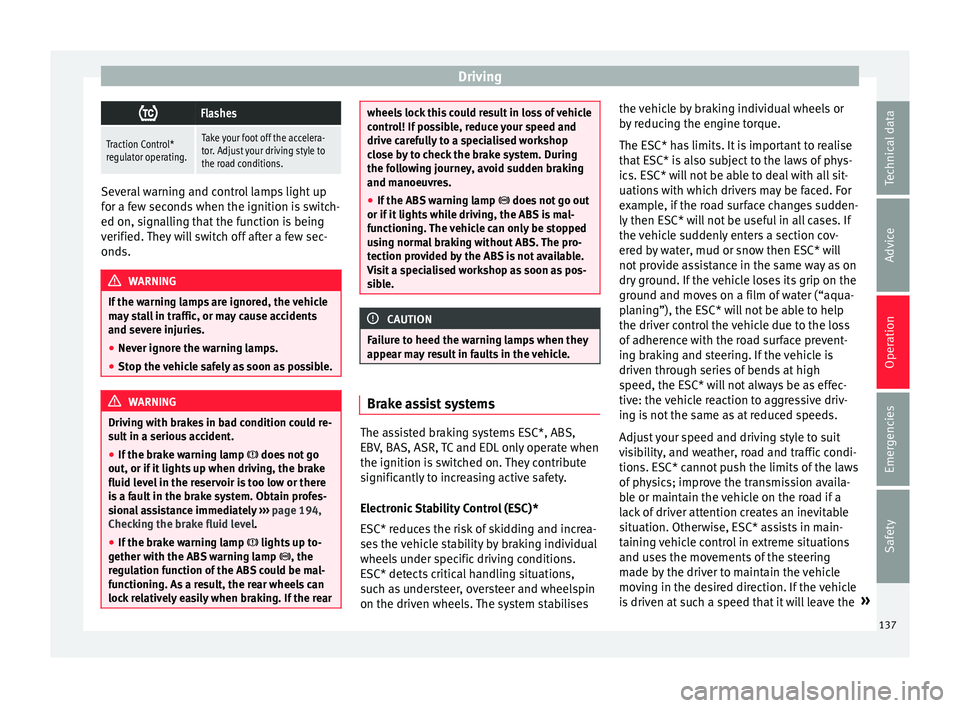
Flashes
Traction Control*
regulator operating.Take your foot off the accelera-
tor. Adjust your driving style to
the road conditions. Several warning and control lamps light up
for a f
ew sec
onds when the ignition is switch-
ed on, signalling that the function is being
verified. They will switch off after a few sec-
onds. WARNING
If the warning lamps are ignored, the vehicle
ma y
stall in traffic, or may cause accidents
and severe injuries.
● Never ignore the warning lamps.
● Stop the vehicle safely as soon as possible. WARNING
Driving with brakes in bad condition could re-
su lt
in a serious accident.
● If the brake warning lamp does not
go
out, or if it lights up when driving, the brake
fluid level in the reservoir is too low or there
is a fault in the brake system. Obtain profes-
sional assistance immediately ››› page 194,
Checking the brake fluid level.
● If the brake warning lamp lights up t
o-
gether with the ABS warning lamp , the
regulation function of the ABS could be mal-
functioning. As a result, the rear wheels can
lock relatively easily when braking. If the rear wheels lock this could result in loss of vehicle
contr
o
l! If possible, reduce your speed and
drive carefully to a specialised workshop
close by to check the brake system. During
the following journey, avoid sudden braking
and manoeuvres.
● If the ABS warning lamp does not
go out
or if it lights while driving, the ABS is mal-
functioning. The vehicle can only be stopped
using normal braking without ABS. The pro-
tection provided by the ABS is not available.
Visit a specialised workshop as soon as pos-
sible. CAUTION
Failure to heed the warning lamps when they
appe ar m
ay result in faults in the vehicle. Brake assist systems
The assisted braking systems ESC*, ABS,
EB
V
, B
AS, ASR, TC and EDL only operate when
the ignition is switched on. They contribute
significantly to increasing active safety.
Electronic Stability Control (ESC)*
ESC* reduces the risk of skidding and increa-
ses the vehicle stability by braking individual
wheels under specific driving conditions.
ESC* detects critical handling situations,
such as understeer, oversteer and wheelspin
on the driven wheels. The system stabilises the vehicle by braking individual wheels or
by r
educing the engine torque.
The ESC* has limits. It is important to realise
that ESC* is also subject to the laws of phys-
ics. ESC* will not be able to deal with all sit-
uations with which drivers may be faced. For
example, if the road surface changes sudden-
ly then ESC* will not be useful in all cases. If
the vehicle suddenly enters a section cov-
ered by water, mud or snow then ESC* will
not provide assistance in the same way as on
dry ground. If the vehicle loses its grip on the
ground and moves on a film of water (“aqua-
planing”), the ESC* will not be able to help
the driver control the vehicle due to the loss
of adherence with the road surface prevent-
ing braking and steering. If the vehicle is
driven through series of bends at high
speed, the ESC* will not always be as effec-
tive: the vehicle reaction to aggressive driv-
ing is not the same as at reduced speeds.
Adjust your speed and driving style to suit
visibility, and weather, road and traffic condi-
tions. ESC* cannot push the limits of the laws
of physics; improve the transmission availa-
ble or maintain the vehicle on the road if a
lack of driver attention creates an inevitable
situation. Otherwise, ESC* assists in main-
taining vehicle control in extreme situations
and uses the movements of the steering
made by the driver to maintain the vehicle
moving in the desired direction. If the vehicle
is driven at such a speed that it will leave the »
137
Technical data
Advice
Operation
Emergencies
Safety
Page 142 of 232
Operation
Parking When parking your vehicle, all legal require-
ments shou
l
d be observed.
To park the vehicle
Complete operations only in the sequence
given. ● Park the vehicle on a suitable surface ›››
.
● Press and hold the brake pedal until the ve-
hicl e c
omes to a standstill.
● Apply the handbrake firmly ›››
page 139.
● For an automatic gearbox, move the selec-
tor lev
er to position N.
● Switch off the engine and release the brake
pedal.
● R
emove the key from the ignition.
● If necessary, turn the steering wheel slight-
ly to loc
k the steering.
● With a manual gearbox, engage 1st gear on
flat gr
ound and slopes, or even reverse gear
on hills, and release the clutch pedal.
● Ensure that all passengers leave the vehi-
cle, e
specially children.
● When leaving the vehicle, take all keys with
you.
● Loc
k the vehicle. Additional information for steep slopes and
hill
s
Before switching off the engine, rotate the
steering wheel so that if the vehicle should
move, it will be held by the kerb.
● On slopes, turn the front wheels so that
they are ag
ainst the edge of the kerb.
● Uphill, turn the wheels towards the centre
of the ro
ad. WARNING
The components of the exhaust system reach
ver y
high temperatures. This could cause a
fire and considerable damage.
● Always park your vehicle so that no part of
the exhau
st system can come in contact with
flammable materials (such as wood,
leaves,dried grass, or spilled fuel). CAUTION
● Spec i
al care should be taken when parking
in areas with high kerbs or fixed barriers. Ob-
jects protruding from the ground may dam-
age the bumper or other parts of the vehicle
during manoeuvres. To avoid damage, stop
before the wheels touch the barrier or kerb.
● Special attention is required when driving
through entranc
es, over ramps, kerbs or oth-
er objects. The vehicle underbody, bumpers,
mudguards and running gear, and the engine
and exhaust system could be damaged as
you drive over these objects. Information on the brakes
For the first 200 to 300 km, the new brak
e
p
ads have not yet reached their maximum
braking capacity, and need to be “run in”
first ››› . The slightly reduced braking effect
can be c ompen
sated for by increasing pres-
sure on the brake pedal. While running in,
the full braking distance or emergency brak-
ing distance is larger then when the brake
pads have been run in. While running in,
avoid full power braking or situations requir-
ing braking performance. For example, in
heavy traffic.
The rate of wear of the brake pads depends
to a great extent on the conditions in which
the vehicle is used and the way the vehicle is
driven. If the vehicle is used frequently in city
traffic or for short trips or driven sport style,
visit a specialised workshop regularly, more
frequently than advised in the Maintenance
Programme, to have the brake pads checked.
If you drive with wet brakes, for example, af-
ter crossing areas of water, in heavy rainfall
or even after washing the car, the effect of
the brakes is lessened as the brake discs are
wet or even frozen (in winter). At higher
speed, “dry” the brakes as quickly as possi-
ble by braking gently several times. Only do
this without endangering vehicles behind
you or any other road users ››› .
A l ay
er of salt on the discs and brake pads
will reduce the effectiveness of the brakes
140
Page 146 of 232

Operation
Automatic gear change Fig. 148
Automatic gearbox diagram of gears Read the additional information carefully
› ›
›
page 27
Move the selector lever to the N position to:
● Starting up the engine
● Remove the key from the ignition switch
● Engage the steering wheel lock
Move the sel
ector lever to the D or R position
to:
● Park the vehicle
● Repair a puncture
● Changing a wheel
To mov
e the gear selector lever from the posi-
tion N to D or to R, first press and hold the
brake pedal. In the instrument panel display, with the igni-
tion switc
hed on, the selected gear range or
the gear engaged in the gearbox is shown.
- Reverse gear
Reverse gear is selected. Engage only when
the vehicle is stopped.
- Neutral
The gearbox is in neutral. No movement is
transmitted to the wheels and the engine
does not act as a brake.
- Standard driving position
The gears are changed (up and down) auto-
matically. The gear shifts are determined by
the engine load, your individual driving style
and the speed of the vehicle.
- Tiptronic driving position (manual shift
programme)
All gears can be changed (up and down)
manually ››› page 145. This is possible as
long as the system is not changing gear auto-
matically due to a traffic situation. WARNING
Placing the selector lever in an incorrect posi-
tion ma y
cause loss of control of the vehicle
and a serious accident.
● Do not press the accelerator when engag-
ing a ran
ge of gears. ●
With the en gine ru
nning and a gear range
selected, the vehicle will move when the ac-
celerator is pressed.
● Never engage reverse gear while driving.
● Unintentional movements of the vehicle
coul
d cause serious injury.
● As a driver, you should never leave your ve-
hicle if
the engine is running and a gear range
is engaged. If you have to leave your vehicle
while the engine is running, you must always
apply the handbrake and put the selector lev-
er in position N.
● Never engage the R gear range when the
vehicl
e is moving.
● Never leave the vehicle without applying
the handbrak
e. With the engine running the
vehicle moves downhill regardless of the gear
range selected. Note
If, while driving, the selector lever is acciden-
ta l
ly placed in position N, lift your foot off the
accelerator. Wait until the engine is running
at idle speed before selecting a new gear
range. 144
Page 149 of 232
Driving
Note
The recommended gear display is switched
off when the c lut
ch pedal is pressed.Steering
Introduction The power steering* is not hydraulic but elec-
tromec
h
anical. The advantage of this steer-
ing system is that it disposes of hydraulic
tubes, hydraulic oil, the pump, filter and oth-
er components. The electromechanical sys-
tem saves fuel. While a hydraulic system re-
quires oil pressure to be maintained, electro-
mechanical steering only requires energy
when the steering wheel is turned.
With the power steering system, the assisted
steering function automatically adjusts ac-
cording to the vehicle speed, the steering tor-
que and the wheel turning angle. The power
steering only works when the engine is run-
ning. WARNING
If the power steering is not working then the
st eerin
g wheel is much more difficult to turn
and the vehicle more difficult to control.
● The power steering only works when the
engine is
running. ●
Never a l
low the vehicle to move when the
engine is switched off.
● Never remove the key from the ignition if
the vehic
le is in motion. The steering may
lock and it will not be possible to turn the
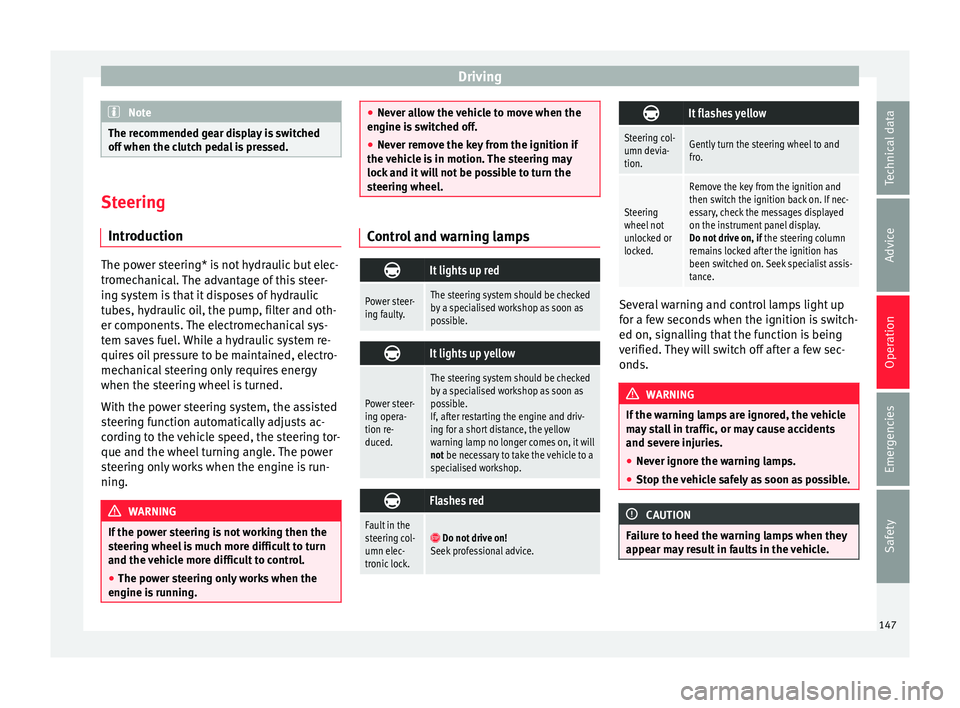
steering wheel. Control and warning lamps
It lights up red
Power steer-
ing faulty.The steering system should be checked
by a specialised workshop as soon as
possible.
It lights up yellow
Power steer-
ing opera-
tion re-
duced.
The steering system should be checked
by a specialised workshop as soon as
possible.
If, after restarting the engine and driv-
ing for a short distance, the yellow
warning lamp no longer comes on, it will
not be necessary to take the vehicle to a
specialised workshop.
Flashes red
Fault in the
steering col-
umn elec-
tronic lock.
Do not drive on!
Seek professional advice.
It flashes yellow
Steering col-
umn devia-
tion.Gently turn the steering wheel to and
fro.
Steering
wheel not
unlocked or
locked.
Remove the key from the ignition and
then switch the ignition back on. If nec-
essary, check the messages displayed
on the instrument panel display.
Do not drive on, if
the steering column
remains locked after the ignition has
been switched on. Seek specialist assis-
tance. Several warning and control lamps light up
f
or a f
ew sec
onds when the ignition is switch-
ed on, signalling that the function is being
verified. They will switch off after a few sec-
onds. WARNING
If the warning lamps are ignored, the vehicle
ma y
stall in traffic, or may cause accidents
and severe injuries.
● Never ignore the warning lamps.
● Stop the vehicle safely as soon as possible. CAUTION
Failure to heed the warning lamps when they
appe ar m
ay result in faults in the vehicle. 147
Technical data
Advice
Operation
Emergencies
Safety
Page 150 of 232
Operation
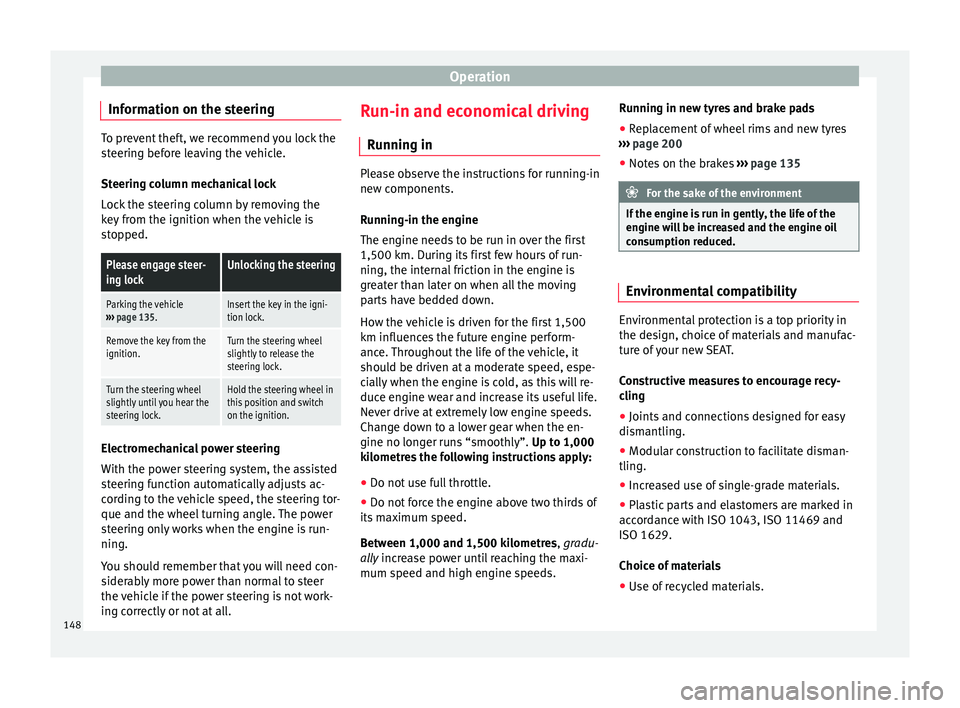
Information on the steering To prevent theft, we recommend you lock the
st
eerin
g before leaving the vehicle.
Steering column mechanical lock
Lock the steering column by removing the
key from the ignition when the vehicle is
stopped.
Please engage steer-
ing lockUnlocking the steering
Parking the vehicle
››› page 135.Insert the key in the igni-
tion lock.
Remove the key from the
ignition.Turn the steering wheel
slightly to release the
steering lock.
Turn the steering wheel
slightly until you hear the
steering lock.Hold the steering wheel in
this position and switch
on the ignition. Electromechanical power steering
W
ith the po
w
er steering system, the assisted
steering function automatically adjusts ac-
cording to the vehicle speed, the steering tor-
que and the wheel turning angle. The power
steering only works when the engine is run-
ning.
You should remember that you will need con-
siderably more power than normal to steer
the vehicle if the power steering is not work-
ing correctly or not at all. Run-in and economical driving
Runnin
g in Please observe the instructions for running-in
new components.
R u
nning-in the engine
The engine needs to be run in over the first
1,500 km. During its first few hours of run-
ning, the internal friction in the engine is
greater than later on when all the moving
parts have bedded down.
How the vehicle is driven for the first 1,500
km influences the future engine perform-
ance. Throughout the life of the vehicle, it
should be driven at a moderate speed, espe-
cially when the engine is cold, as this will re-
duce engine wear and increase its useful life.
Never drive at extremely low engine speeds.
Change down to a lower gear when the en-
gine no longer runs “smoothly”. Up to 1,000
kilometres the following instructions apply:
● Do not use full throttle.
● Do not force the engine above two thirds of
its m ax
imum speed.
Between 1,000 and 1,500 kilometres, gradu-
ally increase power until reaching the maxi-
mum speed and high engine speeds. Running in new tyres and brake pads
●
Replacement of wheel rims and new tyres
›››
page 200
● Notes on the brakes ›››
page 135 For the sake of the environment
If the engine is run in gently, the life of the
engine w i
ll be increased and the engine oil
consumption reduced. Environmental compatibility
Environmental protection is a top priority in
the de
s
ign, c
hoice of materials and manufac-
ture of your new SEAT.
Constructive measures to encourage recy-
cling
● Joints and connections designed for easy
dismantlin
g.
● Modular construction to facilitate disman-
tling.
● Incr
eased use of single-grade materials.
● Plastic parts and elastomers are marked in
accor
dance with ISO 1043, ISO 11469 and
ISO 1629.
Choice of materials
● Use of recycled materials.
148
Page 161 of 232
Driver assistance systems
Switch off the City Safety Assist function in
the f o
l
lowing situations
Switching off the City Safety Assist function is
recommended in the following situations
››› :
● While the vehicle is being towed.
● If the vehicle has been taken to an auto-
m atic
c
ar wash.
● If the vehicle is above a test bed.
● If the laser sensor is faulty.
● After the laser sensor has been involved in
a col
lision.
● When driving off road (overhanging branch-
es).
● If o
bjects are protruding above the bonnet,
e.g. a loa
d carried on the roof that signifi-
cantly protrudes over the front.
● If the windscreen is damaged in the laser
sensor are
a. WARNING
Failure to switch off the City Safety Assist
fu nction in the abo
ve situations may result in
accidents and serious injury.
● Switch off the City Safety Assist function in
critica
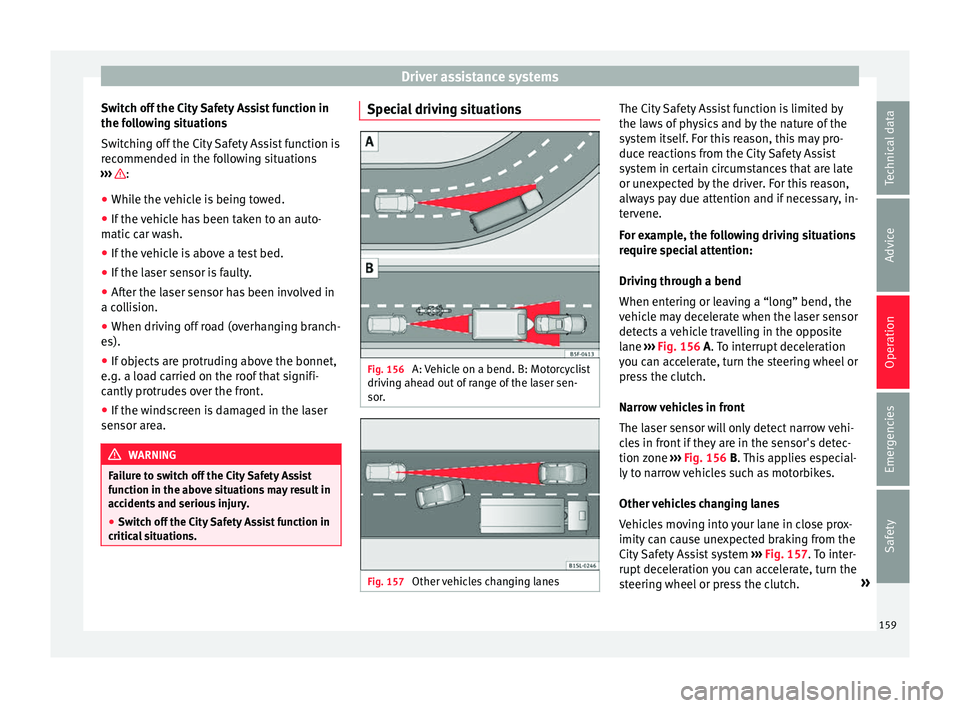
l situations. Special driving situations
Fig. 156
A: Vehicle on a bend. B: Motorcyclist
driv in
g ahe
ad out of range of the laser sen-
sor. Fig. 157
Other vehicles changing lanes The City Safety Assist function is limited by
the l
a
w
s of physics and by the nature of the
system itself. For this reason, this may pro-
duce reactions from the City Safety Assist
system in certain circumstances that are late
or unexpected by the driver. For this reason,
always pay due attention and if necessary, in-
tervene.
For example, the following driving situations
require special attention:
Driving through a bend
When entering or leaving a “long” bend, the
vehicle may decelerate when the laser sensor
detects a vehicle travelling in the opposite
lane ››› Fig. 156 A. To interrupt deceleration
you can accelerate, turn the steering wheel or
press the clutch.
Narrow vehicles in front
The laser sensor will only detect narrow vehi-
cles in front if they are in the sensor's detec-
tion zone ››› Fig. 156 B. This applies especial-
ly to narrow vehicles such as motorbikes.
Other vehicles changing lanes
Vehicles moving into your lane in close prox-
imity can cause unexpected braking from the
City Safety Assist system ›››
Fig. 157. To inter-
rupt deceleration you can accelerate, turn the
steering wheel or press the clutch. »
159
Technical data
Advice
Operation
Emergencies
Safety
Page 207 of 232
Wheels and tyres
Tread depth
C er
t
ain driving conditions require a deeper
tread, as well as needing the tread to be ap-
proximately the same on the front and rear
tyres. This is particularly important when
driving in winter, in cold temperatures and on
wet roads ››› .
The minimum tr e
a
d depth required by law in
the majority of cases is 1.6 mm, measured in
the tread grooves next to the tread wear indi-
cators. Observe legal requirements in each
country.
The performance of winter tyres is much re-
duced when the tread has worn to 4 mm.
The tread depth of new tyres may vary, ac-
cording to the type and make of tyre and the
tread pattern.
Wear indicators on the tyre
The original tyres on your vehicle have
1.6 mm high ››› Fig. 175 tread wear indicators
running across the tread. A number of these
indicators are equally spaced around the tyre
tread. Certain marks on the tyre walls (e.g.
the letters “TWI” or other symbols) indicate
the position of the wear indicators.
Tread wear indicators indicate if a tyre is
worn. They must always be replaced before
the tyre tread has worn to the level of the in-
dicator. WARNING
Driving with worn tyres is dangerous, and
ma y
lead to loss of control of the vehicle with
serious consequences.
● Tyres must be replaced before the wear in-
dicator
s are at the same level as the tread
pattern.
● Worn tyres have significantly reduced grip,
espec
ially on wet surfaces, increasing the
risk of “aquaplaning”.
● Worn tyres make control of the vehicle
more difficu
lt in normal or difficult driving
conditions, increasing the braking distance
and the risk of skidding. Tyre damage
Damage to wheels and tyres is often invisible
t
o the n
ak
ed eye. If you notice unusual vibra-
tion or the car pulling to one side, this may
indicate that one of the tyres is damaged
››› .
● Slow down immediately if you think you
h av
e a d
amaged wheel.
● Check the wheels and tyres for damage.
● If tyres are worn, stop driving and seek
qualified ass
istance.
● If there is no visible exterior damage, drive
slowly
and carefully to the nearest special-
ised workshop and have the vehicle checked. Foreign bodies in the tyre
●
Do not remove foreign bodies if they have
penetrated thr
ough the tyre wall!
● You should obtain professional assistance
immediately
.
Tyre wear
The wear of tyres depends on a number of
factors, for example:
● Driving style.
● Unbalanced wheels.
● Running gear settings.
Driving
style: Driving round bends quickly or
sudden acceleration or braking speed accel-
erates tyre wear. When the driving style is
normal, if the tyres wear too quickly, have the
running gear settings checked at a special-
ised workshop.
Wheel run-out: The wheels on new vehicles
are balanced. However, certain circumstan-
ces may lead to imbalance (run-out), which is
detected as vibrations in the steering wheel.
Run-out leads to wear of the steering and
suspension. In the event of run out, the
wheels should be balanced again. When a
new wheel is fitted, it should be balanced
again.
Running gear settings : an incorrectly posi-
tioned running gear increases the wear of
tyres and affects your safety while driving. If »
205
Technical data
Advice
Operation
Emergencies
Safety
Page 228 of 232
Index
Replacement par
ts
. . . . . . . . . . . . . . . . . . . . . . . . . . . . . . . . . 164
Replacement parts . . . . . . . . . . . . . . . . . . . . . . . . 164
Replacing bulbs see "Changing bulbs" . . . . . . . . . . . . . . . . . . . . 79
Reprogramming control units . . . . . . . . . . . . . . . 167
Retaining hooks . . . . . . . . . . . . . . . . . . . . . . . . . . 127
Revolution counter . . . . . . . . . . . . . . . . . . . . . . . . . 88
Rims changing a wheel . . . . . . . . . . . . . . . . . . . . . . . . 36
RON (petrol) . . . . . . . . . . . . . . . . . . . . . . . . . . . . . 181
Roof carrier . . . . . . . . . . . . . . . . . . . . . . . . . . . . . . 127
Roof carrier system . . . . . . . . . . . . . . . . . . . . . . . . 127 fastening the supports . . . . . . . . . . . . . . . . . . . 128
Roof rack . . . . . . . . . . . . . . . . . . . . . . . . . . . . . . . . 127
Rubber seals . . . . . . . . . . . . . . . . . . . . . . . . . . . . . 174
Running in brake pads . . . . . . . . . . . . . . . . . . . . . . . . . . . . 140
new engine . . . . . . . . . . . . . . . . . . . . . . . . . . . . 148
wheels and tyres . . . . . . . . . . . . . . . . . . . . . . . . 203
S SAFE . . . . . . . . . . . . . . . . . . . . . . . . . . . . . . . 97, 135
Safe driving . . . . . . . . . . . . . . . . . . . . . . . . . . . . . . 47
Safety child safety . . . . . . . . . . . . . . . . . . . . . . . . . . . . . 64
child seats . . . . . . . . . . . . . . . . . . . . . . . . . . . . . . 64
disabling the front passenger front airbag . . . . 15
safe driving . . . . . . . . . . . . . . . . . . . . . . . . . . . . . 47
Safety Assist . . . . . . . . . . . . . . . . . . . . . . . . . . . . . 156
Safety equipment . . . . . . . . . . . . . . . . . . . . . . . . . . 48
Safety instructions using child seats . . . . . . . . . . . . . . . . . . . . . 16, 64
using seat belts . . . . . . . . . . . . . . . . . . . . . . . . . 54
Sale of vehicle in other countries / continents . . . . . . . . . . . . 179 Scrapping . . . . . . . . . . . . . . . . . . . . . . . . . . . . . . . 180
airbag sys tem . . . . . . . . . . . . . . . . . . . . . . . . . . 180
vend-of-life vehicles . . . . . . . . . . . . . . . . . . . . . 180
Seat belt adjustment . . . . . . . . . . . . . . . . . . . . . . . . . . . . . 56
Seat belts . . . . . . . . . . . . . . . . . . . . . . . . . . . . . . . . 52 adjustment . . . . . . . . . . . . . . . . . . . . . . . . . . . . . 13
automatic belt retractor . . . . . . . . . . . . . . . . . . . 57
belt tensioner . . . . . . . . . . . . . . . . . . . . . . . . . . . 57
belt tension limiter . . . . . . . . . . . . . . . . . . . . . . . 57
cleaning . . . . . . . . . . . . . . . . . . . . . . . . . . . . . . 178
protective function . . . . . . . . . . . . . . . . . . . . . . . 54
purpose . . . . . . . . . . . . . . . . . . . . . . . . . . . . . . . . 52
safety instructions . . . . . . . . . . . . . . . . . . . . . . . 54
twisted belt . . . . . . . . . . . . . . . . . . . . . . . . . . . . . 54
unfastened . . . . . . . . . . . . . . . . . . . . . . . . . . . . . 55
warning lamp . . . . . . . . . . . . . . . . . . . . . . . . . . . 53
Seat belt tensioner . . . . . . . . . . . . . . . . . . . . . . 13, 57
Seat heating . . . . . . . . . . . . . . . . . . . . . . . . . . . . . 113
SEAT information system . . . . . . . . . . . . . . . . . . . . 23
Seats . . . . . . . . . . . . . . . . . . . . . . . . . . . . . . . . . . . . 49 heating . . . . . . . . . . . . . . . . . . . . . . . . . . . . . . . 113
incorrect position . . . . . . . . . . . . . . . . . . . . . . . . 49
number of seats . . . . . . . . . . . . . . . . . . . . . . . . . 49
rear backrest . . . . . . . . . . . . . . . . . . . . . . . . . . . 124
Service fluids . . . . . . . . . . . . . . . . . . . . . . . . . . . . 164
Service interval display . . . . . . . . . . . . . . . . . . . . . 90
Side airbags description . . . . . . . . . . . . . . . . . . . . . . . . . . . . . 16
Smartphone holder removing and inserting . . . . . . . . . . . . . . . . . . 122
Smell of gas . . . . . . . . . . . . . . . . . . . . . . . . . . . . . 182
Snow chains . . . . . . . . . . . . . . . . . . . . . . . . . 41, 213 temporary spare wheel . . . . . . . . . . . . . . . . . . . 41
Spare fuel canister . . . . . . . . . . . . . . . . . . . . . . . . 183
Spare parts . . . . . . . . . . . . . . . . . . . . . . . . . . . . . . 164 Spare wheel
remov ing . . . . . . . . . . . . . . . . . . . . . . . . . . . . . . 207
Spare wheel or temporary spare wheel advice for driving . . . . . . . . . . . . . . . . . . . . . . . 207
Speed limiter . . . . . . . . . . . . . . . . . . . . . . . . . . . . 155
Speed rating . . . . . . . . . . . . . . . . . . . . . . . . . . . . . 209
Start-Stop system . . . . . . . . . . . . . . . . . . . . 160, 161 operation . . . . . . . . . . . . . . . . . . . . . . . . . . . . . . 160
Starting the vehicle . . . . . . . . . . . . . . . . . . . . . . . . 20
Steering . . . . . . . . . . . . . . . . . . . . . . . . . . . . . . . . 147 control and warning lamps . . . . . . . . . . . . . . . 147
electromechanical . . . . . . . . . . . . . . . . . . . . . . 148
power steering . . . . . . . . . . . . . . . . . . . . . . . . . 148
steering column lock . . . . . . . . . . . . . . . . . . . . 148
tendency to pull to one side . . . . . . . . . . . . . . 205
Steering wheel adjustment . . . . . . . . . . . . . . . . . . . . . . . . . . 14, 49
Storage compartments . . . . . . . . . . . . . . . . . . . . 115 centre console . . . . . . . . . . . . . . . . . . . . . . . . . 118
driver side . . . . . . . . . . . . . . . . . . . . . . . . . . . . . 116
other storage compartments . . . . . . . . . . . . . . 118
Sunglasses storage compartment . . . . . . . . . . . 117
Sun protection . . . . . . . . . . . . . . . . . . . . . . . . . . . 108
Sun visors . . . . . . . . . . . . . . . . . . . . . . . . . . . . . . . 108
Switch hazard warning lights . . . . . . . . . . . . . . . . . . . 106
Switching lights off . . . . . . . . . . . . . . . . . . . . . . . 103
Switching lights on . . . . . . . . . . . . . . . . . . . . . . . 103
Switching the ignition on and off . . . . . . . . . . . . . 20
Symbols see control and warning lamps . . . . . . . . . . . . . 25
T
TC see Brake assist system . . . . . . . . . . . . . . . . . . 138
226
Page 230 of 232
Index
V
V alv
e c
aps . . . . . . . . . . . . . . . . . . . . . . . . . . . . . . . 204
Vanity mirror . . . . . . . . . . . . . . . . . . . . . . . . . . . . . 108
Vehicle chassis number . . . . . . . . . . . . . . . . . . . . . . . . 211
data label . . . . . . . . . . . . . . . . . . . . . . . . . . . . . 211
identification data . . . . . . . . . . . . . . . . . . . . . . 211
identification number . . . . . . . . . . . . . . . . . . . . 211
loading . . . . . . . . . . . . . . . . . . . . . . . . . . . . . . . 114
raising . . . . . . . . . . . . . . . . . . . . . . . . . . . . . . . . . 39
recycling . . . . . . . . . . . . . . . . . . . . . . . . . . . . . . 180
Vehicle battery . . . . . . . . . . . . . . . . . . . . . . . 33, 196 acid . . . . . . . . . . . . . . . . . . . . . . . . . . . . . . . . . . 198
assisted starting . . . . . . . . . . . . . . . . . . . . . . . . . 43
automatic device disconnection . . . . . . . . . . . 199
charging . . . . . . . . . . . . . . . . . . . . . . . . . . . . . . 198
checking the battery electrolyte level . . . . . . . 197
connecting . . . . . . . . . . . . . . . . . . . . . . . . . . . . 198
control and warning lamps . . . . . . . . . . . . . . . 197
discharging . . . . . . . . . . . . . . . . . . . . . . . . . . . . 134
disconnecting . . . . . . . . . . . . . . . . . . . . . . . . . . 198
preparations . . . . . . . . . . . . . . . . . . . . . . . . . . . 197
replacing . . . . . . . . . . . . . . . . . . . . . . . . . . . . . . 198
running flat . . . . . . . . . . . . . . . . . . . . . . . . . . . . 199
Vehicle care . . . . . . . . . . . . . . . . . . . . . . . . . . . . . 170 airbag modules (dash panel) . . . . . . . . . . . . . 178
aluminium wheel rims . . . . . . . . . . . . . . . . . . . 174
anodized surfaces . . . . . . . . . . . . . . . . . . . . . . 174
antenna incorporated in window . . . . . . . . . . . 180
chrome wheel rims . . . . . . . . . . . . . . . . . . . . . . 174
cleaning wheels . . . . . . . . . . . . . . . . . . . . . . . . 174
dash panel . . . . . . . . . . . . . . . . . . . . . . . . . . . . 178
de-icing the door lock cylinder . . . . . . . . . . . . 175
engine compartment . . . . . . . . . . . . . . . . . . . . 175
exterior mirrors . . . . . . . . . . . . . . . . . . . . . . . . . 172
interior . . . . . . . . . . . . . . . . . . . . . . . . . . . . . . . . 176
plastic parts . . . . . . . . . . . . . . . . . . . . . . . . . . . 178 protection of vehicle undercarriage . . . . . . . . 175
rubber seals
. . . . . . . . . . . . . . . . . . . . . . . . . . . 174
vehicle paintwork . . . . . . . . . . . . . . . . . . . . . . . 173
windows . . . . . . . . . . . . . . . . . . . . . . . . . . . . . . 172
wooden trim . . . . . . . . . . . . . . . . . . . . . . . . . . . 178
Vehicle care products . . . . . . . . . . . . . . . . . . . . . . 170
Vehicle code vehicle data label . . . . . . . . . . . . . . . . . . . . . . . 211
Vehicle key set . . . . . . . . . . . . . . . . . . . . . . . . . . . . 92
Vehicle tool kit . . . . . . . . . . . . . . . . . . . . . . . . . 36, 70 components . . . . . . . . . . . . . . . . . . . . . . . . . . . . 71
location . . . . . . . . . . . . . . . . . . . . . . . . . . . . . . . . 71
Vibrations steering . . . . . . . . . . . . . . . . . . . . . . . . . . . . . . . 205
W
Warning lamps . . . . . . . . . . . . . . . . . . . . . . . . . . . . 25
Warning triangle . . . . . . . . . . . . . . . . . . . . . . 70, 106
Washing the vehicle . . . . . . . . . . . . . . . . . . . . . . . 171 sensors . . . . . . . . . . . . . . . . . . . . . . . . . . . . . . . 154
Water box . . . . . . . . . . . . . . . . . . . . . . . . . . . . . . . 175
Wax . . . . . . . . . . . . . . . . . . . . . . . . . . . . . . . . . . . . 173
Wear indicators . . . . . . . . . . . . . . . . . . . . . . . . . . 205
Weights . . . . . . . . . . . . . . . . . . . . . . . . . . . . . . . . . 212
What negatively affects driving safety? . . . . . . . . 47
Wheel bolts . . . . . . . . . . . . . . . . . . . . . . . . . . 72, 213 anti-theft . . . . . . . . . . . . . . . . . . . . . . . . . . . . . . . 72
caps . . . . . . . . . . . . . . . . . . . . . . . . . . . . . . . . . . . 37
loosening . . . . . . . . . . . . . . . . . . . . . . . . . . . . . . 38
Tightening torque . . . . . . . . . . . . . . . . . . . . . . . . 38
Wheel load capacity . . . . . . . . . . . . . . . . . . . . . . . 208
Wheel rims beadlock . . . . . . . . . . . . . . . . . . . . . . . . . . . . . . 202
bolted trims . . . . . . . . . . . . . . . . . . . . . . . . . . . 202
Wheels . . . . . . . . . . . . . . . . . . . . . . . . 200, 202, 212 changing . . . . . . . . . . . . . . . . . . . . . . . . . . . . 36, 40
changing a wheel . . . . . . . . . . . . . . . . . . . . . . . . 72 hubcaps . . . . . . . . . . . . . . . . . . . . . . . . . . . . . . . 37
spar
e wheel or temporary spare wheel . . . . . . 207
storing the replaced wheel . . . . . . . . . . . . . . . 207
Wheel trim hubcaps . . . . . . . . . . . . . . . . . . . . . . . . . . . . . . . 37
remove . . . . . . . . . . . . . . . . . . . . . . . . . . . . . . . . 37
Wheel trims Full hub caps . . . . . . . . . . . . . . . . . . . . . . . . . . . . 37
Windows . . . . . . . . . . . . . . . . . . . . . . . . . . . . . . . . 101 electric . . . . . . . . . . . . . . . . . . . . . . . . . . . . . . . . . 11
removing ice . . . . . . . . . . . . . . . . . . . . . . . . . . . 172
Window wiper . . . . . . . . . . . . . . . . . . . . . . . . . . . . 108 window wiper lever . . . . . . . . . . . . . . . . . . . . . . 108
Window wiper blade . . . . . . . . . . . . . . . . . . . . . . . . 22
Windscreen heat-insulating glass . . . . . . . . . . . . . . . . . . . . 108
infrared coating . . . . . . . . . . . . . . . . . . . . . . . . 108
removing ice . . . . . . . . . . . . . . . . . . . . . . . . . 29, 30
Windscreen and rear window wiper blades . . . . . 75
Windscreen washer . . . . . . . . . . . . . . . . . . . 33, 108 rain and light sensor . . . . . . . . . . . . . . . . . . . . 109
Windscreen washer water checking . . . . . . . . . . . . . . . . . . . . . . . . . . . . . . 195
topping up . . . . . . . . . . . . . . . . . . . . . . . . . . . . 195
Windscreen wipers . . . . . . . . . . . . . . . . . . . . 22, 108 functions . . . . . . . . . . . . . . . . . . . . . . . . . . . . . . 109
heated windscreen washer jets . . . . . . . . . . . . 109
lifting the wiper blade . . . . . . . . . . . . . . . . . . . . 45
replacing the wiper blade . . . . . . . . . . . . . . . . . 45
service position . . . . . . . . . . . . . . . . . . . . . . . . . 45
Windscreen wipers service position . . . . . . . . . . . 45
228