ESP Seat Mii 2017 Repair Manual
[x] Cancel search | Manufacturer: SEAT, Model Year: 2017, Model line: Mii, Model: Seat Mii 2017Pages: 232, PDF Size: 4.91 MB
Page 191 of 232
Checking and refilling levels
●
To av oid d
amage to the bonnet and to the
windscreen wiper arms, only open it when
the windscreen wipers are in place against
the windscreen.
● Before driving, always lower the wiper
arms. For the sake of the environment
Service fluids leaks are harmful to the envi-
r onment . F
or this reason you should make
regular checks on the ground underneath
your vehicle. Take the vehicle to a specialised
workshop to be checked if you see stains, oil
or other fluids on the ground. Collect any
spilt service fluids and allow a professional to
dispose of them. Engine oil
Intr oduction WARNING
Incorrectly handling engine oil can cause in-
jury and seriou
s burns.
● Always protect your eyes when handling
engine oil
.
● Oil is toxic and must be kept out of the
reac
h of children. ●
Engine oi l
should only be kept in its origi-
nal packaging; the same goes for used oil un-
til it is disposed of.
● Never store engine oil in empty food con-
tainers
or bottles as other people may acci-
dentally drink it.
● Regular contact with engine oil can be bad
for the skin. If
you come into contact with en-
gine oil, wash your skin with soap and water.
● With the engine running, the engine oil
gets
extremely hot and can cause severe skin
burns. Always wait until the engine has fully
cooled. For the sake of the environment
Similar to the other service liquids, spilled
engine oi l
can be bad for the environment.
Collect these liquids in suitable containers
and dispose of them while respecting the en-
vironment. Warning and control lamps
Flashes
Engine oil pres-
sure too low.
Stop the vehicle!
Switch off the engine. Check the
engine oil level, and if necessary,
refill with ››› page 190.
engine oil - If the warning indicator
flashes although the oil level is cor-
rect, do not continue driving or
leave the engine running. Other-
wise, the engine could be dam-
aged. Seek specialist assistance. WARNING
Observe the safety warnings ›››
in On the
ins trument
panel on page 26. Engine oil specifications
Read the additional information carefully
› ›
›
page 31
Replacement engine oil must strictly comply
with the specifications.
The correct oil must be used to ensure the
correct operation and long service life of the
engine. The engine comes with a high-quality
multigrade oil that can generally be used all
year round.
Only use an engine oil that complies to SEAT
standards whenever possible ››› . Only refill
»
189
Technical data
Advice
Operation
Emergencies
Safety
Page 192 of 232
Advice
engine oil using approved engine oil in ac-
c or
d
ance with the corresponding VW stand-
ard ( ›››
page 32). All oils indicated are
synthetic multigrade oils .
Engine oils are being continuously further
developed. Technical services are constantly
updated with any modifications. SEAT there-
fore recommends that you have the engine
oil changed by a technical service. CAUTION
● Only u
se engine oils whose specifications
are expressly approved by SEAT. The use of
any other type of oil could cause engine dam-
age!
● No additives should be used with engine
oil. An
y damage caused by the use of such
additives would not be covered by the factory
warranty. Checking engine oil level and topping
up
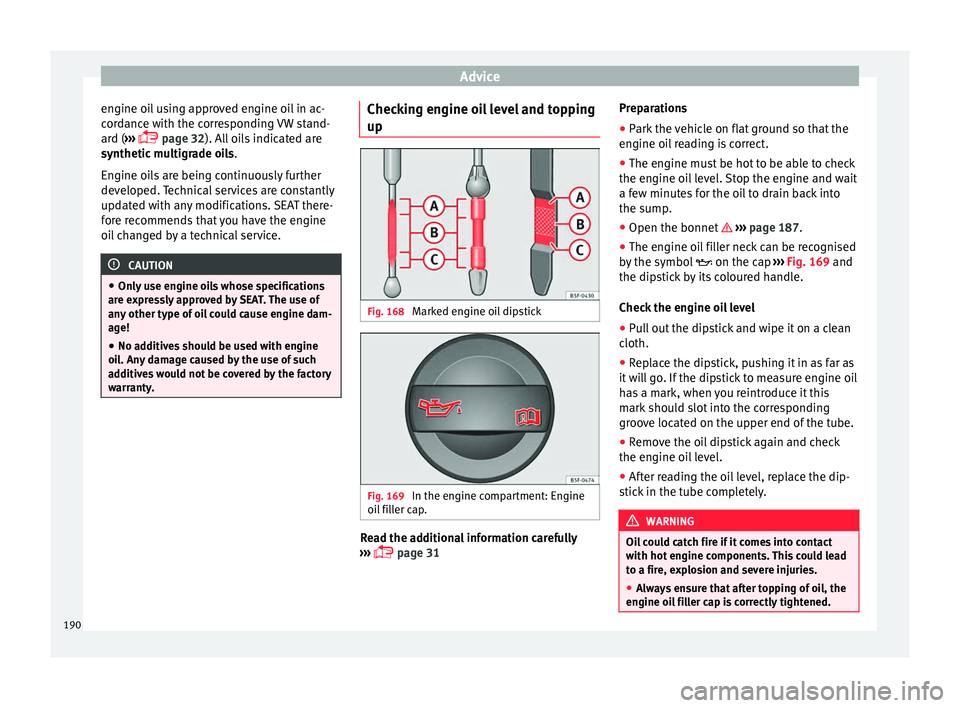
Fig. 168
Marked engine oil dipstick Fig. 169
In the engine compartment: Engine
oi l
fi
ller cap. Read the additional information carefully
› ›
›
page 31 Preparations
●
Park the vehicle on flat ground so that the
engine oil
reading is correct.
● The engine must be hot to be able to check
the engine oil
level. Stop the engine and wait
a few minutes for the oil to drain back into
the sump.
● Open the bonnet ›››
page 187.
● The engine oil filler neck can be recognised
by the symbo
l on the cap ››› Fig. 169 and
the dipstick by its coloured handle.
Check the engine oil level
● Pull out the dipstick and wipe it on a clean
cloth.
● Rep
lace the dipstick, pushing it in as far as
it wi
ll go. If the dipstick to measure engine oil
has a mark, when you reintroduce it this
mark should slot into the corresponding
groove located on the upper end of the tube.
● Remove the oil dipstick again and check
the engine oil
level.
● After reading the oil level, replace the dip-
stick
in the tube completely. WARNING
Oil could catch fire if it comes into contact
with hot en
gine components. This could lead
to a fire, explosion and severe injuries.
● Always ensure that after topping of oil, the
engine oil
filler cap is correctly tightened.190
Page 194 of 232
Advice
used engine oil in places such as a garden,
wood
s, dr
ains, roads, paths, rivers and drain-
age systems. Engine coolant
Introduction WARNING
Engine coolant is toxic!
● Only keep engine coolant in its original
c ont ainer
, tightly shut and in a safe place.
● Never store engine coolant in empty food
container
s or bottles as other people may ac-
cidentally drink it.
● Always keep engine coolant out of reach of
chil
dren.
● Ensure that the proportion of engine cool-
ant ad
ditive corresponds to the lowest out-
side temperature to which the vehicle will be
exposed.
● If the outside temperature is extremely low,
the engine coo
lant could freeze causing the
vehicle to stop. As this would also cause the
heating to stop working, vehicle occupants
without warm clothing could freeze. For the sake of the environment
Coolants and additives can contaminate the
env ir
onment. If any fluids are spilled, they should be collected and correctly disposed
of, w
ith r
espect to the environment. Coolant warning lamp
Several warning and control lamps light up
for a f
ew sec
onds when the ignition is switch-
ed on, signalling that the function is being
verified. They will switch off after a few sec-
onds.
It lights up red
Excessive engine
coolant temperature.
Stop the vehicle!
Stop the vehicle safely as soon
as possible. Switch off the en-
gine and let it cool.
Insufficient engine
coolant level.
¡Stop the vehicle!
Check the engine coolant
when the engine has cooled
and, if it is low, refill with en-
gine coolant ››› page 193.
Engine coolant sys-
tem faulty. Do not drive any further.
Obtain professional assis-
tance.
Flashes red
Engine coolant sys-
tem faulty.Seek specialist assistance.
It lights up blue
The natural gas en-
gine coolant tempera-
ture is low. The en-
gine has not reached
the operating temper-
ature.As long as the warning lamp is
on, avoid high engine speeds
and pushing the engine too
hard.
WARNING
Observe the safety warnings ›››
in On the
ins trument
panel on page 26. 192
Page 196 of 232
Advice
●
When refi l
ling liquids, avoid spilling them
on parts of the engine and the exhaust sys-
tem. Spilled liquids could cause a fire. Under
specific circumstances, the ethylene glycol
can catch fire. WARNING
If there is not enough anti-freeze in the cool-
ant sys
tem, the engine may fail leading to se-
rious damage.
● Please make sure that the percentage of
additiv
e is correct with respect to the lowest
expected ambient temperature in the zone in
which the vehicle is to be used.
● When the outside temperature is very low,
the cool
ant could freeze and the vehicle
would be immobilised. In this case, the heat-
ing would not work either and inadequately
dressed passengers could die of cold. CAUTION
● If ther e i
s no appropriate coolant liquid
available, fill it using distilled water, and
nothing else. Any other type of water may
lead to considerable rusting in the engine
due to its chemical components. This could
consequently damage the engine. If you have
not used distilled water but another type of
water to top up the coolant, a specialised
workshop must immediately replace all of the
fluid in the engine cooling system.
● Only top up coolant to the top level of the
marked ar
ea ››› Fig. 170. Otherwise the ex- cess coolant will be forced out of the cooling
sys
t
em when the engine is hot, causing dam-
age.
● If a lot of liquid coolant has been lost, wait
for the engine t
o cool down completely before
adding coolant. Extensive coolant loss is an
indication of leaks in the engine cooling sys-
tem. Have the engine cooling system inspec-
ted immediately by a specialised workshop.
Otherwise engine damage may occur.
● When refilling service liquids, ensure that
you put
the liquids into the right tank. Mak-
ing a mistake when refilling could cause seri-
ous malfunctions and damage the engine! CAUTION
The original additives should never be mixed
with c oo
lants which are not approved by
SEAT. Otherwise, you run the risk of causing
severe damage to the engine and the engine
cooling system.
● If the fluid in the expansion tank is not pur-
ple b
ut is, for example, brown, this indicates
that the G13 additive has been mixed with an
inadequate coolant. The coolant must be
changed as soon as possible if this is the
case! This could result in serious faults and
engine damage. Brake fluid
Chec k
in
g the brake fluid level Read the additional information carefully
›› ›
page 33
In the course of time, the brake fluid absorbs
water from the ambient air. If there is too
much water in the brake fluid, the brake sys-
tem could be damaged. In addition, the boil-
ing point of the brake fluid is significantly
lowered. When the brake fluid contains too
much water and the brakes are subject to
considerable forces, bubbles of water vapour
can form in the system. These bubbles can
significantly reduce braking power, notably
increasing braking distance, and could even
result in the total failure of the brake system.
Ensuring that the brake system is always
functioning correctly is essential for your own
safety and the safety of other road users
››› .
Br ak
e fluid s
pecifications
SEAT have developed a special brake fluid
optimised for the brake systems of their vehi-
cles. To ensure the optimum working of the
brake system, SEAT recommends the use of
brake fluid in accordance with the VW 501 14
standard. If this brake fluid is not available or
another brake fluid is used for different rea-
sons, use a brake fluid that complies with the
United States standard FMVSS 116 DOT 4 or
194
Page 200 of 232
Advice
Checking the battery electrolyte level
● Make sure there is sufficient lighting to
c l
e
arly recognise the colours. Never use
flames or shiny objects as a light source.
● Depending on the level of acid, the Magic
eye on the top of
the battery will change col-
our.
Colour indica-
torNecessary operations
Light yellow or
colourlessThe electrolyte level of the vehicle's
battery is too low. Have the battery
checked and, where applicable, re-
placed by a specialised workshop.
BlackThe electrolyte level of the vehicle's
battery is correct. WARNING
Working with the vehicle battery involves a
risk of
corrosion, explosions and electric
shock.
● Never tilt the vehicle battery. Battery acid
coul
d spill out of the openings for the release
of gases and cause corrosion damage.
● Never open the vehicle battery.
● If battery acid splashes on you, immediate-
ly rinse
your eyes and skin abundantly with
water for several minutes. Then seek medical
care immediately.
● If acid is swallowed by mistake, consult a
doctor immediat
ely. Charging, replacing and connecting or
di
s
c
onnecting the battery Charging the battery
The v
ehic
le battery should be charged by a
specialised workshop only, as batteries us-
ing special technology have been installed
and they must be charged in a controlled en-
vironment ››› . SEAT recommends taking
your c ar in f
or technical service.
Replacing a vehicle battery
The battery has been developed to suit the
conditions of its location and has special
safety features. If the battery must be re-
placed, consult a technical service for infor-
mation on electromagnetic compatibility, the
size and maintenance, performance and
safety requirements of the new battery in
your vehicle before you purchase one. SEAT
recommends you have the battery replaced
by a technical service.
Use only maintenance-free genuine batteries
conforming to TL 825 06 and VW 7 50 73
Standards. These standards must be dated
April 2008 or later.
Vehicles fitted with the Start-Stop system are
equipped with a special battery. Therefore,
this battery must only be replaced by another
with the same specifications. Disconnecting the vehicle's battery
If
y
ou must disconnect the battery from the
electrical system, please note the following:
● Switch off the ignition and all electrical
equipment.
● The v
ehicle must be unlocked before dis-
connecting the b
attery, otherwise the alarm
will be triggered.
● First disconnect the negative cable and
then the positiv
e ››› .
C onnectin
g the
vehicle's battery
● Before reconnecting the battery, switch off
the engine and all
electrical devices.
● First reconnect the positive cable and then
the negativ
e ››› .
Diff er
ent
control lamps may light up after
connecting the battery and switching the ig-
nition on. They will be turned off after a short
trip at a speed of between 15-20 km/h
(10-12 mph). If the warning indicators remain
lit, please visit a specialised workshop to
have the vehicle checked.
If the battery has been disconnected for a
long time, it is possible that the next service
date is not displayed or calculated correctly
››› page 88. Respect the maximum service in-
tervals permitted ››› Booklet Maintenance
Programme.
198
Page 202 of 232
Advice
Wheels and tyres
T y
r
es
Introduction SEAT recommend that all work on tyres and
wheels
i
s carried out by a specialised work-
shop. These workshops have the necessary
special tools and replacement parts, trained
personnel and facilities for disposing of the
old tyres while respecting the environment.
SEAT recommends taking your car in for tech-
nical service. WARNING
The vehicle cannot be totally controlled or
brak ed if
the tyres (new or used) are worn or
damaged.
● Incorrect use of wheels and tyres could
make driv
ing more dangerous and result in
serious accidents and damage.
● All four wheels must be fitted with radial
tyre
s of the same type, size (rolling circumfer-
ence) and the same tread pattern.
● New tyres do not give maximum grip and
wil
l not have reached their maximum braking
capacity to start with, and therefore need
running in. To prevent accidents and major
damage, extreme caution should be taken for
the first 600 km. ●
Check ty
re pressures regularly and ensure
they are maintained at the pressures indica-
ted. If the tyre pressure is too low, they could
overheat, resulting in tread detachment or
even burst tyres.
● Never drive on damaged (punctured, cut,
crac
ked or dented) or worn tyres. Driving on
damaged or worn tyres could result in burst
tyres, serious accidents or damage. Worn or
damaged tyres must be replaced immediate-
ly.
● Never exceed the maximum permitted
speed or loa
ds specified for the type of tyre
fitted on your vehicle.
● The effectiveness of driver and brake assist
syst
ems also depends on the grip of the
tyres.
● If you notice unusual vibration or if the ve-
hicle p
ulls to one side when driving, stop the
car immediately and check the tyres and
wheels for damage.
● To minimise the risk of losing control of the
vehicl
e or causing a serious accident, never
undo the bolted joints of beadlock wheels.
● Never mount used tyres or wheels if you are
not sur
e of their previous history. They may
be damaged, although the damage is not im-
mediately visible.
● Old tyres, even if they have never been
used, ma
y lose air or burst unexpectedly
while driving, especially at high speeds, re-
sulting in serious accident and injury. If tyres
are over six years old, they should only be used in an emergency and with extreme cau-
tion.
Note
For technical reasons, it is not generally pos-
s ib l
e to use the wheels from other vehicles.
In some cases, this may also be true for the
same model of wheel. Please refer to the ve-
hicle documentation or ask at a technical
service. Handling tyres and wheels
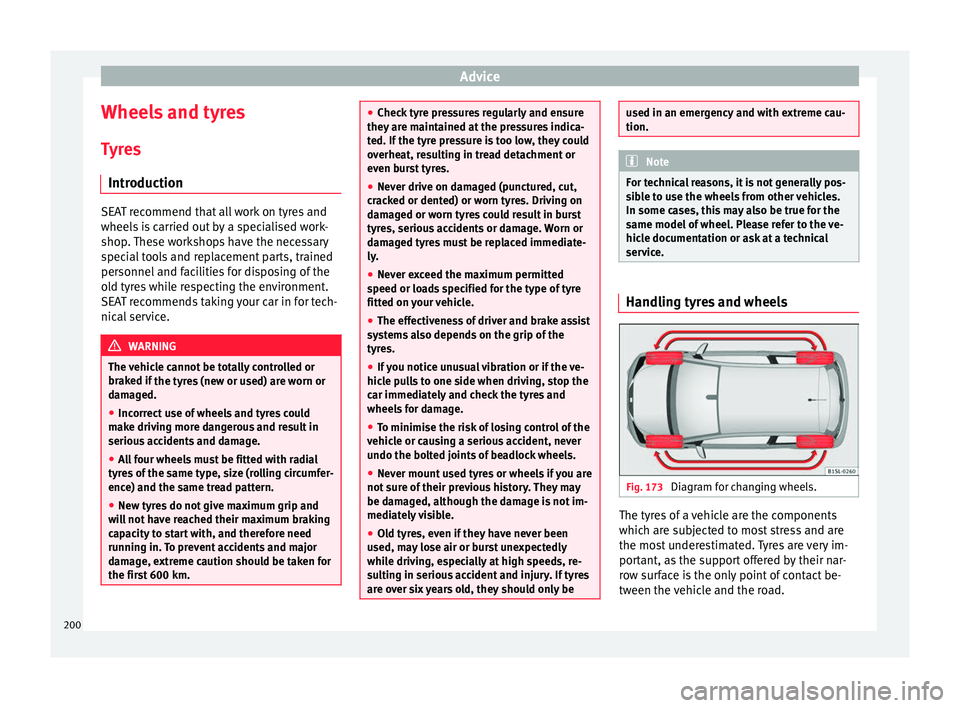
Fig. 173
Diagram for changing wheels. The tyres of a vehicle are the components
whic
h ar
e s
ubjected to most stress and are
the most underestimated. Tyres are very im-
portant, as the support offered by their nar-
row surface is the only point of contact be-
tween the vehicle and the road.
200
Page 205 of 232
Wheels and tyres
Replacement of wheel rims and new
ty r
e
s New tyres
● When tyres are new, drive with extreme
caution f or the fir
st 600 km, as all tyres need
to be run-in. Tyres which have not been run
in do not have such good grip or ››› brak-
ing c ap
acity ››› .
● All four wheels must be fitted with radial
tyr e
s of the same type, size (rolling circumfer-
ence) and the same tread pattern.
● The tread depth of new tyres may vary, ac-
cor din
g to the type and make of tyre and the
tread pattern.
Replacing tyres
● Where possible, always replace both
wheels on an ax
le (both wheels on the front
axle or both wheels on the rear axle) ››› .
● Only replace used tyres with those author-
i sed b
y
SEAT for the corresponding type vehi-
cle. Pay special attention to size, diameter,
and maximum load and speed capacity.
● Never use tyres which are larger than SEAT
appro
ved tyres. If the tyres are too big, they
may knock or rub against the chassis or other
components, resulting in damage. WARNING
New tyres do not give maximum grip and will
not h av
e reached their maximum braking ca-
pacity to start with, and therefore need run-
ning in.
● To prevent accidents and major damage,
extreme c
aution should be taken for the first
600 km. WARNING
There should be adequate space between the
tyr e
s and the vehicle in accordance with the
vehicle design. If this is not the case, the
tyres may rub against parts of the running
gear, chassis or brake lines, leading to faults
in the brake system or to tread detachment,
and the risk of burst tyres.
● The true tyre dimension should not be
great
er than the dimensions of tyres manu-
factured and approved by SEAT and should
not rub against parts of the vehicle. Note
Although tyres may be shown as being the
same s iz
e, the true dimensions of different
types of tyre may vary with respect to the
nominal size, or tread patterns may be differ-
ent. Note
If you use tyres that are approved by SEAT,
you c an be s
ure that the true tyre dimensions will be correct for your vehicle. For other tyre
models, the ty
r
e vendor should provide the
manufacturer's certificate with the tyre, indi-
cating that this type of tyre is suitable for
your vehicle. This certificate should always
be carried with the vehicle. Tyre pressures
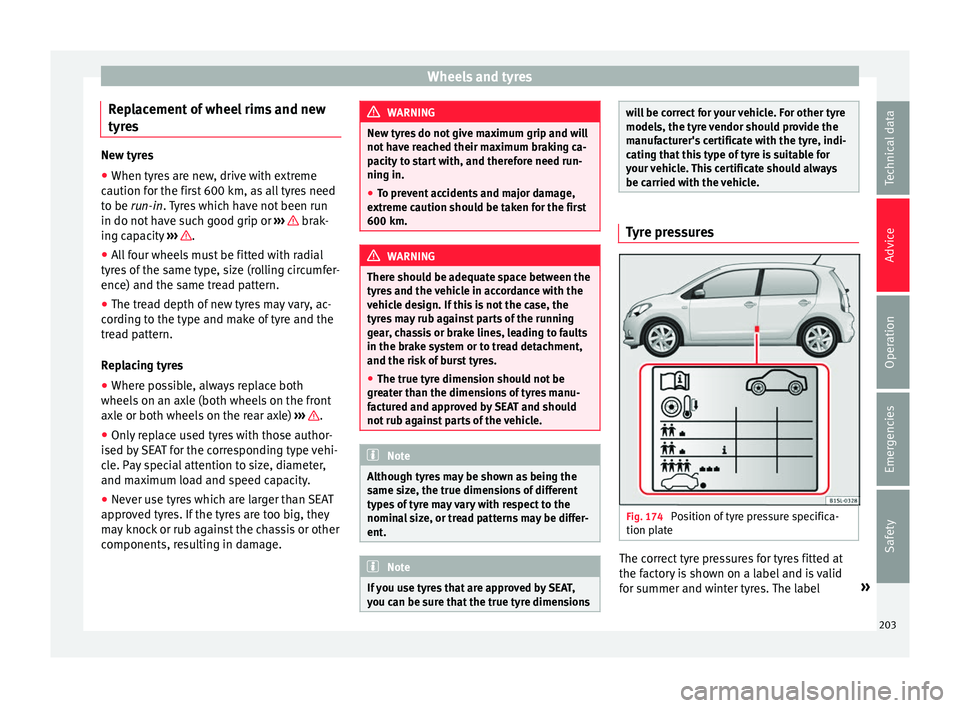
Fig. 174
Position of tyre pressure specifica-
tion p l
at
e The correct tyre pressures for tyres fitted at
the f
act
or
y is shown on a label and is valid
for summer and winter tyres. The label »
203
Technical data
Advice
Operation
Emergencies
Safety
Page 206 of 232
Advice
››› Fig. 174 i s
loc ated on the driver's door pil-
lar.
Under-inflation or over-inflation will reduce
the life of the tyres considerably and also im-
pair the car's handling ››› . It is essential to
m aint
ain the c
orrect tyre pressures, especial-
ly if driving at high speeds. Incorrect tyre
pressure causes premature wear and could
cause tyre blow-out.
The pressure should therefore be checked at
least once a month and before starting a
journey.
As a general rule, the pressures given are for
cold tyres. When the tyres are hot, the pres-
sures are greater.
Never deflate a hot tyre in order to obtain the
required pressure. This could result in very
low tyre pressures which may lead to sudden
blow-outs.
Tyre pressure monitoring system
Check tyre pressures only when the vehicle
has not been driven for more than a few kilo-
metres at low speeds in the past three hours.
● The tyre pressures should be checked regu-
larly, and on
ly when the tyres are cold. Al-
ways check all tyres, including the spare
wheel. Tyre pressures should be checked
more often in colder regions, and only when
the vehicle has not been driven recently. Al-
ways use a correctly-operating tyre gauge. ●
Adjust
tyre pressures to the loads carried in
the vehicle.
● After adjusting the tyre pressure, check that
the caps
are properly screwed on.
The spare wheel or temporary spare wheel
must always be kept at the maximum pres-
sure stipulated. WARNING
If tyre pressures are too high or too low, the
tyr e m
ay deflate or burst suddenly while driv-
ing. This could result in a serious accident.
● If the tyre pressure is too low, they could
overhe
at, resulting in tread detachment or
even burst tyres.
● When driving at high speeds and/or fully
loaded, the ty
re could suddenly overheat,
burst or be subject to tread detachment, with
the resultant loss of control of the vehicle.
● Tyre pressures which are too high or too
low reduc
e the service life of the tyre, affect-
ing the vehicle's performance.
● Tyre pressures should be checked regularly,
at le
ast once a month and before long jour-
neys.
● Adjust the pressures of all the tyres to the
vehicl
e load.
● Never deflate excess pressure from hot
tyre
s. CAUTION
● Tak e c
are not to tilt the manometer when
placing it on the valve. Otherwise, the valve
may be damaged.
● If tyre valves are not protected by caps, or if
the caps
are not screwed on correctly, they
may become damaged. Check that the caps
are identical to the standard caps and have
been correctly tightened. For the sake of the environment
Under-inflated tyres will increase fuel con-
sumption. Wear indicator depth profile
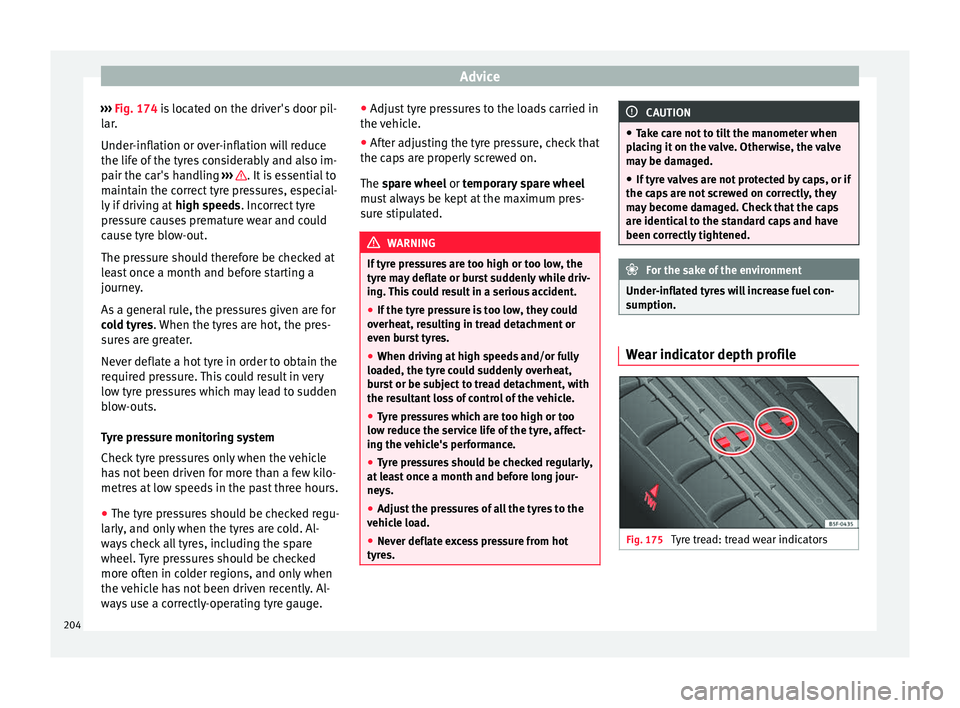
Fig. 175
Tyre tread: tread wear indicators204
Page 207 of 232
Wheels and tyres
Tread depth
C er
t
ain driving conditions require a deeper
tread, as well as needing the tread to be ap-
proximately the same on the front and rear
tyres. This is particularly important when
driving in winter, in cold temperatures and on
wet roads ››› .
The minimum tr e
a
d depth required by law in
the majority of cases is 1.6 mm, measured in
the tread grooves next to the tread wear indi-
cators. Observe legal requirements in each
country.
The performance of winter tyres is much re-
duced when the tread has worn to 4 mm.
The tread depth of new tyres may vary, ac-
cording to the type and make of tyre and the
tread pattern.
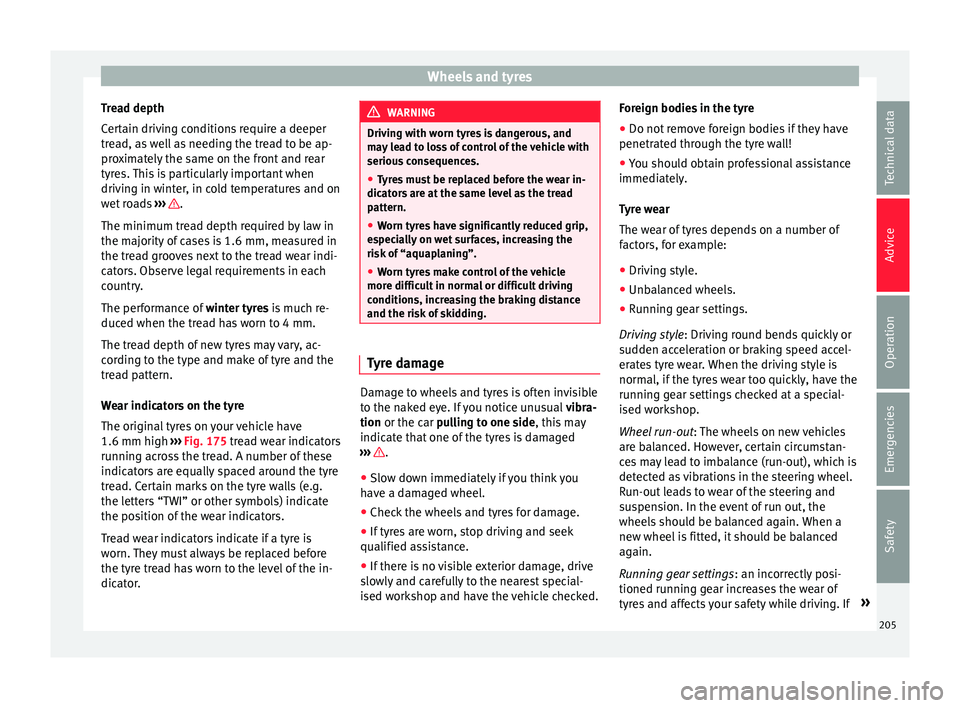
Wear indicators on the tyre
The original tyres on your vehicle have
1.6 mm high ››› Fig. 175 tread wear indicators
running across the tread. A number of these
indicators are equally spaced around the tyre
tread. Certain marks on the tyre walls (e.g.
the letters “TWI” or other symbols) indicate
the position of the wear indicators.
Tread wear indicators indicate if a tyre is
worn. They must always be replaced before
the tyre tread has worn to the level of the in-
dicator. WARNING
Driving with worn tyres is dangerous, and
ma y
lead to loss of control of the vehicle with
serious consequences.
● Tyres must be replaced before the wear in-
dicator
s are at the same level as the tread
pattern.
● Worn tyres have significantly reduced grip,
espec
ially on wet surfaces, increasing the
risk of “aquaplaning”.
● Worn tyres make control of the vehicle
more difficu
lt in normal or difficult driving
conditions, increasing the braking distance
and the risk of skidding. Tyre damage
Damage to wheels and tyres is often invisible
t
o the n
ak
ed eye. If you notice unusual vibra-
tion or the car pulling to one side, this may
indicate that one of the tyres is damaged
››› .
● Slow down immediately if you think you
h av
e a d
amaged wheel.
● Check the wheels and tyres for damage.
● If tyres are worn, stop driving and seek
qualified ass
istance.
● If there is no visible exterior damage, drive
slowly
and carefully to the nearest special-
ised workshop and have the vehicle checked. Foreign bodies in the tyre
●
Do not remove foreign bodies if they have
penetrated thr
ough the tyre wall!
● You should obtain professional assistance
immediately
.
Tyre wear
The wear of tyres depends on a number of
factors, for example:
● Driving style.
● Unbalanced wheels.
● Running gear settings.
Driving
style: Driving round bends quickly or
sudden acceleration or braking speed accel-
erates tyre wear. When the driving style is
normal, if the tyres wear too quickly, have the
running gear settings checked at a special-
ised workshop.
Wheel run-out: The wheels on new vehicles
are balanced. However, certain circumstan-
ces may lead to imbalance (run-out), which is
detected as vibrations in the steering wheel.
Run-out leads to wear of the steering and
suspension. In the event of run out, the
wheels should be balanced again. When a
new wheel is fitted, it should be balanced
again.
Running gear settings : an incorrectly posi-
tioned running gear increases the wear of
tyres and affects your safety while driving. If »
205
Technical data
Advice
Operation
Emergencies
Safety
Page 208 of 232
Advice
tyres wear too quickly, have the wheel align-
ment c
hec
ked at a specialised workshop. WARNING
If you notice unusual vibration or the car pulls
to one s ide whi
le driving, this may indicate
that one of the tyres is damaged.
● Reduce speed immediately and stop, while
obser
ving the highway code.
● Check the wheels and tyres for damage.
● Never carry on driving on worn tyres or
wheels. Reque
st qualified assistance immedi-
ately.
● If there is no visible exterior damage, drive
slowly
and carefully to the nearest special-
ised workshop and have the vehicle checked. Tyre monitor system*
Fig. 176
Centre console: tyre monitor system
b utt
on The tyre control lamp compares wheel revolu-
tion
s
and w
ith it, the wheel diameter of each
wheel using the ESC. If the diameter of a
wheel changes, the tyre control lamp
lights up. The wheel diameter changes when:
● Tyre pressure is insufficient.
● The tyre structure is damaged.
● The vehicle is unbalanced because of a
load.
● The wheel
s of one axle are under more
pres
sure (for example, driving with a trailer or
on steep slopes).
● The vehicle is fitted with snow chains.
● The temporary spare wheel is fitted.
● The wheel on one axle is changed.
Tyr
e pressure adjustment
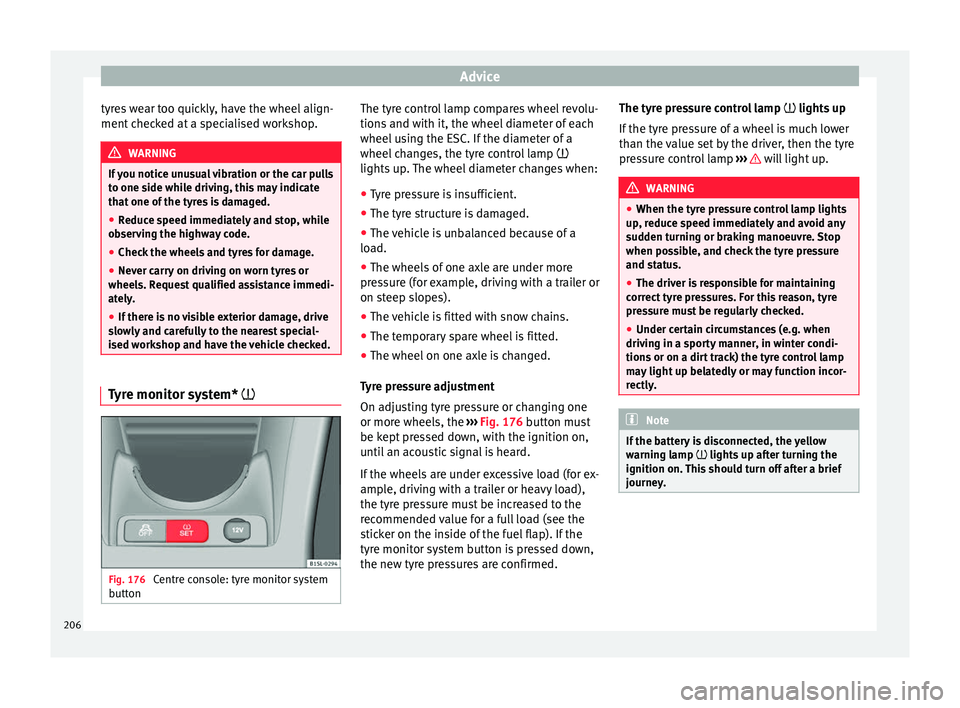
On adjusting tyre pressure or changing one
or more wheels, the ››› Fig. 176 button must
be kept pressed down, with the ignition on,
until an acoustic signal is heard.
If the wheels are under excessive load (for ex-
ample, driving with a trailer or heavy load),
the tyre pressure must be increased to the
recommended value for a full load (see the
sticker on the inside of the fuel flap). If the
tyre monitor system button is pressed down,
the new tyre pressures are confirmed. The tyre pressure control lamp
lights up
If
the tyre pressure of a wheel is much lower
than the value set by the driver, then the tyre
pressure control lamp ››› will light up.
WARNING
● When the tyr e pr
essure control lamp lights
up, reduce speed immediately and avoid any
sudden turning or braking manoeuvre. Stop
when possible, and check the tyre pressure
and status.
● The driver is responsible for maintaining
correct
tyre pressures. For this reason, tyre
pressure must be regularly checked.
● Under certain circumstances (e.g. when
driving in a s
porty manner, in winter condi-
tions or on a dirt track) the tyre control lamp
may light up belatedly or may function incor-
rectly. Note
If the battery is disconnected, the yellow
warnin g l
amp lights up after turning the
ignition on. This should turn off after a brief
journey. 206