brake pads Seat Mii 2017 Owner's manual
[x] Cancel search | Manufacturer: SEAT, Model Year: 2017, Model line: Mii, Model: Seat Mii 2017Pages: 232, PDF Size: 4.91 MB
Page 137 of 232
Driving
Engaging the steering wheel lock
In v
ehic
les with automatic gearbox, the igni-
tion key can only be removed when the selec-
tor lever is in position N.
– Remove the key from the ignition in posi-
tion 1
› ››
Fig. 145
›
›› .
– Turn the steering wheel until you hear it en-
gag
e.
P
ossible vehicle theft is prevented with the
steering lock engaged. WARNING
Never switch off the engine while the vehicle
is mo
ving. You may lose control of the vehicle
and there is a risk of serious accident.
● The airbags and belt tensioners do not
work when the ignition i
s switched off.
● The brake servo does not work with the en-
gine off. T
o stop, the brake pedal must be
pressed with more force.
● As the power steering does not work if the
engine is
not running, you will need more
strength to steer than normally.
● If the key is removed from the ignition, the
steerin
g may lock and it will not be possible
to steer the vehicle. CAUTION
If the engine has been driven at high speed
for a pr o
longed period of time, it may over-
heat when turned off. To avoid engine dam- age, allow the engine to run for approximate-
ly 2 minut
e
s in neutral before switching it off. Note
After stopping the engine, the engine com-
p ar tment
fan may continue running for a few
minutes, even when the ignition has been
switched off or the key removed. The radiator
fan is automatically switched off. Electronic immobiliser
The gear lock prevents the engine from being
s
t
ar
ted with an unauthorised key and the ve-
hicle being moved.
The vehicle key has a built-in chip. It auto-
matically deactivates the electronic immobil-
iser when the key is inserted into the ignition
lock.
The electronic immobilizer will be activated
again automatically as soon as you remove
the key from the ignition lock.
For this reason, the vehicle can only be used
with a genuine SEAT key with the correct
code. Coded keys can be obtained from SEAT
dealerships ››› page 92.
If an unauthorised key is used, the signal
appears on the instrument panel display. The
vehicle cannot be started in this case Note
The correct operation of the vehicle is only
guarant eed when origin
al SEAT keys are
used. Braking and parking
Introduction The assisted brake systems are the electron-
ic di
stribution of braking force (EBV), the an-
ti-lock brake system (ABS), the brake assist
system (BAS), the electronic differential lock
(EDL), traction control (TC)*, the traction con-
trol system (ASR) and the electronic stability
control (ESC*). WARNING
Driving with worn brake pads or a faulty
brak e sy
stem may lead to serious accident.
● If you believe the brake pads to be worn or
the brake sy
stem to be faulty, immediately
refer to a specialised workshop to check the
brake pads and replace the worn ones. WARNING
Careless parking can cause serious injury.
● Never remove the key from the ignition if
the v ehic
le is in motion. The steering lock » 135
Technical data
Advice
Operation
Emergencies
Safety
Page 141 of 232
Driving
●
Ev en though br
ake assist systems are ex-
tremely effective and help control the vehicle
in difficult situations, remember that the ve-
hicle stability depends on tyre grip.
● When accelerating on a slippery surface,
for ex
ample on ice or snow, press the acceler-
ator carefully. The wheels can still slip even
with brake assist systems resulting in loss of
vehicle control. WARNING
The effectiveness of the ESC* can be consid-
er ab ly
reduced if other components and sys-
tems affecting driving dynamics are not main-
tained or are not functioning correctly. This
includes, among others, brakes, tyres and
other systems already mentioned.
● Remember that changing and fitting other
components
to the vehicle can affect opera-
tion of the ABS, BAS, ASR TC, EDL and ESC*.
● Changes to the vehicle suspension or using
unap
proved wheel/tyre combinations can af-
fect operation of the ABS, BAS, ASR, TC, EDL
and ESC* and their effectiveness.
● Likewise, the effectiveness of ESC* de-
pends on the u
se of suitable tyres
››› page 200. Note
● To en s
ure that the ESC*, ASR and TC work
properly, all four wheels must be fitted with
identical tyres. Any differences in the rolling
radius of the tyres can cause the system to reduce engine power when this is not de-
sir
ed.
● If
a malfunction should occur in the ABS,
the ESC*, ASR, T
C and EDL will also be affec-
ted.
● Noises may be heard while any of the
above sy
stems are operating. Handbrake
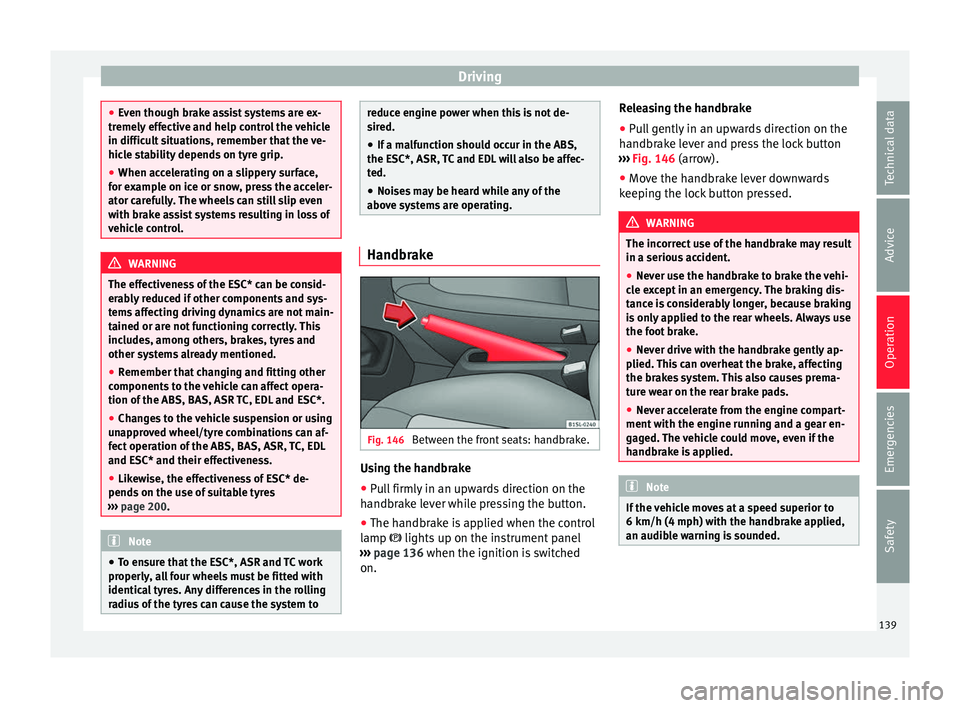
Fig. 146
Between the front seats: handbrake. Using the handbrake
●
Pull firmly in an upwards direction on the
h andbr
ak
e lever while pressing the button.
● The handbrake is applied when the control
lamp lights up on the in
strument panel
››› page 136 when the ignition is switched
on. Releasing the handbrake
● Pull gently in an upwards direction on the
handbrak
e lever and press the lock button
››› Fig. 146 (arrow).
● Move the handbrake lever downwards
keeping the loc
k button pressed. WARNING
The incorrect use of the handbrake may result
in a serious ac
cident.
● Never use the handbrake to brake the vehi-
cle e
xcept in an emergency. The braking dis-
tance is considerably longer, because braking
is only applied to the rear wheels. Always use
the foot brake.
● Never drive with the handbrake gently ap-
plied. Thi
s can overheat the brake, affecting
the brakes system. This also causes prema-
ture wear on the rear brake pads.
● Never accelerate from the engine compart-
ment with the en
gine running and a gear en-
gaged. The vehicle could move, even if the
handbrake is applied. Note
If the vehicle moves at a speed superior to
6 km/h (4 mph) with the h andbr
ake applied,
an audible warning is sounded. 139
Technical data
Advice
Operation
Emergencies
Safety
Page 142 of 232
Operation
Parking When parking your vehicle, all legal require-
ments shou
l
d be observed.
To park the vehicle
Complete operations only in the sequence
given. ● Park the vehicle on a suitable surface ›››
.
● Press and hold the brake pedal until the ve-
hicl e c
omes to a standstill.
● Apply the handbrake firmly ›››
page 139.
● For an automatic gearbox, move the selec-
tor lev
er to position N.
● Switch off the engine and release the brake
pedal.
● R
emove the key from the ignition.
● If necessary, turn the steering wheel slight-
ly to loc
k the steering.
● With a manual gearbox, engage 1st gear on
flat gr
ound and slopes, or even reverse gear
on hills, and release the clutch pedal.
● Ensure that all passengers leave the vehi-
cle, e
specially children.
● When leaving the vehicle, take all keys with
you.
● Loc
k the vehicle. Additional information for steep slopes and
hill
s
Before switching off the engine, rotate the
steering wheel so that if the vehicle should
move, it will be held by the kerb.
● On slopes, turn the front wheels so that
they are ag
ainst the edge of the kerb.
● Uphill, turn the wheels towards the centre
of the ro
ad. WARNING
The components of the exhaust system reach
ver y
high temperatures. This could cause a
fire and considerable damage.
● Always park your vehicle so that no part of
the exhau
st system can come in contact with
flammable materials (such as wood,
leaves,dried grass, or spilled fuel). CAUTION
● Spec i
al care should be taken when parking
in areas with high kerbs or fixed barriers. Ob-
jects protruding from the ground may dam-
age the bumper or other parts of the vehicle
during manoeuvres. To avoid damage, stop
before the wheels touch the barrier or kerb.
● Special attention is required when driving
through entranc
es, over ramps, kerbs or oth-
er objects. The vehicle underbody, bumpers,
mudguards and running gear, and the engine
and exhaust system could be damaged as
you drive over these objects. Information on the brakes
For the first 200 to 300 km, the new brak
e
p
ads have not yet reached their maximum
braking capacity, and need to be “run in”
first ››› . The slightly reduced braking effect
can be c ompen
sated for by increasing pres-
sure on the brake pedal. While running in,
the full braking distance or emergency brak-
ing distance is larger then when the brake
pads have been run in. While running in,
avoid full power braking or situations requir-
ing braking performance. For example, in
heavy traffic.
The rate of wear of the brake pads depends
to a great extent on the conditions in which
the vehicle is used and the way the vehicle is
driven. If the vehicle is used frequently in city
traffic or for short trips or driven sport style,
visit a specialised workshop regularly, more
frequently than advised in the Maintenance
Programme, to have the brake pads checked.
If you drive with wet brakes, for example, af-
ter crossing areas of water, in heavy rainfall
or even after washing the car, the effect of
the brakes is lessened as the brake discs are
wet or even frozen (in winter). At higher
speed, “dry” the brakes as quickly as possi-
ble by braking gently several times. Only do
this without endangering vehicles behind
you or any other road users ››› .
A l ay
er of salt on the discs and brake pads
will reduce the effectiveness of the brakes
140
Page 143 of 232
Driving
and increase braking distance. If you drive for
a pr o
lon
ged period on salted roads without
braking then brake carefully several times to
eliminate the layer of salt on the brakes ››› .
If the
v
ehicle remains parked for considera-
ble lengths of time, is used little, or if the
brakes are not used, there may be corrosion
on the brake discs and a build up of dirt on
the brake pads. If the brakes are not used fre-
quently, or if rust has formed on the discs,
SEAT recommends cleaning the pads and
discs by braking firmly a few times at a mod-
erately high speed. Only do this without en-
dangering vehicles behind you or any other
road users ››› .
F au
lt
s in the brake system
During braking, if you notice that the vehicle
does not react as usual (that the braking dis-
tance has increased suddenly) it may be pos-
sible that there is a fault in the braking sys-
tem. This is indicated by the warning lamp
. Take the vehicle to a specialised work-
shop immediately and have the fault re-
paired. Drive at a moderate speed and be
prepared to use more pressure on the brake
pedal, and allow for longer stopping distan-
ces.
Brake servo
The brake servo only operates when the en-
gine is running and the pressure applied by
the driver on the brake pedal increases. If the brake servo does not operate or the ve-
hicle mu
st be towed, then the brake pedal
will have to be pressed with more force given
that the braking distance will be increased
when the brake servo does not operate ››› .
WARNING
New brake pads do not brake to full efficien-
cy.
● For the fir
st 320 km, new brake pads have
not y
et reached their maximum braking ca-
pacity, and need to be “run in” first. For this,
to compensate for reduced braking efficiency
the brake pedal will have to be pressed with
more force.
● To avoid losing control of the vehicle and
caus
ing serious accidents, always take great
care when driving with new brake pads.
● When running in new brake pads, always
res
pect the safety distances between you and
other vehicles and do not cause situations re-
quiring extreme braking performance. WARNING
When brakes overheat, braking is less effi-
cient and br
aking distances increase.
● When driving on slopes, brakes can be
overlo
aded and overheat quickly.
● Reduce speed or change down a gear when
faced w
ith steep and long slopes. This allows
you to use the engine braking effect and to
reduce the strain on the brake system. ●
Non-s t
andard or damaged front spoilers
could restrict the airflow to the brakes and
cause them to overheat. WARNING
Wet, frozen or salt-covered brakes take lon-
g er t o en
gage and this increases braking dis-
tances.
● Test the brakes carefully.
● Dry the brakes, free them of ice and salt by
brakin
g gently several times, when visibility,
weather, and road and traffic conditions per-
mit. WARNING
Driving without the brake servo may signifi-
cantly inc
rease the braking distance and re-
sult in a severe accident.
● Never allow the vehicle to move forwards
when the engine is
switched off.
● If the brake servo does not operate or the
vehicl
e must be towed, then the brake pedal
will have to be pressed with more force given
that the braking distance will be increased
when the brake servo does not operate. CAUTION
● Never m ak
e the brakes “slip” by pressing
the pedal gently, if it is not really necessary
to brake. Continuously pressing on the brake
pedal will heat the brakes. This could signifi-
cantly reduce braking power, increase » 141
Technical data
Advice
Operation
Emergencies
Safety
Page 144 of 232
Operation
braking distance or even result in the total
fai
lur
e of the brake system.
● Reduce speed or change down a gear when
faced w
ith steep and long slopes. This allows
you to use the engine braking effect and to
reduce the strain on the brake system. Other-
wise, the brakes may overheat and fail. Only
use the brakes to reduce speed or to stop. Note
Make use, when having the front brake pads
c hec k
ed, and have the rear pads checked al-
so. The thickness of the brake pads should be
checked visually and regularly, by looking
through the openings in the wheel rims or
from underneath the vehicle. If necessary, re-
move the wheels to check them thoroughly.
SEAT recommends taking your car in for tech-
nical service. Changing gear
Intr oduction When reverse gear is engaged and the igni-
tion i
s
sw
itched on the following takes place:
● Reverse lights light up.
● The rear wiper blade performs one move-
ment when the wind
screen wiper is activa-
ted. ●
If nece
ssary, connect the parking distance
warning system. WARNING
Rapid acceleration can cause loss of traction
and skid din
g, especially on slippery ground.
This could cause loss of control of the vehicle
resulting in an accident and considerable
damage.
● Use rapid acceleration only when visibility,
weather
, road conditions and traffic permit. WARNING
Do not allow the brakes to “rub” for a pro-
long ed period of
time, or brake frequently or
for long periods of time. Continuous braking
heats up the brakes. This could significantly
reduce braking power, increase braking dis-
tance or even result in the total failure of the
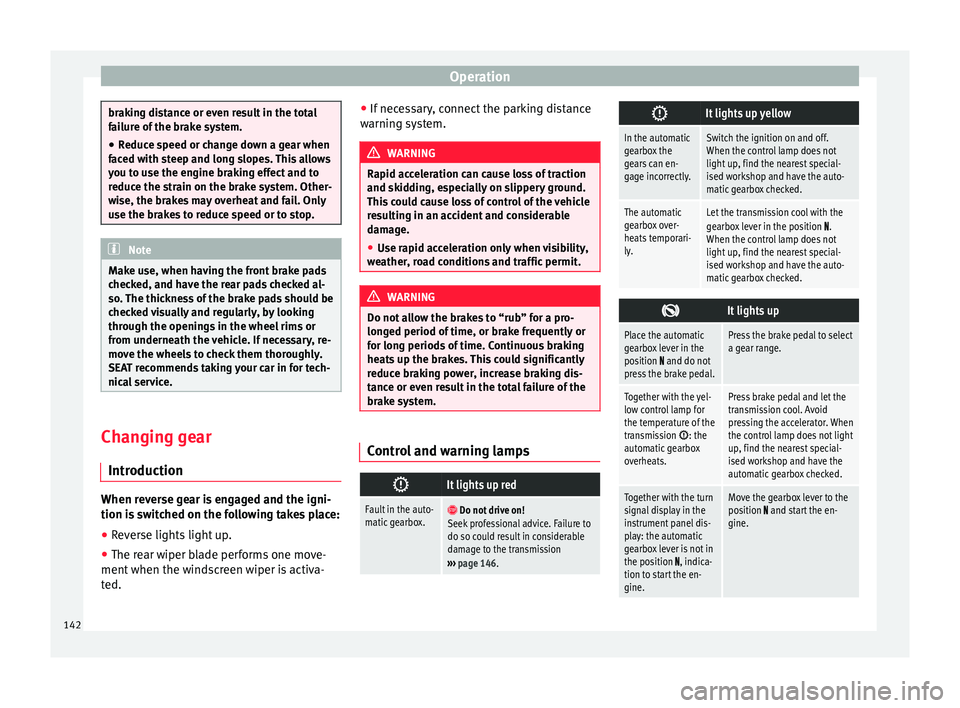
brake system. Control and warning lamps
It lights up red
Fault in the auto-
matic gearbox.
Do not drive on!
Seek professional advice. Failure to
do so could result in considerable
damage to the transmission
››› page 146.
It lights up yellow
In the automatic
gearbox the
gears can en-
gage incorrectly.Switch the ignition on and off.
When the control lamp does not
light up, find the nearest special-
ised workshop and have the auto-
matic gearbox checked.
The automatic
gearbox over-
heats temporari-
ly.Let the transmission cool with the
gearbox lever in the position .
When the control lamp does not
light up, find the nearest special-
ised workshop and have the auto-
matic gearbox checked.
It lights up
Place the automatic
gearbox lever in the
position
and do not
press the brake pedal.
Press the brake pedal to select
a gear range.
Together with the yel-
low control lamp for
the temperature of the
transmission
: the
automatic gearbox
overheats.
Press brake pedal and let the
transmission cool. Avoid
pressing the accelerator. When
the control lamp does not light
up, find the nearest special-
ised workshop and have the
automatic gearbox checked.
Together with the turn
signal display in the
instrument panel dis-
play: the automatic
gearbox lever is not in
the position
, indica-
tion to start the en-
gine.
Move the gearbox lever to the
position and start the en-
gine. 142
Page 150 of 232
Operation
Information on the steering To prevent theft, we recommend you lock the
st
eerin
g before leaving the vehicle.
Steering column mechanical lock
Lock the steering column by removing the
key from the ignition when the vehicle is
stopped.
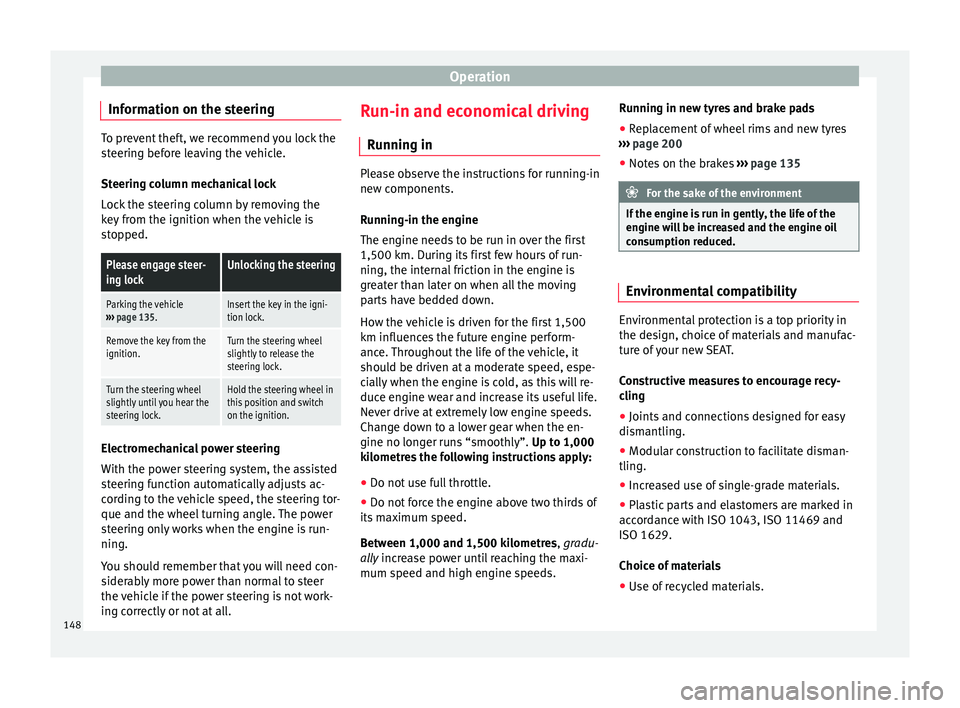
Please engage steer-
ing lockUnlocking the steering
Parking the vehicle
››› page 135.Insert the key in the igni-
tion lock.
Remove the key from the
ignition.Turn the steering wheel
slightly to release the
steering lock.
Turn the steering wheel
slightly until you hear the
steering lock.Hold the steering wheel in
this position and switch
on the ignition. Electromechanical power steering
W
ith the po
w
er steering system, the assisted
steering function automatically adjusts ac-
cording to the vehicle speed, the steering tor-
que and the wheel turning angle. The power
steering only works when the engine is run-
ning.
You should remember that you will need con-
siderably more power than normal to steer
the vehicle if the power steering is not work-
ing correctly or not at all. Run-in and economical driving
Runnin
g in Please observe the instructions for running-in
new components.
R u
nning-in the engine
The engine needs to be run in over the first
1,500 km. During its first few hours of run-
ning, the internal friction in the engine is
greater than later on when all the moving
parts have bedded down.
How the vehicle is driven for the first 1,500
km influences the future engine perform-
ance. Throughout the life of the vehicle, it
should be driven at a moderate speed, espe-
cially when the engine is cold, as this will re-
duce engine wear and increase its useful life.
Never drive at extremely low engine speeds.
Change down to a lower gear when the en-
gine no longer runs “smoothly”. Up to 1,000
kilometres the following instructions apply:
● Do not use full throttle.
● Do not force the engine above two thirds of
its m ax
imum speed.
Between 1,000 and 1,500 kilometres, gradu-
ally increase power until reaching the maxi-
mum speed and high engine speeds. Running in new tyres and brake pads
●
Replacement of wheel rims and new tyres
›››
page 200
● Notes on the brakes ›››
page 135 For the sake of the environment
If the engine is run in gently, the life of the
engine w i
ll be increased and the engine oil
consumption reduced. Environmental compatibility
Environmental protection is a top priority in
the de
s
ign, c
hoice of materials and manufac-
ture of your new SEAT.
Constructive measures to encourage recy-
cling
● Joints and connections designed for easy
dismantlin
g.
● Modular construction to facilitate disman-
tling.
● Incr
eased use of single-grade materials.
● Plastic parts and elastomers are marked in
accor
dance with ISO 1043, ISO 11469 and
ISO 1629.
Choice of materials
● Use of recycled materials.
148
Page 176 of 232
Advice
Polishing
P o
li
shing is only necessary if the paint has
lost its shine, and the gloss cannot be
brought back by applying wax.
If the polish does not contain wax, a wax
product should be applied after polishing. CAUTION
● To pr ev
ent damage, car polish or hard wax
should not be used on components painted in
matt paint, plastic components and the glass
headlamp and tail light covers.
● Do not polish your vehicle in a sandy or
dusty
environment. Care and cleaning of chrome and alu-
minium wheel
rims●
Use a clean, damp, lint-free, smooth cloth
t o c
l
ean anodized surfaces.
● If there is a lot of dirt, use a special clean-
ing product
which does not contain solvents.
● Then, polish the chrome and aluminium
wheel trims w
ith a smooth dry cloth. CAUTION
In order to prevent damage to the aluminium
and chr ome wheel
trims:
● Do not clean or polish them in direct sun-
light. ●
Do not c l
ean or polish them in sandy or
dusty environments.
● Do not use abrasive cleaning agents such
as home c
ream cleaners.
● Do not use insect sponges, scouring pads,
or simil
ar products to clean insect deposits.
● Do not polish dirty surfaces.
● Do not use products containing solvents.
● Do not use hard wax. CAUTION
Chrome hub caps or wheel covers may have
been p ainted a
dditionally. Do not treat them
with aluminium or chrome wax products, nor
chrome or aluminium polish. Instead, use
commercial paint wax or polish. Cleaning wheels
Cleaning steel wheels
U
se an indu
s
trial cleaner to remove brake
dust. Therefore, clean wheels regularly with a
separate sponge.
Any damage to the paint on steel wheels
should be touched up before the metal starts
to rust.
Caring for and cleaning alloy wheels
Remove road salt and brake dust by washing
the wheels approximately once a fortnight.Use an acid free detergent to clean the wheel
rims. SEA
T recommends treating the wheel
rims thoroughly with a hard wax about once
every three months.
It is important to remove road salt and brake
dust by washing the wheels at regular inter-
vals, otherwise the finish will be impaired.
Always use an acid-free detergent for alloy
wheel rims. Car polish or other abrasive
agents should not be used for maintaining
the rims.
If the protective coating on the paint has
been damaged (for example, hit by a stone),
it should be repaired immediately.
Caring for rubber seals The rubber seals on doors, windows, etc., re-
m
ain fl
e
xible, provide a better seal and last
longer if they are regularly treated with a
product specifically designed for use on rub-
ber.
Before applying the product, use a soft cloth
to remove dust and dirt from the rubber
seals.
174
Page 197 of 232
Checking and refilling levels
the German standard DIN ISO 4925 CLASS 4
› ›
›
.
Br ak
e fluid
s conforming to the standard
VW 501 14, fulfil the American requirements
of the FMVSS 116 DOT 4 standard and the
German DIN ISO 4925 CLASS 4 standard.
However, fluids that comply with the Ameri-
can FMVSS 116 DOT 4 standard or the Ger-
man DIN ISO 4925 CLASS 4 standard do not
necessarily comply with the VW 501 14
standard. Always check the information on
the brake fluid container and ensure that you
are using suitable brake fluid.
A suitable brake fluid can be obtained from
SEAT dealerships.
Brake fluid level
The level of the brake fluid should always be
between the MIN and MAX marks, or above
the MIN mark ››› .
It i
s
not always possible to check the level of
the brake fluid, as in some models the en-
gine components make it difficult to see the
brake fluid reservoir. If you cannot read the
exact brake fluid level, consult a specialist.
The brake fluid level drops slightly when the
vehicle is being used due to wear of the
brake pads and the automatic readjustment
of the brake. Changing the brake fluid
The brake fluid shou
ld be changed in accord-
ance with the instructions given in the Main-
tenance Programme. Have the brake fluid
changed by a specialised workshop. SEAT
recommends taking your car in for technical
service. This means that only brake fluid
complying with the required specifications
will be used. WARNING
If the brake fluid level is low or unsuita-
bl e/o
ld brake fluid is used, the brake system
may fail or braking power may be reduced.
● Check the brake system and the brake fluid
level
regularly!
● The brake fluid should be changed regular-
ly in acc
ordance with the instructions given
in the Maintenance Programme.
● Always ensure that you use suitable brake
fluid. Only u
sed brake fluid that conforms to
the VW 501 14 standard, FMVSS 116 DOT 4
standard or even the DIN ISO 4925 CLASS 4
standard. Other types of brake fluid could af-
fect brake operation and reduce braking pow-
er. Do not use a brake fluid if the container
does not specify compliance with the
VW 501 14, FMVSS 116 DOT 4 or
DIN ISO 4925 CLASS 4 standards.
● The replacement brake fluid must be new.
● Brake fluid should be stored in the closed
original
container in a safe place out of reach
of children. Risk of poisoning! ●
If the br ak
e fluid is left in the system for
too long and the brakes are subjected to
heavy use, vapour bubbles may form in the
brake system. This would seriously affect the
efficiency of the brakes and the safety of the
vehicle. This may cause an accident. CAUTION
Brake fluid damages the vehicle paintwork.
W ipe off an
y brake fluid from the paintwork
immediately. For the sake of the environment
Brake fluid is an environmental pollutant.
Co l
lect any spilt service fluids and allow a
professional to dispose of them. Windscreen washer reservoir
Chec k
in
g and topping up the wind-
screen washer reservoir with water Read the additional information carefully
› ›
›
page 33
Check the water level in the windscreen
washer reservoir regularly and top up as re-
quired.
● Open the bonnet ›››
page 187.
● The washer reservoir is marked with the
symbol
on the lid. »
195
Technical data
Advice
Operation
Emergencies
Safety
Page 222 of 232
Index
Brake fluid . . . . . . . . . . . . . . . . . . . . . . . . . . . . . . . 33 spec
ific
ation . . . . . . . . . . . . . . . . . . . . . . . . . . . 194
Brakes . . . . . . . . . . . . . . . . . . . . . . . . . . . . . . . . . . 135 brake assist system . . . . . . . . . . . . . . . . . . . . . 137
brake fluid . . . . . . . . . . . . . . . . . . . . . . . . . . . . . 194
brake fluid level . . . . . . . . . . . . . . . . . . . . . . . . 195
brake pads . . . . . . . . . . . . . . . . . . . . . . . . . . . . 140
brake servo . . . . . . . . . . . . . . . . . . . . . . . . . . . . 141
changing the brake fluid . . . . . . . . . . . . . . . . . 195
control and warning lamps . . . . . . . . . . . . . . . 136
running in new brake pads . . . . . . . . . . . . . . . 140
Brake servo . . . . . . . . . . . . . . . . . . . . . . . . . 137, 141
Brake system . . . . . . . . . . . . . . . . . . . . . . . . . . . . 137 fault . . . . . . . . . . . . . . . . . . . . . . . . . . . . . . . . . . 141
Braking brake assist system . . . . . . . . . . . . . . . . . . . . . 137
Bulb fault see "Changing bulbs" . . . . . . . . . . . . . . . . . . . . 79
C Capacities . . . . . . . . . . . . . . . . . . . . . . . . . . . . . . . . 31 windscreen washer liquid reservoir . . . . . . . . 196
Capacity natural gas tank . . . . . . . . . . . . . . . . . . . . . . . . 186
Caring for paintwork . . . . . . . . . . . . . . . . . . . . . . . 173
Caring for the vehicle exterior . . . . . . . . . . . . . . . . . . . . . . . . . . . . . . . 171
Catalytic converter . . . . . . . . . . . . . . . . . . . . . . . . 152 control and warning lamps . . . . . . . . . . . . . . . 151
malfunction . . . . . . . . . . . . . . . . . . . . . . . . . . . . 151
CCS see cruise control . . . . . . . . . . . . . . . . . . . . . . . . 24
Central locking . . . . . . . . . . . . . . . . . . . . . . . . . . . . 94 emergency locking . . . . . . . . . . . . . . . . . . . . . . . . 9
opening doors individually . . . . . . . . . . . . . . . . 95 Central locking system
after airb ag deployment . . . . . . . . . . . . . . . . . . 95
description . . . . . . . . . . . . . . . . . . . . . . . . . . . . . 95
remote control key . . . . . . . . . . . . . . . . . . . . . . . 95
Changes . . . . . . . . . . . . . . . . . . . . . . . . . . . . . . . . 165
Changing a wheel . . . . . . . . . . . . . . . . . . . . . . 36, 72 subsequent tasks . . . . . . . . . . . . . . . . . . . . . . . . 41
wheel bolts . . . . . . . . . . . . . . . . . . . . . . . . . . . . . 38
Changing bulbs . . . . . . . . . . . . . . . . . . . . . . . . . . . 79 front bumper . . . . . . . . . . . . . . . . . . . . . . . . . . . . 81
headlights . . . . . . . . . . . . . . . . . . . . . . . . . . . . . . 80
number plate light . . . . . . . . . . . . . . . . . . . . . . . 83
rear lights . . . . . . . . . . . . . . . . . . . . . . . . . . . . . . 82
side turn signal . . . . . . . . . . . . . . . . . . . . . . . . . . 84
Changing gear . . . . . . . . . . . . . . . . . . . . . . . . . . . 142 automatic gear change . . . . . . . . . . . . . . . . . . 144
control and warning lamps . . . . . . . . . . . . . . . 142
engaging the gears (automatic gearbox) . . . . 144
tiptronic . . . . . . . . . . . . . . . . . . . . . . . . . . . . . . . 145
Changing the blades . . . . . . . . . . . . . . . . . . . . . . . 75
Changing the wiper blades . . . . . . . . . . . . . . . . . . 45
Charging the battery . . . . . . . . . . . . . . . . . . . . . . . 43
Child safety seat Securing with the seat belt . . . . . . . . . . . . . . . . 18
Child seat . . . . . . . . . . . . . . . . . . . . . . . . . . . . . 16, 65 disabling the front passenger front airbag . . . . 15
ISOFIX system . . . . . . . . . . . . . . . . . . . . . . . . 18, 69
mounting child seats . . . . . . . . . . . . . . . . . . . . . 17
mounting systems . . . . . . . . . . . . . . . . . . . . . . . 17
on the front passenger seat . . . . . . . . . . . . . . . . 68
on the rear seats . . . . . . . . . . . . . . . . . . . . . . . . . 69
regulations . . . . . . . . . . . . . . . . . . . . . . . . . . . . . 67
safety instructions . . . . . . . . . . . . . . . . . . . . 16, 64
Top Tether system . . . . . . . . . . . . . . . . . . . . . . . . 20
transporting children in the vehicle . . . . . . . . . 67
weight categories . . . . . . . . . . . . . . . . . . . . . . . . 67
Cigarette lighter . . . . . . . . . . . . . . . . . . . . . . . . . . 120 City Safety Assist function . . . . . . . . . . . . . . . . . . 156
contro l and warning lamps . . . . . . . . . . . . . . . 157
function . . . . . . . . . . . . . . . . . . . . . . . . . . . . . . . 158
sensor . . . . . . . . . . . . . . . . . . . . . . . . . . . . . . . . 158
special driving situations . . . . . . . . . . . . . . . . . 159
Cleaning . . . . . . . . . . . . . . . . . . . . . . . . . . . . . . . . 170 compartments . . . . . . . . . . . . . . . . . . . . . . . . . 177
dash panel . . . . . . . . . . . . . . . . . . . . . . . . . . . . 178
engine compartment . . . . . . . . . . . . . . . . . . . . 175
fabrics . . . . . . . . . . . . . . . . . . . . . . . . . . . . . . . . 176
padding . . . . . . . . . . . . . . . . . . . . . . . . . . . . . . . 177
seat belts . . . . . . . . . . . . . . . . . . . . . . . . . . . . . 178
textile covers . . . . . . . . . . . . . . . . . . . . . . . . . . . 177
washing the vehicle . . . . . . . . . . . . . . . . . . . . . 171
washing the vehicle with high pressure clean-ers . . . . . . . . . . . . . . . . . . . . . . . . . . . . . . . . . 172
wheels . . . . . . . . . . . . . . . . . . . . . . . . . . . . . . . . 174
windows . . . . . . . . . . . . . . . . . . . . . . . . . . . . . . 172
Cleaning the vehicle high pressure cleaners . . . . . . . . . . . . . . . . . . . 172
Climatronic adjusting the temperature . . . . . . . . . . . . . . . . . 28
air distribution . . . . . . . . . . . . . . . . . . . . . . . . . . 28
air recirculation . . . . . . . . . . . . . . . . . . . . . . . . . . 29
AUTO (automatic mode) . . . . . . . . . . . . . . . . . . . 28
controls . . . . . . . . . . . . . . . . . . . . . . . . . . . . . . . . 28
cooling mode . . . . . . . . . . . . . . . . . . . . . . . . . . . 28
fan . . . . . . . . . . . . . . . . . . . . . . . . . . . . . . . . . . . . 28
removing ice from windows . . . . . . . . . . . . . . . . 28
switch off . . . . . . . . . . . . . . . . . . . . . . . . . . . . . . . 28
Close . . . . . . . . . . . . . . . . . . . . . . . . . . . . . . . . . . . . 92 bonnet . . . . . . . . . . . . . . . . . . . . . . . . . . . . . . . . . 10
Closing . . . . . . . . . . . . . . . . . . . . . . . . . . . . . . . . . . 92 bonnet . . . . . . . . . . . . . . . . . . . . . . . . . . . . . . . . . 10
electric windows . . . . . . . . . . . . . . . . . . . . . . . . . 11
luggage compartment . . . . . . . . . . . . . . . . . . . 100
panoramic sunroof . . . . . . . . . . . . . . . . . . . . . . . 11
windows . . . . . . . . . . . . . . . . . . . . . . . . . . . . . . 101
220
Page 228 of 232
Index
Replacement par
ts
. . . . . . . . . . . . . . . . . . . . . . . . . . . . . . . . . 164
Replacement parts . . . . . . . . . . . . . . . . . . . . . . . . 164
Replacing bulbs see "Changing bulbs" . . . . . . . . . . . . . . . . . . . . 79
Reprogramming control units . . . . . . . . . . . . . . . 167
Retaining hooks . . . . . . . . . . . . . . . . . . . . . . . . . . 127
Revolution counter . . . . . . . . . . . . . . . . . . . . . . . . . 88
Rims changing a wheel . . . . . . . . . . . . . . . . . . . . . . . . 36
RON (petrol) . . . . . . . . . . . . . . . . . . . . . . . . . . . . . 181
Roof carrier . . . . . . . . . . . . . . . . . . . . . . . . . . . . . . 127
Roof carrier system . . . . . . . . . . . . . . . . . . . . . . . . 127 fastening the supports . . . . . . . . . . . . . . . . . . . 128
Roof rack . . . . . . . . . . . . . . . . . . . . . . . . . . . . . . . . 127
Rubber seals . . . . . . . . . . . . . . . . . . . . . . . . . . . . . 174
Running in brake pads . . . . . . . . . . . . . . . . . . . . . . . . . . . . 140
new engine . . . . . . . . . . . . . . . . . . . . . . . . . . . . 148
wheels and tyres . . . . . . . . . . . . . . . . . . . . . . . . 203
S SAFE . . . . . . . . . . . . . . . . . . . . . . . . . . . . . . . 97, 135
Safe driving . . . . . . . . . . . . . . . . . . . . . . . . . . . . . . 47
Safety child safety . . . . . . . . . . . . . . . . . . . . . . . . . . . . . 64
child seats . . . . . . . . . . . . . . . . . . . . . . . . . . . . . . 64
disabling the front passenger front airbag . . . . 15
safe driving . . . . . . . . . . . . . . . . . . . . . . . . . . . . . 47
Safety Assist . . . . . . . . . . . . . . . . . . . . . . . . . . . . . 156
Safety equipment . . . . . . . . . . . . . . . . . . . . . . . . . . 48
Safety instructions using child seats . . . . . . . . . . . . . . . . . . . . . 16, 64
using seat belts . . . . . . . . . . . . . . . . . . . . . . . . . 54
Sale of vehicle in other countries / continents . . . . . . . . . . . . 179 Scrapping . . . . . . . . . . . . . . . . . . . . . . . . . . . . . . . 180
airbag sys tem . . . . . . . . . . . . . . . . . . . . . . . . . . 180
vend-of-life vehicles . . . . . . . . . . . . . . . . . . . . . 180
Seat belt adjustment . . . . . . . . . . . . . . . . . . . . . . . . . . . . . 56
Seat belts . . . . . . . . . . . . . . . . . . . . . . . . . . . . . . . . 52 adjustment . . . . . . . . . . . . . . . . . . . . . . . . . . . . . 13
automatic belt retractor . . . . . . . . . . . . . . . . . . . 57
belt tensioner . . . . . . . . . . . . . . . . . . . . . . . . . . . 57
belt tension limiter . . . . . . . . . . . . . . . . . . . . . . . 57
cleaning . . . . . . . . . . . . . . . . . . . . . . . . . . . . . . 178
protective function . . . . . . . . . . . . . . . . . . . . . . . 54
purpose . . . . . . . . . . . . . . . . . . . . . . . . . . . . . . . . 52
safety instructions . . . . . . . . . . . . . . . . . . . . . . . 54
twisted belt . . . . . . . . . . . . . . . . . . . . . . . . . . . . . 54
unfastened . . . . . . . . . . . . . . . . . . . . . . . . . . . . . 55
warning lamp . . . . . . . . . . . . . . . . . . . . . . . . . . . 53
Seat belt tensioner . . . . . . . . . . . . . . . . . . . . . . 13, 57
Seat heating . . . . . . . . . . . . . . . . . . . . . . . . . . . . . 113
SEAT information system . . . . . . . . . . . . . . . . . . . . 23
Seats . . . . . . . . . . . . . . . . . . . . . . . . . . . . . . . . . . . . 49 heating . . . . . . . . . . . . . . . . . . . . . . . . . . . . . . . 113
incorrect position . . . . . . . . . . . . . . . . . . . . . . . . 49
number of seats . . . . . . . . . . . . . . . . . . . . . . . . . 49
rear backrest . . . . . . . . . . . . . . . . . . . . . . . . . . . 124
Service fluids . . . . . . . . . . . . . . . . . . . . . . . . . . . . 164
Service interval display . . . . . . . . . . . . . . . . . . . . . 90
Side airbags description . . . . . . . . . . . . . . . . . . . . . . . . . . . . . 16
Smartphone holder removing and inserting . . . . . . . . . . . . . . . . . . 122
Smell of gas . . . . . . . . . . . . . . . . . . . . . . . . . . . . . 182
Snow chains . . . . . . . . . . . . . . . . . . . . . . . . . 41, 213 temporary spare wheel . . . . . . . . . . . . . . . . . . . 41
Spare fuel canister . . . . . . . . . . . . . . . . . . . . . . . . 183
Spare parts . . . . . . . . . . . . . . . . . . . . . . . . . . . . . . 164 Spare wheel
remov ing . . . . . . . . . . . . . . . . . . . . . . . . . . . . . . 207
Spare wheel or temporary spare wheel advice for driving . . . . . . . . . . . . . . . . . . . . . . . 207
Speed limiter . . . . . . . . . . . . . . . . . . . . . . . . . . . . 155
Speed rating . . . . . . . . . . . . . . . . . . . . . . . . . . . . . 209
Start-Stop system . . . . . . . . . . . . . . . . . . . . 160, 161 operation . . . . . . . . . . . . . . . . . . . . . . . . . . . . . . 160
Starting the vehicle . . . . . . . . . . . . . . . . . . . . . . . . 20
Steering . . . . . . . . . . . . . . . . . . . . . . . . . . . . . . . . 147 control and warning lamps . . . . . . . . . . . . . . . 147
electromechanical . . . . . . . . . . . . . . . . . . . . . . 148
power steering . . . . . . . . . . . . . . . . . . . . . . . . . 148
steering column lock . . . . . . . . . . . . . . . . . . . . 148
tendency to pull to one side . . . . . . . . . . . . . . 205
Steering wheel adjustment . . . . . . . . . . . . . . . . . . . . . . . . . . 14, 49
Storage compartments . . . . . . . . . . . . . . . . . . . . 115 centre console . . . . . . . . . . . . . . . . . . . . . . . . . 118
driver side . . . . . . . . . . . . . . . . . . . . . . . . . . . . . 116
other storage compartments . . . . . . . . . . . . . . 118
Sunglasses storage compartment . . . . . . . . . . . 117
Sun protection . . . . . . . . . . . . . . . . . . . . . . . . . . . 108
Sun visors . . . . . . . . . . . . . . . . . . . . . . . . . . . . . . . 108
Switch hazard warning lights . . . . . . . . . . . . . . . . . . . 106
Switching lights off . . . . . . . . . . . . . . . . . . . . . . . 103
Switching lights on . . . . . . . . . . . . . . . . . . . . . . . 103
Switching the ignition on and off . . . . . . . . . . . . . 20
Symbols see control and warning lamps . . . . . . . . . . . . . 25
T
TC see Brake assist system . . . . . . . . . . . . . . . . . . 138
226