gearbox Seat Toledo 2005 User Guide
[x] Cancel search | Manufacturer: SEAT, Model Year: 2005, Model line: Toledo, Model: Seat Toledo 2005Pages: 290, PDF Size: 8.65 MB
Page 176 of 290
Driving
174•
if the clutch pedal is depressed,
•
if the vehicle is accelerated to over 180 km/h,
•
when the lever is pressed in the direction of OFF without engaging it.
To resume the cruise control, release the brake or clutch pedal or reduce the
vehicle speed to less than 180 km/h and press once on the upper part of the
rocker switch RES ⇒ page 173, fig. 142 .
WARNING
It is dangerous to use a set speed which is too high for the current road,
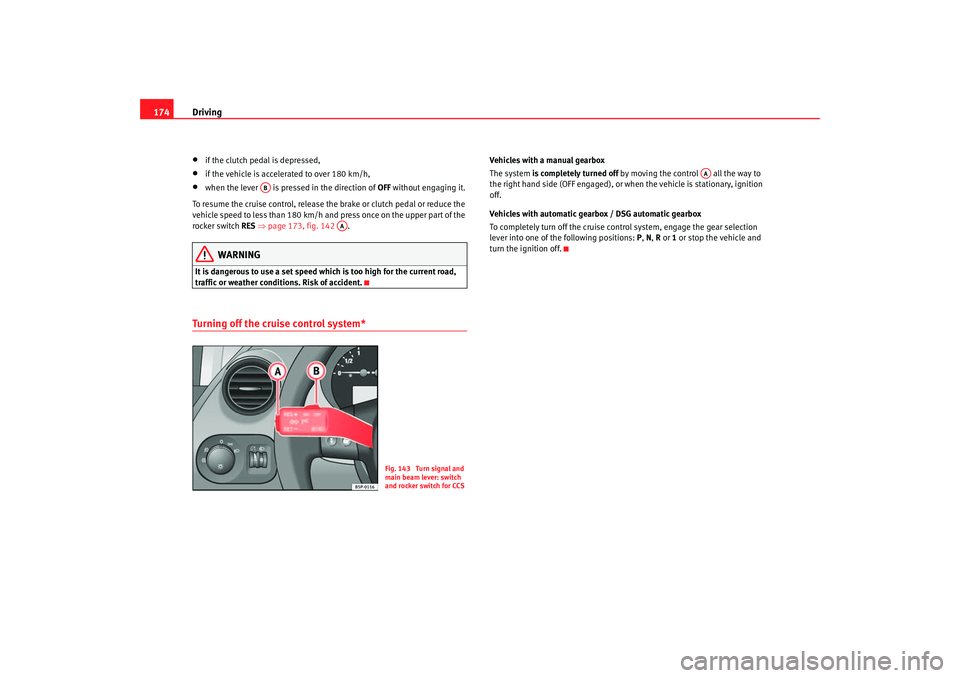
traffic or weather conditions. Risk of accident.Turning off the cruise control system*
Vehicles with a manual gearbox
The system is completely turned off by moving the control all the way to
the right hand side (OFF engaged), or when the vehicle is stationary, ignition
off.
Vehicles with automatic gearbox / DSG automatic gearbox
To completely turn off the cruise control system, engage the gear selection
lever into one of the following positions: P , N , R or 1 or stop the vehicle and
turn the ignition off.
AB
AA
Fig. 143 Turn signal and
main beam lever: switch
and rocker switch for CCS
AA
Toledo angles Seite 174 Mittwoch, 5. Oktober 2005 9:43 09
Page 206 of 290

Checking and refilling levels
204
WARNING
All work on the engine or in the engine compartment, e.g. checking and
refilling fluids, involves the danger of injury and scalding as well as the risk
of accident or fire.•
Never open the bonnet if you see steam, smoke or coolant escaping
from the engine compartment. Otherwise, there is a risk of sustaining
burns. Wait until no more steam or coolant is emitted, then allow the
engine to cool before carefully opening the bonnet.
•
Switch off the engine and remove the key from the ignition.
•
Apply the handbrake and move the gea r stick to neutral or selector
lever to position P.
•
Keep children away from the vehicle.
•
Never touch hot engine parts. This is a risk of burns.
•
Never spill liquids on a hot engine or on a hot exhaust gas system. This
is a fire hazard.
•
Avoid causing short-circuits in the electrical system, particularly at the
points where the jump leads are attached ⇒page 253. The battery could
explode.
•
Never touch the radiator fan. It is temperature controlled and could
start automatically, even when the engine has been switched off and the
key removed from the ignition!
•
Do not unscrew the cap on the expansion tank when the engine is hot.
If the coolant is hot, the cooling system will be pressurised!
•
Protect face, hands and arms by covering the cap with a large, thick
cloth to protect against escaping coolant and steam.
•
Always make sure you have not left any objects, such as cleaning cloths
and tools, in the engine compartment.
•
If you have to work underneath the vehicle, you must use suitable
stands additionally to support the vehicle, risk of accident!. A hydraulic
jack is insufficient for securing the vehicle and there is a risk of injury.
•
If any work has to be performed when the engine is started or with the
engine running, there is an additional, potentially fatal, safety risk from the
rotating parts, such as the drive belt s, alternator, radiator fan, etc., and
from the high-voltage ignition system. You should also observe the
following points:
−Never touch the electrical wiring of the ignition system.
− Ensure that jewellery, loose clothing and long hair do not get
trapped in rotating engine parts. Danger of death. Before starting any
work remove jewellery, tie back and cover hair, and wear tight-fitting
clothes.
− Always think carefully about pressing the accelerator if a gear is
engaged in either an automatic or manual gearbox. The vehicle could
move, even if the handbrake is applied. Danger of death.
•
If work has to be carried out on the fuel system or on electrical compo-
nents, you must observe the following safety notes in addition to the above
warnings:
−Always disconnect the battery. The vehicle must be unlocked when
this is done, otherwise the alarm will be triggered.
− Do not smoke.
− Never work near naked flames.
− Always have a fire extinguisher on hand.Caution
When changing or topping up service fluids, make absolutely certain that you
fill the fluids into the correct reservoirs. Failure to observe this point will result
in serious malfunctions and engine damage!
WARNING (continued)
Toledo angles Seite 204 Mittwoch, 5. Oktober 2005 9:43 09
Page 230 of 290

If and when
228
Note•
Seek professional assistance if the repair of a tyre puncture is not
possible with the sealing compound.
Wheel changePreparation work
What you must do before changing a wheel.– If you have a flat tyre or puncture, park the vehicle as far away from the flow of traffic as possible. Choose a location that is as
level as possible.
– All passengers should leave the ve hicle. They should wait in a
safe area (for instance behind the roadside crash barrier).
– Switch off the engine. Switch on the hazard warning lights.
–Apply the handbrake firmly.
– Engage the first gear, or put the selector lever to position P for
those vehicles with an automatic gearbox.
– If you are towing a trailer, unhitch it from your vehicle.
– Take the vehicle tools and the spare wheel out of the luggage
compartment.
WARNING
Put the hazard warning lights on and place the warning triangle in position.
This is for your own safety and also warns other road users.
Caution
If you have to change the tyre on a gradient, block the wheel opposite the
wheel being changed by placing a stone or similar object under it to prevent
the vehicle from rolling away.
Note
Please observe legal requirements when doing so.Changing a wheelChange the wheel as described below
– Rem ove the wheel cover. Also refer to ⇒ page 229.
– Slacken the wheel bolts
– Raise the car with the jack in the corresponding zone
– Ta k e o f f the wheel and then put on the spare wheel
– Lower the vehicle.
– Tighten the wheel bolts firmly in diagonal sequence with the box
spanner
–Replace the cover .
Toledo angles Seite 228 Mittwoch, 5. Oktober 2005 9:43 09
Page 239 of 290

If and when237
Safety First
Operating instructions
Tips and Maintenance
Te c h n i c a l D a t a
Fuses on left side of dash panelFuses
Number Electrical equipment Amperes
1 Electro-chromatic mirror / relay 50 5
2 Engine control unit 5
3 Lights switch / Headlight control unit / Right hand side headlight / Telephone 5
4 Telephone pre-installation 5
5 Flow meter, frequency tube 10
6A ir b ag 5
7 Vacant
8 Vacant
9 Power steering 5
10 Diagnosis, reverse gear switch 5
11 Heated windscreen 5
12 FSI measure 10
13 Trailer control unit 5
14 ESP/TCP, ABS/ESP control unit 5
15 Automatic gearbox 5
16 Heating controls / Climatronic / Pressure sensor / Heated seats 10
17 Engine 7,5
18 Vacant
19 Vacant
20 Engine fuse box supply 5
21 Gear lever 5
Toledo angles Seite 237 Mittwoch, 5. Oktober 2005 9:43 09
Page 240 of 290
If and when
238
22 Vacant
23 Brake lights 5
24 Diagnosis / lights switch 10
25 Vacuum pump 20
26 Engine supply coupling 10
27 Automatic gearbox 20
28 Light switch 5
29 Rear window wiper motor 15
30 Heating operation 5
31 Cable control unit 15
32 Jets 5
33 Heater 40
34 Vacant
35 Vacant
36 Vacant
37 Vacant
38 Vacant
39 Trailer control unit (coupling) 15
40 Trailer control unit (indicators, brakes and left side) 20
41 Trailer control unit (fog light, reversing light and right side) 20
42 Console electrical socket
15
Electrical socket, rear 30
43 Fuel control unit 15
44 Alarm horn and interior monitor sensor 5
Number
Electrical equipment Amperes
Toledo angles Seite 238 Mittwoch, 5. Oktober 2005 9:43 09
Page 242 of 290

If and when
240Fuses layout, engine compartment, left partFuses
Number Electrical equipment Amperes
1C le a n 30
2 Steering column 5
3 Cable control unit 5
4A BS 30
5 AQ gearbox 15
6 Kombi 5
7 Vacant
8R ad io 15
9 Telephone 5
10 Main relay in the FSI / diesel engine compartment / injection module supply
5
Main relay in the engine compartment D2L (2.0 FSI 147 kW) 10
11 Vacant
12 Gateway 5
13 Petrol injection module supply
25
Diesel injection module supply 30
14 Coil 20
15 Engine T71 / 20 FSI
5
Pump relay 10
16 ADS pump 30
17 Horn 15
18 Vacant
Toledo angles Seite 240 Mittwoch, 5. Oktober 2005 9:43 09
Page 258 of 290

If and when
256
Notes for the driver of the towing vehicle
– Drive slowly at first until the to w-rope is taut. Then accelerate
gradually.
– Begin and change gears cautiously. If you are driving an auto- matic vehicle, accelerate gently.
– Remember that the brake servo and power steering are not working in the vehicle you are towing. Brake earlier than you
would normally, but with a more gentle pressure on the brake.
Notes for the driver of the towed vehicle
– Ensure that the tow-rope remains taut at all times when towing.
Fitting the towing eye
– Take the towing ring and the wheel spanner out of the vehicle tool kit.
– Pull the lower front cover down and leave the cover hanging on the vehicle.
– Remove the cover of the screw hole, insert a screwdriver into the lower slot and lever gently.
– Screw the towing eye as shown by arrow anti-clockwise to the
limit position in the front ⇒page 255, fig. 195 or rear
⇒ page 255, fig. 196 threaded hole.
– Use the wrench for leverage to tighten the towing eye.Tow-rope or tow-bar
It is easier and safer to tow a vehicle with a tow-bar. You should only use a
tow-rope if you do not have a tow-bar. A tow-rope should be slightly elastic to reduce the loading on both vehicles.
It is advisable to use a tow-rope made of synthetic fibre or similarly elastic
material.
Attach the tow-rope or the tow-bar only to the towing eyes provided or a
towing bracket.
Driving style
Towing requires some experience, espec
ially when using a tow-rope. Both
drivers should be familiar with the te chnique required for towing. Inexperi-
enced drivers should not attempt to tow-start or tow away another vehicle.
Do not pull too hard with the towing vehicle and take care to avoid jerking the
tow-rope. When towing on an unpaved road, there is always a risk of over-
loading and damaging the anchorage points.
The ignition of the vehicle being towed must be switched on to prevent the
steering wheel from locking and also to allow the use of the turn signals,
horn, windscreen wipers and washers.
As the brake servo does not work if the engine is not running, you must apply
considerably more pressure to the brake pedal than you normally would.
As the power assisted steering does not work if the engine is not running, you
will need more strength to steer than you normally would.
Towing vehicles with an automatic gearbox
•
Put the selector lever into position “N”.
•
Do not drive faster than 50 km/h when towing a vehicle.
•
Do not tow further than 50 km.
•
If a breakdown vehicle is used, the vehicle must be towed with the front
wheels raised.Note
•
Observe legal requirements when towing or tow-starting.
Toledo angles Seite 256 Mittwoch, 5. Oktober 2005 9:43 09
Page 259 of 290
If and when257
Safety First
Operating instructions
Tips and Maintenance
Te c h n i c a l D a t a
•
Switch on the hazard warning lights of both vehicles. However, observe
any regulations to the contrary.
•
For technical reasons, vehicles with an automatic gearbox must not be
tow-started.
•
If damage to your vehicle means that there is no lubricant in the gearbox,
you must raise the drive wheels while the vehicle is being towed.
•
If the vehicle has to be towed more than 50 km, the front wheels must be
raised during towing, and towing should be carried out by a qualified person.
•
The steering wheel is locked when the vehicle has no electrical power. The
vehicle must then be towed with the front wheels raised. Towing should be
carried out by a qualified person.
Toledo angles Seite 257 Mittwoch, 5. Oktober 2005 9:43 09
Page 262 of 290
General notes on the technical data
260Vehicle identification dataVehicle identification number
The vehicle identification number (chass is number) can be read from outside
the vehicle through a viewer in the windscreen. This is located on the left-
hand side of the vehicle in the lower area of the windscreen. It is also located
on the right hand side of the engine compartment.
Type plate
The type plate is located on the left rib inside the engine compartment.
Vehicle data
The data sticker is placed on the inside of the spare wheel recess in the
luggage compartment.
The following information can be found in the vehicle information:•
Vehicle identification number (chassis number)
•
Vehicle type / engine power / gearbox type
•
Engine and gearbox code / paint number / interior equipment
•
Optional extras / PR numbers
This vehicle data are also contained in the Inspection and Maintenance
schedule ⇒Booklet “Inspection and Maintenance schedule”.
Toledo angles Seite 260 Mittwoch, 5. Oktober 2005 9:43 09
Page 281 of 290

Index279
Index
AABS . . . . . . . . . . . . . . . . . . . . . . . . . . . . . . . . . . . 176
Warning lamp . . . . . . . . . . . . . . . . . . . . . . . . . 77
Accessories . . . . . . . . . . . . . . . . . . . . . . . . . . . . 196
Acoustic signal . . . . . . . . . . . . . . . . . . . . . . . . . . 20
Acoustic warning . . . . . . . . . . . . . . . . . . . . . . . . 159
Adjusting headlights driving on the left . . . . . . . . . . . . . . . . . . . . 182
driving on the right . . . . . . . . . . . . . . . . . . . 182
Adjusting the seat belt height . . . . . . . . . . . . . . 27
Air conditioner* 2C-Climatronic* . . . . . . . . . . . . . . . . . . . . . . 152
Air conditioning system General notes . . . . . . . . . . . . . . . . . . . . . . . . 156
Air conditioning* . . . . . . . . . . . . . . . . . . . . . . . . 149
Air recirculation mode 2C-Climatronic . . . . . . . . . . . . . . . . . . . . . . . 155
Manual air conditioner . . . . . . . . . . . . . . . . 151
Airbag covers . . . . . . . . . . . . . . . . . . . . . . . . . . . . 36
Airbag system . . . . . . . . . . . . . . . . . . . . . . . . . . . 30 Curtain airbags . . . . . . . . . . . . . . . . . . . . . . . 42
Front airbags . . . . . . . . . . . . . . . . . . . . . . . . . 34
Side airbags . . . . . . . . . . . . . . . . . . . . . . . . . . 38
Warning lamp . . . . . . . . . . . . . . . . . . . . . . . . . 31 Airbags
Care . . . . . . . . . . . . . . . . . . . . . . . . . . . . . . . . 32
Disposal . . . . . . . . . . . . . . . . . . . . . . . . . . . . . 32
Safety notes . . . . . . . . . . . . . . . . . . . . . . . . . . 32
Alarm system Switching off . . . . . . . . . . . . . . . . . . . . . . . . 101
Alterations to the vehicle . . . . . . . . . . . . . . . . . 196
Alternator Warning lamp . . . . . . . . . . . . . . . . . . . . . . . . . 78
Ambient temperature display . . . . . . . . . . . . . . . 63
Anti-freeze . . . . . . . . . . . . . . . . . . . . . . . . . . . . . 211
Anti-lock brake system . . . . . . . . . . . . . . . . . . . 176 Warning lamp . . . . . . . . . . . . . . . . . . . . . . . . . 77
Anti-theft alarm system . . . . . . . . . . . . . . . . . . . 101 Switching off . . . . . . . . . . . . . . . . . . . . . . . . 101
Anti-theft wheel bolts . . . . . . . . . . . . . . . . . . . . 230
Aquaplaning . . . . . . . . . . . . . . . . . . . . . . . . . . . 222
Ashtray* . . . . . . . . . . . . . . . . . . . . . . . . . . . . . . . 141
Automatic anti-dazzle interior mirror* Activating the anti-dazzle function . . . . . . 124
Deactivating anti-dazzle function . . . . . . . . 124
Automatic car washes . . . . . . . . . . . . . . . . . . . . 188
Automatic gearbox / DS G automatic gearbox . 164
Automatic lighting . . . . . . . . . . . . . . . . . . . . . . . 112
Automatic mode 2C-Climatronic . . . . . . . . . . . . . . . . . . . . . . . 153
Automatic wiper/wash function for the rear window 123
BBall coupling . . . . . . . . . . . . . . . . . . . . . . . . . . . 184
BAS . . . . . . . . . . . . . . . . . . . . . . . . . . . . . . . . . . . 175
Battery
Changing . . . . . . . . . . . . . . . . . . . . . . . . . . . 219
Charging . . . . . . . . . . . . . . . . . . . . . . . . . . . . 219
Winter conditions . . . . . . . . . . . . . . . . . . . . 218
Belt tension device Disposal . . . . . . . . . . . . . . . . . . . . . . . . . . . . . 28
Warning lamp . . . . . . . . . . . . . . . . . . . . . . . . 31
Belt tension devices . . . . . . . . . . . . . . . . . . . . . . 28
Biodiesel . . . . . . . . . . . . . . . . . . . . . . . . . . . . . . 202
Bonnet . . . . . . . . . . . . . . . . . . . . . . . . . . . . . . . . 205
Brake assist system . . . . . . . . . . . . . . . . . . . . . 175
Brake fluid . . . . . . . . . . . . . . . . . . . . . . . . . . . . . 216 Changing . . . . . . . . . . . . . . . . . . . . . . . . . . . 217
monitor indicator . . . . . . . . . . . . . . . . . . . . . . 64
Brake pad wear indicator* Indicator . . . . . . . . . . . . . . . . . . . . . . . . . . . . . 81
Brake pads . . . . . . . . . . . . . . . . . . . . . . . . . . . . . 179
Brake servo . . . . . . . . . . . . . . . . . . . . . . . 175, 179
Brake system . . . . . . . . . . . . . . . . . . . . . . . . . . . 216 Warning lamp . . . . . . . . . . . . . . . . . . . . . . . . 76
Brakes . . . . . . . . . . . . . . . . . . . . . . . . . . . . . . . . 179
Braking distance . . . . . . . . . . . . . . . . . . . . . . . . 179
Bulb defect warning lamp . . . . . . . . . . . . . . . . . . . . . . . . . 75
Toledo angles Seite 279 Mittwoch, 5. Oktober 2005 9:43 09