ECU Seat Toledo 2005 Owner's Guide
[x] Cancel search | Manufacturer: SEAT, Model Year: 2005, Model line: Toledo, Model: Seat Toledo 2005Pages: 290, PDF Size: 8.65 MB
Page 206 of 290

Checking and refilling levels
204
WARNING
All work on the engine or in the engine compartment, e.g. checking and
refilling fluids, involves the danger of injury and scalding as well as the risk
of accident or fire.•
Never open the bonnet if you see steam, smoke or coolant escaping
from the engine compartment. Otherwise, there is a risk of sustaining
burns. Wait until no more steam or coolant is emitted, then allow the
engine to cool before carefully opening the bonnet.
•
Switch off the engine and remove the key from the ignition.
•
Apply the handbrake and move the gea r stick to neutral or selector
lever to position P.
•
Keep children away from the vehicle.
•
Never touch hot engine parts. This is a risk of burns.
•
Never spill liquids on a hot engine or on a hot exhaust gas system. This
is a fire hazard.
•
Avoid causing short-circuits in the electrical system, particularly at the
points where the jump leads are attached ⇒page 253. The battery could
explode.
•
Never touch the radiator fan. It is temperature controlled and could
start automatically, even when the engine has been switched off and the
key removed from the ignition!
•
Do not unscrew the cap on the expansion tank when the engine is hot.
If the coolant is hot, the cooling system will be pressurised!
•
Protect face, hands and arms by covering the cap with a large, thick
cloth to protect against escaping coolant and steam.
•
Always make sure you have not left any objects, such as cleaning cloths
and tools, in the engine compartment.
•
If you have to work underneath the vehicle, you must use suitable
stands additionally to support the vehicle, risk of accident!. A hydraulic
jack is insufficient for securing the vehicle and there is a risk of injury.
•
If any work has to be performed when the engine is started or with the
engine running, there is an additional, potentially fatal, safety risk from the
rotating parts, such as the drive belt s, alternator, radiator fan, etc., and
from the high-voltage ignition system. You should also observe the
following points:
−Never touch the electrical wiring of the ignition system.
− Ensure that jewellery, loose clothing and long hair do not get
trapped in rotating engine parts. Danger of death. Before starting any
work remove jewellery, tie back and cover hair, and wear tight-fitting
clothes.
− Always think carefully about pressing the accelerator if a gear is
engaged in either an automatic or manual gearbox. The vehicle could
move, even if the handbrake is applied. Danger of death.
•
If work has to be carried out on the fuel system or on electrical compo-
nents, you must observe the following safety notes in addition to the above
warnings:
−Always disconnect the battery. The vehicle must be unlocked when
this is done, otherwise the alarm will be triggered.
− Do not smoke.
− Never work near naked flames.
− Always have a fire extinguisher on hand.Caution
When changing or topping up service fluids, make absolutely certain that you
fill the fluids into the correct reservoirs. Failure to observe this point will result
in serious malfunctions and engine damage!
WARNING (continued)
Toledo angles Seite 204 Mittwoch, 5. Oktober 2005 9:43 09
Page 207 of 290

Checking and refilling levels205
Safety First
Operating instructions
Tips and Maintenance
Te c h n i c a l D a t a
For the sake of the environment
Service fluids leaks are harmful to the environment. For this reason you
should make regular checks on the ground underneath your vehicle. If you
find spots of oil or other fluids, have your vehicle inspected in a qualified
workshop.Opening the bonnet
The bonnet is released from inside the vehicle.
Before opening the bonnet ensure that the windscreen wipers are in
rest position.
– To release the bonnet, pull the lever under the dashboard ⇒fig. 151 in the direction indicated (arrow). The bonnet will be
released by a spring action ⇒.
– Lift the bonnet using the rele ase lever (arrow) and open the
bonnet.
– Release the bonnet stay and secure it in fixture designed for this in the bonnet.
WARNING
Hot coolant can scald!•
Never open the bonnet if you see steam, smoke or coolant escaping
from the engine compartment.
Fig. 151 Detail of the
footwell: The release lever
for the bonnet is located
in the driver side footwell
Fig. 152 Arrester hook
for bonnet.
Toledo angles Seite 205 Mittwoch, 5. Oktober 2005 9:43 09
Page 208 of 290

Checking and refilling levels
206•
Wait until no more steam, smoke or coolant is emitted from the bonnet,
then carefully open the bonnet.
•
When working in the engine compartment, always observe the safety
wa rnings ⇒ page 203.
Closing the bonnet– Raise the bonnet slightly
– Release the bonnet stay and replace it in its support.
– At a height of about 30 cm let it fall so it is locked.If the bonnet does not close, do not press downwards. Open it once more and
let it fall as before.
WARNING
If the bonnet is not closed properly, it could open while you are driving and
completely obscure your view of the road. Risk of accident.•
After closing the bonnet, always check that it is properly secured. The
bonnet must be flush with the surrounding body panels.
•
If you notice that the bonnet latch is not secured when the vehicle is
moving, stop the vehicle immediately and close the bonnet properly. Risk
of accident.
Engine oilEngine oil specifications
The engine used must conform to exact specifications.Specifications
The engine comes with a special, high quality, multi grade oil that can be
used in all seasons of the year except for those regions affected by extreme
cold.
As the use of high quality oil is essential for the correct operation of the
engine and its long useful life, when topping up or replacement is necessary
use only those oils that conform to the requirements of the VW standards.
If it is not possible to find oil conforming to the VW standards then oil
conforming to the ACEA or API standards with an appropriate viscosity at
atmospheric temperature should be used in stead. The use of this type of oil
may have some repercussions on the performance of the engine for example,
long starting time, increased consumption and a higher emission level.
If a top up is required then different oils may be mixed as long as they all
conform to the VW standards.
The specifications (VW standards) set out in the following page should
appear on the container of the service oil; the container will display together
the different standards for petrol and diesel engines, the oil can be used for
both types of engines.
WARNING (continued)
Toledo angles Seite 206 Mittwoch, 5. Oktober 2005 9:43 09
Page 226 of 290

Checking and refilling levels
224heads must be used. This ensures that wheels are fitted securely and that the
brake system functions correctly.
In certain circumstances, you may not use wheel bolts from a different car -
even if it is the same model ⇒page 196.
WARNING
If the wheel bolts are not tightened correctly, the wheel could become
loose while driving. Risk of accident.•
The wheel bolts must be clean and turn easily. Never apply grease or oil
to them.
•
Use only wheel bolts which belong to the wheel.
•
If the prescribed torque of the wheel bolts is too low, they could loosen
whilst the vehicle is in motion. Risk of accident! If the tightening torque is
too high, the wheel bolts and threads could be damaged.Caution
The prescribed torque for wheel bolts for steel and alloy wheels is 120 Nm.Winter tyres
Winter tyres will improve the vehicles handling on snow and
ice.In winter conditions winter tyres will considerably improve the vehicles
handling. The design of summer tyres (width, rubber compound, tread
pattern) gives less grip on ice and snow.
Winter tyres must be inflated to a pressure 0.2 bar higher than the pressures
specified for summer tyres (see sticker on tank flap).
Winter tyres must be fitted on all four wheels. Information on permitted
winter tyre sizes can be found in the vehicle's regis-
tration documents. Use only radial winter tyres. All tyre sizes listed in the
vehicle documentation also apply to winter tyres.
Winter tyres lose their effectiveness when the tread is worn down to a depth
of 4 mm.
The speed rating code ⇒page 222, “New tyres and wheels” determines the
following speed limits : ⇒
Q max. 160 km/h
S max. 180 km/h
T max. 190 km/h
H max. 210 km/h
In some countries, vehicles which can exceed the speed rating of the fitted
tyre must have an appropriate sticker in the driver's field of view. These
stickers are available from your Authorised Service Centre. The legal require-
ments of each country must be followed.
Do not have winter tyres fitted for unnecessarily long periods. Vehicles with
summer tyres handle better when the roads are free of snow and ice.
If you have a flat tyre, please refer to the notes on the spare wheel
⇒ page 222, “New tyres and wheels”.
WARNING
The maximum speed for the winter tyres must not be exceeded. Otherwise,
this could lead to tyre damage and thus, an accident risk.
For the sake of the environment
Fit your summer tyres in good time. They are quieter, do not wear so quickly
and reduce fuel consumption.
Toledo angles Seite 224 Mittwoch, 5. Oktober 2005 9:43 09
Page 228 of 290
If and when
226If and whenTools, tyre repair kit and spare wheelVehicle To ols
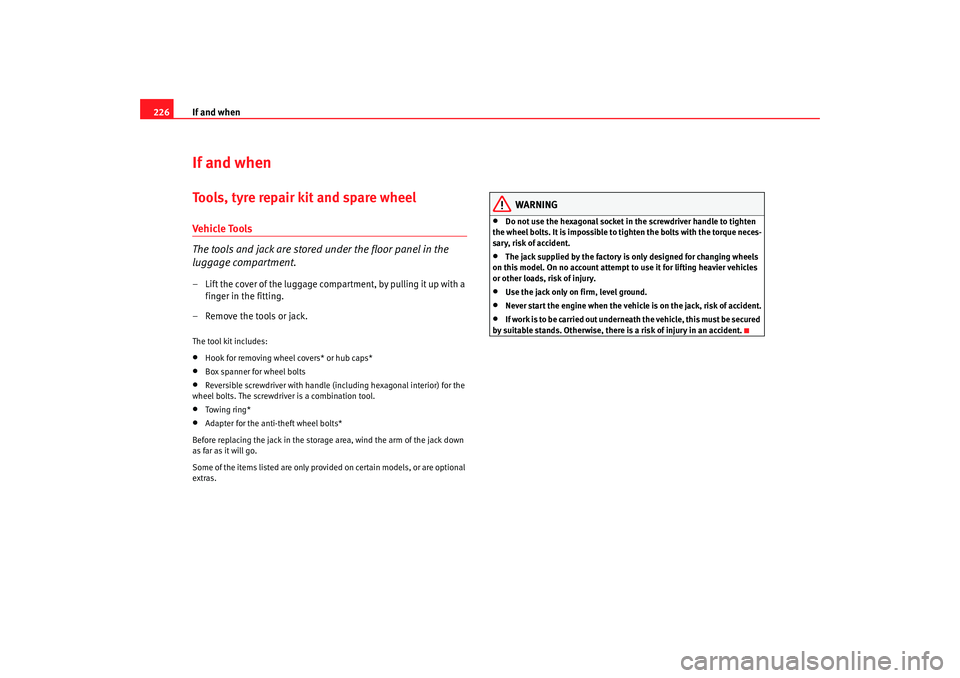
The tools and jack are stored under the floor panel in the
luggage compartment.– Lift the cover of the luggage compartment, by pulling it up with a
finger in the fitting.
– Remove the tools or jack.The tool kit includes:•
Hook for removing wheel covers* or hub caps*
•
Box spanner for wheel bolts
•
Reversible screwdriver with handle (including hexagonal interior) for the
wheel bolts. The screwdriver is a combination tool.
•
Towing ring*
•
Adapter for the anti-theft wheel bolts*
Before replacing the jack in the storage area, wind the arm of the jack down
as far as it will go.
Some of the items listed are only provided on certain models, or are optional
extras.
WARNING
•
Do not use the hexagonal socket in the screwdriver handle to tighten
the wheel bolts. It is impossible to ti ghten the bolts with the torque neces-
sary, risk of accident.
•
The jack supplied by the factory is only designed for changing wheels
on this model. On no account attempt to use it for lifting heavier vehicles
or other loads, risk of injury.
•
Use the jack only on firm, level ground.
•
Never start the engine when the vehicle is on the jack, risk of accident.
•
I f wo r k is t o b e ca r r i e d o u t un d e r n ea th the vehicle, this must be secured
by suitable stands. Otherwise, there is a risk of injury in an accident.
Toledo angles Seite 226 Mittwoch, 5. Oktober 2005 9:43 09
Page 231 of 290
If and when229
Safety First
Operating instructions
Tips and Maintenance
Te c h n i c a l D a t a
After changing a wheel
After changing the wheel there are still tasks to complete.– Put the tools and jack back in the luggage compartment.
– Place the wheel with the defective tyre in the luggage compart-
ment and secure it.
– Check the tyre pressure of the newly fitted tyre as soon as
possible.
– Have the tightening torque of the wheel bolts checked as soon as possible with a torque wrench. The prescribed torque is 120 Nm.
Note•
If you notice that the wheel bolts are corroded and difficult to turn when
changing a wheel, they must be replaced before having the wheel bolt torque
checked.
•
In the interest of safety, drive at moderate speeds until the wheel bolt
torque has been checked.
Wheel trims
The wheel trims must be removed to gain access to the wheel
bolts.Removing
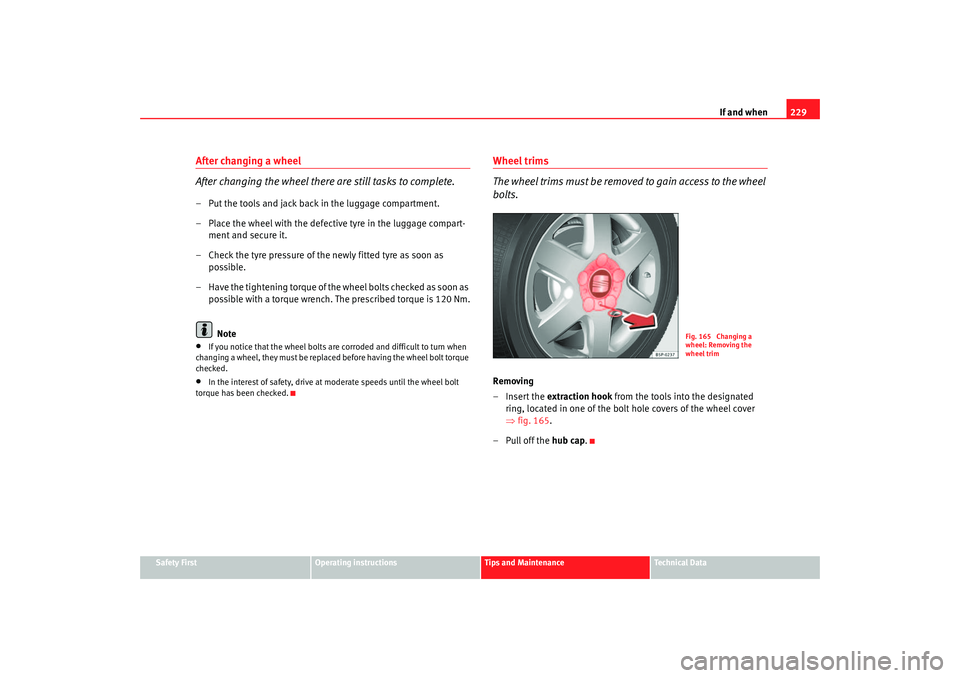
–Insert the extraction hook from the tools into the designated ring, located in one of the bolt hole covers of the wheel cover
⇒ fig. 165.
–Pull off the hub cap .
Fig. 165 Changing a
wheel: Removing the
wheel trim
Toledo angles Seite 229 Mittwoch, 5. Oktober 2005 9:43 09
Page 232 of 290
If and when
230Wheel covers*
The wheel covers must be removed for access to the wheel
boltsRemoving
– Remove the wheel cover using the spanner and the hook*.
– Hook this into one of the rebates of the wheel cover.
– Put the box spanner over the wheel cover hook and lever gently
and carefully to avoid damage to the paintwork.
Fitting
– Fit the wheel cover onto the wheel rim by pressing it firmly. Put pressure initially on the point of the rebate for the valve. Then
press the wheel cover onto the steel rim so that it engages all
round.
Loosening the wheel bolts
The wheel bolts must be loosened before raising the vehicle.Loosening
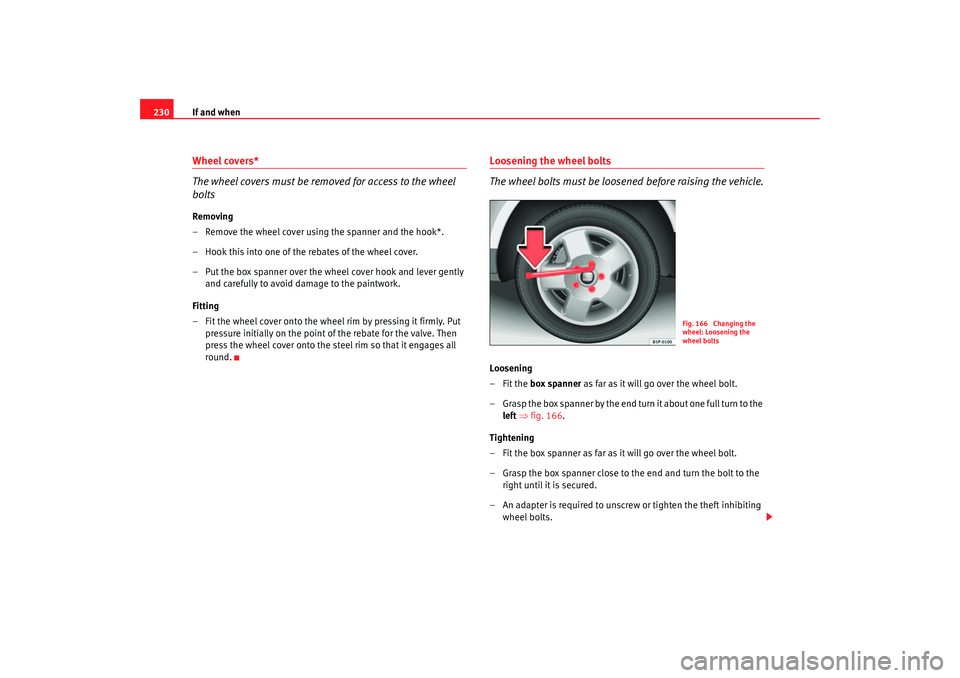
–Fit the box spanner as far as it will go over the wheel bolt.
– Grasp the box spanner by the end turn it about one full turn to the left ⇒ fig. 166.
Tightening
– Fit the box spanner as far as it will go over the wheel bolt.
– Grasp the box spanner close to the end and turn the bolt to the right until it is secured.
– An adapter is required to unscrew or tighten the theft inhibiting wheel bolts.
Fig. 166 Changing the
wheel: Loosening the
wheel bolts
Toledo angles Seite 230 Mittwoch, 5. Oktober 2005 9:43 09
Page 249 of 290

If and when247
Safety First
Operating instructions
Tips and Maintenance
Te c h n i c a l D a t a
Side lights and brake lights– Open the tailgate
– Remove the bolts ⇒fig. 181 – Remove the cover of the luggage compartment lateral panel.
– Unscrew the plastic fitting
⇒fig. 182 securing the rear light.
Inserting a screwdriver under the plastic fitting may help to
loosen it.
– Partially remove the rear light from its casing taking care not to pull on the cable.
– Remove the lamp holder connector.
–Unscrew the bolts ⇒page 248, fig. 183 from the lamp holder
and pull on this.
– Press on the lamp and rotate to the left then fit the replacement.
– To refit follow the steps in reverse order, taking special care when fitting the lamp holder. The metal contacts of the lamp holder
ends should be correctly fitted with respect to the rear light
contacts.
Fig. 181 Side lights and
brake lightsFig. 182 Side lights and
brake lights
AA
ABAC
Toledo angles Seite 247 Mittwoch, 5. Oktober 2005 9:43 09
Page 282 of 290

Index
280Buzzer . . . . . . . . . . . . . . . . . . . . . . . . . . . . 116, 159CCar care
Exterior . . . . . . . . . . . . . . . . . . . . . . . . . . . . . 188
Car care products . . . . . . . . . . . . . . . . . . . . . . . 187
Car phone . . . . . . . . . . . . . . . . . . . . . . . . . . . . . 197
Car washes . . . . . . . . . . . . . . . . . . . . . . . . . . . . 188
Catalytic converter . . . . . . . . . . . . . . . . . . . . . . 180
CD changer . . . . . . . . . . . . . . . . . . . . . . . . . . . . 134
Central locking . . . . . . . . . . . . . . . . . . . . . . . . . . 92 Automatic speed dependent locking and un-locking system* . . . . . . . . . . . . . . . . . . . . . 94
Emergency unlocking system . . . . . . . . . . . . 94
Locking system for invo luntary unlocking . . 94
Selective unlocking system* . . . . . . . . . . . . 93
Central locking button Central locking . . . . . . . . . . . . . . . . . . . . . . . 96
unlocking . . . . . . . . . . . . . . . . . . . . . . . . . . . . 96
Central locking system Automatic speed dependent locking and un-locking system* . . . . . . . . . . . . . . . . . . . . . 94
Centre arm rest . . . . . . . . . . . . . . . . . . . . . . . . . 134
Cetane number . . . . . . . . . . . . . . . . . . . . . . . . . 202
Changing gear See Manual gearbox . . . . . . . . . . . . . . . . . . 163
Changing the lamps Main headlight lamps . . . . . . . . . . . . . . . . . 243
rear lights . . . . . . . . . . . . . . . . . . . . . . . . . . . 246 Changing the main headlight lamps
dipped beam lights . . . . . . . . . . . . . . . . . . . 244
main beam lights . . . . . . . . . . . . . . . . . . . . 245
Side lights . . . . . . . . . . . . . . . . . . . . . . . . . . 246
turn signal lamps . . . . . . . . . . . . . . . . . . . . 244
Changing the rear lights indicator lights . . . . . . . . . . . . . . . . . . . . . . 248
luggage compartment lights . . . . . . . . . . . 250
rear fog light . . . . . . . . . . . . . . . . . . . . . . . . 249
reverse light . . . . . . . . . . . . . . . . . . . . . . . . . 249
side lights . . . . . . . . . . . . . . . . . . . . . . . . . . 247
Changing windscreen wiper blades . . . . . . . . . 214
Chassis number . . . . . . . . . . . . . . . . . . . . . . . . 260
Checking . . . . . . . . . . . . . . . . . . . . . . . . . . . . . . 219
Checking battery electrolyte level . . . . . . . . . . 219
Checking engine oil level . . . . . . . . . . . . . . . . . 208
Child safety . . . . . . . . . . . . . . . . . . . . . . . . . . . . . 47
Child seat . . . . . . . . . . . . . . . . . . . . . . . . . . . . . . . 49 Categorisation in groups . . . . . . . . . . . . . . . 49
Group 1 . . . . . . . . . . . . . . . . . . . . . . . . . . . . . 50
Group 2 . . . . . . . . . . . . . . . . . . . . . . . . . . . . . 50
Group 3 . . . . . . . . . . . . . . . . . . . . . . . . . . . . . 50
Groups 0 and 0+ . . . . . . . . . . . . . . . . . . . . . . 49
ISOFIX system . . . . . . . . . . . . . . . . . . . . . . . . 52
Safety notes . . . . . . . . . . . . . . . . . . . . . . . . . . 48
Securing . . . . . . . . . . . . . . . . . . . . . . . . . . . . . 51
Child seats on the front passenger seat . . . . . . . . . . . . . 31
Cigarette lighter* . . . . . . . . . . . . . . . . . . . . . . . . 142
Cleaning alloy wheels . . . . . . . . . . . . . . . . . . . . 192
Cleaning and caring for your vehicle . . . . . . . . 187 Cleaning chrome . . . . . . . . . . . . . . . . . . . . . . . . 191
Cleaning cloth seat covers . . . . . . . . . . . . . . . . 194
Cleaning dash panel . . . . . . . . . . . . . . . . . . . . . 193
Cleaning engine compartment . . . . . . . . . . . . . 193
Cleaning fabric trim . . . . . . . . . . . . . . . . . . . . . 194
Cleaning leather . . . . . . . . . . . . . . . . . . . . . . . . 194
Cleaning plastic parts . . . . . . . . . . . . . . . . . . . . 193
Cleaning seat belts . . . . . . . . . . . . . . . . . . . . . . 195
Cleaning steel wheels . . . . . . . . . . . . . . . . . . . . 191
Cleaning windows . . . . . . . . . . . . . . . . . . . . . . . 190
Cleaning wooden trim . . . . . . . . . . . . . . . . . . . . 194
Climatic* . . . . . . . . . . . . . . . . . . . . . . . . . . . . . . 149
Climatronic
General notes . . . . . . . . . . . . . . . . . . . . . . . 156
Clock . . . . . . . . . . . . . . . . . . . . . . . . . . . . . . . . . . 58
Clothes hook . . . . . . . . . . . . . . . . . . . . . . . . . . . 137
Cockpit . . . . . . . . . . . . . . . . . . . . . . . . . . . . . . . . . 55
Control Light switches . . . . . . . . . . . . . . . . . . . . . . . 111
Control lamps . . . . . . . . . . . . . . . . . . . . . . . . . . . 71
Control lighting . . . . . . . . . . . . . . . . . . . . . . . . . . 55
Controls Electric windows . . . . . . . . . . . . . . . . . . . . . 106
Convenience closing Sliding/tilting roof . . . . . . . . . . . . . . . . . . . 109
Windows . . . . . . . . . . . . . . . . . . . . . . . . . . . 108
Convenience opening Windows . . . . . . . . . . . . . . . . . . . . . . . . . . . 108
Coolant . . . . . . . . . . . . . . . . . . . . . . . . . . . . . . . 211 monitor indicator . . . . . . . . . . . . . . . . . . . . . 64
Toledo angles Seite 280 Mittwoch, 5. Oktober 2005 9:43 09