bonnet Seat Toledo 2012 User Guide
[x] Cancel search | Manufacturer: SEAT, Model Year: 2012, Model line: Toledo, Model: Seat Toledo 2012Pages: 249, PDF Size: 3.6 MB
Page 175 of 249
174Checking and refilling levels
WARNING
● Never open the bonnet if you see steam, smoke or coolant escaping
from the engine compartment. Risk of scalding! Wait until no steam or
coolant can be seen before opening the bonnet.
● Switch off the engine and remove the key from the ignition.
● Engage neutral in vehicles with manual gearbox and move the selec-
tor lever to position P in vehicles with automatic gearbox.
● Apply the handbrake firmly.
● Wait for the engine to cool down.
● For safety reasons, the bonnet must always be closed when the vehi-
cle is moving. Therefore, after closing the bonnet always check that it is
properly secured.
● Should you notice that the bonnet is not safely secured when the ve-
hicle is moving, stop the vehicle immediately and close the bonnet prop-
erly. Risk of accident!
● Keep children away from the engine compartment.
● Do not touch hot engine parts. Risk of burns!
● Never spill fluids on hot engine compartments. These fluids can
cause a fire (e.g. antifreeze in coolant).
● Take care not to cause short circuits in the electrical system, especial-
ly when working on the battery.
● Never touch the radiator fan when the engine is hot. The fan may start
running suddenly!
● Do not unscrew the cap on the coolant expansion tank when the en-
gine is hot. The cooling system is under pressure!
● Protect face, hands and arms from any hot steam or hot coolant re-
leased by covering the cap with a large, thick rag when opening the ex-
pansion tank.
● Do not leave any objects, such as cloths and tools, in the engine com-
partment.WARNING (Continued)
● When working underneath the vehicle, secure it so that it cannot roll
away and support it safely on suitable supports. The hydraulic jack is not
sufficient for this purpose. Risk of injuries!
● If any tests have to be performed with the engine running, there is an
extra safety risk from rotating parts, such as the drive belt, alternator
and radiator fan, etc., and from the high-voltage ignition system. You
should also note the following:
–Never touch the electrical wiring of the ignition system.
– Keep away from moving engine parts when wearing jewellery,
loose clothing or long hair. Risk of fatal injuries! All jewellery must be
removed, hair tied back and close-fitting clothing worn.
● Observe the following additional warnings if work on the fuel system
or the electrical system is necessary.
–Always disconnect the battery from the onboard network.
– Do not smoke.
– Never work near naked flames.
– Always keep an approved fire extinguisher immediately available.
CAUTION
● When topping up fluids, make sure the correct fluid is put into the cor-
rect filler opening. Otherwise this can cause serious malfunctions or engine
damage!
● Never open the bonnet using the release catch. Risk of damage.
For the sake of the environment
Due to the environment-friendly disposal of fluids, the equipment necessary
and the knowledge required, fluids must be changed by an authorised SEAT
dealer during the service inspections of the vehicle.
Page 176 of 249

175
Checking and refilling levels
Note
● Please contact an authorised SEAT dealer with any doubts regarding flu-
ids.
● Fluids of the correct specifications can be acquired from the selection of
SEAT Original Accessories.
Opening and closing the bonnet
Fig. 116 Releasing bonnet
Fig. 117 Securing the bonnet Opening the bonnet
–
Open the front left door.
– Pull the lever 1
⇒ Fig. 116 under the dash panel in the direc-
tion indicated by the arrow.
Before opening the bonnet, make sure that the windscreen wiper
arms are not lifted away from the glass. Otherwise the paintwork
may be damaged.
– Pull the release catch in the direction of the arrow 2
⇒ Fig. 116
and the bonnet will be released.
– Hold and lift the bonnet.
– Remove the support strut 3
⇒ Fig. 117 from its fastening in the
direction of the arrow and secure the raised bonnet so that the
end of the strut hooks onto the opening in the bonnet 4
.
Closing the bonnet
– Lift the bonnet slightly and unhook the support strut keeping
the bonnet open and insert it into its fastening 3
.
– Let the bonnet drop from a height of around 20 cm into the
catch Do not press down afterwards!
– Check that the bonnet is correctly closed.
Safety FirstOperating instructionsPractical TipsTechnical specifications
Page 178 of 249

177
Checking and refilling levels
Oil properties
Engine typeSpecificationPetrol without flexible service in-
tervalVW 502 00/VW 504 00
Petrol with flexible service inter-
val (LongLife)VW 504 00
Diesel. Engines with no Particu-
late Filter (DPF)VW 505 01/VW 506 01/VW 507 00
Diesel. Particulate Filter Engines
(DPF).
With or without flexible service in-
terval (with and without Long-
life) a)VW 507 00
a)
Only use recommended oils, otherwise you may damage the engine.
Engine oil additives
No type of additive should be mixed with the engine oil. The deterioration
caused by these additives is not covered by the warranty.
Note
Before a long trip, we recommend finding an engine oil that conforms to the
corresponding VW specifications and keeping it in the vehicle. This way, the
correct engine oil will always be available for a top-up if needed. Checking the engine oil level
Fig. 118 Engine oil dip-
sticks
The dipstick shows the engine oil level. ⇒ Fig. 118.
Checking oil level
– Park the vehicle on a level surface and ensure the engine is at
operating temperature.
– Switch the ignition off.
– Open the bonnet.
– Wait a few minutes for the engine oil to flow back to the sump
and remove the dipstick.
– Wipe the dipstick with a clean cloth and insert it again as far as
it will go.
– Then pull the dipstick out again and check the oil level.
Safety FirstOperating instructionsPractical TipsTechnical specifications
Page 180 of 249
179
Checking and refilling levels
Coolant
General notes
The cooling system is factory-filled with an anti-freeze product.
Coolant consists of a mixture of water and 40% anti-freeze additive. This
mixture gives the required anti-freeze protection at temperatures down to
-25 °C (-13 °F) and protects the cooling and heating system against corro-
sion. It also prevents scaling and raises the boiling point of the coolant con-
siderably.
The coolant concentration must not be reduced by adding water, even in
warmer seasons or in warm countries. The concentration of the anti-freeze
additive in the coolant must be at least 40 %.
If greater anti-freeze protection is required in very cold climates, the propor-
tion of the anti-freeze additive can be increased, but only up to 60 % (anti-
freeze protection down to approx. -40 °C (-40 °F)). Any excess in this propor-
tion would reduce the anti-freeze protection and affect the cooling effect.
Vehicles in countries with a cold climate are supplied with coolant protec-
tion down to around -35 °C (-31 °F). The proportion of anti-freeze additive in
these countries should always be at least 50 %.
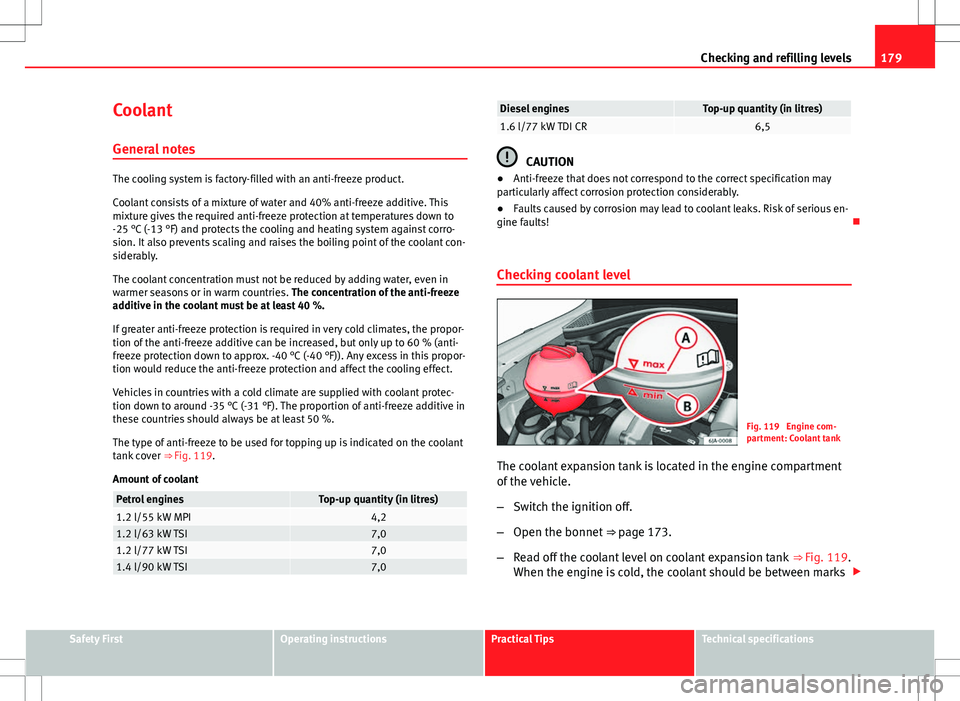
The type of anti-freeze to be used for topping up is indicated on the coolant
tank cover ⇒ Fig. 119.
Amount of coolant
Petrol enginesTop-up quantity (in litres)1.2 l/55 kW MPI4,21.2 l/63 kW TSI7,01.2 l/77 kW TSI7,01.4 l/90 kW TSI7,0
Diesel enginesTop-up quantity (in litres)1.6 l/77 kW TDI CR6,5
CAUTION
● Anti-freeze that does not correspond to the correct specification may
particularly affect corrosion protection considerably.
● Faults caused by corrosion may lead to coolant leaks. Risk of serious en-
gine faults!
Checking coolant level
Fig. 119 Engine com-
partment: Coolant tank
The coolant expansion tank is located in the engine compartment
of the vehicle.
– Switch the ignition off.
– Open the bonnet ⇒ page 173.
– Read off the coolant level on coolant expansion tank ⇒
Fig. 119.
When the engine is cold, the coolant should be between marks
Safety FirstOperating instructionsPractical TipsTechnical specifications
Page 182 of 249

181
Checking and refilling levels
Brake fluid Checking brake fluid level
Fig. 120 Engine com-
partment: Brake fluid res-
ervoir
The brake fluid reservoir is located in the engine compartment of
the vehicle.
– Switch the ignition off.
– Open the bonnet ⇒ page 173.
– Check the brake fluid level in the reservoir ⇒ Fig. 120. It should
be between the “MIN” and “MAX” marks.
The fluid level drops slightly after a period of time due to automatic com-
pensation for brake pad wear. This is quite normal.
However, if the level goes down noticeably in a short time, or drops below
the “MIN” mark, there may be a leak in the brake system. If the brake fluid
level in the reservoir is too low, this will be indicated by the warning lamp in
the instrument panel
⇒ page 66, Brake system .
WARNING
If the fluid level has dropped below the MIN mark, do not drive on.
Risk of accident! Seek professional help.
Changing brake fluid
Brake fluid absorbs moisture. Therefore, it gradually absorbs moisture from
the atmosphere. If the water content in the brake fluid is too high, the brake
system could corrode. The water content also reduces the boiling point of
the brake fluid.
The brake fluid must comply with one of the following standards or specifi-
cations:
● VW 50114
● FMVSS 116 DOT4
WARNING
Heavy use of the brakes may cause a vapour lock if the brake fluid is left
in the brake system for too long. This would seriously affect the efficien-
cy of the brakes and the safety of the vehicle.
CAUTION
Brake fluid damages the vehicle paintwork.
Safety FirstOperating instructionsPractical TipsTechnical specifications
Page 217 of 249
216Fuses and bulbs
Changing side light bulbs
Fig. 147 Changing side
light bulbs
– Raise the bonnet.
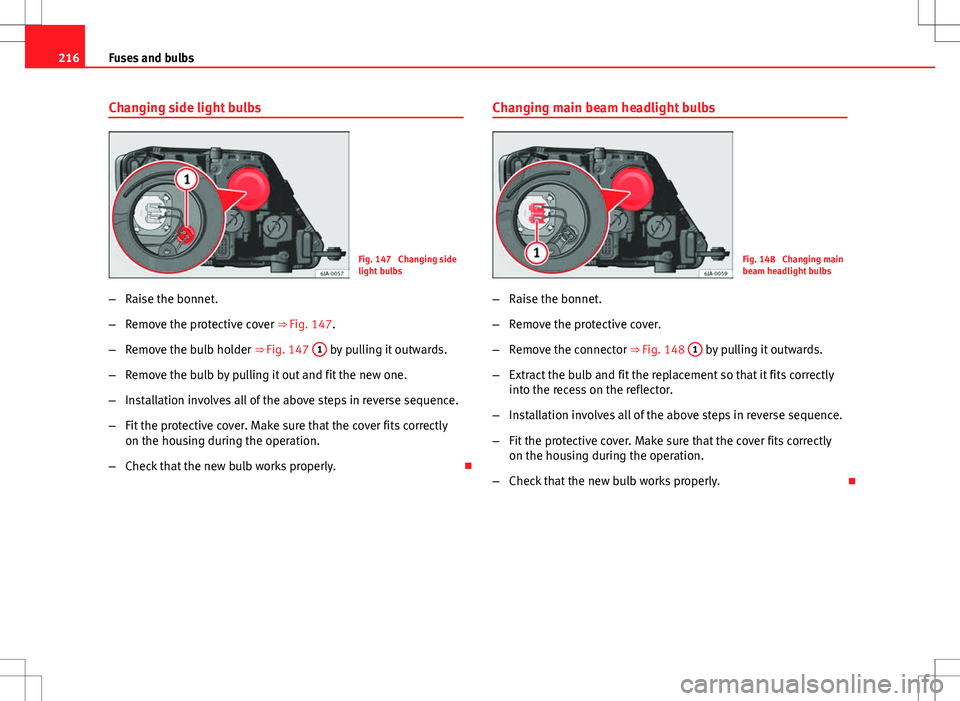
– Remove the protective cover ⇒ Fig. 147.
– Remove the bulb holder ⇒ Fig. 147 1
by pulling it outwards.
– Remove the bulb by pulling it out and fit the new one.
– Installation involves all of the above steps in reverse sequence.
– Fit the protective cover. Make sure that the cover fits correctly
on the housing during the operation.
– Check that the new bulb works properly. Changing main beam headlight bulbs
Fig. 148 Changing main
beam headlight bulbs
– Raise the bonnet.
– Remove the protective cover.
– Remove the connector ⇒ Fig. 148 1
by pulling it outwards.
– Extract the bulb and fit the replacement so that it fits correctly
into the recess on the reflector.
– Installation involves all of the above steps in reverse sequence.
– Fit the protective cover. Make sure that the cover fits correctly
on the housing during the operation.
– Check that the new bulb works properly.
Page 218 of 249

217
Fuses and bulbs
Changing dipped beam headlight bulbs
Fig. 149 Changing dip-
ped beam headlight
bulbs: wheel housing
Fig. 150 Changing dip-
ped beam headlight
bulbs
– Turn the wheel for access to the wheel housing cover and re-
move the cover ⇒ Fig. 149.
– Remove the protective cover from the headlight ⇒
Fig. 150.
– Remove the connector ⇒
Fig. 150 1
by pulling it outwards.
– Unclip the retainer spring ⇒
Fig. 150 2
pressing clockwise and
inwards. –
Extract the bulb and fit the replacement so that the lug on the
base fits into the recess on the reflector.
– Fit the connector.
– Fit the protective cover. Make sure that the cover fits correctly
on the housing during the operation.
– Replace the wheel housing cover.
– Check that the new bulb works properly.
Changing turn signal light bulbs
Fig. 151 Changing turn
signal light bulbs
– Raise the bonnet.
– Turn the bulb holder ⇒ Fig. 151 1
anti-clockwise and remove
it.
– Remove the bulb by pressing on the bulb holder and turning it
anti-clockwise at the same time.
Safety FirstOperating instructionsPractical TipsTechnical specifications
Page 219 of 249
218Fuses and bulbs
–Fit the replacement bulb in the bulb holder and turn clockwise
as far as it will go.
– Check that the new bulb works properly.
Changing daytime driving light bulbs
Fig. 152 Changing day-
time driving light bulbs
– Raise the bonnet.
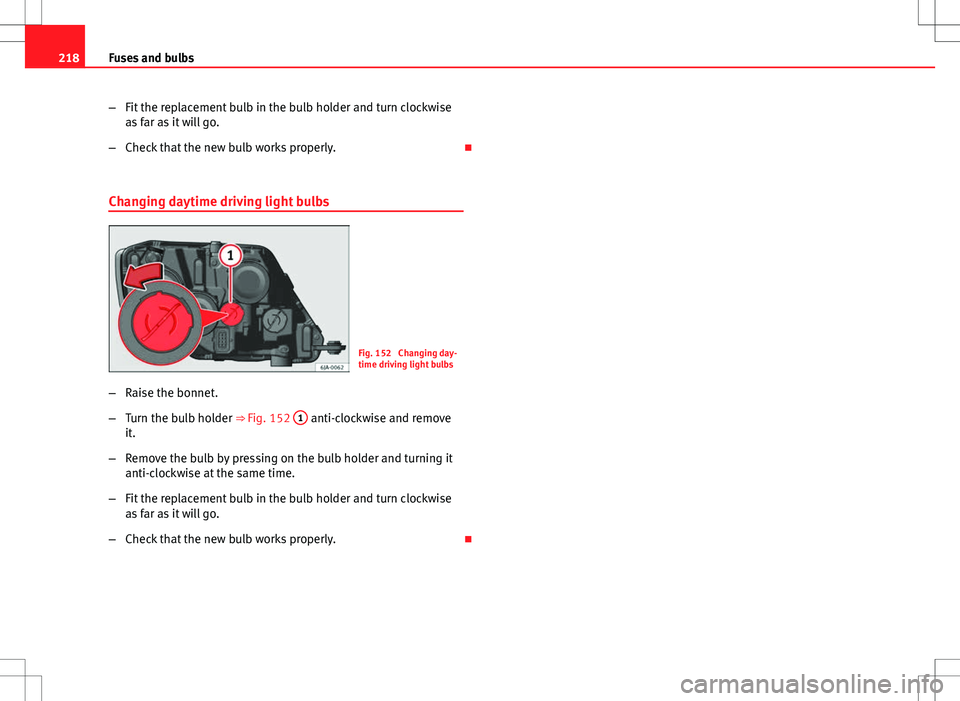
– Turn the bulb holder ⇒ Fig. 152 1
anti-clockwise and remove
it.
– Remove the bulb by pressing on the bulb holder and turning it
anti-clockwise at the same time.
– Fit the replacement bulb in the bulb holder and turn clockwise
as far as it will go.
– Check that the new bulb works properly.
Page 240 of 249
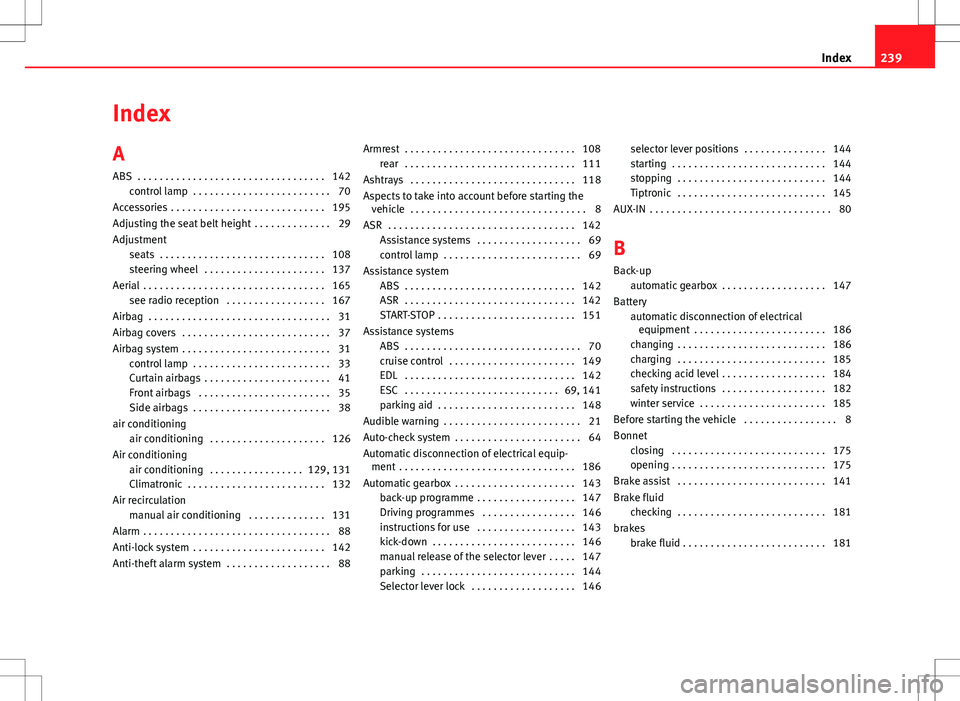
Index
A
ABS . . . . . . . . . . . . . . . . . . . . . . . . . . . . . . . . . . 142control lamp . . . . . . . . . . . . . . . . . . . . . . . . . 70
Accessories . . . . . . . . . . . . . . . . . . . . . . . . . . . . 195
Adjusting the seat belt height . . . . . . . . . . . . . . 29
Adjustment seats . . . . . . . . . . . . . . . . . . . . . . . . . . . . . . 108
steering wheel . . . . . . . . . . . . . . . . . . . . . . 137
Aerial . . . . . . . . . . . . . . . . . . . . . . . . . . . . . . . . . 165 see radio reception . . . . . . . . . . . . . . . . . . 167
Airbag . . . . . . . . . . . . . . . . . . . . . . . . . . . . . . . . . 31
Airbag covers . . . . . . . . . . . . . . . . . . . . . . . . . . . 37
Airbag system . . . . . . . . . . . . . . . . . . . . . . . . . . . 31 control lamp . . . . . . . . . . . . . . . . . . . . . . . . . 33
Curtain airbags . . . . . . . . . . . . . . . . . . . . . . . 41
Front airbags . . . . . . . . . . . . . . . . . . . . . . . . 35
Side airbags . . . . . . . . . . . . . . . . . . . . . . . . . 38
air conditioning air conditioning . . . . . . . . . . . . . . . . . . . . . 126
Air conditioning air conditioning . . . . . . . . . . . . . . . . . 129, 131
Climatronic . . . . . . . . . . . . . . . . . . . . . . . . . 132
Air recirculation manual air conditioning . . . . . . . . . . . . . . 131
Alarm . . . . . . . . . . . . . . . . . . . . . . . . . . . . . . . . . . 88
Anti-lock system . . . . . . . . . . . . . . . . . . . . . . . . 142
Anti-theft alarm system . . . . . . . . . . . . . . . . . . . 88 Armrest . . . . . . . . . . . . . . . . . . . . . . . . . . . . . . . 108
rear . . . . . . . . . . . . . . . . . . . . . . . . . . . . . . . 111
Ashtrays . . . . . . . . . . . . . . . . . . . . . . . . . . . . . . 118
Aspects to take into account before starting the vehicle . . . . . . . . . . . . . . . . . . . . . . . . . . . . . . . . 8
ASR . . . . . . . . . . . . . . . . . . . . . . . . . . . . . . . . . . 142 Assistance systems . . . . . . . . . . . . . . . . . . . 69
control lamp . . . . . . . . . . . . . . . . . . . . . . . . . 69
Assistance system ABS . . . . . . . . . . . . . . . . . . . . . . . . . . . . . . . 142
ASR . . . . . . . . . . . . . . . . . . . . . . . . . . . . . . . 142
START-STOP . . . . . . . . . . . . . . . . . . . . . . . . . 151
Assistance systems ABS . . . . . . . . . . . . . . . . . . . . . . . . . . . . . . . . 70
cruise control . . . . . . . . . . . . . . . . . . . . . . . 149
EDL . . . . . . . . . . . . . . . . . . . . . . . . . . . . . . . 142
ESC . . . . . . . . . . . . . . . . . . . . . . . . . . . . 69, 141
parking aid . . . . . . . . . . . . . . . . . . . . . . . . . 148
Audible warning . . . . . . . . . . . . . . . . . . . . . . . . . 21
Auto-check system . . . . . . . . . . . . . . . . . . . . . . . 64
Automatic disconnection of electrical equip- ment . . . . . . . . . . . . . . . . . . . . . . . . . . . . . . . . 186
Automatic gearbox . . . . . . . . . . . . . . . . . . . . . . 143 back-up programme . . . . . . . . . . . . . . . . . . 147
Driving programmes . . . . . . . . . . . . . . . . . 146
instructions for use . . . . . . . . . . . . . . . . . . 143
kick-down . . . . . . . . . . . . . . . . . . . . . . . . . . 146
manual release of the selector lever . . . . . 147
parking . . . . . . . . . . . . . . . . . . . . . . . . . . . . 144
Selector lever lock . . . . . . . . . . . . . . . . . . . 146 selector lever positions . . . . . . . . . . . . . . . 144
starting . . . . . . . . . . . . . . . . . . . . . . . . . . . . 144
stopping . . . . . . . . . . . . . . . . . . . . . . . . . . . 144
Tiptronic . . . . . . . . . . . . . . . . . . . . . . . . . . . 145
AUX-IN . . . . . . . . . . . . . . . . . . . . . . . . . . . . . . . . . 80
B
Back-up automatic gearbox . . . . . . . . . . . . . . . . . . . 147
Battery automatic disconnection of electricalequipment . . . . . . . . . . . . . . . . . . . . . . . . 186
changing . . . . . . . . . . . . . . . . . . . . . . . . . . . 186
charging . . . . . . . . . . . . . . . . . . . . . . . . . . . 185
checking acid level . . . . . . . . . . . . . . . . . . . 184
safety instructions . . . . . . . . . . . . . . . . . . . 182
winter service . . . . . . . . . . . . . . . . . . . . . . . 185
Before starting the vehicle . . . . . . . . . . . . . . . . . 8
Bonnet closing . . . . . . . . . . . . . . . . . . . . . . . . . . . . 175
opening . . . . . . . . . . . . . . . . . . . . . . . . . . . . 175
Brake assist . . . . . . . . . . . . . . . . . . . . . . . . . . . 141
Brake fluid checking . . . . . . . . . . . . . . . . . . . . . . . . . . . 181
brakes brake fluid . . . . . . . . . . . . . . . . . . . . . . . . . . 181
239
Index