check oil Seat Toledo 2012 User Guide
[x] Cancel search | Manufacturer: SEAT, Model Year: 2012, Model line: Toledo, Model: Seat Toledo 2012Pages: 249, PDF Size: 3.6 MB
Page 178 of 249

177
Checking and refilling levels
Oil properties
Engine typeSpecificationPetrol without flexible service in-
tervalVW 502 00/VW 504 00
Petrol with flexible service inter-
val (LongLife)VW 504 00
Diesel. Engines with no Particu-
late Filter (DPF)VW 505 01/VW 506 01/VW 507 00
Diesel. Particulate Filter Engines
(DPF).
With or without flexible service in-
terval (with and without Long-
life) a)VW 507 00
a)
Only use recommended oils, otherwise you may damage the engine.
Engine oil additives
No type of additive should be mixed with the engine oil. The deterioration
caused by these additives is not covered by the warranty.
Note
Before a long trip, we recommend finding an engine oil that conforms to the
corresponding VW specifications and keeping it in the vehicle. This way, the
correct engine oil will always be available for a top-up if needed. Checking the engine oil level
Fig. 118 Engine oil dip-
sticks
The dipstick shows the engine oil level. ⇒ Fig. 118.
Checking oil level
– Park the vehicle on a level surface and ensure the engine is at
operating temperature.
– Switch the ignition off.
– Open the bonnet.
– Wait a few minutes for the engine oil to flow back to the sump
and remove the dipstick.
– Wipe the dipstick with a clean cloth and insert it again as far as
it will go.
– Then pull the dipstick out again and check the oil level.
Safety FirstOperating instructionsPractical TipsTechnical specifications
Page 179 of 249

178Checking and refilling levels
Oil level in area A
–
Do not top up oil.
Oil level in area B
–
Oil can be topped up. After topping up the oil level could be in
area A.
Oil level in area C
–
Oil must be topped up. After topping up the oil level should be
in area B.
It is normal for the engine to consume a certain amount of oil. Depending
on how you drive and the conditions in which the vehicle is used, oil con-
sumption can be up to 0.5 litres per 1000 km (621 miles). Oil consumption
can also be higher for the first 5000 km (3000 miles).
You should therefore check the oil level at regular intervals, ideally every
time you fill the tank or before setting off on a long trip.
When the engine is working hard, for instance during sustained motorway
cruising in summer, when towing a trailer or caravan or climbing on moun-
tain passes, the oil level should preferably be kept within area A
, but no
higher.
A warning lamp will appear on the instrument panel ⇒ page 67, Engine oil
if the oil level is too low. In this case, check the oil level as soon as pos-
sible. Top up with the required amount of oil.
CAUTION
● The oil level must never exceed area A ⇒ Fig. 118. Risk of damage to
the exhaust system!
● If the engine oil cannot be topped up under the given conditions, do
not drive on! Stop the engine and seek the professional assistance of an Of-
ficial Service, as this could cause serious damage to the engine. Topping up engine oil
–
Check the engine oil level ⇒ page 177, Checking the engine oil
level.
– Unscrew the cap from the filler opening.
– Put in the specified grade of oil 0.5 litres at a time ⇒ page 176.
– Check the oil level ⇒ page 177.
– Replace the oil filler cap carefully and push the dipstick all the
way in.
Changing engine oil
Engine oil must be changed with the frequency indicated in the Mainte-
nance Programme or according to the service interval indicator ⇒ page 57.
CAUTION
Do not mix engine oil with additives. Risk of damage to the engine! Damage
caused by these products is not covered by the warranty.
Note
Wash your skin thoroughly if it comes into contact with engine oil.
Page 180 of 249
179
Checking and refilling levels
Coolant
General notes
The cooling system is factory-filled with an anti-freeze product.
Coolant consists of a mixture of water and 40% anti-freeze additive. This
mixture gives the required anti-freeze protection at temperatures down to
-25 °C (-13 °F) and protects the cooling and heating system against corro-
sion. It also prevents scaling and raises the boiling point of the coolant con-
siderably.
The coolant concentration must not be reduced by adding water, even in
warmer seasons or in warm countries. The concentration of the anti-freeze
additive in the coolant must be at least 40 %.
If greater anti-freeze protection is required in very cold climates, the propor-
tion of the anti-freeze additive can be increased, but only up to 60 % (anti-
freeze protection down to approx. -40 °C (-40 °F)). Any excess in this propor-
tion would reduce the anti-freeze protection and affect the cooling effect.
Vehicles in countries with a cold climate are supplied with coolant protec-
tion down to around -35 °C (-31 °F). The proportion of anti-freeze additive in
these countries should always be at least 50 %.
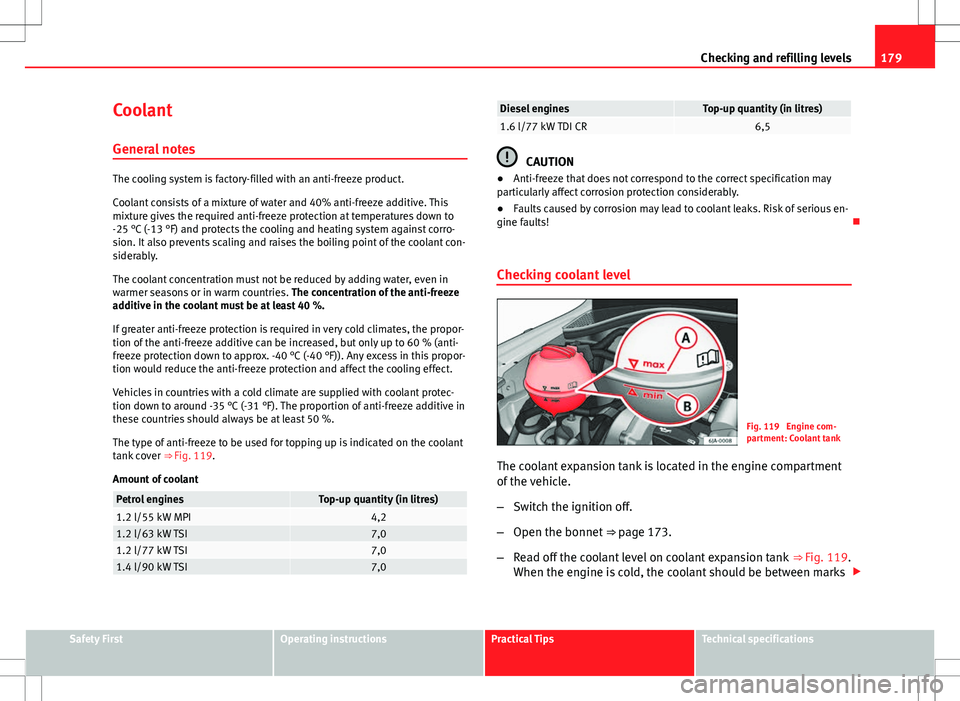
The type of anti-freeze to be used for topping up is indicated on the coolant
tank cover ⇒ Fig. 119.
Amount of coolant
Petrol enginesTop-up quantity (in litres)1.2 l/55 kW MPI4,21.2 l/63 kW TSI7,01.2 l/77 kW TSI7,01.4 l/90 kW TSI7,0
Diesel enginesTop-up quantity (in litres)1.6 l/77 kW TDI CR6,5
CAUTION
● Anti-freeze that does not correspond to the correct specification may
particularly affect corrosion protection considerably.
● Faults caused by corrosion may lead to coolant leaks. Risk of serious en-
gine faults!
Checking coolant level
Fig. 119 Engine com-
partment: Coolant tank
The coolant expansion tank is located in the engine compartment
of the vehicle.
– Switch the ignition off.
– Open the bonnet ⇒ page 173.
– Read off the coolant level on coolant expansion tank ⇒
Fig. 119.
When the engine is cold, the coolant should be between marks
Safety FirstOperating instructionsPractical TipsTechnical specifications
Page 181 of 249
180Checking and refilling levels
B
(min.) and A (max.). When the engine is hot, it may be
slightly above mark A (max.).
The warning lamp (red) in the general instrument panel ⇒ page 68, Cool-
ant level and temperature will appear when the coolant level is too low.
However, we recommend checking the coolant level directly in the tank.
Coolant loss
Any loss of coolant normally indicates a leak. It is not sufficient merely to
top up the coolant. The cooling system should be inspected by an Official
Service without delay.
CAUTION
In the event of a fault that causes the engine to overheat, contact an author-
ised SEAT dealer immediately, as this could damage the engine.
Topping up coolant
– Switch the ignition off.
– Wait for the engine to cool down.
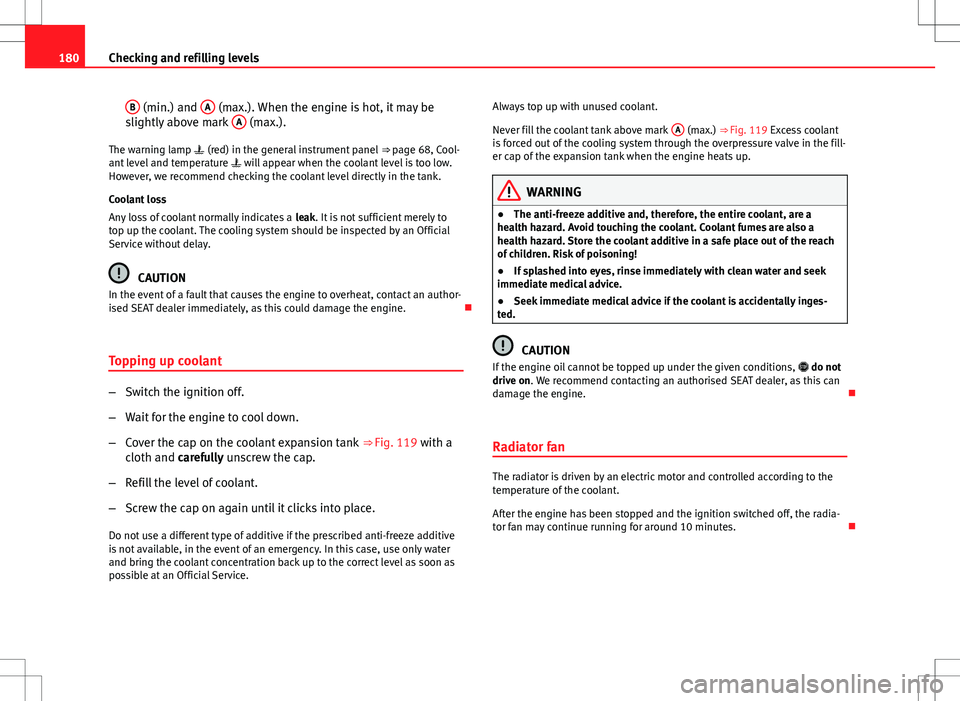
– Cover the cap on the coolant expansion tank ⇒ Fig. 119 with a
cloth and carefully unscrew the cap.
– Refill the level of coolant.
– Screw the cap on again until it clicks into place.
Do not use a different type of additive if the prescribed anti-freeze additive
is not available, in the event of an emergency. In this case, use only water
and bring the coolant concentration back up to the correct level as soon as
possible at an Official Service. Always top up with unused coolant.
Never fill the coolant tank above mark
A
(max.) ⇒ Fig. 119 Excess coolant
is forced out of the cooling system through the overpressure valve in the fill-
er cap of the expansion tank when the engine heats up.
WARNING
● The anti-freeze additive and, therefore, the entire coolant, are a
health hazard. Avoid touching the coolant. Coolant fumes are also a
health hazard. Store the coolant additive in a safe place out of the reach
of children. Risk of poisoning!
● If splashed into eyes, rinse immediately with clean water and seek
immediate medical advice.
● Seek immediate medical advice if the coolant is accidentally inges-
ted.
CAUTION
If the engine oil cannot be topped up under the given conditions, do not
drive on. We recommend contacting an authorised SEAT dealer, as this can
damage the engine.
Radiator fan
The radiator is driven by an electric motor and controlled according to the
temperature of the coolant.
After the engine has been stopped and the ignition switched off, the radia-
tor fan may continue running for around 10 minutes.
Page 182 of 249

181
Checking and refilling levels
Brake fluid Checking brake fluid level
Fig. 120 Engine com-
partment: Brake fluid res-
ervoir
The brake fluid reservoir is located in the engine compartment of
the vehicle.
– Switch the ignition off.
– Open the bonnet ⇒ page 173.
– Check the brake fluid level in the reservoir ⇒ Fig. 120. It should
be between the “MIN” and “MAX” marks.
The fluid level drops slightly after a period of time due to automatic com-
pensation for brake pad wear. This is quite normal.
However, if the level goes down noticeably in a short time, or drops below
the “MIN” mark, there may be a leak in the brake system. If the brake fluid
level in the reservoir is too low, this will be indicated by the warning lamp in
the instrument panel
⇒ page 66, Brake system .
WARNING
If the fluid level has dropped below the MIN mark, do not drive on.
Risk of accident! Seek professional help.
Changing brake fluid
Brake fluid absorbs moisture. Therefore, it gradually absorbs moisture from
the atmosphere. If the water content in the brake fluid is too high, the brake
system could corrode. The water content also reduces the boiling point of
the brake fluid.
The brake fluid must comply with one of the following standards or specifi-
cations:
● VW 50114
● FMVSS 116 DOT4
WARNING
Heavy use of the brakes may cause a vapour lock if the brake fluid is left
in the brake system for too long. This would seriously affect the efficien-
cy of the brakes and the safety of the vehicle.
CAUTION
Brake fluid damages the vehicle paintwork.
Safety FirstOperating instructionsPractical TipsTechnical specifications
Page 201 of 249

200Self-help
–Lower the vehicle.
– Tighten the wheel bolts firmly in diagonal sequence with the
box spanner and then the anti-theft wheel bolt ⇒ page 200.
– Replace the hub cap and/or the bolt covers.
Note
● All bolts must be clean and turn easily.
● Never grease or oil the wheel bolts!
● Note the direction of rotation when putting on a tyre with directional
tread pattern ⇒ page 187.
After changing a wheel
Tasks that must be carried out after changing a wheel.
– Place the wheel with the defective tyre in the spare wheel well
and secure it using a special bolt ⇒ page 190.
– Put the vehicle tools back in their storage location.
– Check the tyre pressure of the newly fitted spare wheel as soon
as possible.
– Have the tightening torque of the wheel bolts checked as soon
as possible with a torque wrench.
– Have the flat tyre replaced or ask an Official Service about the
possibility of repair.
Note
● If you notice that the wheel bolts are rusty and difficult to turn when
changing a wheel, they must be replaced before having the tightening tor-
que checked.
● Drive carefully and at moderate speeds until the tightening torque of the
wheel bolts has been checked.
Loosening and tightening wheel bolts
Fig. 131 Changing a
wheel: Loosening wheel
bolts
Loosening wheel bolts
– Fit the box spanner as far as it will go over the wheel bolt 1)
.
– Grip the end of the box spanner and turn the wheel bolt about
one turn anti-clockwise ⇒ Fig. 131.
Tightening wheel bolts
– Fit the box spanner as far as it will go over the wheel bolt 1)
.
1)
The corresponding adapter is required to unscrew or tighten the anti-theft wheel bolts
⇒ page 202.
Page 205 of 249
204Self-help
Before using the tyre repair kit
The following jobs must be performed before using the tyre repair
kit:
–If you have a flat tyre, stop the vehicle well away from moving
traffic. Stop on flat, solid ground.
– All vehicle occupants should leave the vehicle. Vehicle occu-
pants should waiting in a safe place, e.g. behind the roadside
crash barrier) while the wheel is being changed.
– Switch off the ignition and engage neutral or move the selector
lever on the automatic gearbox to position P.
– Apply the handbrake firmly.
– Check whether the tyre can be repaired using the tyre repair kit
⇒ page 202.
– If towing a trailer, unhitch it.
– Take the tyre repair kit out of the luggage compartment.
– Fix the sticker 2
⇒ Fig. 135 ⇒
page 203 onto the dash panel
where the driver will see it.
– Do not remove the foreign body, e.g. bolts or nails, from the
tyre.
– Unscrew the tyre valve cap.
– Using the valve extractor 1
, unscrew the valve insert and place
it onto a clean surface (cloth, paper, etc.) Filling and inflating the tyre
Filling the tyre
–
Shake the tyre sealant can 10
⇒ Fig. 135 ⇒ page 203 thorough-
ly several times.
– Attach the flexible filling hose 3
onto the can 10. The foil seal-
ing the can will be automatically pierced.
– Remove the cap from the flexible filling hose 3
and insert the
open end as far as it will go into the tyre valve.
– Hold the can 10
upside down and fill the complete contents of
the can into the tyre.
– Remove the empty can from the tyre.
– Screw the valve insert back into the tyre valve using the valve
extractor 1
.
Inflating the tyre
– Screw the tyre filling hose 5
⇒ Fig. 135 ⇒ page 203 firmly onto
the tyre valve.
– Make sure that the bleed screw 7
is closed.
– Start the vehicle engine and leave it running.
– Plug the connector 9
into the 12-volt power socket.
– Turn the air compressor on with the switch 8
.
– Leave the air compressor running until the tyre pressure has
reached 2.0 - 2.5 bar. Max. operating time for the compressor is
8 minutes ⇒
!
Page 232 of 249

231
Technical Data
Technical Data
Checking fluid levels
From time to time, the levels of the different fluids in the ve-
hicle must be checked. Never fill with incorrect fluids, other-
wise serious damage to the engine may be caused.
Fig. 169 Diagram for the location of the various elements Coolant expansion tank
. . . . . . . . . . . . . . . . . . . . . . . . . . . . . . . . . . . 179
Windscreen washer fluid container . . . . . . . . . . . . . . . . . . . . . . . . .182
Engine oil filler cap . . . . . . . . . . . . . . . . . . . . . . . . . . . . . . . . . . . . . . . . 178
Engine oil level dipstick . . . . . . . . . . . . . . . . . . . . . . . . . . . . . . . . . . . 177
Brake fluid reservoir . . . . . . . . . . . . . . . . . . . . . . . . . . . . . . . . . . . . . . . 181
Battery . . . . . . . . . . . . . . . . . . . . . . . . . . . . . . . . . . . . . . . . . . . . . . . . . . . 182
The checking and replenishment of the service fluids are carried out on the
components mentioned above. These operations are described in the
⇒ page 173.
Overview
You will find further explanations, instructions and restrictions on the tech-
nical specifications as of ⇒ page 226.
Note
Availability in the engine compartment is very similar to all the petrol and
diesel engines.
1
23456
Safety FirstOperating instructionsPractical TipsTechnical specifications
Page 241 of 249
Brakeshandbrake . . . . . . . . . . . . . . . . . . . . . . . . . 140
running in . . . . . . . . . . . . . . . . . . . . . . . . . . 154
warning lamps . . . . . . . . . . . . . . . . . . . . . . . 66
Brake servo . . . . . . . . . . . . . . . . . . . . . . . . . . . . 140 Brake servo . . . . . . . . . . . . . . . . . . . . . . . . . 140
bulbs – changing . . . . . . . . . . . . . . . . . . . . . . . 214
Button on driver door opening and closing electric windows . . . . 92
C
Car computer see multi-function display . . . . . . . . . . . . . . 59
Care of the vehicle . . . . . . . . . . . . . . . . . . . . . . 164
Care of vehicle automatic car wash . . . . . . . . . . . . . . . . . . 165
cleaning chrome . . . . . . . . . . . . . . . . . . . . . 166
cleaning wheels . . . . . . . . . . . . . . . . . . . . . 168
door lock cylinder . . . . . . . . . . . . . . . . . . . . 167
headlights . . . . . . . . . . . . . . . . . . . . . . . . . 167
high-pressure cleaners . . . . . . . . . . . . . . . 166
leatherette . . . . . . . . . . . . . . . . . . . . . . . . . 169
natural leather . . . . . . . . . . . . . . . . . . . . . . 169
plastic parts . . . . . . . . . . . . . . . . . . . . . . . . 167
polishing of paintwork . . . . . . . . . . . . . . . . 166
rubber seals . . . . . . . . . . . . . . . . . . . . . . . . 167
seat belts . . . . . . . . . . . . . . . . . . . . . . . . . . 170
upholstery . . . . . . . . . . . . . . . . . . . . . . . . . . 169
washing . . . . . . . . . . . . . . . . . . . . . . . . . . . 165
washing by hand . . . . . . . . . . . . . . . . . . . . 165
waxing . . . . . . . . . . . . . . . . . . . . . . . . . . . . . 166
carrier . . . . . . . . . . . . . . . . . . . . . . . . . . . . . . . . 116 Catalytic converter . . . . . . . . . . . . . . . . . . . . . . 154
Central lock button . . . . . . . . . . . . . . . . . . . . . . . 85
Central locking system . . . . . . . . . . . . . . . . . . . . 83
locking . . . . . . . . . . . . . . . . . . . . . . . . . . . . . 85
unlocking . . . . . . . . . . . . . . . . . . . . . . . . . . . 84
Changing a wheel . . . . . . . . . . . . . . . . . . . . . . . . . . . . 198
battery . . . . . . . . . . . . . . . . . . . . . . . . . . . . . 186
blades . . . . . . . . . . . . . . . . . . . . . . . . . . . . . 104
bulbs . . . . . . . . . . . . . . . . . . . . . . . . . . . . . . 214
engine oil . . . . . . . . . . . . . . . . . . . . . . . . . . 178
fuses . . . . . . . . . . . . . . . . . . . . . . . . . . . . . . 210
wiper blades . . . . . . . . . . . . . . . . . . . . . . . . 105
Changing bulbs double headlight bulbs . . . . . . . . . . . . . . . 215
front fog light bulbs . . . . . . . . . . . . . . . . . . 219
Changing gear economical driving . . . . . . . . . . . . . . . . . . . 155
recommended gear . . . . . . . . . . . . . . . . . . . 58
Charging the battery . . . . . . . . . . . . . . . . . . . . 185
Checking battery acid level . . . . . . . . . . . . . . . . . . . . 184
brake fluid . . . . . . . . . . . . . . . . . . . . . . . . . . 181
coolant . . . . . . . . . . . . . . . . . . . . . . . . . . . . 179
engine oil . . . . . . . . . . . . . . . . . . . . . . . . . . 177
oil level . . . . . . . . . . . . . . . . . . . . . . . . . . . . 177
windscreen washer . . . . . . . . . . . . . . . . . . 182
Checking fluid levels engine compartment . . . . . . . . . . . . . . . . . 231
Childproof locks . . . . . . . . . . . . . . . . . . . . . . . . . 82
Child safety . . . . . . . . . . . . . . . . . . . . . . . . . . . . . 45 Child seat
Categorisation in groups . . . . . . . . . . . . . . . 47
Group 1 . . . . . . . . . . . . . . . . . . . . . . . . . . . . . 48
Group 2 . . . . . . . . . . . . . . . . . . . . . . . . . . . . . 48
Group 3 . . . . . . . . . . . . . . . . . . . . . . . . . . . . . 48
Groups 0 and 0+ . . . . . . . . . . . . . . . . . . . . . . 47
Safety notes . . . . . . . . . . . . . . . . . . . . . . . . . 45
Securing . . . . . . . . . . . . . . . . . . . . . . . . . . . . 50
Child seats . . . . . . . . . . . . . . . . . . . . . . . . . . . . . 47 ISOFIX system . . . . . . . . . . . . . . . . . . . . . . . . 51
on the front passenger seat . . . . . . . . . . . . . 32
Top Tether system . . . . . . . . . . . . . . . . . . . . 51
Cigarette lighter . . . . . . . . . . . . . . . . . . . . . . . . 118
Cleaning . . . . . . . . . . . . . . . . . . . . . . . . . . . . . . 164 chrome . . . . . . . . . . . . . . . . . . . . . . . . . . . . 166
headlights . . . . . . . . . . . . . . . . . . . . . . . . . 167
leatherette . . . . . . . . . . . . . . . . . . . . . . . . . 169
natural leather . . . . . . . . . . . . . . . . . . . . . . 169
plastic parts . . . . . . . . . . . . . . . . . . . . . . . . 167
upholstery . . . . . . . . . . . . . . . . . . . . . . . . . . 169
wheels . . . . . . . . . . . . . . . . . . . . . . . . . . . . . 168
Cleaning chrome see care of vehicle . . . . . . . . . . . . . . . . . . . 166
Climatronic air recirculation . . . . . . . . . . . . . . . . . . . . . 134
Clock . . . . . . . . . . . . . . . . . . . . . . . . . . . . . . . . . . 58
Coat hooks . . . . . . . . . . . . . . . . . . . . . . . . . . . . 124
Compartments . . . . . . . . . . . . . . . . . . . . . . . . . 120
Computer see multi-function display . . . . . . . . . . . . . . 59
control lamp . . . . . . . . . . . . . . . . . . . . . . . . . . . . 33
Control lamps . . . . . . . . . . . . . . . . . . . . . . . . . . . 65
240 Index
Page 242 of 249

Controls and displayssummary . . . . . . . . . . . . . . . . . . . . . . . . . . . . 53
coolant temperature display . . . . . . . . . . . . . . . . . . . 56
Coolant . . . . . . . . . . . . . . . . . . . . . . . . . . . . . . . 179 checking . . . . . . . . . . . . . . . . . . . . . . . . . . . 179
topping up . . . . . . . . . . . . . . . . . . . . . . . . . 180
warning lamp . . . . . . . . . . . . . . . . . . . . . . . . 68
Correct adjustment of front seat head re- straints . . . . . . . . . . . . . . . . . . . . . . . . . . . . . . . 14
Correct adjustment of rear seat head restraints In-use and non-use positions . . . . . . . . . . . 15
Correct sitting position front passenger . . . . . . . . . . . . . . . . . . . . . . 12
Incorrect sitting position . . . . . . . . . . . . . . . 16
passenger . . . . . . . . . . . . . . . . . . . . . . . . . . . 13
Cruise control . . . . . . . . . . . . . . . . . . . . . . . . . . 149
Curtain airbags . . . . . . . . . . . . . . . . . . . . . . . . . . 41 Description . . . . . . . . . . . . . . . . . . . . . . . . . . 41
Operation . . . . . . . . . . . . . . . . . . . . . . . . . . . 42
Safety notes . . . . . . . . . . . . . . . . . . . . . . . . . 42
D Danger of fitting a child seat on the front pas- senger seat . . . . . . . . . . . . . . . . . . . . . . . . . . . 32
Data sticker . . . . . . . . . . . . . . . . . . . . . . . . . . . . 227
DAY LIGHT see daytime driving lights . . . . . . . . . . . . . . 95
Daytime driving lights . . . . . . . . . . . . . . . . . . . . 95
Defrosting rear window . . . . . . . . . . . . . . . . . . 101 Diesel
fuel . . . . . . . . . . . . . . . . . . . . . . . . . . . . . . . 173
see fuel . . . . . . . . . . . . . . . . . . . . . . . . . . . . 173
Diesel fuel winter driving . . . . . . . . . . . . . . . . . . . . . . . 173
Digital clock . . . . . . . . . . . . . . . . . . . . . . . . . . . . 58
Dipstick . . . . . . . . . . . . . . . . . . . . . . . . . . . . . . . 177
Disabling the airbag . . . . . . . . . . . . . . . . . . . . . . 43
Display service interval . . . . . . . . . . . . . . . . . . . . . . . 57
Disposal Airbags . . . . . . . . . . . . . . . . . . . . . . . . . . . . . 33
Seat belt tensioners . . . . . . . . . . . . . . . . . . . 30
Door childproof locks . . . . . . . . . . . . . . . . . . . . . . 82
manual locking . . . . . . . . . . . . . . . . . . . . . . . 86
Drink holder Drink holder . . . . . . . . . . . . . . . . . . . . . . . . 117
rear . . . . . . . . . . . . . . . . . . . . . . . . . . . . . . . 117
Driver see Correct sitting position . . . . . . . 11, 12, 13
Driving abroad . . . . . . . . . . . . . . . . . . . . . . . . . . . . . 158
driving through water . . . . . . . . . . . . . . . . 159
Emission values . . . . . . . . . . . . . . . . . . . . . 227
fuel consumption . . . . . . . . . . . . . . . . . . . . 227
Driving safety . . . . . . . . . . . . . . . . . . . . . . . . . . . . 8
Driving the vehicle with a trailer . . . . . . . . . . . 161
E
Ecological driving . . . . . . . . . . . . . . . . . . . . . . . 154 Economical and ecological driving . . . . . . . . . 154
EDL . . . . . . . . . . . . . . . . . . . . . . . . . . . . . . . . . . 142
Electronic differential lock . . . . . . . . . . . . . . . . 142
Electronic immobiliser . . . . . . . . . . . . . . . . . . . 138
Emergency
jump-starting . . . . . . . . . . . . . . . . . . . . . . . 205
towing the vehicle . . . . . . . . . . . . . . . . . . . 207
tyre repairs . . . . . . . . . . . . . . . . . . . . . . . . . 202
Emission values . . . . . . . . . . . . . . . . . . . . . . . . 227
Engine running in . . . . . . . . . . . . . . . . . . . . . . . . . . 153
starting the engine . . . . . . . . . . . . . . . . . . . 138
switching off the engine . . . . . . . . . . . . . . 139
Engine compartment . . . . . . . . . . . . . . . . . . . . 231 battery . . . . . . . . . . . . . . . . . . . . . . . . . . . . . 182
brake fluid . . . . . . . . . . . . . . . . . . . . . . . . . . 181
coolant . . . . . . . . . . . . . . . . . . . . . . . . . . . . 179
Engine coolant . . . . . . . . . . . . . . . . . . . . . . . . . 179
Engine oil . . . . . . . . . . . . . . . . . . . . . . . . . . . . . 176 changing . . . . . . . . . . . . . . . . . . . . . . . . . . . 178
oil properties . . . . . . . . . . . . . . . . . . . . . . . 177
specifications . . . . . . . . . . . . . . . . . . . . . . . 176
topping up . . . . . . . . . . . . . . . . . . . . . . . . . 178
warning lamp . . . . . . . . . . . . . . . . . . . . . . . . 67
Environment . . . . . . . . . . . . . . . . . . . . . . . . . . . 154
Environmental compatibility . . . . . . . . . . . . . . 158
ESC . . . . . . . . . . . . . . . . . . . . . . . . . . . . . . . . . . 141 control lamp . . . . . . . . . . . . . . . . . . . . . . . . . 69
extending the rear lid locking time see rear lid . . . . . . . . . . . . . . . . . . . . . . . . . . 90
241
Index