gearbox Seat Toledo 2012 User Guide
[x] Cancel search | Manufacturer: SEAT, Model Year: 2012, Model line: Toledo, Model: Seat Toledo 2012Pages: 249, PDF Size: 3.6 MB
Page 143 of 249
142Driving
The HHC is activated on gradients of over 5 %, as the driver door is closed.
It only works to start on hills, moving both forwards and in reverse. It is not
activated during start-up down hill.
Anti-lock system (ABS)
The ABS system prevents the wheels locking during braking. This helps the
driver keep control of the vehicle.
The driver is made aware of ABS assistance by the pulsating of the brake
pedal and a characteristic noise.
Keep the brake pedal pressed down while the ABS is working. The ABS will
switch off when the brake pedal is released. Never brake intermittently
while the ABS is working!
Traction control system (ASR)
If the wheels start to slide, the ASR adapts the engine speed to the driving
conditions. Particularly in unfavourable conditions, ASR helps starting, ac-
celerating and hill starts.
The 1)
warning lamp in the general instrument panel flashes when the
system is working. Electronic differential lock
If one of the wheels starts to skid, the EDL brakes that wheel, transmitting
the driving force to the other wheels. This increases vehicle stability and im-
proves driving stability.
To prevent the disc brake of the braking wheel from overheating, the EDL
cuts out automatically if subjected to excessive loads. The vehicle will con-
tinue to function normally without EDL. The EDL will switch on again auto-
matically when the brake has cooled down.
Manual gearbox
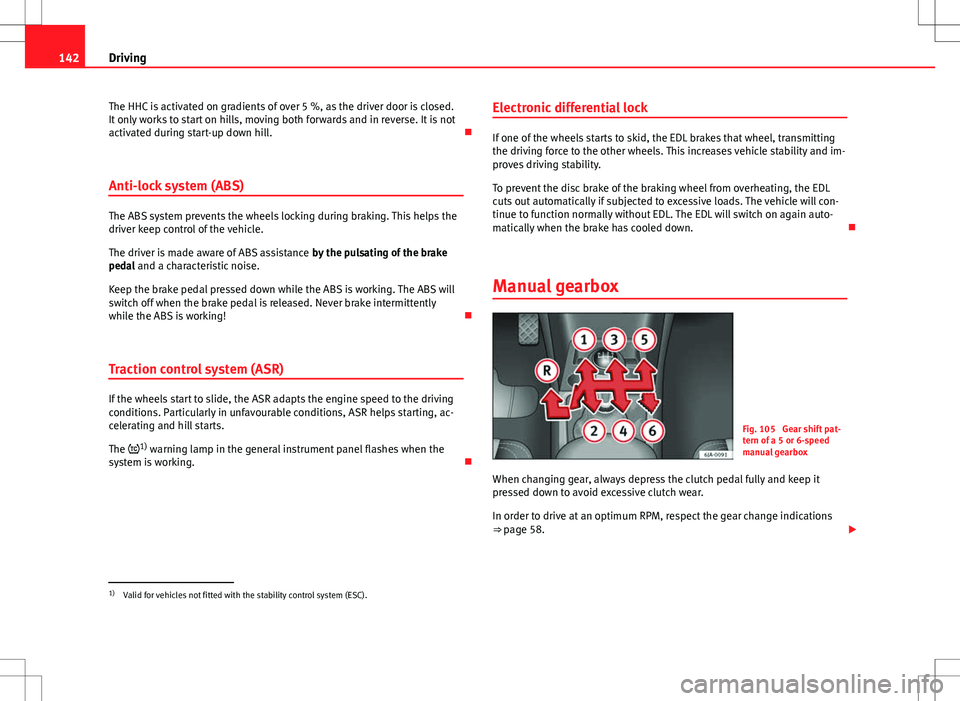
Fig. 105 Gear shift pat-
tern of a 5 or 6-speed
manual gearbox
When changing gear, always depress the clutch pedal fully and keep it
pressed down to avoid excessive clutch wear.
In order to drive at an optimum RPM, respect the gear change indications
⇒ page 58.
1)
Valid for vehicles not fitted with the stability control system (ESC).
Page 144 of 249

143
Driving
Engage reverse gear only when the vehicle is stopped. On engaging reverse
gear while the engine is running, first wait a moment with the clutch pedal
pressed down fully to limit gear shift noise.
The reverse lights switch on when the reverse gear is selected and the igni-
tion is on.
WARNING
Never engage reverse gear when moving forwards. Risk of accident!
Note
Do not rest your hand on the gear lever while driving. The pressure of your
hand could lead to premature wear of the gear system.
Automatic gearbox Introduction
WARNING
● Never press the accelerator when selecting the operating mode of the
automatic gearbox when the vehicle is stationary. Risk of accident!
● Never move the selector lever to positions R or P when driving. Risk of
accident!
● If the vehicle is to be stopped with a gear selected and the engine
idling (e.g. waiting or moving slowly at traffic lights), press down on the
brake pedal because the transmission is not entirely interrupted when
the engine is idling and the vehicle will tend to start moving.
WARNING (Continued)
● Apply the handbrake firmly and put the selector lever in position P
before opening the bonnet and working on the vehicle with the engine
running. Risk of accident! Strictly follow the safety instructions
⇒ page 173, Engine compartment.
● When stopping on a slope (hill), try not to stop the vehicle from mov-
ing by pressing the “accelerator” with a gear selected. This could over-
heat the clutch. If the clutch risks being burnt due to this force, it would
switch off and the vehicle could move backwards. Risk of accident!
● If you have to stop on a hill, press down on the brake pedal to stop
the vehicle from moving.
● The drive wheels could lose traction on a slippery road surface when
the kick-down function is activated. Risk of sliding!
CAUTION
● In DSG automatic gearboxes, the double clutch is protected from over-
loads. If the hill hold control is used, the clutches are subjected to greater
force if the vehicle is at a standstill on a slope or suddenly accelerating on a
slope.
● Should the clutches overheat, the symbol is shown on the informative
display with a warning message Gear overheated. Stop! Instruction Manual!
An audible warning is also heard. Stop the vehicle in this case, stop the en-
gine and wait until the symbol has switched off. Danger of damage to the
gearbox! You can continue driving once the symbol is switched off.
Basic information
The gearbox changes up and down automatically. The gearbox can be set to
Tiptronic mode. The gears can be changed manually in this mode
⇒ page 145.
Safety FirstOperating instructionsPractical TipsTechnical specifications
Page 146 of 249

145
Driving
R
– Reverse
Reverse gear must be engaged only when the vehicle is stationary and the
engine is idling.
To move the selector lever to position R from positions P or N, press the in-
terlock button on the selector lever knob and press down on the brake ped-
al.
The reverse lights come on when the selector lever is in position R and the
ignition is on.
N
– Neutral (idling)
Neutral (idling) is engaged in this position.
To move the selector lever from position N (if the lever has remained in this
position for more than 2 seconds) to position D or R at speeds of less than
5 km/h (3 mph) and when the vehicle is stationary, press down on the
brake pedal.
D
– Drive (forwards)
In this position, the gearbox automatically changes to a lower or higher
gear, depending on engine requirements, the driving speed and the gear
shift programme.
To move the selector lever to position D from position N at speeds of less
than 5 km/h (3 mph) and when the vehicle is stationary, press down on the
brake pedal.
In some situations (e.g. on mountain roads or when towing a trailer or cara-
van), it can be advantageous to switch temporarily to the manual shift pro-
gramme ⇒ page 145 so that the gear ratios can be selected manually to
suit driving conditions.
S
– Sports driving position
Shifting up later than usual makes full use of the engine power. This shifts
down earlier in relation to position D. To move the selector lever to position S from position D, press the interlock
button on the selector lever knob.
Tiptronic gearbox
Fig. 107 Selector lever:
Tiptronic
The Tiptronic gearbox allows the driver to change gears manually
using the selector lever.
Activating the manual gearbox
– From position D, push the selector lever to the right. The selec-
ted position of the selector lever is shown on the general instru-
ment panel display together with the gear engaged 1
⇒ Fig. 106.
Shifting up
– Push the selector lever gently forwards +
⇒ Fig. 107.
Shifting down
– Push the selector lever gently backwards -
⇒ Fig. 107.
Safety FirstOperating instructionsPractical TipsTechnical specifications
Page 147 of 249

146Driving
The manual gearbox can be activated when the vehicle is either moving or
stationary.
When accelerating, the gearbox automatically shifts up shortly before the
maximum engine speed is reached.
On shifting up, the gear is only engaged when there is no risk of engine
damage.
When the accelerator pedal is pressed down to the kick-down zone, the
gearbox will shift down in line with the road speed and engine speed.
Note
The kick-down function is also available in manual shift mode.
Selector lever lock
Automatic selector lever lock
The selector lever is locked in the positions P and N when the ignition is on.
Press down on the brake to unlock it. Remember, if the selector lever is in
positions P and N then the ⇒ page 73 warning lamp will light up on the
general instrument panel.
When the selector lever merely moves through position N (e.g. when moved
from R to D), the lever lock is not applied. This makes it possible, for exam-
ple, to rock a stuck vehicle backwards and forwards. The lock is only applied
if the brake is not pressed and the selector lever is moved to position N for
more than 2 seconds.
The selector lever lock is only activated in vehicles that are stationary or at
speeds of less than 5 km/h (3 mph). It is automatically switched off in posi-
tion N at higher speeds. Interlock button
The interlock button on the selector lever knob prevents the driver from in-
advertently engaging a gear. Press the button to unlock the selector lever.
Safety interlock for ignition key
1)
After switching off the ignition, you can only remove the ignition key if the
selector lever is in position P. When the ignition key is removed, the selec-
tor lever is locked in position P.
Kick-down feature
The kick-down feature allows maximum acceleration to be reached.
In any gear programme, press down fully on the accelerator for the automat-
ic gearbox to activate the kick-down feature. This function takes priority over
the gear programmes without taking into account the position of the selec-
tor lever (D, S or Tiptronic) and is used to reach maximum acceleration, us-
ing full engine power. Depending on the road speed and engine speed, the
automatic gearbox shifts down and the vehicle accelerates. It only shifts up
after the maximum engine speed has been reached.
Driving programmes
Your vehicle is equipped with an electronically-controlled automatic gear-
box. Shifting up or down depends on the programme selected.
For a calm driving style, the gearbox uses the most economic programme.
The gearbox shifts up as quickly as possible and shifts down as late as pos-
sible, thus increasing driving economy.
1)
Valid only for certain countries.
Page 148 of 249

147
Driving
With a sporty driving style , characterised by sudden acceleration, heavy ac-
celeration, speeds that often increase and decrease and maximum speed,
the gearbox adapts to this driving style when the accelerator is pressed fully
down (kick-down) by shifting down as quickly as possible and can even
shift down by several gears at once.
Selecting the best driving programmes is an endless job. Regardless of this,
the driver can also make the gearbox switch to a more dynamic gear shift
programme by pressing the accelerator quickly. This makes the automatic
gearbox shift down into a lower gear that would normally apply to the cur-
rent speed for more rapid acceleration (e.g. to overtake another vehicle)
without having to press the accelerator fully down into the kick-down posi-
tion. On shifting up in a corresponding driving style, the gearbox returns to
the original programme.
When driving along mountain roads, the gearbox adapts to the gradients.
This avoids having to frequently change gears when driving uphill. In Tip-
tronic mode, it is possible to shift down manually when driving downhill to
use the braking effect of the engine.
Back-up programme
A back-up programme exists in case of faults.
In the event of a fault in the gearbox electronics, this will continue to work
in one of the corresponding back-up programmes. All segments of the
screen are lit up or switched off.
The fault can be seen as follows:
● The gearbox only engages certain gears
● Reverse gear R cannot be engaged
● The manual gearbox switches off in the back-up programme
Note
If the gearbox switches to the back-up programme, visit an Authorised Serv-
ice as soon as possible to solve the problem.
Manual release of the selector lever
Fig. 108 Manual release
of the selector lever
If there is a fault in the power system to the electronic selector lev-
er lock system (flat battery, blown fuse) or the system itself is faul-
ty, the selector lever cannot be moved from position P in the nor-
mal manner, which prevents the vehicle from being moved. The se-
lector lever must be unlocked using the manual release.
– Apply the handbrake.
– Pull gently on both sides at the front of the selector lever cover.
– Also loosen the cover at the rear.
– Press the yellow plastic part with your finger in the direction in-
dicated by the arrow ⇒
Fig. 108.
Safety FirstOperating instructionsPractical TipsTechnical specifications
Page 150 of 249

149
Driving
Switching the parking aid system on and off
Parking aid is switched on when the ignition is on and reverse gear engag-
ed. This is confirmed by a short audible warning.
Parking aid is switched off when reverse gear is released.
WARNING
● Parking aid does not free the driver from responsibility when parking
or performing similar manoeuvres. Pay special attention to small children
or animals, as the parking aid sensors may not always be able to detect
them.
● Before reversing or parking, make sure there are no small obstacles,
e.g. stones, narrow pillars, towing brackets, etc. in front and behind the
vehicle. These obstacles may not always be detected by the parking aid
device.
● The surface of certain objects may not reflect the signals of the park-
ing aid sensors. Therefore, people wearing clothing of this kind may not
be detected by the parking aid system.
● Outside noise may interfere with the parking aid system. Under cer-
tain unfavourable circumstances, certain objects or people may not be
detected.
Note
● If a constant sound at a higher frequency is emitted for 3 seconds when
the system is switched on then there is a fault in the system. Please take the
vehicle to a specialised technical service to solve this fault.
● To ensure that the parking aid system works properly, the sensors must
be kept clean (e.g. free of ice).
● If the parking aid system is switched on when the automatic gearbox se-
lector lever is in position P, the acoustic signal will be interrupted (the car
cannot be moved). Cruise control
Introduction
The cruise control system allows you to drive at a constant speed of 30 km/
h (19 mph) or higher without having to press the accelerator. However, the
speed is only maintained within the margin permitted by the engine power
and the braking effect of the engine.
The warning lamp lights up on the general instrument panel if cruise con-
trol is switched on.
WARNING
● For safety reasons the cruise control system must not be used in
dense traffic or where roads conditions are poor (e.g. due to ice, aqua-
planing, loose grit, snow). Risk of accident!
● The programmed speed can only be re-established if it is not too high
for current traffic conditions.
● Always switch the cruise control system off after using it in order to
avoid involuntary use.
CAUTION
● The cruise control cannot maintain a constant speed when the vehicle is
moving downhill. The vehicle tends to accelerate under its own weight.
Therefore, shift down or use the brake pedal in good time to slow the vehi-
cle.
Note
● In vehicles with an automatic gearbox, the cruise control system cannot
be switched on if the selector lever is in position P, N or R.
● In vehicles with a manual gearbox, the cruise control cannot be switched
on if first gear or reverse gear is engaged.
Safety FirstOperating instructionsPractical TipsTechnical specifications
Page 154 of 249

153
Driving and the environment
Practical Tips Driving and the environment
The first 1500 km (900 miles) New engine
Over the first 1500 kilometres (900 miles) the engine must be run
in.
Up to 1000 kilometres (600 miles)
– Do not drive at more than 3/4 of the maximum speed corre-
sponding to the engaged gear, i.e. up to 3/4 of the maximum
permitted engine speed.
– Do not drive at full speed.
– Avoid high engine speeds.
– Do not tow a trailer.
From 1000 to 1500 kilometres (600 to 900 miles)
– Slowly increase the engine speed until reaching the maximum
permitted speed of the engaged gear, i.e. the maximum permit-
ted engine speed.
During its first few hours of running, the internal friction in the engine is
greater than later on, when all the moving parts have bedded in. How the
vehicle is driven over approximately the first 1500 kilometres (900 miles),
determines the success of the process of running in the engine. After the running in, the vehicle should not be driven at
high engine
speeds. The maximum permitted engine speed is marked at the start of the
red zone on the rev counter dial. The gear must be changed up when the red
area is reached in vehicles with a manual gearbox. Extremely high engine
speeds when accelerating are automatically limited, however the engine is
not protected against high engine speeds produced by incorrectly changing
to a lower gear, which could cause the engine to run at revs above the maxi-
mum permitted amount, and consequently result in damage to the engine.
Additionally, vehicles with a manual gearbox must also bear the following in
mind: do not drive with the engine speed too low. Change down to a lower
gear when the engine no longer runs smoothly. Observe the recommenda-
tions for changing gear ⇒ page 58, Recommended gear display.
CAUTION
All the information for speed and engine speed refers to an engine that op-
erates at operating temperature. Do not run the engine at high engine
speeds, neither when stopped or while driving.
For the sake of the environment
Do not drive at unnecessarily high engine speeds – an anticipated change
to a higher gear contributes to saving fuel, reducing operating noise and
protects the environment.
Safety FirstOperating instructionsPractical TipsTechnical specifications
Page 156 of 249
155
Driving and the environment
Fuel consumption also depends on factors that cannot be influenced by the
driver. It is normal for consumption to be greater in winter or in difficult con-
ditions, on roads in poor condition, when towing a trailer, etc.
Fuel consumption can also vary considerably from that stated by the manu-
facturer due to the outside temperature, the weather and driving style.
The vehicle has factory-fitted technical conditions in order to save fuel and
to operate in economic mode. SEAT pays special attention to minimize the
environmental impact. Take the following indications in this chapter into ac-
count in order to conserve and to take advantage of these qualities:
The engine speed must be maintained at the maximum in order to prevent
vehicle resonance and high fuel consumption.
Foresighted driving
The vehicle consumes the majority of fuel when accelerating, therefore
avoid unnecessary acceleration and braking. If you think ahead when driv-
ing, you will need to brake less and thus accelerate less. For example, when
approaching a red traffic light, allow the vehicle to decelerate freely or use
the engine braking effect. Saving energy when changing gear
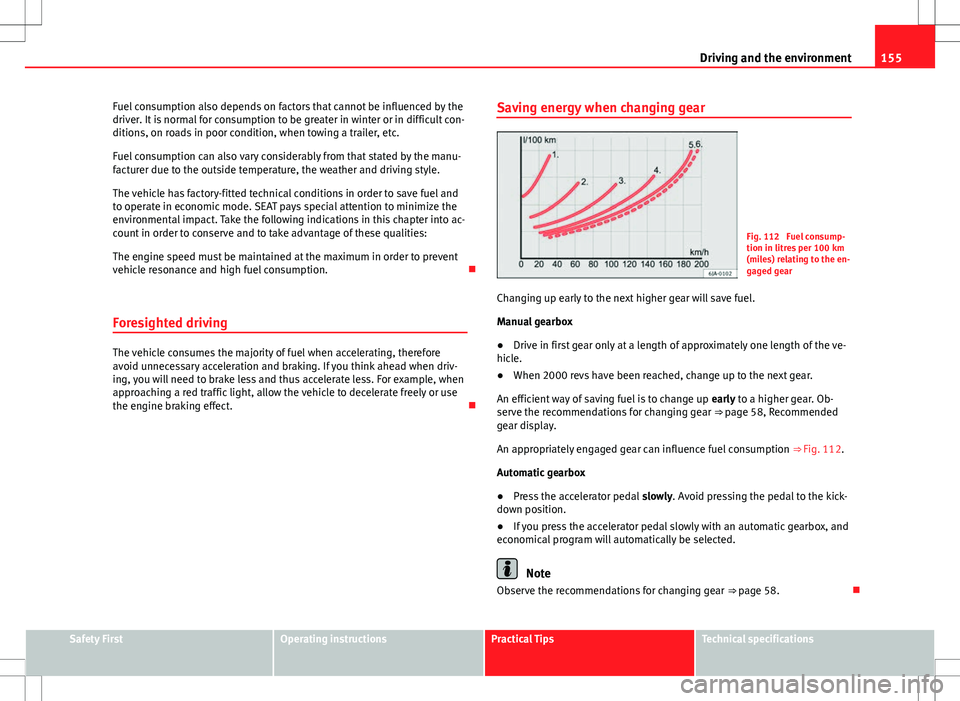
Fig. 112 Fuel consump-
tion in litres per 100 km
(miles) relating to the en-
gaged gear
Changing up early to the next higher gear will save fuel.
Manual gearbox
● Drive in first gear only at a length of approximately one length of the ve-
hicle.
● When 2000 revs have been reached, change up to the next gear.
An efficient way of saving fuel is to change up early to a higher gear. Ob-
serve the recommendations for changing gear ⇒ page 58, Recommended
gear display.
An appropriately engaged gear can influence fuel consumption ⇒ Fig. 112.
Automatic gearbox
● Press the accelerator pedal slowly. Avoid pressing the pedal to the kick-
down position.
● If you press the accelerator pedal slowly with an automatic gearbox, and
economical program will automatically be selected.
Note
Observe the recommendations for changing gear ⇒ page 58.
Safety FirstOperating instructionsPractical TipsTechnical specifications
Page 161 of 249
160Driving and the environment
WARNING
● Driving through water, dirt and mud can reduce braking capability
and prolong the braking distance – Risk of accident!
● Do not carry out any sudden or strong braking manoeuvres after driv-
ing through water.
● Clean and dry the brakes as soon as possible after driving through
water by breaking intermittently. Carry out braking in order to dry the
brakes and clean the brake discs only if traffic so permits. Do not put oth-
er drivers at risk.
CAUTION
● In the event of driving through water the parts of the vehicle can be seri-
ously damaged, such as the engine, gearbox, catalytic converter, suspen-
sion or the electrical system.
● Oncoming vehicles that drive through water can cause waves that ex-
ceed your vehicle's permitted level for driving through water.
● There may be pot-holes mud or rocks under the water that can hinder or
prevent driving through water.
● Do not drive through salt water. The salt can cause rust. All components
that are exposed to salt water must be rinsed immediately with fresh water.
Note
After driving through water we recommend that you contact a specialised
service for an inspection.
Page 175 of 249
174Checking and refilling levels
WARNING
● Never open the bonnet if you see steam, smoke or coolant escaping
from the engine compartment. Risk of scalding! Wait until no steam or
coolant can be seen before opening the bonnet.
● Switch off the engine and remove the key from the ignition.
● Engage neutral in vehicles with manual gearbox and move the selec-
tor lever to position P in vehicles with automatic gearbox.
● Apply the handbrake firmly.
● Wait for the engine to cool down.
● For safety reasons, the bonnet must always be closed when the vehi-
cle is moving. Therefore, after closing the bonnet always check that it is
properly secured.
● Should you notice that the bonnet is not safely secured when the ve-
hicle is moving, stop the vehicle immediately and close the bonnet prop-
erly. Risk of accident!
● Keep children away from the engine compartment.
● Do not touch hot engine parts. Risk of burns!
● Never spill fluids on hot engine compartments. These fluids can
cause a fire (e.g. antifreeze in coolant).
● Take care not to cause short circuits in the electrical system, especial-
ly when working on the battery.
● Never touch the radiator fan when the engine is hot. The fan may start
running suddenly!
● Do not unscrew the cap on the coolant expansion tank when the en-
gine is hot. The cooling system is under pressure!
● Protect face, hands and arms from any hot steam or hot coolant re-
leased by covering the cap with a large, thick rag when opening the ex-
pansion tank.
● Do not leave any objects, such as cloths and tools, in the engine com-
partment.WARNING (Continued)
● When working underneath the vehicle, secure it so that it cannot roll
away and support it safely on suitable supports. The hydraulic jack is not
sufficient for this purpose. Risk of injuries!
● If any tests have to be performed with the engine running, there is an
extra safety risk from rotating parts, such as the drive belt, alternator
and radiator fan, etc., and from the high-voltage ignition system. You
should also note the following:
–Never touch the electrical wiring of the ignition system.
– Keep away from moving engine parts when wearing jewellery,
loose clothing or long hair. Risk of fatal injuries! All jewellery must be
removed, hair tied back and close-fitting clothing worn.
● Observe the following additional warnings if work on the fuel system
or the electrical system is necessary.
–Always disconnect the battery from the onboard network.
– Do not smoke.
– Never work near naked flames.
– Always keep an approved fire extinguisher immediately available.
CAUTION
● When topping up fluids, make sure the correct fluid is put into the cor-
rect filler opening. Otherwise this can cause serious malfunctions or engine
damage!
● Never open the bonnet using the release catch. Risk of damage.
For the sake of the environment
Due to the environment-friendly disposal of fluids, the equipment necessary
and the knowledge required, fluids must be changed by an authorised SEAT
dealer during the service inspections of the vehicle.