lights Seat Toledo 2012 Workshop Manual
[x] Cancel search | Manufacturer: SEAT, Model Year: 2012, Model line: Toledo, Model: Seat Toledo 2012Pages: 249, PDF Size: 3.6 MB
Page 193 of 249

192Wheels and tyres
Removing
–Insert the plastic clip into the cap until the inner retaining
notches on the clips touch the collar of the cap and then re-
move ⇒ Fig. 127.
Fitting
– Insert the caps as far as they will go over the wheel bolts.
The wheel bolt caps are stored in a box on the spare wheel or in the spare
wheel well.
Tyre pressure
Fig. 128 Tyre pressure
setting switch
The tyre pressure monitoring system uses ABS sensors to compare the revo-
lutions and the circumference of each wheel. Should the circumference of
any wheel change, the warning lamp in the general instrument panel
⇒ page 72 will light up and an audible warning will be heard.
Tyre circumference may change if:
● Tyre pressure is too low
● Tyre structure is damaged ●
Vehicle load not evenly distributed
● Wheels on one axle are subjected to greater load, (e.g. driving with trail-
er, uphill, downhill)
● Snow chains are fitted
● The temporary spare wheel is fitted
● One wheel on the axle has been changed
Basic system settings
Should the tyre pressure change or if one or more wheels are changed or
the position of the wheel on the vehicle is changed, e.g. changing round the
front and rear wheels, or where a warning lamp lights up when driving, the
system must be adjusted as follows:
● Inflate all tyres to the prescribed pressures ⇒ page 188.
● Switch the ignition on.
● Hold the
⇒ Fig. 128 button down for at least 2 seconds. The warn-
ing lamp will light up when the button is pressed. The system memory is
also deleted and a new calibration system will begin, which is indicated by
an audible warning before the warning lamp switches off .
● If the warning lamp remains lit and does not switch off, not even once
the basic setting process is complete, this indicates a fault in the system.
Contact an Official Service.
The warning lamp lights up
If the pressure on at least one tyre is significantly lower than the pressure
set by the driver, the warning lamp ⇒
will light up.
The warning lamp flashes
If the warning lamp flashes, there is a fault in the system. Contact a special-
ised service to have it fixed.
Page 194 of 249
193
Wheels and tyres
WARNING
● If the warning lamp lights up, slow down immediately and avoid
any severe braking or steering manoeuvres. Stop and check the tyres and
their pressure as soon as possible.
● Under certain conditions (e.g. sporty driving style, driving on loose
surfaces or in the winter) the warning lamp may take a while to light
up or may remain switched off.
● Despite the tyre pressure monitoring system, the driver remains re-
sponsible for maintaining the correct tyre pressure. You must therefore
check the tyre pressure often.
Note
● The tyre pressure monitoring system is not a replacement for regularly
checking the tyre pressure, as it is unable to recognise an even drop in pres-
sure.
● The tyre pressure monitoring system is unable to warn of a sudden drop
in tyre pressure, e.g. a puncture. In this case, try to stop the vehicle carefully
with no severe braking or steering manoeuvres.
● To ensure the tyre pressure monitoring system works correctly, the basic
setting must be performed every 10 000 km (6000 miles) or once a year.
Wheel bolts
The wheel bolts are matched to the rims. When installing different wheels,
e.g. to fit light alloy wheels or wheels with winter tyres, it is important to use
the correct wheel bolts with the right length and correctly shaped bolt
heads. The is essential for the secure fit of the wheels and for the proper
function of the brake system. Winter tyres
Winter tyres will significantly improve handling of the vehicle in winter road
conditions. The design of summer tyres (width, rubber compound, tread
pattern) gives less grip at temperatures below 7 °C (45 °F), on ice and snow.
This applies particularly to vehicles equipped with
wide section tyres or
high speed tyres (code letters H or V on the sidewall).
In order to preserve the performance of the vehicle as much as possible,
winter tyres must be fitted on all four wheels, the minimum depth of the
tread must be 4 mm and the maximum age must be 4 years.
You can use winter tyres of a lower speed rating if the maximum speed limit
of these tyres will not be exceeded, even if the maximum speed limit for the
vehicle is higher.
For the sake of the environment
Summer tyres should be fitted again in time, as they give better handling on
roads free of snow and ice and at temperatures over 7 °C (45 °F). Summer
tyres have a shorter braking distance, produce less rolling noise and do not
wear down as quickly. They also reduce fuel consumption.
Snow chains
Snow chains must only be used on the front wheels.
In winter road conditions, snow chains not only help to improve grip but al-
so improve the braking capacity.
For technical reasons snow chains may only be used on tyres with the fol-
lowing wheel rim/tyre combinations.
Safety FirstOperating instructionsPractical TipsTechnical specifications
Page 199 of 249
198Self-help
Vehicle tool kit*
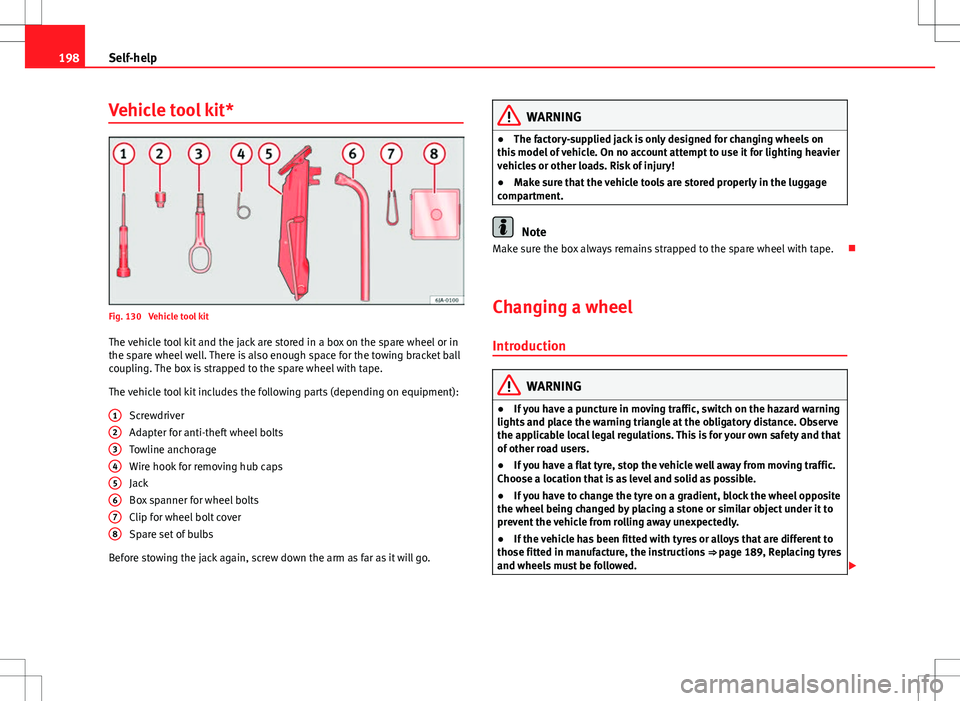
Fig. 130 Vehicle tool kit
The vehicle tool kit and the jack are stored in a box on the spare wheel or in
the spare wheel well. There is also enough space for the towing bracket ball
coupling. The box is strapped to the spare wheel with tape.
The vehicle tool kit includes the following parts (depending on equipment):
Screwdriver
Adapter for anti-theft wheel bolts
Towline anchorage
Wire hook for removing hub caps
Jack
Box spanner for wheel bolts
Clip for wheel bolt cover
Spare set of bulbs
Before stowing the jack again, screw down the arm as far as it will go. 1
2345678
WARNING
● The factory-supplied jack is only designed for changing wheels on
this model of vehicle. On no account attempt to use it for lighting heavier
vehicles or other loads. Risk of injury!
● Make sure that the vehicle tools are stored properly in the luggage
compartment.
Note
Make sure the box always remains strapped to the spare wheel with tape.
Changing a wheel Introduction
WARNING
● If you have a puncture in moving traffic, switch on the hazard warning
lights and place the warning triangle at the obligatory distance. Observe
the applicable local legal regulations. This is for your own safety and that
of other road users.
● If you have a flat tyre, stop the vehicle well away from moving traffic.
Choose a location that is as level and solid as possible.
● If you have to change the tyre on a gradient, block the wheel opposite
the wheel being changed by placing a stone or similar object under it to
prevent the vehicle from rolling away unexpectedly.
● If the vehicle has been fitted with tyres or alloys that are different to
those fitted in manufacture, the instructions ⇒ page 189, Replacing tyres
and wheels must be followed.
Page 204 of 249

203
Self-help
WARNING
● If you have a puncture in moving traffic, switch on the hazard warning
lights and place the warning triangle at the obligatory distance. Observe
the applicable local legal regulations. This is for your own safety and that
of other road users.
● If you have a flat tyre, stop the vehicle well away from moving traffic.
Choose a location that is as level and solid as possible.
● A tyre filled with sealant does not have the same performance proper-
ties as a conventional tyre.
● Do not drive faster than 80 km/h (50 mph).
● Avoid heavy acceleration, hard braking and fast cornering.
● Check the tyre pressure after 10 minutes of driving!
● The sealant is harmful to health and must be immediately rinsed from
affected skin.
For the sake of the environment
Used or out-of-date sealant must be disposed of in line with environmental
protection regulations.
Note
● Observe the instructions for use provided by the tyre repair kit manufac-
turer.
● A new can of sealant can be acquired from the selection of SEAT Original
Accessories.
● Change the tyre repaired using the tyre repair kit as soon as possible or
ask an Official Service about the possibility of repair. Tyre repair kit components
Fig. 135 Tyre repair kit
components
The tyre repair kit includes the following parts:
An adapter to fit and remove the valve
Sticker indicating the speed: “max. 80 km/h” or “max. 50 mph”
Flexible filling hose with cap
Compressor
Flexible tyre inflating hose
Tyre pressure gauge
Air release screw
ON/OFF button
12 Volt cable connector ⇒ page 119
Can of sealant
Spare valve
The valve extractor 1
⇒ Fig. 135 has a slot in its lower end that fits onto
the valve insert. This is used to remove the valve insert from the tyre and to
replace it. This is also valid for the spare valve insert 11
.
1
234567891011
Safety FirstOperating instructionsPractical TipsTechnical specifications
Page 212 of 249

211
Fuses and bulbs
Fuses in the dash panel
Fig. 140 Bottom of the
dash panel. Fuse cover
Fig. 141 Diagram of the
fuse box to the left/right
of the steering wheel
The fuses are located behind a cover below the steering wheel.
● Carefully tilt the cover in the direction indicated by the arrow and remove
it ⇒ Fig. 140.
● After changing the fuse, replace the cover on the dash panel in the di-
rection opposite that is indicated by the arrow so that the cover tabs fit into
the slots on the dash panel. Subsequently, press down on the cover to
close. List of fuses in the dash panel
NumberElectrical equipment1S - ignition2START-STOP
3Instrument panel, headlight range control, telephone, oil level
sensor
4ABS/ESC control unit5Petrol engine: cruise control6Reverse light (manual gearbox)7Switch, engine control unit, automatic gearbox8Brake switch, clutch switch, cooling fan
9Heating control panel, air conditioning control unit, parking
aid, electric window riser, radiator fan, windscreen wiper jets
10DC-DC converter11Exterior mirror control12Towing bracket control unit13Automatic gearbox control unit, automatic gear selector14Headlight range control15Vacant16Power steering, speed sensor, engine control unit17Radio (START-STOP ) daytime driving light18Heated mirrors19Ignition inlet20Engine control unit, fuel pump control unit, fuel pump
21Reverse light (automatic gearbox), fog lights with CORNER func-
tion
22Heating control panel, control unit of the climate control, tele-
phone, general instrument panel, steering wheel angle sensor,
multifunction steering wheel, automatic gearbox key lock
23Interior lighting, glove compartment and luggage compartment
lighting, side lights
Safety FirstOperating instructionsPractical TipsTechnical specifications
Page 213 of 249
212Fuses and bulbs
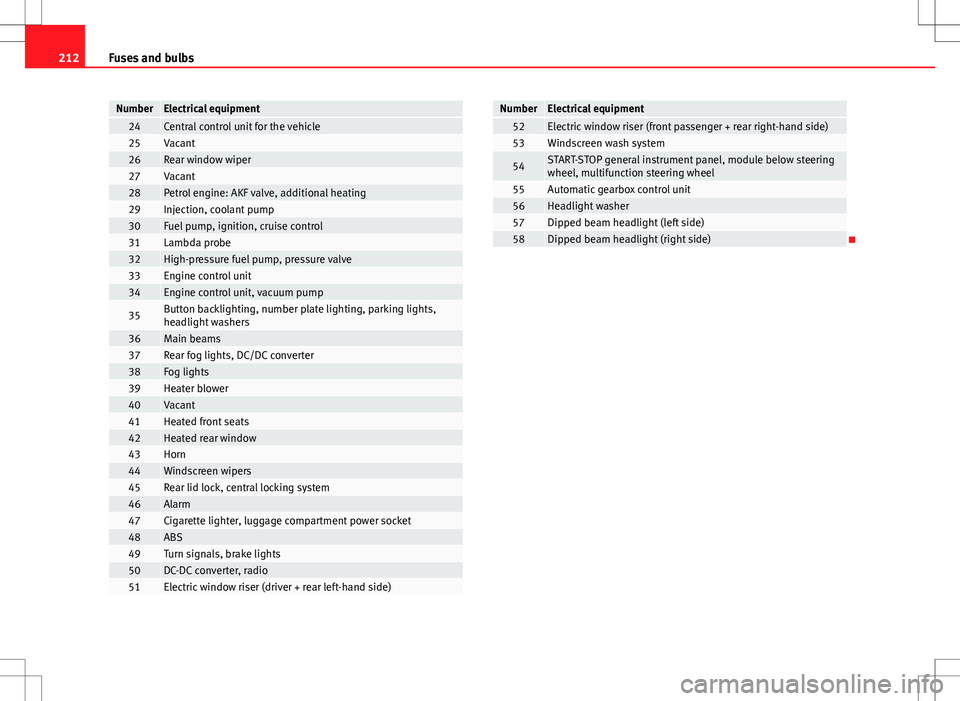
NumberElectrical equipment24Central control unit for the vehicle25Vacant26Rear window wiper27Vacant28Petrol engine: AKF valve, additional heating29Injection, coolant pump30Fuel pump, ignition, cruise control31Lambda probe32High-pressure fuel pump, pressure valve33Engine control unit34Engine control unit, vacuum pump
35Button backlighting, number plate lighting, parking lights,
headlight washers
36Main beams37Rear fog lights, DC/DC converter38Fog lights39Heater blower40Vacant41Heated front seats42Heated rear window43Horn44Windscreen wipers45Rear lid lock, central locking system46Alarm47Cigarette lighter, luggage compartment power socket48ABS49Turn signals, brake lights50DC-DC converter, radio51Electric window riser (driver + rear left-hand side)
NumberElectrical equipment52Electric window riser (front passenger + rear right-hand side)53Windscreen wash system
54START-STOP general instrument panel, module below steering
wheel, multifunction steering wheel
55Automatic gearbox control unit56Headlight washer57Dipped beam headlight (left side)58Dipped beam headlight (right side)
Page 215 of 249

214Fuses and bulbs
Changing fuses in the engine compartment
Fig. 144 Battery: fuse cover (version 1)
Fig. 145 Battery: fuse cover (version 2)
●Press the flexible tabs on the fuse box cover in the direction indicated by
the arrows 1
⇒ Fig. 144.
● Remove the cover by sliding it in the direction indicated by arrow 2.
● Use a flat-headed screwdriver to unlock the holes 3.
● Open the cover in the direction indicated by the arrow 4.Changing bulbs
Introduction
Changing bulbs requires a certain degree of practical skill. If in doubt, we
recommend you have defective bulbs changed by a specialised service or,
in case of an emergency, seek professional assistance.
● Switch off the ignition and all of the lights before changing a bulb.
● Do not touch the glass part of the bulb with your bare hands. The finger-
prints left on the glass will vaporise as a result of the heat generated by the
bulb, causing a reduction in bulb life and condensation on the mirror sur-
face, thus reducing efficiency.
● A bulb must only be replaced by one of the same type. The type is indi-
cated on the bulb, either on the glass part or on the base.
● There is a storage area for the bulb box in the spare wheel well or below
the carpet in the luggage compartment.
The light source used for each function is listed below:
Double headlights
H7 Long Life
H7
W5W Long Life PY21W NA P21W Super Long Life
Dipped beam:
Main beam:
Side lights:
Turn signals:
Daytime driving lights:
Page 216 of 249

215
Fuses and bulbs
WARNING
● Take particular care when working on components in the engine com-
partment if the engine is warm. Risk of burns.
● Bulbs are highly sensitive to pressure. The glass can break when you
touch the bulb, causing injury.
● The high voltage element of gas discharge bulbs* (xenon light) must
be handled correctly. Otherwise, there is a risk of death.
● When changing bulbs, please take care not to injure yourself on sharp
parts in the headlight housing.
CAUTION
● Remove the ignition key before working on the electric system. Other-
wise, a short circuit could occur.
● Switch off the lights and the parking light before changing a bulb.
For the sake of the environment
Please ask your specialist retailer how to dispose of used bulbs in the prop-
er manner.
Note
● Depending on weather conditions (cold or wet), the front lights, the fog
lights, the rear lights and the turn signals may be temporarily misted. This
has no influence on the useful life of the lighting system. By switching on
the lights, the area through which the beam of light is projected will quickly
be demisted. However, the edges may remain misted.
● Please check at regular intervals that all lighting (especially the exterior
lighting) on your vehicle is functioning properly. This is not only in the inter-
est of your own safety, but also in that of all other road users. ●
Before changing a bulb, make sure you have the correct new bulb.
● Do not touch the glass part of the bulb with your bare hands, use a cloth
or paper towel instead. Otherwise, the fingerprints left on the glass will va-
porise as a result of the heat generated by the bulb, they will be deposited
on the reflector and will impair its surface.
Double headlight bulbs
Fig. 146 Main headlight
bulbs
Installation position of double headlight bulbs side light
main beam headlight
dipped beam headlight
turn signal light
daytime driving light
A
BCDE
Safety FirstOperating instructionsPractical TipsTechnical specifications
Page 221 of 249
220Fuses and bulbs
–Remove the bulb by pressing on the bulb holder and turning it
anti-clockwise at the same time.
– Installation involves all of the above steps in reverse sequence.
– Check that the bulb works properly.
Changing bulbs for rear lights (in side panel) Removing tail light
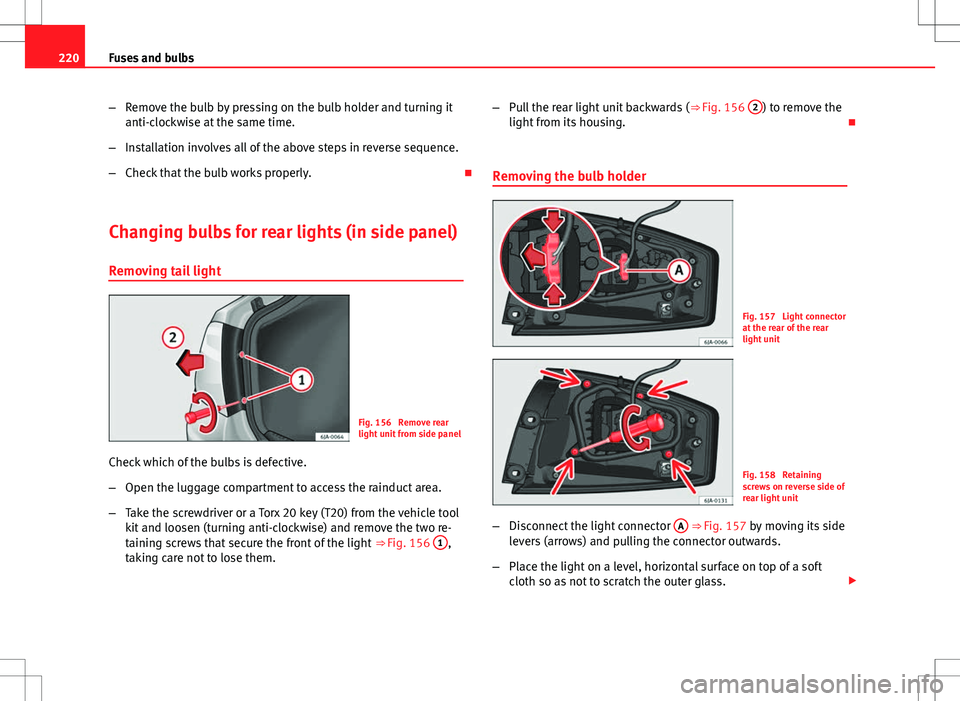
Fig. 156 Remove rear
light unit from side panel
Check which of the bulbs is defective.
– Open the luggage compartment to access the rainduct area.
– Take the screwdriver or a Torx 20 key (T20) from the vehicle tool
kit and loosen (turning anti-clockwise) and remove the two re-
taining screws that secure the front of the light ⇒ Fig. 156 1
,
taking care not to lose them. –
Pull the rear light unit backwards ( ⇒ Fig. 156 2
) to remove the
light from its housing.
Removing the bulb holder
Fig. 157 Light connector
at the rear of the rear
light unit
Fig. 158 Retaining
screws on reverse side of
rear light unit
– Disconnect the light connector A
⇒ Fig. 157 by moving its side
levers (arrows) and pulling the connector outwards.
– Place the light on a level, horizontal surface on top of a soft
cloth so as not to scratch the outer glass.
Page 222 of 249

221
Fuses and bulbs
– Unscrew the four retaining screws from the bulb holder anti-
clockwise using a screwdriver or a Torx 20 key (T20) from the ve-
hicle tool kit ⇒ Fig. 158. Take care not to lose the bulb holder
retaining screws.
Changing bulbs
All bulbs can be changed easily in the bulb holder.
Fig. 159 Position of the
bulbs in the bulb holder
The bulbs are secured with a bayonet fastener. The table below
gives an overview of the bulbs.
– Lightly press the defective bulb into the bulb holder, then turn it
anti-clockwise and remove it.
– Fit the new bulb, pressing it into the bulb holder and turn it
clockwise as far as it will go.
– Use a cloth to remove any fingerprints from the glass part of the
bulb. –
Check that the new bulb works properly.
– Replace the bulb holder.
– Screw in the bulb holder using the four screws, turning them
clockwise.
List of bulbs
Position: ⇒ Fig. 159Bulb functionATurn signals: PY21W NA LLBSide lights-brake lights: P21/5WCSide lights: P21/5W
Note
Check the condition of the seal. If damaged, a replacement can be acquired
from an Official Service.
Safety FirstOperating instructionsPractical TipsTechnical specifications