engine Seat Toledo 2013 User Guide
[x] Cancel search | Manufacturer: SEAT, Model Year: 2013, Model line: Toledo, Model: Seat Toledo 2013Pages: 258, PDF Size: 3.94 MB
Page 76 of 258
74Controls and displays
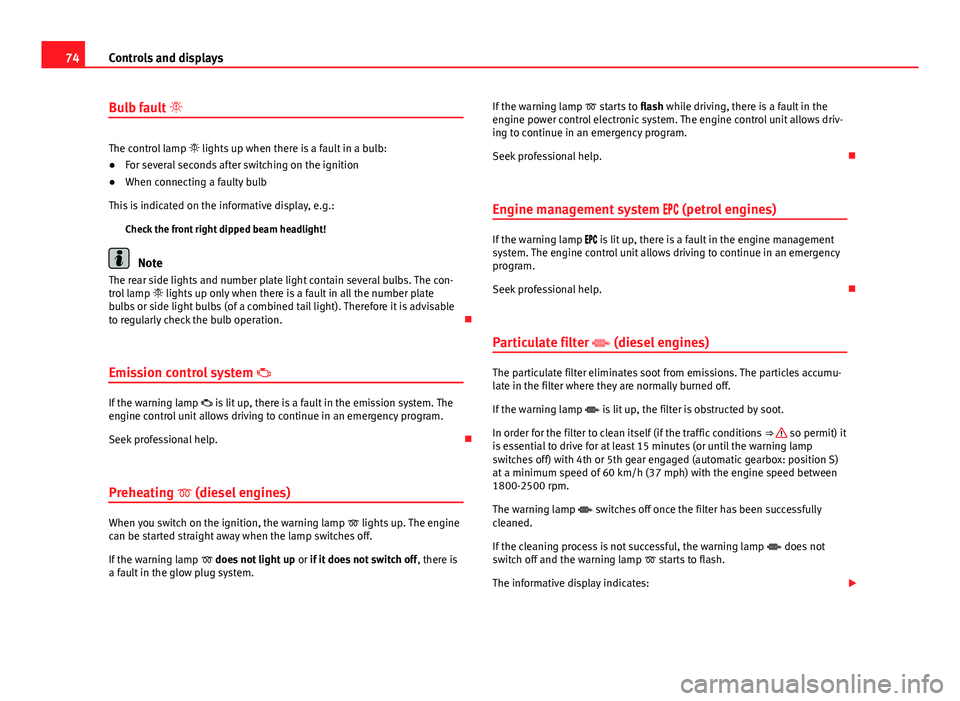
Bulb fault
The control lamp lights up when there is a fault in a bulb:
● For several seconds after switching on the ignition
● When connecting a faulty bulb
This is indicated on the informative display, e.g.: Check the front right dipped beam headlight!
Note
The rear side lights and number plate light contain several bulbs. The con-
trol lamp lights up only when there is a fault in all the number plate
bulbs or side light bulbs (of a combined tail light). Therefore it is advisable
to regularly check the bulb operation.
Emission control system
If the warning lamp is lit up, there is a fault in the emission system. The
engine control unit allows driving to continue in an emergency program.
Seek professional help.
Preheating (diesel engines)
When you switch on the ignition, the warning lamp lights up. The engine
can be started straight away when the lamp switches off.
If the warning lamp does not light up or if it does not switch off , there is
a fault in the glow plug system. If the warning lamp
starts to flash while driving, there is a fault in the
engine power control electronic system. The engine control unit allows driv-
ing to continue in an emergency program.
Seek professional help.
Engine management system (petrol engines)
If the warning lamp is lit up, there is a fault in the engine management
system. The engine control unit allows driving to continue in an emergency
program.
Seek professional help.
Particulate filter (diesel engines)
The particulate filter eliminates soot from emissions. The particles accumu-
late in the filter where they are normally burned off.
If the warning lamp is lit up, the filter is obstructed by soot.
In order for the filter to clean itself (if the traffic conditions ⇒
so permit) it
is essential to drive for at least 15 minutes (or until the warning lamp
switches off) with 4th or 5th gear engaged (automatic gearbox: position S)
at a minimum speed of 60 km/h (37 mph) with the engine speed between
1800-2500 rpm.
The warning lamp switches off once the filter has been successfully
cleaned.
If the cleaning process is not successful, the warning lamp does not
switch off and the warning lamp starts to flash.
The informative display indicates:
Page 77 of 258
75
Controls and displays
Diesel particulate filter. Instruction Manual!
The engine control unit allows driving to continue in an emergency program.
When switching the ignition off and on again, the warning lamp also
lights up.
Seek professional help.
WARNING
● The particulate filter attains very high temperatures. Therefore, do
not park the vehicle in places where the exhaust pipe could come into
contact with dry grass or with highly-flammable materials. Risk of fire!
● Always adjust your speed to suit the weather, road, terrain and traffic
conditions. Never be encouraged, by the recommendations shown in the
warning lamps, to fail to respect traffic legislation.
CAUTION
While the warning lamp is lit up, the fuel consumption is high, and in
certain conditions, the engine power is reduced.
Note
● In order for the particulate filter to burn off soot in a correct manner,
avoid carrying out frequent short journeys.
● Using diesel fuel with a high sulphur count can considerably reduce the
useful life of the particulate filter. The specialised service provides informa-
tion about the countries where fuel with a high sulphur content is used.
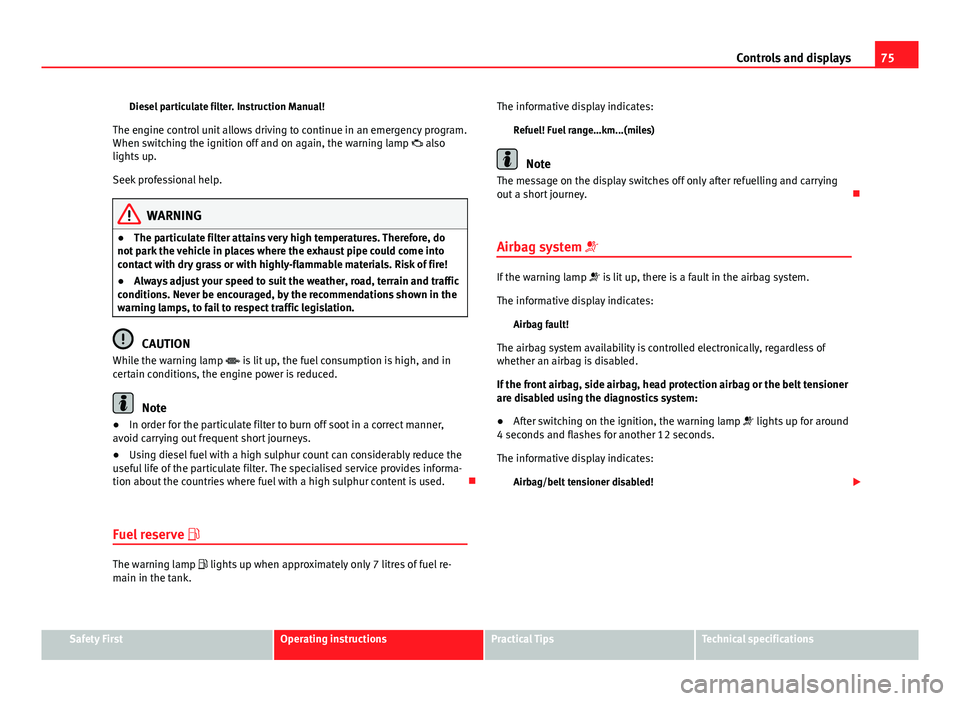
Fuel reserve
The warning lamp lights up when approximately only 7 litres of fuel re-
main in the tank. The informative display indicates:
Refuel! Fuel range…km...(miles)
Note
The message on the display switches off only after refuelling and carrying
out a short journey.
Airbag system
If the warning lamp is lit up, there is a fault in the airbag system.
The informative display indicates: Airbag fault!
The airbag system availability is controlled electronically, regardless of
whether an airbag is disabled.
If the front airbag, side airbag, head protection airbag or the belt tensioner
are disabled using the diagnostics system:
● After switching on the ignition, the warning lamp lights up for around
4 seconds and flashes for another 12 seconds.
The informative display indicates:
Airbag/belt tensioner disabled!
Safety FirstOperating instructionsPractical TipsTechnical specifications
Page 86 of 258
84Opening and closing
Opening and closing
Keys
General notes
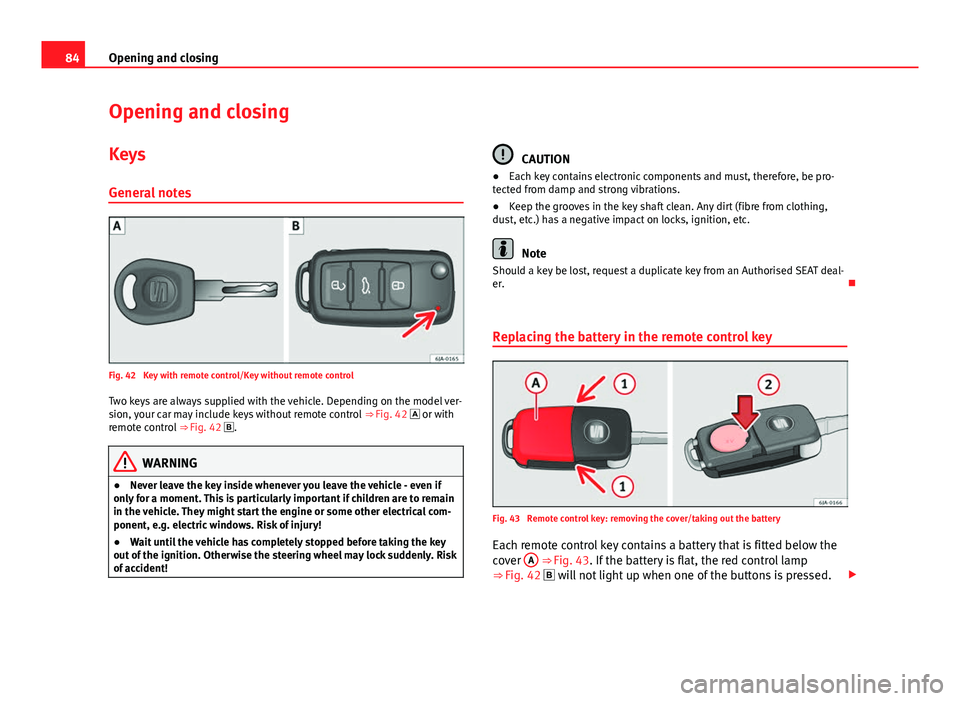
Fig. 42 Key with remote control/Key without remote control Two keys are always supplied with the vehicle. Depending on the model ver-
sion, your car may include keys without remote control ⇒ Fig. 42 or with
remote control ⇒ Fig. 42 .
WARNING
● Never leave the key inside whenever you leave the vehicle - even if
only for a moment. This is particularly important if children are to remain
in the vehicle. They might start the engine or some other electrical com-
ponent, e.g. electric windows. Risk of injury!
● Wait until the vehicle has completely stopped before taking the key
out of the ignition. Otherwise the steering wheel may lock suddenly. Risk
of accident!
CAUTION
● Each key contains electronic components and must, therefore, be pro-
tected from damp and strong vibrations.
● Keep the grooves in the key shaft clean. Any dirt (fibre from clothing,
dust, etc.) has a negative impact on locks, ignition, etc.
Note
Should a key be lost, request a duplicate key from an Authorised SEAT deal-
er.
Replacing the battery in the remote control key
Fig. 43 Remote control key: removing the cover/taking out the battery
Each remote control key contains a battery that is fitted below the
cover A
⇒ Fig. 43. If the battery is flat, the red control lamp
⇒ Fig. 42 will not light up when one of the buttons is pressed.
Page 91 of 258
89
Opening and closing
Manual locking
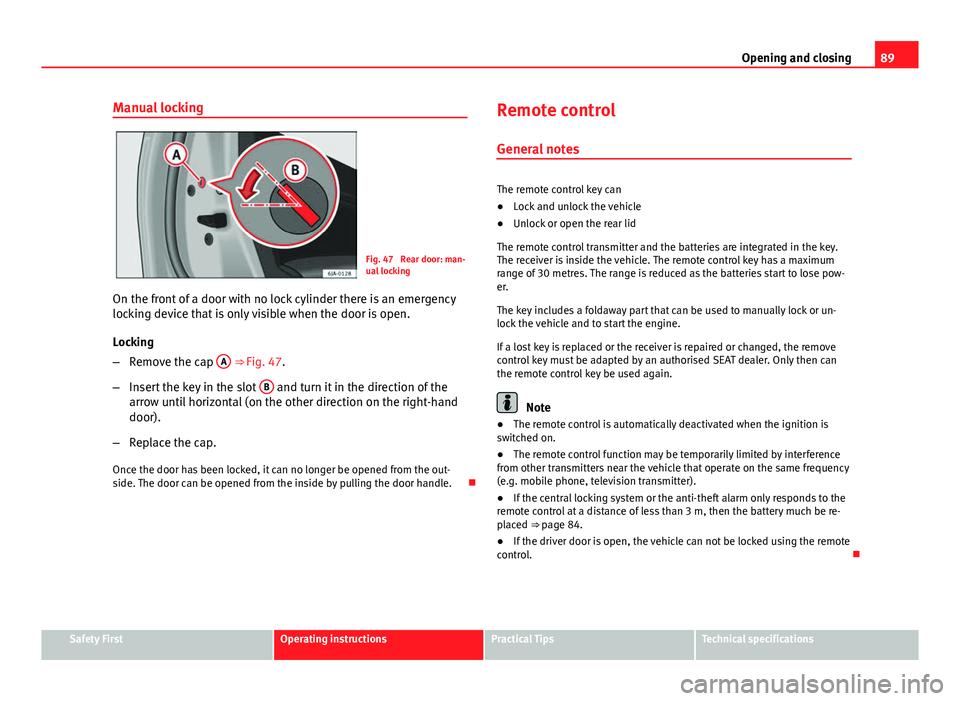
Fig. 47 Rear door: man-
ual locking
On the front of a door with no lock cylinder there is an emergency
locking device that is only visible when the door is open.
Locking
– Remove the cap A
⇒ Fig. 47.
– Insert the key in the slot B
and turn it in the direction of the
arrow until horizontal (on the other direction on the right-hand
door).
– Replace the cap.
Once the door has been locked, it can no longer be opened from the out-
side. The door can be opened from the inside by pulling the door handle. Remote control
General notes
The remote control key can
● Lock and unlock the vehicle
● Unlock or open the rear lid
The remote control transmitter and the batteries are integrated in the key.
The receiver is inside the vehicle. The remote control key has a maximum
range of 30 metres. The range is reduced as the batteries start to lose pow-
er.
The key includes a foldaway part that can be used to manually lock or un-
lock the vehicle and to start the engine.
If a lost key is replaced or the receiver is repaired or changed, the remove
control key must be adapted by an authorised SEAT dealer. Only then can
the remote control key be used again.
Note
● The remote control is automatically deactivated when the ignition is
switched on.
● The remote control function may be temporarily limited by interference
from other transmitters near the vehicle that operate on the same frequency
(e.g. mobile phone, television transmitter).
● If the central locking system or the anti-theft alarm only responds to the
remote control at a distance of less than 3 m, then the battery much be re-
placed ⇒ page 84.
● If the driver door is open, the vehicle can not be locked using the remote
control.
Safety FirstOperating instructionsPractical TipsTechnical specifications
Page 106 of 258

104Lights and visibility
Visibility
Heated rear window
Fig. 62 Heated rear win-
dow switch
– Switch the heated rear window on or off by pressing the button
⇒ Fig. 62, the warning lamp in the button will come on or go
off respectively.
The heated rear window only works when the engine is running.
After approx. 7 minutes, the rear window heating device switches off auto-
matically.
For the sake of the environment
The heated rear window should be switched off as soon as the glass is dem-
isted. By saving electrical power you can also save fuel ⇒ page 160, Save
electrical energy.
Note
In the event of a drop in voltage in the onboard systems, the heated rear
window switches off automatically to ensure enough power to control the
engine ⇒ page 194, Automatic disconnection of electrical equipment. Sun visors
Fig. 63 Driver sun visor
Fig. 64 Front passenger
sun visor
The sun visors for the driver and the front passenger can be pulled out of
their central supports and turned towards the doors in the direction of arrow 1
⇒ Fig. 63 and 2
⇒ Fig. 64 respectively.
The strip A
is to store small objects such as notepaper, etc.
The front passenger sun visor includes a vanity mirror B
with a cover. The
cover is opened by sliding it in the direction indicated by arrow 3
⇒
Fig. 64.
Page 108 of 258
106Lights and visibility
Windscreen wipers and windscreen washers
Introduction
The windscreen wipers and windscreen washers only work when the igni-
tion is switched on.
The rear window is wiped once if the windscreen wipers are switched on and
reverse gear is engaged.
Fill the windscreen washer fluid ⇒ page 190.
WARNING
● Make sure the blades ⇒ page 107 are in perfect condition for good
visibility and safe driving.
● In cold conditions, you should not use the wash/wipe system unless
you have warmed the windscreen with the heating and ventilation sys-
tem. The windscreen washer fluid could otherwise freeze on the wind-
screen and obscure your view of the road.
CAUTION
● During the winter, always check that the windscreen wiper blades are
not frozen to the glass before each trip or before switching on the ignition. If
you switch on the windscreen wipers when the wiper blades are frozen to
the glass, this could damage both the wiper blades and the wiper motor.
● If the ignition is switched off when the windscreen wipers are on, they
will start operating in the same mode when the ignition is switched back
on. The wiper blades could be frozen to the glass at low temperatures when
the ignition is switched off.
● Carefully separate the frozen wipers from the windscreen or rear win-
dow.
● Remove snow and ice from the wipers before starting your journey. ●
Careless handling could lead to the wiper arms damaging the wind-
screen.
● For safety reasons, the wiper blades should be changed once or twice a
year. They can be purchased at a SEAT Authorised Service.
● The ignition cannot be switched on while the windscreen wiper arms are
in a raised position. Otherwise, the windscreen wipers would return to their
original position and could damage the paintwork on the bonnet.
Note
Keep the wipers clean. The wipers can be soiled with remains of wax solu-
tions from car washes ⇒ page 173.
● On vehicles equipped with windscreen washer jets, these are heated
once the engine is running.
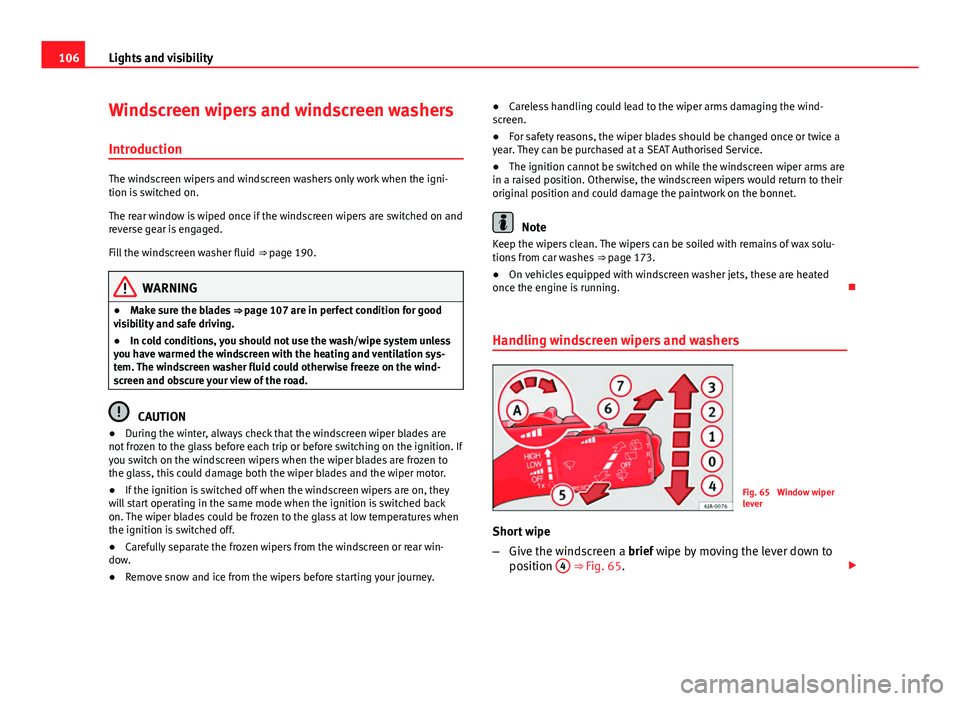
Handling windscreen wipers and washers
Fig. 65 Window wiper
lever
Short wipe
– Give the windscreen a brief wipe by moving the lever down to
position 4
⇒ Fig. 65.
Page 111 of 258
109
Lights and visibility
Rear vision mirrors
Interior rear vision mirror with manual anti-dazzle
adjustment
Basic settings
– Push the lever at the bottom of the mirror away from you.
Rear vision mirror anti-dazzle setting
– Pull the lever at the bottom of the mirror towards you.
Exterior mirrors
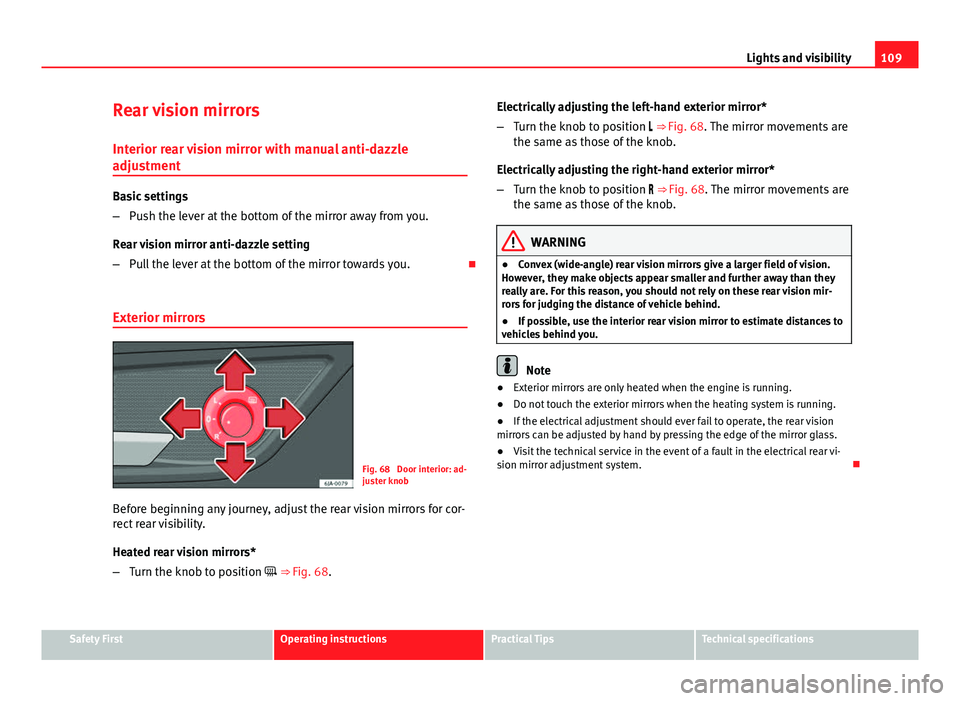
Fig. 68 Door interior: ad-
juster knob
Before beginning any journey, adjust the rear vision mirrors for cor-
rect rear visibility.
Heated rear vision mirrors*
– Turn the knob to position ⇒ Fig. 68. Electrically adjusting the left-hand exterior mirror*
–
Turn the knob to position ⇒ Fig. 68. The mirror movements are
the same as those of the knob.
Electrically adjusting the right-hand exterior mirror*
– Turn the knob to position ⇒ Fig. 68. The mirror movements are
the same as those of the knob.
WARNING
● Convex (wide-angle) rear vision mirrors give a larger field of vision.
However, they make objects appear smaller and further away than they
really are. For this reason, you should not rely on these rear vision mir-
rors for judging the distance of vehicle behind.
● If possible, use the interior rear vision mirror to estimate distances to
vehicles behind you.
Note
● Exterior mirrors are only heated when the engine is running.
● Do not touch the exterior mirrors when the heating system is running.
● If the electrical adjustment should ever fail to operate, the rear vision
mirrors can be adjusted by hand by pressing the edge of the mirror glass.
● Visit the technical service in the event of a fault in the electrical rear vi-
sion mirror adjustment system.
Safety FirstOperating instructionsPractical TipsTechnical specifications
Page 114 of 258
112Seats and storage
Heated front seats*
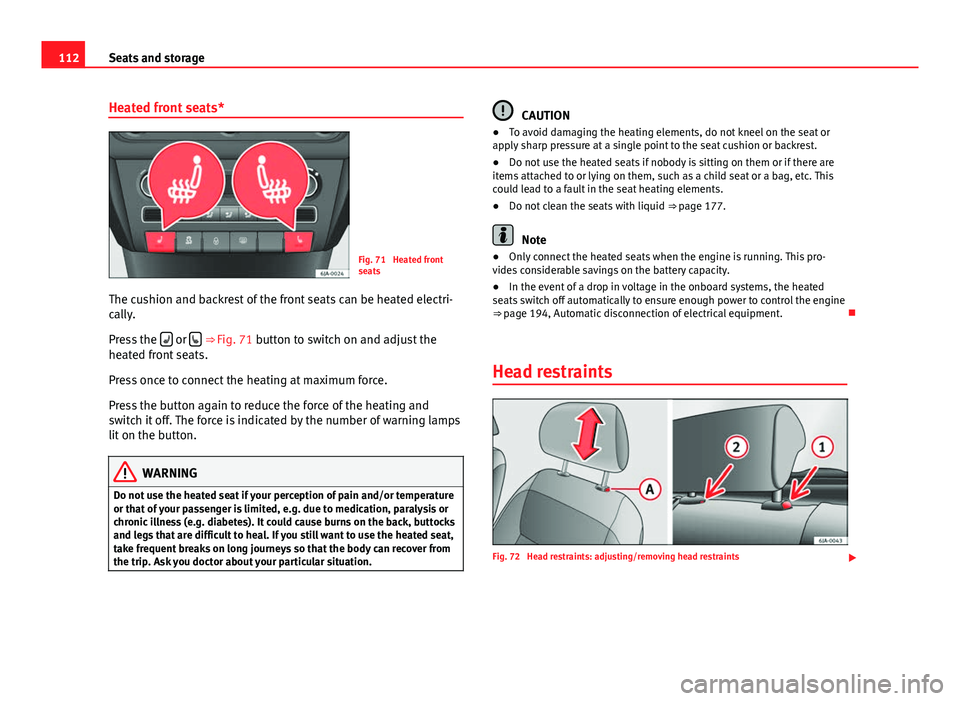
Fig. 71 Heated front
seats
The cushion and backrest of the front seats can be heated electri-
cally.
Press the
or ⇒
Fig. 71 button to switch on and adjust the
heated front seats.
Press once to connect the heating at maximum force.
Press the button again to reduce the force of the heating and
switch it off. The force is indicated by the number of warning lamps
lit on the button.
WARNING
Do not use the heated seat if your perception of pain and/or temperature
or that of your passenger is limited, e.g. due to medication, paralysis or
chronic illness (e.g. diabetes). It could cause burns on the back, buttocks
and legs that are difficult to heal. If you still want to use the heated seat,
take frequent breaks on long journeys so that the body can recover from
the trip. Ask you doctor about your particular situation.
CAUTION
● To avoid damaging the heating elements, do not kneel on the seat or
apply sharp pressure at a single point to the seat cushion or backrest.
● Do not use the heated seats if nobody is sitting on them or if there are
items attached to or lying on them, such as a child seat or a bag, etc. This
could lead to a fault in the seat heating elements.
● Do not clean the seats with liquid ⇒ page 177.
Note
● Only connect the heated seats when the engine is running. This pro-
vides considerable savings on the battery capacity.
● In the event of a drop in voltage in the onboard systems, the heated
seats switch off automatically to ensure enough power to control the engine
⇒ page 194, Automatic disconnection of electrical equipment.
Head restraints
Fig. 72 Head restraints: adjusting/removing head restraints
Page 124 of 258
122Seats and storage
WARNING
● Take care when using the cigarette lighter! Carelessness or negli-
gence when using the cigarette lighter can cause burns and serious inju-
ries.
● The cigarette lighter also works when the ignition is off and when the
ignition key is removed. Therefore, never leave children unsupervised in
the vehicle.
Note
● The 12 volt power socket of the cigarette lighter can also be used as a
power source for electrical appliances ⇒ page 122, 12 V power socket.
● Additional information ⇒ page 204, Accessories, modifications and
spare parts.
12 V power socket
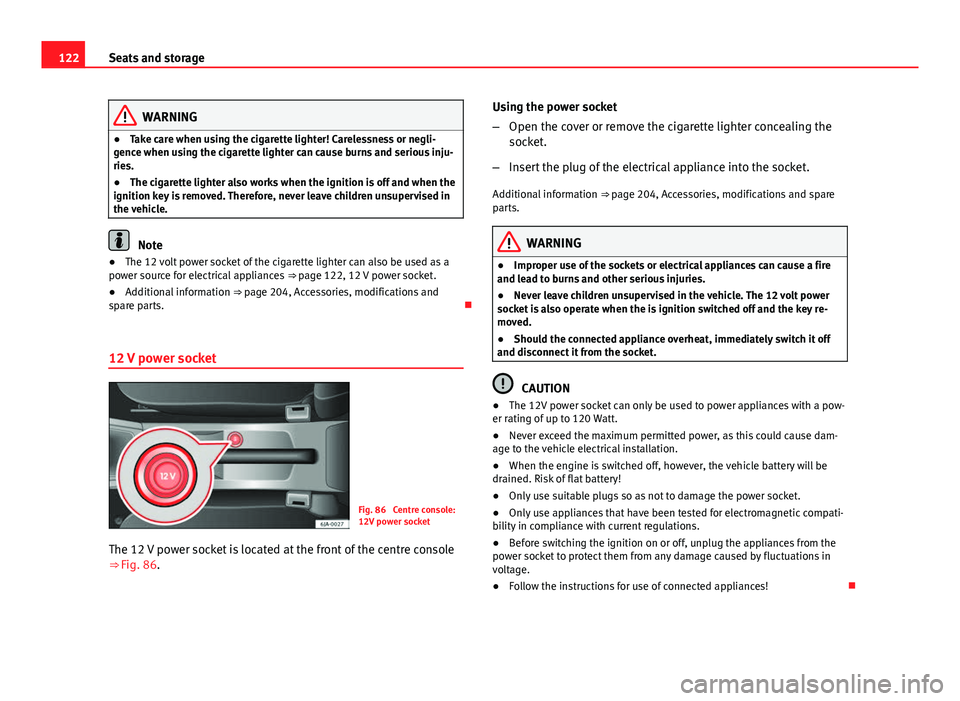
Fig. 86 Centre console:
12V power socket
The 12 V power socket is located at the front of the centre console
⇒ Fig. 86. Using the power socket
–
Open the cover or remove the cigarette lighter concealing the
socket.
– Insert the plug of the electrical appliance into the socket.
Additional information ⇒ page 204, Accessories, modifications and spare
parts.
WARNING
● Improper use of the sockets or electrical appliances can cause a fire
and lead to burns and other serious injuries.
● Never leave children unsupervised in the vehicle. The 12 volt power
socket is also operate when the is ignition switched off and the key re-
moved.
● Should the connected appliance overheat, immediately switch it off
and disconnect it from the socket.
CAUTION
● The 12V power socket can only be used to power appliances with a pow-
er rating of up to 120 Watt.
● Never exceed the maximum permitted power, as this could cause dam-
age to the vehicle electrical installation.
● When the engine is switched off, however, the vehicle battery will be
drained. Risk of flat battery!
● Only use suitable plugs so as not to damage the power socket.
● Only use appliances that have been tested for electromagnetic compati-
bility in compliance with current regulations.
● Before switching the ignition on or off, unplug the appliances from the
power socket to protect them from any damage caused by fluctuations in
voltage.
● Follow the instructions for use of connected appliances!
Page 130 of 258
128Heating and air conditioning
Heating and air conditioning
Heating and air conditioning General notes
The power of the heating depends on the temperature of the coolant. There-
fore, maximum power is only obtained when the engine has reached operat-
ing temperature.
The temperature and the humidity of the air is reduced when the system
cools the interior of the vehicle. This therefore increases the comfort of all
vehicle occupants when outside temperatures and humidity are high. It also
helps prevent the windows from misting over during cold periods of the
year.
The air recirculation system can be switched on temporarily to increase the
cooling effect.
Keep the air intake slots in front of the windscreen clear of ice, snow or
leaves to ensure unimpaired heating and cooling.
When the air conditioning is on, condensation can drip from the evaporator
in the air cooling system and form a pool underneath the vehicle. This is
normal and does not indicate a leak!
WARNING
● All windows must be clear of ice, snow and condensation for driving
safety. Therefore, make sure you familiarise yourself with the correct use
of heating and ventilation, window demisting and defrosting and cooling.
● Never use the air recirculation system for too long, as it prevents
fresh air from entering the vehicle and “used” air can cause tiredness, re-
duce your attention span and cause the windows to mist over. This in-
creases the risk of an accident. Switch off the air recirculation system as
soon as the windows begin to mist over.
Note
● Used air escapes through ventilation slots in the rear of the luggage
compartment.
● Smoking is not recommended while the air recirculation system is in
use, as the smoke drawn from the interior of the vehicle settles in the evap-
orator of the air conditioning system. This causes a persistent, unpleasant
smell while the system is running that is time-consuming and expensive
(evaporator replacement) to eliminate.
● Never cover the air outlets to ensure the system operates correctly.
Economic use of the air conditioning system
When the air conditioning is switched on, the compressor consumes engine
power and has influence on fuel consumption.
If the vehicle interior has overheated due to an excessive solar radiation, it
is best to open the windows or doors to allow the hot air to escape.