handbrake Seat Toledo 2013 User Guide
[x] Cancel search | Manufacturer: SEAT, Model Year: 2013, Model line: Toledo, Model: Seat Toledo 2013Pages: 258, PDF Size: 3.94 MB
Page 156 of 258
154Driving
To recover the set speed, briefly press switch B
in RES once you have re-
leased the brake or clutch pedal.
Switching off cruise control completely
– Move knob A ⇒ Fig. 109 ⇒ page 153 to OFF.
START-STOP*
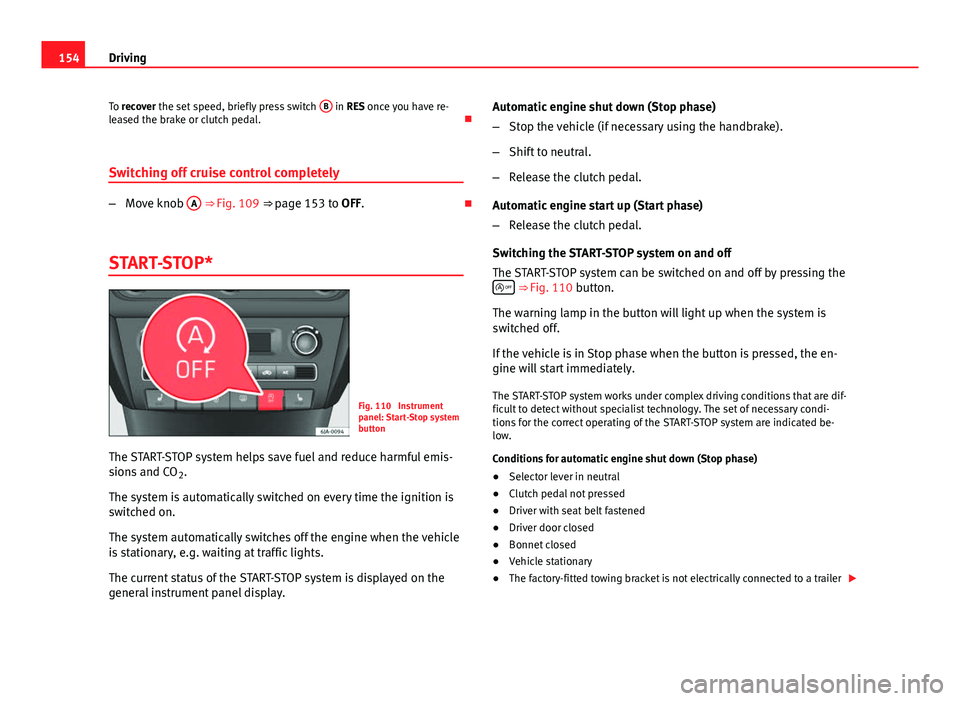
Fig. 110 Instrument
panel: Start-Stop system
button
The START-STOP system helps save fuel and reduce harmful emis-
sions and CO 2.
The system is automatically switched on every time the ignition is
switched on.
The system automatically switches off the engine when the vehicle
is stationary, e.g. waiting at traffic lights.
The current status of the START-STOP system is displayed on the
general instrument panel display. Automatic engine shut down (Stop phase)
–
Stop the vehicle (if necessary using the handbrake).
– Shift to neutral.
– Release the clutch pedal.
Automatic engine start up (Start phase)
– Release the clutch pedal.
Switching the START-STOP system on and off
The START-STOP system can be switched on and off by pressing the
⇒ Fig. 110 button.
The warning lamp in the button will light up when the system is
switched off.
If the vehicle is in Stop phase when the button is pressed, the en-
gine will start immediately.
The START-STOP system works under complex driving conditions that are dif-
ficult to detect without specialist technology. The set of necessary condi-
tions for the correct operating of the START-STOP system are indicated be-
low.
Conditions for automatic engine shut down (Stop phase)
● Selector lever in neutral
● Clutch pedal not pressed
● Driver with seat belt fastened
● Driver door closed
● Bonnet closed
● Vehicle stationary
● The factory-fitted towing bracket is not electrically connected to a trailer
Page 168 of 258
166Driving the vehicle with a trailer
WARNING
● Adjust your speed to suit the road and traffic conditions.
● An electrical installation that is connected incorrectly or by non-spe-
cialised personnel can prevent the connection of the current to the trailer
and cause faults in the electrical system operation throughout the entire
vehicle, leading to accidents and serious injury.
● All electrical work must be carried out only by the specialised serv-
ices.
● Never directly connect the trailer electrical device to the electrical
sockets of the reverse driving lights or other sources of electrical current.
CAUTION
● Avoid corners, and sudden and sharp braking.
● Once the trailing arm has been removed, place the corresponding cover
on the hole of the fastening point. This prevents dirt from entering the hole
– see the trailer system assembly manual.
Note
● In the event of frequent journeys with a trailer, we recommend also hav-
ing the vehicle inspected in-between the service intervals.
● When connecting and disconnecting the trailer, the handbrake must be
applied.
● For technical reasons, trailers with LED reverse lights cannot be incorpo-
rated into the vehicle anti-theft alarm system.
Page 184 of 258
182Checking and refilling levels
● Water allowed to collect in the fuel filter can cause engine faults.
● Your vehicle is not prepared for use of biofuel (RME) and, therefore, this
fuel must not be used for refuelling or driving. The use of biofuel (RME)
could cause serious damage to the engine or the fuel system.
Engine compartment
Introduction
Always be aware of the danger of injury and scalding as well as the risk of
accident or fire when working in the engine compartment, e.g. when check-
ing and refilling fluids. Therefore, always observe the warnings and follow
all general safety precautions. The engine compartment of any motor vehi-
cle is a potentially hazardous area .
WARNING
● Never open the bonnet if you see steam, smoke or coolant escaping
from the engine compartment. Risk of scalding! Wait until no steam or
coolant can be seen before opening the bonnet.
● Switch off the engine and remove the key from the ignition.
● Engage neutral in vehicles with manual gearbox and move the selec-
tor lever to position P in vehicles with automatic gearbox.
● Apply the handbrake firmly.
● Wait for the engine to cool down.
● For safety reasons, the bonnet must always be closed when the vehi-
cle is moving. Therefore, after closing the bonnet always check that it is
properly secured.
WARNING (Continued)
● Should you notice that the bonnet is not safely secured when the ve-
hicle is moving, stop the vehicle immediately and close the bonnet prop-
erly. Risk of accident!
● Keep children away from the engine compartment.
● Do not touch hot engine parts. Risk of burns!
● Never spill fluids on hot engine compartments. These fluids can
cause a fire (e.g. antifreeze in coolant).
● Take care not to cause short circuits in the electrical system, especial-
ly when working on the battery.
● Never touch the radiator fan when the engine is hot. The fan may start
running suddenly!
● Do not unscrew the cap on the coolant expansion tank when the en-
gine is hot. The cooling system is under pressure!
● Protect face, hands and arms from any hot steam or hot coolant re-
leased by covering the cap with a large, thick rag when opening the ex-
pansion tank.
● Do not leave any objects, such as cloths and tools, in the engine com-
partment.
● When working underneath the vehicle, secure it so that it cannot roll
away and support it safely on suitable supports. The hydraulic jack is not
sufficient for this purpose. Risk of injuries!
● If any tests have to be performed with the engine running, there is an
extra safety risk from rotating parts, such as the drive belt, alternator
and radiator fan, etc., and from the high-voltage ignition system. You
should also note the following:
–Never touch the electrical wiring of the ignition system.
– Keep away from moving engine parts when wearing jewellery,
loose clothing or long hair. Risk of fatal injuries! All jewellery must be
removed, hair tied back and close-fitting clothing worn.
● Observe the following additional warnings if work on the fuel system
or the electrical system is necessary.
–Always disconnect the battery from the on-board network.
– Do not smoke.
Page 210 of 258
208Self-help
WARNING (Continued)
● Always raise the vehicle with the doors closed.
● Never place parts of your body, e.g. arms and legs, underneath the
vehicle when supported only by the jack.
● Secure the base of the jack with suitable supports so that it cannot
slip. The jack could slide if the ground below it is soft and slippery and
the vehicle could slip off it. Therefore, place the jack on a firm surface or
use a large, stable base. On a slippery surface, e.g. tiles, use a non-slip
base such as a rubber mat.
● Never start the engine when the vehicle is raised. Risk of injury.
● The jack should only be used in the correct jacking points.
CAUTION
● The prescribed tightening torque for wheel bolts on steel and alloy
wheels is 120 Nm.
● If the anti-theft wheel bolt is overly tightened, this could damage the
bolt and the adapter
Note
● The set of anti-theft wheel bolts or the adapter are available from au-
thorised SEAT dealers.
● Please observe the relevant local legal regulations when changing the
wheel.
Preparation work
Some preparation is required before changing a wheel:
– If you have a flat tyre, stop the vehicle as far away as possible
from moving traffic. The surface must be horizontal.–
All vehicle occupants should leave the vehicle . Vehicle occu-
pants should waiting in a safe place, e.g. behind the roadside
crash barrier) while the wheel is being changed.
– Switch off the ignition and engage neutral or move the selector
lever on the automatic gearbox to position P.
– Apply the handbrake firmly.
– If towing a trailer, unhitch it.
– Take the vehicle tool kit ⇒ page 207 and the spare wheel
⇒ page 207 out of the luggage compartment.
Changing a wheel
If possible, change the wheel on a level surface.
– Pull off the hub cap ⇒ page 200 or the wheel bolt covers
⇒ page 200.
– First loosen the anti-theft wheel bolts and then the other wheel
bolts ⇒ page 209.
– Raise the vehicle until the wheel to be changed is no longer
touching the ground ⇒ page 210.
– Remove the wheel bolts and place them on a clean surface
(cloth, paper, etc.).
– Take off the wheel.
– Lift the spare wheel into position and tighten the wheel bolts
lightly.
Page 215 of 258
213
Self-help
Before using the tyre repair kit
The following jobs must be performed before using the tyre repair
kit:
– If you have a flat tyre, stop the vehicle well away from moving
traffic. Stop on flat, solid ground.
– All vehicle occupants should leave the vehicle. Vehicle occu-
pants should waiting in a safe place, e.g. behind the roadside
crash barrier) while the wheel is being changed.
– Switch off the ignition and engage neutral or move the selector
lever on the automatic gearbox to position P.
– Apply the handbrake firmly.
– Check whether the tyre can be repaired using the tyre repair kit
⇒ page 211.
– If towing a trailer, unhitch it.
– Take the tyre repair kit out of the luggage compartment.
– Fix the sticker 2
⇒ Fig. 142 ⇒
page 212 onto the dash panel
where the driver will see it.
– Do not remove the foreign body, e.g. bolts or nails, from the
tyre.
– Unscrew the tyre valve cap.
– Using the valve extractor 1
, unscrew the valve insert and place
it onto a clean surface (cloth, paper, etc.) Filling and inflating the tyre
Filling the tyre
–
Shake the tyre sealant can 10
⇒ Fig. 142 ⇒ page 212 thorough-
ly several times.
– Attach the flexible filling hose 3
onto the can 10. The foil seal-
ing the can will be automatically pierced.
– Remove the cap from the flexible filling hose 3
and insert the
open end as far as it will go into the tyre valve.
– Hold the can 10
upside down and fill the complete contents of
the can into the tyre.
– Remove the empty can from the tyre.
– Screw the valve insert back into the tyre valve using the valve
extractor 1
.
Inflating the tyre
– Screw the tyre filling hose 5
⇒ Fig. 142 ⇒ page 212 firmly onto
the tyre valve.
– Make sure that the bleed screw 7
is closed.
– Start the vehicle engine and leave it running.
– Plug the connector 9
into the 12-volt power socket.
– Turn the air compressor on with the switch 8
.
– Leave the air compressor running until the tyre pressure has
reached 2.0-2.5 bar (29-36 psi / 200-250 kPa). Max. operating
time for the compressor is 8 minutes ⇒
!
Safety FirstOperating instructionsPractical TipsTechnical specifications
Page 250 of 258
Brakeshandbrake . . . . . . . . . . . . . . . . . . . . . . . . . 143
running in . . . . . . . . . . . . . . . . . . . . . . . . . . 157
warning lamps . . . . . . . . . . . . . . . . . . . . . . . 70
Brake servo . . . . . . . . . . . . . . . . . . . . . . . . . . . . 143 Brake servo . . . . . . . . . . . . . . . . . . . . . . . . . 143
bulbs – changing . . . . . . . . . . . . . . . . . . . . . . . 222
Button on driver door opening and closing electric windows . . . . 95
C
Car computer see multi-function display . . . . . . . . . . . . . . 61
Care of the vehicle . . . . . . . . . . . . . . . . . . . . . . 172
Care of vehicle automatic car wash . . . . . . . . . . . . . . . . . . 173
cleaning chrome . . . . . . . . . . . . . . . . . . . . . 174
cleaning wheels . . . . . . . . . . . . . . . . . . . . . 176
door lock cylinder . . . . . . . . . . . . . . . . . . . . 175
headlights . . . . . . . . . . . . . . . . . . . . . . . . . 175
high-pressure cleaners . . . . . . . . . . . . . . . 174
leatherette . . . . . . . . . . . . . . . . . . . . . . . . . 177
natural leather . . . . . . . . . . . . . . . . . . . . . . 177
plastic parts . . . . . . . . . . . . . . . . . . . . . . . . 175
polishing of paintwork . . . . . . . . . . . . . . . . 174
rubber seals . . . . . . . . . . . . . . . . . . . . . . . . 175
seat belts . . . . . . . . . . . . . . . . . . . . . . . . . . 178
upholstery . . . . . . . . . . . . . . . . . . . . . . . . . . 177
washing . . . . . . . . . . . . . . . . . . . . . . . . . . . 173
washing by hand . . . . . . . . . . . . . . . . . . . . 173
waxing . . . . . . . . . . . . . . . . . . . . . . . . . . . . . 174
carrier . . . . . . . . . . . . . . . . . . . . . . . . . . . . . . . . 119 Catalytic converter . . . . . . . . . . . . . . . . . . . . . . 157
Central lock button . . . . . . . . . . . . . . . . . . . . . . . 88
Central locking system . . . . . . . . . . . . . . . . . . . . 86
locking . . . . . . . . . . . . . . . . . . . . . . . . . . . . . 88
unlocking . . . . . . . . . . . . . . . . . . . . . . . . . . . 87
Changing a wheel . . . . . . . . . . . . . . . . . . . . . . . . . . . . 207
battery . . . . . . . . . . . . . . . . . . . . . . . . . . . . . 194
blades . . . . . . . . . . . . . . . . . . . . . . . . . . . . . 107
bulbs . . . . . . . . . . . . . . . . . . . . . . . . . . . . . . 222
engine oil . . . . . . . . . . . . . . . . . . . . . . . . . . 187
fuses . . . . . . . . . . . . . . . . . . . . . . . . . . . . . . 219
wiper blades . . . . . . . . . . . . . . . . . . . . . . . . 108
Changing bulbs double headlight bulbs . . . . . . . . . . . . . . . 223
front fog light bulbs . . . . . . . . . . . . . . . . . . 226
Changing gear economical driving . . . . . . . . . . . . . . . . . . . 158
recommended gear . . . . . . . . . . . . . . . . . . . 60
Charging the battery . . . . . . . . . . . . . . . . . . . . 193
Checking battery acid level . . . . . . . . . . . . . . . . . . . . 193
brake fluid . . . . . . . . . . . . . . . . . . . . . . . . . . 189
coolant . . . . . . . . . . . . . . . . . . . . . . . . . . . . 188
engine oil . . . . . . . . . . . . . . . . . . . . . . . . . . 186
oil level . . . . . . . . . . . . . . . . . . . . . . . . . . . . 186
windscreen washer . . . . . . . . . . . . . . . . . . 190
Checking fluid levels engine compartment . . . . . . . . . . . . . . . . . 238
Childproof locks . . . . . . . . . . . . . . . . . . . . . . . . . 85
Child safety . . . . . . . . . . . . . . . . . . . . . . . . . . . . . 46 Child seat
Categorisation in groups . . . . . . . . . . . . . . . 48
Group 1 . . . . . . . . . . . . . . . . . . . . . . . . . . . . . 49
Group 2 . . . . . . . . . . . . . . . . . . . . . . . . . . . . . 49
Group 3 . . . . . . . . . . . . . . . . . . . . . . . . . . . . . 49
Groups 0 and 0+ . . . . . . . . . . . . . . . . . . . . . . 48
Safety notes . . . . . . . . . . . . . . . . . . . . . . . . . 46
Securing . . . . . . . . . . . . . . . . . . . . . . . . . . . . 51
Child seats . . . . . . . . . . . . . . . . . . . . . . . . . . . . . 48 ISOFIX system . . . . . . . . . . . . . . . . . . . . . . . . 52
on the front passenger seat . . . . . . . . . . . . . 32
Top Tether system . . . . . . . . . . . . . . . . . . . . 52
Cigarette lighter . . . . . . . . . . . . . . . . . . . . . . . . 121
Cleaning . . . . . . . . . . . . . . . . . . . . . . . . . . . . . . 172 chrome . . . . . . . . . . . . . . . . . . . . . . . . . . . . 174
headlights . . . . . . . . . . . . . . . . . . . . . . . . . 175
leatherette . . . . . . . . . . . . . . . . . . . . . . . . . 177
natural leather . . . . . . . . . . . . . . . . . . . . . . 177
plastic parts . . . . . . . . . . . . . . . . . . . . . . . . 175
upholstery . . . . . . . . . . . . . . . . . . . . . . . . . . 177
wheels . . . . . . . . . . . . . . . . . . . . . . . . . . . . . 176
Cleaning chrome see care of vehicle . . . . . . . . . . . . . . . . . . . 174
Climatronic air recirculation . . . . . . . . . . . . . . . . . . . . . 137
Clock . . . . . . . . . . . . . . . . . . . . . . . . . . . . . . . . . . 60
Coat hooks . . . . . . . . . . . . . . . . . . . . . . . . . . . . 127
Compartments . . . . . . . . . . . . . . . . . . . . . . . . . 123
Computer see multi-function display . . . . . . . . . . . . . . 61
control lamp . . . . . . . . . . . . . . . . . . . . . . . . . . . . 33
Control lamps . . . . . . . . . . . . . . . . . . . . . . . . . . . 69
248 Index
Page 252 of 258
Environment . . . . . . . . . . . . . . . . . . . . . . . . . . . 157Environmental friendliness . . . . . . . . . . . . 161
ESC . . . . . . . . . . . . . . . . . . . . . . . . . . . . . . . . . . 144 control lamp . . . . . . . . . . . . . . . . . . . . . . . . . 72
extending the rear lid locking time see rear lid . . . . . . . . . . . . . . . . . . . . . . . . . . 93
F
Fastening rings . . . . . . . . . . . . . . . . . . . . . . . . . . 18
Fire extinguisher . . . . . . . . . . . . . . . . . . . . . . . . 206
First-aid kit . . . . . . . . . . . . . . . . . . . . . . . . . . . . 206
Floor mats . . . . . . . . . . . . . . . . . . . . . . . . . . 17, 151
Front airbags . . . . . . . . . . . . . . . . . . . . . . . . . . . 35 Description . . . . . . . . . . . . . . . . . . . . . . . . . . 35
Operation . . . . . . . . . . . . . . . . . . . . . . . . . . . 36
Safety notes . . . . . . . . . . . . . . . . . . . . . . . . . 37
Front fog light bulb . . . . . . . . . . . . . . . . . . . . . . 226
Front seats . . . . . . . . . . . . . . . . . . . . . . . . . . . . 110
Fuel . . . . . . . . . . . . . . . . . . . . . . . . . . . . . . . . . . 179 fuel gauge . . . . . . . . . . . . . . . . . . . . . . . . . . . 58
refuelling . . . . . . . . . . . . . . . . . . . . . . . . . . . 179
see fuel . . . . . . . . . . . . . . . . . . . . . . . . . . . . 179
unleaded petrol . . . . . . . . . . . . . . . . . . . . . 180
Fuel consumption . . . . . . . . . . . . . . . . . . . . . . . 157
Fuses changing . . . . . . . . . . . . . . . . . . . . . . . . . . . 219
Fuse box . . . . . . . . . . . . . . . . . . . . . . . . . . . 220
Identifying blown fuses . . . . . . . . . . . . . . . 221
Identifying by colours . . . . . . . . . . . . . . . . 220
position . . . . . . . . . . . . . . . . . . . . . . . . . . . . 219 Preparation before replacing . . . . . . . . . . . 221
Replacement . . . . . . . . . . . . . . . . . . . . . . . . 221
G
Gauge coolant temperature . . . . . . . . . . . . . . . . . . . 58
fuel level . . . . . . . . . . . . . . . . . . . . . . . . . . . . 58
General instrument panel . . . . . . . . . . . . . . . . . 57
H
Handbrake . . . . . . . . . . . . . . . . . . . . . . . . . . . . 143
Hazard warning lights . . . . . . . . . . . . . . . . . . . . . . . 101
HBA . . . . . . . . . . . . . . . . . . . . . . . . . . . . . . . . . . 144
Headlights driving abroad . . . . . . . . . . . . . . . . . . . . . . 161
Headlight washer system . . . . . . . . . . . . . 107
Head restraints . . . . . . . . . . . . . . . . . . . . . . . . . 112
Heated rear window . . . . . . . . . . . . . . . . . . . . . 104
Heating . . . . . . . . . . . . . . . . . . . . . . . . . . . . . . . 130 air recirculation . . . . . . . . . . . . . . . . . . . . . 131
defrosting windows . . . . . . . . . . . . . . . . . . 131
exterior mirrors . . . . . . . . . . . . . . . . . . . . . . 109
rear window . . . . . . . . . . . . . . . . . . . . . . . . 104
seats . . . . . . . . . . . . . . . . . . . . . . . . . . . . . . 112
HHC . . . . . . . . . . . . . . . . . . . . . . . . . . . . . . . . . . 144
Hill-hold control . . . . . . . . . . . . . . . . . . . . . . . . 144
Horn . . . . . . . . . . . . . . . . . . . . . . . . . . . . . . . . . . 55 I
Identification plate . . . . . . . . . . . . . . . . . . . . . . 234
Ignition . . . . . . . . . . . . . . . . . . . . . . . . . . . . . . . 141
Ignition lock . . . . . . . . . . . . . . . . . . . . . . . . . . . 141
Immobiliser . . . . . . . . . . . . . . . . . . . . . . . . . . . . 141
Informative display see MAXI DOT . . . . . . . . . . . . . . . . . . . . . . . . 66
Instrument panel see general instrument panel . . . . . . . . . . . 57
Interior ashtray . . . . . . . . . . . . . . . . . . . . . . . . . . . . 121
cigarette lighter . . . . . . . . . . . . . . . . . . . . . 121
lighting . . . . . . . . . . . . . . . . . . . . . . . . . . . . 102
Power socket . . . . . . . . . . . . . . . . . . . . . . . 122
Storage compartment . . . . . . . . . . . . . . . . 123
Interval wipe . . . . . . . . . . . . . . . . . . . . . . . . . . . 107
ISOFIX system . . . . . . . . . . . . . . . . . . . . . . . . . . . 52
J Jack . . . . . . . . . . . . . . . . . . . . . . . . . . . . . . . . . . 207 securing . . . . . . . . . . . . . . . . . . . . . . . . . . . 210
Jump-starting . . . . . . . . . . . . . . . . . . . . . . . . . . 214
K
Keys . . . . . . . . . . . . . . . . . . . . . . . . . . . . . . . . . . . 84
250 Index