fuel Seat Toledo 2013 Owner's Guide
[x] Cancel search | Manufacturer: SEAT, Model Year: 2013, Model line: Toledo, Model: Seat Toledo 2013Pages: 258, PDF Size: 3.94 MB
Page 160 of 258
158Driving and the environment
Fuel consumption also depends on factors that cannot be influenced by the
driver. It is normal for consumption to be greater in winter or in difficult con-
ditions, on roads in poor condition, when towing a trailer, etc.
Fuel consumption can also vary considerably from that stated by the manu-
facturer due to the outside temperature, the weather and driving style.
The vehicle has factory-fitted technical conditions in order to save fuel and
to operate in economic mode. SEAT pays special attention to minimize the
environmental impact. Take the following indications in this chapter into ac-
count in order to conserve and to take advantage of these qualities:
The engine speed must be maintained at the maximum in order to prevent
vehicle resonance and high fuel consumption.
Foresighted driving
The vehicle consumes the majority of fuel when accelerating, therefore
avoid unnecessary acceleration and braking. If you think ahead when driv-
ing, you will need to brake less and thus accelerate less. For example, when
approaching a red traffic light, allow the vehicle to decelerate freely or use
the engine braking effect. Saving energy when changing gear
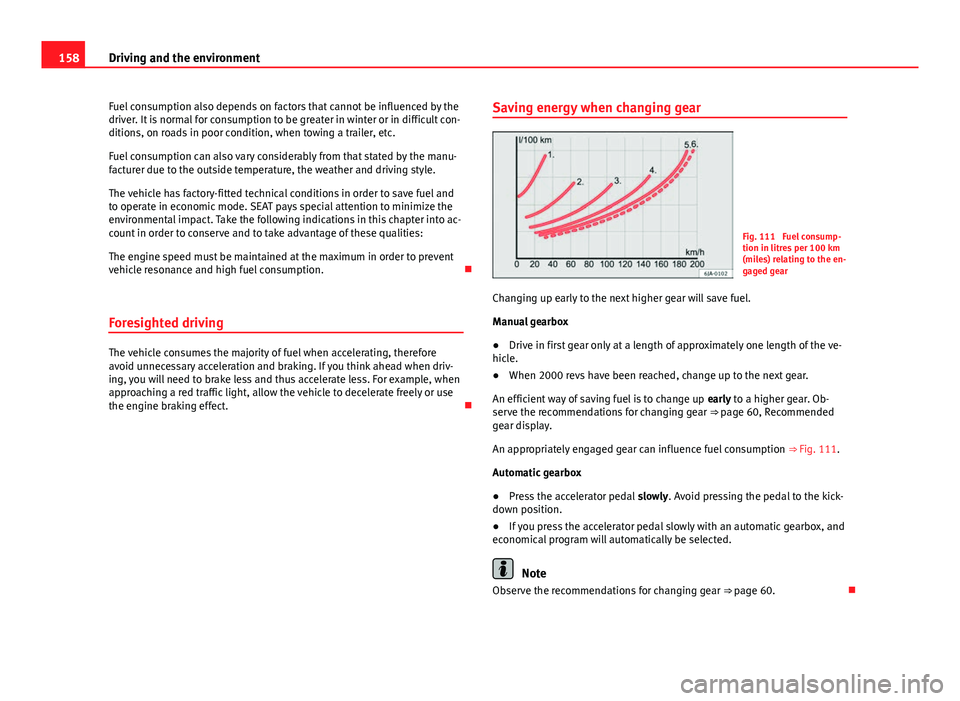
Fig. 111 Fuel consump-
tion in litres per 100 km
(miles) relating to the en-
gaged gear
Changing up early to the next higher gear will save fuel.
Manual gearbox
● Drive in first gear only at a length of approximately one length of the ve-
hicle.
● When 2000 revs have been reached, change up to the next gear.
An efficient way of saving fuel is to change up early to a higher gear. Ob-
serve the recommendations for changing gear ⇒ page 60, Recommended
gear display.
An appropriately engaged gear can influence fuel consumption ⇒ Fig. 111.
Automatic gearbox
● Press the accelerator pedal slowly. Avoid pressing the pedal to the kick-
down position.
● If you press the accelerator pedal slowly with an automatic gearbox, and
economical program will automatically be selected.
Note
Observe the recommendations for changing gear ⇒ page 60.
Page 161 of 258
159
Driving and the environment
Avoid driving at full speed
Fuel can be saved by driving at a slower speed.
Accelerating slowly not only considerably reduces fuel consumption, but al-
so reduces the environmental impact and vehicle wear.
If possible, you should never take advantage of the maximum speed of your
vehicle. Fuel consumption, exhaust emissions of toxic substances and
noise levels all increase very rapidly at higher speeds.
You can reduce fuel consumption by about one half if you do not drive faster
than three quarters of top speed.
Reduce idling
Idling also consumes fuel.
In a vehicle that does not have the START-STOP function, stop the engine in
traffic jams, level crossings and at traffic lights that remain red for a long
period of time. After 30-40 seconds with the engine switched off, the fuel
savings are greater that the quantity of fuel required to restart the engine
again.
When the engine is idling, a great deal of time is required in order for the
engine to reach operating temperature. When heating the vehicle, however,
engine waste and emissions of toxic substances are elevated. Therefore, im-
mediately begin driving after switching on the engine. Doing so avoids high
engine speeds.
Regular maintenance
A badly tuned engine unnecessarily consumes a large quantity of fuel. Conditions for economical driving can be created with regular maintenance
at an Official Service. Maintenance of your vehicle has positive repercus-
sions on traffic safety and conserving the value of the vehicle.
A badly tuned engine can result in fuel consumption that is 10% higher
than normal!
Additionally, check the
oil level after refuelling. Oil consumption depends
to a great extent on the engine load and engine speed. Depending on your
driving style, oil consumption can reach 0.5 litres per 1000 km (600 miles).
It is normal for the oil consumption of a new engine not to reach its mini-
mum level until after a period of running in time. Therefore, the oil con-
sumption of a new vehicle can only be judged correctly after covering 5000
km (3000 miles).
For the sake of the environment
● An additional reduction in consumption can be achieved using high-per-
formance synthetic oils.
● In order to detect leaks in good time, check the ground underneath the
vehicle regularly. If you notice stains from oils or other operating liquids,
contact an Official Service.
Note
We recommend that you have regular maintenance performed on your vehi-
cle a the SEAT Authorised Service.
Safety FirstOperating instructionsPractical TipsTechnical specifications
Page 162 of 258
160Driving and the environment
Make less short journeys
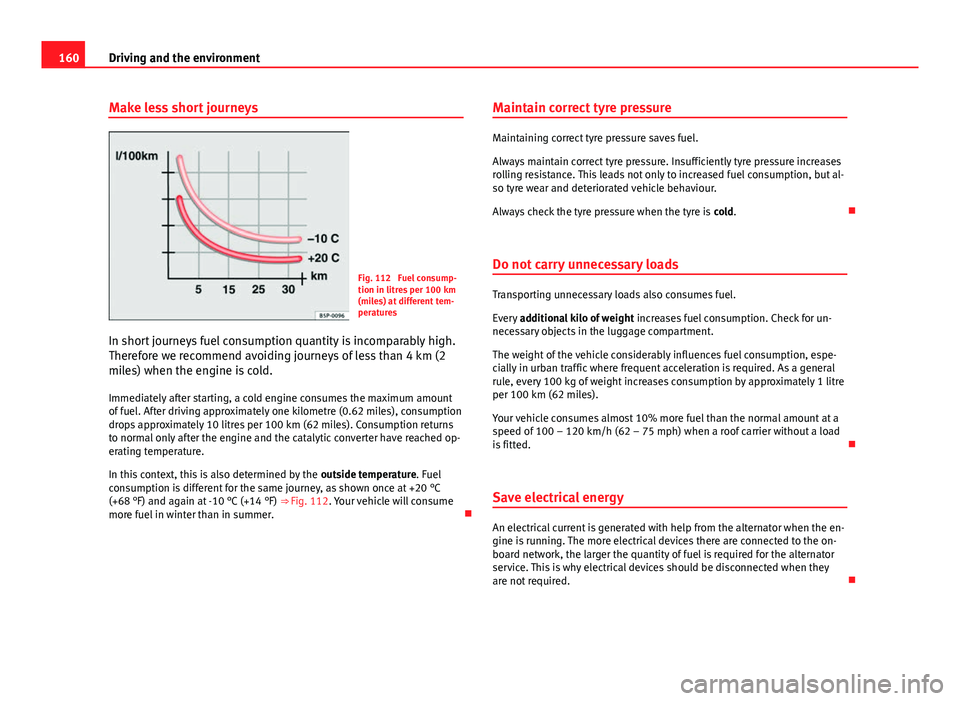
Fig. 112 Fuel consump-
tion in litres per 100 km
(miles) at different tem-
peratures
In short journeys fuel consumption quantity is incomparably high.
Therefore we recommend avoiding journeys of less than 4 km (2
miles) when the engine is cold. Immediately after starting, a cold engine consumes the maximum amount
of fuel. After driving approximately one kilometre (0.62 miles), consumption
drops approximately 10 litres per 100 km (62 miles). Consumption returns
to normal only after the engine and the catalytic converter have reached op-
erating temperature.
In this context, this is also determined by the outside temperature. Fuel
consumption is different for the same journey, as shown once at +20 °C
(+68 °F) and again at -10 °C (+14 °F) ⇒ Fig. 112. Your vehicle will consume
more fuel in winter than in summer. Maintain correct tyre pressure
Maintaining correct tyre pressure saves fuel.
Always maintain correct tyre pressure. Insufficiently tyre pressure increases
rolling resistance. This leads not only to increased fuel consumption, but al-
so tyre wear and deteriorated vehicle behaviour.
Always check the tyre pressure when the tyre is
cold.
Do not carry unnecessary loads
Transporting unnecessary loads also consumes fuel.
Every additional kilo of weight increases fuel consumption. Check for un-
necessary objects in the luggage compartment.
The weight of the vehicle considerably influences fuel consumption, espe-
cially in urban traffic where frequent acceleration is required. As a general
rule, every 100 kg of weight increases consumption by approximately 1 litre
per 100 km (62 miles).
Your vehicle consumes almost 10% more fuel than the normal amount at a
speed of 100 – 120 km/h (62 – 75 mph) when a roof carrier without a load
is fitted.
Save electrical energy
An electrical current is generated with help from the alternator when the en-
gine is running. The more electrical devices there are connected to the on-
board network, the larger the quantity of fuel is required for the alternator
service. This is why electrical devices should be disconnected when they
are not required.
Page 163 of 258
161
Driving and the environment
Environmental friendliness
Environmental protection is a top priority in the design, choice of materials
and manufacture of your new SEAT.
Constructive measures to encourage recycling
● Joints and connections designed for easy dismantling
● Modular construction to facilitate dismantling
● Increased use of single-grade materials.
● Plastic parts and elastomers are marked in accordance with ISO 1043,
ISO 11469 and ISO 1629.
Choice of materials
● Use of recycled materials.
● Use of compatible plastics in the same part if its components are not
easily separated.
● Use of recycled materials and/or materials originating from renewable
sources.
● Reduction of volatile components, including odour, in plastic materials.
● Use of CFC-free coolants.
Ban on heavy metals, with the exceptions dictated by law (Annex II of ELV
Directive 2000/53/EC): cadmium, lead, mercury, hexavalent chromium.
Manufacturing methods
● Reduction of the quantity of thinner in the protective wax for cavities.
● Use of plastic film as protection during vehicle transport.
● Use of solvent-free adhesives.
● Use of CFC-free coolants in cooling systems.
● Recycling and energy recovery from residues (RDF).
● Improvement in the quality of waste water. ●
Use of systems for the recovery of residual heat (thermal recovery, en-
thalpy wheels, etc.).
● The use of water-soluble paints
Driving abroad General notes
It is possible that in some countries the SEAT dealer network is limited or
inexistent. Therefore it is difficult to acquire certain spare parts and the
workers at the specialised workshops can only carry out limited repair
works. SEAT will inform you about the technical requirements of your vehi-
cle, necessary maintenance work and possibilities for repair.
Unleaded petrol
Refuel only using unleaded petrol ⇒ page 157, Catalytic converter in petrol
engine vehicles. Automobile associations will provide information regarding
the network of petrol stations offering unleaded petrol.
Headlights
Your dipped beam headlights are adjusted in an asymmetrical formation.
The side of the road on which you are driving is illuminated more brightly.
If you are driving in a foreign country where traffic drives on the opposite
side of the road this will dazzle the oncoming traffic. In order to avoid daz-
zling oncoming traffic, it is essential to have the headlights adjusted at an
authorised SEAT dealer.
Safety FirstOperating instructionsPractical TipsTechnical specifications
Page 181 of 258
179
Checking and refilling levels
Checking and refilling levels Fuel
Introduction
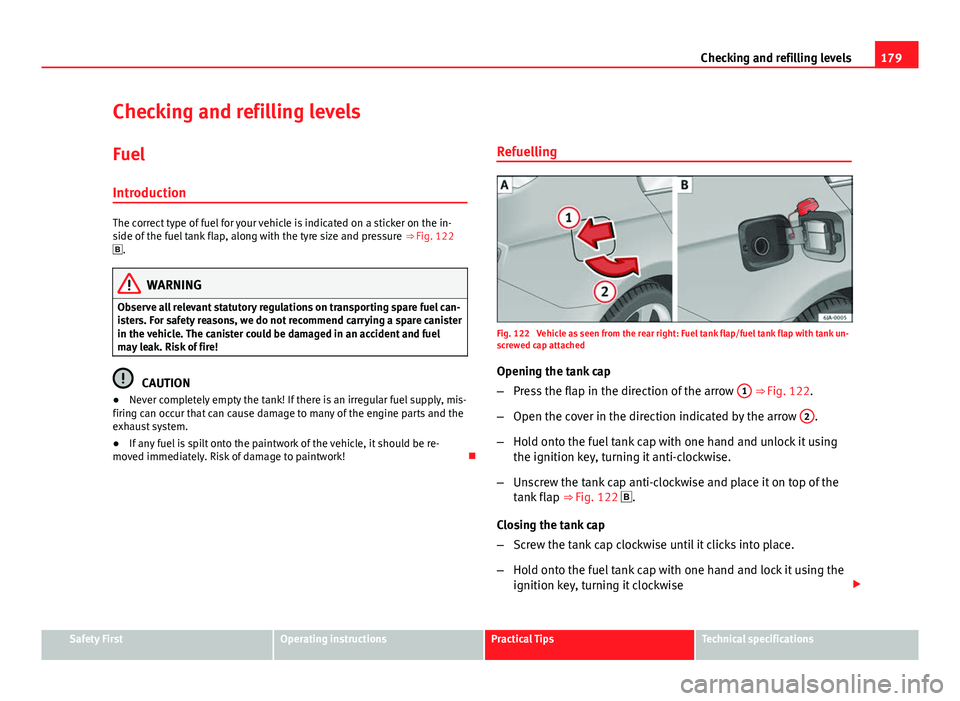
The correct type of fuel for your vehicle is indicated on a sticker on the in-
side of the fuel tank flap, along with the tyre size and pressure ⇒ Fig. 122
.
WARNING
Observe all relevant statutory regulations on transporting spare fuel can-
isters. For safety reasons, we do not recommend carrying a spare canister
in the vehicle. The canister could be damaged in an accident and fuel
may leak. Risk of fire!
CAUTION
● Never completely empty the tank! If there is an irregular fuel supply, mis-
firing can occur that can cause damage to many of the engine parts and the
exhaust system.
● If any fuel is spilt onto the paintwork of the vehicle, it should be re-
moved immediately. Risk of damage to paintwork! Refuelling
Fig. 122 Vehicle as seen from the rear right: Fuel tank flap/fuel tank flap with tank un-
screwed cap attached
Opening the tank cap
– Press the flap in the direction of the arrow 1
⇒ Fig. 122.
– Open the cover in the direction indicated by the arrow 2
.
– Hold onto the fuel tank cap with one hand and unlock it using
the ignition key, turning it anti-clockwise.
– Unscrew the tank cap anti-clockwise and place it on top of the
tank flap ⇒ Fig. 122 .
Closing the tank cap
– Screw the tank cap clockwise until it clicks into place.
– Hold onto the fuel tank cap with one hand and lock it using the
ignition key, turning it clockwise
Safety FirstOperating instructionsPractical TipsTechnical specifications
Page 182 of 258
180Checking and refilling levels
–Press the tank flap with your hand to close it.
– Check that the fuel flap is correctly closed.
CAUTION
● Switch off the auxiliary heater (heater and independent heater) before
filling the tank.
● The fuel tank is full as soon as the automatic filler nozzle cuts out. Do
not continue filling, as this will fill the expansion chamber.
Note
The fuel tank capacity is around 55 litres, of which 7 litres are the reserve.
Unleaded petrol
Your vehicle must only be run on unleaded petrol that complies with the
Standard EN 228 (in Germany, also DIN 51626 – 1, or E10 for unleaded pet-
rol with 95 and 91 octane rating (RON) or DIN 51626 – 2, or E5 for unleaded
petrol with 95 and 98 RON).
Prescribed fuel – unleaded petrol (95/91 RON)
Use unleaded petrol with 95 RON. Unleaded petrol with 91 RON can also be
used, although this will result in a slight loss of power.
If, as an emergency measure, you have to fill the tank with petrol with a low-
er RON to that prescribed, use only moderate engine speeds and light throt-
tle. High engine speed and full throttle can seriously damage the engine!
Fill up with petrol with the correct RON as soon as possible.
Prescribed fuel – unleaded petrol (min. 95 RON)
Use unleaded petrol with 95 RON. If unleaded petrol with
95 RON is not available, you can fill up with petrol
with 91 RON as an emergency measure. In this case, use only moderate en-
gine speeds and a light throttle. High engine speed and full throttle can se-
riously damage the engine! Fill up with petrol with the correct RON as soon
as possible.
Petrol with a RON below 91 cannot be used, even as an emergency meas-
ure. Risk of seriously damaging the engine!
Unleaded petrol with higher RON
Unleaded petrol with a higher RON to that prescribed can be used without
limits.
In vehicles running on prescribed unleaded petrol with 95/91 RON, there is
no notable increase in power or lower fuel consumption when petrol with a
RON higher than 95 is used.
In vehicles running on prescribed unleaded petrol with min. 95 RON, there
is an increase in power and a lower fuel consumption when petrol with a
RON higher than 95 is used.
Prescribed fuel – unleaded petrol (98/(95) RON)
Use unleaded petrol with 98 RON. Unleaded petrol with 95 RON can also be
used, although this will result in a slight loss of power.
If unleaded petrol with 98 or 95 RON is not available, you can fill up with
petrol with 91 RON as an emergency measure. In this case, use only moder-
ate engine speeds and a light throttle. High engine speed and full throttle
can seriously damage the engine! Fill up with petrol with the correct RON as
soon as possible.
Petrol with a RON below 91 cannot be used, even as an emergency meas-
ure. Risk of seriously damaging the engine!
Petrol additives
The quality of the fuel influences the behaviour, performance and service
life of the engine. This is why the petrol you use should carry suitable addi-
tives already included by the petrol industry, free of metals. These additives
Page 183 of 258
181
Checking and refilling levels
will help to prevent corrosion, keep the fuel system clean and prevent de-
posits from building up in the engine.
If good quality petrol with metal-free additives is not available or engine
problems arise, the necessary additives must be added when refuelling
⇒
.
Not all petrol additives have been shown to be effective. The use of unsuita-
ble petrol additives may cause significant damage to the engine and the
catalytic converter. Metal additives should never be used. Metal additives
may also be contained in petrol additives for improving anti-detonation rat-
ings or octane ratings ⇒
.
SEAT recommends “genuine Volkswagen Group fuel additives for petrol en-
gines”. These additives can be bought at SEAT Authorised Services, where
information on how to use them can also be obtained.
CAUTION
● Do not refuel if the filler indicates that the fuel contains metal. LRP (lead
replacement petrol) fuels contain high concentrations of metal additives.
Using them may damage the engine!
● All SEAT vehicles with petrol engines can only run on unleaded petrol.
Refuelling just once with leaded petrol disables the exhaust system!
● Use of petrol with a lower RON to that prescribed could damage the en-
gine components.
● Fuels marked as containing metal on the garage fuel pump cannot be
used. Risk of damage to most engine parts or the exhaust system!
● The use of unsuitable additives in petrol can cause damage to most en-
gine parts or the exhaust system. Diesel fuel
Your vehicle can only run on
diesel fuel that complies with the Standard EN
590 (in Germany, also DIN 51628, in Austria also ÖNORM C 1590 , in Russia
also GOST R 52368-2005/EN 590:2004 ).
Winter driving – winter-grade diesel
In winter use diesel fuel that complies with the Standard EN 590 (in Germa-
ny, also DIN 51628, in Austria also ÖNORM C 1590, in Russia also GOST R
52368-2005/EN 590:2004). “Winter-grade diesel” still performs well at
-20 °C (-4 °F).
In countries with other weather conditions, diesel is often available that be-
haves differently with regards to the temperature. The authorised SEAT deal-
ers and petrol stations in each country will inform you on the normal diesel
fuel of the country in question.
Preheating the fuel filter
The vehicle is fitted with a glow plug system for the fuel filter. Therefore, the
reliability of the diesel is ensured at ambient temperatures of down to ap-
prox. -25 °C (-13 °F).
Fuel additives
Fuel additives, known as “thinners” (petrol or similar substances) should
not be mixed with the diesel fuel.
CAUTION
● Even one tankful of diesel fuel that does not comply with the standard
could damage engine parts, the fuel system and the exhaust system!
● If fuel different to the prescribed diesel fuel (e.g. petrol) is used by mis-
take, never start the engine or switch on the ignition! Risk of serious dam-
age to the engine! Contact an authorised SEAT dealer to clean the engine
fuel system.
Safety FirstOperating instructionsPractical TipsTechnical specifications
Page 184 of 258
182Checking and refilling levels
● Water allowed to collect in the fuel filter can cause engine faults.
● Your vehicle is not prepared for use of biofuel (RME) and, therefore, this
fuel must not be used for refuelling or driving. The use of biofuel (RME)
could cause serious damage to the engine or the fuel system.
Engine compartment
Introduction
Always be aware of the danger of injury and scalding as well as the risk of
accident or fire when working in the engine compartment, e.g. when check-
ing and refilling fluids. Therefore, always observe the warnings and follow
all general safety precautions. The engine compartment of any motor vehi-
cle is a potentially hazardous area .
WARNING
● Never open the bonnet if you see steam, smoke or coolant escaping
from the engine compartment. Risk of scalding! Wait until no steam or
coolant can be seen before opening the bonnet.
● Switch off the engine and remove the key from the ignition.
● Engage neutral in vehicles with manual gearbox and move the selec-
tor lever to position P in vehicles with automatic gearbox.
● Apply the handbrake firmly.
● Wait for the engine to cool down.
● For safety reasons, the bonnet must always be closed when the vehi-
cle is moving. Therefore, after closing the bonnet always check that it is
properly secured.
WARNING (Continued)
● Should you notice that the bonnet is not safely secured when the ve-
hicle is moving, stop the vehicle immediately and close the bonnet prop-
erly. Risk of accident!
● Keep children away from the engine compartment.
● Do not touch hot engine parts. Risk of burns!
● Never spill fluids on hot engine compartments. These fluids can
cause a fire (e.g. antifreeze in coolant).
● Take care not to cause short circuits in the electrical system, especial-
ly when working on the battery.
● Never touch the radiator fan when the engine is hot. The fan may start
running suddenly!
● Do not unscrew the cap on the coolant expansion tank when the en-
gine is hot. The cooling system is under pressure!
● Protect face, hands and arms from any hot steam or hot coolant re-
leased by covering the cap with a large, thick rag when opening the ex-
pansion tank.
● Do not leave any objects, such as cloths and tools, in the engine com-
partment.
● When working underneath the vehicle, secure it so that it cannot roll
away and support it safely on suitable supports. The hydraulic jack is not
sufficient for this purpose. Risk of injuries!
● If any tests have to be performed with the engine running, there is an
extra safety risk from rotating parts, such as the drive belt, alternator
and radiator fan, etc., and from the high-voltage ignition system. You
should also note the following:
–Never touch the electrical wiring of the ignition system.
– Keep away from moving engine parts when wearing jewellery,
loose clothing or long hair. Risk of fatal injuries! All jewellery must be
removed, hair tied back and close-fitting clothing worn.
● Observe the following additional warnings if work on the fuel system
or the electrical system is necessary.
–Always disconnect the battery from the on-board network.
– Do not smoke.
Page 198 of 258
196Wheels and tyres
Wheels and tyres
Wheels
Introduction
WARNING
● During the first 500 km (300 miles), new tyres do not give maximum
grip, therefore you should drive carefully. Risk of accident!
● Never drive with damaged tyres. Risk of accident!
● Only use wheels and tyres that been authorised by SEAT or your vehi-
cle model. Failure to do so could impair road safety. Risk of accident!
● Never exceed the maximum speed permitted for your tyres. Risk of ac-
cident due to tyre damage and loss of vehicle control.
● Under-inflated tyres are submitted to greater rolling resistance. This
means that they can overheat at high speeds. This can cause tread sepa-
ration and even tyre blow-out.
● For driving safety, tyres should be replaced at least in pairs according
to the axle and not individually. The tyres with the deepest tread should
always be used on the front wheels.
● Never fit used tyres of an unknown age or prior use.
● Tyres must be immediately changed at the very latest when they have
worn down to the tread wear indicators.
● Worn tyres reduce the necessary grip at high speeds on damp surfa-
ces. This could lead to “aquaplaning” (uncontrolled vehicle movement –
“skidding” on damp surfaces).
● Damaged wheels and tyres must be replaced immediately.
WARNING (Continued)
● Do not use summer or winter tyres that are more than 6 or 4 years old
respectively.
● Wheel bolts should be clean and screw easily. However, they must
never be treated with grease or oil.
● If the tightening torque of the wheel bolts is too low, they could loos-
en while the vehicle is moving. Risk of accident! If the tightening torque
of the wheel bolts is too high, the bolts and threads could be damaged,
leading to the permanent deforming of the rim support surfaces.
● Incorrectly handled wheel bolts could lead to a wheel coming loose
while the vehicle is moving. Risk of accident!
● The national regulations on the use of snow tyres and chains should
be observed.
CAUTION
● Where a spare wheel that is not compatible with the wheels fitted is
used, follow the instructions ⇒ page 199.
● The prescribed tightening torque for wheel bolts on steel and alloy
wheels is 120 Nm.
● Protect your tyres from coming into contact with oil, grease and fuel.
● Replace any lost valve caps immediately.
For the sake of the environment
Under-inflated tyres increases fuel consumption.
Page 199 of 258
197
Wheels and tyres
Note
● We recommend having all work on tyres and wheels carried out by an
authorised SEAT dealer.
● We recommend using wheels, tyres, hub caps and snow chains from the
SEAT Original Accessories programme.
Tyre useful life
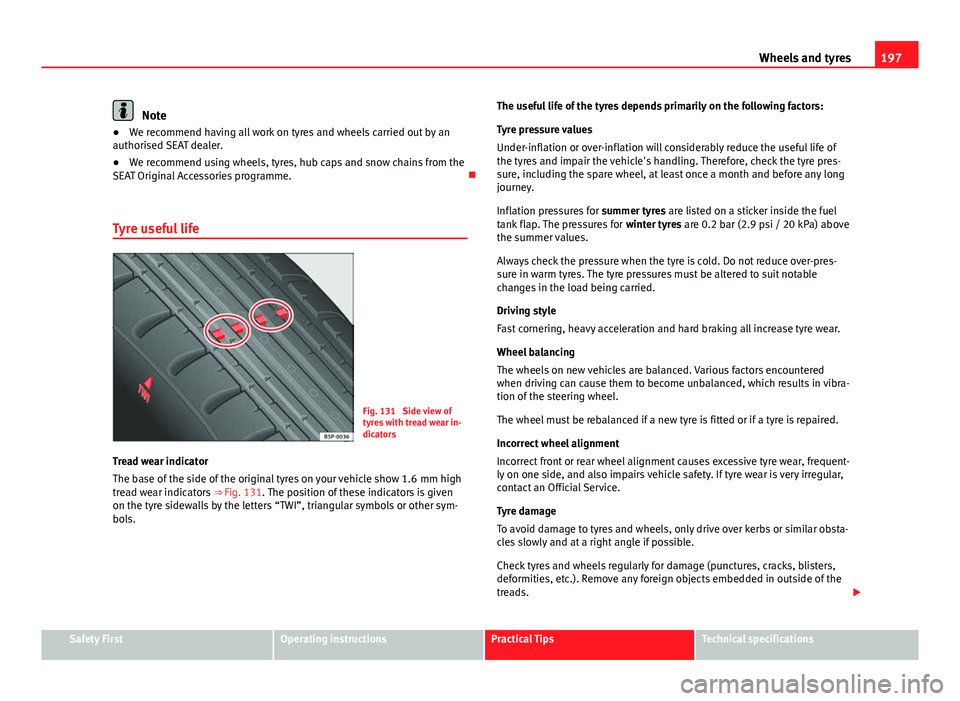
Fig. 131 Side view of
tyres with tread wear in-
dicators
Tread wear indicator
The base of the side of the original tyres on your vehicle show 1.6 mm high
tread wear indicators ⇒ Fig. 131. The position of these indicators is given
on the tyre sidewalls by the letters “TWI”, triangular symbols or other sym-
bols. The useful life of the tyres depends primarily on the following factors:
Tyre pressure values
Under-inflation or over-inflation will considerably reduce the useful life of
the tyres and impair the vehicle's handling. Therefore, check the tyre pres-
sure, including the spare wheel, at least once a month and before any long
journey.
Inflation pressures for
summer tyres are listed on a sticker inside the fuel
tank flap. The pressures for winter tyres are 0.2 bar (2.9 psi / 20 kPa) above
the summer values.
Always check the pressure when the tyre is cold. Do not reduce over-pres-
sure in warm tyres. The tyre pressures must be altered to suit notable
changes in the load being carried.
Driving style
Fast cornering, heavy acceleration and hard braking all increase tyre wear.
Wheel balancing
The wheels on new vehicles are balanced. Various factors encountered
when driving can cause them to become unbalanced, which results in vibra-
tion of the steering wheel.
The wheel must be rebalanced if a new tyre is fitted or if a tyre is repaired.
Incorrect wheel alignment
Incorrect front or rear wheel alignment causes excessive tyre wear, frequent-
ly on one side, and also impairs vehicle safety. If tyre wear is very irregular,
contact an Official Service.
Tyre damage
To avoid damage to tyres and wheels, only drive over kerbs or similar obsta-
cles slowly and at a right angle if possible.
Check tyres and wheels regularly for damage (punctures, cracks, blisters,
deformities, etc.). Remove any foreign objects embedded in outside of the
treads.
Safety FirstOperating instructionsPractical TipsTechnical specifications