fuel Seat Toledo 2013 Owner's Guide
[x] Cancel search | Manufacturer: SEAT, Model Year: 2013, Model line: Toledo, Model: Seat Toledo 2013Pages: 258, PDF Size: 3.94 MB
Page 201 of 258
199
Wheels and tyres
The manufacturing date is also indicated on the tyre sidewall (possibly only
on the inner side of the wheel). DOT … 27 12…
means, for example, that the tyre was produced in the 27th week of 2012.
Follow the instructions ⇒ page 199 if you only have a temporary spare
wheel.
Tyres with directional tread pattern
The direction of rotation is indicated by the arrows on the tyre sidewall. The
direction of rotation indicated must be respected. This guarantees optimum
grip and helps avoid excessive noise, wear and aquaplaning.
In the event of a flat tyre, a spare wheel with an undetermined tread pattern
or an opposite tread pattern must be used and you must drive carefully, as
in these cases the tyres no longer offer maximum performance. Spare wheel*Fig. 133 Luggage com-
partment: spare wheel
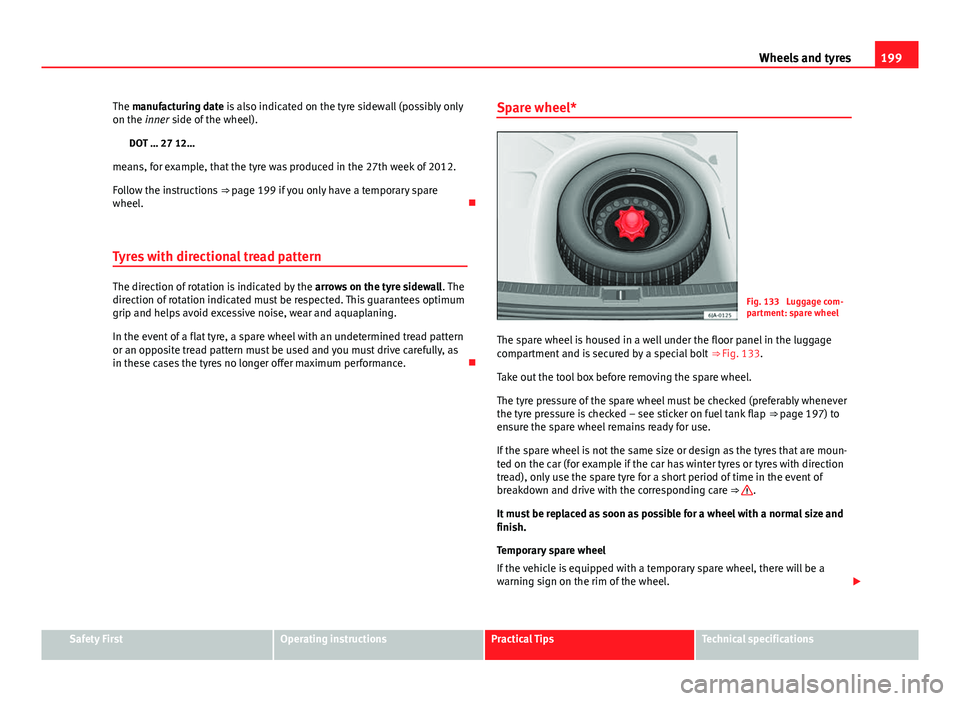
The spare wheel is housed in a well under the floor panel in the luggage
compartment and is secured by a special bolt ⇒ Fig. 133.
Take out the tool box before removing the spare wheel.
The tyre pressure of the spare wheel must be checked (preferably whenever
the tyre pressure is checked – see sticker on fuel tank flap ⇒ page 197) to
ensure the spare wheel remains ready for use.
If the spare wheel is not the same size or design as the tyres that are moun-
ted on the car (for example if the car has winter tyres or tyres with direction
tread), only use the spare tyre for a short period of time in the event of
breakdown and drive with the corresponding care ⇒
.
It must be replaced as soon as possible for a wheel with a normal size and
finish.
Temporary spare wheel
If the vehicle is equipped with a temporary spare wheel, there will be a
warning sign on the rim of the wheel.
Safety FirstOperating instructionsPractical TipsTechnical specifications
Page 204 of 258

202Wheels and tyres
WARNING
● If the warning lamp lights up, slow down immediately and avoid
any severe braking or steering manoeuvres. Stop and check the tyres and
their pressure as soon as possible.
● Under certain conditions (e.g. sporty driving style, driving on loose
surfaces or in the winter) the warning lamp may take a while to light
up or may remain switched off.
● Despite the tyre pressure monitoring system, the driver remains re-
sponsible for maintaining the correct tyre pressure. You must therefore
check the tyre pressure often.
Note
● The tyre pressure monitoring system is not a replacement for regularly
checking the tyre pressure, as it is unable to recognise an even drop in pres-
sure.
● The tyre pressure monitoring system is unable to warn of a sudden drop
in tyre pressure, e.g. a puncture. In this case, try to stop the vehicle carefully
with no severe braking or steering manoeuvres.
● To ensure the tyre pressure monitoring system works correctly, the basic
setting must be performed every 10 000 km (6000 miles) or once a year.
Wheel bolts
The wheel bolts are matched to the rims. When installing different wheels,
e.g. to fit light alloy wheels or wheels with winter tyres, it is important to use
the correct wheel bolts with the right length and correctly shaped bolt
heads. The is essential for the secure fit of the wheels and for the proper
function of the brake system. Winter tyres
Winter tyres will significantly improve handling of the vehicle in winter road
conditions. The design of summer tyres (width, rubber compound, tread
pattern) gives less grip at temperatures below +7 °C (45 °F), on ice and
snow. This applies particularly to vehicles equipped with
wide section tyres
or high speed tyres (code letters H or V on the sidewall).
In order to preserve the performance of the vehicle as much as possible,
winter tyres must be fitted on all four wheels, the minimum depth of the
tread must be 4 mm and the maximum age must be 4 years.
You can use winter tyres of a lower speed rating if the maximum speed limit
of these tyres will not be exceeded, even if the maximum speed limit for the
vehicle is higher.
For the sake of the environment
Summer tyres should be fitted again in time, as they give better handling on
roads free of snow and ice and at temperatures over +7 °C (45 °F). Summer
tyres have a shorter braking distance, produce less rolling noise and do not
wear down as quickly. They also reduce fuel consumption.
Snow chains
Snow chains must only be used on the front wheels.
In winter road conditions, snow chains not only help to improve grip but al-
so improve the braking capacity.
For technical reasons snow chains may only be used on tyres with the fol-
lowing wheel rim/tyre combinations.
Page 216 of 258
214Self-help
–Switch the compressor off.
– If it is not possible to achieve an air pressure of 2.0-2.5 bar
(29-36 psi / 200-250 kPa), unscrew the tyre inflator tube 5
from the tyre valve.
– Drive the vehicle approx. 10 metres forwards or backwards, so
that the sealant can “spread evenly” in the tyre.
– Screw the flexible hose from the air compressor 5
back onto
the tyre valve and repeat the inflation process.
– If the pressure is still lower than specified, the tyre is too badly
damaged. The tyre cannot be repaired using the tyre sealant kit
⇒
.
– Switch the compressor off.
– Unscrew the flexible hose 5
from the tyre valve.
When a tyre pressure of 2.0-2.5 bar (29-36 psi / 200-250 kPa) is
reached then you can continue driving at a max. speed of 80 km/h
(50 mph)
Check the tyre pressure after 10 minutes of driving ⇒ page 214.
WARNING
● The flexible tyre filling hose and the air compressor may heat up dur-
ing the filling process. Risk of injury!
● Do not place the hot flexible tyre filling hose or hot air compressor on
top of flammable materials. Risk of fire!
● If the tyre cannot be inflated to a minimum pressure of 2.0 bar
(29 psi / 200 kPa) then the tyre is too badly damaged. The sealing prod-
uct is unable to seal the tyre . Do not drive on and obtain professional
assistance.
CAUTION
Do not use the air compressor for longer than 8 minutes at a time. Risk of
overheating! Before using the air compressor again, leave it to cool down
for several minutes.
Check after 10 minutes of driving
Check the tyre pressure after 10 minutes of driving!
If the tyre pressure is less than 1.3 bar (18.8 psi / 130 kPa):
– Do not drive on! The tyre cannot be sufficiently filled using
the tyre repair kit.
– See professional assistance.
If the tyre pressure is greater than 1.3 bar (18.8 psi / 130 kPa):
– Correct the tyre pressure again to the correct value (see inside
of the fuel tank flap).
– Carefully resume your journey to the nearest specialised work-
shop at a maximum speed of 80 km/h (50 mph).
Jump-starting
Introduction
If the engine fails to start because of a discharged battery, the battery can
be connected to the battery of another vehicle to start the engine. Suitable
jump leads are required.
Page 219 of 258

217
Self-help
road. If the vehicle is towed with the rear wheels lifted off the road
the automatic gearbox will be damaged!
It is easier and safer to tow a vehicle with a towbar. A towrope
should only be used if you do not have a towbar.
Follow the instructions below when towing a vehicle:
Notes for the driver of the towing vehicle
– Engage the clutch very gently when starting to move or on vehi-
cles with automatic gearbox press the accelerator carefully.
– On vehicles with manual gearbox, the towrope must be taut be-
fore driving off.
The maximum towing speed is 50 km/h (31 mph).
Notes for the driver of the towed vehicle
– The ignition should be switched on so that the steering wheel
lock is not engaged and the turn signals, horn and windscreen
wipers and washers can be used.
– Put the gear lever in neutral or move the selector lever to posi-
tion N (automatic gearbox).
The brake servo and power steering only work when the engine is
running. Considerably more effort is required on the brake pedal
and steering wheel when the engine is switched off.
Ensure the towrope remains taut at all times when towing.
CAUTION
● Do not tow-start the engine. Risk of engine damage! In vehicles with a
catalytic converter, unburnt fuel could reach the catalytic converter and
catch fire in it. This could damage and destroy the catalytic converter. Use
the battery from another vehicle for help in starting the engine ⇒ page 215,
Starting the engine.
● If, due to a fault, there is no oil in the gearbox, the car may only be tow-
ed with the driven wheels lifted clear of the road and transported on a spe-
cial vehicle transporter or trailer.
● If normal towing is not possible or if the vehicle is to be towed for further
than 50 km (31 miles), the vehicle must be transported on a special vehicle
transporter or trailer.
● The towrope should be slightly elastic to reduce the loading on both ve-
hicles during towing. It is advisable to use a towrope made of synthetic fibre
or similar material only.
● Do not pull too hard with the towing vehicle and always take care to
avoid jerking the towrope. When towing on a loose surface there is always a
risk of overloading and damaging the anchorage points.
● Attach the towrope or towbar only to the towline anchorages or to the
removable towing bracket ⇒ page 164, or ⇒ page 218.
Note
● We recommend you use the towrope or towbar available in the SEAT
Original Accessories programme from authorised SEAT dealers.
● Towing a vehicle requires some experience. Both drivers should be fa-
miliar with the technique required for towing. Inexperienced drivers should
not attempt to tow away another vehicle or to have their vehicle towed.
● Note the legal regulations concerning towing, particularly those regard-
ing the signalling of the towed and towing vehicle.
● The towrope must not be twisted, as under certain circumstances this
could unscrew the front towline anchorage.
Safety FirstOperating instructionsPractical TipsTechnical specifications
Page 235 of 258
233
Description of the data
Technical specifications Description of the data
Important information
Important
The information in the vehicle documentation always takes
precedence over the information in this Instruction Manual. All technical specifications provided in this documentation are valid for the
standard model in Spain. The vehicle data card included in the Mainte-
nance Programme or the vehicle registration documentation shows which
engine is installed in the vehicle.
The figures may be different depending whether additional equipment is fit-
ted, for different models, for special vehicles and for other countries.
Abbreviations used in the Technical Specifications section
Abbrevia- tionMeaning
kWKilowatt, engine power measurement.
PSPferdestärke (horsepower), formerly used to denote engine
power.
rpmRevolutions per minute - engine speed.NmNewton metres, unit of engine torque.litres per100 kmFuel consumption in litres per 100 km (70 miles).
g/kmCarbon dioxide emissions in grams per km (mile) travelled.CO 2Carbon dioxide
Abbrevia-
tionMeaning
CNCetane number, indication of the diesel combustion power.
RONResearch octane number, indication of the knock resistance
of petrol.
Safety FirstOperating instructionsPractical TipsTechnical specifications
Page 236 of 258
234Description of the data
Vehicle identification data on the data sticker
Fig. 173 Data sticker
Fig. 174 Type plate
Vehicle data sticker
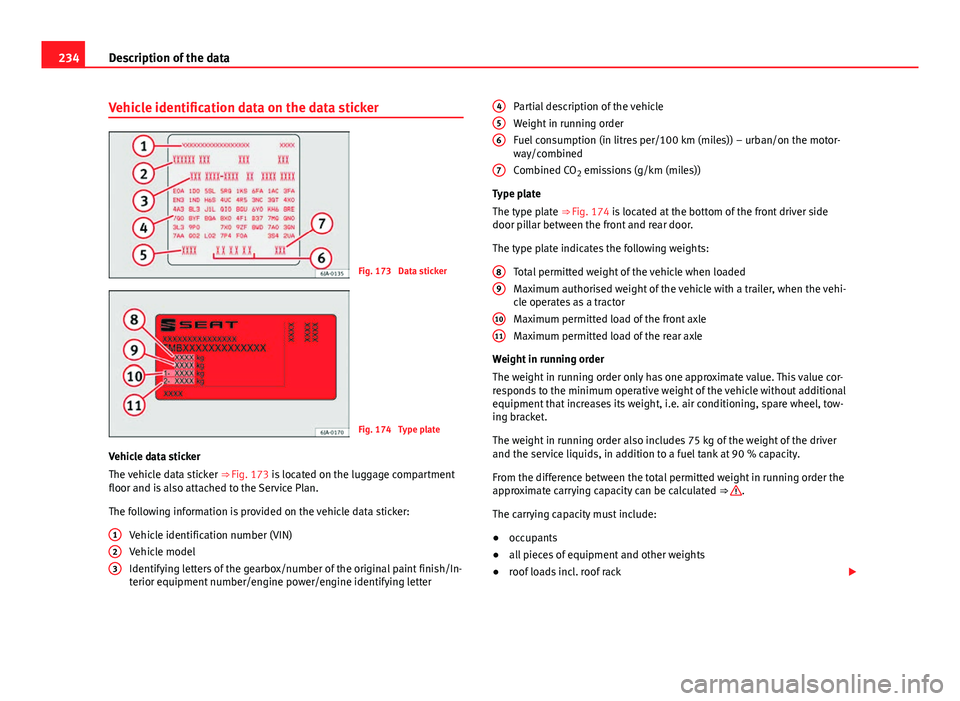
The vehicle data sticker ⇒ Fig. 173 is located on the luggage compartment
floor and is also attached to the Service Plan.
The following information is provided on the vehicle data sticker:
Vehicle identification number (VIN)
Vehicle model
Identifying letters of the gearbox/number of the original paint finish/In-
terior equipment number/engine power/engine identifying letter
1
23
Partial description of the vehicle
Weight in running order
Fuel consumption (in litres per/100 km (miles)) – urban/on the motor-
way/combined
Combined CO
2 emissions (g/km (miles))
Type plate
The type plate ⇒ Fig. 174 is located at the bottom of the front driver side
door pillar between the front and rear door.
The type plate indicates the following weights:
Total permitted weight of the vehicle when loaded
Maximum authorised weight of the vehicle with a trailer, when the vehi-
cle operates as a tractor
Maximum permitted load of the front axle
Maximum permitted load of the rear axle
Weight in running order
The weight in running order only has one approximate value. This value cor-
responds to the minimum operative weight of the vehicle without additional
equipment that increases its weight, i.e. air conditioning, spare wheel, tow-
ing bracket.
The weight in running order also includes 75 kg of the weight of the driver
and the service liquids, in addition to a fuel tank at 90 % capacity.
From the difference between the total permitted weight in running order the
approximate carrying capacity can be calculated ⇒
.
The carrying capacity must include:
● occupants
● all pieces of equipment and other weights
● roof loads incl. roof rack
4
56
7
89
1011
Page 237 of 258

235
Description of the data
● equipment that is not included in the running order weight
● when using the towing bracket, the drawbar load (max. 50 kg)
Calculating fuel consumption and CO 2 emissions according to the ECE
regulations and the EU specifications
Calculation of fuel consumption for urban driving starts when cold-starting
the engine. Then, normal city driving is simulated.
In extra-urban driving fuel consumption calculation, the vehicle brakes and
accelerated in all gears, as in daily use of the vehicle. The driving speed
moves between a range of 0 and 120 km/h (75 mph).
The consumption value in combined driving is composed of 37 % of the val-
ue of urban driving and 63 % of the value of extra-urban driving.
WARNING
The maximum permitted weight values must not be exceeded – Risk of
an accident and damage to the vehicle!
Note
● If you wish to calculate the exact weight of your vehicle please contact a
SEAT dealer.
● Depending on the volume of equipment, the driving style, road condi-
tions, weather conditions and the condition of the vehicle, the consumption
values can differ from the theoretical values reproduced here. Information on fuel consumption
Fuel consumption
The consumption and emission details shown on the vehicle
data sticker differ from one vehicle to another.
The vehicle fuel consumption and CO 2 emissions can be consulted on the
vehicle data sticker in the spare wheel well, inside the luggage compart-
ment and on the rear cover of the Maintenance Programme.
The fuel consumption and CO 2 emission values refer to the weight category
assigned to your vehicle according to the engine and gearbox combination,
as well as the specific equipment fitted, and is only used to compare be-
tween the different models.
The fuel consumption and CO 2 emissions do not depend only on the per-
formance of the vehicle, they can also differ from the established values de-
pending on other factors such as driving style, road conditions, traffic con-
ditions, environmental conditions, load and number of passengers.
Calculation of fuel consumption
The consumption values have been calculated based on measurements per-
formed or supervised by certified CE laboratories according to the latest ver-
sion of directives 715/2007/EC and 80/1268/CEE (for more information
consult the European Union Publications Office at EUR-Lex: © European Un-
ion, http://eur-lex.europa.eu/en/index.htm) and are valid for the kerb
weight indicated for the vehicle.
Note
In practice, and considering all the factors mentioned here, consumption
values can differ from those calculated in the current European regulations.
Safety FirstOperating instructionsPractical TipsTechnical specifications
Page 238 of 258
236Description of the data
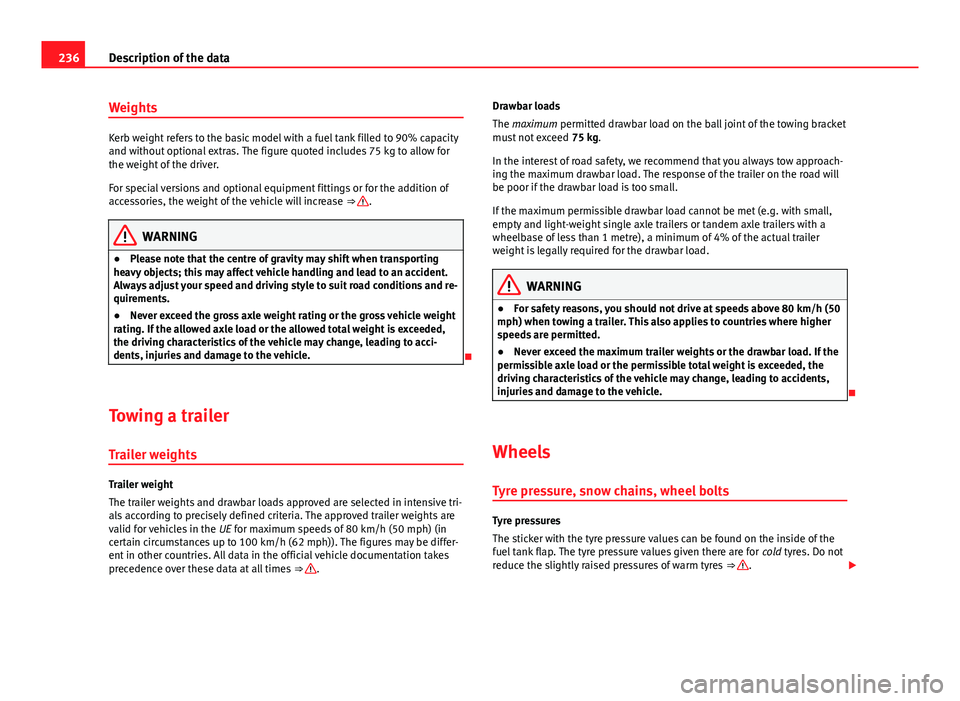
Weights
Kerb weight refers to the basic model with a fuel tank filled to 90% capacity
and without optional extras. The figure quoted includes 75 kg to allow for
the weight of the driver.
For special versions and optional equipment fittings or for the addition of
accessories, the weight of the vehicle will increase ⇒
.
WARNING
● Please note that the centre of gravity may shift when transporting
heavy objects; this may affect vehicle handling and lead to an accident.
Always adjust your speed and driving style to suit road conditions and re-
quirements.
● Never exceed the gross axle weight rating or the gross vehicle weight
rating. If the allowed axle load or the allowed total weight is exceeded,
the driving characteristics of the vehicle may change, leading to acci-
dents, injuries and damage to the vehicle.
Towing a trailer Trailer weights
Trailer weight
The trailer weights and drawbar loads approved are selected in intensive tri-
als according to precisely defined criteria. The approved trailer weights are
valid for vehicles in the UE for maximum speeds of 80 km/h (50 mph) (in
certain circumstances up to 100 km/h (62 mph)). The figures may be differ-
ent in other countries. All data in the official vehicle documentation takes
precedence over these data at all times ⇒
.Drawbar loads
The maximum permitted drawbar load on the ball joint of the towing bracket
must not exceed
75 kg.
In the interest of road safety, we recommend that you always tow approach-
ing the maximum drawbar load. The response of the trailer on the road will
be poor if the drawbar load is too small.
If the maximum permissible drawbar load cannot be met (e.g. with small,
empty and light-weight single axle trailers or tandem axle trailers with a
wheelbase of less than 1 metre), a minimum of 4% of the actual trailer
weight is legally required for the drawbar load.
WARNING
● For safety reasons, you should not drive at speeds above 80 km/h (50
mph) when towing a trailer. This also applies to countries where higher
speeds are permitted.
● Never exceed the maximum trailer weights or the drawbar load. If the
permissible axle load or the permissible total weight is exceeded, the
driving characteristics of the vehicle may change, leading to accidents,
injuries and damage to the vehicle.
Wheels
Tyre pressure, snow chains, wheel bolts
Tyre pressures
The sticker with the tyre pressure values can be found on the inside of the
fuel tank flap. The tyre pressure values given there are for cold tyres. Do not
reduce the slightly raised pressures of warm tyres ⇒
.
Page 241 of 258
239
Technical Data
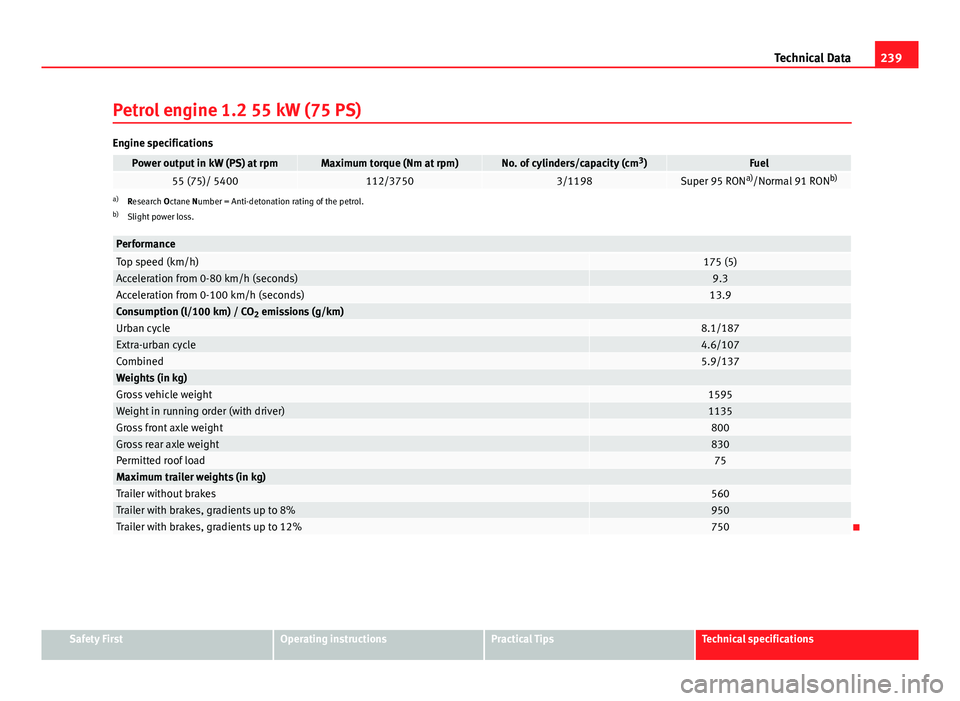
Petrol engine 1.2 55 kW (75 PS)
Engine specifications
Power output in kW (PS) at rpmMaximum torque (Nm at rpm)No. of cylinders/capacity (cm 3
)Fuel55 (75)/ 5400112/37503/1198Super 95 RON a)
/Normal 91 RON b)a)
Research Octane Number = Anti-detonation rating of the petrol.
b) Slight power loss.
PerformanceTop speed (km/h)175 (5)Acceleration from 0-80 km/h (seconds)9.3Acceleration from 0-100 km/h (seconds)13.9Consumption (l/100 km) / CO 2 emissions (g/km)Urban cycle8.1/187Extra-urban cycle4.6/107Combined5.9/137Weights (in kg)Gross vehicle weight1595Weight in running order (with driver)1135Gross front axle weight800Gross rear axle weight830Permitted roof load75Maximum trailer weights (in kg)Trailer without brakes560Trailer with brakes, gradients up to 8%950Trailer with brakes, gradients up to 12%750
Safety FirstOperating instructionsPractical TipsTechnical specifications
Page 242 of 258
240Technical Data
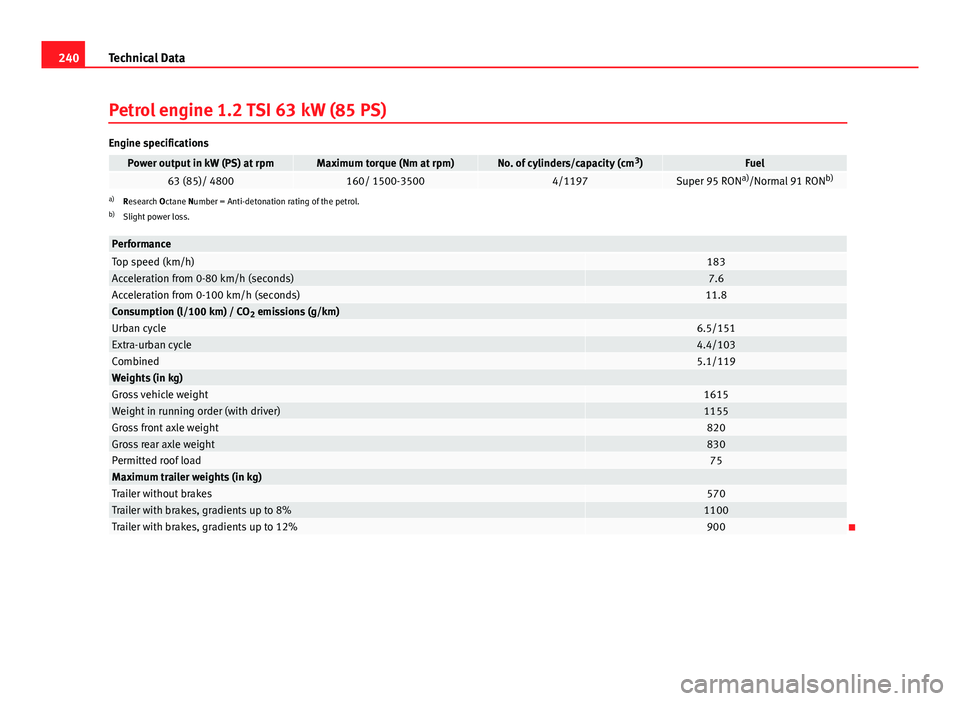
Petrol engine 1.2 TSI 63 kW (85 PS)
Engine specifications
Power output in kW (PS) at rpmMaximum torque (Nm at rpm)No. of cylinders/capacity (cm 3
)Fuel63 (85)/ 4800160/ 1500-35004/1197Super 95 RON a)
/Normal 91 RON b)a)
Research Octane Number = Anti-detonation rating of the petrol.
b) Slight power loss.
PerformanceTop speed (km/h)183Acceleration from 0-80 km/h (seconds)7.6Acceleration from 0-100 km/h (seconds)11.8Consumption (l/100 km) / CO 2 emissions (g/km)Urban cycle6.5/151Extra-urban cycle4.4/103Combined5.1/119Weights (in kg)Gross vehicle weight1615Weight in running order (with driver)1155Gross front axle weight820Gross rear axle weight830Permitted roof load75Maximum trailer weights (in kg)Trailer without brakes570Trailer with brakes, gradients up to 8%1100Trailer with brakes, gradients up to 12%900