fuel Seat Toledo 2013 User Guide
[x] Cancel search | Manufacturer: SEAT, Model Year: 2013, Model line: Toledo, Model: Seat Toledo 2013Pages: 258, PDF Size: 3.94 MB
Page 109 of 258
107
Lights and visibility
Interval wipe
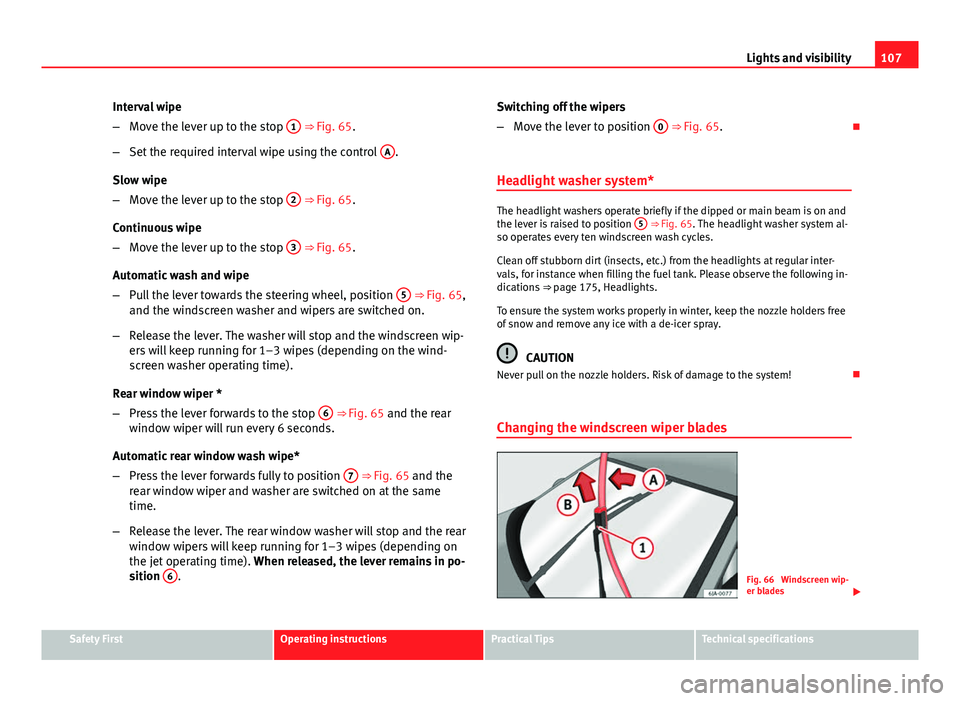
– Move the lever up to the stop 1
⇒ Fig. 65.
– Set the required interval wipe using the control A
.
Slow wipe
– Move the lever up to the stop 2
⇒ Fig. 65.
Continuous wipe
– Move the lever up to the stop 3
⇒ Fig. 65.
Automatic wash and wipe
– Pull the lever towards the steering wheel, position 5
⇒ Fig. 65,
and the windscreen washer and wipers are switched on.
– Release the lever. The washer will stop and the windscreen wip-
ers will keep running for 1–3 wipes (depending on the wind-
screen washer operating time).
Rear window wiper *
– Press the lever forwards to the stop 6
⇒ Fig. 65 and the rear
window wiper will run every 6 seconds.
Automatic rear window wash wipe*
– Press the lever forwards fully to position 7
⇒ Fig. 65 and the
rear window wiper and washer are switched on at the same
time.
– Release the lever. The rear window washer will stop and the rear
window wipers will keep running for 1–3 wipes (depending on
the jet operating time). When released, the lever remains in po-
sition 6
. Switching off the wipers
–
Move the lever to position 0
⇒ Fig. 65.
Headlight washer system*
The headlight washers operate briefly if the dipped or main beam is on and
the lever is raised to position 5 ⇒ Fig. 65. The headlight washer system al-
so operates every ten windscreen wash cycles.
Clean off stubborn dirt (insects, etc.) from the headlights at regular inter-
vals, for instance when filling the fuel tank. Please observe the following in-
dications ⇒ page 175, Headlights.
To ensure the system works properly in winter, keep the nozzle holders free
of snow and remove any ice with a de-icer spray.
CAUTION
Never pull on the nozzle holders. Risk of damage to the system!
Changing the windscreen wiper blades
Fig. 66 Windscreen wip-
er blades
Safety FirstOperating instructionsPractical TipsTechnical specifications
Page 121 of 258
119
Seats and storage
Roof carrier*
Introduction
WARNING
● The load on the roof carrier must be properly secured. Risk of acci-
dent!
● Always secure the load using retaining straps in good condition.
● Distribute the load evenly.
● When transporting heavy or large objects on the roof, any change in
the normal vehicle behaviour due to a change in the centre of gravity or
an increased wind resistance must be taken into account. Risk of acci-
dent! For this reason, a suitable speed and driving style must be used.
● Avoid sudden manoeuvres and braking.
● Adjust your driving style to suit visibility, the weather and road and
traffic conditions.
● Never exceed the allowed axle loads or allowed maximum weight.
Risk of accident!
CAUTION
● Only use SEAT-authorised roof carriers.
● Where roof carriers from other systems are used or where they are not
fitted properly, any damage caused to the vehicle will not be covered by the
warranty. Therefore, carefully follow the Instruction Manual for installation
of the roof carrier.
● On vehicles fitted with a sliding sunroof, make sure it does not hit the
load on the roof when opened
● Remember that the rear lid must not hit the roof load.
● The total height of the vehicle increases according to the roof load. Com-
pare the height of the vehicle with the heights of bridges or, for example,
the size of the garage door. ●
Do not forget to remove the roof carrier before entering an automatic
carwash.
● Take into account that the load must not damage the aerial located on
the roof.
For the sake of the environment
The increased air resistance means that the vehicle uses more fuel.
Attachment points
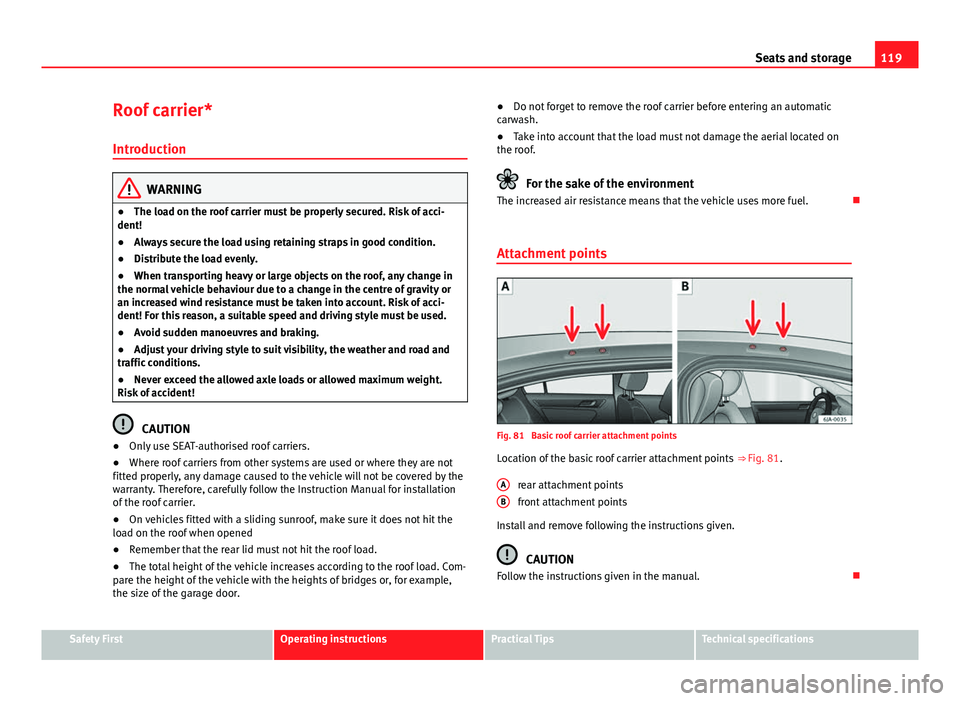
Fig. 81 Basic roof carrier attachment points
Location of the basic roof carrier attachment points ⇒ Fig. 81.
rear attachment points
front attachment points
Install and remove following the instructions given.
CAUTION
Follow the instructions given in the manual.
A
B
Safety FirstOperating instructionsPractical TipsTechnical specifications
Page 130 of 258
128Heating and air conditioning
Heating and air conditioning
Heating and air conditioning General notes
The power of the heating depends on the temperature of the coolant. There-
fore, maximum power is only obtained when the engine has reached operat-
ing temperature.
The temperature and the humidity of the air is reduced when the system
cools the interior of the vehicle. This therefore increases the comfort of all
vehicle occupants when outside temperatures and humidity are high. It also
helps prevent the windows from misting over during cold periods of the
year.
The air recirculation system can be switched on temporarily to increase the
cooling effect.
Keep the air intake slots in front of the windscreen clear of ice, snow or
leaves to ensure unimpaired heating and cooling.
When the air conditioning is on, condensation can drip from the evaporator
in the air cooling system and form a pool underneath the vehicle. This is
normal and does not indicate a leak!
WARNING
● All windows must be clear of ice, snow and condensation for driving
safety. Therefore, make sure you familiarise yourself with the correct use
of heating and ventilation, window demisting and defrosting and cooling.
● Never use the air recirculation system for too long, as it prevents
fresh air from entering the vehicle and “used” air can cause tiredness, re-
duce your attention span and cause the windows to mist over. This in-
creases the risk of an accident. Switch off the air recirculation system as
soon as the windows begin to mist over.
Note
● Used air escapes through ventilation slots in the rear of the luggage
compartment.
● Smoking is not recommended while the air recirculation system is in
use, as the smoke drawn from the interior of the vehicle settles in the evap-
orator of the air conditioning system. This causes a persistent, unpleasant
smell while the system is running that is time-consuming and expensive
(evaporator replacement) to eliminate.
● Never cover the air outlets to ensure the system operates correctly.
Economic use of the air conditioning system
When the air conditioning is switched on, the compressor consumes engine
power and has influence on fuel consumption.
If the vehicle interior has overheated due to an excessive solar radiation, it
is best to open the windows or doors to allow the hot air to escape.
Page 131 of 258
129
Heating and air conditioning
While in motion, the air conditioning should not be switched on if the win-
dows are open.
If the interior temperature can be reached without switching on the air con-
ditioning, the fresh air mode should be used.
For the sake of the environment
This saves on fuel and reduces emissions.
Faults
If the air conditioning does not work at outside temperatures above +5 °C
(+41 °F) then the system is faulty. This may be due to one of the following
reasons:
● One of the fuses has blown. Check the fuse and replace if necessary
⇒ page 219.
● The air conditioning compressor has switched off temporarily because
of an increased engine coolant temperature ⇒ page 58.
If you cannot repair the fault yourself or where the cooling power continues
to drop, switch the system off. Contact a specialised service. Air ventsFig. 96 Air vents
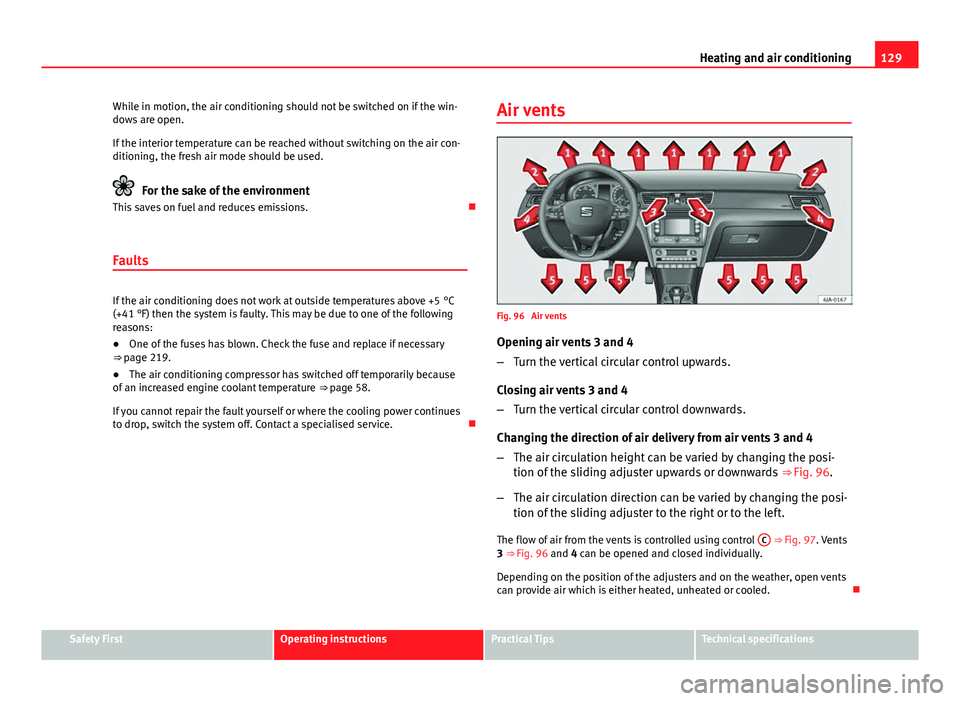
Opening air vents 3 and 4
– Turn the vertical circular control upwards.
Closing air vents 3 and 4
– Turn the vertical circular control downwards.
Changing the direction of air delivery from air vents 3 and 4
– The air circulation height can be varied by changing the posi-
tion of the sliding adjuster upwards or downwards ⇒ Fig. 96.
– The air circulation direction can be varied by changing the posi-
tion of the sliding adjuster to the right or to the left.
The flow of air from the vents is controlled using control C
⇒ Fig. 97. Vents
3 ⇒ Fig. 96 and 4 can be opened and closed individually.
Depending on the position of the adjusters and on the weather, open vents
can provide air which is either heated, unheated or cooled.
Safety FirstOperating instructionsPractical TipsTechnical specifications
Page 142 of 258
140Driving
● Do not tow-start the engine. Risk of engine damage! In vehicles with a
catalytic converter, unburnt fuel could reach the catalytic converter and
catch fire in it. This would lead to a fault in the catalytic converter. Use the
battery from another vehicle for help in starting the engine ⇒ page 214,
Jump-starting.
● After the engine has been working hard for a long time, leave the engine
idling for about one minute before switching it off at the end of a journey.
This will stop the engine from overheating.
For the sake of the environment
Do not warm up the engine when the vehicle is stationary. If possible, move
off immediately after starting the engine. This will help the engine reach op-
erating temperature more quickly, reducing the quantity of emissions.
Note
● The engine can only be started with the original SEAT key.
● Loud running noises may be heard briefly after cold-starting the engine.
This is normal and is no cause for concern.
● After the engine has been stopped and the ignition switched off, the ra-
diator fan may continue running for around 10 minutes.
● If the engine still does not start after a second attempt, the fuel pump
fuse might have blown. Check the fuse and replace if necessary
⇒ page 219 or contact your Specialised Service.
● You should always engage the steering lock when you leave the vehicle.
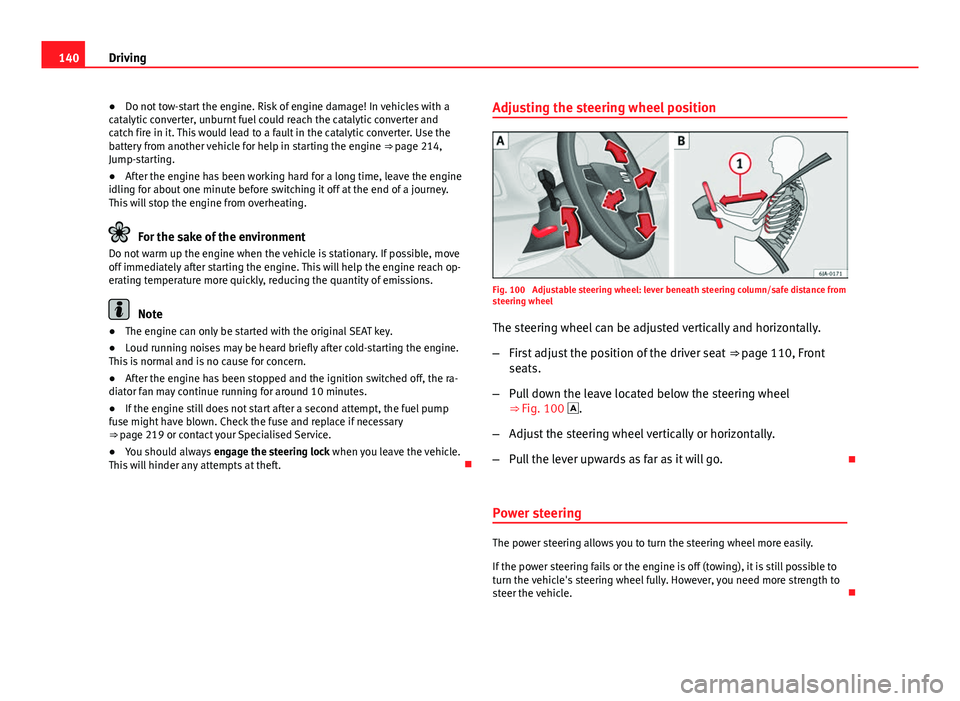
This will hinder any attempts at theft. Adjusting the steering wheel position
Fig. 100 Adjustable steering wheel: lever beneath steering column/safe distance from
steering wheel
The steering wheel can be adjusted vertically and horizontally.
– First adjust the position of the driver seat ⇒ page 110, Front
seats.
– Pull down the leave located below the steering wheel
⇒ Fig. 100 .
– Adjust the steering wheel vertically or horizontally.
– Pull the lever upwards as far as it will go.
Power steering
The power steering allows you to turn the steering wheel more easily.
If the power steering fails or the engine is off (towing), it is still possible to
turn the vehicle's steering wheel fully. However, you need more strength to
steer the vehicle.
Page 143 of 258

141
Driving
Start-up lock security system (immobiliser)
There is an electronic chip in the key. The electronic immobiliser is deactiva-
ted when the key is inserted into the ignition. The electronic immobiliser is
automatically activated when the key is removed from the ignition.
The engine will not start if an unauthorised key is used.
The informative display indicates: Immobiliser active!
Ignition lock
Fig. 101 Ignition key po-
sitions
Petrol engines 1
– Ignition switched off, engine stopped, steering can be locked
2
– Ignition switched on
3
– Starting Diesel engines
1
– Fuel supply stopped, ignition switched off, engine stopped,
steering can be locked
2
– Engine pre-heating, ignition switched on
3
– Starting
To engage the Steering lock without the key in the ignition, turn the steer-
ing wheel slightly until it engages
If the steering lock is engaged and it is difficult or impossible to turn the key
to position 2
, release the lock by turning the steering wheel slightly in
both directions.
Starting the engine
Vehicles with a diesel engine are equipped with a glow plug system. When
you switch on the ignition, the glow plug warning lamp will light up. The
engine can be started straight away when the lamp switches off.
Do not connect electrical appliances during preheating so as not the drain
the vehicle battery unnecessarily.
Starting the engine
● Move the gearbox lever into neutral or move the selector lever to posi-
tion P or N and pull firmly on the handbrake.
● Press the clutch pedal all the way down 2
⇒ Fig. 101 ⇒ page 141 and
start the engine 3 – without pressing the accelerator. Keep the clutch ped-
al pressed down until the engine starts.
● Release the ignition key as soon as the engine starts. The key returns to
position 2
.
Safety FirstOperating instructionsPractical TipsTechnical specifications
Page 144 of 258
142Driving
● If the engine does not start after 10 seconds, turn the key back to posi-
tion 1
. Repeat the action after 30 seconds.
● Release the handbrake before moving off.
Switching off the engine
Stop the engine by turning the ignition key to position 1 ⇒ Fig. 101
⇒ page 141.
Brakes and brake servo systems Introduction
WARNING
● The brake servo only works when the engine is running. Braking
when the engine is switched off requires more strength on the brake ped-
al. Risk of accident!
● Press down on the clutch pedal when stopping and braking with a
manual gearbox, petrol engine vehicle at low speed. Otherwise, the
brake servo might not work properly. Risk of accident!
● In the event of damage to the standard front spoiler or where a differ-
ent front spoiler, hubcaps, etc. are subsequently fitted, make sure the air
vent to the brakes on the front wheels is not blocked. Otherwise, braking
operations may be impaired. Risk of accident!
● Always fully release the handbrake. If it is only partially released, this
will cause overheating of the rear brakes, which can impair the function
of the brake system. Risk of accident!
WARNING (Continued)
● Never leave children unsupervised in the vehicle. They could release
the handbrake or move the gear lever. The vehicle could start moving.
Risk of accident!
● Insufficient fuel can cause the engine to run irregularly or to switch
off. Brake assist systems could be impaired. Risk of accident!
● Always adjust your driving style to suit visibility, the weather and
road and traffic conditions. The best vehicle safety offered by brake as-
sist systems must never encourage you to run greater risks. Risk of acci-
dent!
CAUTION
● Observe the information concerning new brake pads ⇒ page 157.
● Where braking is not necessary, do not wear down the brake pads by
pressing down gently on the brake pedal. This causes the brakes to over-
heat, increasing their wear and increasing braking distances.
● To ensure the brake assist systems work properly, all wheels must be fit-
ted with tyres approved by the manufacturer.
Note
● If you brake suddenly and the brake system control unit regards the sit-
uation as hazardous for the drivers behind you, the brake lights will begin
to flash automatically. After reducing speed to approx. 10 km/h (6 mph) or
stopping the vehicle, the brake lights will stop flashing and the hazard
warning lights will switch on. The hazard warning lights are automatically
switched off when you accelerate or restart the vehicle.
● On long, steep gradients, reduce your speed and change to a lower gear
(manual gearbox) or move the selector lever to a lower gear position (auto-
matic gearbox). This uses the force of the engine and the brakes do not suf-
fer as much. If you still have to brake, do so intermittently, pressing down
repeatedly on the brake pedal.
Page 156 of 258
154Driving
To recover the set speed, briefly press switch B
in RES once you have re-
leased the brake or clutch pedal.
Switching off cruise control completely
– Move knob A ⇒ Fig. 109 ⇒ page 153 to OFF.
START-STOP*
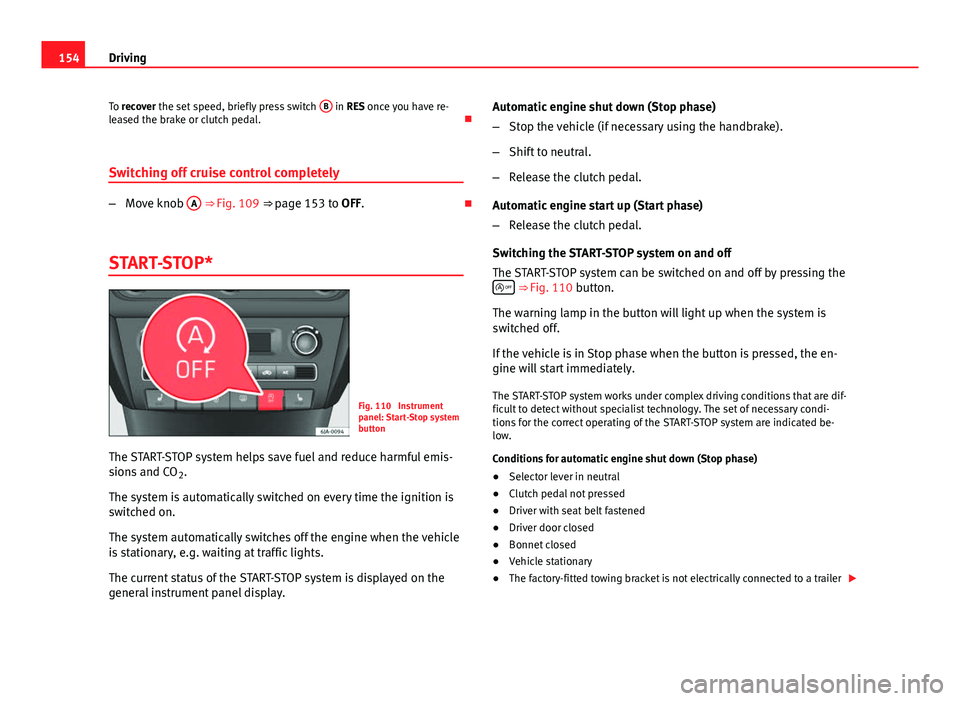
Fig. 110 Instrument
panel: Start-Stop system
button
The START-STOP system helps save fuel and reduce harmful emis-
sions and CO 2.
The system is automatically switched on every time the ignition is
switched on.
The system automatically switches off the engine when the vehicle
is stationary, e.g. waiting at traffic lights.
The current status of the START-STOP system is displayed on the
general instrument panel display. Automatic engine shut down (Stop phase)
–
Stop the vehicle (if necessary using the handbrake).
– Shift to neutral.
– Release the clutch pedal.
Automatic engine start up (Start phase)
– Release the clutch pedal.
Switching the START-STOP system on and off
The START-STOP system can be switched on and off by pressing the
⇒ Fig. 110 button.
The warning lamp in the button will light up when the system is
switched off.
If the vehicle is in Stop phase when the button is pressed, the en-
gine will start immediately.
The START-STOP system works under complex driving conditions that are dif-
ficult to detect without specialist technology. The set of necessary condi-
tions for the correct operating of the START-STOP system are indicated be-
low.
Conditions for automatic engine shut down (Stop phase)
● Selector lever in neutral
● Clutch pedal not pressed
● Driver with seat belt fastened
● Driver door closed
● Bonnet closed
● Vehicle stationary
● The factory-fitted towing bracket is not electrically connected to a trailer
Page 158 of 258

156Driving and the environment
Practical Tips
Driving and the environment
The first 1500 km (900 miles) New engine
Over the first 1500 kilometres (900 miles) the engine must be run
in.
Up to 1,000 kilometres (600 miles)
– Do not drive at more than 3/4 of the maximum speed corre-
sponding to the engaged gear, i.e. up to 3/4 of the maximum
permitted engine speed.
– Do not drive at full speed.
– Avoid high engine speeds.
– Do not tow a trailer.
From 1,000 to 1,500 kilometres (600 to 900 miles)
– Slowly increase the engine speed until reaching the maximum
permitted speed of the engaged gear, i.e. the maximum permit-
ted engine speed.
During its first few hours of running, the internal friction in the engine is
greater than later on, when all the moving parts have bedded in. How the
vehicle is driven over approximately the first 1500 kilometres (900 miles),
determines the success of the process of running in the engine. After the running in, the vehicle should not be driven at
high engine
speeds. The maximum permitted engine speed is marked at the start of the
red zone on the rev counter dial. The gear must be changed up when the red
area is reached in vehicles with a manual gearbox. Extremely high engine
speeds when accelerating are automatically limited, however the engine is
not protected against high engine speeds produced by incorrectly changing
to a lower gear, which could cause the engine to run at revs above the maxi-
mum permitted amount, and consequently result in damage to the engine.
Additionally, vehicles with a manual gearbox must also bear the following in
mind: do not drive with the engine speed too low. Change down to a lower
gear when the engine no longer runs smoothly. Observe the recommenda-
tions for changing gear ⇒ page 60, Recommended gear display.
CAUTION
All the information for speed and engine speed refers to an engine that op-
erates at operating temperature. Do not run the engine at high engine
speeds, neither when stopped or while driving.
For the sake of the environment
Do not drive at unnecessarily high engine speeds – an anticipated change
to a higher gear contributes to saving fuel, reducing operating noise and
protects the environment.
Page 159 of 258
157
Driving and the environment
New tyres
New tyres must be submitted to “running in”, given that initially their grip is
not yet at the maximum level. During approximately the first 500 km (120
miles) drive very carefully.
New brake pads
New brake pads do not yet provide maximum friction capacity. New brake
pads must be “run in” first. During approximately the first 200 km (120
miles) drive very carefully.
Catalytic converter
An exhaust gas emission control system (catalytic converter) that functions
perfectly is vitally important for vehicle operation that respects the environ-
ment.
Please observe the following indications:
● Refuel only using unleaded petrol ⇒ page 180, Unleaded petrol in pet-
rol engine vehicles.
● Do not add too much oil to the engine ⇒ page 186, Checking the en-
gine oil level;.
● Do not switch off the ignition while driving.
If you are required to drive in a country where unleaded fuel is not available
and when returning to a country where using a catalytic converter is obliga-
tory, the catalytic converter must be replaced.
WARNING
● Due to the high temperatures that the catalytic converter can reach,
the vehicle must be stopped so that the catalytic converter does not
come into contact with easily flammable material underneath the vehicle.
Risk of fire!
● Never use substances for additional underbody protection or anti-cor-
rosion for the exhaust pipes, the catalytic converter or the antithermic
screen. Risk of fire!
CAUTION
● Never completely empty the tank! An irregular fuel supply can cause ig-
nition faults, which can result in damage to a substantial amount of engine
parts and the exhaust system.
● Refuelling just once with leaded petrol disables the exhaust system!
Economical and ecological driving General notes
Fuel consumption, environmental impact and engine, brake and tyre wear
depend largely on three factors:
● personal driving style
● the conditions in which the vehicle is used
● prior technical conditions
By adopting an economical driving style and anticipating the traffic situa-
tion ahead, you can easily reduce fuel consumption by 10-15%.
Safety FirstOperating instructionsPractical TipsTechnical specifications