lock Seat Toledo 2013 Workshop Manual
[x] Cancel search | Manufacturer: SEAT, Model Year: 2013, Model line: Toledo, Model: Seat Toledo 2013Pages: 258, PDF Size: 3.94 MB
Page 151 of 258
149
Driving
The manual gearbox can be activated when the vehicle is either moving or
stationary.
When accelerating, the gearbox automatically shifts up shortly before the
maximum engine speed is reached.
On shifting up, the gear is only engaged when there is no risk of engine
damage.
When the accelerator pedal is pressed down to the kick-down zone, the
gearbox will shift down in line with the road speed and engine speed.
Note
The kick-down function is also available in manual shift mode.
Selector lever lock
Automatic selector lever lock
The selector lever is locked in the positions P and N when the ignition is on.
Press down on the brake to unlock it. Remember, if the selector lever is in
positions P and N then the ⇒ page 77 warning lamp will light up on the
general instrument panel.
When the selector lever merely moves through position N (e.g. when moved
from R to D), the lever lock is not applied. This makes it possible, for exam-
ple, to rock a stuck vehicle backwards and forwards. The lock is only applied
if the brake is not pressed and the selector lever is moved to position N for
more than 2 seconds.
The selector lever lock is only activated in vehicles that are stationary and at
speeds below 5 km/h (3 mph). It is automatically switched off in position N
at higher speeds. Interlock button
The interlock button on the selector lever knob prevents the driver from in-
advertently engaging a gear. Press the button to unlock the selector lever.
Safety interlock for ignition key
1)
After switching off the ignition, you can only remove the ignition key if the
selector lever is in position P. When the ignition key is removed, the selec-
tor lever is locked in position P.
Kick-down feature
The kick-down feature allows maximum acceleration to be reached.
In any gear programme, press down fully on the accelerator for the automat-
ic gearbox to activate the kick-down feature. This function takes priority over
the gear programmes without taking into account the position of the selec-
tor lever (D, S or Tiptronic) and is used to reach maximum acceleration, us-
ing full engine power. Depending on the road speed and engine speed, the
automatic gearbox shifts down and the vehicle accelerates. It only shifts up
after the maximum engine speed has been reached.
Driving programmes
Your vehicle is equipped with an electronically-controlled automatic gear-
box. Shifting up or down depends on the programme selected.
For a calm driving style, the gearbox uses the most economic programme.
The gearbox shifts up as quickly as possible and shifts down as late as pos-
sible, thus increasing driving economy.
1)
Valid only for certain countries.
Safety FirstOperating instructionsPractical TipsTechnical specifications
Page 152 of 258
150Driving
With a sporty driving style , characterised by sudden acceleration, heavy ac-
celeration, speeds that often increase and decrease and maximum speed,
the gearbox adapts to this driving style when the accelerator is pressed fully
down (kick-down) by shifting down as quickly as possible and can even
shift down by several gears at once.
Selecting the best driving programmes is an endless job. Regardless of this,
the driver can also make the gearbox switch to a more dynamic gear shift
programme by pressing the accelerator quickly. This makes the automatic
gearbox shift down into a lower gear that would normally apply to the cur-
rent speed for more rapid acceleration (e.g. to overtake another vehicle)
without having to press the accelerator fully down into the kick-down posi-
tion. On shifting up in a corresponding driving style, the gearbox returns to
the original programme.
When driving along mountain roads, the gearbox adapts to the gradients.
This avoids having to frequently change gears when driving uphill. In Tip-
tronic mode, it is possible to shift down manually when driving downhill to
use the braking effect of the engine.
Back-up programme
A back-up programme exists in case of faults.
In the event of a fault in the gearbox electronics, this will continue to work
in one of the corresponding back-up programmes. All segments of the
screen are lit up or switched off.
The fault can be seen as follows:
● The gearbox only engages certain gears
● Reverse gear R cannot be engaged
● The manual gearbox switches off in the back-up programme
Note
If the gearbox switches to the back-up programme, visit an Authorised Serv-
ice as soon as possible to solve the problem.
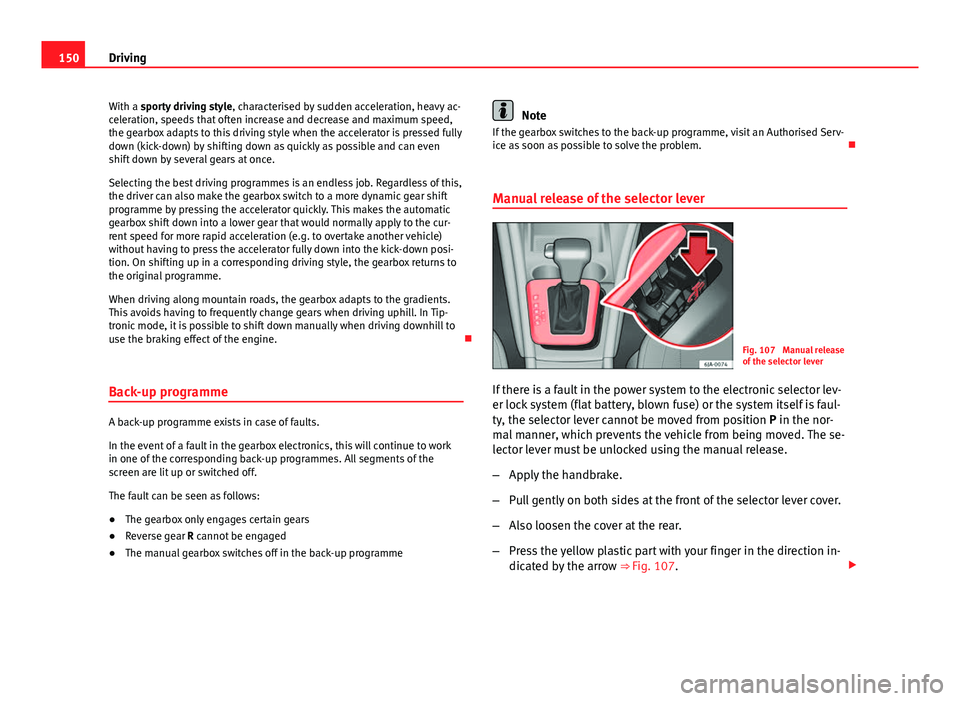
Manual release of the selector lever
Fig. 107 Manual release
of the selector lever
If there is a fault in the power system to the electronic selector lev-
er lock system (flat battery, blown fuse) or the system itself is faul-
ty, the selector lever cannot be moved from position P in the nor-
mal manner, which prevents the vehicle from being moved. The se-
lector lever must be unlocked using the manual release.
– Apply the handbrake.
– Pull gently on both sides at the front of the selector lever cover.
– Also loosen the cover at the rear.
– Press the yellow plastic part with your finger in the direction in-
dicated by the arrow ⇒
Fig. 107.
Page 153 of 258
151
Driving
– Press the interlock button on the selector lever knob at the
same time and move the selector lever to position N (if the se-
lector lever were to be moved back to position P then it would
lock again).
Foot pedals
Under no circumstances must correct use of the pedals be impaired!
Only a floor mat secured to the two corresponding fastening points may be
used in the driver footwell.
Only use floor mats from the catalogue of SEAT Original Accessories that
fasten at two points.
WARNING
No object must be left in the driver footwell. Risk of preventing or limit-
ing use of the foot pedals!
Parking aid*
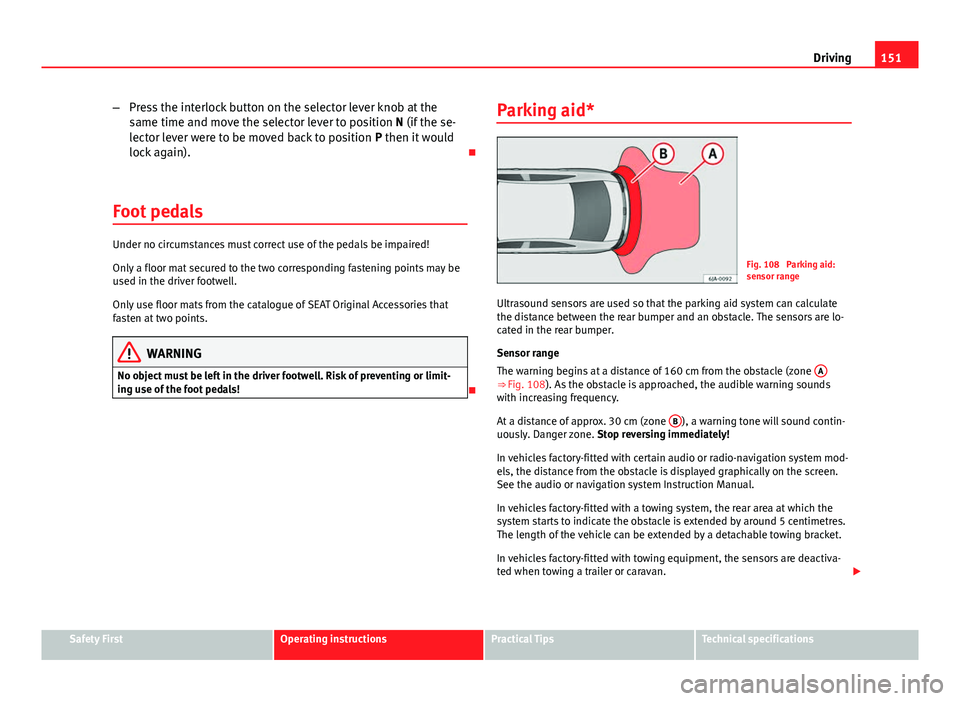
Fig. 108 Parking aid:
sensor range
Ultrasound sensors are used so that the parking aid system can calculate
the distance between the rear bumper and an obstacle. The sensors are lo-
cated in the rear bumper.
Sensor range
The warning begins at a distance of 160 cm from the obstacle (zone A
⇒ Fig. 108). As the obstacle is approached, the audible warning sounds
with increasing frequency.
At a distance of approx. 30 cm (zone B
), a warning tone will sound contin-
uously. Danger zone. Stop reversing immediately!
In vehicles factory-fitted with certain audio or radio-navigation system mod-
els, the distance from the obstacle is displayed graphically on the screen.
See the audio or navigation system Instruction Manual.
In vehicles factory-fitted with a towing system, the rear area at which the
system starts to indicate the obstacle is extended by around 5 centimetres.
The length of the vehicle can be extended by a detachable towing bracket.
In vehicles factory-fitted with towing equipment, the sensors are deactiva-
ted when towing a trailer or caravan.
Safety FirstOperating instructionsPractical TipsTechnical specifications
Page 167 of 258
165
Driving the vehicle with a trailer
WARNING
● Exceeding the maximum established load per axle and the maximum
towing bracket load in addition to the maximum permitted load or the
load of the vehicle + trailer assembly can cause accidents and serious in-
juries.
● A sliding load could considerably affect the stability and safety of the
vehicle + trailer assembly, resulting in accidents and serious injuries.
Towing a trailer
Exterior mirrors
Check whether you can see enough of the road behind the trailer with the
standard rear vision mirrors. If this is not the case, you should have addi-
tional exterior mirrors fitted. Observe the relevant statutory requirements of
the country you are in.
Headlights
Before starting a journey, also check the headlight beam settings with the
trailer hitched up. Adjust the headlight range settings if necessary
⇒ page 99, Range control of main lights .
Driving speed
For your own safety do not drive faster than the maximum permitted speed
indicated on the trailer.
At all times, immediately reduce speed if you detect the slightest swaying
movement of the trailer. Never try to “return the trailer to a straight posi-
tion” by accelerating.
Brakes
Brake in due course! If the trailer has an overrun brake, apply the brakes
gently at first and then, firmly. This will prevent the jerking that can be caused by locking of trailer wheels. Change to a lower gear in good time be-
fore descending a slope in order to take advantage of the engine brake.
The trailer is incorporated into the vehicle anti-theft alarm system.
●
When the vehicle has a factory-fitted anti-theft alarm and a towing
bracket
● When the trailer is electrically connected to the vehicle via the towing
bracket socket
● When the vehicle electrical device and the towing bracket are operation-
al
● When the vehicle is locked and the vehicle anti-theft alarm device is ac-
tivated
Once the electrical connection is interrupted with the vehicle trailer locked,
the alarm sounds.
Always switch off the vehicle anti-theft alarm device before connecting or
disconnecting a trailer. The vehicle anti-theft alarm device could cause the
alarm to sound ⇒ page 91, Anti-theft alarm system*.
Engine overheating
In the event that the coolant temperature gauge needle moves to the right
section of the scale or to the red area, immediately reduce speed. If the con-
trol lamp flashes on the general instrument panel, stop the vehicle and
switch off the engine. Wait several minutes and check the coolant level in
the tank ⇒ page 188.
Please observe the following indications ⇒ page 72, Coolant level and tem-
perature .
The coolant temperature can be reduced by switching on the heating.
Safety FirstOperating instructionsPractical TipsTechnical specifications
Page 169 of 258
167
Driving the vehicle with a trailer
Towing bracket device Introduction
If the vehicle is equipped with a towing bracket device from the factory or
consisting of genuine SEAT accessories, it meets all the national technical
and legal requirements for towing.
Your vehicle is fitted with a 13-pin power socket for the electrical connection
between the trailer and the vehicle. If the towing bracket is equipped with a
7-pin connector, the corresponding available adaptor may be used as a
genuine SEAT accessory.
The towing device has a maximum vertical load of 50 kg.
WARNING
● Before driving with the ball-headed bar fitted, verify its correct as-
sembly and placement in the clamping bush.
● Do not use the ball-headed bar if it is not correctly placed and fixed in
the clamping bush.
● Do not use the towing device for towing if it is damaged or missing
parts.
● Do not modify or adapt the towing device for towing.
● Never disengage the ball-headed bar with the trailer still hitched.
CAUTION
Be careful not to damage the paint on the bumper when handling the ball-
headed bar. Description
Fig. 114 Towing bracket device support for hitching/ball-headed bar
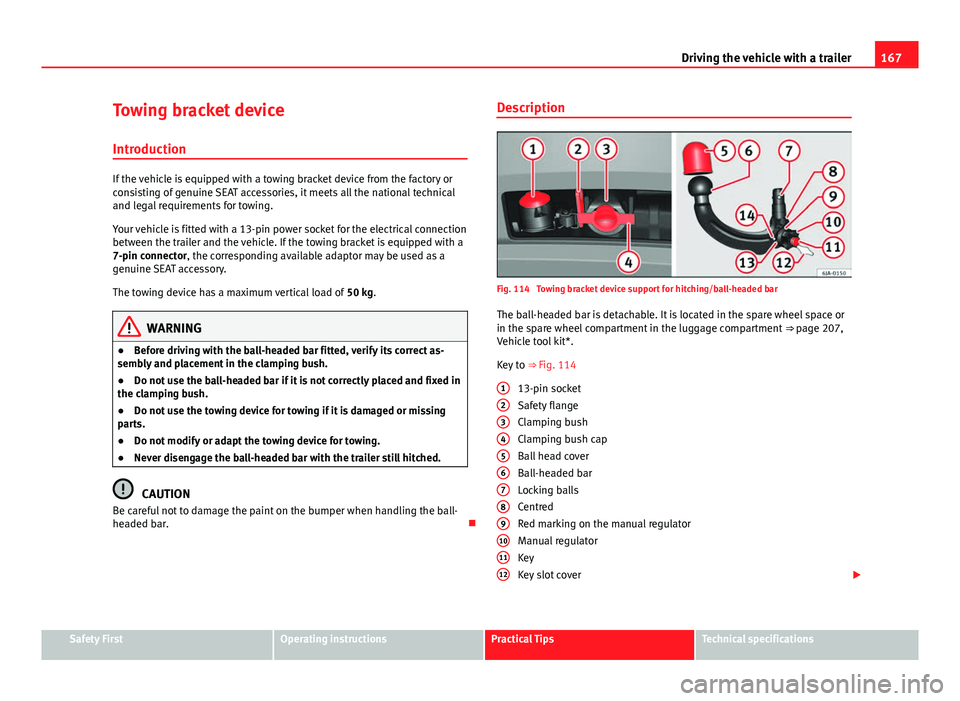
The ball-headed bar is detachable. It is located in the spare wheel space or
in the spare wheel compartment in the luggage compartment ⇒ page 207,
Vehicle tool kit*.
Key to ⇒ Fig. 114
13-pin socket
Safety flange
Clamping bush
Clamping bush cap
Ball head cover
Ball-headed bar
Locking balls
Centred
Red marking on the manual regulator
Manual regulator
Key
Key slot cover
1
23456789101112
Safety FirstOperating instructionsPractical TipsTechnical specifications
Page 170 of 258
168Driving the vehicle with a trailer
Red marking on the manual regulator
White marking on the ball-headed bar
Note
Contact an Authorised Service Partner if you lose your key.
Placing in service position
Fig. 115 Placing in service position
Fig. 116 Service position 13
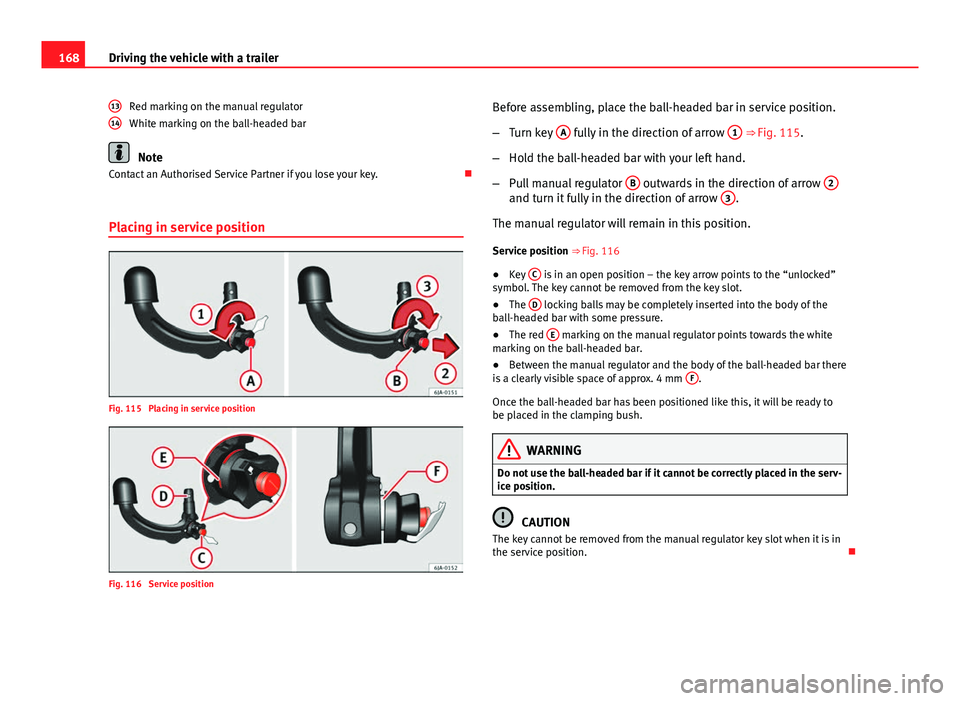
14Before assembling, place the ball-headed bar in service position.
–
Turn key A
fully in the direction of arrow 1 ⇒ Fig. 115.
– Hold the ball-headed bar with your left hand.
– Pull manual regulator B
outwards in the direction of arrow 2and turn it fully in the direction of arrow 3.
The manual regulator will remain in this position.
Service position ⇒ Fig. 116
● Key C
is in an open position – the key arrow points to the “unlocked”
symbol. The key cannot be removed from the key slot.
● The D
locking balls may be completely inserted into the body of the
ball-headed bar with some pressure.
● The red E
marking on the manual regulator points towards the white
marking on the ball-headed bar.
● Between the manual regulator and the body of the ball-headed bar there
is a clearly visible space of approx. 4 mm F
.
Once the ball-headed bar has been positioned like this, it will be ready to
be placed in the clamping bush.
WARNING
Do not use the ball-headed bar if it cannot be correctly placed in the serv-
ice position.
CAUTION
The key cannot be removed from the manual regulator key slot when it is in
the service position.
Page 171 of 258
169
Driving the vehicle with a trailer
Assembling the ball-headed bar
Fig. 117 Placing the ball-headed bar/locking and removing the key
Fig. 118 Placing the key
slot cover
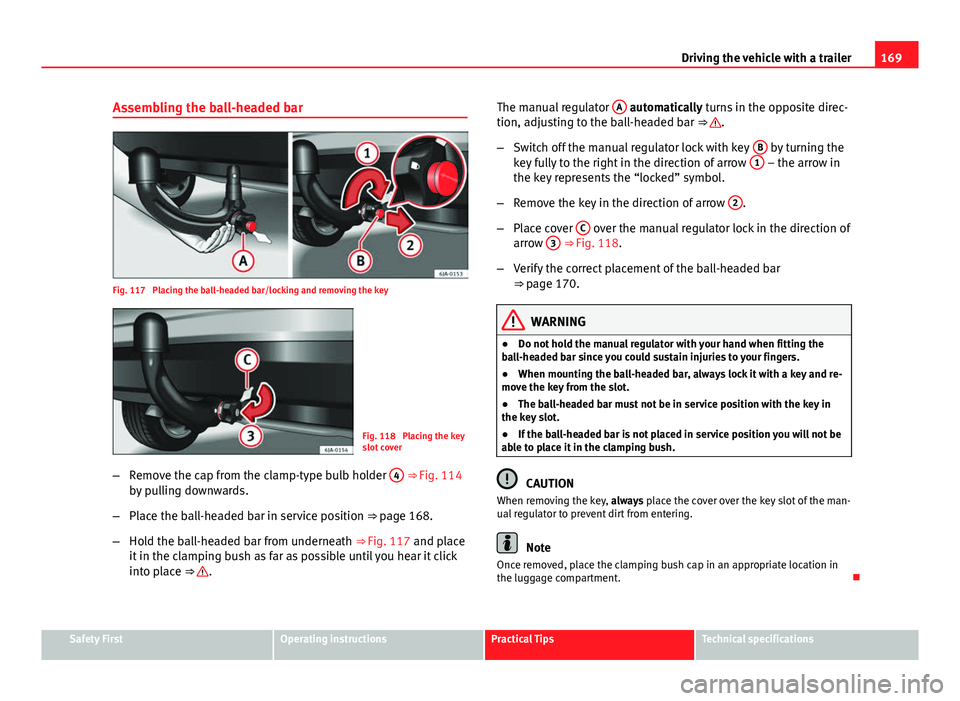
– Remove the cap from the clamp-type bulb holder 4
⇒ Fig. 114
by pulling downwards.
– Place the ball-headed bar in service position ⇒ page 168.
– Hold the ball-headed bar from underneath ⇒ Fig. 117 and place
it in the clamping bush as far as possible until you hear it click
into place ⇒
. The manual regulator
A
automatically turns in the opposite direc-
tion, adjusting to the ball-headed bar ⇒ .
– Switch off the manual regulator lock with key B
by turning the
key fully to the right in the direction of arrow 1 – the arrow in
the key represents the “locked” symbol.
– Remove the key in the direction of arrow 2
.
– Place cover C
over the manual regulator lock in the direction of
arrow 3 ⇒ Fig. 118.
– Verify the correct placement of the ball-headed bar
⇒ page 170.
WARNING
● Do not hold the manual regulator with your hand when fitting the
ball-headed bar since you could sustain injuries to your fingers.
● When mounting the ball-headed bar, always lock it with a key and re-
move the key from the slot.
● The ball-headed bar must not be in service position with the key in
the key slot.
● If the ball-headed bar is not placed in service position you will not be
able to place it in the clamping bush.
CAUTION
When removing the key, always place the cover over the key slot of the man-
ual regulator to prevent dirt from entering.
Note
Once removed, place the clamping bush cap in an appropriate location in
the luggage compartment.
Safety FirstOperating instructionsPractical TipsTechnical specifications
Page 172 of 258
170Driving the vehicle with a trailer
Verification of correct placement
Fig. 119 Correct place-
ment of the ball-headed
bar
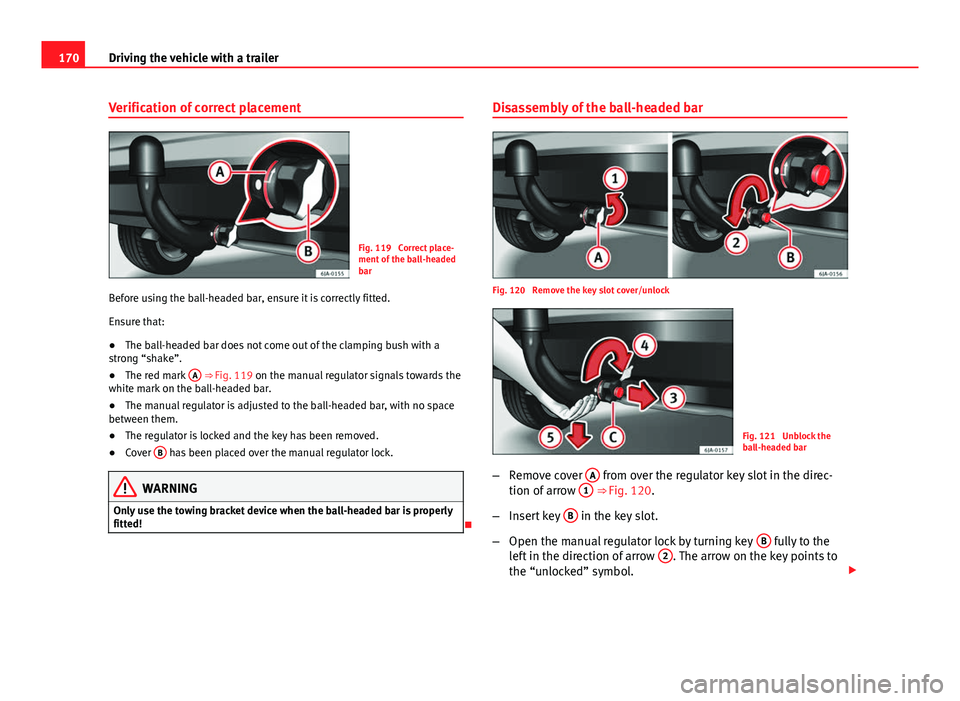
Before using the ball-headed bar, ensure it is correctly fitted.
Ensure that:
● The ball-headed bar does not come out of the clamping bush with a
strong “shake”.
● The red mark A
⇒ Fig. 119 on the manual regulator signals towards the
white mark on the ball-headed bar.
● The manual regulator is adjusted to the ball-headed bar, with no space
between them.
● The regulator is locked and the key has been removed.
● Cover B
has been placed over the manual regulator lock.
WARNING
Only use the towing bracket device when the ball-headed bar is properly
fitted!
Disassembly of the ball-headed bar
Fig. 120 Remove the key slot cover/unlock
Fig. 121 Unblock the
ball-headed bar
– Remove cover A
from over the regulator key slot in the direc-
tion of arrow 1 ⇒ Fig. 120.
– Insert key B
in the key slot.
– Open the manual regulator lock by turning key B
fully to the
left in the direction of arrow 2. The arrow on the key points to
the “unlocked” symbol.
Page 174 of 258

172Care of the vehicle and cleaning
Care of the vehicle and cleaning
Care of the vehicle
Introduction
Regular and suitable care helps to maintain the useful life of your vehicle.
This may also be one of the requirements for upholding any warranty claims
in the event of corrosion or paint defects.
We recommend you use cleaning products from the SEAT Original Accesso-
ries programme available in SEAT dealers. Please follow the instructions for
use on the packaging.
WARNING
● Cleaning products and other materials used for car care can damage
the health if misused.
● Always keep car care materials in a safe place out of the reach of chil-
dren. Risk of poisoning!
● When washing the car during the winter season: Moisture and ice on
the brakes may affect braking efficiency. Risk of accident!
● The ignition must always be switched off when the car is washed.
Risk of accident!
● Do not clean the underside of the car or inside the wheel arches with-
out protecting your hands and arms. You may cut yourself on sharp metal
parts!
● Perfumes and air fresheners inside the vehicle may be harmful to
health at high temperatures in the interior.
CAUTION
● Check the colour stability of your clothing to avoid damaging or visibly
staining the fabric (leather), upholstery and fabric trim.
● Cleaning products containing solvents may damage the material being
cleaned.
● Do not wash the vehicle in direct sunlight. Risk of damage to paintwork.
● If washing the vehicle with a hose in winter, do not direct the jet of water
directly at the locks or at the door seals or bonnet. Risk of freezing.
● Do not use insect sponges or abrasive household sponges, etc. on pain-
ted surfaces. Risk of damage to the painted surface.
● Do not put stickers on the inner side of the window in areas where heat-
ing elements or the aerial is located. This could cause damage and, in the
case of the aerial, radio and navigation system reception faults.
● Do not clean the inner side of the window with sharp objects or corro-
sive or acidic cleaning products. Risk of damaging the heating elements or
the aerial.
● Do not attach any fragrance or air freshener to the dash panel. Risk of
damage to the dash panel.
● To avoid damaging the parking aid system sensors, spray them only
briefly at a minimum distance of 10 cm when cleaning the vehicle with a
high-pressure or steam cleaner.
● Do not clean the roof panel with a brush. Risk of damage to the panel
surface!
For the sake of the environment
● The packaging of the product used to care for your vehicle is hazardous
waste. It must be disposed of according to current local law.
● Only wash the car in special wash bays.
Page 177 of 258
175
Care of the vehicle and cleaning
Plastic parts
Exterior plastic parts will come clean using a damp cloth. If this is not suffi-
cient, plastic parts can also be treated with special solvent-free plastic
cleaning detergents.
Do not use paint cleaners, polishes or wax on plastic parts.
Windows and exterior mirrors
Remove snow and ice from windows and rear vision mirrors with a plastic
scraper only. To avoid damaging the surface of the glass, the scraper should
only be pushed in one direction and not moved to and fro.
The windows should also be cleaned on the inside at regular intervals.
Use a separate cloth or chamois to dry the windows and rear vision mirrors.
Do not use the chamois used to polish the bodywork to dry the windows.
Waxing and polishing residues could cause smears on the glass and hinder
visibility.
CAUTION
● Never use warm or hot water to remove snow and ice from the windows
and mirrors. Risk of cracking glass!
● Make sure you do not damage the paintwork on the vehicle on removing
snow and ice from the windows and rear vision mirrors.
● Do not remove the snow or ice from windows and mirrors that are dirty
with thick particles, e.g. gravel, sand or road salt. Risk of damage to surface
of glass and windows. Radio reception and aerial
In vehicles factory-fitted with an audio and navigation system, the aerial
may be installed in different places:
●
Inside the rear window next to the heating elements
● on the roof of the vehicle.
Headlights
Use soap and clean, hot water to clean the front headlights.
CAUTION
● Never rub the headlights dry and do not use sharp objects to clean the
plastic glass material. These could damage the protective paint and cause
the headlights to crack.
● Do not use aggressive cleaning products or chemical solvents to clean
the glass. This could damage the headlights.
Care of rubber seals
The weatherstrips on doors and windows will remain pliable and last longer
if they are occasionally treated with a suitable rubber care product. This will
prevent premature ageing and leaks. If they are correctly cared for, the seals
will be less likely to freeze up in the winter.
Door lock cylinder
Special products must be used to defrost lock cylinders.
Safety FirstOperating instructionsPractical TipsTechnical specifications