lock Seat Toledo 2013 Manual PDF
[x] Cancel search | Manufacturer: SEAT, Model Year: 2013, Model line: Toledo, Model: Seat Toledo 2013Pages: 258, PDF Size: 3.94 MB
Page 219 of 258

217
Self-help
road. If the vehicle is towed with the rear wheels lifted off the road
the automatic gearbox will be damaged!
It is easier and safer to tow a vehicle with a towbar. A towrope
should only be used if you do not have a towbar.
Follow the instructions below when towing a vehicle:
Notes for the driver of the towing vehicle
– Engage the clutch very gently when starting to move or on vehi-
cles with automatic gearbox press the accelerator carefully.
– On vehicles with manual gearbox, the towrope must be taut be-
fore driving off.
The maximum towing speed is 50 km/h (31 mph).
Notes for the driver of the towed vehicle
– The ignition should be switched on so that the steering wheel
lock is not engaged and the turn signals, horn and windscreen
wipers and washers can be used.
– Put the gear lever in neutral or move the selector lever to posi-
tion N (automatic gearbox).
The brake servo and power steering only work when the engine is
running. Considerably more effort is required on the brake pedal
and steering wheel when the engine is switched off.
Ensure the towrope remains taut at all times when towing.
CAUTION
● Do not tow-start the engine. Risk of engine damage! In vehicles with a
catalytic converter, unburnt fuel could reach the catalytic converter and
catch fire in it. This could damage and destroy the catalytic converter. Use
the battery from another vehicle for help in starting the engine ⇒ page 215,
Starting the engine.
● If, due to a fault, there is no oil in the gearbox, the car may only be tow-
ed with the driven wheels lifted clear of the road and transported on a spe-
cial vehicle transporter or trailer.
● If normal towing is not possible or if the vehicle is to be towed for further
than 50 km (31 miles), the vehicle must be transported on a special vehicle
transporter or trailer.
● The towrope should be slightly elastic to reduce the loading on both ve-
hicles during towing. It is advisable to use a towrope made of synthetic fibre
or similar material only.
● Do not pull too hard with the towing vehicle and always take care to
avoid jerking the towrope. When towing on a loose surface there is always a
risk of overloading and damaging the anchorage points.
● Attach the towrope or towbar only to the towline anchorages or to the
removable towing bracket ⇒ page 164, or ⇒ page 218.
Note
● We recommend you use the towrope or towbar available in the SEAT
Original Accessories programme from authorised SEAT dealers.
● Towing a vehicle requires some experience. Both drivers should be fa-
miliar with the technique required for towing. Inexperienced drivers should
not attempt to tow away another vehicle or to have their vehicle towed.
● Note the legal regulations concerning towing, particularly those regard-
ing the signalling of the towed and towing vehicle.
● The towrope must not be twisted, as under certain circumstances this
could unscrew the front towline anchorage.
Safety FirstOperating instructionsPractical TipsTechnical specifications
Page 220 of 258
218Self-help
Front towline anchorage
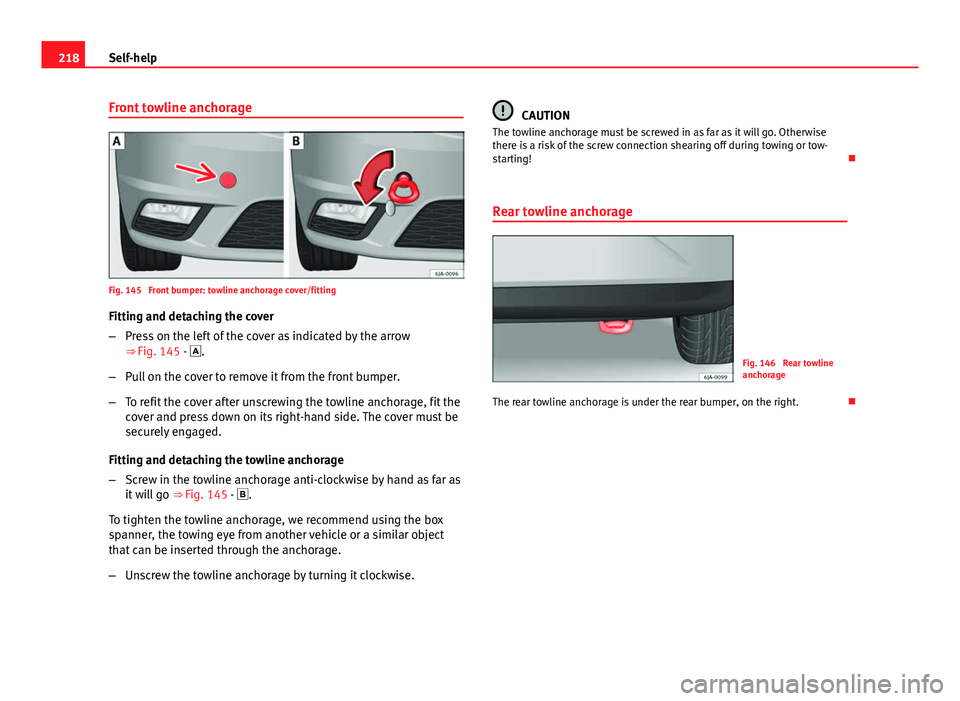
Fig. 145 Front bumper: towline anchorage cover/fitting
Fitting and detaching the cover
–Press on the left of the cover as indicated by the arrow
⇒ Fig. 145 - .
– Pull on the cover to remove it from the front bumper.
– To refit the cover after unscrewing the towline anchorage, fit the
cover and press down on its right-hand side. The cover must be
securely engaged.
Fitting and detaching the towline anchorage
– Screw in the towline anchorage anti-clockwise by hand as far as
it will go ⇒ Fig. 145 - .
To tighten the towline anchorage, we recommend using the box
spanner, the towing eye from another vehicle or a similar object
that can be inserted through the anchorage.
– Unscrew the towline anchorage by turning it clockwise.
CAUTION
The towline anchorage must be screwed in as far as it will go. Otherwise
there is a risk of the screw connection shearing off during towing or tow-
starting!
Rear towline anchorage
Fig. 146 Rear towline
anchorage
The rear towline anchorage is under the rear bumper, on the right.
Page 223 of 258
221
Fuses and bulbs
Changing fuses in the engine compartment
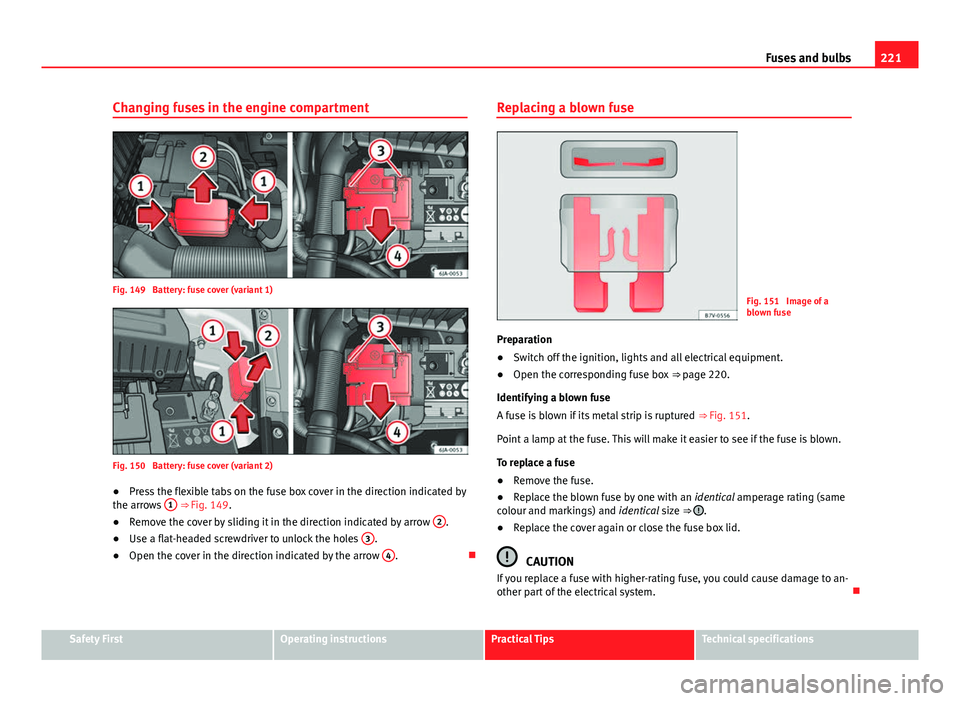
Fig. 149 Battery: fuse cover (variant 1)
Fig. 150 Battery: fuse cover (variant 2)
● Press the flexible tabs on the fuse box cover in the direction indicated by
the arrows 1
⇒ Fig. 149.
● Remove the cover by sliding it in the direction indicated by arrow 2.
● Use a flat-headed screwdriver to unlock the holes 3.
● Open the cover in the direction indicated by the arrow 4.Replacing a blown fuse
Fig. 151 Image of a
blown fuse
Preparation
● Switch off the ignition, lights and all electrical equipment.
● Open the corresponding fuse box
⇒ page 220.
Identifying a blown fuse
A fuse is blown if its metal strip is ruptured ⇒ Fig. 151.
Point a lamp at the fuse. This will make it easier to see if the fuse is blown.
To replace a fuse
● Remove the fuse.
● Replace the blown fuse by one with an identical amperage rating (same
colour and markings) and identical size ⇒
.
● Replace the cover again or close the fuse box lid.
CAUTION
If you replace a fuse with higher-rating fuse, you could cause damage to an-
other part of the electrical system.
Safety FirstOperating instructionsPractical TipsTechnical specifications
Page 226 of 258
224Fuses and bulbs
Changing main beam headlight bulbs
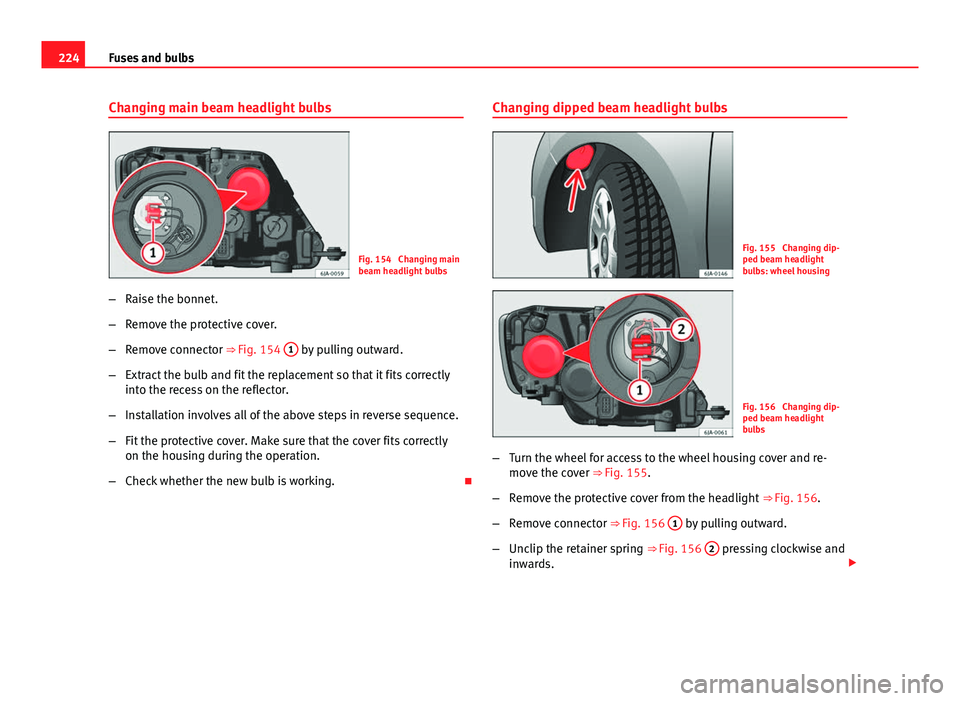
Fig. 154 Changing main
beam headlight bulbs
– Raise the bonnet.
– Remove the protective cover.
– Remove connector ⇒ Fig. 154 1
by pulling outward.
– Extract the bulb and fit the replacement so that it fits correctly
into the recess on the reflector.
– Installation involves all of the above steps in reverse sequence.
– Fit the protective cover. Make sure that the cover fits correctly
on the housing during the operation.
– Check whether the new bulb is working. Changing dipped beam headlight bulbs
Fig. 155 Changing dip-
ped beam headlight
bulbs: wheel housing
Fig. 156 Changing dip-
ped beam headlight
bulbs
– Turn the wheel for access to the wheel housing cover and re-
move the cover ⇒ Fig. 155.
– Remove the protective cover from the headlight ⇒
Fig. 156.
– Remove connector ⇒
Fig. 156 1
by pulling outward.
– Unclip the retainer spring ⇒
Fig. 156 2
pressing clockwise and
inwards.
Page 227 of 258
225
Fuses and bulbs
– Extract the bulb and fit the replacement so that the lug on the
base fits into the recess on the reflector.
– Fit the connector.
– Fit the protective cover. Make sure that the cover fits correctly
on the housing during the operation.
– Replace the wheel housing cover.
– Check whether the new bulb is working.
Changing turn signal light bulbs
Fig. 157 Changing turn
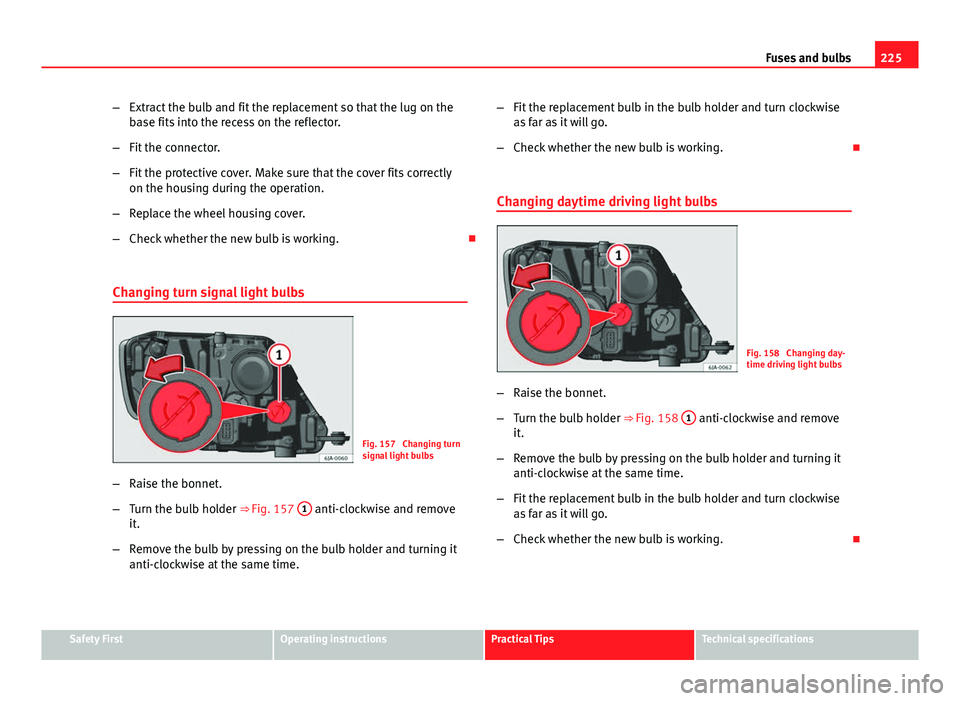
signal light bulbs
– Raise the bonnet.
– Turn the bulb holder ⇒ Fig. 157 1
anti-clockwise and remove
it.
– Remove the bulb by pressing on the bulb holder and turning it
anti-clockwise at the same time. –
Fit the replacement bulb in the bulb holder and turn clockwise
as far as it will go.
– Check whether the new bulb is working.
Changing daytime driving light bulbs
Fig. 158 Changing day-
time driving light bulbs
– Raise the bonnet.
– Turn the bulb holder ⇒ Fig. 158 1
anti-clockwise and remove
it.
– Remove the bulb by pressing on the bulb holder and turning it
anti-clockwise at the same time.
– Fit the replacement bulb in the bulb holder and turn clockwise
as far as it will go.
– Check whether the new bulb is working.
Safety FirstOperating instructionsPractical TipsTechnical specifications
Page 228 of 258

226Fuses and bulbs
Changing front fog light bulbs
Front fog light bulb
Fig. 159 Front fog light
Fig. 160 Front fog light –
Remove the bolt ⇒ Fig. 159 A
from the fog light grille with a
screwdriver.
– Subsequently, remove the clips located on the edge of the grill
with gentle leverage.
– Remove the bolts (3x) ⇒ Fig. 160 B
to remove the fog light.
– Remove the metal clip situated on the upper part of the fog
light pulling towards the exterior of the vehicle ⇒ Fig. 160 C
.
Remove the bulb holder
Fig. 161 Front fog light
– Remove connector ⇒ Fig. 161 A
from the bulb.
– Turn bulb holder ⇒ Fig. 161 B
to the left and pull.
– Remove the bulb by pressing on the bulb holder and turning it
anticlockwise at the same time.
Page 229 of 258
227
Fuses and bulbs
– Installation involves all of the above steps in reverse sequence.
– Check that the bulb works properly.
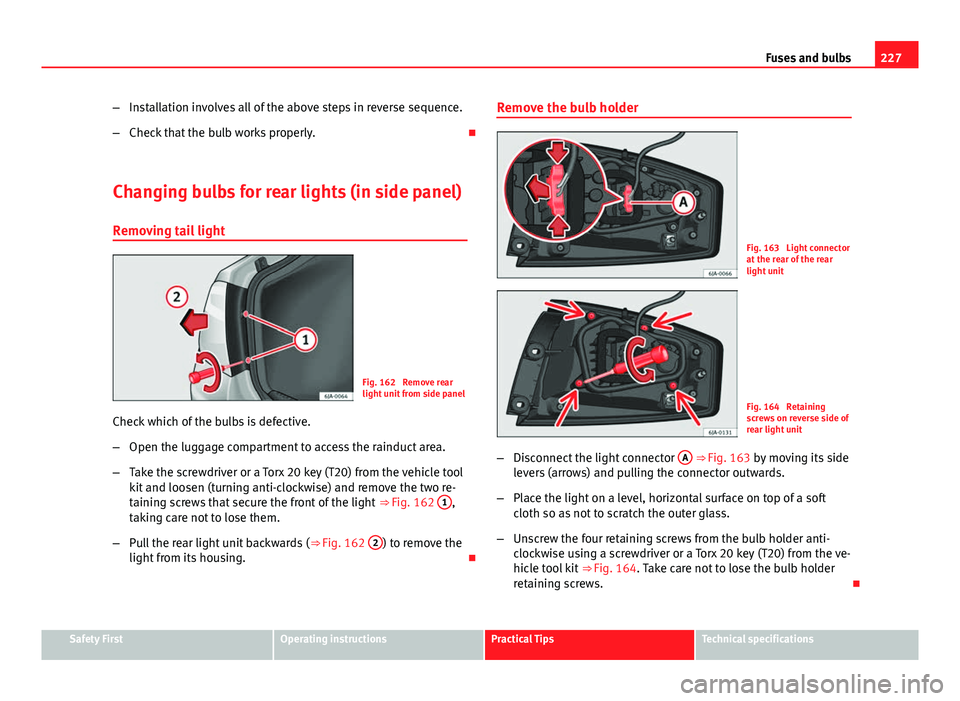
Changing bulbs for rear lights (in side panel) Removing tail light
Fig. 162 Remove rear
light unit from side panel
Check which of the bulbs is defective.
– Open the luggage compartment to access the rainduct area.
– Take the screwdriver or a Torx 20 key (T20) from the vehicle tool
kit and loosen (turning anti-clockwise) and remove the two re-
taining screws that secure the front of the light ⇒ Fig. 162 1
,
taking care not to lose them.
– Pull the rear light unit backwards ( ⇒ Fig. 162 2
) to remove the
light from its housing. Remove the bulb holder
Fig. 163 Light connector
at the rear of the rear
light unit
Fig. 164 Retaining
screws on reverse side of
rear light unit
– Disconnect the light connector A
⇒ Fig. 163 by moving its side
levers (arrows) and pulling the connector outwards.
– Place the light on a level, horizontal surface on top of a soft
cloth so as not to scratch the outer glass.
– Unscrew the four retaining screws from the bulb holder anti-
clockwise using a screwdriver or a Torx 20 key (T20) from the ve-
hicle tool kit ⇒
Fig. 164. Take care not to lose the bulb holder
retaining screws.
Safety FirstOperating instructionsPractical TipsTechnical specifications
Page 230 of 258
228Fuses and bulbs
Changing bulbs
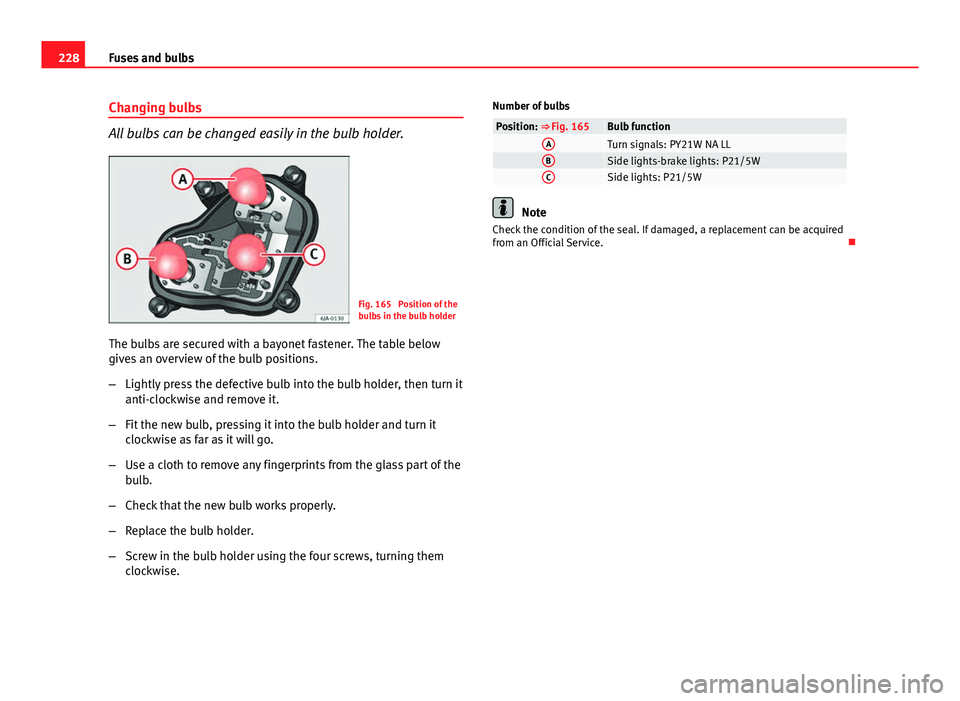
All bulbs can be changed easily in the bulb holder.
Fig. 165 Position of the
bulbs in the bulb holder
The bulbs are secured with a bayonet fastener. The table below
gives an overview of the bulb positions.
– Lightly press the defective bulb into the bulb holder, then turn it
anti-clockwise and remove it.
– Fit the new bulb, pressing it into the bulb holder and turn it
clockwise as far as it will go.
– Use a cloth to remove any fingerprints from the glass part of the
bulb.
– Check that the new bulb works properly.
– Replace the bulb holder.
– Screw in the bulb holder using the four screws, turning them
clockwise. Number of bulbs
Position: ⇒ Fig. 165Bulb functionATurn signals: PY21W NA LLBSide lights-brake lights: P21/5WCSide lights: P21/5W
Note
Check the condition of the seal. If damaged, a replacement can be acquired
from an Official Service.
Page 231 of 258
229
Fuses and bulbs
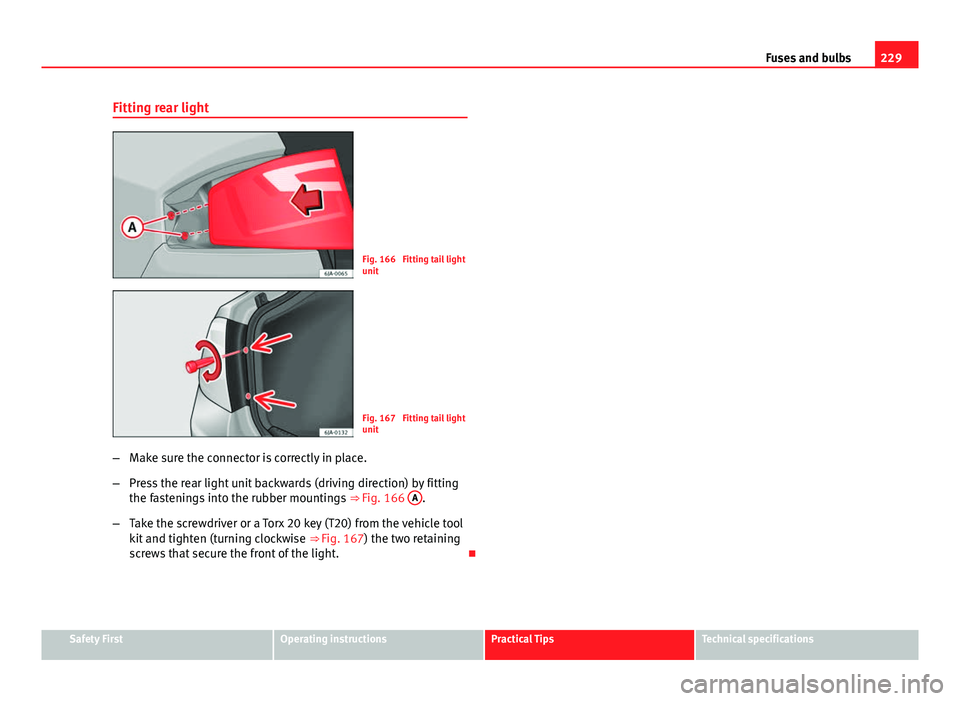
Fitting rear light
Fig. 166 Fitting tail light
unit
Fig. 167 Fitting tail light
unit
– Make sure the connector is correctly in place.
– Press the rear light unit backwards (driving direction) by fitting
the fastenings into the rubber mountings ⇒ Fig. 166 A
.
– Take the screwdriver or a Torx 20 key (T20) from the vehicle tool
kit and tighten (turning clockwise ⇒
Fig. 167) the two retaining
screws that secure the front of the light.
Safety FirstOperating instructionsPractical TipsTechnical specifications
Page 233 of 258
231
Fuses and bulbs
– Lightly press the defective bulb into the bulb holder, then turn it
anti-clockwise and remove it.
– Fit the new bulb, pressing it into the bulb holder and turn it
clockwise as far as it will go.
– Use a cloth to remove any fingerprints from the glass part of the
bulb.
– Check that the new bulb works properly.
– Re-install the bulb holder ⇒ page 231.
– Screw in the bulb holder.
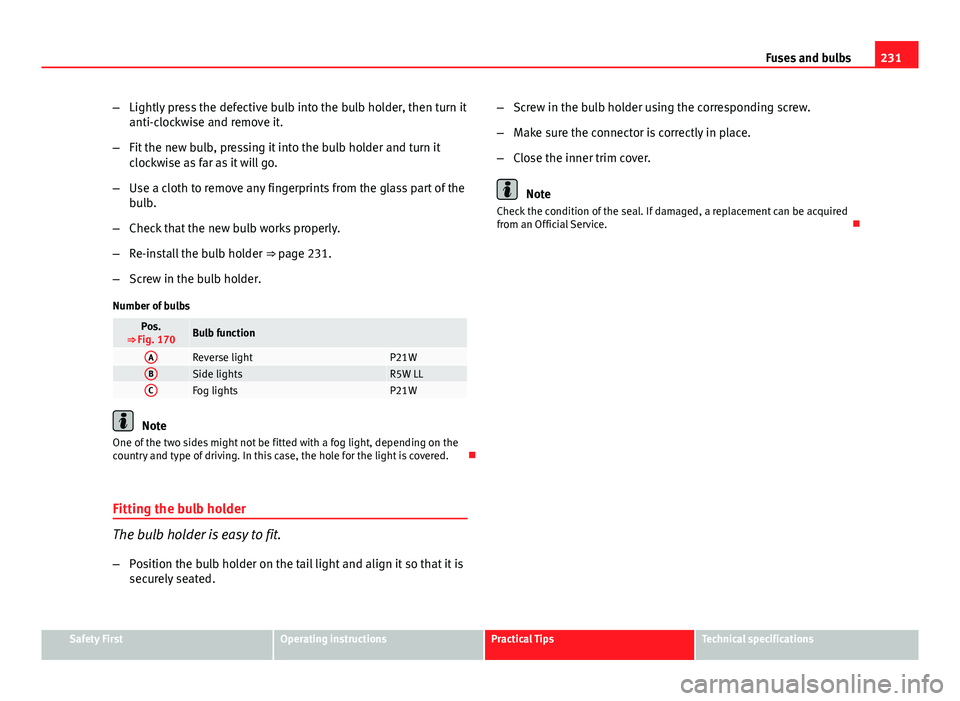
Number of bulbs
Pos.
⇒ Fig. 170Bulb function
AReverse lightP21WBSide lightsR5W LLCFog lightsP21W
Note
One of the two sides might not be fitted with a fog light, depending on the
country and type of driving. In this case, the hole for the light is covered.
Fitting the bulb holder
The bulb holder is easy to fit. – Position the bulb holder on the tail light and align it so that it is
securely seated. –
Screw in the bulb holder using the corresponding screw.
– Make sure the connector is correctly in place.
– Close the inner trim cover.
Note
Check the condition of the seal. If damaged, a replacement can be acquired
from an Official Service.
Safety FirstOperating instructionsPractical TipsTechnical specifications