lights Seat Toledo 2014 Owner's Guide
[x] Cancel search | Manufacturer: SEAT, Model Year: 2014, Model line: Toledo, Model: Seat Toledo 2014Pages: 200, PDF Size: 4.37 MB
Page 68 of 200
Operation
Note
● The parking lights can only be activated
with the ignition disconnected.
● The parking light will not come on automat-
ically after switching off the ignition if the
left- or right-hand turn signal is left on. Adjusting the headlights
The light beam of the dipped beam lights is
asymmetric: the side of the road on which
you are driving is lit more intensely.
When a car that is manufactured in a country
that drives on the right travels to a country
that drives on the left (or vice versa), it is nor-
mally necessary to cover part of the headlight
bulbs with stickers or to change the adjust-
ment of the headlights to avoid dazzling oth-
er drivers.
In such cases, the regulations specify certain
light values that must be complied with for
designated points of the light distribution.
This is known as “Tourist light”.
The light distribution of the halogen and full-
LED headlights of the SEAT Toledo allows the
specific “tourist light” values to be met with-
out the need for stickers or changes in the
settings. Note
“Tourist light” is only allowed temporarily. If
you are planning a long stay in a country that
drives on the other side, you should take the
vehicle to an Authorised Technical Service to
change the headlights. Interior lights
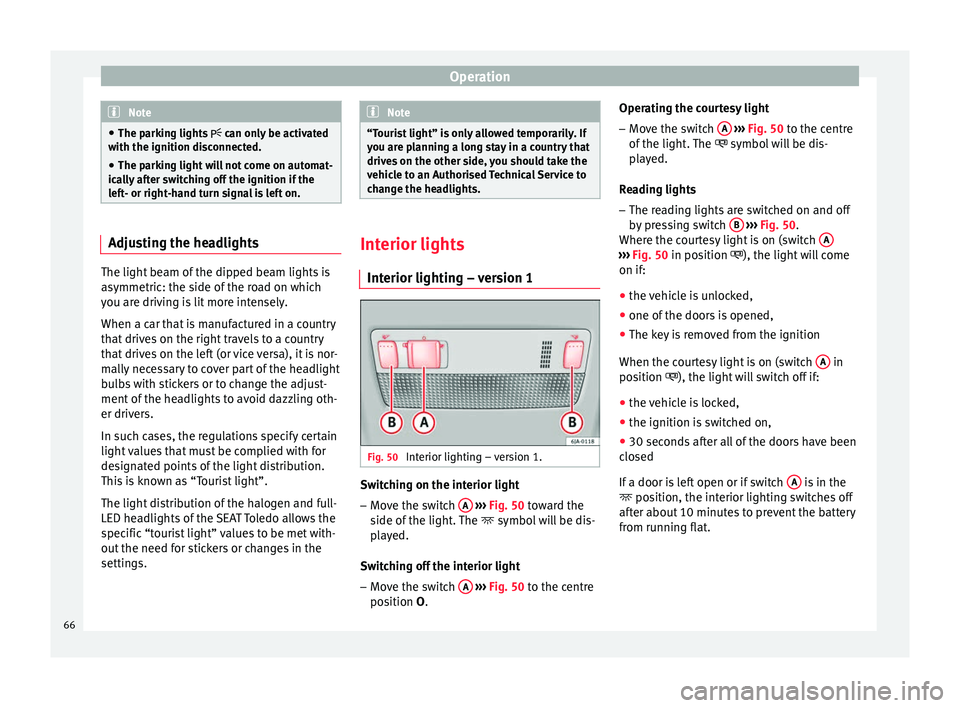
Interior lighting – version 1 Fig. 50
Interior lighting – version 1. Switching on the interior light
– Move the switch A
›››
Fig. 50 toward the
s ide of
the light. The symbol will be dis-
played.
Switching off the interior light – Move the switch A
›››
Fig. 50 to the centre
po s
ition O. Operating the courtesy light
–
Move the switch A
››› Fig. 50 to the centre
of the light
. The symbol will be dis-
played.
Reading lights
– The reading lights are switched on and off
by pressing switch B
››› Fig. 50 .
Wher e the c
ourtesy light is on (switch A ›››
Fig. 50 in position
), the light will come
on if:
● the
vehicle is unlocked,
● one of the doors is opened,
● The key is removed from the ignition
When the courtesy light is on (switch A in
position ), the light will switch off if:
● the vehicle is locked,
● the ignition is switched on,
● 30 seconds after all of the doors have been
closed
If a door is left open or if switch A is in the
position, the interior lighting switches off
after about 10 minutes to prevent the battery
from running flat.
66
Page 69 of 200

Lights and visibility
Interior lighting – version 2 Fig. 51
Interior lighting – version 2. Switching on the interior light
– Move the light switch to position
››› Fig. 51 .
Sw it
ching off the interior light
– Move the light switch to position 0.
Operatin
g the courtesy light
– Move the light switch to position .
The lights in version 2 are operated using the
same guidelines as ››› page 66, Interior light-
ing – version 1 . Rear interior light
Fig. 52
Rear interior light. Press the button
››› Fig. 52 to switch the light-
in g on or off
.
Glove compartment light The light will come on automatically when
the glove compartment is opened. The light
will go out when the glove compartment is
closed.
Luggage compartment light The light switches on automatically when the
boot is open and switches off automatically
10 minutes after the boot lid has been
opened.Visibility
Heated rear window Fig. 53
Heated rear window switch. –
Switch the heated rear window on or off by
pressing the button
››› Fig. 53 , the warn-
in g l
amp in the button will come on or go
off respectively.
The heated rear window only works when the
engine is running.
After approximately 7 minutes, the heating
device of the rear window switches off auto-
matically. For the sake of the environment
The heated rear window should be switched
off as soon as the glass is demisted. By sav-
ing electrical power you can also save fuel
››› page 106.
» 67
Technical specifications
Advice
Operation
Safety
Page 71 of 200

Lights and visibility
●
Remove snow and ice from the wipers be-
fore starting your journey.
● Careless handling could lead to the wiper
arms damaging the windscreen.
● For safety reasons, the wiper blades should
be changed once or twice a year. They can be
purchased at a SEAT Authorised Service.
● The ignition cannot be switched on while
the windscreen wiper arms are in a raised po-
sition. Otherwise, the windscreen wipers
would return to their original position and
could damage the paintwork on the bonnet. Note
Keep the wipers clean. The wipers can be
soiled with remains of wax solutions from car
washes ››› page 124.
● On vehicles equipped with windscreen
washer jets, these are heated once the en-
gine is running. Handling windscreen wipers and
washers
Fig. 56
Window wiper lever. Short wipe
– Give the windscreen a brief wipe by moving
the lever down to position 4
››› Fig. 56 .
W ipe int
ervals/automatic wipe with rain
sensor*
– Push the lever up to position 1
››› Fig. 56 .
– With sw
itch A , adjust the wipe interval or
rain sensor sensitivity.
Switch A has 4 positions.
The rain sensor* is part of the intermittent
wipe function.
The rain sensor* controls the frequency of
the windscreen wiper intervals, depending
on the amount of rain. Slow wipe
–
Push the lever up to position 2
››› Fig. 56 .
C ontinuou
s wipe
– Push the lever up to position 3
››› Fig. 56 .
Aut om
atic windscreen wash and wipe
– Pull the lever towards the steering wheel,
position 5
››› Fig. 56 , and the windscreen
w a
sher and wipers are switched on.
– Release the lever. The washer will stop and
the windscreen wipers will keep running for
1-3 wipes (depending on the windscreen
washer operating time).
Rear window wiper*
– Press the lever forward to position 6 ›››
Fig. 56 and the rear window wiper will
ru n ev
ery 6 seconds.
Automatic rear window wash and wipe* – Press the lever fully forward to position 7 ›››
Fig. 56 and the rear window wiper and
w a
sher switch on at the same time.
– Release the lever. The rear window washer
will stop and the rear window wipers will
keep running for 1-3 wipes (depending on
the jet operating time). When released, the
lever remains in position 6 .
»
69
Technical specifications
Advice
Operation
Safety
Page 72 of 200

Operation
Switching off the wipers – Move the lever to position 0
››› Fig. 56 . WARNING
The rain sensor may not detect enough rain
to switch on the wipers.
● If necessary, switch on the wipers manually
when water on the windscreen obstructs visi-
bility. Note
Do not put stickers on the windscreen in front
of the rain sensor*. This may cause sensor
disruption or faults. Headlight washer system*
The headlight washers operate briefly if the
dipped headlights or headlights are on and
the lever is moved to position
5
›››
Fig. 56 .
The he a
dlight washer system also operates
every 10 windscreen wash cycles.
Clean off stubborn dirt (insects, etc.) from the
headlights at regular intervals, for instance
when filling the fuel tank. Please observe the
following indications ›››
page 126, Head-
lights.
To en
sure the system works properly in win-
ter, keep the nozzle holders free of snow and
remove any ice with a de-icer spray. CAUTION
Never pull on the nozzle holders. Risk of
damage to the system! Rear vision mirrors
Interior rear vision mirror with manual
anti-dazzle adjustment Basic settings
– Push the lever at the bottom of the mirror
forward.
Rear vision mirror anti-dazzle setting – Pull the lever at the bottom of the mirror to-
wards you.
Exterior mirrors Fig. 57
Door interior: adjuster knob. Before beginning any journey, adjust the rear
view mirrors for a good rear visibility.
Heated rear vision mirrors*
–
Turn the knob to position
›
›› Fig. 57
.
Electrical adjustment of the left-hand
exterior mirror*
– Turn the knob to position ›
›› Fig. 57. The
mirror movements are the same as those of
the knob.
Electrical adjustment of the right-hand
exterior mirror*
– Turn the knob to position ››› Fig. 57. The
mirror mo
vements are the same as those of
the knob. WARNING
● Convex (wide-angle) rear vision mirrors give
a larger field of vision. However, they make
objects appear smaller and further away than
they really are. For this reason, you should
not rely on these rear vision mirrors for judg-
ing the distance of vehicle behind.
● If possible, use the interior rear vision mir-
ror to estimate distances to vehicles behind
you. Note
● Exterior mirrors are only heated when the
engine is running. 70
Page 94 of 200

Operation
Air conditioning selection Basic air conditioning control settings recom-
mended for the corresponding operating
modes:SettingsControl positionButtonAir vents 4ABC12
Windscreen and side window de-
frost
a)Required tempera-
ture3 or 4 Do not switch onSwitched on automati-
callyb)Open and direct towards the
side window
Heat as quickly as possibleClockwise as far asit will go3 Switch on brieflyOffOpening
Mild heatingRequired tempera-
ture2 or 3 / Do not switch onOffOpening
Heat as quickly as possibleAnti-clockwise as far
as it will goBriefly 4, then 2 or 3 Switch on briefly
c)IgnitionOpening
Optimum coolingRequired tempera-
ture1 or 2 Do not switch onIgnitionOpen and direct towards the
roof
Fresh air mode - blowerAnti-clockwise as faras it will goRequired position Do not switch onOffOpening
a)
This type of setting is not recommended in countries with high air humidity. The windows could cool too quickly and cause them to mist over on the outside.
b) The lamp in button 2
lights up, even if not all of the conditions for cooling system operations are met. Cooling is indicated as available once all of the conditions are met
››› page 90, General notes .
c) In certain conditions, air recirculation mode can switch on automatically ››› page 92, a lamp illuminates in the button. Note
● Controls A
››› Fig. 87 ››› p
age 90, B ,
C and buttons
1 and
2 .
● Air vents 4 ››› page 88 . ●
We recommend you leave the air vents 3
››› page 88 in the open position. Air recirculation
Air recirculation prevents unpleasant smells,
e.g. when passing through a tunnel or in
queuing traffic, from entering the interior.
92
Page 100 of 200

Operation
Starting the engine
● Move the gearbox lever into neutral or
move the selector lever to position P
or N and
pull firmly on the handbrake.
● Press the clutch pedal all the way down 2›››
Fig. 89
›
›› p
age 97 and start the engine 3 ,
without pressing the accelerator. Keep the
clutch pedal pressed down until the engine
starts.
● Release the ignition key as soon as the en-
gine starts. The key returns to position 2 .
● If the engine does not start after 10 sec-
onds, turn the key back to position 1 . Re-
peat the action after 30 seconds.
● Release the handbrake before moving off.
Switching off the engine Stop the engine by turning the ignition key to
position
1
›››
Fig. 89 ›
›
›
page 97. Brakes and brake servo
systems
Introduction WARNING
● The brake servo only works when the en-
gine is running. Braking when the engine is
switched off requires applying more strength
to the brake pedal. Risk of accident!
● Press down on the clutch pedal when stop-
ping and braking with a manual gearbox, pet-
rol engine vehicle at low speed. Otherwise,
the brake servo might not work properly. Risk
of accident!
● In the event of damage to the standard
front spoiler or where a different front spoil-
er, wheel trims, etc. are subsequently fitted,
make sure the air vent to the brakes on the
front wheels is not blocked. Otherwise, brak-
ing operations may be impaired. Risk of acci-
dent!
● Always fully release the handbrake. If it is
only partially released, this will cause over-
heating of the rear brakes, which can impair
the function of the brake system. Risk of acci-
dent!
● Never leave children unsupervised in the
vehicle. They could release the handbrake or
move the gear lever. The vehicle could start
moving. Risk of accident! ●
Insufficient fuel can cause the engine to run
irregularly or to switch off. Brake assist sys-
tems could be impaired. Risk of accident!
● Always adjust your driving style to suit visi-
bility, the weather and road and traffic condi-
tions. The best vehicle safety offered by
brake assist systems must never encourage
you to run greater risks. Risk of accident! CAUTION
● Observe the information concerning new
brake pads ››› page 104
.
● Wher e br
aking is not necessary, do not
wear down the brake pads by pressing down
gently on the brake pedal. This causes the
brakes to overheat, increasing their wear and
increasing braking distances.
● To ensure the brake assist systems work
properly, all wheels must be fitted with tyres
approved by the manufacturer. Note
● If you brake suddenly and the brake system
control unit regards the situation as hazard-
ous for the drivers behind you, the brake
lights will begin to flash automatically. After
reducing speed to approximately 10 km/h (6
mph) or stopping the vehicle, the brake lights
will stop flashing and the hazard warning
lights will switch on. The hazard warning
lights are automatically switched off when
you accelerate or restart the vehicle. 98
Page 101 of 200

Driving
●
On long, steep gradients, reduce your
speed and change to a lower gear (manual
gearbox) or move the selector lever to a lower
gear position (automatic gearbox). This uses
the force of the engine and the brakes do not
suffer as much. If you still have to brake, do
so intermittently, pressing down repeatedly
on the brake pedal.
● Vehicle modifications (e.g. to the engine,
brakes, frame or a combination of wheels and
tyres) could impair the brake assist systems
››› page 122, Accessories and modifications
to the vehicle .
● In the event of a fault in the ABS system,
the ESC, TCS and EDL are switched off auto-
matically. A fault in the ABS is indicated by
the ››› page 36 warning lamp. Brakes
Wear
The rate of wear of the brake pads depends
on the driving style and on the way in which
the vehicle is used. The brake pads will wear
more quickly if you use your vehicle frequent-
ly in urban traffic and short trips or drive in a
sporty style. Under these
demanding condi-
tions , visit your specialised service, even be-
f or
e the scheduled service date, so that the
thickness of the brake pads can be meas-
ured. Wet roads or road salt
If brakes are wet or frozen, or if you are driv-
ing on roads which have been gritted with
salt, braking power may set in later than nor-
mal. Dry the brakes as soon as possible by
braking repeatedly.
Corrosion
Long periods of inactivity and little use can
lead to rust on the brake discs and dirt on the
brake pads. Where the brake system is sub-
jected to light stress or in the case of corro-
sion, clean the brake discs by braking fully
several times at a high speed.
Brake system fault
If you notice that the braking distance sud-
denly increases and the brake pedal can be
pressed down more fully, there may be a fault
in the brake system. Visit a specialised serv-
ice immediately and adjust your driving style
to the extent of the damage and to limit the
effect of the brakes.
Low brake fluid level
Insufficient brake fluid could cause faults in
the brake system. The brake fluid level is con-
trolled electronically
››› page 33, Brake sys-
tem . Brake servo
The brake servo supplements the pressure
you exert on the brake pedal. The brake servo
only works when the engine is running.
Handbrake Fig. 90
Centre console: handbrake. Applying the handbrake
– Pull the handbrake lever up all the way.
Releasing the handbrake
– Pull the handbrake lever up slightly and
press the unlock button at the same time
››› Fig. 90 .
– Keep the b
utton pressed down and push
the lever all the way down.
The warning lamp lights up when the hand-
brake is applied with the ignition on .
99
Technical specifications
Advice
Operation
Safety
Page 102 of 200

Operation
Manual gearbox Changing gears Fig. 91
Gear shift diagram of a 5- or 6-speed
manual gearbox When changing gear, always depress the
clutch pedal fully and keep it pressed down
to avoid excessive clutch wear.
In order to drive at an optimum RPM, follow
the gear change indications
››› page 32.
Engage reverse gear only when the vehicle is
stopped. On engaging reverse gear while the
engine is running, first wait a moment with
the clutch pedal pressed down fully to limit
gear shift noise.
The reverse lights switch on when the reverse
gear is selected and the ignition is on. WARNING
Never engage reverse gear when moving for-
ward. Risk of accident! Note
Do not rest your hand on the gear lever while
driving. The pressure of your hand could lead
to premature wear of the gear system. Automatic gearbox
Basic information The gearbox changes up and down automati-
cally. The gearbox can be set to
Tiptronic
mode. The gears can be changed manually in
this mode ›››
page 102 .
The en gine c
an only be started
in positions P
or N. If, on engaging the steering lock,
switching the ignition on/off or starting the
engine, the selector lever is not in these posi-
tions, the informative display will show Move
the selector lever to position P/N! , or P/N
is
shown on the general dash panel display.
At temperatures below -10 °C (14 °F), the en-
gine can only be started in position P.
Mov
e the selector lever to position P when
parking the vehicle on a flat surface. On a
slope, the handbrake should be firmly ap-
plied before moving the selector lever to the park position. This reduces the load on the
lock mechanism while making it easier to
move the selector lever from position P.
If, while the vehicle is moving, the selector
lever is accidentally moved to position
N, re-
le
ase the accelerator and wait for the engine
to idle before moving it back into position. WARNING
● Never press the accelerator when selecting
the automatic gearbox operating mode when
the vehicle is stationary. Risk of accident!
● Never move the selector lever to positions
R or P when driving. Risk of accident!
● If the vehicle is to be stopped with a gear
selected and the engine idling (e.g. waiting
or moving slowly at traffic lights), press down
on the brake pedal because the transmission
is not entirely interrupted when the engine is
idling and the vehicle will tend to start mov-
ing.
● Apply the handbrake firmly and put the se-
lector lever in position P before opening the
bonnet and working on the vehicle with the
engine running. Risk of accident! Strictly fol-
low the safety instructions ››› page 132, En-
gine compartment.
● When s t
opping on a slope (hill), try not to
stop the vehicle from moving by pressing the
“accelerator” with a gear selected. This could
overheat the clutch. If the clutch risks being
burnt due to this force, it would switch off 100
Page 104 of 200
Operation
P – Parking position
In this position, the driven wheels are me-
chanically locked.
The parking position can only be selected
when the vehicle is stationary.
If you want to move the selector lever from
this position, press the interlock button on
the selector lever knob while pressing down
on the brake pedal.
If the battery is drained, the selector lever
cannot be moved from position P.
R – Reverse
Reverse gear must be engaged only when the
vehicle is stationary and the engine is idling.
To move the selector lever to position R from
positions P or
N, press the interlock button
on the selector lever knob and press down on
the brake pedal.
The reverse lights come on when the selector
lever is in position R and the ignition is on.
N – Neutral (idling)
Neutral (idling) is engaged in this position.
To move the selector lever from position N (if
the lever has remained in this position for
more than 2 seconds) to position D or R at
speeds of less than 5 km/h (3 mph) and
when the vehicle is stationary, press down on
the brake pedal. D – Drive (forwards)
In this position, the gearbox automatically
changes to a lower or higher gear, depending
on engine requirements, the driving speed
and the gear shift programme.
To move the selector lever to position D from
position N
at speeds of less than 5 km/h (3
mph) and when the
vehicle is stationary,
press down on the brake pedal.
In some situations (e.g. on mountain roads or
when towing a trailer or caravan), it can be
advantageous to switch temporarily to the
manual shift programme ››› page 102 so that
the gear ratios can be selected manually to
suit driving conditions.
S – Sports driving position
Shifting up later than usual makes full use of
the engine power. This shifts down earlier in
relation to position D
.
T
o move the selector lever to position S from
position
D, press the interlock button on the
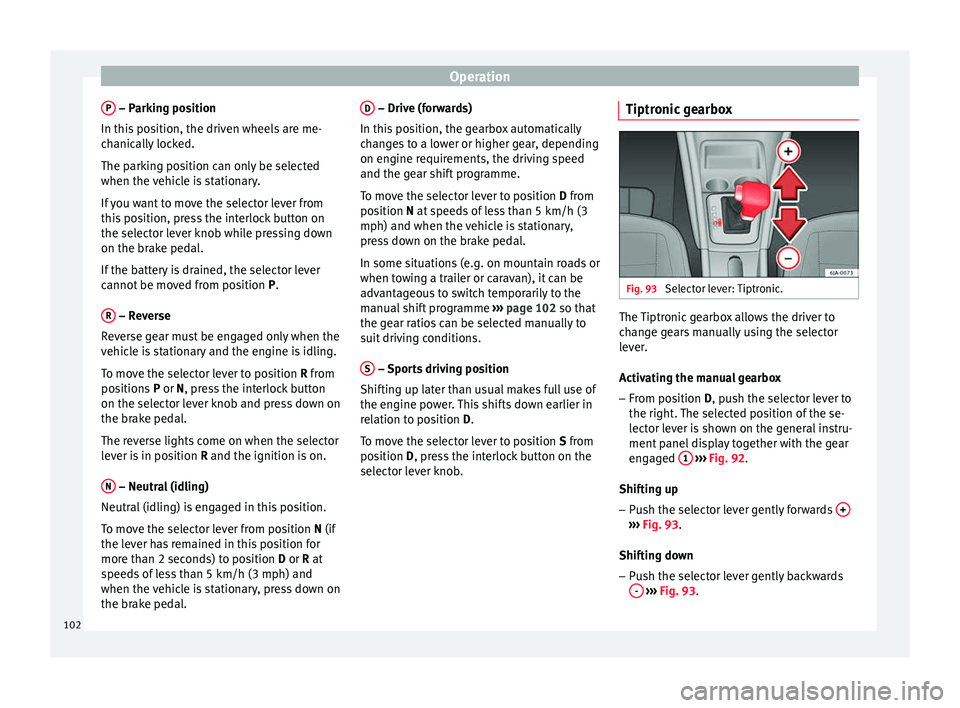
selector lever knob. Tiptronic gearbox Fig. 93
Selector lever: Tiptronic. The Tiptronic gearbox allows the driver to
change gears manually using the selector
lever.
Activating the manual gearbox
– From position D
, push the selector lever to
the right
. The selected position of the se-
lector lever is shown on the general instru-
ment panel display together with the gear
engaged 1
››› Fig. 92 .
Shif tin
g up
– Push the selector lever gently forwards + ›››
Fig. 93 .
Shif tin
g down
– Push the selector lever gently backwards
-
››› Fig. 93 .
102
Page 108 of 200
Operation
●
Refuelling just once with leaded petrol dis-
ables the exhaust system! Economical and environmentally
friendly driving
Fuel consumption, environmental pollution
and wear to the engine, brakes and tyres de-
pends in large part on your driving style. By
adopting an economical driving style and an-
ticipating the traffic situation ahead, you can
easily reduce fuel consumption by 10-15%.
Some tips on how to help you reduce pollu-
tion while saving money are listed below.
Drive anticipating the traffic situation
A vehicle uses most fuel when accelerating.
When you anticipate situations, you have to
brake less often and, thus, accelerate less. If
it is possible, let the vehicle roll with a
gear
engaged , for example, if you see a red light
ahe a
d. The braking effect achieved in this
way helps to reduce the wear of brakes and
tyres; emissions and fuel consumption are
reduced to zero (disconnection due to iner-
tia).
Change gear early to save energy
An effective way of saving fuel is to change
up
quickly through the gears. Running the
engine at high rpm in the lower gears uses
an unnecessary amount of fuel. Manual gearbox:
shift up from first to second
gear as soon as possible. We recommend
that, whenever possible, you change to a
higher gear upon reaching 2000 rpm. Follow
the “recommended gear” indication that ap-
pears on the instrument panel ››› page 32,
Recommended gear display.
Avoid driving at high speed
We advise you not to drive at the top speed
permitted by the vehicle. Fuel consumption,
exhaust emissions and noise levels all in-
crease very rapidly at higher speeds. Driving
at moderate speeds will help to save fuel.
Avoid idling
It is worthwhile switching off the engine
when waiting in a traffic jam, at level cross-
ings or at traffic lights with a long red phase.
The fuel saved after only 30 - 40 seconds is
greater than the amount of fuel needed to re-
start the engine.
The engine takes a long time to warm up
when it is idling. Mechanical wear and pollu-
tant emissions are also especially high dur-
ing this initial warm-up phase. It is therefore
best to drive off immediately after starting
the engine. Avoid running the engine at high
speed. Periodic maintenance
Periodic maintenance work guarantees that,
before beginning a journey, you will not con-
sume more than the required amount of fuel.
A well-serviced engine gives you the benefit
of
improved fuel efficiency as well as maxi-
mum reliability and an enhanced resale val-
ue.
A badly serviced engine can consume up to
10% more fuel than necessary.
Avoid short journeys
To reduce the consumption and emission of
polluting exhaust gases, the engine and the
exhaust gas filtration systems should reach
the optimum operating temperature.
With the en
gine cold, fuel consumption is
proportionally higher. The engine does not
warm up and fuel consumption does not nor-
malise until having driven approximately four
kilometres (2.5 miles). This is why we recom-
mend avoiding short trips whenever possi-
ble.
Maintain the correct tyre pressures
Bear in mind that keeping the tyres at an ad-
equate pressure saves fuel. If the tyre pres-
sure is just one bar (14.5 psi/100 kPa) too
low, fuel consumption can increase by as
much as 5%. Due to the greater rolling resist-
ance, under-inflation also increases tyre wear
wear and impairs handling.
106