mirror Seat Toledo 2014 Owner's manual
[x] Cancel search | Manufacturer: SEAT, Model Year: 2014, Model line: Toledo, Model: Seat Toledo 2014Pages: 200, PDF Size: 4.37 MB
Page 5 of 200
Table of Contents
Table of Contents
Safety . . . . . . . . . . . . . . . . . . . . . . . . . . . . . . . . 5
Safe driving . . . . . . . . . . . . . . . . . . . . . . . . . . . . 5
Safety first! . . . . . . . . . . . . . . . . . . . . . . . . . . . . . 5
Advice about driving . . . . . . . . . . . . . . . . . . . . . 5
Sitting position for vehicle occupants . . . . . . . 6
Pedal area . . . . . . . . . . . . . . . . . . . . . . . . . . . . . . 10
Seat belts . . . . . . . . . . . . . . . . . . . . . . . . . . . . . . 11
The reasons why we should wear seat belts . . 11
How to properly adjust your seatbelt . . . . . . . . 14
Seat belt tensioners . . . . . . . . . . . . . . . . . . . . . . 15
Airbag system . . . . . . . . . . . . . . . . . . . . . . . . . . 16
Brief introduction . . . . . . . . . . . . . . . . . . . . . . . . 16
Airbag overview . . . . . . . . . . . . . . . . . . . . . . . . . 19
Deactivating airbags . . . . . . . . . . . . . . . . . . . . . 22
Transporting children safety . . . . . . . . . . . . . . . 24
Safety for children . . . . . . . . . . . . . . . . . . . . . . . 24
Child seats . . . . . . . . . . . . . . . . . . . . . . . . . . . . . 26
Operation . . . . . . . . . . . . . . . . . . . . . . . . . . . . . 29
Controls and displays . . . . . . . . . . . . . . . . . . . . 29
Overview . . . . . . . . . . . . . . . . . . . . . . . . . . . . . . . 28
Instruments and warning lamps . . . . . . . . . . . . 30
Dash . . . . . . . . . . . . . . . . . . . . . . . . . . . . . . . . . . 30
Control lamps . . . . . . . . . . . . . . . . . . . . . . . . . . . 32
Information system . . . . . . . . . . . . . . . . . . . . . . 39
Multi-function display* (on board computer) . . 39
MAXI DOT* (Informative display) . . . . . . . . . . . . 43
Maintenance interval display* . . . . . . . . . . . . . 45
Communication . . . . . . . . . . . . . . . . . . . . . . . . . 46
Steering wheel controls* . . . . . . . . . . . . . . . . . . 46
Multimedia . . . . . . . . . . . . . . . . . . . . . . . . . . . . . 51
Opening and closing . . . . . . . . . . . . . . . . . . . . . 51
Remote control . . . . . . . . . . . . . . . . . . . . . . . . . . 51
Keys . . . . . . . . . . . . . . . . . . . . . . . . . . . . . . . . . . . 53
Central locking system . . . . . . . . . . . . . . . . . . . . 54 Anti-theft alarm system* . . . . . . . . . . . . . . . . . . 57
Rear lid . . . . . . . . . . . . . . . . . . . . . . . . . . . . . . . . 58
Electric window opening and closing . . . . . . . . 60
Lights and visibility
. . . . . . . . . . . . . . . . . . . . . . 61
Lights . . . . . . . . . . . . . . . . . . . . . . . . . . . . . . . . . 61
Interior lights . . . . . . . . . . . . . . . . . . . . . . . . . . . 66
Visibility . . . . . . . . . . . . . . . . . . . . . . . . . . . . . . . 67
Windscreen wipers and windscreen washers . . 68
Rear vision mirrors . . . . . . . . . . . . . . . . . . . . . . . 70
Seats and head restraints . . . . . . . . . . . . . . . . . 71
Adjusting seats and head restraints . . . . . . . . . 71
Seat functions . . . . . . . . . . . . . . . . . . . . . . . . . . 73
Transport and practical equipment . . . . . . . . . 76
Practical equipment . . . . . . . . . . . . . . . . . . . . . . 76
Storing objects . . . . . . . . . . . . . . . . . . . . . . . . . . 81
Luggage compartment . . . . . . . . . . . . . . . . . . . . 82
Roof rack* . . . . . . . . . . . . . . . . . . . . . . . . . . . . . . 85
Heating and air conditioning . . . . . . . . . . . . . . 87
Heating and air conditioning . . . . . . . . . . . . . . . 87
Heating . . . . . . . . . . . . . . . . . . . . . . . . . . . . . . . . 88
Air conditioning (manual)* . . . . . . . . . . . . . . . . 90
Climatronic* (automatic air conditioning) . . . . 93
Driving . . . . . . . . . . . . . . . . . . . . . . . . . . . . . . . . 96
Starting and stopping the engine . . . . . . . . . . . 96
Brakes and brake servo systems . . . . . . . . . . . . 98
Manual gearbox . . . . . . . . . . . . . . . . . . . . . . . . . 100
Automatic gearbox . . . . . . . . . . . . . . . . . . . . . . . 100
Run-in and economical driving . . . . . . . . . . . . . 104
Wading and driving off-road . . . . . . . . . . . . . . . 107
Driver assistance systems . . . . . . . . . . . . . . . . . 108
Braking and stability systems . . . . . . . . . . . . . . 108
Parking aid* . . . . . . . . . . . . . . . . . . . . . . . . . . . . 110
Cruise control* . . . . . . . . . . . . . . . . . . . . . . . . . . 111
Start-Stop* System . . . . . . . . . . . . . . . . . . . . . . . 112
Towing bracket device . . . . . . . . . . . . . . . . . . . . 114
Driving the vehicle with a trailer . . . . . . . . . . . . 114
Towing bracket device . . . . . . . . . . . . . . . . . . . . 116 Advice
. . . . . . . . . . . . . . . . . . . . . . . . . . . . . . . . 122
Care and maintenance . . . . . . . . . . . . . . . . . . . . 122
Accessories and modifications to the vehicle . 122
Care and cleaning . . . . . . . . . . . . . . . . . . . . . . . 123
Checking and refilling levels . . . . . . . . . . . . . . . 129
Fuel . . . . . . . . . . . . . . . . . . . . . . . . . . . . . . . . . . . 129
Engine compartment . . . . . . . . . . . . . . . . . . . . . 132
Engine oil . . . . . . . . . . . . . . . . . . . . . . . . . . . . . . 135
Coolant . . . . . . . . . . . . . . . . . . . . . . . . . . . . . . . . 137
Brake fluid . . . . . . . . . . . . . . . . . . . . . . . . . . . . . 139
Windscreen washer . . . . . . . . . . . . . . . . . . . . . . 139
Battery . . . . . . . . . . . . . . . . . . . . . . . . . . . . . . . . . 140
Wheels and tyres . . . . . . . . . . . . . . . . . . . . . . . . 144
Wheels . . . . . . . . . . . . . . . . . . . . . . . . . . . . . . . . 144
Spare wheel . . . . . . . . . . . . . . . . . . . . . . . . . . . . 146
Tyre control systems . . . . . . . . . . . . . . . . . . . . . . 147
Winter service . . . . . . . . . . . . . . . . . . . . . . . . . . . 148
Emergencies . . . . . . . . . . . . . . . . . . . . . . . . . . . . 149
Emergency equipment . . . . . . . . . . . . . . . . . . . . 149
Changing a wheel . . . . . . . . . . . . . . . . . . . . . . . 150
Tyre repairs . . . . . . . . . . . . . . . . . . . . . . . . . . . . . 154
Jump-starting . . . . . . . . . . . . . . . . . . . . . . . . . . . 157
Towing the vehicle . . . . . . . . . . . . . . . . . . . . . . . 159
Emergency locking and unlocking . . . . . . . . . . 161
Changing the wiper blades . . . . . . . . . . . . . . . . 162
Fuses and bulbs . . . . . . . . . . . . . . . . . . . . . . . . . 163
Fuses . . . . . . . . . . . . . . . . . . . . . . . . . . . . . . . . . . 163
Changing bulbs . . . . . . . . . . . . . . . . . . . . . . . . . 166
Changing front fog light bulbs . . . . . . . . . . . . . 169
Changing bulbs for rear lights (in side panel) . 169
Changing rear lights (in rear lid) . . . . . . . . . . . . 171
Changing bulb for the number plate light . . . . 173
Technical specifications . . . . . . . . . . . . . . . 174
Technical specifications . . . . . . . . . . . . . . . . . . 174
Important information . . . . . . . . . . . . . . . . . . . . 174
Information on fuel consumption . . . . . . . . . . . 175
Towing a trailer . . . . . . . . . . . . . . . . . . . . . . . . . . 176 3
Page 7 of 200
Safe driving
Safety
Safe driving Safety first! This chapter contains important information,
tips, suggestions and warnings that you
should read and consider for both your own
safety and for your passengers' safety.
WARNING
● This manual contains important informa-
tion about the operation of the vehicle, both
for the driver and the passengers. The other
sections of the on-board documentation also
contain further information that you should
be aware of for your own safety and for the
safety of your passengers.
● Ensure that the on-board documentation is
kept in the vehicle at all times. This is espe-
cially important when lending or selling the
vehicle to another person. Advice about driving
Before starting every trip For your own safety and the safety of your
passengers, always note the following points
before every trip: –
Make sure that the vehicle's lights and turn
signals are working properly.
– Check tyre pressure.
– Ensure that all windows provide a clear and
good view of the surroundings.
– Make sure all luggage is secured
››› page 81 .
– Mak
e sure that no objects can interfere
with the pedals.
– Adjust front seat, head restraint and rear vi-
sion mirrors properly according to your
size.
– Ensure that the passengers in the rear
seats always have the head restraints in
the in-use position ››› page 10.
– Instruct passengers to adjust the head re-
straints according to their height.
– Protect children with appropriate child
seats and properly applied seat belts
››› page 24.
– Ass
ume the correct sitting position. Instruct
your passengers also to assume a proper
sitting position. ››› page 6.
– Fasten your seat belt securely. Instruct your
passengers also to fasten their seat belts
properly. ›››
page 11. What
affects driving safety? As a driver, you are responsible for yourself
and your passengers. When your concentra-
tion or driving safety is affected by any cir-
cumstance, you endanger yourself as well as
others on the road
››› , for this reason:
– Always pay attention to traffic and do not
get distracted by passengers or telephone calls.
– Never drive when your driving ability is im-
paired (e.g. by medication, alcohol, drugs).
– Observe traffic laws and speed limits.
– Always reduce your speed as appropriate
for road, traffic and weather conditions.
– When travelling long distances, take
breaks regularly - at least every two hours.
– If possible, avoid driving when you are tired
or stressed. WARNING
When driving safety is impaired during a trip,
the risk of injury and accidents increases. Safety equipment
Never put your safety or the safety of your
passengers in danger. In the event of an acci-
dent, the safety equipment may reduce the
»
5
Technical specifications
Advice
Operation
Safety
Page 31 of 200
Controls and displays
Operation
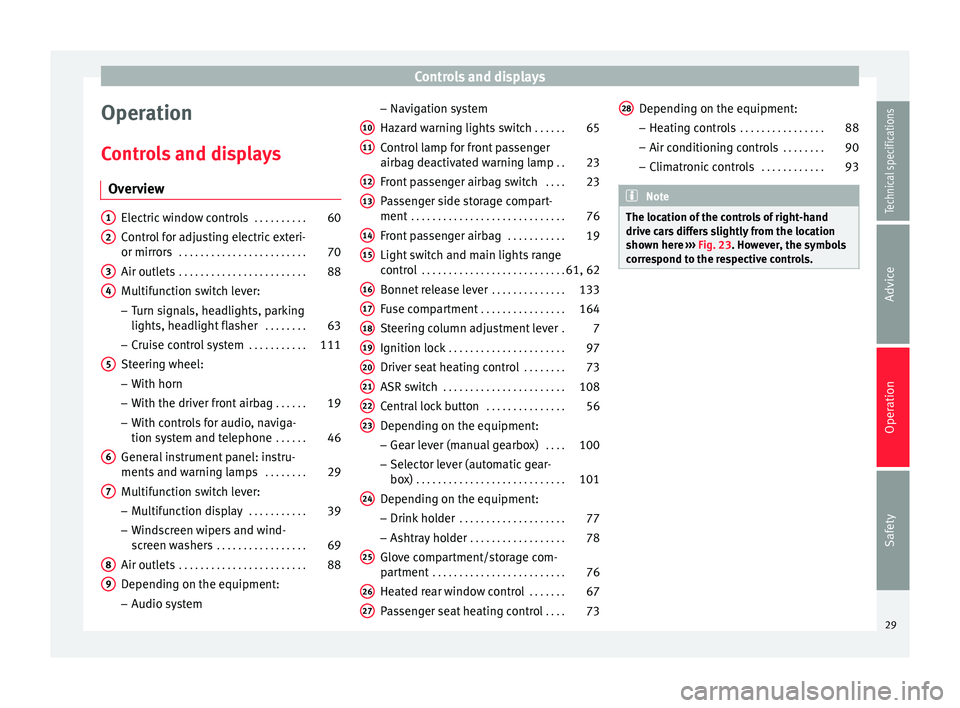
Controls and displays Overview Electric window controls
. . . . . . . . . .60
Control for adjusting electric exteri-
or mirrors . . . . . . . . . . . . . . . . . . . . . . . . 70
Air outlets . . . . . . . . . . . . . . . . . . . . . . . . 88
Multifunction switch lever:
– Turn signals, headlights, parking
lights, headlight flasher . . . . . . . .63
– Cruise control system . . . . . . . . . . .111
Steering wheel:
– With horn
– With the driver front airbag . . . . . .19
– With controls for audio, naviga-
tion system and telephone . . . . . .46
General instrument panel: instru-
ments and warning lamps . . . . . . . .29
Multifunction switch lever:
– Multifunction display . . . . . . . . . . .39
– Windscreen wipers and wind-
screen washers . . . . . . . . . . . . . . . . . 69
Air outlets . . . . . . . . . . . . . . . . . . . . . . . . 88
Depending on the equipment:
– Audio system
1 2
3
4
5
6
7
8
9 –
Navigation system
Hazard warning lights switch . . . . . .65
Control lamp for front passenger
airbag deactivated warning lamp . .23
Front passenger airbag switch . . . .23
Passenger side storage compart-
ment . . . . . . . . . . . . . . . . . . . . . . . . . . . . . 76
Front passenger airbag . . . . . . . . . . .19
Light switch and main lights range
control . . . . . . . . . . . . . . . . . . . . . . . . . . . 61, 62
Bonnet release lever . . . . . . . . . . . . . .133
Fuse compartment . . . . . . . . . . . . . . . . 164
Steering column adjustment lever .7
Ignition lock . . . . . . . . . . . . . . . . . . . . . . 97
Driver seat heating control . . . . . . . .73
ASR switch . . . . . . . . . . . . . . . . . . . . . . . 108
Central lock button . . . . . . . . . . . . . . .56
Depending on the equipment:
– Gear lever (manual gearbox) . . . .100
– Selector lever (automatic gear-
box) . . . . . . . . . . . . . . . . . . . . . . . . . . . . 101
Depending on the equipment:
– Drink holder . . . . . . . . . . . . . . . . . . . . 77
– Ashtray holder . . . . . . . . . . . . . . . . . . 78
Glove compartment/storage com-
partment . . . . . . . . . . . . . . . . . . . . . . . . . 76
Heated rear window control . . . . . . .67
Passenger seat heating control . . . .73
10 11
12
13
14
15
16
17
18
19
20
21
22
23
24
25
26
27 Depending on the equipment:
– Heating controls . . . . . . . . . . . . . . . . 88
– Air conditioning controls . . . . . . . .90
– Climatronic controls . . . . . . . . . . . .93 Note
The location of the controls of right-hand
drive cars differs slightly from the location
shown here ››› Fig. 23. However, the symbols
c orr
espond to the respective controls. 28
29
Technical specifications
Advice
Operation
Safety
Page 62 of 200

Operation
Electric window opening and
closing Introduction WARNING
● When locking the vehicle from the outside,
make sure that nobody is inside the vehicle,
as the windows cannot be opened from the
inside in an emergency.
● For safety reasons, use safety button 5›››
Fig. 44 that deactivates the window
sw it
ches on the rear doors when children are
travelling in the rear seats. CAUTION
● Keep the windows clean to ensure the sys-
tem operates correctly.
● Defrost ››› page 125, Windows and exterior
mirrors any frozen windows before use. Oth-
er w
ise you run the risk of damaging the elec-
tric window riser mechanism.
● Always make sure all of the windows are
closed on leaving the locked vehicle. Note
● The vehicle heating and ventilation system
should be used to ventilate the interior while
driving. Leaving the windows open could al-
low dust and other dirt to enter the vehicle and cause unpleasant noises at certain
speeds.
● Do not leave the side windows open at high
speeds, as this will overly increase fuel con-
sumption. Using electric window switches
Fig. 44
Detail of the driver door: controls for
the windows. The electric window opening and closing sys-
tem only works when the ignition is switched
on.
Opening
– Press gently on the respective button on
the door to open the window. The process
will stop when the button is released.
– The driver door window can also be auto-
matically opened by pressing the button as far as it will go (fully open). Press the but-
ton again to immediately stop it.
Closing
– Press the respective button gently to close
the window. The process will stop when the
button is released.
Window control buttons Button for window in front left door
Button for window in front right door
Button for window in rear left door
Button for window in rear right door
Safety switch for deactivating the electric
window buttons in the rear doors
Safety button
Press the safety button 5
››› Fig. 44 to deac-
tiv at
e the controls on the rear doors. Pressing
the safety button 5 again will reactivate the
controls on the rear doors.
If the rear door controls are deactivated, the
warning lamp on the safety button 5 will
light up. Note
The electric window opening mechanism is
equipped with a thermostat switch. This may
overheat if the window is opened and closed
repeatedly. This causes the window to lock
temporarily. Once the thermostat switch has 1
2
3
4
5
60
Page 65 of 200

Lights and visibility
Turn signal and main beam lever Fig. 47
Turn signal and main beam lever. The turn signal and main beam lever also op-
erates the parking lights and the headlight
flasher.
Right and left-hand
turn signal
– Move the lever ››› Fig. 47 up A or down
B .
– In order for the turn signals to flash three
times (turn signal to change lanes), move
the lever briefly up or down just as far as
point of resistance and then release it.
– Keep the lever held down at the point of re-
sistance for the turn signals to flash for as
long as you hold the lever, e.g. when
changing lanes.
Main beams
– Switch on the dipped beam ›››
page 61. –
Press the lever ››› Fig. 47 forward in the di-
r ection indic
ated by arrow C .
– Pull the lever back to its original position in
the direction indicated by arrow D to
switch the main beam off.
Headlight flasher
– Pull the lever ››› Fig. 47 towards the steer-
ing wheel (point of resistance) in the direc- tion indicated by arrow D .
Parking lights
Instructions for use ››› page 65. CAUTION
Never use the main beam headlights or the
headlight flasher if they could dazzle other
drivers. Note
● The turn signals only work when the igni-
tion is switched on. The corresponding warn-
ing lamp or flashes in the general instru-
ment p
anel.
● The turn signals switch off automatically
when the steering wheel is returned to the
straight-ahead position.
● If a turn signal bulb is defective, the control
lamp flashes at double speed. Automatic headlight control (AHC)
If the light switch is in this position
››› Fig. 45, the side lights, headlights and the
number p l
ate lights will turn on or off auto-
matically.
The light is adjusted according to the data re-
corded by the light sensor that is installed
between the windscreen and the inside rear
view mirror.
If the light switch is in position , the sym-
bol located next to the light switch will il-
luminate. If the light illuminates automatical-
ly, symbol located next to the light switch
will also illuminate.
Automatic headlights in case of rain
If the light switch is in position and is
connected to the automatic wipe in case of
rain for more than 10 seconds or wipe (posi-
tion 2 or
3 ) for longer than 15 seconds,
››› page 69 then the side lights and head-
lights w
ill automatically switch on.
The light automatically switches off if more
than 4 minutes have elapsed and the auto-
matic wipe or wipe (position 2 or
3 ) have
not been switched on. »
63
Technical specifications
Advice
Operation
Safety
Page 67 of 200

Lights and visibility
“Coming Home”/“Leaving Home”*
function This function makes it possible, under poor
visibility conditions, to automatically turn on
the lights for a brief period of time after the
vehicle has been parked or when approach-
ing the vehicle.
The function is automatically turned on if the
following conditions are met:
● The light switch is in position
››› page 63
.
● The v
isibility around the vehicle is reduced.
● The ignition is switched off.
To turn on this function, switch on the head-
light flasher prior to exiting the vehicle.
The light is adjusted according to the data re-
corded by the light sensor that is installed
between the windscreen and the inside rear
view mirror.
The function automatically turns on the side
lights and headlights, the lighting for the en-
try area on the exterior mirrors and the num-
ber plate light.
“Coming Home” function
The light is automatically switched on when
the driver door is opened (for 60 seconds af-
ter the ignition is switched off). The lights is switched off when all the doors
and the boot lid are closed.
If a door or the boot lid remains open, the
light will switch off after 60 seconds.
“Leaving Home” function
The light is automatically switched on when
the vehicle is unlocked using the remote con-
trol.
The light is switched off after 10 seconds or
when the vehicle is locked.
Hazard warning light switch Fig. 49
Instrument panel: switch for hazard
warning lights. –
Press the button ››› Fig. 49 to switch the
h az
ard warning lights on or off.
The warning lamps on the instrument panel
and the warning lamp on the switch will flash at the same time as the turn signals when
the hazard warning lights are switched on.
The hazard warning lights also work when
the ignition is switched off.
The hazard warning lights come on automati-
cally in the event of an accident in which an
airbag is triggered.
Note
Switch on the hazard warning lights to warn
other road users, for example:
● When reaching the tail end of a traffic jam
● if the vehicle has a technical fault or you
are involved in an emergency situation. Parking lights*
Parking lights
– Switch the ignition off.
– Move the turn signal lever ›››
Fig. 47
››› page 63 up or down to turn on the right
or l ef
t-hand parking lights respectively.
Parking light on both sides – Turn the light switch ›››
Fig. 45
››
› page 61 to position and eng age the
steering lock. »
65
Technical specifications
Advice
Operation
Safety
Page 70 of 200

Operation
Note
In the event of a drop in voltage in the on-
board systems, the heated rear window
switches off automatically to ensure enough
power to control the engine ››› page 143, Au-
tomatic disconnection of electrical equip-
ment. Sun visors
Fig. 54
Driver's sun visor. Fig. 55
Front passenger's sun visor. The sun visors for the driver and the front
passenger can be pulled out of their central
supports and turned towards the doors in the
direction of arrow
1
››› Fig. 54 and 2 ›››
Fig. 55 respectively.
The s trip A is to store small objects such as
notepaper, etc.
The front passenger sun visor includes a van-
ity mirror B with a cover. The cover is
opened by sliding it in the direction indicated
by arrow 3
››› Fig. 55 . WARNING
Do not turn sun visors with attached objects
such as ball-pens, etc. toward the head pro-
tection airbag triggering zone on the side
windows. The head protection airbags could
injure occupants if triggered. Windscreen wipers and
windscreen washers
Introduction The windscreen wipers and windscreen
washers only work when the ignition is
switched on.
The speed of the automatic wipe in case of
rain is automatically adjusted according to
the intensity of the rainfall.The rear window is wiped once if the wind-
screen wipers are switched on and reverse
gear is engaged.
Fill the windscreen washer fluid
››› page 139. WARNING
● Make sure the blades ››› page 162 are in
perfect condition for good visibility and safe
driving.
● In cold conditions, you should not use the
wash/wipe system unless you have warmed
the windscreen with the heating and ventila-
tion system. The windscreen washer fluid
could otherwise freeze on the windscreen and
obscure your view of the road. CAUTION
● During winter, always check that the wind-
screen wiper blades are not frozen to the
glass before each trip or before switching on
the ignition. If you switch on the windscreen
wipers when the wiper blades are frozen to
the glass, this could damage both the wiper
blades and the wiper motor.
● If the ignition is switched off when the
windscreen wipers are on, they will start op-
erating in the same mode when the ignition
is switched back on. The wiper blades may be
frozen to the glass at low temperatures when
the ignition is switched off.
● Carefully separate the frozen wipers from
the windscreen or rear window. 68
Page 72 of 200

Operation
Switching off the wipers – Move the lever to position 0
››› Fig. 56 . WARNING
The rain sensor may not detect enough rain
to switch on the wipers.
● If necessary, switch on the wipers manually
when water on the windscreen obstructs visi-
bility. Note
Do not put stickers on the windscreen in front
of the rain sensor*. This may cause sensor
disruption or faults. Headlight washer system*
The headlight washers operate briefly if the
dipped headlights or headlights are on and
the lever is moved to position
5
›››
Fig. 56 .
The he a
dlight washer system also operates
every 10 windscreen wash cycles.
Clean off stubborn dirt (insects, etc.) from the
headlights at regular intervals, for instance
when filling the fuel tank. Please observe the
following indications ›››
page 126, Head-
lights.
To en
sure the system works properly in win-
ter, keep the nozzle holders free of snow and
remove any ice with a de-icer spray. CAUTION
Never pull on the nozzle holders. Risk of
damage to the system! Rear vision mirrors
Interior rear vision mirror with manual
anti-dazzle adjustment Basic settings
– Push the lever at the bottom of the mirror
forward.
Rear vision mirror anti-dazzle setting – Pull the lever at the bottom of the mirror to-
wards you.
Exterior mirrors Fig. 57
Door interior: adjuster knob. Before beginning any journey, adjust the rear
view mirrors for a good rear visibility.
Heated rear vision mirrors*
–
Turn the knob to position
›
›› Fig. 57
.
Electrical adjustment of the left-hand
exterior mirror*
– Turn the knob to position ›
›› Fig. 57. The
mirror movements are the same as those of
the knob.
Electrical adjustment of the right-hand
exterior mirror*
– Turn the knob to position ››› Fig. 57. The
mirror mo
vements are the same as those of
the knob. WARNING
● Convex (wide-angle) rear vision mirrors give
a larger field of vision. However, they make
objects appear smaller and further away than
they really are. For this reason, you should
not rely on these rear vision mirrors for judg-
ing the distance of vehicle behind.
● If possible, use the interior rear vision mir-
ror to estimate distances to vehicles behind
you. Note
● Exterior mirrors are only heated when the
engine is running. 70
Page 73 of 200

Seats and head restraints
●
Do not touch the exterior mirrors when the
heating system is running.
● If the electrical adjustment should ever fail
to operate, the rear vision mirrors can be ad-
justed by hand by pressing the edge of the
mirror glass.
● Visit the technical service in the event of a
fault in the electrical rear vision mirror ad-
justment system. Seats and head restraints
Adjusting seats and head
restraints
Introduction Set the driver seat in such a way that the
pedals can be fully depressed with your legs
slightly bent.
Set the driver seat backrest so that you can
reach the upper point of the steering wheel
with your arms slightly bent.
The correct seat position is very important
for:
●
reaching all of the controls safely and
quickly,
● a relaxed posture that will not produce fati-
gue,
● maximum protection from the seat belts
and airbag system WARNING
● Adjust the driver seat only when the vehi-
cle is stationary. Risk of accident!
● Be careful when adjusting the front seats!
Careless and uncontrolled adjustment can
cause injuries. ●
The backrests must not be reclined too far
back while driving. This could limit the effect
of the seat belts and the airbag system. Risk
of injury!
● Never transport more than the permitted
amount of people in your vehicle.
● Every occupant in the vehicle must properly
fasten and wear the seat belt belonging to
his or her seat. Children must be protected
with an appropriate child restraint system
››› page 24, Transporting children safety.
● The front seats, head restraints and seat
belts must always be adjusted to the size of
the vehicle occupant to provide you and your
passengers with the greatest possible protec-
tion.
● Your feet should remain in the footwell
while the vehicle is moving; never rest them
on the dash panel, on the window or on the
seat! This also applies to passengers. An in-
correct sitting position exposes you to an in-
creased risk of injury in case of a sudden
braking or an accident. If the airbag is trig-
gered, you could sustain severe injuries due
to an incorrect sitting position!
● It is important for the driver and front pas-
senger to keep a distance of at least 25 cm
from the steering wheel and dash panel. Fail-
ure to respect the minimum distance means
that the airbag will not protect you. Risk of
fatal injury if triggered!
● Objects must not be placed in the footwell,
as they could move to the area of the pedals
in the event of a braking manoeuvre or
change of direction. This would prevent the » 71Technical specifications
Advice
Operation
Safety
Page 117 of 200

Towing bracket device
altitude, this also reduces climbing ability,
which requires a reduction of the weight of
the vehicle with a trailer by 10% for every
1000 m increase in altitude. The weight of
the assembly is calculated by adding the ve-
hicle weight (loaded) to the trailer weight
(loaded). Always drive with special care when
towing a trailer.
The towed load and support load information
that is displayed on the towing bracket man-
ufacturers label are only values for the verifi-
cation of the device. The correct figures for
your specific vehicle, which are usually lower
than these figures, are given in the documen-
tation of your vehicle. WARNING
● Exceeding the maximum established load
per axle and the maximum towing bracket
load in addition to the maximum permitted
load or the load of the vehicle + trailer as-
sembly can cause accidents and serious inju-
ries.
● A sliding load can considerably affect the
stability and safety of the vehicle + trailer as-
sembly, resulting in accidents and serious in-
juries. Towing a trailer
Exterior mirrors
Check whether you can see enough of the
road behind the trailer with the standard rear
vision mirrors. If this is not the case, you
should have additional exterior mirrors fitted.
Observe the relevant statutory requirements
of the country you are in.
Headlights
Before starting a journey, also check the
headlight beam settings with the trailer
hitched up. Adjust the headlight range set-
tings if necessary
›››
page 62, Range control
of main lights .
Driving speed
For your own safety do not drive faster than
the maximum permitted speed indicated on
the trailer.
At all times, immediately reduce speed if you
detect the slightest swaying movement of the
trailer. Never try to “return the trailer to a
straight position” by accelerating.
Brakes
Brake in due course! If the trailer has an over-
run brake , apply the brakes gently at first and
then, firm ly
. This will prevent the jerking that
can be caused by locking of trailer wheels.
Change to a lower gear in good time before descending a slope in order to take advant-
age of the engine brake.
The trailer is incorporated into the vehicle's
anti-theft alarm system:
● When the vehicle has a factory-fitted anti-
theft alarm and a towing bracket.
● When the trailer is electrically connected to
the vehicle via the towing bracket socket.
● When the vehicle electrical device and the
towing bracket are operational.
● When the vehicle is locked and the vehi-
cle's anti-theft alarm device is activated.
Once the electrical connection is interrupted
with the vehicle trailer locked, the alarm
sounds.
Always switch off the vehicle anti-theft alarm
device before connecting or disconnecting a
trailer. The vehicle anti-theft alarm device
could cause the alarm to sound ››› page 57,
Anti-theft alarm system*.
Engine overheating
In the event that the coolant temperature
gauge needle moves to the right section of
the scale or to the red area, immediately re-
duce speed. If the control lamp flashes on
the general instrument panel, stop the vehi-
cle and switch off the engine. Wait several
minutes and check the coolant level in the
tank ››› page 138
.
»
115
Technical specifications
Advice
Operation
Safety