roof Seat Toledo 2014 Owner's manual
[x] Cancel search | Manufacturer: SEAT, Model Year: 2014, Model line: Toledo, Model: Seat Toledo 2014Pages: 200, PDF Size: 4.37 MB
Page 5 of 200
Table of Contents
Table of Contents
Safety . . . . . . . . . . . . . . . . . . . . . . . . . . . . . . . . 5
Safe driving . . . . . . . . . . . . . . . . . . . . . . . . . . . . 5
Safety first! . . . . . . . . . . . . . . . . . . . . . . . . . . . . . 5
Advice about driving . . . . . . . . . . . . . . . . . . . . . 5
Sitting position for vehicle occupants . . . . . . . 6
Pedal area . . . . . . . . . . . . . . . . . . . . . . . . . . . . . . 10
Seat belts . . . . . . . . . . . . . . . . . . . . . . . . . . . . . . 11
The reasons why we should wear seat belts . . 11
How to properly adjust your seatbelt . . . . . . . . 14
Seat belt tensioners . . . . . . . . . . . . . . . . . . . . . . 15
Airbag system . . . . . . . . . . . . . . . . . . . . . . . . . . 16
Brief introduction . . . . . . . . . . . . . . . . . . . . . . . . 16
Airbag overview . . . . . . . . . . . . . . . . . . . . . . . . . 19
Deactivating airbags . . . . . . . . . . . . . . . . . . . . . 22
Transporting children safety . . . . . . . . . . . . . . . 24
Safety for children . . . . . . . . . . . . . . . . . . . . . . . 24
Child seats . . . . . . . . . . . . . . . . . . . . . . . . . . . . . 26
Operation . . . . . . . . . . . . . . . . . . . . . . . . . . . . . 29
Controls and displays . . . . . . . . . . . . . . . . . . . . 29
Overview . . . . . . . . . . . . . . . . . . . . . . . . . . . . . . . 28
Instruments and warning lamps . . . . . . . . . . . . 30
Dash . . . . . . . . . . . . . . . . . . . . . . . . . . . . . . . . . . 30
Control lamps . . . . . . . . . . . . . . . . . . . . . . . . . . . 32
Information system . . . . . . . . . . . . . . . . . . . . . . 39
Multi-function display* (on board computer) . . 39
MAXI DOT* (Informative display) . . . . . . . . . . . . 43
Maintenance interval display* . . . . . . . . . . . . . 45
Communication . . . . . . . . . . . . . . . . . . . . . . . . . 46
Steering wheel controls* . . . . . . . . . . . . . . . . . . 46
Multimedia . . . . . . . . . . . . . . . . . . . . . . . . . . . . . 51
Opening and closing . . . . . . . . . . . . . . . . . . . . . 51
Remote control . . . . . . . . . . . . . . . . . . . . . . . . . . 51
Keys . . . . . . . . . . . . . . . . . . . . . . . . . . . . . . . . . . . 53
Central locking system . . . . . . . . . . . . . . . . . . . . 54 Anti-theft alarm system* . . . . . . . . . . . . . . . . . . 57
Rear lid . . . . . . . . . . . . . . . . . . . . . . . . . . . . . . . . 58
Electric window opening and closing . . . . . . . . 60
Lights and visibility
. . . . . . . . . . . . . . . . . . . . . . 61
Lights . . . . . . . . . . . . . . . . . . . . . . . . . . . . . . . . . 61
Interior lights . . . . . . . . . . . . . . . . . . . . . . . . . . . 66
Visibility . . . . . . . . . . . . . . . . . . . . . . . . . . . . . . . 67
Windscreen wipers and windscreen washers . . 68
Rear vision mirrors . . . . . . . . . . . . . . . . . . . . . . . 70
Seats and head restraints . . . . . . . . . . . . . . . . . 71
Adjusting seats and head restraints . . . . . . . . . 71
Seat functions . . . . . . . . . . . . . . . . . . . . . . . . . . 73
Transport and practical equipment . . . . . . . . . 76
Practical equipment . . . . . . . . . . . . . . . . . . . . . . 76
Storing objects . . . . . . . . . . . . . . . . . . . . . . . . . . 81
Luggage compartment . . . . . . . . . . . . . . . . . . . . 82
Roof rack* . . . . . . . . . . . . . . . . . . . . . . . . . . . . . . 85
Heating and air conditioning . . . . . . . . . . . . . . 87
Heating and air conditioning . . . . . . . . . . . . . . . 87
Heating . . . . . . . . . . . . . . . . . . . . . . . . . . . . . . . . 88
Air conditioning (manual)* . . . . . . . . . . . . . . . . 90
Climatronic* (automatic air conditioning) . . . . 93
Driving . . . . . . . . . . . . . . . . . . . . . . . . . . . . . . . . 96
Starting and stopping the engine . . . . . . . . . . . 96
Brakes and brake servo systems . . . . . . . . . . . . 98
Manual gearbox . . . . . . . . . . . . . . . . . . . . . . . . . 100
Automatic gearbox . . . . . . . . . . . . . . . . . . . . . . . 100
Run-in and economical driving . . . . . . . . . . . . . 104
Wading and driving off-road . . . . . . . . . . . . . . . 107
Driver assistance systems . . . . . . . . . . . . . . . . . 108
Braking and stability systems . . . . . . . . . . . . . . 108
Parking aid* . . . . . . . . . . . . . . . . . . . . . . . . . . . . 110
Cruise control* . . . . . . . . . . . . . . . . . . . . . . . . . . 111
Start-Stop* System . . . . . . . . . . . . . . . . . . . . . . . 112
Towing bracket device . . . . . . . . . . . . . . . . . . . . 114
Driving the vehicle with a trailer . . . . . . . . . . . . 114
Towing bracket device . . . . . . . . . . . . . . . . . . . . 116 Advice
. . . . . . . . . . . . . . . . . . . . . . . . . . . . . . . . 122
Care and maintenance . . . . . . . . . . . . . . . . . . . . 122
Accessories and modifications to the vehicle . 122
Care and cleaning . . . . . . . . . . . . . . . . . . . . . . . 123
Checking and refilling levels . . . . . . . . . . . . . . . 129
Fuel . . . . . . . . . . . . . . . . . . . . . . . . . . . . . . . . . . . 129
Engine compartment . . . . . . . . . . . . . . . . . . . . . 132
Engine oil . . . . . . . . . . . . . . . . . . . . . . . . . . . . . . 135
Coolant . . . . . . . . . . . . . . . . . . . . . . . . . . . . . . . . 137
Brake fluid . . . . . . . . . . . . . . . . . . . . . . . . . . . . . 139
Windscreen washer . . . . . . . . . . . . . . . . . . . . . . 139
Battery . . . . . . . . . . . . . . . . . . . . . . . . . . . . . . . . . 140
Wheels and tyres . . . . . . . . . . . . . . . . . . . . . . . . 144
Wheels . . . . . . . . . . . . . . . . . . . . . . . . . . . . . . . . 144
Spare wheel . . . . . . . . . . . . . . . . . . . . . . . . . . . . 146
Tyre control systems . . . . . . . . . . . . . . . . . . . . . . 147
Winter service . . . . . . . . . . . . . . . . . . . . . . . . . . . 148
Emergencies . . . . . . . . . . . . . . . . . . . . . . . . . . . . 149
Emergency equipment . . . . . . . . . . . . . . . . . . . . 149
Changing a wheel . . . . . . . . . . . . . . . . . . . . . . . 150
Tyre repairs . . . . . . . . . . . . . . . . . . . . . . . . . . . . . 154
Jump-starting . . . . . . . . . . . . . . . . . . . . . . . . . . . 157
Towing the vehicle . . . . . . . . . . . . . . . . . . . . . . . 159
Emergency locking and unlocking . . . . . . . . . . 161
Changing the wiper blades . . . . . . . . . . . . . . . . 162
Fuses and bulbs . . . . . . . . . . . . . . . . . . . . . . . . . 163
Fuses . . . . . . . . . . . . . . . . . . . . . . . . . . . . . . . . . . 163
Changing bulbs . . . . . . . . . . . . . . . . . . . . . . . . . 166
Changing front fog light bulbs . . . . . . . . . . . . . 169
Changing bulbs for rear lights (in side panel) . 169
Changing rear lights (in rear lid) . . . . . . . . . . . . 171
Changing bulb for the number plate light . . . . 173
Technical specifications . . . . . . . . . . . . . . . 174
Technical specifications . . . . . . . . . . . . . . . . . . 174
Important information . . . . . . . . . . . . . . . . . . . . 174
Information on fuel consumption . . . . . . . . . . . 175
Towing a trailer . . . . . . . . . . . . . . . . . . . . . . . . . . 176 3
Page 24 of 200
Safety
and upper body in the event of a severe side
collision ››› page 20 . WARNING
● In order for the head-protection airbags to
provide their maximum protection, the pre-
scribed sitting position must always be main-
tained with seat belts fastened while travel-
ling.
● For safety reasons, the curtain airbag must
be disabled in those vehicles fitted with a
screen dividing the interior of the vehicle.
See your technical service to make this ad-
justment.
● There must be no other persons, animals or
objects between the occupants of the rear
seats and the deployment space of the head-
protection airbags so that the head-protec-
tion airbag can deploy without restriction and
provide the greatest possible protection.
Therefore, sun blinds which have not been
expressly approved for use in your vehicle
may not be attached to the side windows
● The built-in coat hooks should be used only
for lightweight clothing. Do not leave any
heavy or sharp-edged objects in the pockets.
Please, do not hang the clothes on coat hang-
ers.
● The airbags provide protection for just one
accident; replace them once they have de-
ployed.
● Any work on the head-protection airbag
system or removal and installation of the air-
bag components for other repairs (such as re- moval of the roof lining) should only be per-
formed by a specialised workshop. Other-
wise, faults may occur during the airbag sys-
tem operation.
●
Do not attempt to modify components of
the airbag system in any way.
● The side and head airbags are managed
through sensors located in the interior of the
front doors. To ensure the correct operation of
the side and curtain airbags neither the
doors nor the door panels should be modified
in any way (e.g. fitting loudspeakers). If the
front door is damaged, the airbag system
may not work correctly. All work carried out
on the front door must be done in a special-
ised workshop. Deactivating airbags
Disabling the front airbag The disabling of airbags is only carried out in
certain cases, i.e. if:
● a child seat is required in the front passen-
ger seat with the child facing in the opposite
direction to the direction of travel (in some
countries, due to divergent legal require-
ments, facing in the direction of travel)
››› page 26 ;
● de s
pite the driver seat being in the correct
position, a minimum distance of 25 cm can- not be maintained between the centre of the
steering wheel and the driver's torso,
●
installation of special devices is required in
the steering wheel area due to a physical dis-
ability,
● if you have special seats installed (e.g. an
orthopaedic seat without side airbags).
The front passenger front airbag can be disa-
bled using the switch ››› page 23.
We recommend that you contact an author-
ised SEAT dealer for the disabling of other air-
bags.
Airbag system control
The airbag system availability is controlled
electronically, regardless of whether an air-
bag is disabled.
If an airbag was disabled using a diagnostics
system:
● the airbag system warning lamp illumi-
nates after switching on the ignition for
about 4 seconds, and then flashes for about
12 seconds.
If the airbag has been disabled with the air-
bag switch on the side of the dash panel:
● the airbag control lamp will illuminate
for about 4 seconds after the ignition is
switched on,
22
Page 27 of 200

Transporting children safety
Important information regarding the
front passenger's airbag Fig. 19
Passenger's side sun visor: airbag
sticker. Fig. 20
On the rear frame of the passenger
side door: airbag sticker. A sticker with important information about
the passenger airbag is located on the pas-
senger's sun visor and/or on the passenger
side door frame. Read and always observe the safety information included in the follow-
ing chapters:
● Safety distance with respect to the passen-
ger airbag ››› page 16, Why wear a seat belt
and assume the correct sitting position? .
● Objects between the passenger and the
passenger side airbag ››› in Front airbags
on page 20 .
The p a
ssenger side front airbag, when ena-
bled, is a serious risk for a child that is facing
backward since the airbag can strike the seat
with such force that it can cause serious or
fatal injuries. Children up to 12 years old
should always travel on the rear seat.
Therefore we strongly recommend you to
transport children on the rear seats. This is
the safest location in the vehicle. Alternative-
ly, the front passenger airbag can be disa-
bled with a key-operated switch ››› page 22.
When transporting children, use a child seat
suitable for the age and size of each child
››› page 24. WARNING
● If a child seat is secured to the front pas-
senger seat, the risk to the child of sustain-
ing critical or fatal injuries in the event of an
accident increases.
● An inflating front passenger airbag can
strike the rear-facing child seat and project it with great force against the door, the roof or
the backrest.
●
Never install a child seat facing backwards
on the front passenger seat unless the front
passenger front airbag has been disabled.
Risk of potentially fatal injuries to the child!
However, if it is necessary, in exceptional ca-
ses, to transport a child in the front passen-
ger seat, the front passenger front airbag
must always be disabled ››› page 22. If the
front passenger seat has a height adjustment
option, move it to the highest position.
● For those vehicles that do not include a key
lock switch to deactivate the airbag, the vehi-
cle must be taken to a technical service.
● All vehicle occupants, especially children,
must assume the proper sitting position and
be properly belted in while travelling.
● Never hold children or babies on your lap,
this can result in potentially fatal injuries to
the child!
● Never allow a child to be transported in a
vehicle without being properly secured, or to
stand up or kneel on a seat while travelling.
In an accident, the child could be flung
through the vehicle, causing possibly fatal in-
juries to themselves and to the other vehicle
occupants.
● If children assume an improper sitting posi-
tion when the vehicle is moving, they expose
themselves to greater risk of injury in the
event of a sudden braking manoeuvre or in an
accident. This is particularly important if the
child is travelling on the front passenger seat » 25
Technical specifications
Advice
Operation
Safety
Page 51 of 200

CommunicationButtonRadioMedia (except AUX)AUXTelephone
a)Navigation a)
FChange menu on instrument
panelChange menu on instrumentpanelChange menu on instrumentpanelChange menu on instrumentpanelChange menu on instrumentpanel
GEnable/disable voice control a)Enable/disable voice controla)Enable/disable voice controla)No functionb)Enable/disable voice control
H TurnNext/previous preset station c)Next/previous songc)Acts upon the dash panel
menu depending on where it is locatedActs upon the dash panel
menu depending on where it is locatedActs upon the dash panel
menu depending on where it is located
H Press
Acts on the MFA or confirms
the menu option of the dash
panel depending on the menu optionActs on the MFA or confirms
the menu option of the dash
panel depending on the menu optionActs on the MFA or confirms
the menu option of the dash
panel depending on the menu optionActs on the MFA or confirms
the menu option of the dash
panel depending on the menu optionActs on the MFA or confirms
the menu option of the dash
panel depending on the menu option
a)According to the vehicle's equipment package.
b) When a call is being made, radio/media functionality (except AUX).
c) Only if the dash panel is in audio menu.
Voice control Fig. 33
Multifunction steering wheel: voice
control. The time during which the system is ready to
receive voice commands and execute them is
called dialogue. The system provides acous-
tic warnings and if necessary, will guide you
through the respective functions.
It is recommended to use the
Help menu the
first time that voice control is used in order to
familiarize yourself with this function.
Optimum operation of the voice commands
depends on several factors:
● Speak slowly and clearly, as far as possi-
ble. The system will not recognise words pro-
nounced unclearly, or words and numbers in
which syllables are omitted. ●
Speak with normal voice volume, without
exaggerated intonation or long pauses.
● Close the doors, windows and sunroof for
the purpose of dampening or insulating
against unwanted noise from the exterior. Do
not aim the air from the diffusers at the roof.
● If you are driving very fast, it is recommen-
ded that you speak a little louder.
● While talking, avoid making other noise in-
side the vehicle, i.e., occupants that are talk-
ing at the same time.
● Do not speak when the system is providing
information. »
49
Technical specifications
Advice
Operation
Safety
Page 59 of 200

Opening and closing
Childproof locks Fig. 40
Activating the childproof lock. The childproof lock prevents the rear doors
from being opened from the inside. Doors
can only be opened from the outside.
The childproof lock is activated and deactiva-
ted using the ignition key.
Activating the childproof lock
– Turn the slot in the direction of the arrow
››› Fig. 40 (in the other direction on the
right -h
and door).
Deactivating the childproof lock
– Turn the slot in the opposite direction of
the arrow (in the other direction on the
right-hand door). Anti-theft alarm system*
General notes The anti-theft alarm system increases vehicle
protection from intruders. The system will ini-
tiate acoustic and optical warning signals
when your vehicle is tried to be forced.
Activating the alarm system
The anti-theft alarm switches on automatical-
ly when the vehicle is locked using the re-
mote control key or inserting the key in the
driver door. The alarm is activated around 30
seconds after the vehicle is locked.
Deactivating the alarm system
The anti-theft alarm system is deactivated
when the remote control unlock button is
pressed. If the vehicle is not opened within
30 seconds after emitting the radio frequen-
cy signal, the system will be reactivated.
If the vehicle is unlocked using by inserting
the key in the driver door, the ignition must
be switched on within 15 seconds. This deac-
tivates the alarm system. If, during these 15
seconds,
the vehicle is not started , the alarm
i
s triggered . When does the system trigger an alarm?
The following areas of the vehicle are moni-
tored:
● Bonnet
● Rear lid
● Doors
● Ignition
● Tilt angle ››› page 58, Vehicle interior
monitoring and tow-away protection system
● The interior ››› page 58, Vehicle interior
monitoring and tow-away protection system
● Drop in voltage in the car systems
● The factory-fitted towing bracket
The alarm is triggered immediately if one of
the battery cables is disconnected while the
alarm system is active.
How to turn OFF the alarm
To deactivate the alarm, press the unlock but-
ton on the remote control key or switch on
the ignition. Note
● The alarm horn power supply has a 5-year
useful life. Contact an Official Service for
more detailed information.
● To make sure that the anti-theft alarm is
fully operative when leaving the vehicle, » 57
Technical specifications
Advice
Operation
Safety
Page 82 of 200
Operation
Storage compartment for
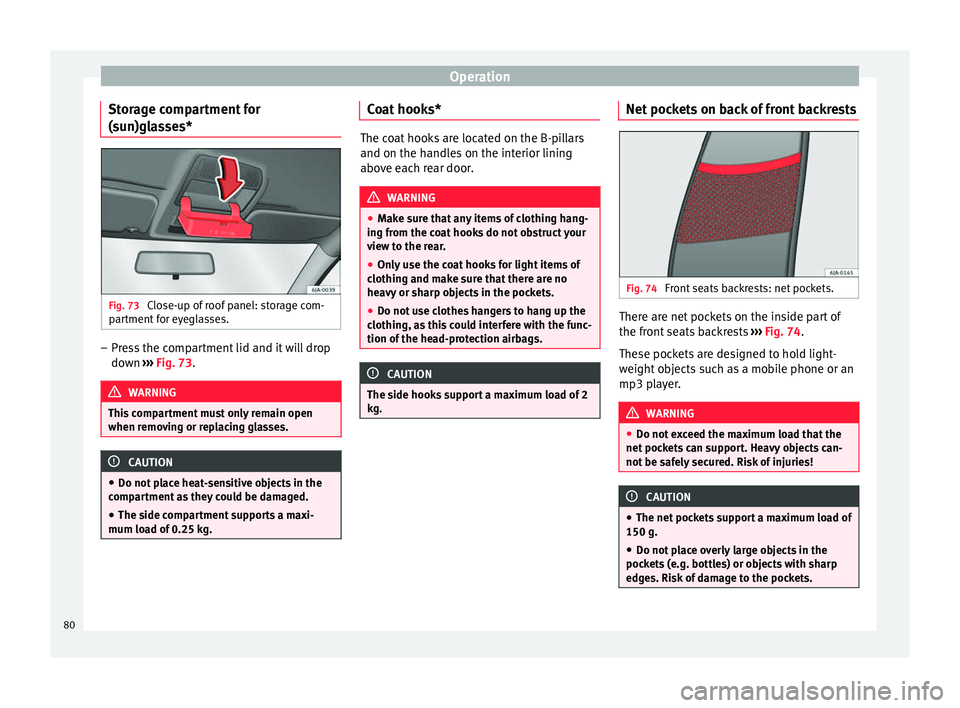
(sun)glasses* Fig. 73
Close-up of roof panel: storage com-
partment for eyeglasses. –
Press the compartment lid and it will drop
down ››› Fig. 73 . WARNING
This compartment must only remain open
when removing or replacing glasses. CAUTION
● Do not place heat-sensitive objects in the
compartment as they could be damaged.
● The side compartment supports a maxi-
mum load of 0.25 kg. Coat hooks*
The coat hooks are located on the B-pillars
and on the handles on the interior lining
above each rear door.
WARNING
● Make sure that any items of clothing hang-
ing from the coat hooks do not obstruct your
view to the rear.
● Only use the coat hooks for light items of
clothing and make sure that there are no
heavy or sharp objects in the pockets.
● Do not use clothes hangers to hang up the
clothing, as this could interfere with the func-
tion of the head-protection airbags. CAUTION
The side hooks support a maximum load of 2
kg. Net pockets on back of front backrests
Fig. 74
Front seats backrests: net pockets. There are net pockets on the inside part of
the front seats backrests
››› Fig. 74 .
The se poc
kets are designed to hold light-
weight objects such as a mobile phone or an
mp3 player. WARNING
● Do not exceed the maximum load that the
net pockets can support. Heavy objects can-
not be safely secured. Risk of injuries! CAUTION
● The net pockets support a maximum load of
150 g.
● Do not place overly large objects in the
pockets (e.g. bottles) or objects with sharp
edges. Risk of damage to the pockets. 80
Page 87 of 200

Transport and practical equipment
Rear shelf Fig. 82
Remove the shelf. Fig. 83
Remove the shelf. The shelf can be removed if a large load is to
be transported.
Removing the shelf
–
Remove the straps from the shelf 1›››
Fig. 82 . –
Remo ve the shelf from its housing
2 by
knocking it gently from underneath be-
tween the supports.
Fitting the shelf – Place the shelf on the side supports on the
trim.
– Adjust the shelf supports 3
››› Fig. 83 to fit
the s up
ports 2 in the trim.
– Fit into place by knocking the top of the
shelf gently between the supports.
– Attach the straps 1 to the tray.
WARNING
Do not place objects on the rear shelf that
could endanger the vehicle occupants in case
of a sudden braking manoeuvre or an acci-
dent. CAUTION
● The rear shelf supports a maximum load of
1 kg.
● If handled incorrectly, the tray could bend
on closing the rear lid and become damaged
or damage the trim. Follow the instructions
below:
– The shelf supports 3
››› Fig. 83 must be
sec ur
ely in place in the trim supports 2 .
– The size of the load must not exceed the
height of the shelf. –
When open, the shelf must not be bent
against the shelf seal.
– There must be no objects in the space be-
tween the open shelf and the backrest of
the rear seat. Note
The shelf will lift when the rear lid is opened. Roof rack*
Introduction WARNING
● The load on the roof carrier must be proper-
ly secured. Risk of accident!
● Always secure the load using retaining
straps that are in good condition.
● Distribute the load evenly.
● When transporting heavy or large objects
on the roof, any change in normal vehicle be-
haviour due to a change in the centre of gravi-
ty or increased wind resistance must be taken
into account. Risk of accident! For this rea-
son, speed and driving style must be adjus-
ted for the situation.
● Avoid sudden manoeuvres and braking.
● Adjust your driving style to suit visibility,
the weather and road and traffic conditions. » 85
Technical specifications
Advice
Operation
Safety
Page 88 of 200
Operation
●
Never exceed the allowed axle loads or al-
lowed maximum weight. Risk of accident! CAUTION
● Only use SEAT-authorised roof carriers.
● Where roof carriers from other systems are
used or where they are not fitted properly,
any damage caused to the vehicle will not be
covered by the warranty. Therefore, carefully
follow the Instruction Manual for installation
of the roof carrier.
● Remember that the rear lid must not hit the
roof load.
● The total height of the vehicle increases ac-
cording to the roof load. Compare the height
of the vehicle with the heights of bridges or
other underpasses, for example, the height
of the garage door.
● Do not forget to remove the roof carrier be-
fore entering an automatic carwash.
● Take into account that the load must not
damage the aerial located on the roof. For the sake of the environment
If aerodynamic resistance increases, fuel con-
sumption will also increase. Attachment points
Fig. 84
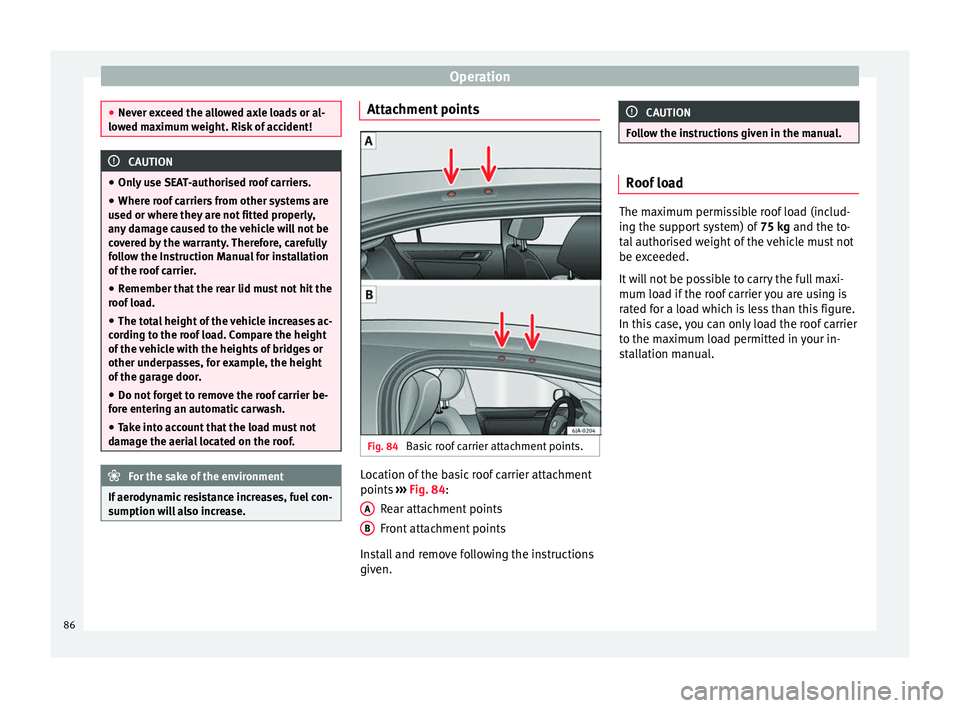
Basic roof carrier attachment points. Location of the basic roof carrier attachment
points
››› Fig. 84 :
R e
ar attachment points
Front attachment points
Install and remove following the instructions
given. A B CAUTION
Follow the instructions given in the manual. Roof load
The maximum permissible roof load (includ-
ing the support system) of
75 kg and the to-
t al
authorised weight of the vehicle must not
be exceeded.
It will not be possible to carry the full maxi-
mum load if the roof carrier you are using is
rated for a load which is less than this figure.
In this case, you can only load the roof carrier
to the maximum load permitted in your in-
stallation manual. 86
Page 94 of 200

Operation
Air conditioning selection Basic air conditioning control settings recom-
mended for the corresponding operating
modes:SettingsControl positionButtonAir vents 4ABC12
Windscreen and side window de-
frost
a)Required tempera-
ture3 or 4 Do not switch onSwitched on automati-
callyb)Open and direct towards the
side window
Heat as quickly as possibleClockwise as far asit will go3 Switch on brieflyOffOpening
Mild heatingRequired tempera-
ture2 or 3 / Do not switch onOffOpening
Heat as quickly as possibleAnti-clockwise as far
as it will goBriefly 4, then 2 or 3 Switch on briefly
c)IgnitionOpening
Optimum coolingRequired tempera-
ture1 or 2 Do not switch onIgnitionOpen and direct towards the
roof
Fresh air mode - blowerAnti-clockwise as faras it will goRequired position Do not switch onOffOpening
a)
This type of setting is not recommended in countries with high air humidity. The windows could cool too quickly and cause them to mist over on the outside.
b) The lamp in button 2
lights up, even if not all of the conditions for cooling system operations are met. Cooling is indicated as available once all of the conditions are met
››› page 90, General notes .
c) In certain conditions, air recirculation mode can switch on automatically ››› page 92, a lamp illuminates in the button. Note
● Controls A
››› Fig. 87 ››› p
age 90, B ,
C and buttons
1 and
2 .
● Air vents 4 ››› page 88 . ●
We recommend you leave the air vents 3
››› page 88 in the open position. Air recirculation
Air recirculation prevents unpleasant smells,
e.g. when passing through a tunnel or in
queuing traffic, from entering the interior.
92
Page 109 of 200

Driving
The tyre pressures should always be checked
when the tyres are cold.
Do not u
se winter tyres all year round as they
increase fuel consumption by up to 10%.
Avoid unnecessary weight
Given that every kilo of extra weight
will in-
crease the fuel consumption, it is advisable
to always check the luggage compartment to
make sure that no unnecessary loads are be-
ing transported.
A roof rack is often left in place for the sake
of convenience, even when it is no longer
needed. At a speed of 100 km/h (62 mph)
and 120 km/h (75 mph) your vehicle will use
about 12% more fuel as a result of the extra
wind resistance caused by the roof rack even
when it is not in use.
Save electricity
The engine activates the alternator, which
produces electricity. With the need for elec-
tricity, fuel consumption also increases. Be-
cause of this, always turn off electrical devi-
ces when you do not need them. Examples of
devices that use a lot of electricity are: the
fan at high speeds, the rear window heating
and the seat heaters*. Note
● If you vehicle has Start-Stop, it is not rec-
ommended t o sw
itch this function off. ●
It is recommended to close the windows
when driving at more than 60 km/h (40 mph)
● Do not drive with your foot resting on the
clutch pedal, as the pressure can make the
p l
ate spin, more fuel will be used and it can
burn the clutch plate lining, causing a serious
fault.
● Do not hold the vehicle on a hill with the
clutch, use the foot brake or hand brake, us-
ing the latter to start. The fuel consumption
will be lower and you will prevent the clutch
plate from being damaged.
● On descents, use the engine brake, chang-
ing to the gear that is more suitable for the
slope. Fuel consumption will be “zero” and
the brakes will not suffer. Wading and driving off-road
Driving through water Fig. 94
Driving through water. To prevent the vehicle from being damaged
when driving through water (i.e. flooded
roads), please observe the following:
● Determine the depth of the water before
entering. Water can reach a maximum height
of below the door sill ››› Fig. 94 .
● Driv e at
a maximum pace of walking speed.
Driving at a higher speed can cause a wave
in front of the vehicle, which can cause water
to enter the engine air intake system or other
parts of the vehicle.
● Never stop in the water, never reverse and
never stop the engine.
● Before driving through water deactivate the
Start-Stop system ››› page 112. WARNING
● Driving through water, dirt and mud can re-
duce braking capability and prolong the brak-
ing distance – Risk of accident!
● Do not carry out any sudden or strong brak-
ing manoeuvres after driving through water.
● Clean and dry the brakes as soon as possi-
ble after driving through water by breaking
intermittently. Carry out braking in order to
dry the brakes and clean the brake discs only
if traffic so permits. Do not put other drivers
at risk. » 107Technical specifications
Advice
Operation
Safety