light Seat Toledo 2015 Owner's manual
[x] Cancel search | Manufacturer: SEAT, Model Year: 2015, Model line: Toledo, Model: Seat Toledo 2015Pages: 248, PDF Size: 5.06 MB
Page 215 of 248
Checking and refilling levels
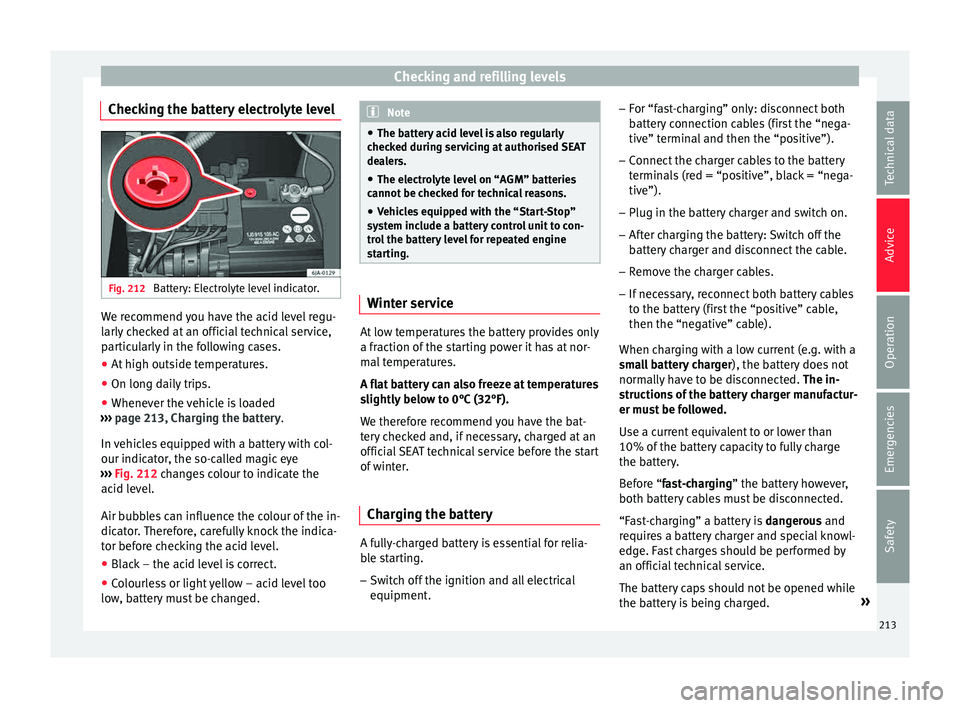
Checking the battery electrolyte level Fig. 212
Battery: Electrolyte level indicator. We recommend you have the acid level regu-
l
arly
c
hecked at an official technical service,
particularly in the following cases.
● At high outside temperatures.
● On long daily trips.
● Whenever the vehicle is loaded
›››
page 213, Charging the battery.
In vehicles equipped with a battery with col-
our indicator, the so-called magic eye
››› Fig. 212 changes colour to indicate the
acid level.
Air bubbles can influence the colour of the in-
dicator. Therefore, carefully knock the indica-
tor before checking the acid level.
● Black – the acid level is correct.
● Colourless or light yellow – acid level too
low , b
attery must be changed. Note
● The batt er
y acid level is also regularly
checked during servicing at authorised SEAT
dealers.
● The electrolyte level on “AGM” batteries
cannot be c
hecked for technical reasons.
● Vehicles equipped with the “Start-Stop”
syst
em include a battery control unit to con-
trol the battery level for repeated engine
starting. Winter service
At low temperatures the battery provides only
a fr
action of
the s
tarting power it has at nor-
mal temperatures.
A flat battery can also freeze at temperatures
slightly below to 0°C (32°F).
We therefore recommend you have the bat-
tery checked and, if necessary, charged at an
official SEAT technical service before the start
of winter.
Charging the battery A fully-charged battery is essential for relia-
b
l
e s
tarting.
– Switch off the ignition and all electrical
equipment. –
For “fa
st-charging” only: disconnect both
battery connection cables (first the “nega-
tive” terminal and then the “positive”).
– Connect the charger cables to the battery
terminal
s (red = “positive”, black = “nega-
tive”).
– Plug in the battery charger and switch on.
– After charging the battery: Switch off the
batter
y charger and disconnect the cable.
– Remove the charger cables.
– If necessary, reconnect both battery cables
to the batt
ery (first the “positive” cable,
then the “negative” cable).
When charging with a low current (e.g. with a
small battery charger ), the battery does not
normally have to be disconnected. The in-
structions of the battery charger manufactur-
er must be followed.
Use a current equivalent to or lower than
10% of the battery capacity to fully charge
the battery.
Before “fast-charging” the battery however,
both battery cables must be disconnected.
“Fast-charging” a battery is dangerous and
requires a battery charger and special knowl-
edge. Fast charges should be performed by
an official technical service.
The battery caps should not be opened while
the battery is being charged. »
213
Technical data
Advice
Operation
Emergencies
Safety
Page 216 of 248
Advice
CAUTION
In vehicles fitted with the “Start-Stop” sys-
tem, the c h
arger cable cannot be directly con-
nected to the negative terminal of the vehicle
battery but must be attached to the engine
ground point ›››
page 52. Disconnecting and connecting the
batt
er
y The following functions will either be inoper-
ative or w
i
ll not work properly after discon-
necting and reconnecting the battery:
FunctionInstallation
Setting the clock››› page 95
The multifunction display data
is deleted››› page 97 Note
We recommend having the vehicle checked by
an authorised S EA
T dealer to guarantee the
correct working order of all electrical sys-
tems. Replacing the battery
A replacement battery must have the same
c
ap
ac
ity, voltage, current rating and size as
the original. The appropriate types of battery can be acquired from authorised SEAT deal-
ers.
We r
ecommend having the battery changed
by an authorised SEAT dealer, where the new
battery will be correctly installed and the
original disposed of in line with regulations.
Automatic disconnection of electrical
equipment When heavily-charging a battery, the pro-
gr
amme sel
ect
ed by the electrical system
control unit prevents the battery from auto-
matically discharging. This may result in the
following:
● Increase in idling speed so that the alterna-
tor can s
upply more current to the electrical
system.
● The performance of certain electrical com-
ponents cou
ld be limited or some may switch
off temporarily, e.g. the heated seats, the
heated rear window, the 12 V power socket. Note
Despite any measures taken by the control
unit, the b att
ery could drain. e.g. with the en-
gine is switched off, the key is turned in the
ignition for a long period or the side lights or
parking lights are switched on. The switching
off of certain electrical components does not impair driving comfort and often the driver
wi
l
l not even notice.214
Page 218 of 248
Advice
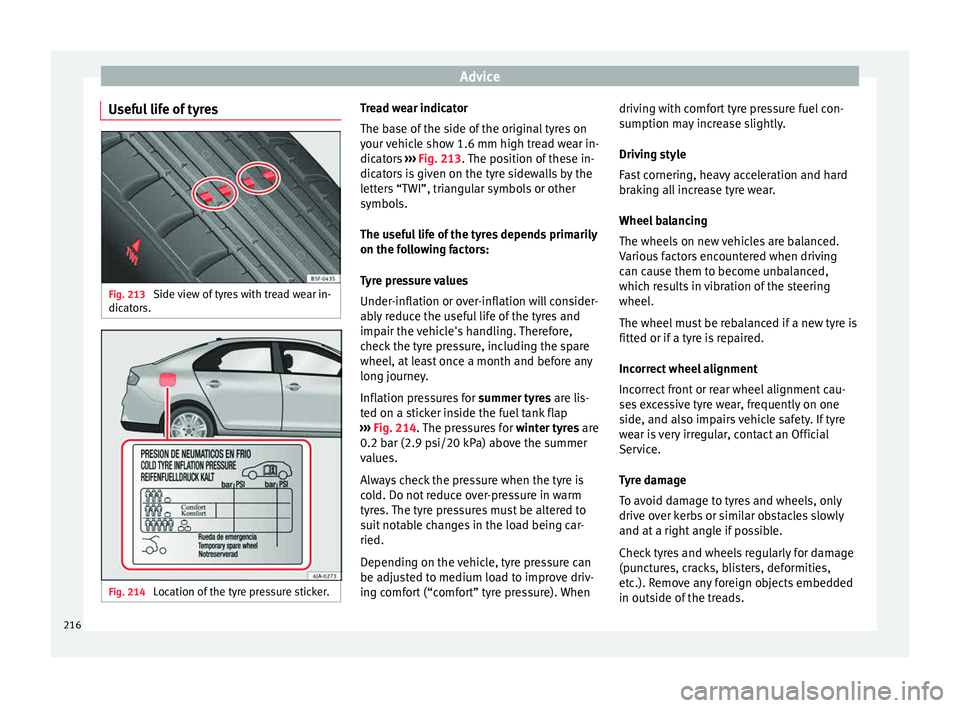
Useful life of tyres Fig. 213
Side view of tyres with tread wear in-
dic at
or
s. Fig. 214
Location of the tyre pressure sticker. Tread wear indicator
The b
ase of
the side of the original tyres on
your vehicle show 1.6 mm high tread wear in-
dicators ››› Fig. 213. The position of these in-
dicators is given on the tyre sidewalls by the
letters “TWI”, triangular symbols or other
symbols.
The useful life of the tyres depends primarily
on the following factors:
Tyre pressure values
Under-inflation or over-inflation will consider-
ably reduce the useful life of the tyres and
impair the vehicle's handling. Therefore,
check the tyre pressure, including the spare
wheel, at least once a month and before any
long journey.
Inflation pressures for summer tyres are lis-
ted on a sticker inside the fuel tank flap
››› Fig. 214. The pressures for winter tyres are
0.2 bar (2.9 psi/20 kPa) above the summer
values.
Always check the pressure when the tyre is
cold. Do not reduce over-pressure in warm
tyres. The tyre pressures must be altered to
suit notable changes in the load being car-
ried.
Depending on the vehicle, tyre pressure can
be adjusted to medium load to improve driv-
ing comfort (“comfort” tyre pressure). When driving with comfort tyre pressure fuel con-
sumption ma
y increase slightly.
Driving style
Fast cornering, heavy acceleration and hard
braking all increase tyre wear.
Wheel balancing
The wheels on new vehicles are balanced.
Various factors encountered when driving
can cause them to become unbalanced,
which results in vibration of the steering
wheel.
The wheel must be rebalanced if a new tyre is
fitted or if a tyre is repaired.
Incorrect wheel alignment
Incorrect front or rear wheel alignment cau-
ses excessive tyre wear, frequently on one
side, and also impairs vehicle safety. If tyre
wear is very irregular, contact an Official
Service.
Tyre damage
To avoid damage to tyres and wheels, only
drive over kerbs or similar obstacles slowly
and at a right angle if possible.
Check tyres and wheels regularly for damage
(punctures, cracks, blisters, deformities,
etc.). Remove any foreign objects embedded
in outside of the treads.
216
Page 221 of 248
Wheels and tyres
CAUTION
Follow the instructions given on the tempora-
ry s
pare wheel label. Note
The tyre pressure of the spare wheel must al-
wa y
s correspond to the highest pressure pre-
scribed for the model of vehicle in question. Tyre monitoring systems
Ty r
e pressure* The tyre pressure monitoring system uses
ABS
sen
sor
s to compare the revolutions and
the circumference of each wheel. Should the
circumference of any wheel change, the
warning lamp on the general dash panel
››› page 103 will light up and an audible
warning will be heard.
Tyre circumference may change if:
● Tyre pressure is too low
● Tyre structure is damaged
● Vehicle load not evenly distributed
● wheels on one axle are subjected to greater
load, (e.
g. driving with trailer, uphill, down-
hill);
● Snow chains are fitted
● The temporary spare wheel is fitted ●
One wheel on the axl
e has been changed
Basic system settings
Should the tyre pressure change or if one or
more wheels are changed or the position of
the wheel on the vehicle is changed, e.g.
changing round the front and rear wheels, or
where a warning lamp lights up when driv-
ing, the system must be adjusted as follows: ● Inflate all tyres to the prescribed pressures
›››
page 216.
● Switch the ignition on.
● Store the new tyre pressure in the Easy
Connect sy
stem with the button and the
f u
nction b
utton Setup
› ›
›
page 20.
The warning lamp lights up
If the pressure on at least one tyre is signifi-
cantly lower than the pressure set by the driv-
er, the warning lamp will light up ››› .
The w arnin
g l
amp flashes
If the warning lamp flashes, there is a fault in
the system. Contact a specialised service to
have it fixed. WARNING
● If the w arnin
g lamp lights up, slow down
immediately and avoid any severe braking or
steering manoeuvres. Stop and check the
tyres and their pressure as soon as possible. ●
Under cer t
ain conditions (e.g. sporty driv-
ing style, driving on loose surfaces or in win-
ter) the warning lamp may take a while to
light up or may remain switched off.
● Despite the tyre pressure monitoring sys-
tem, the driver r
emains responsible for main-
taining the correct tyre pressure. You must
therefore check the tyre pressure often. Note
● The ty re pr
essure monitoring system is not
a replacement for regularly checking the tyre
pressure, as it is unable to recognise an even
drop in pressure.
● The tyre pressure monitoring system is un-
able t
o warn of a sudden drop in tyre pres-
sure, e.g. a puncture. In this case, try to stop
the vehicle carefully with no severe braking
or steering manoeuvres.
● To ensure the tyre pressure monitoring sys-
tem work
s correctly, the basic setting must
be performed every 10 000 km (6000 miles)
or once a year. Winter service
W int
er ty
res Winter tyres will significantly improve han-
dlin
g of
the
vehicle in winter road conditions.
The design of summer tyres (width, rubber
compound, tread pattern) gives less grip at »
219
Technical data
Advice
Operation
Emergencies
Safety
Page 226 of 248
Technical data
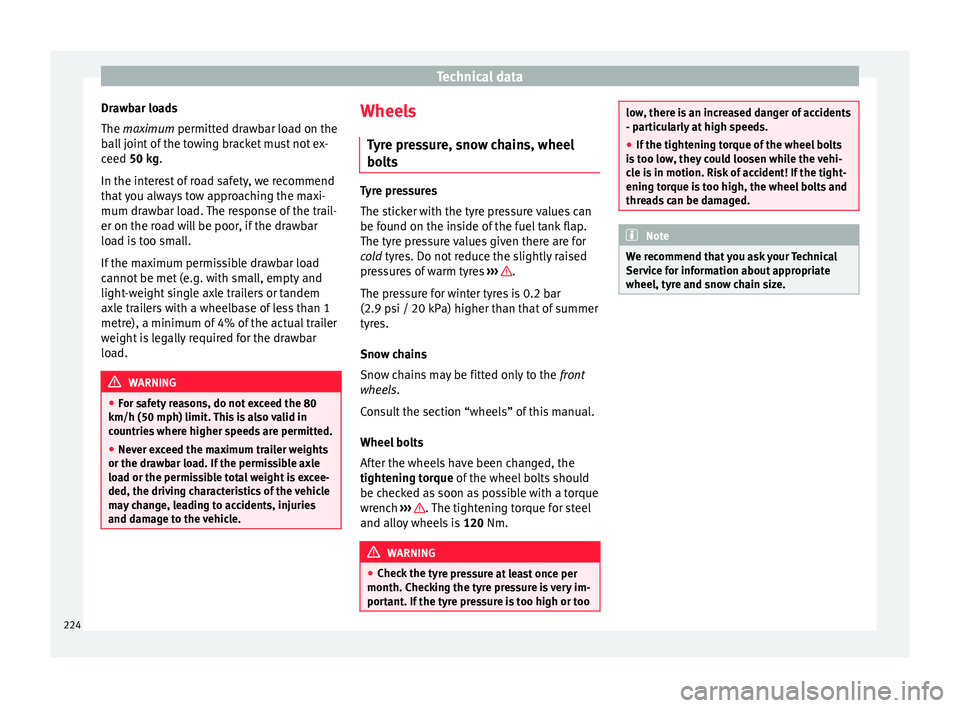
Drawbar loads
The maximum permitt ed dr
a
wbar load on the
ball joint of the towing bracket must not ex-
ceed 50 kg.
In the interest of road safety, we recommend
that you always tow approaching the maxi-
mum drawbar load. The response of the trail-
er on the road will be poor, if the drawbar
load is too small.
If the maximum permissible drawbar load
cannot be met (e.g. with small, empty and
light-weight single axle trailers or tandem
axle trailers with a wheelbase of less than 1
metre), a minimum of 4% of the actual trailer
weight is legally required for the drawbar
load. WARNING
● For s af
ety reasons, do not exceed the 80
km/h (50 mph) limit. This is also valid in
countries where higher speeds are permitted.
● Never exceed the maximum trailer weights
or the drawb
ar load. If the permissible axle
load or the permissible total weight is excee-
ded, the driving characteristics of the vehicle
may change, leading to accidents, injuries
and damage to the vehicle. Wheels
Ty
r
e pressure, snow chains, wheel
bolts Tyre pressures
The stic
k
er with the tyre pressure values can
be found on the inside of the fuel tank flap.
The tyre pressure values given there are for
cold tyres. Do not reduce the slightly raised
pressures of warm tyres ››› .
The pre s
sure for winter tyres is 0.2 bar
(2.9 psi / 20 kPa) higher than that of summer
tyres.
Snow chains
Snow chains may be fitted only to the front
wheels.
Consult the section “wheels” of this manual.
Wheel bolts
After the wheels have been changed, the
tightening torque of the wheel bolts should
be checked as soon as possible with a torque
wrench ››› . The tightening torque for steel
and al lo
y
wheels is 120 Nm. WARNING
● Check the ty
re pressure at least once per
month. Checking the tyre pressure is very im-
portant. If the tyre pressure is too high or too low, there is an increased danger of accidents
- par
tic
ularly at high speeds.
● If the tightening torque of the wheel bolts
is t
oo low, they could loosen while the vehi-
cle is in motion. Risk of accident! If the tight-
ening torque is too high, the wheel bolts and
threads can be damaged. Note
We recommend that you ask your Technical
Ser vic
e for information about appropriate
wheel, tyre and snow chain size. 224
Page 227 of 248
Technical specifications
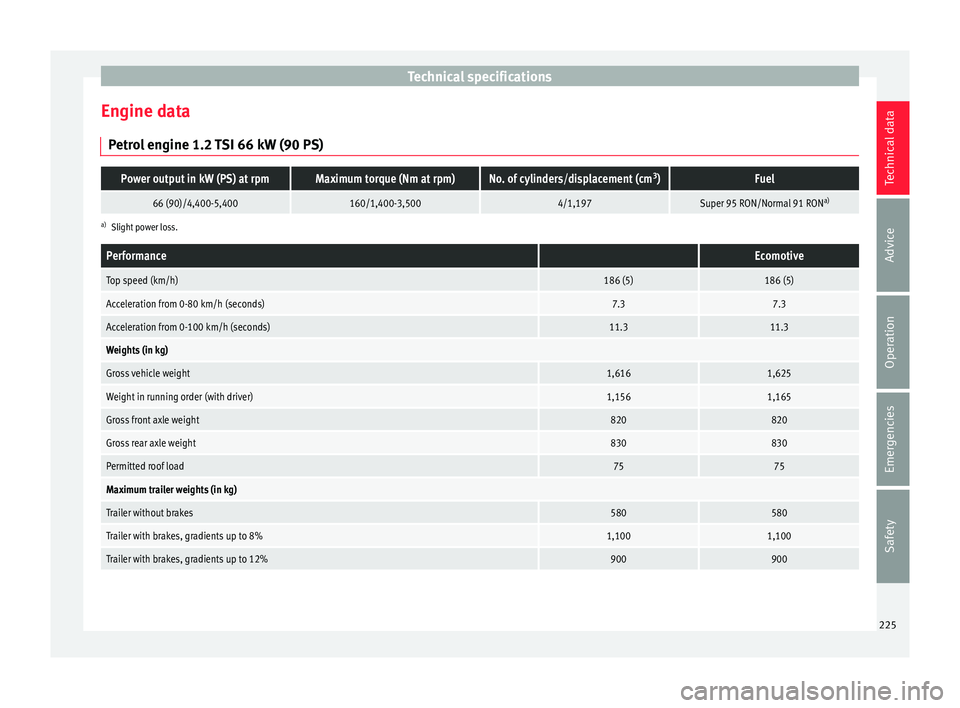
Engine data P etr
o
l engine 1.2 TSI 66 kW (90 PS)
Power output in kW (PS) at rpmMaximum torque (Nm at rpm)No. of cylinders/displacement (cm 3
)Fuel
66 (90)/4,400-5,400160/1,400-3,5004/1,197Super 95 RON/Normal 91 RON a)
a)
Slight power loss.
Performance Ecomotive
Top speed (km/h)186 (5)186 (5)
Acceleration from 0-80 km/h (seconds)7.37.3
Acceleration from 0-100 km/h (seconds)11.311.3
Weights (in kg)
Gross vehicle weight1,6161,625
Weight in running order (with driver)1,1561,165
Gross front axle weight820820
Gross rear axle weight830830
Permitted roof load7575
Maximum trailer weights (in kg)
Trailer without brakes580580
Trailer with brakes, gradients up to 8%1,1001,100
Trailer with brakes, gradients up to 12%900900 225
Technical data
Advice
Operation
Emergencies
Safety
Page 228 of 248
Technical data
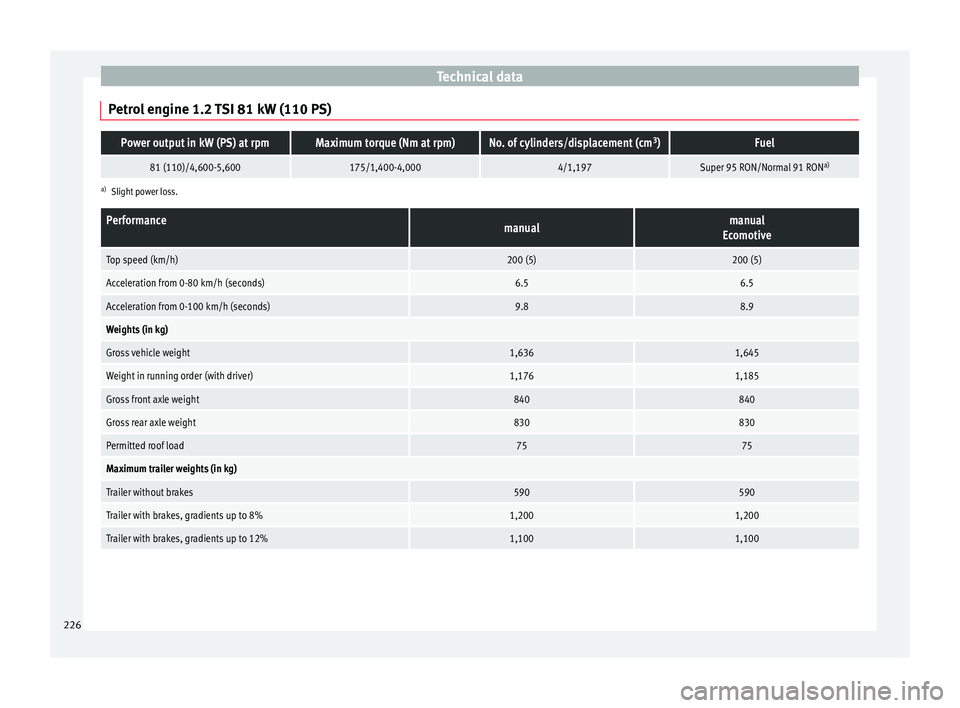
Petrol engine 1.2 TSI 81 kW (110 PS)Power output in kW (PS) at rpmMaximum torque (Nm at rpm)No. of cylinders/displacement (cm 3
)Fuel
81 (110)/4,600-5,600175/1,400-4,0004/1,197Super 95 RON/Normal 91 RON a)
a)
Slight power loss.
Performancemanualmanual
Ecomotive
Top speed (km/h)200 (5)200 (5)
Acceleration from 0-80 km/h (seconds)6.56.5
Acceleration from 0-100 km/h (seconds)9.88.9
Weights (in kg)
Gross vehicle weight1,6361,645
Weight in running order (with driver)1,1761,185
Gross front axle weight840840
Gross rear axle weight830830
Permitted roof load7575
Maximum trailer weights (in kg)
Trailer without brakes590590
Trailer with brakes, gradients up to 8%1,2001,200
Trailer with brakes, gradients up to 12%1,1001,100 226
Page 229 of 248
Technical specifications
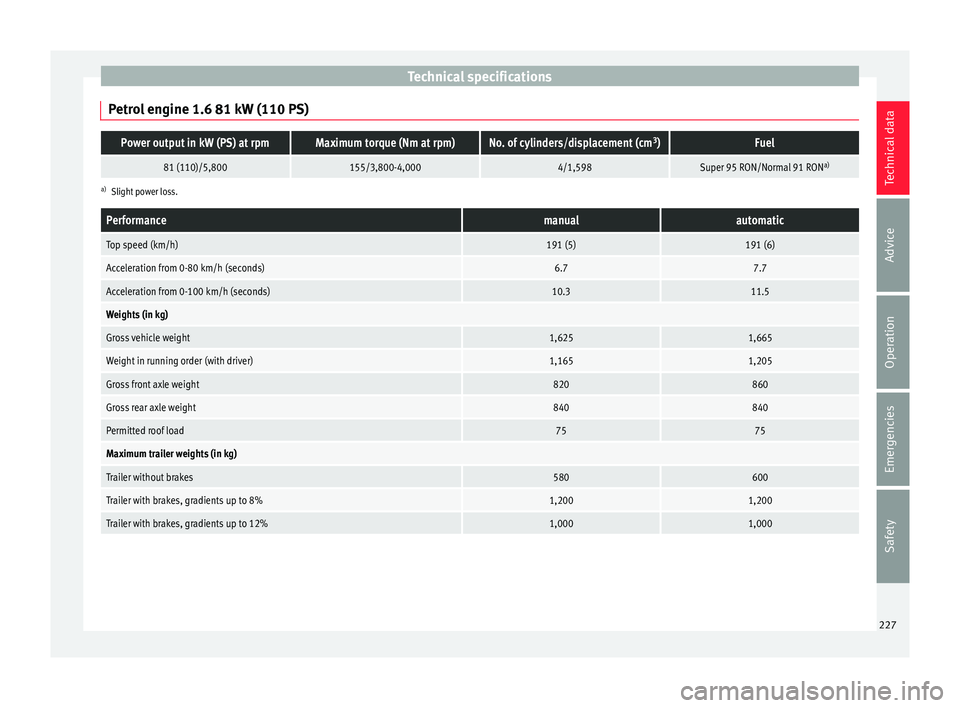
Petrol engine 1.6 81 kW (110 PS)Power output in kW (PS) at rpmMaximum torque (Nm at rpm)No. of cylinders/displacement (cm 3
)Fuel
81 (110)/5,800155/3,800-4,0004/1,598Super 95 RON/Normal 91 RON a)
a)
Slight power loss.
Performancemanualautomatic
Top speed (km/h)191 (5)191 (6)
Acceleration from 0-80 km/h (seconds)6.77.7
Acceleration from 0-100 km/h (seconds)10.311.5
Weights (in kg)
Gross vehicle weight1,6251,665
Weight in running order (with driver)1,1651,205
Gross front axle weight820860
Gross rear axle weight840840
Permitted roof load7575
Maximum trailer weights (in kg)
Trailer without brakes580600
Trailer with brakes, gradients up to 8%1,2001,200
Trailer with brakes, gradients up to 12%1,0001,000 227
Technical data
Advice
Operation
Emergencies
Safety
Page 230 of 248
Technical data
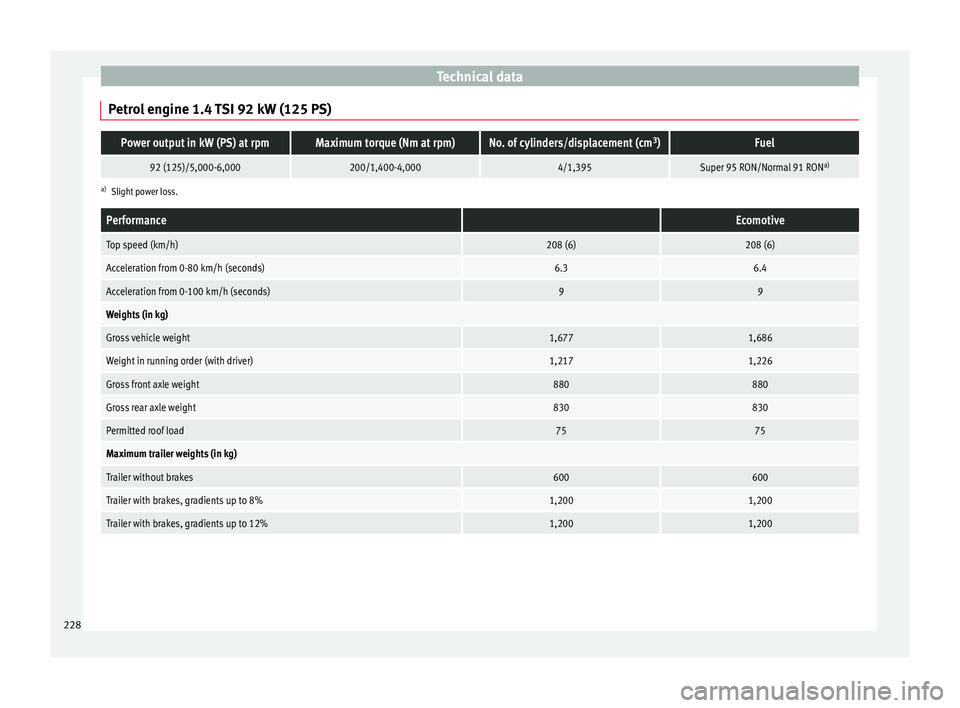
Petrol engine 1.4 TSI 92 kW (125 PS)Power output in kW (PS) at rpmMaximum torque (Nm at rpm)No. of cylinders/displacement (cm 3
)Fuel
92 (125)/5,000-6,000200/1,400-4,0004/1,395Super 95 RON/Normal 91 RON a)
a)
Slight power loss.
Performance Ecomotive
Top speed (km/h)208 (6)208 (6)
Acceleration from 0-80 km/h (seconds)6.36.4
Acceleration from 0-100 km/h (seconds)99
Weights (in kg)
Gross vehicle weight1,6771,686
Weight in running order (with driver)1,2171,226
Gross front axle weight880880
Gross rear axle weight830830
Permitted roof load7575
Maximum trailer weights (in kg)
Trailer without brakes600600
Trailer with brakes, gradients up to 8%1,2001,200
Trailer with brakes, gradients up to 12%1,2001,200 228
Page 235 of 248
Index
Index
A
ABS contr
o
l lamp . . . . . . . . . . . . . . . . . . . . . . . . . . . 101
see also Anti-lock brake system . . 100, 167, 168
Accessories . . . . . . . . . . . . . . . . . . . . . . . . . 138, 193
Additional electrical appliances (efficiency pro- gramme) . . . . . . . . . . . . . . . . . . . . . . . . . . . . . . . 28
Adjustment CAR menu . . . . . . . . . . . . . . . . . . . . . . . . . . . . . 104
front head restraints . . . . . . . . . . . . . . . . . 59, 132
lights . . . . . . . . . . . . . . . . . . . . . . . . . . . . . . . . . 122
rear head restraints . . . . . . . . . . . . . . . . . . . . . . 59
seats . . . . . . . . . . . . . . . . . . . . . . . . . . . . . . . . . . 56
Aerial . . . . . . . . . . . . . . . . . . . . . . . . . . . . . . . . . . . 195
Air-conditioning economic use . . . . . . . . . . . . . . . . . . . . . . . . . . 147
Airbag covers . . . . . . . . . . . . . . . . . . . . . . . . . . . . . 13
Airbag system . . . . . . . . . . . . . . . . . . . . . . . . . . 13, 66 activation . . . . . . . . . . . . . . . . . . . . . . . . . . . . . . 68
control lamp . . . . . . . . . . . . . . . . . . . . . . . . . . . 103
deactivation of front airbag . . . . . . . . . . . . . 68, 71
description . . . . . . . . . . . . . . . . . . . . . . . . . . . . . 67
front airbags . . . . . . . . . . . . . . . . . . . . . . . . . 13, 69
functioning . . . . . . . . . . . . . . . . . . . . . . . . . . . . . 68
head-protection airbags . . . . . . . . . . . . . . . . . . 15
Side airbags . . . . . . . . . . . . . . . . . . . . . . . . . . . . 15
Air conditioning . . . . . . . . . . . . . . . . . . . . . . . . 36, 37 air vents . . . . . . . . . . . . . . . . . . . . . . . . . . . . . . 147
faults . . . . . . . . . . . . . . . . . . . . . . . . . . . . . . . . . 147
introduction . . . . . . . . . . . . . . . . . . . . . . . . . . . 146
operation . . . . . . . . . . . . . . . . . . . . . . . . . . . . . . 149
Alarm system . . . . . . . . . . . . . . . . . . . . . . . . . . . . 117
Alternator control lamp . . . . . . . . . . . . . . . . . . . . . . . . . . . . 99 Ambient lighting . . . . . . . . . . . . . . . . . . . . . . . . . 127
Anti-freeze
. . . . . . . . . . . . . . . . . . . . . . . . . . . . . . . 40
Anti-lock brake system . . . . . . . . . . . . . . . . . . . . . 100
Anti-lock system . . . . . . . . . . . . . . . . . . . . . 167, 168
Anti-puncture kit . . . . . . . . . . . . . . . . . . . . . . . . 45, 76 Check after 10 minutes . . . . . . . . . . . . . . . . . . . 78
Anti-theft alarm . . . . . . . . . . . . . . . . . . . . . . . . . . 117
Anti-theft system . . . . . . . . . . . . . . . . . . . . . . . 9, 113
Armrest front seats . . . . . . . . . . . . . . . . . . . . . . . . . . . . . 133
rear seats . . . . . . . . . . . . . . . . . . . . . . . . . . . . . 134
Ashtrays . . . . . . . . . . . . . . . . . . . . . . . . . . . . . . . . 138
Aspects to take into account before starting the vehicle . . . . . . . . . . . . . . . . . . . . . . . . . . . . . . . . . 55
ASR control lamp . . . . . . . . . . . . . . . . . . . . . . . . . . . 101
see also Traction control system . . 100, 167, 168
Assistance systems ABS . . . . . . . . . . . . . . . . . . . . . . . . . . . . . 101, 168
ASR . . . . . . . . . . . . . . . . . . . . . . . . . . . . . . . . . . 168
cruise speed . . . . . . . . . . . . . . . . . . . . . . . . . . . 176
EDS . . . . . . . . . . . . . . . . . . . . . . . . . . . . . . . . . . 168
front assist monitoring system . . . . . . . . . . . . 177
parking aid . . . . . . . . . . . . . . . . . . . . . . . 168, 169
Start-Stop . . . . . . . . . . . . . . . . . . . . . . . . . . . . . 182
tiredness detection . . . . . . . . . . . . . . . . . . . . . 184
Tyre monitoring systems . . . . . . . . . . . . . . . . . 219
Assisted starting . . . . . . . . . . . . . . . . . . . . . . . . . . 51
Assist systems ASR . . . . . . . . . . . . . . . . . . . . . . . . . . . . . . . . . . 101
Audible signal . . . . . . . . . . . . . . . . . . . . . . . . . . . . 61
Audible warning signal warning and indication lamps . . . . . . . . . . . . . . 98
Automatic air conditioning climatronic . . . . . . . . . . . . . . . . . . . . . . . . . . . . 151
Automatic car washes see Washing . . . . . . . . . . . . . . . . . . . . . . . . . . . 195 Automatic gearbox
back up programme . . . . . . . . . . . . . . . . . . . . . 162
driving programmes . . . . . . . . . . . . . . . . . . . . . 162
instructions for use . . . . . . . . . . . . . . . . . . . . . 158
kick-down . . . . . . . . . . . . . . . . . . . . . . . . . . . . . 159
manual release of selector lever . . . . . . . . . . . . 35
parking . . . . . . . . . . . . . . . . . . . . . . . . . . . . . . . 159
selector lever lock . . . . . . . . . . . . . . . . . . . . . . . 161
selector lever positions . . . . . . . . . . . . . . . . . . 160
starting . . . . . . . . . . . . . . . . . . . . . . . . . . . . . . . 159
stopping . . . . . . . . . . . . . . . . . . . . . . . . . . . . . . 159
tiptronic . . . . . . . . . . . . . . . . . . . . . . . . . . 158, 161
AUX-IN . . . . . . . . . . . . . . . . . . . . . . . . . . . . . . . . . . 109
B Back seat folding down and raising the back seat back- rest . . . . . . . . . . . . . . . . . . . . . . . . . . . . . . . . . 134
Ball coupling disassembly . . . . . . . . . . . . . . . . . . . . . . . . . . . 191
Battery . . . . . . . . . . . . . . . . . . . . . . . . . . . . . . . . . . 111
Before starting the vehicle . . . . . . . . . . . . . . . . . . 55
Belt tightening . . . . . . . . . . . . . . . . . . . . . . . . . . . . 65
Biodiesel . . . . . . . . . . . . . . . . . . . . . . . . . . . . . . . . 202
Blown bulbs changing a bulb . . . . . . . . . . . . . . . . . . . . . . . . . 83
Bonnet . . . . . . . . . . . . . . . . . . . . . . . . . . . . . 11, 206 opening the bonnet . . . . . . . . . . . . . . . . . . . . . 205
Boot hook . . . . . . . . . . . . . . . . . . . . . . . . . . . . . . . . . 143
retaining elements . . . . . . . . . . . . . . . . . . . . . . 143
retaining nets . . . . . . . . . . . . . . . . . . . . . . . . . . 143
Brake assist . . . . . . . . . . . . . . . . . . . . . . . . 100, 167
Brake fluid . . . . . . . . . . . . . . . . . . . . . . . . . . . . . . . 41 checking . . . . . . . . . . . . . . . . . . . . . . . . . . . . . . 209
233