boot Seat Toledo 2017 User Guide
[x] Cancel search | Manufacturer: SEAT, Model Year: 2017, Model line: Toledo, Model: Seat Toledo 2017Pages: 248, PDF Size: 5.86 MB
Page 142 of 248
Operation
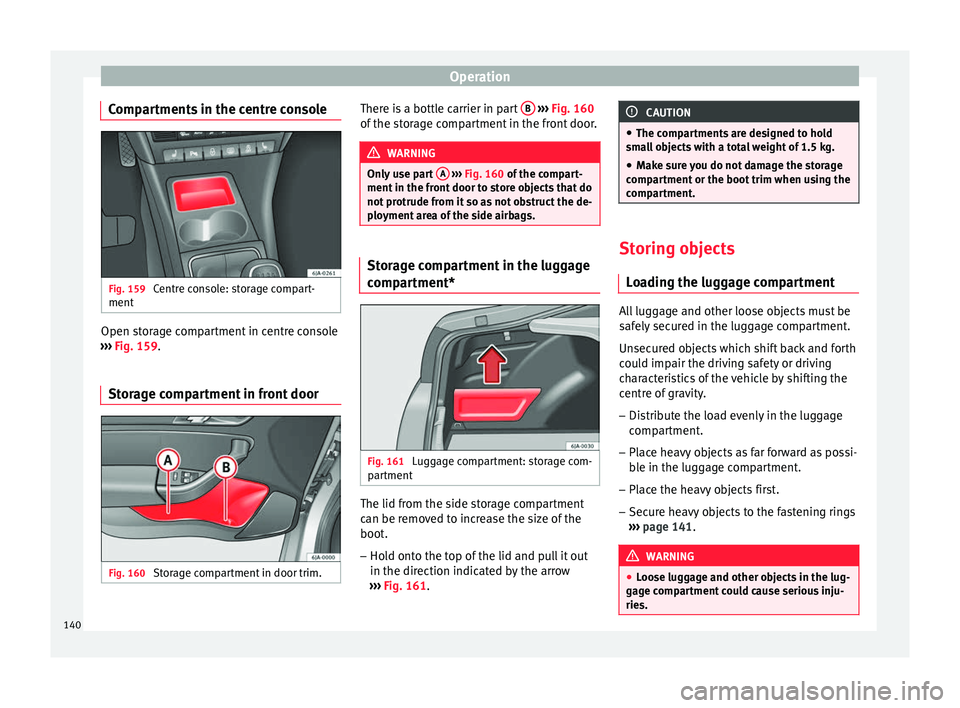
Compartments in the centre console Fig. 159
Centre console: storage compart-
ment Open storage compartment in centre console
› ›
›
Fig. 159.
Storage compartment in front door Fig. 160
Storage compartment in door trim. There is a bottle carrier in part
B
› ››
Fig. 160
of the s
torage compartment in the front door. WARNING
Only use part A
››› Fig. 160 of
the compart-
ment in the front door to store objects that do
not protrude from it so as not obstruct the de-
ployment area of the side airbags. Storage compartment in the luggage
comp
ar
tment* Fig. 161
Luggage compartment: storage com-
p ar
tment The lid from the side storage compartment
c
an be r
emo
ved to increase the size of the
boot.
– Hold onto the top of the lid and pull it out
in the direction indicat
ed by the arrow
››› Fig. 161. CAUTION
● The comp ar
tments are designed to hold
small objects with a total weight of 1.5 kg.
● Make sure you do not damage the storage
compar
tment or the boot trim when using the
compartment. Storing objects
Lo a
ding the luggage compartment All luggage and other loose objects must be
s
af
ely
secured in the luggage compartment.
Unsecured objects which shift back and forth
could impair the driving safety or driving
characteristics of the vehicle by shifting the
centre of gravity. – Distribute the load evenly in the luggage
compar
tment.
– Place heavy objects as far forward as possi-
ble in the lug
gage compartment.
– Place the heavy objects first.
– Secure heavy objects to the fastening rings
›››
page 141. WARNING
● Loo se lug
gage and other objects in the lug-
gage compartment could cause serious inju-
ries. 140
Page 144 of 248
Operation
During an accident, even small and light ob-
j ects
c
an have so much kinetic energy that
they can cause very severe injuries. The
amount of kinetic energy depends on the
speed of the vehicle and the weight of the
object. However, the speed of the vehicle is
the most important factor.
Example: An unsecured object weighing 4.5
kg produces energy corresponding to 20
times its weight in a frontal collision at 50
km/h (31 mph). This means that its weight
reaches around 90 kg. You can imagine the
severity of the injuries that might be sus-
tained if this “projectile” strikes an occupant
as it flies through the vehicle interior. WARNING
● Stor e o
bjects in the luggage compartment
and secure to the fastening points.
● In an accident or sudden manoeuvre, loose
obj
ects in the interior can be flung forward
and possibly injure vehicle occupants or oth-
ers. This risk is even greater if the flying ob-
jects hit a triggering airbag. In this case, any
rebounding objects could injure vehicle occu-
pants. Risk of fatal injuries!
● Take into account that transporting heavy
obj
ects changes the centre of gravity that
could also cause changes in vehicle handling.
Risk of accident! Therefore, always adjust
your speed and driving style to suit these cir-
cumstances. ●
Securin g the lo
ad to the rings using unsuit-
able or damaged straps could lead to injuries
in the event of an accident or sudden braking
manoeuvre. Secure suitable straps safely to
the rings to ensure this does not happen.
● Position the load so it cannot move forward
during a sud
den braking manoeuvre. Risk of
injuries!
● If transporting sharp or dangerous objects
in the spac
e provided when the rear seats are
folded, ensure the safety of the occupant of
the remaining rear seat ››› page 59.
● If the rear seat located alongside a folded
seat i
s occupied, ensure safety, for example,
by placing the load so that it stops the seat
from folding backward in the event of being
hit from behind.
● Never drive with the rear lid open or half-
closed, e
xhaust gases may penetrate into the
interior of the vehicle. Danger of poisoning!
● Never exceed the allowed axle loads or al-
lowed m
aximum weight. Risk of accident!
● Never transport passengers in the luggage
compar
tment! CAUTION
Make sure sharp objects stored in the boot
cannot not
damage the rear window heating
filaments. Note
Tyre pressure must be adapted to suit the
loa d ›
›› page 218, Service life of tyres . Category N1 vehicles
Category N1 vehicles with no protection grille
mus
t
use a retaining set compliant with
Standard EN 12195 (1 – 4) to secure the
load.
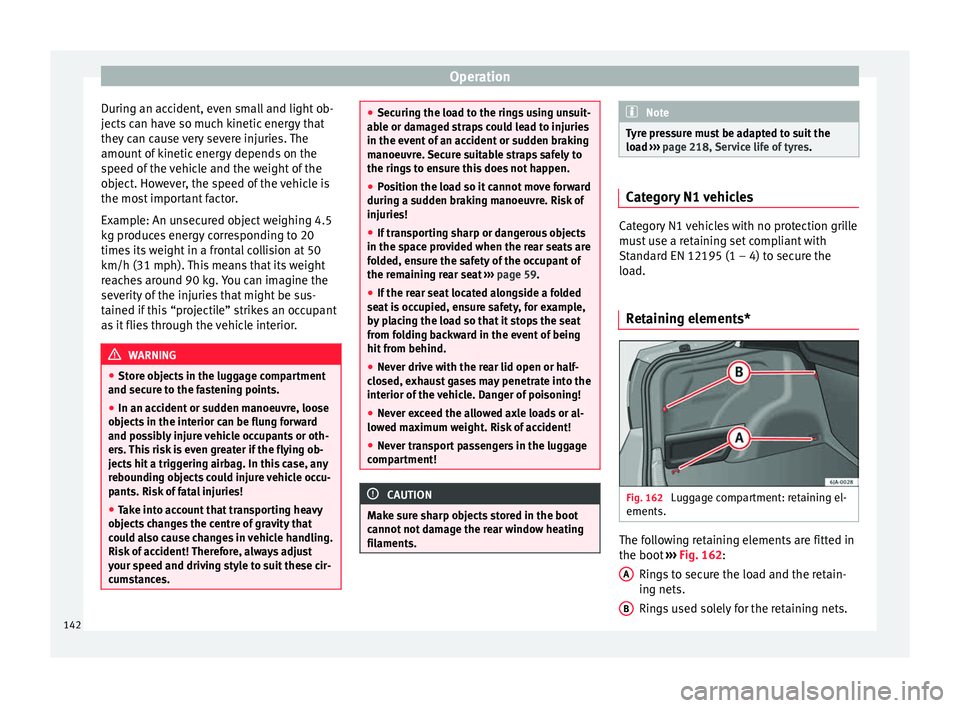
Retaining elements* Fig. 162
Luggage compartment: retaining el-
ements. The following retaining elements are fitted in
the boot
›
›
› Fig. 162:
Rings to secure the load and the retain-
ing nets.
Rings used solely for the retaining nets.
A B
142
Page 145 of 248
Transport and practical equipment
CAUTION
The rings support a maximum load of 3.5 kN
(350 kg). Note
The front ring B is below the folding back-
re s
t of the rear seats ››› Fig. 162. Hook*
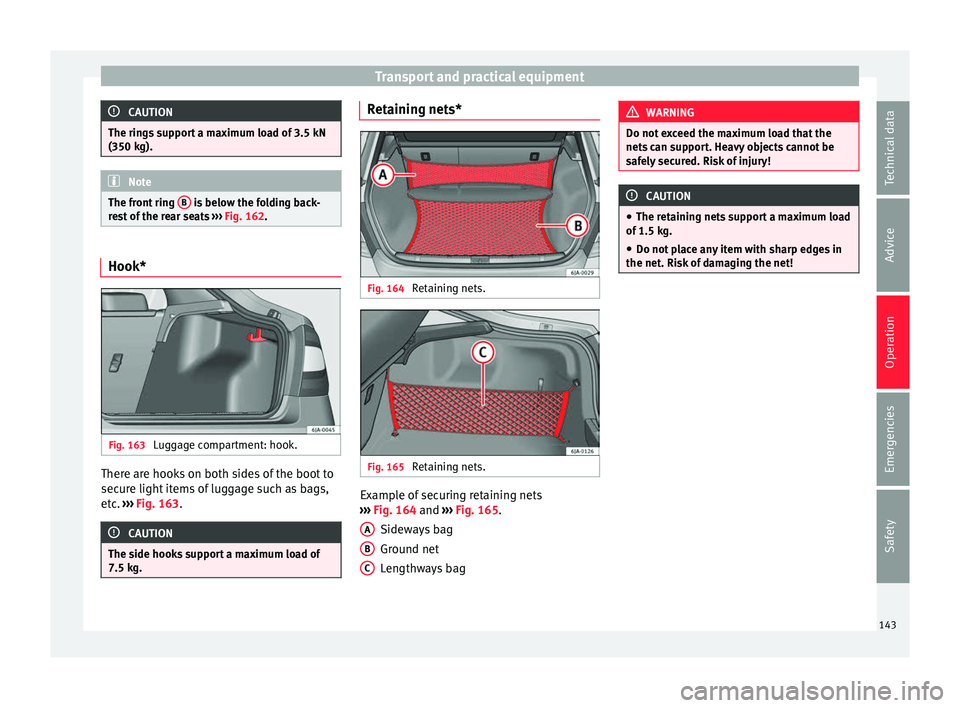
Fig. 163
Luggage compartment: hook. There are hooks on both sides of the boot to
sec
ur
e light
items of luggage such as bags,
etc. ›››
Fig. 163. CAUTION
The side hooks support a maximum load of
7.5 kg. Retaining nets*
Fig. 164
Retaining nets. Fig. 165
Retaining nets. Example of securing retaining nets
› ›
›
Fig. 164 and ››› Fig. 165.
Sideways bag
Ground net
Lengthways bag
A B
C WARNING
Do not exceed the maximum load that the
nets c
an support. Heavy objects cannot be
safely secured. Risk of injury! CAUTION
● The ret ainin
g nets support a maximum load
of 1.5 kg.
● Do not place any item with sharp edges in
the net. Risk
of damaging the net! 143
Technical data
Advice
Operation
Emergencies
Safety
Page 191 of 248
Towing bracket device
WARNING
● Bef or
e driving with the ball-headed bar fit-
ted, verify its correct assembly and place-
ment in the clamping bush.
● Do not use the ball-headed bar if it is not
correctly
placed and fixed in the clamping
bush.
● Do not use the towing device for towing if it
is d
amaged or has missing parts.
● Do not modify or adapt the towing device
connection.
● Never di
sengage the ball-headed bar with
the trail
er still hitched. CAUTION
Be careful not to damage the paint on the
bumper when h andlin
g the ball-headed bar. Description
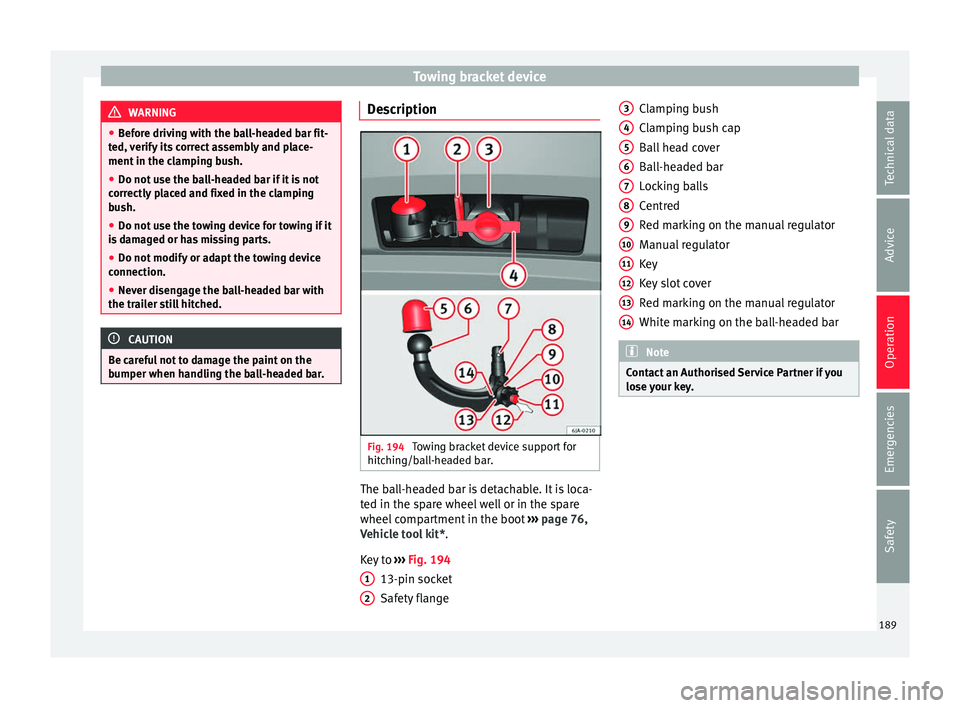
Fig. 194
Towing bracket device support for
hit c
hin
g/ball-headed bar. The ball-headed bar is detachable. It is loca-
t
ed in the s
p
are wheel well or in the spare
wheel compartment in the boot ››› page 76,
Vehicle tool kit*.
Key to ››› Fig. 194
13-pin socket
Safety flange
1 2 Clamping bush
C
l
ampin
g bush cap
Ball head cover
Ball-headed bar
Locking balls
Centred
Red marking on the manual regulator
Manual regulator
Key
Key slot cover
Red marking on the manual regulator
White marking on the ball-headed bar Note
Contact an Authorised Service Partner if you
lose y
our key. 3
4
5
6
7
8
9
10
11
12
13
14
189
Technical data
Advice
Operation
Emergencies
Safety
Page 193 of 248
Towing bracket device
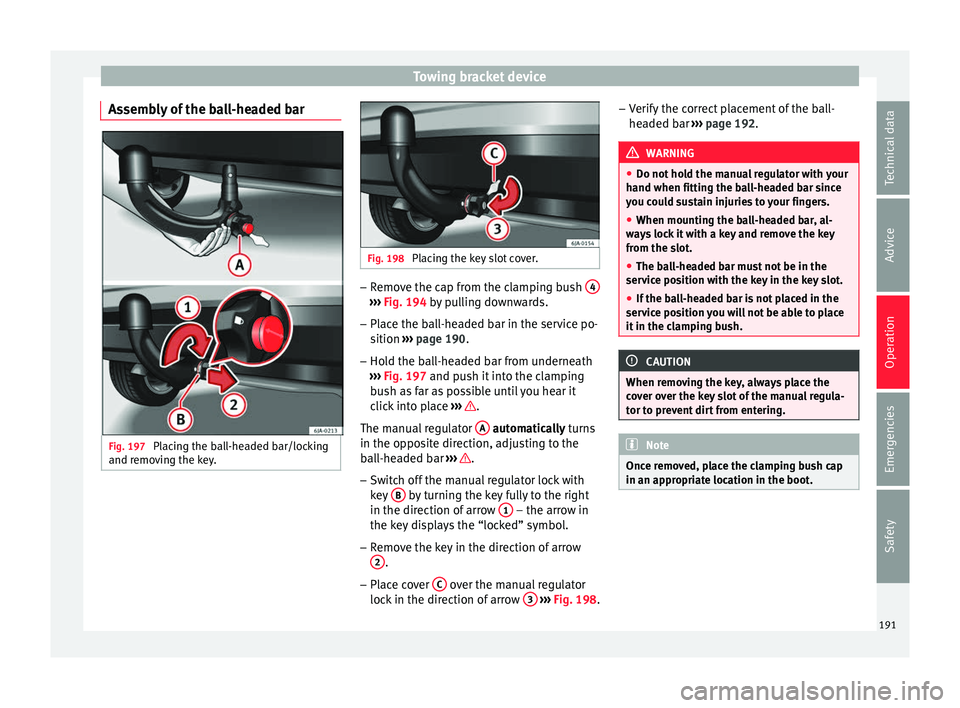
Assembly of the ball-headed bar Fig. 197
Placing the ball-headed bar/locking
and r emo
v
ing the key. Fig. 198
Placing the key slot cover. –
Remove the cap from the clamping bush 4 ›››
Fig. 194 by p
ulling downwards.
– Place the ball-headed bar in the service po-
sition ››
› page 190.
– Hold the ball-headed bar from underneath
›››
Fig. 197 and push it into the clamping
bush as far as possible until you hear it
click into place ››› .
The m anual
r
egulator A aut
omatically turns
in the op po
site direction, adjusting to the
ball-headed bar ››› .
– Switch off the manual regulator lock with
key
B by turning the key fully to the right
in the dir ection of
arr
ow 1 – the arrow in
the k ey
di
splays the “locked” symbol.
– Remove the key in the direction of arrow
2 .
– Place cover C over the manual regulator
loc k
in the dir
ection of arrow 3
› ›
› Fig. 198 .–
Verify
the correct placement of the ball-
headed bar ››› page 192. WARNING
● Do not ho l
d the manual regulator with your
hand when fitting the ball-headed bar since
you could sustain injuries to your fingers.
● When mounting the ball-headed bar, al-
way
s lock it with a key and remove the key
from the slot.
● The ball-headed bar must not be in the
servic
e position with the key in the key slot.
● If the ball-headed bar is not placed in the
servic
e position you will not be able to place
it in the clamping bush. CAUTION
When removing the key, always place the
co v
er over the key slot of the manual regula-
tor to prevent dirt from entering. Note
Once removed, place the clamping bush cap
in an appr opri
ate location in the boot. 191
Technical data
Advice
Operation
Emergencies
Safety
Page 195 of 248
Towing bracket device
The ball-headed bar should be placed in the
ser v
ic
e position so that it is ready to be inser-
ted into the clamping bush ››› .
– Place the cover over the clamping bush 4›››
Fig. 194. WARNING
● Never leave the ball-headed bar unsecured
in the boot. It c
ould be damaged in the event
of sudden braking, putting the safety of pas-
sengers at risk!
● Never disassemble the ball-headed bar
with the trai
ler still hitched. CAUTION
● If y
ou do not turn the manual regulator
fully, it will return to its original position
when the ball-headed bar is removed. The
manual regulator will be stuck to the ball-
headed bar and you will not be able to put it
in the service position. Therefore, before you
assemble it again, you must place the ball-
headed bar in this position.
● After disassembly, place the cap on the
clampin
g bush’s orifice. This way you will
prevent dirt from entering the clamping bush. Note
● Bef or
e disassembling the ball-headed bar,
we recommend placing the cover on the ball
head. ●
Cle
an the ball-headed bar thoroughly be-
fore returning it to the on-board toolbox. Use and maintenance
Cover the clamping bush with the cap to pre-
vent
dir
t from entering.
Before hooking on the trailer, check the ball
head and, if necessary, lubricate it with ade-
quate lubricant.
Place the protective cover over the ball head
when storing the bar. This way, you will avoid
getting the boot dirty.
If it gets dirty, clean and dry the clamping
bush thoroughly with an appropriate prod-
uct. CAUTION
The top part of the clamping bush opening is
lubricat ed. B
e careful not to remove this lu-
brication. 193
Technical data
Advice
Operation
Emergencies
Safety
Page 201 of 248
Care and maintenance
Wheels Wheel trims
If
y
ou wash the vehicle regularly, you should
also thoroughly wash the wheel trim. Regu-
larly remove any brake dust and road salt
from the wheels, otherwise the wheel materi-
al could be damaged. Repair any damage to
the wheel paintwork immediately.
Alloy wheels
After thorough washing, treat the wheels
with a protective product for alloy wheels. Do
not use abrasive products to care for the
wheels. WARNING
Moisture, ice and road salt may affect braking
efficiency . Ri
sk of accident! CAUTION
Heavy dirt on the wheels could lead to their
mis a
lignment. This could result in vibrations
being transmitted to the steering wheel that
under certain conditions may cause prema-
ture steering wear. This dirt must be re-
moved. Note
We recommend you leave paint damage re-
pair s
to a SEAT Authorised Service. Vehicle underbody protection
The underside of the vehicle is coated to per-
manently
pr
otect it from chemical and me-
chanical agents.
Given that damage to the protective coating
during driving cannot be completely ruled
out, we recommend you check the condition
of the protective coating on the underbody
and suspension at regular intervals, prefera-
bly before the start and end of the coldest
season of the year.
Authorised SEAT dealers have suitable spe-
cial products and the necessary facilities and
are aware of the techniques required for their
application. We therefore recommend all
touch-up work or additional anti-corrosion
measures be performed by an authorised
SEAT dealer. WARNING
Do not apply underseal or anti-corrosion
co atin
gs to the exhaust pipes, catalytic con-
verter, particulate filter or heat shields on the
exhaust system. Once the engine has
reached operating temperature, these sub-
stances could catch fire. Risk of fire! Cavity waxing
All cavities on the vehicle exposed to corro-
sion ar
e perm
anently factory-protected by a
wax solution .
This wax solution does not need to be
checked or touched up. Should wax run out
of the cavities at high ambient temperatures,
remove it using a plastic scraper and clean
away any stains using lighter fluid. WARNING
Note the regulations concerning safety and
env ir
onmental protection if you use lighter
fluid to remove the wax. Risk of fire! Leatherette and upholstery
Leatherette can be cleaned with a damp
c
loth. If
thi
s is not sufficient, these parts
should only be cleaned with solvent-free
plastic care and cleaning products .
Textile covers and trim parts on doors, boot
lid, etc. can be cleaned with special deter-
gents, e.g. dry foam. A soft sponge or brush
or a micro-fibre cloth for normal cleaning can
be used. Use special products to clean the
headliner. »
199
Technical data
Advice
Operation
Emergencies
Safety
Page 225 of 248
Technical specifications
Technical data
T ec
hnic
al specifications
Important information Important The information in the vehicle documentation
alwa
y
s takes precedence over the informa-
tion in this Instruction Manual.
All technical specifications provided in this
documentation are valid for the standard
model in Spain. The vehicle data card inclu-
ded in the Maintenance Programme or the
vehicle registration documents shows which
engine is installed in the vehicle.
The figures may be different depending
whether additional equipment is fitted, for
different models, for special vehicles and for
other countries. Abbreviations used in the Technical Specifi-
cation
s
section
kWKilowatt, engine power measurement.
PSPferdestärke (horsepower), formerly
used to denote engine power.
rpmRevolutions per minute - engine speed.
NmNewton metres, unit of engine torque.
CZCetane number, indication of the diesel
combustion power.
RONResearch octane number, indication of
the knock resistance of petrol. Vehicle identification data
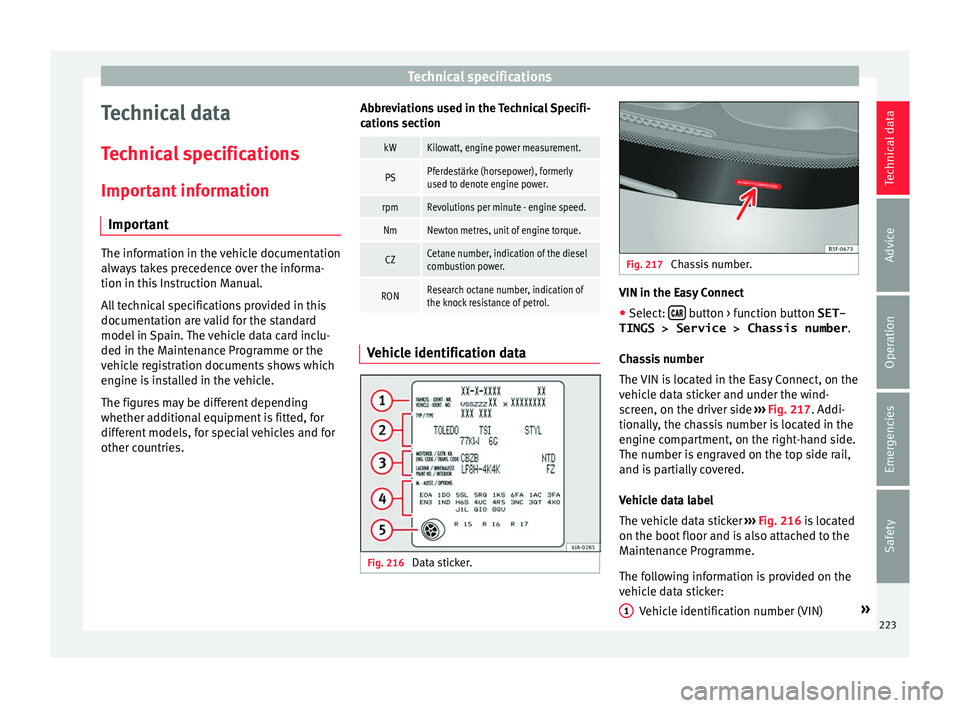
Fig. 216
Data sticker. Fig. 217
Chassis number. VIN in the Easy Connect
● Select:
button > function button SET-
TINGS > Service > Chassis number .
Ch a
s
sis number
The VIN is located in the Easy Connect, on the
vehicle data sticker and under the wind-
screen, on the driver side ››› Fig. 217. Addi-
tionally, the chassis number is located in the
engine compartment, on the right-hand side.
The number is engraved on the top side rail,
and is partially covered.
Vehicle data label
The vehicle data sticker ››› Fig. 216 is located
on the boot floor and is also attached to the
Maintenance Programme.
The following information is provided on the
vehicle data sticker:
Vehicle identification number (VIN) »
1 223
Technical data
Advice
Operation
Emergencies
Safety