maintenance Seat Toledo 2017 User Guide
[x] Cancel search | Manufacturer: SEAT, Model Year: 2017, Model line: Toledo, Model: Seat Toledo 2017Pages: 248, PDF Size: 5.86 MB
Page 199 of 248
Care and maintenance
WARNING
Do no use a nozzle that sprays the water out
in a direct s
tream or one that has a “rotating
jet”! CAUTION
Do not use water hotter than +60°C (+140°F).
Risk of
damage to the vehicle! Factory-fitted adhesive sheets
The following indications should be taken in-
t
o ac
c
ount to avoid damaging adhesive
sheets:
● Do not use high pressure cleaners.
● Do not use scrapers to remove ice or snow
from the sheets.
● Do not po
lish the adhesive sheets.
● Do not use dirty cloths or sponges.
● It is preferable to wash them with a soft
spong
e and gentle neutral soap.
Camera sensors and lenses ●
Use a small brush to remove snow and a
de-ic er s
pr
ay to remove ice.
● Clean the sensors with a solvent-free prod-
uct and a soft, dr
y cloth. ●
Moist
en the camera lens using a standard
alcohol-based glass cleaning agent and
clean the lens with a dry cloth. CAUTION
● When y ou c
lean the vehicle with a pressure
washer:
–Stay a suitable distance from the sensors
on the front and rear bumpers.
– Do not clean the camera lenses or sur-
rounding area with the pressure washer.
● Never use warm or hot water to remove
snow and ic
e from the reverse camera lens,
as it could crack the lens.
● Never use abrasive cleaning agents on the
lens. Waxing and polishing the vehicle's
p
aintw
ork Care
T
o a gr
e
at extent, good waxing protects the
vehicle surface from the harmful effects of
the environment.
The vehicle must be treated with a high qual-
ity, hard wax when water no longer forms
droplets on clean paintwork.
A new coat of high quality, hard wax can be
applied to the clean, painted surface only
when it has fully dried. Even if a wax solution
is used regularly in the car wash, it is advisa- ble to protect the paint with a coat of wax at
lea
st twice a year.
Polishing
Polishing is only necessary if the paint has
lost its shine, and the gloss cannot be
brought back by applying wax.
The vehicle must be waxed after polishing if
the polish used does not contain wax com-
pounds to seal the paint. CAUTION
● Never w ax
the windows.
● Do not use polishes and hard wax on pain-
ted par
ts with a matt finish or on plastic
parts.
● Do not polish your vehicle in a sandy or
dusty
environment. Cleaning of chromed parts
Clean the chrome first with a clean cloth and
then b
uff
up w
ith a soft, dry cloth. If this does
not clean the chrome properly, use a special
chrome cleaner. CAUTION
Do not polish the chrome in a dusty environ-
ment or it c
ould be scratched. 197
Technical data
Advice
Operation
Emergencies
Safety
Page 201 of 248
Care and maintenance
Wheels Wheel trims
If
y
ou wash the vehicle regularly, you should
also thoroughly wash the wheel trim. Regu-
larly remove any brake dust and road salt
from the wheels, otherwise the wheel materi-
al could be damaged. Repair any damage to
the wheel paintwork immediately.
Alloy wheels
After thorough washing, treat the wheels
with a protective product for alloy wheels. Do
not use abrasive products to care for the
wheels. WARNING
Moisture, ice and road salt may affect braking
efficiency . Ri
sk of accident! CAUTION
Heavy dirt on the wheels could lead to their
mis a
lignment. This could result in vibrations
being transmitted to the steering wheel that
under certain conditions may cause prema-
ture steering wear. This dirt must be re-
moved. Note
We recommend you leave paint damage re-
pair s
to a SEAT Authorised Service. Vehicle underbody protection
The underside of the vehicle is coated to per-
manently
pr
otect it from chemical and me-
chanical agents.
Given that damage to the protective coating
during driving cannot be completely ruled
out, we recommend you check the condition
of the protective coating on the underbody
and suspension at regular intervals, prefera-
bly before the start and end of the coldest
season of the year.
Authorised SEAT dealers have suitable spe-
cial products and the necessary facilities and
are aware of the techniques required for their
application. We therefore recommend all
touch-up work or additional anti-corrosion
measures be performed by an authorised
SEAT dealer. WARNING
Do not apply underseal or anti-corrosion
co atin
gs to the exhaust pipes, catalytic con-
verter, particulate filter or heat shields on the
exhaust system. Once the engine has
reached operating temperature, these sub-
stances could catch fire. Risk of fire! Cavity waxing
All cavities on the vehicle exposed to corro-
sion ar
e perm
anently factory-protected by a
wax solution .
This wax solution does not need to be
checked or touched up. Should wax run out
of the cavities at high ambient temperatures,
remove it using a plastic scraper and clean
away any stains using lighter fluid. WARNING
Note the regulations concerning safety and
env ir
onmental protection if you use lighter
fluid to remove the wax. Risk of fire! Leatherette and upholstery
Leatherette can be cleaned with a damp
c
loth. If
thi
s is not sufficient, these parts
should only be cleaned with solvent-free
plastic care and cleaning products .
Textile covers and trim parts on doors, boot
lid, etc. can be cleaned with special deter-
gents, e.g. dry foam. A soft sponge or brush
or a micro-fibre cloth for normal cleaning can
be used. Use special products to clean the
headliner. »
199
Technical data
Advice
Operation
Emergencies
Safety
Page 206 of 248
Advice
Water in the fuel filter 1)
If
y
our vehicle has a diesel engine and is
equipped with a fuel filter with a water sepa-
rator, the instrument panel may display the
following warning: Water in the
fuel filter. If this is the case, take the
vehicle to a specialised workshop so that
they can drain the fuel filter. CAUTION
● The v ehic
le is not designed for the use of
FAME fuel (biodiesel). The fuel system would
be damaged if you used biodiesel.
● Do not mix fuel additives, the so-called
“thinners”, petro
l or similar additives with
diesel fuel.
● If poor-quality diesel fuel is used, it may be
neces
sary to drain the fuel filter more fre-
quently than is specified in the Maintenance
Programme. We recommend having this done
by a specialised workshop. If water is allowed
to collect in the filter, this can cause engine
performance problems. Engine compartment
Intr oduction Read the additional information carefully
›› ›
page 11
Always be aware of the danger of injury and
scalding as well as the risk of accident or fire
when working in the engine compartment,
e.g. when checking and refilling fluids.
Therefore, always observe the warnings and
follow all general safety precautions. The en-
gine compartment is a dangerous area . WARNING
● Never open the bonnet if
you see steam,
smoke or coolant escaping from the engine
compartment. Risk of scalding! Wait until no
steam or coolant can be seen before opening
the bonnet.
● Switch off the engine and remove the key
from the ignition.
● Eng
age neutral in vehicles with manual
gearbo
x and move the selector lever to posi-
tion P in vehicles with automatic gearbox.
● Apply the handbrake firmly.
● Wait for the engine to cool down.
● For safety reasons, the bonnet must always
be closed when the
vehicle is moving. There- fore, after closing the bonnet always check
that
it
is properly secured.
● Should you notice that the bonnet is not
safely
secured when the vehicle is moving,
stop the vehicle immediately and close the
bonnet properly. Risk of accident!
● Keep children away from the engine com-
partment
.
● Do not touch hot engine parts. Risk of
burns!
● Nev
er spill fluids on hot engine compart-
ments. The
se fluids can cause a fire (e.g. anti-
freeze in coolant)!
● Take care not to cause short circuits in the
electrica
l system, especially when working
on the battery.
● Never touch the radiator fan when the en-
gine is hot
. The fan may start running sud-
denly!
● Never cover the engine with additional in-
sul
ating materials such as a blanket. Risk of
fire!
● Do not unscrew the cap on the coolant ex-
pans
ion tank when the engine is hot. The
cooling system is under pressure!
● Protect face, hands and arms from any hot
ste
am or hot coolant released by covering the
cap with a large, thick rag when opening the
expansion tank.
● Do not leave any objects, such as cloths or
tool
s, in the engine compartment. 1)
Valid for the market: Algeria.
204
Page 209 of 248
Checking and refilling levels
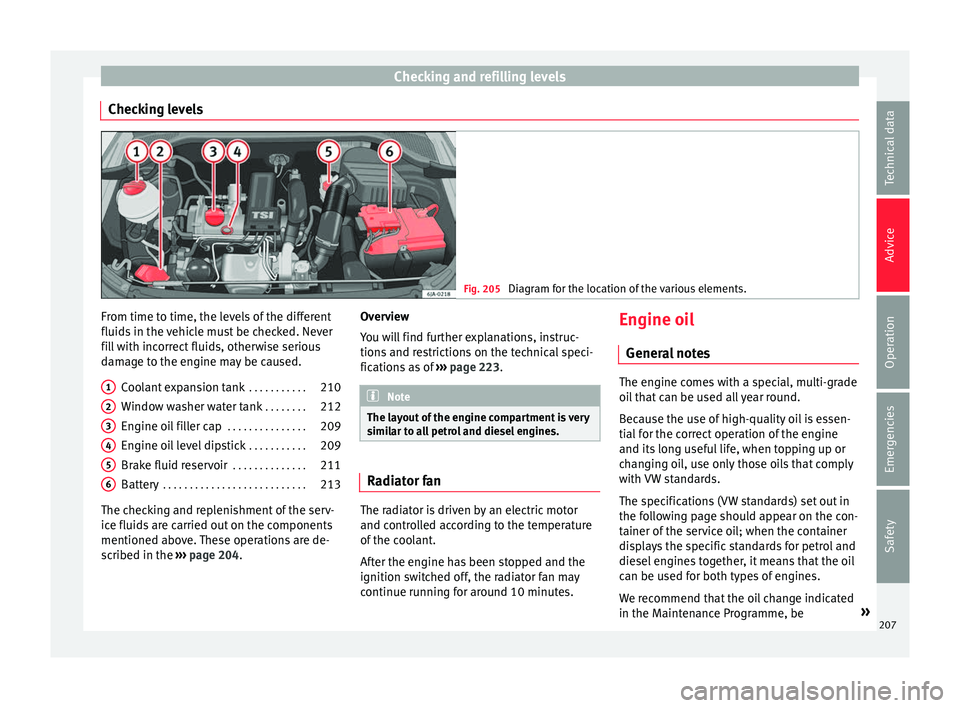
Checking levels Fig. 205
Diagram for the location of the various elements. From time to time, the levels of the different
fluid
s
in the
vehicle must be checked. Never
fill with incorrect fluids, otherwise serious
damage to the engine may be caused.
Coolant expansion tank . . . . . . . . . . .210
Window washer water tank . . . . . . . .212
Engine oil filler cap . . . . . . . . . . . . . . .209
Engine oil level dipstick . . . . . . . . . . .209
Brake fluid reservoir . . . . . . . . . . . . . .211
Battery . . . . . . . . . . . . . . . . . . . . . . . . . . . 213
The checking and replenishment of the serv-
ice fluids
are carried out on the components
mentioned above. These operations are de-
scribed in the ››› page 204.
1 2
3
4
5
6 Overview
Y
ou w
i
ll find further explanations, instruc-
tions and restrictions on the technical speci-
fications as of ››› page 223. Note
The layout of the engine compartment is very
simi l
ar to all petrol and diesel engines. Radiator fan
The radiator is driven by an electric motor
and c
ontr
o
lled according to the temperature
of the coolant.
After the engine has been stopped and the
ignition switched off, the radiator fan may
continue running for around 10 minutes. Engine oil
General
notes The engine comes with a special, multi-grade
oil
th
at can be used all year round.
Because the use of high-quality oil is essen-
tial for the correct operation of the engine
and its long useful life, when topping up or
changing oil, use only those oils that comply
with VW standards.
The specifications (VW standards) set out in
the following page should appear on the con-
tainer of the service oil; when the container
displays the specific standards for petrol and
diesel engines together, it means that the oil
can be used for both types of engines.
We recommend that the oil change indicated
in the Maintenance Programme, be »
207
Technical data
Advice
Operation
Emergencies
Safety
Page 210 of 248
Advice
performed by a technical service or special-
i sed w
ork
shop.
The correct oil specifications for your engine
are listed in the ›››
page 41.
Service intervals
Service intervals can be flexible (LongLife
service) or fixed (dependent on time/dis-
tance travelled).
If the PR code that appears on the back of the
Maintenance Programme booklet is PR QI6,
this means that your vehicle has the LongLife
service programmed. If it lists the codes QI1,
QI2, QI3, QI4 or QI7, the interval service is
dependent on time/distance travelled.
Flexible service intervals (LongLife service
intervals*)
Special oils and processes have been devel-
oped which, depending on the characteris-
tics and individual driving profiles, enable
the extension of the oil change service (Long-
Life service intervals).
Because this oil is essential for extending the
service intervals, it must only be used ob-
serving the following indications:
● Avoid mixing it with oil for fixed service in-
terv
als.
● Only in exceptional circumstances, if the
engine oi l
level is too low ››› page 209 and
LongLife oil is not available, it is permitted to top up (once) with oil for
fixed ser
vice inter-
vals ›››
page 41 (up to a maximum of 0.5
litres).
Fixed service intervals*
If your vehicle does not have the “LongLife
service interval” or it has been disabled (by
request), you may use oils for fixed service
intervals, which also appear in
››› page 41. In this case, your vehicle
must be serviced after a fixed interval of 1
year/15,000 km (10,000 miles)(whatever
comes first) ››› Booklet Maintenance Pro-
gramme.
● In exceptional circumstances, if the engine
oil l
evel is too low ››› page 209 and you can-
not obtain the oil specified for your vehicle,
you can add a small quantity of oil conform-
ing to the specification ACEA A2 or ACEA A3
(petrol engines) or ACEA B3 or ACEA B4 (die-
sel engines) (up to 0.5 l).
Vehicles with diesel particulate filter*
The Maintenance Programme states whether
your vehicle is fitted with a diesel particulate
filter.
Only VW 507 00 engine oil, with reduced ash
formation, may be used in diesel engines
equipped with particulate filter. Using other
types of oil will cause a higher soot concen-
tration and reduce the life of the DPF. There-
fore: ●
Avoid mi
xing this oil with other engine oils.
● Only in exceptional circumstances, if the
engine oil
level is too low ››› page 209,
Checking engine oil level and you cannot ob-
tain the oil specified for your vehicle, you can
use a small quantity of oil (once) conforming
to the VW 506 00, VW 506 01, VW 505 00,
VW 505 01 or ACEA B3/ACEA B4 specification
(up to 0.5 l). Note
Before a long trip, we recommend finding an
engine oi l
that conforms to the correspond-
ing VW specifications and recommend keep-
ing it in the vehicle. This way, the correct en-
gine oil will always be available for a top-up if
needed. Control lamp
The control lamp
fla
she
s red (oil pressure
low)
The informative display indicates:
Oil pressure. Switch off the en-
gine! Instruction Manual!
Stop the vehicle, switch off the engine and
check the engine oil level ›››
page 209
If the symbol flashes although the oil level is
correct, do not drive on . Do not even run
the engine at idle speed!
208
Page 212 of 248
Advice
– Rep
l
ace the oil filler cap carefully and push
the dipstick all the way in.
Changing engine oil Engine oil must be changed with the frequen-
cy indic
at
ed in the Maintenance Programme
or according to the service interval indicator
››› page 31. CAUTION
Do not mix engine oil with additives. Risk of
dam ag
e to the engine! Damage caused by
these products is not covered by the warran-
ty. Note
Wash your skin thoroughly if it comes into
cont act
with engine oil. Coolant
C ontr
o
l lamp If the warning lamp
(b lue) i
s
lit up, the en-
gine has not yet reached its operating tem-
perature 1)
. Avoid high engine speeds, hard acceleration and subjecting the engine to
high load
s.
If the warning lamp (red) is lit up or flash-
ing, the coolant temperature is too high or its
level is too low.
The informative display indicates:
Check coolant! Instruction Man-
ual!
Stop the vehicle, switch off the engine, check
the coolant level ››› page 210 and refill if
necessary ››› page 211.
If the coolant is situated in the prescribed
area, the high temperature may be due to a
fault in the cooling system fan. Check the ra-
diator fan fuse and replace it if necessary
››› page 44.
If the warning lamp (red) remains lit up,
despite both the coolant level and the radia-
tor fan fuse being in correct condition,
stop the vehicle!
Go to a technical service. WARNING
● Tak e c
are when opening the coolant reser-
voir. When the engine is warm or hot, the
system is pressurised – Danger of burns! Wait for the engine to cool before opening
the co
v
er.
● Do not touch the fan. The fan can switch on
automatic
ally regardless of whether the igni-
tion is switched on. Checking coolant level
Fig. 207
Engine compartment: coolant fluid
t ank. Read the additional information carefully
› ›
›
page 42
The coolant expansion tank is located in the
engine compartment of the vehicle. – Switch the ignition off.
– Open the bonnet ›››
page 204. 1)
This does not apply to vehicles equipped with an
inform ativ
e display.
210
Page 225 of 248
Technical specifications
Technical data
T ec
hnic
al specifications
Important information Important The information in the vehicle documentation
alwa
y
s takes precedence over the informa-
tion in this Instruction Manual.
All technical specifications provided in this
documentation are valid for the standard
model in Spain. The vehicle data card inclu-
ded in the Maintenance Programme or the
vehicle registration documents shows which
engine is installed in the vehicle.
The figures may be different depending
whether additional equipment is fitted, for
different models, for special vehicles and for
other countries. Abbreviations used in the Technical Specifi-
cation
s
section
kWKilowatt, engine power measurement.
PSPferdestärke (horsepower), formerly
used to denote engine power.
rpmRevolutions per minute - engine speed.
NmNewton metres, unit of engine torque.
CZCetane number, indication of the diesel
combustion power.
RONResearch octane number, indication of
the knock resistance of petrol. Vehicle identification data
Fig. 216
Data sticker. Fig. 217
Chassis number. VIN in the Easy Connect
● Select:
button > function button SET-
TINGS > Service > Chassis number .
Ch a
s
sis number
The VIN is located in the Easy Connect, on the
vehicle data sticker and under the wind-
screen, on the driver side ››› Fig. 217. Addi-
tionally, the chassis number is located in the
engine compartment, on the right-hand side.
The number is engraved on the top side rail,
and is partially covered.
Vehicle data label
The vehicle data sticker ››› Fig. 216 is located
on the boot floor and is also attached to the
Maintenance Programme.
The following information is provided on the
vehicle data sticker:
Vehicle identification number (VIN) »
1 223
Technical data
Advice
Operation
Emergencies
Safety
Page 240 of 248
Index
jump leads . . . . . . . . . . . . . . . . . . . . . . . . . . . . . 52
p u
nct
ure . . . . . . . . . . . . . . . . . . . . . . . . . . . . . . . 45
replacing a blown fuse . . . . . . . . . . . . . . . . . . . . 44
Emergency fuses . . . . . . . . . . . . . . . . . . . . . . . . . . . . . . . . . . 44
Emergency brake assist system indications on the display . . . . . . . . . . . . . . . . 179
Emergency braking assistance system malfunction . . . . . . . . . . . . . . . . . . . . . . . . . . . . 181
operating . . . . . . . . . . . . . . . . . . . . . . . . . . . . . . 182
radar sensor . . . . . . . . . . . . . . . . . . . . . . . . . . . 181
switching off temporarily . . . . . . . . . . . . . . . . . 182
system limitations . . . . . . . . . . . . . . . . . . . . . . 183
Emergency operation front passenger door . . . . . . . . . . . . . . . . . . . . . 10
selector lever . . . . . . . . . . . . . . . . . . . . . . . . . . . 36
Emission control system catalytic converter . . . . . . . . . . . . . . . . . . . . . . 168
control lamp . . . . . . . . . . . . . . . . . . . . . . . . . . . 169
diesel particulate filter . . . . . . . . . . . . . . . . . . . 168
Emissions data . . . . . . . . . . . . . . . . . . . . . . . . . . . 224
Engine assisted starting . . . . . . . . . . . . . . . . . . . . . . . . . 52
preheating . . . . . . . . . . . . . . . . . . . . . . . . . . . . 152
run-in . . . . . . . . . . . . . . . . . . . . . . . . . . . . . . . . . 165
Start-Stop system . . . . . . . . . . . . . . . . . . . . . . . 183
starting . . . . . . . . . . . . . . . . . . . . . . . . . . . . . . . 152
starting the engine . . . . . . . . . . . . . . . . . . . . . . 156
switching off the engine . . . . . . . . . . . . . . . . . 156
Engine and ignition starting the engine with Keyless Access . . . . . 155
Engine compartment . . . . . . . . . . . . . . 11, 204, 207 battery . . . . . . . . . . . . . . . . . . . . . . . . . . . . . . . . 213
brake fluid . . . . . . . . . . . . . . . . . . . . . . . . . . . . . 211 coolant . . . . . . . . . . . . . . . . . . . . . . . . . . . . . . . 210
engine oil
. . . . . . . . . . . . . . . . . . . . . . . . 207, 209
opening the bonnet . . . . . . . . . . . . . . . . . . . . . 205
windscreen washer fluid . . . . . . . . . . . . . . . . . 212
Engine coolant . . . . . . . . . . . . . . . . . . . . . . . . . . . . 42 checking level . . . . . . . . . . . . . . . . . . . . . . . . . . 210
control lamp . . . . . . . . . . . . . . . . . . . . . . . . . . . 210
G12 plus-plus . . . . . . . . . . . . . . . . . . . . . . . . . . . 42
G13 . . . . . . . . . . . . . . . . . . . . . . . . . . . . . . . . . . . 42
specifications . . . . . . . . . . . . . . . . . . . . . . . . . . . 42
topping up . . . . . . . . . . . . . . . . . . . . . . . . . . . . 211
Engine data . . . . . . . . . . . . . . . . . . . . . . . . . . . . . . 227
Engine fault control lamp . . . . . . . . . . . . . . . . . . . . . . . . . . . 169
Engine management . . . . . . . . . . . . . . . . . . . . . . 167 control lamp . . . . . . . . . . . . . . . . . . . . . . . . . . . 169
Engine oil . . . . . . . . . . . . . . . . . . . . . . . . . . . 41, 207 changing . . . . . . . . . . . . . . . . . . . . . . . . . 207, 210
checking oil level . . . . . . . . . . . . . . . . . . . . . . . 209
consumption . . . . . . . . . . . . . . . . . . . . . . . . . . . 209
control lamp . . . . . . . . . . . . . . . . . . . . . . . . . . . 208
dipstick . . . . . . . . . . . . . . . . . . . . . . . . . . . . . . . 209
inspection service . . . . . . . . . . . . . . . . . . . . . . 207
maintenance intervals . . . . . . . . . . . . . . . . . . . 207
oil properties . . . . . . . . . . . . . . . . . . . . . . . . . . . 42
specifications . . . . . . . . . . . . . . . . . . . . . . . . . . 207
temperature display . . . . . . . . . . . . . . . . . . . . . . 29
topping up . . . . . . . . . . . . . . . . . . . . . . . . . . . . 209
Environment ecological driving . . . . . . . . . . . . . . . . . . . . . . . 166
environmental compatibility . . . . . . . . . . . . . . 165
Environmental tips refuelling . . . . . . . . . . . . . . . . . . . . . . . . . . . . . . 201
Equipment . . . . . . . . . . . . . . . . . . . . . . . . . 138, 194
ESC electronic stability control . . . . . . . . . . . . . . . . 158
Ethanol (fuel) . . . . . . . . . . . . . . . . . . . . . . . . . . . . 202 Extending
the luggag e compartment . . . . . . . . . . . . . . . . 134
Exterior lighting changing a bulb . . . . . . . . . . . . . . . . . . . . . . . . . 84
Exterior mirrors adjusting . . . . . . . . . . . . . . . . . . . . . . . . . . . . . . . 13
exterior . . . . . . . . . . . . . . . . . . . . . . . . . . . . . . . 130
heated . . . . . . . . . . . . . . . . . . . . . . . . . . . . . . . . 130
Exterior view . . . . . . . . . . . . . . . . . . . . . . . . . . . . . 5, 6
External aerial . . . . . . . . . . . . . . . . . . . . . . . . . . . . 195
F Fastening rings . . . . . . . . . . . . . . . . . . . . . . . . . . . 141
Fatigue detection . . . . . . . . . . . . . . . . . . . . . . . . . 185
Filling up the tank . . . . . . . . . . . . . . . . . . . . . . . . 201
Fire extinguisher . . . . . . . . . . . . . . . . . . . . . . . . . . . 76
First-aid kit . . . . . . . . . . . . . . . . . . . . . . . . . . . . . . . 76
Floor mats . . . . . . . . . . . . . . . . . . . . . . . . . . . . . . . . 61
Fluid Level control . . . . . . . . . . . . . . . . . . . . . . . . . 40
Fog light bulb . . . . . . . . . . . . . . . . . . . . . . . . . . . . . 88
Front airbags . . . . . . . . . . . . . . . . . . . . . . . . . . 14, 70
Front Assist indications on the display . . . . . . . . . . . . . . . . 179
Front passenger front airbag control lamp . . . . . . . . . . . . . . . . . . . . . . . . . . . . 72
deactivating . . . . . . . . . . . . . . . . . . . . . . . . . . . . 14
deactivation . . . . . . . . . . . . . . . . . . . . . . . . . . . . 72
Front seat . . . . . . . . . . . . . . . . . . . . . . . . . . . . . . . 131 heating . . . . . . . . . . . . . . . . . . . . . . . . . . . . . . . 132
manual adjustment . . . . . . . . . . . . . . . . . . . . . . 11
Fuel . . . . . . . . . . . . . . . . . . . . . . . . . . . . . . . . . . . . . 40 diesel . . . . . . . . . . . . . . . . . . . . . . . . . . . . . . . . . 203
fuel level gauge . . . . . . . . . . . . . . . . . . . . . . . . 100
refuelling . . . . . . . . . . . . . . . . . . . . . . . . . 201, 202
saving . . . . . . . . . . . . . . . . . . . . . . . . . . . . . . . . 166
238
Page 245 of 248
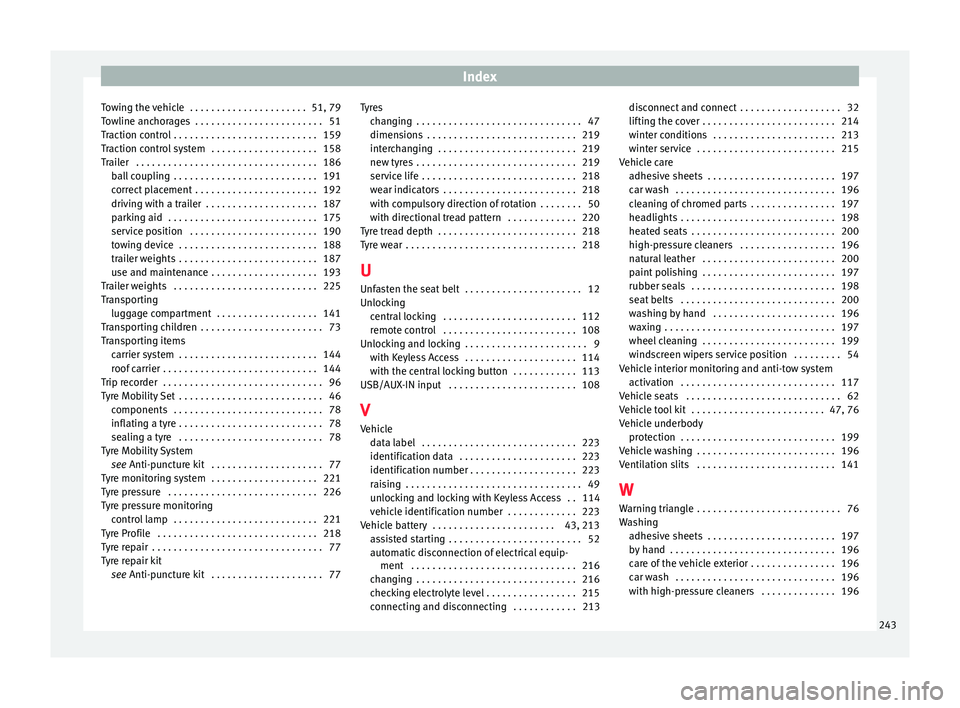
Index
Towing the vehicle . . . . . . . . . . . . . . . . . . . . . . 51, 79
T o
wline anc
horages . . . . . . . . . . . . . . . . . . . . . . . . 51
Traction control . . . . . . . . . . . . . . . . . . . . . . . . . . . 159
Traction control system . . . . . . . . . . . . . . . . . . . . 158
Trailer . . . . . . . . . . . . . . . . . . . . . . . . . . . . . . . . . . 186 ball coupling . . . . . . . . . . . . . . . . . . . . . . . . . . . 191
correct placement . . . . . . . . . . . . . . . . . . . . . . . 192
driving with a trailer . . . . . . . . . . . . . . . . . . . . . 187
parking aid . . . . . . . . . . . . . . . . . . . . . . . . . . . . 175
service position . . . . . . . . . . . . . . . . . . . . . . . . 190
towing device . . . . . . . . . . . . . . . . . . . . . . . . . . 188
trailer weights . . . . . . . . . . . . . . . . . . . . . . . . . . 187
use and maintenance . . . . . . . . . . . . . . . . . . . . 193
Trailer weights . . . . . . . . . . . . . . . . . . . . . . . . . . . 225
Transporting luggage compartment . . . . . . . . . . . . . . . . . . . 141
Transporting children . . . . . . . . . . . . . . . . . . . . . . . 73
Transporting items carrier system . . . . . . . . . . . . . . . . . . . . . . . . . . 144
roof carrier . . . . . . . . . . . . . . . . . . . . . . . . . . . . . 144
Trip recorder . . . . . . . . . . . . . . . . . . . . . . . . . . . . . . 96
Tyre Mobility Set . . . . . . . . . . . . . . . . . . . . . . . . . . . 46 components . . . . . . . . . . . . . . . . . . . . . . . . . . . . 78
inflating a tyre . . . . . . . . . . . . . . . . . . . . . . . . . . . 78
sealing a tyre . . . . . . . . . . . . . . . . . . . . . . . . . . . 78
Tyre Mobility System see Anti-puncture kit . . . . . . . . . . . . . . . . . . . . . 77
Tyre monitoring system . . . . . . . . . . . . . . . . . . . . 221
Tyre pressure . . . . . . . . . . . . . . . . . . . . . . . . . . . . 226
Tyre pressure monitoring control lamp . . . . . . . . . . . . . . . . . . . . . . . . . . . 221
Tyre Profile . . . . . . . . . . . . . . . . . . . . . . . . . . . . . . 218
Tyre repair . . . . . . . . . . . . . . . . . . . . . . . . . . . . . . . . 77
Tyre repair kit see Anti-puncture kit . . . . . . . . . . . . . . . . . . . . . 77 Tyres
chan ging . . . . . . . . . . . . . . . . . . . . . . . . . . . . . . . 47
dimensions . . . . . . . . . . . . . . . . . . . . . . . . . . . . 219
interchanging . . . . . . . . . . . . . . . . . . . . . . . . . . 219
new tyres . . . . . . . . . . . . . . . . . . . . . . . . . . . . . . 219
service life . . . . . . . . . . . . . . . . . . . . . . . . . . . . . 218
wear indicators . . . . . . . . . . . . . . . . . . . . . . . . . 218
with compulsory direction of rotation . . . . . . . . 50
with directional tread pattern . . . . . . . . . . . . . 220
Tyre tread depth . . . . . . . . . . . . . . . . . . . . . . . . . . 218
Tyre wear . . . . . . . . . . . . . . . . . . . . . . . . . . . . . . . . 218
U Unfasten the seat belt . . . . . . . . . . . . . . . . . . . . . . 12
Unlocking central locking . . . . . . . . . . . . . . . . . . . . . . . . . 112
remote control . . . . . . . . . . . . . . . . . . . . . . . . . 108
Unlocking and locking . . . . . . . . . . . . . . . . . . . . . . . 9 with Keyless Access . . . . . . . . . . . . . . . . . . . . . 114
with the central locking button . . . . . . . . . . . . 113
USB/AUX-IN input . . . . . . . . . . . . . . . . . . . . . . . . 108
V Vehicle data label . . . . . . . . . . . . . . . . . . . . . . . . . . . . . 223
identification data . . . . . . . . . . . . . . . . . . . . . . 223
identification number . . . . . . . . . . . . . . . . . . . . 223
raising . . . . . . . . . . . . . . . . . . . . . . . . . . . . . . . . . 49
unlocking and locking with Keyless Access . . 114
vehicle identification number . . . . . . . . . . . . . 223
Vehicle battery . . . . . . . . . . . . . . . . . . . . . . . 43, 213 assisted starting . . . . . . . . . . . . . . . . . . . . . . . . . 52
automatic disconnection of electrical equip-ment . . . . . . . . . . . . . . . . . . . . . . . . . . . . . . . 216
changing . . . . . . . . . . . . . . . . . . . . . . . . . . . . . . 216
checking electrolyte level . . . . . . . . . . . . . . . . . 215
connecting and disconnecting . . . . . . . . . . . . 213 disconnect and connect . . . . . . . . . . . . . . . . . . . 32
lifting the c
over . . . . . . . . . . . . . . . . . . . . . . . . . 214
winter conditions . . . . . . . . . . . . . . . . . . . . . . . 213
winter service . . . . . . . . . . . . . . . . . . . . . . . . . . 215
Vehicle care adhesive sheets . . . . . . . . . . . . . . . . . . . . . . . . 197
car wash . . . . . . . . . . . . . . . . . . . . . . . . . . . . . . 196
cleaning of chromed parts . . . . . . . . . . . . . . . . 197
headlights . . . . . . . . . . . . . . . . . . . . . . . . . . . . . 198
heated seats . . . . . . . . . . . . . . . . . . . . . . . . . . . 200
high-pressure cleaners . . . . . . . . . . . . . . . . . . 196
natural leather . . . . . . . . . . . . . . . . . . . . . . . . . 200
paint polishing . . . . . . . . . . . . . . . . . . . . . . . . . 197
rubber seals . . . . . . . . . . . . . . . . . . . . . . . . . . . 198
seat belts . . . . . . . . . . . . . . . . . . . . . . . . . . . . . 200
washing by hand . . . . . . . . . . . . . . . . . . . . . . . 196
waxing . . . . . . . . . . . . . . . . . . . . . . . . . . . . . . . . 197
wheel cleaning . . . . . . . . . . . . . . . . . . . . . . . . . 199
windscreen wipers service position . . . . . . . . . 54
Vehicle interior monitoring and anti-tow system activation . . . . . . . . . . . . . . . . . . . . . . . . . . . . . 117
Vehicle seats . . . . . . . . . . . . . . . . . . . . . . . . . . . . . 62
Vehicle tool kit . . . . . . . . . . . . . . . . . . . . . . . . . 47, 76
Vehicle underbody protection . . . . . . . . . . . . . . . . . . . . . . . . . . . . . 199
Vehicle washing . . . . . . . . . . . . . . . . . . . . . . . . . . 196
Ventilation slits . . . . . . . . . . . . . . . . . . . . . . . . . . 141
W Warning triangle . . . . . . . . . . . . . . . . . . . . . . . . . . . 76
Washing adhesive sheets . . . . . . . . . . . . . . . . . . . . . . . . 197
by hand . . . . . . . . . . . . . . . . . . . . . . . . . . . . . . . 196
care of the vehicle exterior . . . . . . . . . . . . . . . . 196
car wash . . . . . . . . . . . . . . . . . . . . . . . . . . . . . . 196
with high-pressure cleaners . . . . . . . . . . . . . . 196
243