air condition Seat Toledo 2017 Owner's Guide
[x] Cancel search | Manufacturer: SEAT, Model Year: 2017, Model line: Toledo, Model: Seat Toledo 2017Pages: 248, PDF Size: 5.86 MB
Page 153 of 248
Air conditioning
The system also allows for the effect of sun-
light, so ther e i
s
no need for manual adjust-
ment. It also has a humidity sensor that
helps to automatically demist the wind-
screen.
Automatic operations ››› page 151 guaran-
tee maximum comfort any time of year.
Climatronic description
Cooling only works if the following conditions
are met:
● The engine is running
● the outside temperature is above +2°C
(+36°F);
● ››› Fig. 172 18 turned on.
St ar
tin
g the Climatronic
The corresponding function will be switched
on when a button is pressed, turning on the
air conditioning if it was switched off, with
the exception of button 17 (recirculation).
Sw it
c
hing off the Climatronic
● Turn control 10 to the left until the seg-
ments of
c
olumn 9
› ›
› Fig. 172 switch off.
● After 1 second has elapsed, turn the control
again t
o switch off the display.
In order to ensure engines subject to heavy
loads are cooled, the air conditioning com-
pressor is switched off in the event of high
coolant temperatures. Recommended setting for all seasons of the
year
● Set
the required temperature. We recom-
mend +22°C (+72°F).
● Pre
ss the button 13
› ››
Fig. 172
.
● Adju
st vents 3 and 4 ›››
page 147 so that
the air flow is directed slightly upwards.
Change between degrees Centigrade and de-
grees Fahrenheit
Keep the and buttons ››› Fig. 172
held down for 2 seconds at the same time.
The data is displayed on the screen in the
units required. Note
● A v i
sit to the specialised service once a
year is recommended to clean the Climatronic
system.
● The interior temperature sensor 11 ›››
Fig. 172 is at
the bottom. Do not cover it
with stickers or the like, as this could have a
negative effect on Climatronic operations. Automatic mode
Automatic mode is used to maintain a con-
s
t
ant
temperature and demist the windows
inside the vehicle. Switching on automatic mode
● Set a interior temperature between +16°C
(+64°F) and +29°C (+84°F).
● Adjus
t vents 3 ›››
page 147 and 4 so that
the air flow is directed slightly upwards.
● Press the button 13
› ››
Fig. 172
, and
AUTO i
s displayed on the screen.
Automatic mode is switched off by pressing
the air distribution buttons or increasing or
decreasing the blower speed. However, the
temperature remains regulated.
Adjusting the temperature ●
When you switch on the ignition, control 1 ›››
Fig. 172 can be u sed t
o set the required in-
terior temperature.
It is possible to select interior temperatures
from +16°C (+64°F) to +29°C (+84°F). In this
range the temperature is regulated automati-
cally. If a temperature below +16°C (+64°F) is
selected, “LO” is displayed on the screen. If a
temperature above +29°C (+84°F) is selected,
“HI” is displayed on the screen. At both ex-
tremes, Climatronic works at maximum cool-
ing or heating power, respectively. The tem-
perature is not regulated. »
151
Technical data
Advice
Operation
Emergencies
Safety
Page 170 of 248
Operation
●
Do not ap p
ly wax underneath the vehicle
around the area of the exhaust system: Fire
hazard! Note
While the control lamps , , or r
e-
m ain lit, ther
e may be engine problems, fuel
consumption may increase and the engine
may lose power. Catalytic converter
An exhaust gas emission control system (cat-
alytic
c
on
verter) that functions perfectly is vi-
tally important for vehicle operation that re-
spects the environment.
Please observe the following indications:
● Refuel only using unleaded petrol in petrol
engine v
ehicles ››› page 202.
● Do not add too much oil to the engine
›››
page 209, Checking engine oil level .
● Do not switch off the ignition while driving.
If y
ou are required to drive in a country where
unleaded fuel is not available, when return-
ing to a country where using a catalytic con-
verter is obligatory, the catalytic converter
must be replaced. CAUTION
● Never c omp
letely empty the tank! An irreg-
ular fuel supply can cause ignition faults,
which can result in damage to a substantial
amount of engine parts and the exhaust sys-
tem.
● Refuelling just once with leaded petrol dis-
able
s the exhaust system! Particulate filter (diesel
en
gines) The diesel engine particulate filter eliminates
mo
s
t
of the soot from the exhaust gas sys-
tem. Under normal driving conditions, the fil-
ter cleans itself. The diesel particulate filter is
cleaned automatically without need for indi-
cation by the warning lamp . This may be
noticed because the engine idle speed in-
creases and an odour may be detected.
If automatic filter purification cannot be car-
ried out (because only short trips are taken,
for example), soot will accumulate on the fil-
ter and the Diesel particulate filter warning
lamp will switch on.
Facilitate the automatic filter cleaning proc-
ess by driving in the following manner: drive
for approximately 15 minutes at a minimum
speed of 60 km/h (37 mph) in 4th or 5th gear
(automatic gearbox: gear S). Maintain the en-
gine speed at approximately 2,000 rpm. The
rise in temperature causes the soot on the fil- ter to burn. On completion of the cleaning
the warning l
amp will switch off.
If the lamp does not turn off, or the three
lamps turn on (particulate filter , fault in
the emission control system and glow
plugs ), drive the vehicle to a specialised
workshop and have the fault repaired at the
earliest opportunity. WARNING
● Alw a
ys drive according to the road weather
conditions, the terrain and traffic.
● The particulate filter attains very high tem-
peratur
es. Therefore, do not park the vehicle
in places where the exhaust pipe could come
into contact with dry grass or with highly-
flammable materials. Risk of fire! CAUTION
While the warning lamp is lit
up, the fuel
consumption is high, and in certain condi-
tions, the engine power is reduced. Note
● In order f or the p
articulate filter to burn off
soot in a correct manner, avoid carrying out
frequent short journeys.
● Using diesel fuel with a high sulphur count
can con
siderably reduce the useful life of the
particulate filter. The specialised service pro-
vides information about the countries where
fuel with a high sulphur content is used. 168
Page 182 of 248
Operation
The function is intended to prevent collisions
w ith p
ark
ed vehicles or vehicles in the same
lane travelling in the same direction. It may
fail to activate in other danger situations.
The Front Assist function is active within a
range of speeds between 4 km/h (2.5 mph)
and 250 km/h (156 mph). Depending on
speed, traffic conditions and driver behav-
iour, some of the sub-functions described be-
low are omitted in order to optimise the sys-
tem’s general behaviour.
The Front Assist is a driving assistance func-
tion that can never replace the driver’s atten-
tion.
Safety distance warning
If the system detects a situation of danger
because the vehicle is too close to the vehi-
cle ahead, it will warn the driver by means of
an indication on the instrument panel display
.
The timing of the warning varies depending
on driver behaviour and the traffic situation.
Advance warning
If the system detects a possible collision with
the vehicle in front, it may alert the driver by
means of an audible warning and an indica-
tion on the instrument panel display
››› Fig. 189. The warning moment varies depending on
the traffic s
ituation and driver behaviour. At
the same time, the vehicle will prepare for a
possible emergency braking ››› .
C ritic
a
l warning
If the driver fails to react to the pre-warning
(advance warning), the system may actively
intervene in the brakes and generate a brief
jolt to warn the driver of the imminent danger
of a collision.
Automatic braking
If the driver also fails to react to the critical
warning, the system may initiate independ-
ent emergency braking by progressively in-
creasing the braking effect in accordance
with how critical the situation is.
Driver emergency brake assist system
Faced with an imminent collision, the system
may detect that the driver is not braking hard
enough to avoid the collision. In this case, it
will automatically increase the braking effect.
Due to certain driving circumstances and the
limitations of its operation, there are some
cases in which the system cannot prevent a
collision, although it can significantly mini-
mise the consequences by reducing the
speed and the force of the impact. WARNING
Observe the safety warnings ›››
in Control
and warnin g l
amps on page 101. WARNING
The Front Assist system cannot change the
la w
s of physics or replace the driver in terms
of keeping control of the vehicle and reacting
to a possible emergency situation. WARNING
Following a Front Assist emergency warning,
pa y
immediate attention to the situation and
try to avoid the collision by braking or by
dodging the obstacle, as applicable.
● If the Front Assist does not work as descri-
bed in this c
hapter (e.g. it repeatedly inter-
venes unnecessarily), switch it off.
● Adapt your speed and safe distance to the
vehicl
e in front of you at all times to suit visi-
bility, weather, road and traffic conditions.
● The Front Assist alone cannot avoid acci-
dents and seriou
s injuries.
● In complex driving situations, occasionally
the Front As
sist may issue warnings and in-
tervene in braking unnecessarily, for example
at traffic islands.
● If the operation of the Front Assist is im-
paired, f
or example, by dirt or because the ra-
dar sensor has lost its settings, the system
may issue unnecessary warnings and inter-
vene inopportunely in the braking. 180
Page 187 of 248
Driver assistance systems
●
Do not mo v
e the vehicle when the engine is
switched off. CAUTION
Switch off the Start-Stop system ›
››
page 169
before driving through a pool of water on the
road. Note
● The batt er
y temperature may reflect
changes in outside temperature after several
hours. If the vehicle has been stopped out-
side at temperatures below zero or in direct
sunlight, for example, the battery tempera-
ture may take several hours to reach the val-
ues required for the correct operating of the
Start-Stop system.
● If the Climatronic system is operating auto-
matica
lly, this could impair automatic engine
shut down under certain conditions. Fatigue detection (break rec-
ommend
ation)*
Intr oduction The Fatigue detection informs the driver
when their driv
in
g beh
aviour shows signs of
fatigue. WARNING
Do not let the comfort afforded by the Fatigue
detection sy s
tem tempt you into taking any
risks when driving. Take regular breaks, suffi-
cient in length when making long journeys.
● The driver always assumes the responsibil-
ity of driv
ing to their full capacity.
● Never drive if you are tired.
● The system does not detect the tiredness of
the driver in al
l circumstances. Consult the in-
formation in the section ››› page 186, System
limitations.
● In some situations, the system may incor-
rectly int
erpret an intended driving manoeu-
vre as driver tiredness.
● No warning is given in the event of the ef-
fect c
alled microsleep!
● Please observe the indications on the in-
strument p
anel and act as is necessary. Note
● Fatigue det ection h
as been developed for
driving on motorways and well paved roads
only.
● If there is a fault in the system, have it
check
ed by a specialised workshop. Function and operation
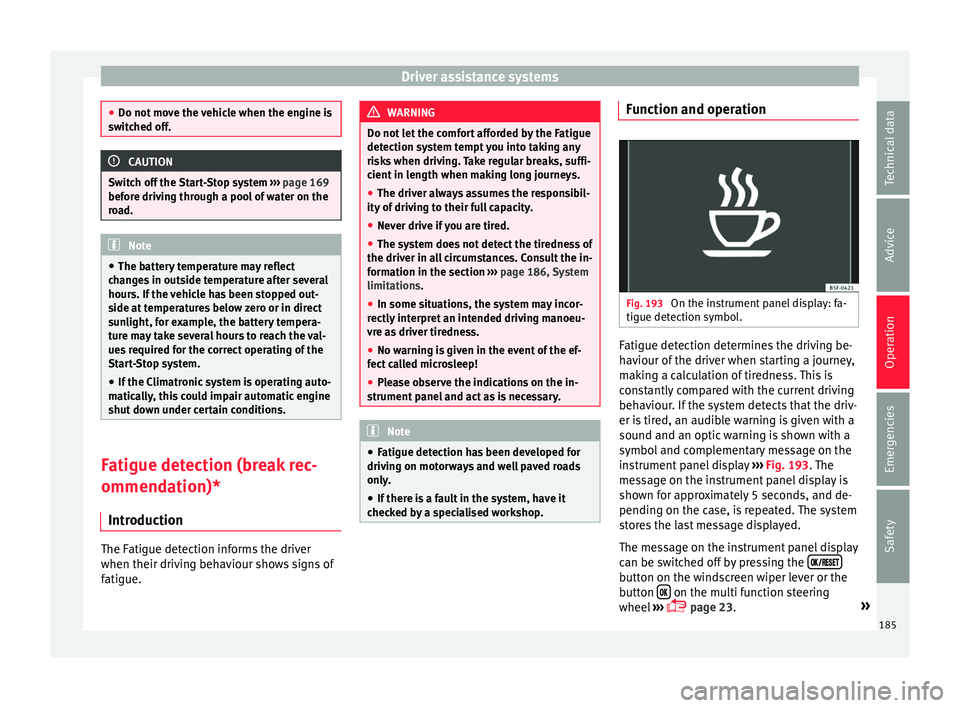
Fig. 193
On the instrument panel display: fa-
tigue det ection symbo
l
. Fatigue detection determines the driving be-
h
av
iour of
the driver when starting a journey,
making a calculation of tiredness. This is
constantly compared with the current driving
behaviour. If the system detects that the driv-
er is tired, an audible warning is given with a
sound and an optic warning is shown with a
symbol and complementary message on the
instrument panel display ››› Fig. 193. The
message on the instrument panel display is
shown for approximately 5 seconds, and de-
pending on the case, is repeated. The system
stores the last message displayed.
The message on the instrument panel display
can be switched off by pressing the button on the windscreen wiper lever or the
b
utt
on on the multi function steering
wheel
›
›
› page 23. »
185
Technical data
Advice
Operation
Emergencies
Safety
Page 189 of 248
Towing bracket device
Trailer weight Trailer weight
The comb
ined
vehicle and trailer must be
balanced. To do so use the maximum permit-
ted towing bracket load. An insufficient
weight exerted by the trailer drawbar on the
ball joint of the towing bracket will have a
negative impact upon the response of the ve-
hicle-trailer assembly on the road.
Weight distribution
Distribute loads in the trailer so that heavy
objects are as near to the axle as possible.
Ensure that the objects do not move.
If the towing vehicle is empty and the trailer
loaded then the load distribution is incorrect.
However, if these conditions cannot be avoi-
ded, drive very slowly.
Tyre pressure values
Correct the tyre pressure in your vehicle to
“total load” ›››
page 218, Service life of
tyres.
Trailer weight
Never exceed the authorised trailer weight
under any circumstances ›››
page 223, Tech-
nical specifications .
The trailer weights listed are only applicable
for altitudes up to 1000 m above sea level.
Due to lower air density, engine power de- creases depending on the increase in alti-
tude, thi
s
also reduces climbing ability,
which requires a reduction of the weight of
the vehicle with a trailer by 10% for every
1000 m increase in altitude. The weight of
the assembly is calculated by adding the ve-
hicle weight (loaded) to the trailer weight
(loaded). Always drive with special care when
towing a trailer.
The towed load and support load information
that is displayed on the towing bracket man-
ufacturers label are only values for the verifi-
cation of the device. The correct figures for
your specific vehicle, which are usually lower
than these figures, are given in the documen-
tation of your vehicle. WARNING
● Exc eedin
g the maximum established load
per axle and the maximum towing bracket
load in addition to the maximum permitted
load or the load of the vehicle + trailer as-
sembly can cause accidents and serious inju-
ries.
● A sliding load can considerably affect the
stab
ility and safety of the vehicle + trailer as-
sembly, resulting in accidents and serious in-
juries. Driving with a trailer
Exterior mirrors
Check
whether
you can see enough of the
road behind the trailer with the standard rear
vision mirrors. If this is not the case, you
should have additional exterior mirrors fitted.
Observe the relevant statutory requirements
of the country you are in.
Headlights
Before starting a journey, also check the
headlight beam settings with the trailer
hitched up. Adjust the headlight range set-
tings if necessary ›››
page 122, Headlight
range control.
Driving speed
For your own safety do not drive faster than
the maximum permitted speed indicated on
the trailer.
At all times, immediately reduce speed if you
detect the slightest swaying movement of the
trailer. Never try to “return the trailer to a
straight position” by accelerating.
Brakes
Brake in due course! If the trailer has an over-
run brake, apply the brakes gently at first and
then, firmly. This will prevent the jerking that
can be caused by locking of trailer wheels.
Change to a lower gear in good time before »
187
Technical data
Advice
Operation
Emergencies
Safety
Page 201 of 248
Care and maintenance
Wheels Wheel trims
If
y
ou wash the vehicle regularly, you should
also thoroughly wash the wheel trim. Regu-
larly remove any brake dust and road salt
from the wheels, otherwise the wheel materi-
al could be damaged. Repair any damage to
the wheel paintwork immediately.
Alloy wheels
After thorough washing, treat the wheels
with a protective product for alloy wheels. Do
not use abrasive products to care for the
wheels. WARNING
Moisture, ice and road salt may affect braking
efficiency . Ri
sk of accident! CAUTION
Heavy dirt on the wheels could lead to their
mis a
lignment. This could result in vibrations
being transmitted to the steering wheel that
under certain conditions may cause prema-
ture steering wear. This dirt must be re-
moved. Note
We recommend you leave paint damage re-
pair s
to a SEAT Authorised Service. Vehicle underbody protection
The underside of the vehicle is coated to per-
manently
pr
otect it from chemical and me-
chanical agents.
Given that damage to the protective coating
during driving cannot be completely ruled
out, we recommend you check the condition
of the protective coating on the underbody
and suspension at regular intervals, prefera-
bly before the start and end of the coldest
season of the year.
Authorised SEAT dealers have suitable spe-
cial products and the necessary facilities and
are aware of the techniques required for their
application. We therefore recommend all
touch-up work or additional anti-corrosion
measures be performed by an authorised
SEAT dealer. WARNING
Do not apply underseal or anti-corrosion
co atin
gs to the exhaust pipes, catalytic con-
verter, particulate filter or heat shields on the
exhaust system. Once the engine has
reached operating temperature, these sub-
stances could catch fire. Risk of fire! Cavity waxing
All cavities on the vehicle exposed to corro-
sion ar
e perm
anently factory-protected by a
wax solution .
This wax solution does not need to be
checked or touched up. Should wax run out
of the cavities at high ambient temperatures,
remove it using a plastic scraper and clean
away any stains using lighter fluid. WARNING
Note the regulations concerning safety and
env ir
onmental protection if you use lighter
fluid to remove the wax. Risk of fire! Leatherette and upholstery
Leatherette can be cleaned with a damp
c
loth. If
thi
s is not sufficient, these parts
should only be cleaned with solvent-free
plastic care and cleaning products .
Textile covers and trim parts on doors, boot
lid, etc. can be cleaned with special deter-
gents, e.g. dry foam. A soft sponge or brush
or a micro-fibre cloth for normal cleaning can
be used. Use special products to clean the
headliner. »
199
Technical data
Advice
Operation
Emergencies
Safety
Page 226 of 248
Technical data
Vehicle model
Identif y
in
g letters of the gearbox/number
of the original paint finish/Interior equip-
ment number/engine power/engine
identifying letter
Partial description of the vehicle
Diameter of authorised tyre in inches 1)
Type plate
The model plate is located at the bottom of
the B pillar, between the front and rear doors,
on the right-hand side.
The type plate indicates the following
weights:
● Total permitted weight of the vehicle when
loaded
● M
aximum authorised weight of the vehicle
with a trai
ler, when the vehicle operates as a
tractor
● Maximum permitted load of the front axle
● Maximum permitted load of the rear axle
Weight in ru
nning order
The weight in running order only has one ap-
proximate value. This value corresponds to
the minimum operative weight of the vehicle
without additional equipment that increases 2 3
4
5 its weight, i.e. air conditioning, spare wheel,
t
o
w
ing bracket.
The running order weight also includes 75 kg
of the weight of the driver and service fluids,
in addition to a fuel tank at 90% capacity.
From the difference between the total permit-
ted weight in running order the approximate
carrying capacity can be calculated ››› .
The c arr
y
ing capacity must include:
● occupants,
● all pieces of equipment and other weights,
● roof loads including the roof rack,
● equipment that is not included in the run-
ning order w
eight,
● when using the towing bracket, the draw-
bar loa
d (max. 50 kg)
Calculating fuel consumption and CO 2 emis-
sions according to the ECE regulations and
the EU specifications
Calculation of fuel consumption for urban
driving begins when cold-starting the engine.
Then, normal city driving is simulated.
In calculating extra-urban driving fuel con-
sumption, braking and acceleration is done
in all gears, as in daily use of the vehicle.
Driving speed varies within a range of 0 and
120 km/h (75 mph). The consumption value in combined driving
is c
omposed of 37% of the value of urban
driving and 63% of the value of extra-urban
driving. WARNING
The maximum permitted weight values must
not be e x
ceeded – Risk of an accident and
damage to the vehicle! Note
● If y
ou wish to calculate the exact weight of
your vehicle please contact a SEAT dealer.
● Depending on the volume of equipment,
driving s
tyle, road conditions, weather condi-
tions and the condition of the vehicle, con-
sumption values can differ from the theoreti-
cal values stated here. Information on fuel consump-
tion
Fuel
c
onsumption Approved consumption values are derived
fr
om me
a
surements performed or supervised
by certified EU laboratories, according to the
legislation in force at the time (for more infor-
mation, see the Publications Office of the 1)
Valid only for certain countries.
224
Page 237 of 248
Index
Index
A
ABS contr
o
l lamp . . . . . . . . . . . . . . . . . . . . . . . . . . . 159
see also Anti-lock brake system . . . . . . 158, 159
Accessories . . . . . . . . . . . . . . . . . . . . . . . . . 138, 194
Additional consumers (efficiency program) . . . . . 30
Adjusting front head restraints . . . . . . . . . . . . . . . . . . . . . . 60
seats . . . . . . . . . . . . . . . . . . . . . . . . . . . . . . . . . . 57
Adjusting the head restraints front head restraints . . . . . . . . . . . . . . . . . . . . . 132
Adjustment CAR menu . . . . . . . . . . . . . . . . . . . . . . . . . . . . . 101
front head restraints . . . . . . . . . . . . . . . . . . . . . 132
lights . . . . . . . . . . . . . . . . . . . . . . . . . . . . . . . . . 122
rear head restraints . . . . . . . . . . . . . . . . . . . . . . 60
Aerial . . . . . . . . . . . . . . . . . . . . . . . . . . . . . . . . . . . 196
Air-conditioning economic use . . . . . . . . . . . . . . . . . . . . . . . . . . 146
Airbag covers . . . . . . . . . . . . . . . . . . . . . . . . . . . . . 14
Airbags . . . . . . . . . . . . . . . . . . . . . . . . . . . . . . . . . . 67 description . . . . . . . . . . . . . . . . . . . . . . . . . . . . . 68
Airbag system . . . . . . . . . . . . . . . . . . . . . . . . . . 14, 67 activation . . . . . . . . . . . . . . . . . . . . . . . . . . . . . . 69
control lamp . . . . . . . . . . . . . . . . . . . . . . . . . . . . 69
deactivation of front airbag . . . . . . . . . . . . . 69, 72
description . . . . . . . . . . . . . . . . . . . . . . . . . . . . . 68
front airbags . . . . . . . . . . . . . . . . . . . . . . . . . 14, 70
functioning . . . . . . . . . . . . . . . . . . . . . . . . . . . . . 69
head-protection airbags . . . . . . . . . . . . . . . 16, 71
side airbags . . . . . . . . . . . . . . . . . . . . . . . . . 15, 70
Air conditioning . . . . . . . . . . . . . . . . . . . . . . . . 37, 38 air vents . . . . . . . . . . . . . . . . . . . . . . . . . . . . . . 147
faults . . . . . . . . . . . . . . . . . . . . . . . . . . . . . . . . . 146 introduction . . . . . . . . . . . . . . . . . . . . . . . . . . . 146
operation . . . . . . . . . . . . . . . . . . . . . . . . . . . . . .
149
Alarm system . . . . . . . . . . . . . . . . . . . . . . . . . . . . 116
Alternator control lamp . . . . . . . . . . . . . . . . . . . . . . . . . . . 214
Ambient lighting . . . . . . . . . . . . . . . . . . . . . . . . . 127
Anchoring the front tow line. . . . . . . . . . . . . . . . . . . . . . . . . 80
Anti-freeze . . . . . . . . . . . . . . . . . . . . . . . . . . . . . . . 42
Anti-lock brake system . . . . . . . . . . . . . . . . 158, 159
Anti-puncture . . . . . . . . . . . . . . . . . . . . . . . . . . 46, 77
Anti-puncture kit . . . . . . . . . . . . . . . . . . . . . . . . 46, 77 check after 10 minutes . . . . . . . . . . . . . . . . . . . . 79
Anti-slip regulation . . . . . . . . . . . . . . . . . . . . . . . 159
Anti-theft alarm . . . . . . . . . . . . . . . . . . . . . . . . . . 116
Anti-theft security system . . . . . . . . . . . . . . . . . . . . 9
Anti-theft system . . . . . . . . . . . . . . . . . . . . . . . . . 112
Armrests front seats . . . . . . . . . . . . . . . . . . . . . . . . . . . . . 133
rear seats . . . . . . . . . . . . . . . . . . . . . . . . . . . . . 134
Ashtrays . . . . . . . . . . . . . . . . . . . . . . . . . . . . . . . . 138
Aspects to note before setting off . . . . . . . . . . . . . 56
ASR control lamp . . . . . . . . . . . . . . . . . . . . . . . . . . . 159
see also Traction control system . . . . . . 158, 159
Assistance systems ABS . . . . . . . . . . . . . . . . . . . . . . . . . . . . . . . . . . 159
ASR . . . . . . . . . . . . . . . . . . . . . . . . . . . . . . . . . . 159
cruise speed . . . . . . . . . . . . . . . . . . . . . . . . . . . 178
EDL . . . . . . . . . . . . . . . . . . . . . . . . . . . . . . . . . . 160
emergency brake assist (Front Assist) . . . . . . . 179
fatigue detection . . . . . . . . . . . . . . . . . . . . . . . 185
parking aid . . . . . . . . . . . . . . . . . . . . . . . 170, 171
Start-Stop . . . . . . . . . . . . . . . . . . . . . . . . . . . . . 183
tyre monitoring system . . . . . . . . . . . . . . . . . . 221
Assisted starting . . . . . . . . . . . . . . . . . . . . . . . . . . 52 Audible signal . . . . . . . . . . . . . . . . . . . . . . . . . . . . 62
contro l and warning lamps . . . . . . . . . . . . . . . 100
Automatic air conditioning climatronic . . . . . . . . . . . . . . . . . . . . . . . . . . . . 150
Automatic car washes see Washing . . . . . . . . . . . . . . . . . . . . . . . . . . . 196
Automatic gearbox driving programmes . . . . . . . . . . . . . . . . . . . . . 164
emergency program . . . . . . . . . . . . . . . . . . . . . 164
instructions for use . . . . . . . . . . . . . . . . . . . . . 160
kick-down . . . . . . . . . . . . . . . . . . . . . . . . . . . . . 161
manual release of selector lever . . . . . . . . . . . . 36
parking . . . . . . . . . . . . . . . . . . . . . . . . . . . . . . . 161
selector lever lock . . . . . . . . . . . . . . . . . . . . . . . 163
selector lever positions . . . . . . . . . . . . . . . . . . 162
starting . . . . . . . . . . . . . . . . . . . . . . . . . . . . . . . 161
stopping . . . . . . . . . . . . . . . . . . . . . . . . . . . . . . 161
tiptronic . . . . . . . . . . . . . . . . . . . . . . . . . . 160, 163
AUX-IN . . . . . . . . . . . . . . . . . . . . . . . . . . . . . . . . . . 108
B Back seat folding down and raising the back seat back- rest . . . . . . . . . . . . . . . . . . . . . . . . . . . . . . . . . 134
Ball coupling disassembly . . . . . . . . . . . . . . . . . . . . . . . . . . . 192
Battery . . . . . . . . . . . . . . . . . . . . . . . . . . . . . . . . . . 110
Before setting off . . . . . . . . . . . . . . . . . . . . . . . . . . 56
Belt tightening . . . . . . . . . . . . . . . . . . . . . . . . . . . . 66
Biodiesel . . . . . . . . . . . . . . . . . . . . . . . . . . . . . . . . 203
Bonnet . . . . . . . . . . . . . . . . . . . . . . . . . . . . . 11, 207 opening the bonnet . . . . . . . . . . . . . . . . . . . . . 205
Brake assist . . . . . . . . . . . . . . . . . . . . . . . . . . . . . 158
Brake fluid . . . . . . . . . . . . . . . . . . . . . . . . . . . . . . . 43 checking . . . . . . . . . . . . . . . . . . . . . . . . . . . . . . 211
235
Page 242 of 248
Index
Journey data . . . . . . . . . . . . . . . . . . . . . . . . . . . . . . 23
Jump l e
a
ds . . . . . . . . . . . . . . . . . . . . . . . . . . . . . . . 52
K Key-operated switch . . . . . . . . . . . . . . . . . . . . . . . . 69
Keyless Access go . . . . . . . . . . . . . . . . . . . . . . . . . . . . . . . . . . . 155
keyless-Entry . . . . . . . . . . . . . . . . . . . . . . . . . . . 114
keyless-Exit . . . . . . . . . . . . . . . . . . . . . . . . . . . . 114
Keyless-Go . . . . . . . . . . . . . . . . . . . . . . . . . . . . 114
special characteristics . . . . . . . . . . . . . . . . . . . 115
starter button . . . . . . . . . . . . . . . . . . . . . . . . . . 155
unlocking and locking the vehicle . . . . . . . . . . 114
Keyless Access lock and ignition system: see Keyless Access . . . . . . . . . . . . . . . . . . . . . . 114
Keys remote control . . . . . . . . . . . . . . . . . . . . . . . . . 109
replacing the battery . . . . . . . . . . . . . . . . . . . . 110
unlocking and locking . . . . . . . . . . . . . . . . . . . . . 9
vehicle key . . . . . . . . . . . . . . . . . . . . . . . . . . . . 109
L Lever main beam headlights . . . . . . . . . . . . . . . . . . . 123
turn signals . . . . . . . . . . . . . . . . . . . . . . . . . . . . 123
Lifting the vehicle . . . . . . . . . . . . . . . . . . . . . . . . . . 49
Lighting of the instrument panel . . . . . . . . . . . . . 122
Lights . . . . . . . . . . . . . . . . . . . . . . . . . . . . . . 18, 120 automatic dipped beam control . . . . . . . . . . . 123
changing a bulb . . . . . . . . . . . . . . . . . . . . . . . . . 84
coming home and Leaving Home . . . . . . . . . . 125
control and warning lamps . . . . . . . . . . . . . . . 121
daytime running lights . . . . . . . . . . . . . . . . . . . 122
dipped beam . . . . . . . . . . . . . . . . . . . . . . . . . . 121
fog lights . . . . . . . . . . . . . . . . . . . . . . . . . . . . . . 124
fog lights with the cornering function . . . . . . . 124
glove box . . . . . . . . . . . . . . . . . . . . . . . . . . . . . . 127 hazard warning lights . . . . . . . . . . . . . . . . . . . . 19
headlight
flasher . . . . . . . . . . . . . . . . . . . . . . . 123
headlight range control . . . . . . . . . . . . . . . . . . 122
interior lights . . . . . . . . . . . . . . . . . . . . . 126, 127
lighting of the controls . . . . . . . . . . . . . . . . . . . 122
lighting of the instruments . . . . . . . . . . . . . . . 122
light switch . . . . . . . . . . . . . . . . . . . . . . . . . . . . 120
luggage compartment . . . . . . . . . . . . . . . . . . . 127
main beam headlights . . . . . . . . . . . . . . . . . . . 123
main beams . . . . . . . . . . . . . . . . . . . . . . . . . . . . 19
parking lights . . . . . . . . . . . . . . . . . . . . . . . . . . 126
parking lights on both sides . . . . . . . . . . . . . . 126
rear fog light . . . . . . . . . . . . . . . . . . . . . . . . . . . 125
rear interior light . . . . . . . . . . . . . . . . . . . . . . . . 127
side lights . . . . . . . . . . . . . . . . . . . . . . . . . . . . . 121
switch . . . . . . . . . . . . . . . . . . . . . . . . . . . . . . . . . 18
turn signals . . . . . . . . . . . . . . . . . . . . . . . . . . . . 123
Loading the vehicle . . . . . . . . . . . . . . . . . . . . . . . 140 luggage compartment . . . . . . . . . . . . . . . . . . . . 10
Locking central locking . . . . . . . . . . . . . . . . . . . . . . . . . 112
remote control . . . . . . . . . . . . . . . . . . . . . . . . . 108
Locking and unlocking in the door cylinder . . . . . . . . . . . . . . . . . . . . . . . 9
with Keyless Access . . . . . . . . . . . . . . . . . . . . . 114
with the central locking button . . . . . . . . . . . . 113
Locking the front passenger door manually . . . . . 10
Luggage compartment . . . . . . . . . . . . . . . . . . . . . . 10 automatic locking . . . . . . . . . . . . . . . . . . . . . . . 118
category N1 vehicles . . . . . . . . . . . . . . . . . . . . 142
light . . . . . . . . . . . . . . . . . . . . . . . . . . . . . . . . . . 127
manual release mechanism . . . . . . . . . . . . . . . . 10
opening and closing . . . . . . . . . . . . . . . . . . . . 118
rear shelf . . . . . . . . . . . . . . . . . . . . . . . . . . . . . . 144
retaining elements . . . . . . . . . . . . . . . . . . . . . . 142
retaining nets . . . . . . . . . . . . . . . . . . . . . . . . . . 143 Luggage Compartment
hook . . . . . . . . . . . . . . . . . . . . . . . . . . . . . . . . . 143
M Maint
enance intervals . . . . . . . . . . . . . . . . . . . . . 207
Malfunction catalytic converter . . . . . . . . . . . . . . . . . . . . . . 168
diesel particulate filter . . . . . . . . . . . . . . . . . . . 168
emergency braking assistance system (FrontAssist) . . . . . . . . . . . . . . . . . . . . . . . . . . . . . . 181
gearbox . . . . . . . . . . . . . . . . . . . . . . . . . . . . . . . 164
Manual air conditioning . . . . . . . . . . . . . . . . . . . 148 air recirculation . . . . . . . . . . . . . . . . . . . . . . . . . 149
Manual gearbox gear lever . . . . . . . . . . . . . . . . . . . . . . . . . . . . . 160
Manual release mechanism rear lid . . . . . . . . . . . . . . . . . . . . . . . . . . . . . . . . . 10
MFD see Driver information system . . . . . . . . . . . . . . 23
Mirror vanity mirror . . . . . . . . . . . . . . . . . . . . . . . . . . . 128
Mobile . . . . . . . . . . . . . . . . . . . . . . . . . . . . . . . . . . 195
Mobile telephones . . . . . . . . . . . . . . . . . . . . . . . . 195
Model plate . . . . . . . . . . . . . . . . . . . . . . . . . . . . . . 223
Multi-function display (MFD) . . . . . . . . . . . . . . . . . 23
Multimedia . . . . . . . . . . . . . . . . . . . . . . . . . . . . . . 108
Multimedia compartment . . . . . . . . . . . . . . . . . . 139
N
Number of seats . . . . . . . . . . . . . . . . . . . . . . . . . . . 62
O Odometer . . . . . . . . . . . . . . . . . . . . . . . . . . . . . 96, 99 reset button . . . . . . . . . . . . . . . . . . . . . . . . . . . . 99
Oil change . . . . . . . . . . . . . . . . . . . . . . . . . . . . . . . 210
Oil properties . . . . . . . . . . . . . . . . . . . . . . . . . . . . . 42
240
Page 245 of 248
Index
Towing the vehicle . . . . . . . . . . . . . . . . . . . . . . 51, 79
T o
wline anc
horages . . . . . . . . . . . . . . . . . . . . . . . . 51
Traction control . . . . . . . . . . . . . . . . . . . . . . . . . . . 159
Traction control system . . . . . . . . . . . . . . . . . . . . 158
Trailer . . . . . . . . . . . . . . . . . . . . . . . . . . . . . . . . . . 186 ball coupling . . . . . . . . . . . . . . . . . . . . . . . . . . . 191
correct placement . . . . . . . . . . . . . . . . . . . . . . . 192
driving with a trailer . . . . . . . . . . . . . . . . . . . . . 187
parking aid . . . . . . . . . . . . . . . . . . . . . . . . . . . . 175
service position . . . . . . . . . . . . . . . . . . . . . . . . 190
towing device . . . . . . . . . . . . . . . . . . . . . . . . . . 188
trailer weights . . . . . . . . . . . . . . . . . . . . . . . . . . 187
use and maintenance . . . . . . . . . . . . . . . . . . . . 193
Trailer weights . . . . . . . . . . . . . . . . . . . . . . . . . . . 225
Transporting luggage compartment . . . . . . . . . . . . . . . . . . . 141
Transporting children . . . . . . . . . . . . . . . . . . . . . . . 73
Transporting items carrier system . . . . . . . . . . . . . . . . . . . . . . . . . . 144
roof carrier . . . . . . . . . . . . . . . . . . . . . . . . . . . . . 144
Trip recorder . . . . . . . . . . . . . . . . . . . . . . . . . . . . . . 96
Tyre Mobility Set . . . . . . . . . . . . . . . . . . . . . . . . . . . 46 components . . . . . . . . . . . . . . . . . . . . . . . . . . . . 78
inflating a tyre . . . . . . . . . . . . . . . . . . . . . . . . . . . 78
sealing a tyre . . . . . . . . . . . . . . . . . . . . . . . . . . . 78
Tyre Mobility System see Anti-puncture kit . . . . . . . . . . . . . . . . . . . . . 77
Tyre monitoring system . . . . . . . . . . . . . . . . . . . . 221
Tyre pressure . . . . . . . . . . . . . . . . . . . . . . . . . . . . 226
Tyre pressure monitoring control lamp . . . . . . . . . . . . . . . . . . . . . . . . . . . 221
Tyre Profile . . . . . . . . . . . . . . . . . . . . . . . . . . . . . . 218
Tyre repair . . . . . . . . . . . . . . . . . . . . . . . . . . . . . . . . 77
Tyre repair kit see Anti-puncture kit . . . . . . . . . . . . . . . . . . . . . 77 Tyres
chan ging . . . . . . . . . . . . . . . . . . . . . . . . . . . . . . . 47
dimensions . . . . . . . . . . . . . . . . . . . . . . . . . . . . 219
interchanging . . . . . . . . . . . . . . . . . . . . . . . . . . 219
new tyres . . . . . . . . . . . . . . . . . . . . . . . . . . . . . . 219
service life . . . . . . . . . . . . . . . . . . . . . . . . . . . . . 218
wear indicators . . . . . . . . . . . . . . . . . . . . . . . . . 218
with compulsory direction of rotation . . . . . . . . 50
with directional tread pattern . . . . . . . . . . . . . 220
Tyre tread depth . . . . . . . . . . . . . . . . . . . . . . . . . . 218
Tyre wear . . . . . . . . . . . . . . . . . . . . . . . . . . . . . . . . 218
U Unfasten the seat belt . . . . . . . . . . . . . . . . . . . . . . 12
Unlocking central locking . . . . . . . . . . . . . . . . . . . . . . . . . 112
remote control . . . . . . . . . . . . . . . . . . . . . . . . . 108
Unlocking and locking . . . . . . . . . . . . . . . . . . . . . . . 9 with Keyless Access . . . . . . . . . . . . . . . . . . . . . 114
with the central locking button . . . . . . . . . . . . 113
USB/AUX-IN input . . . . . . . . . . . . . . . . . . . . . . . . 108
V Vehicle data label . . . . . . . . . . . . . . . . . . . . . . . . . . . . . 223
identification data . . . . . . . . . . . . . . . . . . . . . . 223
identification number . . . . . . . . . . . . . . . . . . . . 223
raising . . . . . . . . . . . . . . . . . . . . . . . . . . . . . . . . . 49
unlocking and locking with Keyless Access . . 114
vehicle identification number . . . . . . . . . . . . . 223
Vehicle battery . . . . . . . . . . . . . . . . . . . . . . . 43, 213 assisted starting . . . . . . . . . . . . . . . . . . . . . . . . . 52
automatic disconnection of electrical equip-ment . . . . . . . . . . . . . . . . . . . . . . . . . . . . . . . 216
changing . . . . . . . . . . . . . . . . . . . . . . . . . . . . . . 216
checking electrolyte level . . . . . . . . . . . . . . . . . 215
connecting and disconnecting . . . . . . . . . . . . 213 disconnect and connect . . . . . . . . . . . . . . . . . . . 32
lifting the c
over . . . . . . . . . . . . . . . . . . . . . . . . . 214
winter conditions . . . . . . . . . . . . . . . . . . . . . . . 213
winter service . . . . . . . . . . . . . . . . . . . . . . . . . . 215
Vehicle care adhesive sheets . . . . . . . . . . . . . . . . . . . . . . . . 197
car wash . . . . . . . . . . . . . . . . . . . . . . . . . . . . . . 196
cleaning of chromed parts . . . . . . . . . . . . . . . . 197
headlights . . . . . . . . . . . . . . . . . . . . . . . . . . . . . 198
heated seats . . . . . . . . . . . . . . . . . . . . . . . . . . . 200
high-pressure cleaners . . . . . . . . . . . . . . . . . . 196
natural leather . . . . . . . . . . . . . . . . . . . . . . . . . 200
paint polishing . . . . . . . . . . . . . . . . . . . . . . . . . 197
rubber seals . . . . . . . . . . . . . . . . . . . . . . . . . . . 198
seat belts . . . . . . . . . . . . . . . . . . . . . . . . . . . . . 200
washing by hand . . . . . . . . . . . . . . . . . . . . . . . 196
waxing . . . . . . . . . . . . . . . . . . . . . . . . . . . . . . . . 197
wheel cleaning . . . . . . . . . . . . . . . . . . . . . . . . . 199
windscreen wipers service position . . . . . . . . . 54
Vehicle interior monitoring and anti-tow system activation . . . . . . . . . . . . . . . . . . . . . . . . . . . . . 117
Vehicle seats . . . . . . . . . . . . . . . . . . . . . . . . . . . . . 62
Vehicle tool kit . . . . . . . . . . . . . . . . . . . . . . . . . 47, 76
Vehicle underbody protection . . . . . . . . . . . . . . . . . . . . . . . . . . . . . 199
Vehicle washing . . . . . . . . . . . . . . . . . . . . . . . . . . 196
Ventilation slits . . . . . . . . . . . . . . . . . . . . . . . . . . 141
W Warning triangle . . . . . . . . . . . . . . . . . . . . . . . . . . . 76
Washing adhesive sheets . . . . . . . . . . . . . . . . . . . . . . . . 197
by hand . . . . . . . . . . . . . . . . . . . . . . . . . . . . . . . 196
care of the vehicle exterior . . . . . . . . . . . . . . . . 196
car wash . . . . . . . . . . . . . . . . . . . . . . . . . . . . . . 196
with high-pressure cleaners . . . . . . . . . . . . . . 196
243