instrument panel Seat Toledo 2017 Service Manual
[x] Cancel search | Manufacturer: SEAT, Model Year: 2017, Model line: Toledo, Model: Seat Toledo 2017Pages: 248, PDF Size: 5.86 MB
Page 184 of 248
Operation
Operating the Emergency braking as-
s i
s
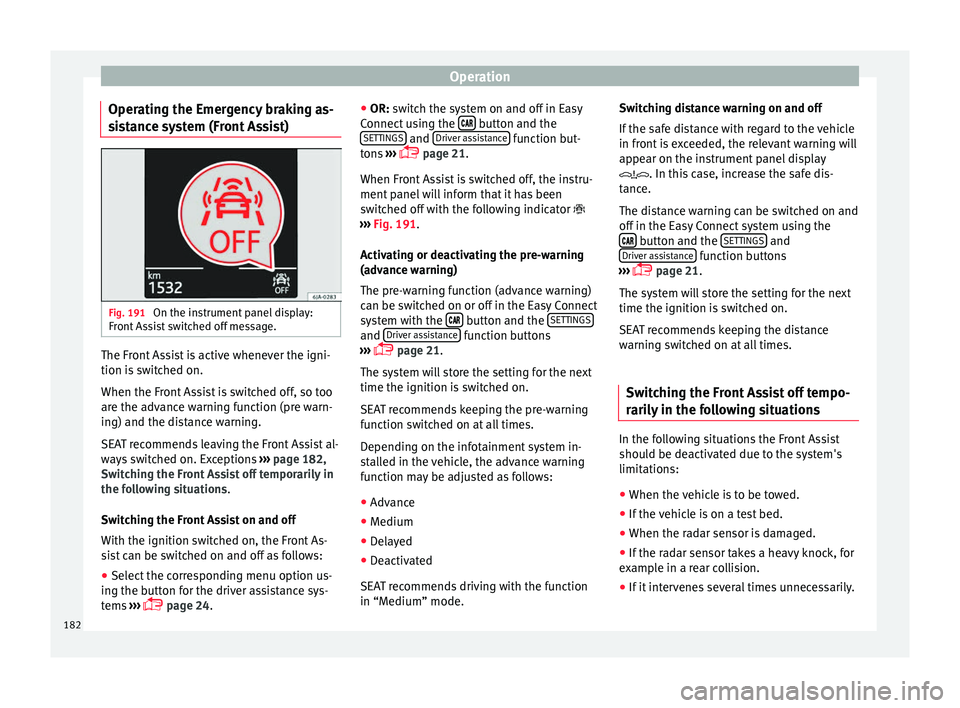
tance system (Front Assist) Fig. 191
On the instrument panel display:
Fr ont
As
sist switched off message. The Front Assist is active whenever the igni-
tion i
s
sw
itched on.
When the Front Assist is switched off, so too
are the advance warning function (pre warn-
ing) and the distance warning.
SEAT recommends leaving the Front Assist al-
ways switched on. Exceptions ›››
page 182,
Switching the Front Assist off temporarily in
the following situations.
Switching the Front Assist on and off
With the ignition switched on, the Front As-
sist can be switched on and off as follows:
● Select the corresponding menu option us-
ing the butt
on for the driver assistance sys-
tems ›››
page 24. ●
OR: switc
h the system on and off in Easy
Connect using the button and the
S ET
TINGS and
Driv
er a
s
sistance function but-
t on
s
›››
page 21.
When Front Assist is switched off, the instru-
ment panel will inform that it has been
switched off with the following indicator
››› Fig. 191.
Activating or deactivating the pre-warning
(advance warning)
The pre-warning function (advance warning)
can be switched on or off in the Easy Connect
system with the button and the
S
ET
TINGS and
Driv
er a
s
sistance function buttons
› ›
›
page 21.
The system will store the setting for the next
time the ignition is switched on.
SEAT recommends keeping the pre-warning
function switched on at all times.
Depending on the infotainment system in-
stalled in the vehicle, the advance warning
function may be adjusted as follows:
● Advance
● Medium
● Delayed
● Deactivated
SEAT r
ecommends driving with the function
in “Medium” mode. Switching distance warning on and off
If the saf
e distance with regard to the vehicle
in front is exceeded, the relevant warning will
appear on the instrument panel display
. In this case, increase the safe dis-
tance.
The distance warning can be switched on and
off in the Easy Connect system using the button and the
S
ET
TINGS and
Driv er a
s
sistance function buttons
› ›
›
page 21.
The system will store the setting for the next
time the ignition is switched on.
SEAT recommends keeping the distance
warning switched on at all times.
Switching the Front Assist off tempo-
rarily
in the following situations In the following situations the Front Assist
shou
l
d be de
activated due to the system's
limitations:
● When the vehicle is to be towed.
● If the vehicle is on a test bed.
● When the radar sensor is damaged.
● If the radar sensor takes a heavy knock, for
examp
le in a rear collision.
● If it intervenes several times unnecessarily.
182
Page 185 of 248

Driver assistance systems
● If the r
a
dar sensor is covered temporarily
with some kind of accessory, such as an ad-
ditional headlight or the like.
● When the vehicle is to be loaded on a lorry,
ferry
or train.
System limitations The Front Assist has certain physical limita-
tions
inher
ent to the system. Thus, in certain
circumstances, some of the system's reac-
tions may be inopportune from the driver's
standpoint. So pay attention in order to inter-
vene if necessary.
The following conditions may cause the Front
Assist not to react or to do so too late:
● In the first few instants of driving after
swit c
hing on the ignition, due to the system’s
initial auto-calibration.
● On taking tight bends or complex paths.
● Pressing the accelerator all the way down.
● If the Front Assist is switched off or dam-
aged.
● If the ASR h
as been disconnected or the
ESC activ
ated in Sport mode manually
››› page 158.
● If the ESC is controlling.
● If several brake lights of the vehicle or elec-
trical ly
connected trailer are damaged. ●
If the r a
dar sensor is dirty or covered.
● If there are metal objects, e.g. rails on the
roa
d or sheets used in road works.
● If the vehicle is reversing.
● If the vehicle over-accelerates.
● In case of snow or heavy rain.
● In case of narrow vehicles, such as motor-
bike
s.
● Misaligned vehicles.
● Vehicles crossing the other's path.
● Vehicles approaching in the opposite direc-
tion.
● Special loads and accessories of other ve-
hicle
s that jut out over the sides, backwards
or over the top. Start-Stop System*
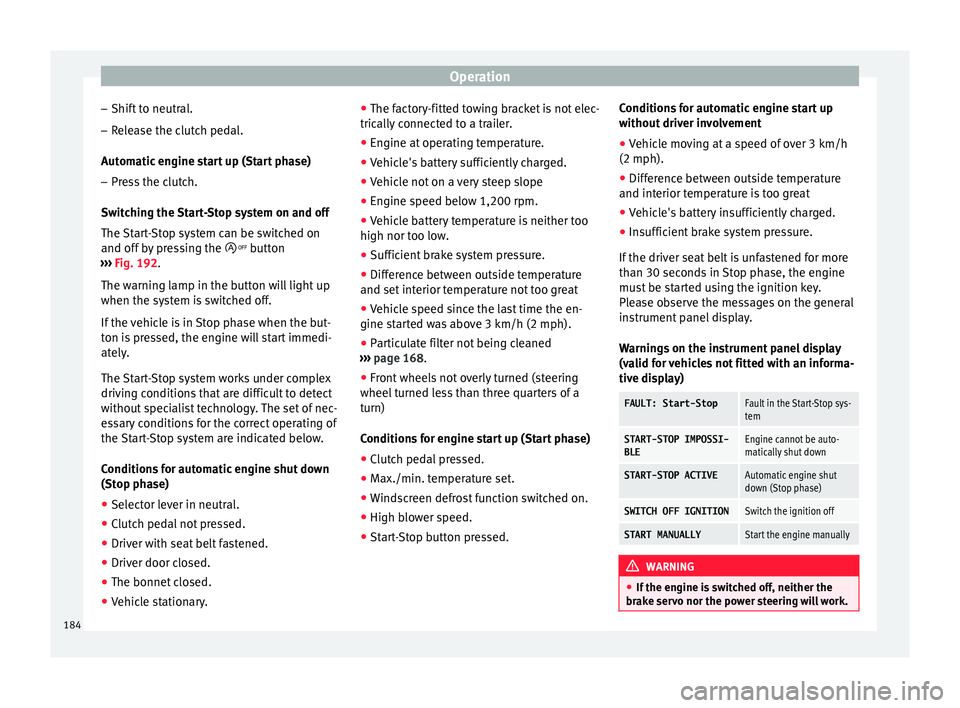
Operating Fig. 192
Instrument panel: Start-Stop system
b utt
on. The Start-Stop system helps save fuel and re-
duc
e h
armf
ul and CO2 emissions.
The system is automatically switched on ev-
ery time the ignition is switched on.
The system automatically switches off the en-
gine when the vehicle is stationary, e.g. wait-
ing at traffic lights.
The current status of the Start-Stop system is
displayed on the general instrument panel
display.
Automatic engine shut down (Stop phase)
– Stop the vehicle (if necessary using the
handbrak
e). »
183
Technical data
Advice
Operation
Emergencies
Safety
Page 186 of 248
Operation
– Shif t
t
o neutral.
– Release the clutch pedal.
Automatic
engine start up (Start phase)
– Press the clutch.
Switc
hing the Start-Stop system on and off
The Start-Stop system can be switched on
and off by pressing the button
››› Fig. 192.
The warning lamp in the button will light up
when the system is switched off.
If the vehicle is in Stop phase when the but-
ton is pressed, the engine will start immedi-
ately.
The Start-Stop system works under complex
driving conditions that are difficult to detect
without specialist technology. The set of nec-
essary conditions for the correct operating of
the Start-Stop system are indicated below.
Conditions for automatic engine shut down
(Stop phase) ● Selector lever in neutral.
● Clutch pedal not pressed.
● Driver with seat belt fastened.
● Driver door closed.
● The bonnet closed.
● Vehicle stationary. ●
The factor
y-fitted towing bracket is not elec-
trically connected to a trailer.
● Engine at operating temperature.
● Vehicle's battery sufficiently charged.
● Vehicle not on a very steep slope
● Engine speed below 1,200 rpm.
● Vehicle battery temperature is neither too
high nor too low
.
● Sufficient brake system pressure.
● Difference between outside temperature
and set interior t
emperature not too great
● Vehicle speed since the last time the en-
gine star
ted was above 3 km/h (2 mph).
● Particulate filter not being cleaned
›››
page 168.
● Front wheels not overly turned (steering
wheel turned l
ess than three quarters of a
turn)
Conditions for engine start up (Start phase)
● Clutch pedal pressed.
● Max./min. temperature set.
● Windscreen defrost function switched on.
● High blower speed.
● Start-Stop button pressed. Conditions for automatic engine start up
without driv
er involvement
● Vehicle moving at a speed of over 3 km/h
(2 mph).
● Difference between outside temperature
and interior temper
ature is too great
● Vehicle's battery insufficiently charged.
● Insufficient brake system pressure.
If the driver se
at belt is unfastened for more
than 30 seconds in Stop phase, the engine
must be started using the ignition key.
Please observe the messages on the general
instrument panel display.
Warnings on the instrument panel display
(valid for vehicles not fitted with an informa-
tive display)
FAULT: Start-StopFault in the Start-Stop sys-
tem
START-STOP IMPOSSI-
BLEEngine cannot be auto-
matically shut down
START-STOP ACTIVEAutomatic engine shut
down (Stop phase)
SWITCH OFF IGNITIONSwitch the ignition off
START MANUALLYStart the engine manually WARNING
● If the en gine i
s switched off, neither the
brake servo nor the power steering will work. 184
Page 187 of 248
Driver assistance systems
●
Do not mo v
e the vehicle when the engine is
switched off. CAUTION
Switch off the Start-Stop system ›
››
page 169
before driving through a pool of water on the
road. Note
● The batt er
y temperature may reflect
changes in outside temperature after several
hours. If the vehicle has been stopped out-
side at temperatures below zero or in direct
sunlight, for example, the battery tempera-
ture may take several hours to reach the val-
ues required for the correct operating of the
Start-Stop system.
● If the Climatronic system is operating auto-
matica
lly, this could impair automatic engine
shut down under certain conditions. Fatigue detection (break rec-
ommend
ation)*
Intr oduction The Fatigue detection informs the driver
when their driv
in
g beh
aviour shows signs of
fatigue. WARNING
Do not let the comfort afforded by the Fatigue
detection sy s
tem tempt you into taking any
risks when driving. Take regular breaks, suffi-
cient in length when making long journeys.
● The driver always assumes the responsibil-
ity of driv
ing to their full capacity.
● Never drive if you are tired.
● The system does not detect the tiredness of
the driver in al
l circumstances. Consult the in-
formation in the section ››› page 186, System
limitations.
● In some situations, the system may incor-
rectly int
erpret an intended driving manoeu-
vre as driver tiredness.
● No warning is given in the event of the ef-
fect c
alled microsleep!
● Please observe the indications on the in-
strument p
anel and act as is necessary. Note
● Fatigue det ection h
as been developed for
driving on motorways and well paved roads
only.
● If there is a fault in the system, have it
check
ed by a specialised workshop. Function and operation
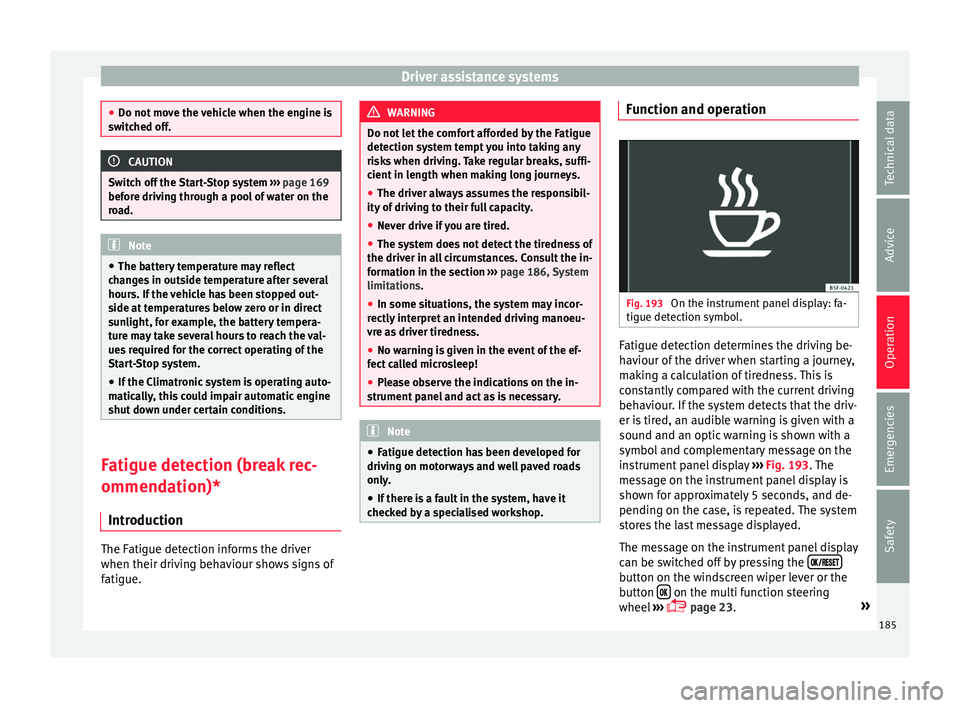
Fig. 193
On the instrument panel display: fa-
tigue det ection symbo
l
. Fatigue detection determines the driving be-
h
av
iour of
the driver when starting a journey,
making a calculation of tiredness. This is
constantly compared with the current driving
behaviour. If the system detects that the driv-
er is tired, an audible warning is given with a
sound and an optic warning is shown with a
symbol and complementary message on the
instrument panel display ››› Fig. 193. The
message on the instrument panel display is
shown for approximately 5 seconds, and de-
pending on the case, is repeated. The system
stores the last message displayed.
The message on the instrument panel display
can be switched off by pressing the button on the windscreen wiper lever or the
b
utt
on on the multi function steering
wheel
›
›
› page 23. »
185
Technical data
Advice
Operation
Emergencies
Safety
Page 190 of 248
Operation
descending a slope in order to take advant-
ag e of
the en
gine brake.
The trailer is incorporated into the vehicle's
anti-theft alarm system:
● When the vehicle has a factory-fitted anti-
theft al
arm and a towing bracket.
● When the trailer is electrically connected to
the vehic
le via the towing bracket socket.
● When the vehicle electrical device and the
tow
ing bracket are operational.
● When the vehicle is locked and the vehi-
cle's
anti-theft alarm device is activated.
Once the electrical connection is interrupted
with the vehicle trailer locked, the alarm
sounds.
Always switch off the vehicle anti-theft alarm
device before connecting or disconnecting a
trailer. The vehicle anti-theft alarm device
could cause the alarm to sound ››› page 116,
Anti-theft alarm*.
Engine overheating
In the event that the coolant temperature
gauge needle moves to the right section of
the scale or to the red area, immediately re-
duce speed. If the control lamp flashes on
the general instrument panel, stop the vehi-
cle and switch off the engine. Wait several
minutes and check the coolant level in the
tank ››› page 210. Please observe the following indications
›››
page 210, Control lamp .
The coolant temperature can be reduced by
switching on the heating. WARNING
● Adjus t
your speed to suit the road and traf-
fic conditions.
● An electrical installation that is connected
incorrectly
or by non-specialised personnel
can prevent the connection of the current to
the trailer and cause faults in the operation of
the electrical system throughout the entire
vehicle, leading to accidents and serious in-
jury.
● All electrical work must be carried out only
by s
pecialised services.
● Never directly connect the trailer electrical
device t
o the electrical sockets of the reverse
driving lights or other sources of electrical
current. CAUTION
● Av oid c
orners, and sudden and sharp brak-
ing.
● Once the trailing arm has been removed,
plac
e the corresponding cover on the hole of
the fastening point. This prevents dirt from
entering the hole – see the trailer system as-
sembly manual. Note
● In the event of
frequent journeys with a
trailer, we recommend also having the vehi-
cle inspected in between the service inter-
vals.
● When connecting and disconnecting the
trail
er, the handbrake must be applied.
● For technical reasons, trailers with LED re-
verse light
s cannot be incorporated into the
vehicle anti-theft alarm system. Towing bracket device
Intr oduction If the vehicle is equipped with a towing
br
ac
k
et device from the factory or is a genu-
ine SEAT accessory, it meets all national tech-
nical and legal requirements for towing.
Your vehicle is fitted with a 13-pin power
socket for the electrical connection between
the trailer and the vehicle. If the trailer is
equipped with a 7-pin connector, you can
use the corresponding adaptor, which is
available as a genuine SEAT accessory.
The towing device has a maximum vertical
load of 50 kg.
188
Page 206 of 248
Advice
Water in the fuel filter 1)
If
y
our vehicle has a diesel engine and is
equipped with a fuel filter with a water sepa-
rator, the instrument panel may display the
following warning: Water in the
fuel filter. If this is the case, take the
vehicle to a specialised workshop so that
they can drain the fuel filter. CAUTION
● The v ehic
le is not designed for the use of
FAME fuel (biodiesel). The fuel system would
be damaged if you used biodiesel.
● Do not mix fuel additives, the so-called
“thinners”, petro
l or similar additives with
diesel fuel.
● If poor-quality diesel fuel is used, it may be
neces
sary to drain the fuel filter more fre-
quently than is specified in the Maintenance
Programme. We recommend having this done
by a specialised workshop. If water is allowed
to collect in the filter, this can cause engine
performance problems. Engine compartment
Intr oduction Read the additional information carefully
›› ›
page 11
Always be aware of the danger of injury and
scalding as well as the risk of accident or fire
when working in the engine compartment,
e.g. when checking and refilling fluids.
Therefore, always observe the warnings and
follow all general safety precautions. The en-
gine compartment is a dangerous area . WARNING
● Never open the bonnet if
you see steam,
smoke or coolant escaping from the engine
compartment. Risk of scalding! Wait until no
steam or coolant can be seen before opening
the bonnet.
● Switch off the engine and remove the key
from the ignition.
● Eng
age neutral in vehicles with manual
gearbo
x and move the selector lever to posi-
tion P in vehicles with automatic gearbox.
● Apply the handbrake firmly.
● Wait for the engine to cool down.
● For safety reasons, the bonnet must always
be closed when the
vehicle is moving. There- fore, after closing the bonnet always check
that
it
is properly secured.
● Should you notice that the bonnet is not
safely
secured when the vehicle is moving,
stop the vehicle immediately and close the
bonnet properly. Risk of accident!
● Keep children away from the engine com-
partment
.
● Do not touch hot engine parts. Risk of
burns!
● Nev
er spill fluids on hot engine compart-
ments. The
se fluids can cause a fire (e.g. anti-
freeze in coolant)!
● Take care not to cause short circuits in the
electrica
l system, especially when working
on the battery.
● Never touch the radiator fan when the en-
gine is hot
. The fan may start running sud-
denly!
● Never cover the engine with additional in-
sul
ating materials such as a blanket. Risk of
fire!
● Do not unscrew the cap on the coolant ex-
pans
ion tank when the engine is hot. The
cooling system is under pressure!
● Protect face, hands and arms from any hot
ste
am or hot coolant released by covering the
cap with a large, thick rag when opening the
expansion tank.
● Do not leave any objects, such as cloths or
tool
s, in the engine compartment. 1)
Valid for the market: Algeria.
204
Page 214 of 248
Advice
The brake fluid reservoir is located in the en-
gine c omp
ar
tment of the vehicle.
– Switch the ignition off.
– Open the bonnet ›››
page 204.
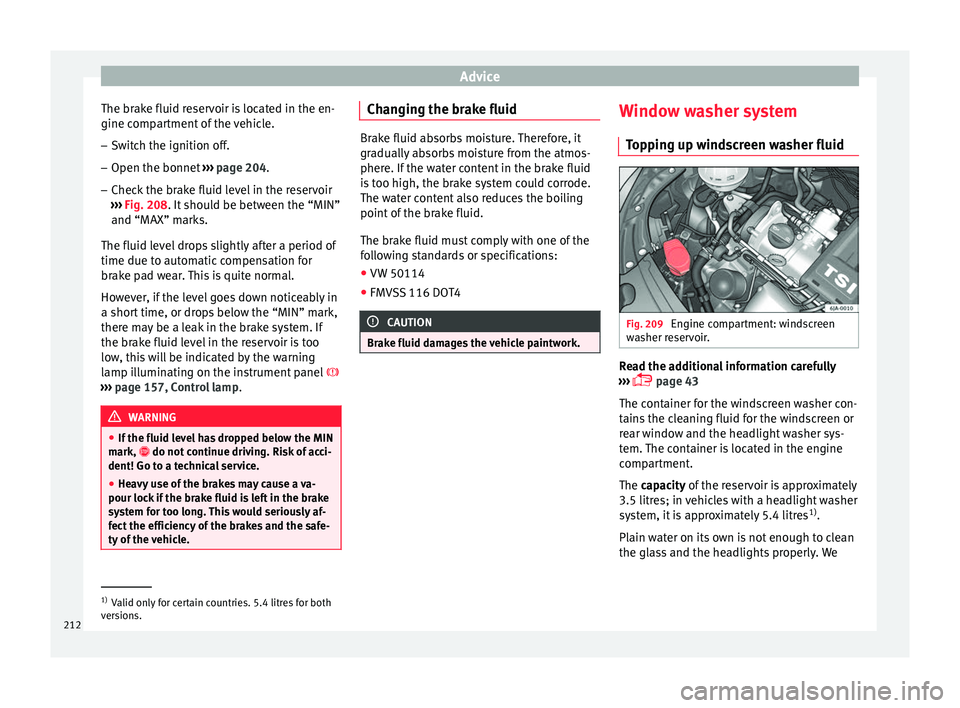
– Check the brake fluid level in the reservoir
›››
Fig. 208. It should be between the “MIN”
and “MAX” marks.
The fluid level drops slightly after a period of
time due to automatic compensation for
brake pad wear. This is quite normal.
However, if the level goes down noticeably in
a short time, or drops below the “MIN” mark,
there may be a leak in the brake system. If
the brake fluid level in the reservoir is too
low, this will be indicated by the warning
lamp illuminating on the instrument panel
››› page 157, Control lamp .WARNING
● If the fluid l ev
el has dropped below the MIN
mark, do not continue driving. Risk of acci-
dent! Go to a technical service.
● Heavy use of the brakes may cause a va-
pour lock if
the brake fluid is left in the brake
system for too long. This would seriously af-
fect the efficiency of the brakes and the safe-
ty of the vehicle. Changing the brake fluid
Brake fluid absorbs moisture. Therefore, it
gra
dual
ly absorbs moisture from the atmos-
phere. If the water content in the brake fluid
is too high, the brake system could corrode.
The water content also reduces the boiling
point of the brake fluid.
The brake fluid must comply with one of the
following standards or specifications:
● VW 50114
● FMVSS 116 DOT4 CAUTION
Brake fluid damages the vehicle paintwork. Window washer system
Top
pin
g up windscreen washer fluid Fig. 209
Engine compartment: windscreen
w a
sher r
eservoir. Read the additional information carefully
› ›
›
page 43
The container for the windscreen washer con-
tains the cleaning fluid for the windscreen or
rear window and the headlight washer sys-
tem. The container is located in the engine
compartment.
The capacity of the reservoir is approximately
3.5 litres; in vehicles with a headlight washer
system, it is approximately 5.4 litres 1)
.
Plain water on its own is not enough to clean
the glass and the headlights properly. We 1)
Valid only for certain countries. 5.4 litres for both
ver s
ions.
212
Page 223 of 248
Wheels and tyres
CAUTION
Follow the instructions given on the tempora-
ry s
pare wheel label. Note
The tyre pressure of the spare wheel must al-
wa y
s correspond to the highest pressure pre-
scribed for the model of vehicle in question. Tyre monitoring systems
Ty r
e pressure* The tyre pressure monitoring system uses
ABS
sen
sor
s to compare the revolutions and
the circumference of each wheel. Should the
circumference of any wheel change, the
warning lamp on the general instrument
panel will light up and an audible warning
will be heard.
Tyre circumference may change if:
● Tyre pressure is too low
● Tyre structure is damaged
● Vehicle load not evenly distributed
● wheels on one axle are subjected to greater
load, (e.
g. driving with trailer, uphill, down-
hill);
● Snow chains are fitted
● The temporary spare wheel is fitted ●
One wheel on the axl
e has been changed
Basic system settings
Should the tyre pressure change or if one or
more wheels are changed or the position of
the wheel on the vehicle is changed, e.g.
changing round the front and rear wheels, or
where a warning lamp lights up when driv-
ing, the system must be adjusted as follows: ● Inflate all tyres to the prescribed pressures
›››
page 218.
● Switch the ignition on.
● Store the new tyre pressure in the Easy
Connect sy
stem with the button and the
S ET
TINGS function button
››
›
page 21.
● In vehicles without radio : pres
s and hold
down the button with the ignition on,
until an acoustic signal is heard.
The warning lamp lights up
If the pressure on at least one tyre is signifi-
cantly lower than the pressure set by the driv-
er, the warning lamp will light up ››› .
The w arnin
g l
amp flashes
If the warning lamp flashes, there is a fault in
the system. Contact a specialised service to
have it fixed. WARNING
● If the w arnin
g lamp lights up, slow down
immediately and avoid any severe braking or
steering manoeuvres. Stop and check the
tyres and their pressure as soon as possible.
● Under certain conditions (e.g. sporty driv-
ing styl
e, driving on loose surfaces or in win-
ter) the warning lamp may take a while to
light up or may remain switched off.
● Despite the tyre pressure monitoring sys-
tem, the driver r
emains responsible for main-
taining the correct tyre pressure. You must
therefore check the tyre pressure often. Note
● The tyr e pr
essure monitoring system is not
a replacement for regularly checking the tyre
pressure, as it is unable to recognise an even
drop in pressure.
● The tyre pressure monitoring system is un-
able t
o warn of a sudden drop in tyre pres-
sure, e.g. a puncture. In this case, try to stop
the vehicle carefully with no severe braking
or steering manoeuvres.
● To ensure the tyre pressure monitoring sys-
tem work
s correctly, the basic setting must
be performed every 10 000 km (6000 miles)
or once a year.
● If the battery is disconnected the warning
lamp lights
up when the ignition is switch-
ed on. This warning lamp must switch off af-
ter covering a short distance. 221
Technical data
Advice
Operation
Emergencies
Safety
Page 239 of 248
Index
depress the brake . . . . . . . . . . . . . . . . . . . . . . . 179
die sel
p
articulate filter . . . . . . . . . . . . . . . . . . . 168
disabling airbag . . . . . . . . . . . . . . . . . . . . . . . . . 72
emission control . . . . . . . . . . . . . . . . . . . . . . . . 169
engine management . . . . . . . . . . . . . . . . . . . . 169
engine oil . . . . . . . . . . . . . . . . . . . . . . . . . . . . . 208
engine pre-heating/fault system . . . . . . . . . . . 169
ESC . . . . . . . . . . . . . . . . . . . . . . . . . . . . . . . . . . 158
fuel level . . . . . . . . . . . . . . . . . . . . . . . . . . . . . . 100
gearbox malfunctions . . . . . . . . . . . . . . . . . . . 164
hand brake . . . . . . . . . . . . . . . . . . . . . . . . . . . . 158
instrument panel . . . . . . . . . . . . . . . . . . . . . 33, 35
instrument panel display . . . . . . . . . . . . . . . . . . 34
lights . . . . . . . . . . . . . . . . . . . . . . . . . . . . . . . . . 121
power steering . . . . . . . . . . . . . . . . . . . . . . . . . 153
seat belt . . . . . . . . . . . . . . . . . . . . . . . . . . . . . . . 62
Start-Stop . . . . . . . . . . . . . . . . . . . . . . . . . . . . . 183
tyre pressure . . . . . . . . . . . . . . . . . . . . . . . . . . . 221
Controls and displays general instrument panel . . . . . . . . . . . . . . . . . . 95
Controls for the windows . . . . . . . . . . . . . . . 11, 119
Controls on the steering wheel without voice control . . . . . . . . . . . . . . . . . . . . 106
with voice control . . . . . . . . . . . . . . . . . . . . . . . 104
Cooling coolant temperature gauge . . . . . . . . . . . . . . . . 99
Cooling system checking coolant . . . . . . . . . . . . . . . . . . . . . . . 210
topping up coolant . . . . . . . . . . . . . . . . . . . . . . 210
Correct sitting position . . . . . . . . . . . . . . . . . . . . . 57 driver . . . . . . . . . . . . . . . . . . . . . . . . . . . . . . . . . . 57
front passenger . . . . . . . . . . . . . . . . . . . . . . . . . 58
rear seat passengers . . . . . . . . . . . . . . . . . . . . . 59
Cruise control . . . . . . . . . . . . . . . . . . . . . . . . 32, 178 adjusting the stored speed . . . . . . . . . . . . . . . 179
setting the speed . . . . . . . . . . . . . . . . . . . . . . . 178 temporary deactivation . . . . . . . . . . . . . . . . . . 179
turning off
the cruise control system . . . . . . . 179
D Damage to the vehicle . . . . . . . . . . . . . . . . . . . . . 170
Dash panel . . . . . . . . . . . . . . . . . . . . . . . . . . . . . . . 33
Data label . . . . . . . . . . . . . . . . . . . . . . . . . . . . . . . 223
Deactivating the front passenger front airbag . . . 14
Deactivation of front airbag . . . . . . . . . . . . . . . 69, 72
Defective bulbs changing a bulb . . . . . . . . . . . . . . . . . . . . . . . . . 84
Defrosting rear window . . . . . . . . . . . . . . . . . . . . 127
Diesel diesel particulate filter . . . . . . . . . . . . . . . . . . . 168
engine oil . . . . . . . . . . . . . . . . . . . . . . . . . . . . . 207
preheating . . . . . . . . . . . . . . . . . . . . . . . . . . . . 152
refuelling . . . . . . . . . . . . . . . . . . . . . . . . . . . . . . 203
Diesel particulate filter . . . . . . . . . . . . . . . . . . . . 168 control lamp . . . . . . . . . . . . . . . . . . . . . . . . . . . 168
malfunction . . . . . . . . . . . . . . . . . . . . . . . . . . . . 168
Digital clock . . . . . . . . . . . . . . . . . . . . . . . . . . . . . . 98
Dimensions . . . . . . . . . . . . . . . . . . . . . . . . . . . . . . 233
Direction of rotation tyres . . . . . . . . . . . . . . . . . . . . . . . . . . . . . . . . . . . 50
Display . . . . . . . . . . . . . . . . . . . . . . . . . . . . . . . 96, 97
Disposal belt tensioners . . . . . . . . . . . . . . . . . . . . . . . . . . 67
Door cylinder . . . . . . . . . . . . . . . . . . . . . . . . . . . . . . 9
Door handle . . . . . . . . . . . . . . . . . . . . . . . . . . . . . . . 9
Door lock . . . . . . . . . . . . . . . . . . . . . . . . . . . . . . . . . . 9
Doors child-proof locking . . . . . . . . . . . . . . . . . . . . . . 116
opening and closing . . . . . . . . . . . . . . . . . . . . . . 9
Drink holder centre console . . . . . . . . . . . . . . . . . . . . . . . . . 136
rear seat armrest . . . . . . . . . . . . . . . . . . . . . . . 137 Driver
see Correct sitting position . . . . . . . . . 57, 58, 59
Driver information system engine oil temperature display . . . . . . . . . . . . . 29
operation through the windscreen wiper lever . 23
Driving economical . . . . . . . . . . . . . . . . . . . . . . . . . . . . 166
safe . . . . . . . . . . . . . . . . . . . . . . . . . . . . . . . . . . . 56
Driving abroad headlights . . . . . . . . . . . . . . . . . . . . . . . . . . . . . 126
Driving data data summary . . . . . . . . . . . . . . . . . . . . . . . . . . . 26
memory . . . . . . . . . . . . . . . . . . . . . . . . . . . . . . . . 25
Driving through water . . . . . . . . . . . . . . . . . . . . . 169
Driving with a trailer . . . . . . . . . . . . . . . . . . 186, 225
Dynamic headlight range control . . . . . . . . . . . . 122
E
E10 see Ethanol (fuel) . . . . . . . . . . . . . . . . . . . . . . . 202
Easy Connect . . . . . . . . . . . . . . . . . . . . . . . . 21, 101
EDL see Electronic differential lock . . . . . . . . 158, 160
Efficiency program saving tips . . . . . . . . . . . . . . . . . . . . . . . . . . . . . . 30
Efficiency Program additional consumers . . . . . . . . . . . . . . . . . . . . 30
Electric windows . . . . . . . . . . . . . . . . . . . . . . 11, 119
Electronic differential lock . . . . . . . . . . . . . 158, 160
Electronic immobiliser . . . . . . . . . . . . . . . . . . . . . . . 9
Electronic Stability Control (ESC) . . . . . . . . . . . . 158
Emergencies . . . . . . . . . . . . . . . . . . . . . . . . . . . . . . 76 automatic gearbox emergency program . . . . . 164
bulbs . . . . . . . . . . . . . . . . . . . . . . . . . . . . . . . . . . 45
changing a wheel . . . . . . . . . . . . . . . . . . . . . 47, 76
emergency towing of the vehicle . . . . . . . . . . . . 51
hazard warning lights . . . . . . . . . . . . . . . . . . . 125
237
Page 241 of 248
Index
Fuel consumption en gine c
ut
-off due to inertia . . . . . . . . . . . . . . 166
why does fuel consumption increase? . . . . . . 168
Fuel tank flap opening and closing . . . . . . . . . . . . . . . . . . . . . 40
Full-LED Headlights . . . . . . . . . . . . . . . . . . . . . . . . 84
Fuses . . . . . . . . . . . . . . . . . . . . . . . . . . . . . . . . . . . . 81 identifying blown fuses . . . . . . . . . . . . . . . . . . . 44
identifying by colours . . . . . . . . . . . . . . . . . . . . . 44
in the dash panel . . . . . . . . . . . . . . . . . . . . . . . . 82
in the engine compartment . . . . . . . . . . . . . . . . 83
in the instrument panel . . . . . . . . . . . . . . . . . . . 44
preparation before replacing . . . . . . . . . . . . . . . 44
replacing . . . . . . . . . . . . . . . . . . . . . . . . . . . . . . . 44
G Gauge fuel level . . . . . . . . . . . . . . . . . . . . . . . . . . . . . . 100
Gear-change indicator . . . . . . . . . . . . . . . . . . . . . . 29
Gearbox lever . . . . . . . . . . . . . . . . . . . . . . . . . . . . . 35
Gear change . . . . . . . . . . . . . . . . . . . . . . . . . . . . . . 35 automatic . . . . . . . . . . . . . . . . . . . . . . . . . . . . . . 36
engaging the gears (manual gearbox) . . . . . . 160
manual . . . . . . . . . . . . . . . . . . . . . . . . . . . . . . . . 35
manual gearbox . . . . . . . . . . . . . . . . . . . . . . . . 160
Gear engaged . . . . . . . . . . . . . . . . . . . . . . . . . . . . . 35
Gear recommendation . . . . . . . . . . . . . . . . . . . . . . 29
General instrument panel control lamps . . . . . . . . . . . . . . . . . . . . . . . . . . . 33
controls and displays . . . . . . . . . . . . . . . . . . . . . 95
warning lamps . . . . . . . . . . . . . . . . . . . . . . . . . . 33
H
Handbrake . . . . . . . . . . . . . . . . . . . . . . . . . 156, 158 control lamp . . . . . . . . . . . . . . . . . . . . . . . . . . . 158
Hazard warning lights . . . . . . . . . . . . . . . . . 19, 125
HBA . . . . . . . . . . . . . . . . . . . . . . . . . . . . . . . . . . . . 158 Head-on collisions and their laws of physics . . . . 64
Head-pr
otection airbags
description . . . . . . . . . . . . . . . . . . . . . . . . . . . . . 16
safety instructions . . . . . . . . . . . . . . . . . . . . . . . 71
Headlight range control . . . . . . . . . . . . . . . . . . . . 122
Headlights driving abroad . . . . . . . . . . . . . . . . . . . . . . . . . 126
Headlight washers . . . . . . . . . . . . . . . . . . . . . . 130
Head restraints . . . . . . . . . . . . . . . . . . . . . . . . . . . . 12 adjustment . . . . . . . . . . . . . . . . . . . . . . . . . . . . 132
front head restraints . . . . . . . . . . . . . . . . . . . . . . 60
rear head restraints . . . . . . . . . . . . . . . . . . . . . . 60
Headrests . . . . . . . . . . . . . . . . . . . . . . . . . . . . . . . . 12 adjustment . . . . . . . . . . . . . . . . . . . . . . . . . . . . 132
front . . . . . . . . . . . . . . . . . . . . . . . . . . . . . . . . . . . 60
Heated rear window . . . . . . . . . . . . . . . . . . . . . . . 127
Heating . . . . . . . . . . . . . . . . . . . . . . . . . . . . . . . . . 148 air recirculation . . . . . . . . . . . . . . . . . . . . . . . . . 148
introduction . . . . . . . . . . . . . . . . . . . . . . . . . . . 146
rear window . . . . . . . . . . . . . . . . . . . . . . . . . . . 127
Heating and fresh air . . . . . . . . . . . . . . . . . . . . . . . 39
HHC . . . . . . . . . . . . . . . . . . . . . . . . . . . . . . . . . . . . 158
Hill hold control . . . . . . . . . . . . . . . . . . . . . . . . . . 158
Horn . . . . . . . . . . . . . . . . . . . . . . . . . . . . . . . . . . . . 95
How to jump start . . . . . . . . . . . . . . . . . . . . . . . . . . 52 description . . . . . . . . . . . . . . . . . . . . . . . . . . . . . 53
I
Identifying letters on engine . . . . . . . . . . . . . . . . 223
Ignition . . . . . . . . . . . . . . . . . . . . . . . . . 18, 152, 154
Ignition lock . . . . . . . . . . . . . . . . . . . . . 18, 152, 154
Immobiliser . . . . . . . . . . . . . . . . . . . . . . . . . . . . . . 154
Incorrect position . . . . . . . . . . . . . . . . . . . . . . . . . . 59
Indications on the display . . . . . . . . . . . . . . . . . . . 97 assist systems submenu . . . . . . . . . . . . . . . . . . 26
compass . . . . . . . . . . . . . . . . . . . . . . . . . . . . . . . 98
distance travelled . . . . . . . . . . . . . . . . . . . . . . . . 97 doors, bonnet and rear lid open . . . . . . . . . . . . 28
driver inform
ation system . . . . . . . . . . . . . . . . . 23
driving data . . . . . . . . . . . . . . . . . . . . . . . . . . . . . 25
ECO . . . . . . . . . . . . . . . . . . . . . . . . . . . . . . . . . . . 98
Emergency brake assist system (Front Assist) 179
MKB . . . . . . . . . . . . . . . . . . . . . . . . . . . . . . . . . . . 98
outside temperature . . . . . . . . . . . . . . . . . . . . . . 29
recommended gear . . . . . . . . . . . . . . . . . . . . . . 98
second speed display . . . . . . . . . . . . . . . . . . . . 98
selector lever position . . . . . . . . . . . . . . . 98, 162
service intervals . . . . . . . . . . . . . . . . . . . . . . . . . 31
speed warning . . . . . . . . . . . . . . . . . . . . . . . . . . 98
Start-Stop . . . . . . . . . . . . . . . . . . . . . . . . . . . . . . 98
time . . . . . . . . . . . . . . . . . . . . . . . . . . . . . . . . . . . 98
warning and information messages . . . . . . . . . 28
Infotainment system . . . . . . . . . . . . . . . . . . . . . . . 21
Inspection . . . . . . . . . . . . . . . . . . . . . . . . . . . . . . . 207
Inspection service . . . . . . . . . . . . . . . . . . . . . . . . 207
Instrument panel . . . . . . . . . . . . . . . . . . . . . . . . . . 96 control and warning lamps . . . . . . . . . . . . . . . 100
display . . . . . . . . . . . . . . . . . . . . . . . . . . . . . . 96, 97
instruments . . . . . . . . . . . . . . . . . . . . . . . . . . . . . 96
odometer . . . . . . . . . . . . . . . . . . . . . . . . . . . . . . . 99
service interval indication . . . . . . . . . . . . . . . . . 31
Instruments . . . . . . . . . . . . . . . . . . . . . . . . . . . . . . 96
Interior lighting . . . . . . . . . . . . . . . . . . . . . . . . . . . . . . . 126
Interior lights . . . . . . . . . . . . . . . . . . . . . . . . . . . . . 19
Interior view left guide . . . . . . . . . . . . . . . . . . . . . . . . . . . . . . . . 7
right-hand drive . . . . . . . . . . . . . . . . . . . . . . . . . . 8
ISOFIX . . . . . . . . . . . . . . . . . . . . . . . . . . . . . . . . . . . 17
ISOFIX system . . . . . . . . . . . . . . . . . . . . . . . . . . . . . 17
J Jack . . . . . . . . . . . . . . . . . . . . . . . . . . . . . . . . . . 47, 76 mounting points . . . . . . . . . . . . . . . . . . . . . . . . . 49
239