wheel SKODA 105S 1980 Owner's Guide
[x] Cancel search | Manufacturer: SKODA, Model Year: 1980, Model line: 105S, Model: SKODA 105S 1980Pages: 238, PDF Size: 47.09 MB
Page 141 of 238
r 0.3-t0,5
Ihe permissible
out-of-bolonce must not ex-
ceed 50 grommes
on the rim rodius. Every new
tyre is provided
with o coloured dot on its side,
indicoting its lightest point.
Fit the tyre olwoys
with this dot focing
the tube volve.
ln this
position, the volve octs os on odditionol weight
compensoting the wheel overoll unbolonce to
o consideroble extent.
lf dynomic boloncing of the wheel is not
possible, bolonce the wheel stoticolly with the
greotest possible qssuroc|.
Boloncing weights
of 30, 50, 75,
ond 100 grommes
ore ovoiloble.
10.4 TUBED TYRES
For mounting,
dismounting,
ond repoirs of
conventionol tyres with inner tubes (for
por-
ticulors, see the preceding
Chopters), the usuol
procedures ore opplicoble. The permissible run-
out (untrue
running)
of the rim is the some os
for tubeless tyres (Chopter
10.5).
10.5 TUBELESS TYRES
The oir-tight seoling of these tyres requires
more core ond o different hondling thon thot of
the tyres with inner
tubes.
Preporotlon of Rirrr
13elore mounting the tyre, inspect the rim for
ony technicol defects. The points
to be checked
ore the rim shoulder ond the moting foce for
the tyre beods,
in oddition to the overoll con-
dition of the rim. lf ony defects ore found, the
rim must be reconditioned.
A sotisfoctory rim
nrust comply with the following conditions:
o) The
rim shoulder ond the tyre volve hole
must not be distorted;
there must be no
shcrp edges or protrusions
likely to domoge
the tyre beod. Minor unevennesses
con be
hornmered flot ond smoothed
with o file.
The moximum eccentric running
of the rim
side must not exceed 1.5 mm.
b) The moting surfoces
must be obsolutely
cleon (free
from stuck-on rubber, rust,
etc.).
Cleon them with emery poper
or o wire brush
ond coot them with point.
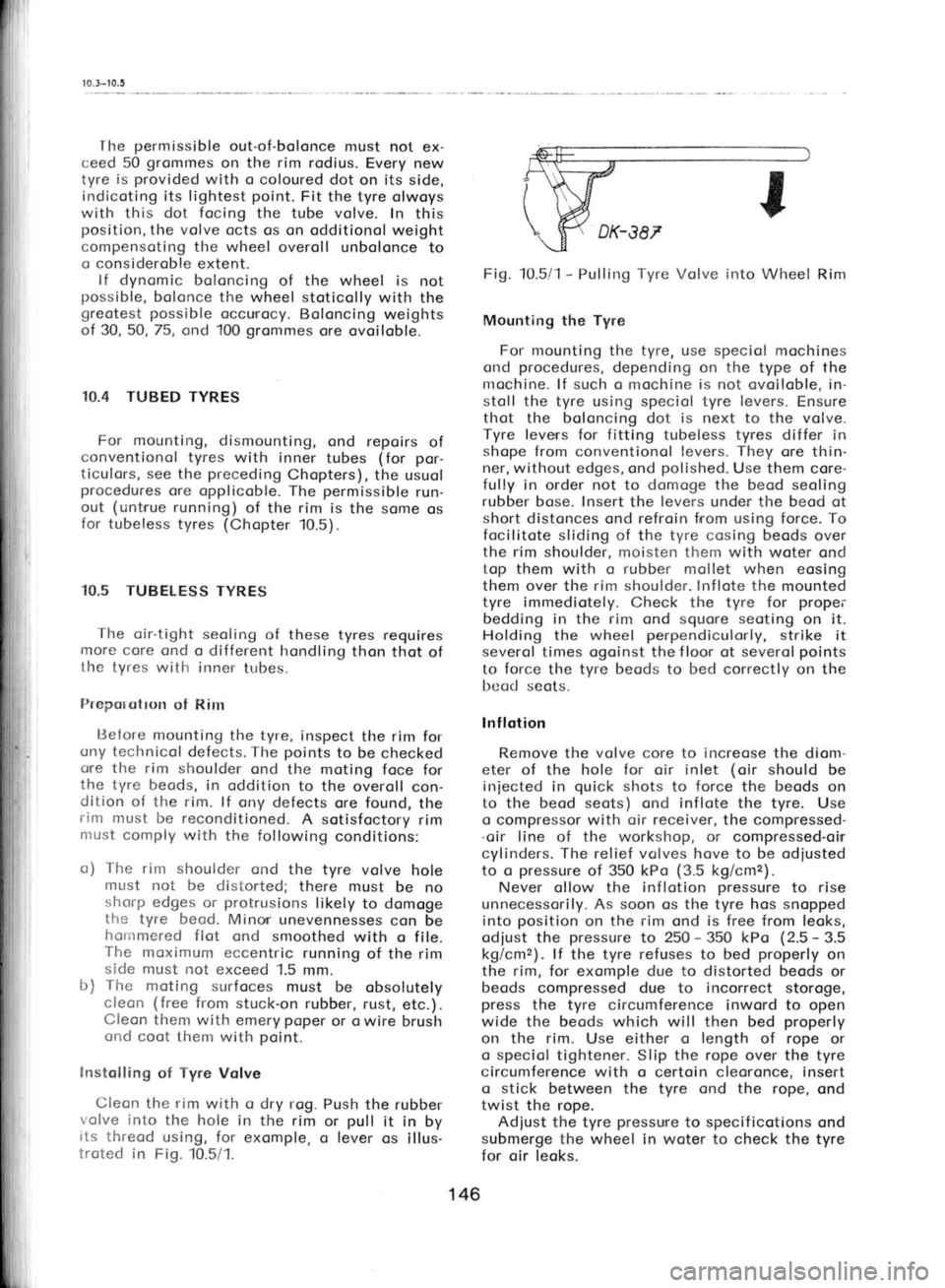
lnstolling of Tyre
Volve
Cleon the rim with o dry rog. Push
the rubber
volve into
the hole in the rim
or pull
it in
by
its threod using, for exomple,
o lever
os illus-
troted in Fig. 10.5/1. Fig. 10.5/1
-
Pulling Tyre Volve
irrto Wheel Rim
Mounting the Tyre
For mounting the tyre, use speciol mochines
ond procedures,
depending on the type of the
nrochine. lf such o mochine is not ovoiloble, in-
stoll the tyre using speciol tyre levers.
Ensure
thot the boloncing dot is next to the volve.
Tyre leverrs for fitting tubeless tyres
differ in
shope from conventionol levers. They
ore thin-
ner, without edges, ond polished.
Use them core-
fully in order not to domoge the
beod seoling
rubber bose. Insert the levers
under the beod
ot
short distonces ond refroin from using force. To
focilitote sliding of the tyre cosing beods over
the rim shoulder, moisten them with woter ond
top them with o rubber
mollet when eosing
them over the rim shoulder. Inflote
the mounted
tyre immediotely. Check the tyre for propei'
bedding in the rim ond
squore seoting
on it.
Holding the wheel perpendiculorly,
strike it
severol times ogoinst the f loor ot severol points
to force the tyre beods
to bed
correctly on the
bcad seots.
lnf lotion
Remove the volve
core to increose
the diom-
eter of the hole for oir inlet (oir
should be
iniected in quick
shots to force
the beods
on
to the beod seots) ond inflote the tyre. Use
o compressor with oir receiver, the
compressed-
.oir line of the
workshop, or
compressed-oirr
cylinders. The relief volves hove to be odiusted
to o pressure
of 350 kPo (3.5
kg/cmz).
Never ollow the inflotion pressure
to rise
unnecessorily. As soon os the tyre hos snopped
into position
on the rim
ond is free from leoks,
odiust the pressure
to 250 -
350 kPo (2.5 -
3.5
kg/cmz). lf the tyre refuses to
bed properly
on
the rim,
for exomple due to distorted beods or
beods compressed due to incorrect storoge,
press the tyre circumference inword to open
wide the beods which will then bed properly
on the rim. Use either o length of
rope or
o speciol tightener. Slip the rope over the
tyre
circumference with o certoin cleoronce, insert
o stick
between the tyre ond the rope, ond
twist the rope.
Adiust the tyre pressure
to specif
icotions ond
submerge the wheel in woter to check the
tyre
for oir leoks.
146
Page 146 of 238
11.4-11.5
I
I
I
F
r
t'
on to the coolont tonk.
Hose
clips ore formed
either by metol strips
or lengths
of wire. When
tightening the wire clips, toke core not to
domoge the rubber of the hoses.
To Fosten Pipes ond
Hoses
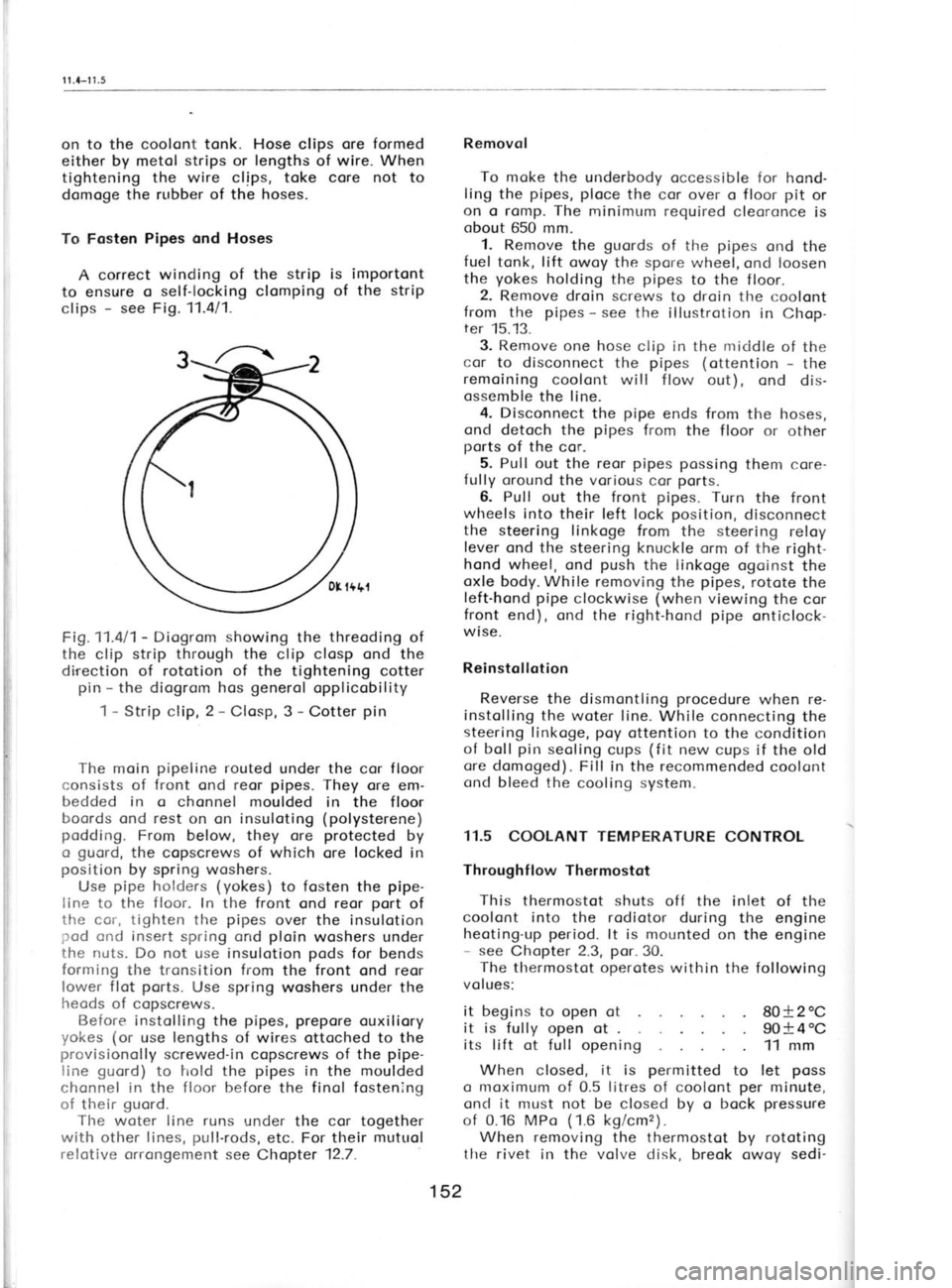
A correct winding of the strip is importont
to ensure o self-locking clomping of the strip
clips -
see Fig. 11.411.
Fig.11.Al1- Diogrom showing
the threoding
of
the clip strip through
the clip closp ond
the
direction of rototion of
the tightening cotter
pin -
the diogrom hos generol
opplicobility
1 -
Strip clip,2 -
Closp, 3 -
Cotter pin
The moin pipeline
routed under the cor f loor
consists of front ond reor pipes.
They ore em-
bedded in o chonnel moulded in the floor
boords ond rest on on insuloting (polysterene)
podding. From below, they ore protected
by
o guord,
the copscrews of which ore locked
in
position by spring woshers.
Use pipe
holders (yokes) to fosten the pipe-
line to the floor. In
the front
ond reor port
of
the cor, tighten
the pipes
over the insulotion
lrod ond insert
spring ond ploin
woshers under
the nuts.
Do not use insulotion pods
for bends
forming the tronsition from
the front
ond reor
lower flot ports.
Use spring woshers under
the
heods of copscrews.
Before instolling the pipes, prepore
ouxiliory
yokes (or use lengths of wires ottoched to the
provisionolly screwed-in copscrews of the pipe-
line guord) to liold the pipes
in the moulded
chonnel in
the floor before
the finol fostening
of their guord.
The woter line runs
under the cor together
with other lines, pull-rods,
etc. For their mutuol
ref otive orrongement see Chopter 12.7. Removol
To moke the underbody occessible for hond-
ling the pipes,
ploce
the cor over o floor pit
or
on o romp. The minimum required cleoronce is
obout 650 mnr.
1. Remo.re the guords
of the pipes
ond the
fuel tonk, lift owoy the spore wheel, ond loosen
the yokes
holding the pipes
to the floor.
2. Remove droin screws to droin the coolont
from the pipes -
see the illustrotion in Chop-
ter 15.'13.
3. Remove one hose clip in the middle
of the
cor to disconnect
the pipes
(ottention -
the
remoining coolont will f low out), ond dis-
ossemble the line.
4. Disconnect the pipe
ends from the hoses,
ond detoch the pipes
from the floor or other
ports of the cor.
5. Pull out the reor pipes
possing
them core-
fully oround the vorious cor ports.
6. Pull out the front pipes.
Turn
the front
wheels into their left lock position,
disconnect
the steering linkoge from the steering
reloy
lever ond the steering knuckle orm of the
right-
hond wheel, ond push
the linkoge ogoinst the
oxle body. While removing the pipes,
rotote the
left-hond pipe clockwise (when
viewing the cor
front end), ond the right-hond pipe
onticlock-
wise.
Reinstollotion Reverse the dismontling procedure
when re-
instolling the woter line. While connecting the
steering linkoge, poy
ottention to the condition
of boll pin
seoling cups (fit
new cups if the old
ore domoged). Fill in the recommended
coolont
ond bleed the cooling system.
11.5 COOLANT TEMPERATURE CONTROL
Throughf low Thermostot
This thermostot shuts off the inlet of the
coolont into the rodiotor
during the engine
heoting-up period. lt is mounted on the engine
- see Chopter 2.3, por.
30.
The thermostot operotes within the following
volues:
it begins to open ot 80+2"C
it is fully open ot 90+4oC
its lift ot full opening
11 mm
When closed, it
is permitted
to let poss
o nroximum
of 0.5 litres
of coolont per
minute,
ond it must not be closed by o bock pressure
of 0.16 MPo (1.6
kg/cm2).
When removing the thermostot by rototing
tlre rivet in the volve disk, breok owoy sedi-
I i
i 152
Page 156 of 238

12.6-12.f
2. Proceeding fronr below, rernove
the fuel
tonk sheet guord
ond the guord
of the cooling
woter pipes.
3. Disconnect the pipe
of the clutclr hydroulic
line from the clutch releose hose brocket.
4. Screw out droin plugs
to droin fuel from
the fuel tonk ond ot the some time disconnect
the fuel hose from
the fuel pump.
After com-
pleting the droining, reinstoll the droin plugs
(screws) with their seoling rings.
Disconnect the tronsverse hose connecting
both sections of the fuel tonk ond stop the
open
pipes with rrubber
plugs (to prevent
the remoin-
ing fuel spilling over your
honds ond clothes
when lifting
the tonk owoy).
5. Disconnect the geor
shift link ond the
speedometer drive from the georbox -
see Chop-
ter 4.1, por.9.
6. Detoch cobles from the hond broke rocker
ond pull
them out from under the cor -
see
Chopter 9.8. 7. Droin the cooling system -
see Chopter
-15.13.
Disconnect the moin woter line in
the
rniddle of the cor. Disconnect the pipes
from
the engine (from
the hose of the thermostot
ond the pump
connecting hose) ond remove
the
pipes -
see Chopter 11.4.
8. Disconnect the hose of the fuel
tonk from
the fuel filling pipe, ond, in the upper port,
the
hose of the fuel filling line vent pipe.
9. Sever the electric connection of the fuel
level gouge
floot system under tlre right-hond
I eor seot.
10. Use o
iock to support
tl're georbox
ond
loosen tlre connection of the georbox
cross
beorer with the bodywork.
11. Loosen the copscrews fostening the fuel
tonk to the bodywork ond lower the
iock to tip
the power
pock.
Retoin the fuel tonk while ne-
nroving the copscrews, move the tonk bock-
words ond down, tip it down ond forword, ond
remove it in
this direction. 12. Should
the pipes
of the broke system ob-
struct tlre removol of the tonk, disconnet them
from the finol drive ond from broke hose brock-
ets.
Refitting Fuel Tqnk in Cor
Reverse the procedure
of the tonk removol.
Fill the cooling system with the recommended
coolont ond bleed it, odjust the hond-broke ond
the occelerotor cobles. Bleed the clutch hy-
droulic line
ond olso the reor wheel brokes if
the hydroulic broke line hos
been disconnected.
Tighten properly
oll joints
ond connections,
fosten the cobles, links, ond pipes
obsenving
their correct orrongement -
see Chapter 12.7.
Fuel Line ond lts Accessories
Filling pipe.
This is q
sheet -
metol tube ot-
toclred to
the hose on the fuel tonk by meons
of o clip, ond to
the bodywork by two holders
with o copscrew ond both o spring ond o ploin
wosher. lt posses
througlr o bushing in the side
of the bodywork. Venting line. The hose is ottoched to the fuel
tonk filler neck in the upper port
of the tonk
ond to the filling pipe
by meons
of clips. For
its possoge
through the bodywork stiffener,
see Fig. 12.714. For clips ond their tightening see
Fig. 11.4/1.
The oir-feed hose
is slipped on the filling
pipe outlet ot
the fuel tonk neck; its
loop is
inserted under the domping lining of the body-
work, ond its other end is inserted into the hole
of the filling pipe
socket bushing.
Filler neck cop -
see Chopter 1.5.
Fuel gouge -
see fuel reserve signolling
switch, Chopter 13.17.
12.7 ARRANGEMENT
OF PIPELINES, LINKS,
AND CABLES UNDER THE
CAR
The routing, fostening, etc., of pipelines,
links, ond cobles is described in
chopters deol-
ing with these ports.
They oll leove the floor
tunnel under tlre fuel tonk to
be covered by
o guold
held in position
by self-locking nuts
with ploin
woshers. The following
illustrotions
show their correct orrongement which hos to
be mointoined if incorrect function or domoge
is to be prevented.
lt is imperotive to ensure
free movement ond swing
of the geor
shift
link.
Secure the correct position
of oll ports
under
the fuel tonk by clips which hove
to be pro-
vided with sleeves preventing
domoge to Bow-
den tubings, etc. The overoll orrongement is
shown in
Fig. 12.712 ond 12.713.
Fig.
12.611- Fuel Tonk Droin
Plugs
164
Page 187 of 238

1 3.1 6-t 3.1
7
focio ofter removing two
copscrews ol-l the
ponel bottom. lt moy
be olso necessory to pull
off the heoter control push
buttons.
c) Switch of disobility worning lights
For fostening see
informotion sub
b). -l
he
switch operotes only
when connected to the
direction indicotor ticker.
d) Dipswitch, direction indicotor, horn, wind-
screen wiper, ond winscreen wosher switch
ox 1568
instolled on
the steering
fostened to
the reduction
with shoft
beorings ond to
steering wheel shoft
shroud.
Fig.
13.16/1 -
Switch Box with Steering Lock -
the orrows indicote the copscrews (M
3.5)
holding down the switch box in the steering
lock housing
disengoging the shoft from
the bodywork -
see
Chopter 7.8, porogrophs
1 to 5 -
without, how-
ever, disengoging the shoft from
the steering
box. The switch box con be removed
ofter loosen-
ing two copscrews on the steering lock hous-
ing (see
illustrotion).
Reverse this procedure
when refitting the
switch box. Turn
the key ond
the key hole of
the switch box into the left-hond extreme pos-
ition (STOP),
instoll the switch box in the
steering lock,tighten the copscrews ond secure
them with o dob of point.
13.17 SWITCHES OF LAMPS
AND WARNING
SYSTEMS, DIRECTION INDICATOR
TICKER, RECEPTACLE
For the wiring of these electricol devices
refer to Chopter 13.1 -
Electricol Equipment
Connections ond Wiring Diogrom -
ond for
their operotion to Chopter 1.3.
All the devices ore expendoble ond they hove
to be reploced with new units if defective.
All the switches ore of the contoct type,
speciol types ond exceptionol connections ore
mentioned in the following text.
o) Switch of porking
lights ond heodlights
(feeder of chonge-over
switch
of these
lights)
The switclr is fostened to the instrument
ponel by o nut with o wosher under the push
button. When instolling the switch,
turn it so
thot it engoges in the locking slots. The push
button con be removed
by pulling
it off ond
refitted bv pressing
it down.
b) Heoter switch
This is fostened in the some monner
os the
switch sub o). Access to the switch
body con
be goined
by removing the centre ponel
of the This switch
is
column shoft ond
sleeve of the tube
the top port
of the
Removol: Remove the steering wheel
ond the bottom
port of the shroud -
see Chopter 7.8.
The switch
con be releosed from the shoft ofter loosening
the screw in the driver ond the removol of the
driver (
if the switch is equipped with
such
driver), ond the loosening of the
screw in the
yoke on the switch bottom right-hond side.
Loosen or remove the fostening screws of
the
shroud ond lift owoy the top port
of the shroud-
lf you
intend to remove olso the
steering
geor, do not loosen the screw
on the switch
bottom right-hond side but the screw on the
left-hond side, ond lift
owoy the switch
together with the reducit-tg
sleeve on the steer-
ing wheel shoft tube.
Refitting ond Adiustment
Reverse the described procedure when
re-
fitting the switch. lf the cor is equipped with
:" outomotic
direction
indicotor concelling
Fig. 13.1711- Adiusting Elements of
Directiorr
lndicotor Self-concelling Device
1 -
Centering pin
of the left-hond
switch or
mork on the switch foce, 2 -
Boss on the bush
foce, 3 -
Driver
194
Page 193 of 238

1 t.1
-1
4.3
surfoces ore
sproyed with o
Protective com'
pound. The floor boords including the floor of
the boot ore covered with textile corpets while
rubber mots ore used in Skodo 105 S.
The in-
terior luggoge comportment is
lined with insu-
loting felt
sheet.
fne body finish consists of severol loyers of
speciol onti-corrosive cootings, o primer
coot,
ond o synthetic boking enomel top
coot in
colours complying with
o speciol specificotion.
14.1 BUMPERS
To Remove Front BumPer
Disconnect the
leods of the horn ond front
direction indicotors. Remove bolts connecting
the side sections of
the bumper with the wings
ond bolts of the bumper brockets, connecting
them to the wheel splosh guords. Now
the
entire bumper is free ond it con be removed.
Te Remove Reor BumPer
Proceed in the some woy with the exception
thot there ore no leods to be disconnected.
To Remove Overriders
Screw off the nut M 10 ond lift owoy the
overri der.
14.2 WTNGS
To Remove Front Wing
First remove the front bumper (see
Chop-
ter 14.1), the front door (see
Chopter 14.5), ond,
in the cose of the left-hond wing, the boot lid
Fig. 14.211- Removing Front Wing -
orrows
indicote fostening points (see
Chopter 14.3). lf the door sill is covered
with o trim moulding, loosen this moulding
portiolly. Now remove the bolts fostening the wing to
the bodywork under the sill (from
underneoth),
on the side edge of the body post,
in the chon'
nel next to the boot, ond in the forebody under
the heodlomp.
To Reinstqll Front Wing
lf the seol strip in the front
Port of the wing
is domoged, reploce it with o new one, ond
stick it on if it hos got
unstuck. Pock olwoys
o new seoling strip between the wing edge ond
the body fromework. Then instoll
the wing in
position ond locote it by tightening slightly the
connecting (fostening) bolts.
Do not tighten
the bolts firmly before hoving fitted properly
the wing.
14.3 BONNET AND BOOT LID
Removing Boot Lid
Remove the nut ond bolt of the strut ond
the screws fostening the
hinges, ond lift owoy
the complete lid.
Removing Engine Bonnet
Slip the bonnet strut out of
its guide,
screw
off the nuts of the hinge fostening bolts, ond
lift owoy the bonnet.
Reinstollotion ond Adiustment of Boot Lid
ond Engine Bonnet
Instoll the lid (or
bonnet) over
the luggoge
(or engine) comportment ond
tighten lightly
the bolts ond/or the nuts of the hinge bolts.
Moke the lid (or
bonnet) fit perfectly
with the
edges of the bodywork by shifting the hinges
in their respective holes
os necessory, ond
tighten fost the bolts ond/or nuts of the hinges-
Assemble the strut of the boot lid.
Boot Lid Releose Rod ond Engine Bonnet
Releose Coble
The releose rod of the boot lid (Fig.
1.3113)
is connected with the reloy link by meons of
o pin
ond forms on ossembly unit with the lid
locks. The
hondle of the releose rod con be
removed ofter pushing
out the pin.
The entire
ossembly con be lifted owoy ofter removing the
lid locks.
Reverse this procedure
to reinstoll the os'
sembly. Tighten the bolts of the locks lightly
ond fit the lid properly
in positlon.
Now odiust
202 c
o
o
o ir
e
tt d
Page 199 of 238
Reverse
the
dismontling procedure
to rein'
stoll tl-re window ond its winder. The
loterol
ploy con be odiusted by odiusting (swinging
out) the centre post
ofter hoving loosened the
respective bolts ond nuts -
see Fig. '14.6/6
ond/
or 14.617.
Use this occosion to lubricote inner door
mechonisms -
see Chopter 15.12.
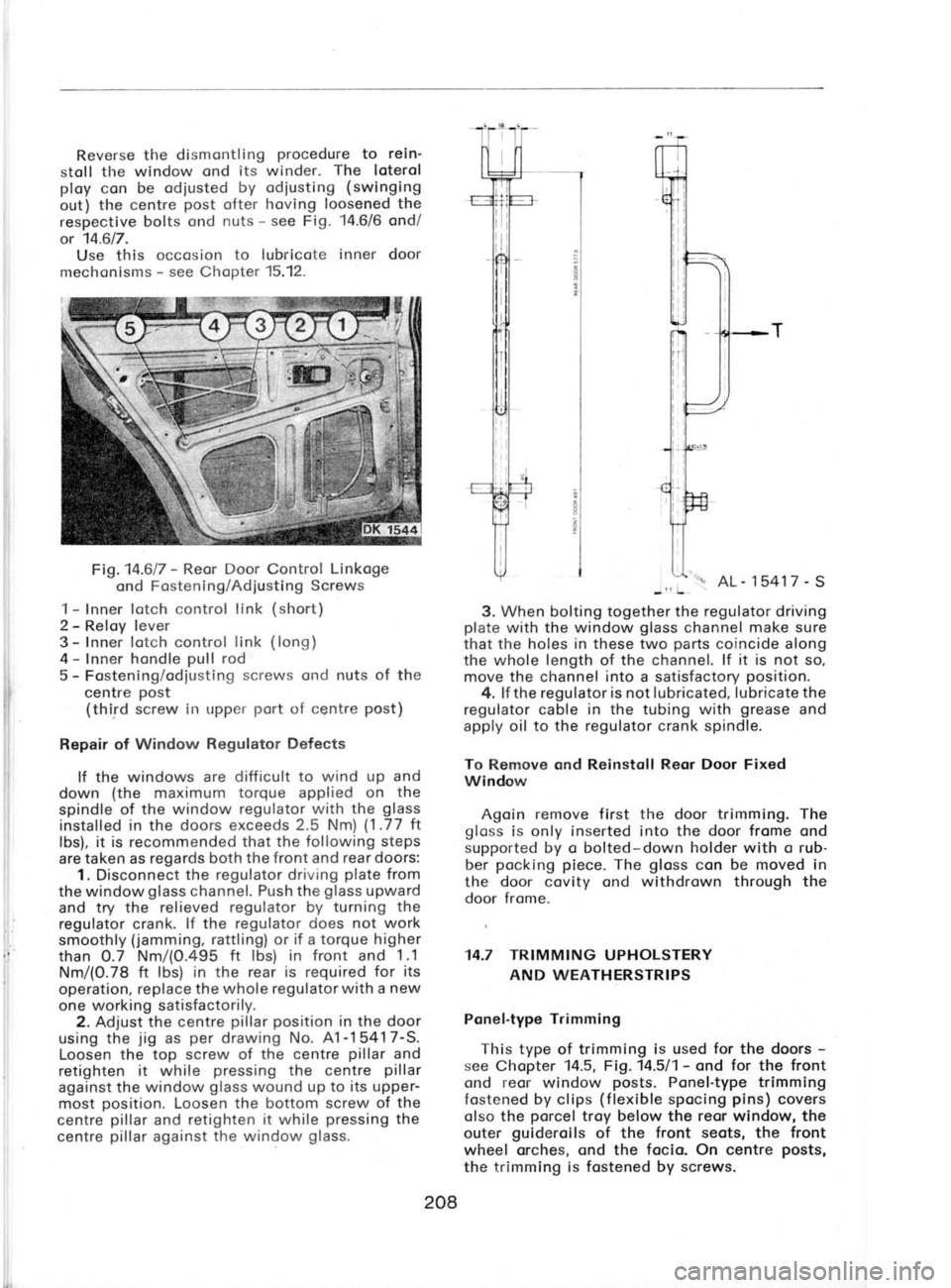
Fig.14.617 -
Reor Door Control Linkoge
ond Fostening/Adiusting Screws
1 -
Inner lotch control link (short)
2 -
Reloy lever
3 -
lnner lotch control link
(long)
4 -
Inner hondle pull
rod
5 -
Fostening/odiusting screws ond nuts
of
the
centre post
(third screw in upper port
of centre post)
Repair of Window Regulator Defects
lf the windows are difficult to wind up and
down (the
maximum torque applied on the
spindle of the window regulator with the glass
installed in the doors exceeds 2.5 Nm) (1.77
tt
lbs), it is recommended that the following steps
are taken as regards both the front
and rear doors:
1. Disconnect the regulator driving plate
from
the window glass
channel. Push the glass
upward
and try the relieved regulator by turning the
regulator crank. lf the regulator does not work
smoothly (jamming,
rattling) or if
a torque higher
than O.7 Nm/(O.495 ft lbs) in front and 1.1
Nm/(0.78 ft lbs) in the rear is required for its
operation, replace the whole regulator with a new
one working satisfactorily.
2. Adjust the centre pillar position
in the door
using the jig
as per
drawing No. A1-1 5417-S.
Loosen the top screw of the centre pillar
and
retighten it while pressing
the centre pillar
against the window glass
wound up to its upper-
most position.
Loosen the bottom screw of the
centre pillar
and retighten it while pressing
the
centre pillar
against the
window glass. 5417
-
S
-l! L
3. When bolting together the regulator driving
plate with the window glass
channel make sure
that the holes in these two parts
coincide along
the whole length of the channel. lf it is not so,
move the
channel into a satisfactory position.
4. lf the regulator is
not lubricated, lubricate the
regulator cable in the
tubing with grease
and
apply oil to the regulator
crank spindle.
To Remove ond Reinstoll Reor Door Fixed
Window
Agoin remove first the door trimming. The
gloss is only inserted
into the door frome ond
supported by o bolted-down holder with o rub-
ber pocking piece.
The gloss
con be moved in
the door
covity ond withdrown through the
door frome.
14.7 TRIMMING UPHOLSTERY AND WEATHERSTRIPS
Ponel-type Trimming
This type of trimming is used for
the doors -
see Chopter 14.5, Fig.14.511- ond for
the front
ond reor window posts.
Ponel-type trimming
fostened by clips (flexible
spocing pins)
covers
olso the porcel
troy below the reor window, the
outer guideroils
of the front seots, the front
wheel orches, ond the focia. On centre posts,
the trimming is fostened by screws.
208
Page 203 of 238

l4.l
l-14.12
has two anchoring points.
The seat belts have
anchoring bolts
on the size 7/16-20 UNF-2A'
In f ront, the anchoring threads
are easily
accessible being provided
on the door posts
(remove only one of the pair
of pins
covering the
thread), on sills
below the posts,
and on
the sides
of the'floor tunnel
behind the front seats'
Anchoring points
for rear seat belts are shown
in the illustation. For the seat
belt of the person
sitting in the
middle, the threads are under the
seat cushions and rather removed from each other
(A3). For the seat belts of persons
occupying the
butside places
the threads are also under the
cushions, nearer to the centre (A2),
in the body
sides close to the cusions (82),
and in window
pillars (C2). These latter threads can be found by
touch in the point
of intersection of the plane
passing about 165 mm
above the
rear window
parcel tray and in parallel
with the door frame at a
distance of about 85 mm. To gain
access to
them,
it is necessary to cut through the trimming.
We must stress that for the fitting of points A2
and A3, the bolts should not protrude
beyond the Fig.M.11l2
-
Lower Anchoring Points
14-12 FACIA
l-he focio cctl be rentoved otter unsct-ewlllg
the nuts of its peripherol bolts ond
ofter lifting
owoy the instrument ponel -
see Chopter '13'15'
It is olso necessory to
remove the steering
wheel with the shroud of
the steering wheel
shoft (see
Chopters 7.7
ond
7.8), ond the heoter
control ponel
(see ChoPter 11.0).
The bolts holding down the focio
ore occess-
ible ofter removin! the
instrument ponel
ond
the heoter control ponel, ond
ofter swinging. out
the glove
box. To swing
out the glove
box,
open its lid ond loosen tlre screws of its
stops'
Fig. 14.1111 -
Upper Anchoring Point
captive not more
than 1lz mm or there is every
likelihood of damaging the
fuel tank.
The depth of the nut from the mounting face
is
15 mm.
Child seat fixing
Follow the seat belt manufacturers instructions
as to the spacing of the belt straps.
The straps can be mounted to the rear parcel
shelf if the mounting holes are drilled 30 mm from
the front engine bulkhead. The
sound deadening
trim in the engine compartment
will need to be
lowered to fit the spreading plate
and nut.
Be careful when drilling the shelf, not to
scratch the rear screen. Fig.
14.1211 -
Focio Mounting Points
14.13 WATER LEAKS
To determine the
source of
a water leak
proceed in a progressive
manner.
1. Determine area
water finally rests'
2. lf possible follow
water trace to
source'
3. lf hot, remove carpets and clutter'
4. Dry car inside
and out'
5. Us'e a sprinkler rather
than
a hose jet'
6. Start on the
underside of
the vehicle and
work up. Do not
do any adjustments or
sealing until after the
first test.
7. When"you have
finished adjustments and
sealing RE
TEST.
212
Page 210 of 238
tificotion
number, or in
words. For exomple
Mobiloil 30 is on oil in the SAE 30 viscosity
closs, Mobiloil Speciol belongs to the SAE
10 W/30 closs. We quote
the viscosity closs
symbol of oils identified
in this woy in brockets
following the oil brond (trode
nome).
Oils designoted by o doubled viscosity closs
symbol ore the so-colled multigrode oils. Their
complionce with viscosity clossificotion is ex-
pressed by the symbol before the froction line
progressively to the clossificotion expressed by
the symbol behind the froction line. Thus,
for
instonce, the SAE 10W/30 oil hos the properties
of the sAE 10w, sAE 20w120,
ond sAE 30
closs.
Czechoslovok oils
Motor oil M6 AD (SAE
30), M4AD (SAE
20W/
20), Mogul Super SAE 20W50,
Mogul Speciol
SAE 2OW/30
Modit Oil SAE 30 (M6
AD), Modit Oil SAE
2OWl2O (M4AD), Modit Oil Speciol
SAE 10W/
30, Modit Super SAE 10W/40
Foreign oils
Agip: Agip F. 1 Motor Oil HD SAE 10W/20,
2OWl30, 4Ol5O; Agip F. 1
Super Motoroil
10w/40,20wl50
BP: Energol HD SAE 40, 30, 2OW (2OW|?O),
10W; Super Visco-Stotic 10Wi30, 10W/40,
20wt20
Costrof : Costrol 40,
30, 20Wl2O, '10
W; Costrolite
(SAE 10W/30), XL (SAE 20W/50);
GTX
(SAE 10w/50)
Mobil: Mobiloil 40, 30, 2OWl2O,
10W; Speciol
(SAE 10W/30); Speciol 20W/50; Super (SAE
10w/so)
Shef l; X-100 40, 30, 2OWl20,
10W; Super (SAE
10w/so)
Other oils of foreign moke con be used if equi-
volent to the listed bronds, for
exomple, Avio,
Esso, Heno (Optimol
LD), INA (Delto TLX),
Noftogos (Golox GTX, Omnio) etc.
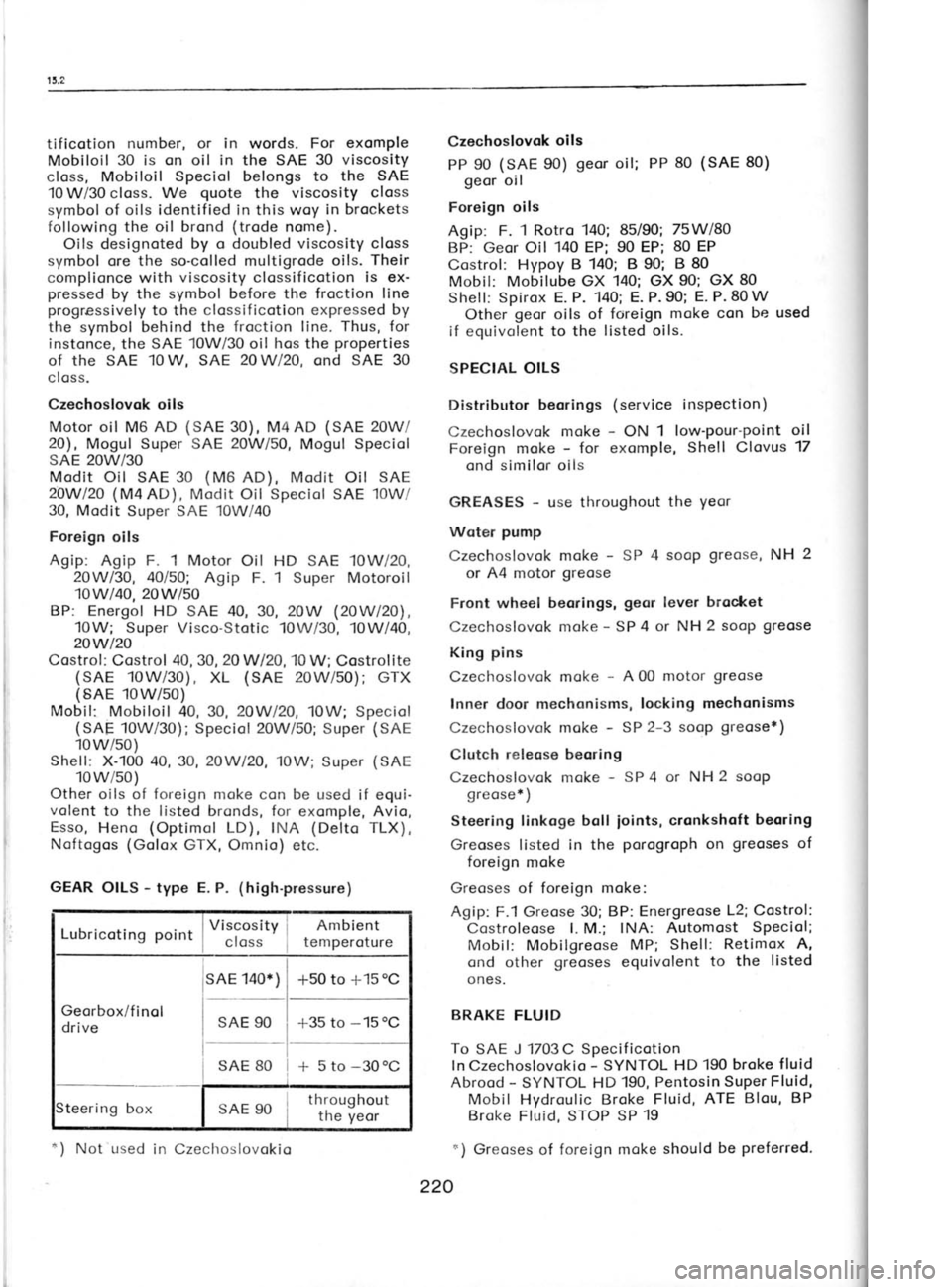
GEAR OILS -
type E. P. (high-pressure)
I Viscosity j Ambient
Lubricoting noint
I closs
! temperoture
sAE 140*) -r50
to +15 oC
Georbox/f inol
drive SAE
90
*35 to -15
oC
* 5 to -30oC
SAE 80
teering box SAE 90 throughout
the yeor Czechoslovok
oils
PP 90 (SAE
90) geor
oil; PP 80 (SAE 80)
geor oil
Foreign oils
Agip: F. 1 Rotro 140; 85/90; 75Wl8O
BP: Geor Oil 140
EP; 90 EP; 80 EP
Costrol: Hypoy B 140; B 90; B 80
Mobil: Mobilube GX 140; GX 90; GX 80
Shell: Spirox E. P. 140; E. P. 90; E. P. 80 W
Other geor
oils of foreign moke con be used
if equivolent to the listed oils.
SPECIAL OILS
Distributor beorings (service inspection)
Czechoslovok moke -
ON 1 low'pour-point oil
Foreign moke -
for exomple, Shell Clovus 17
ond similor oils
GREASES -
use throughout the yeor
Woter pump
Czechoslovok moke -
SP 4 sooP greose,
NH 2
or A4 motor greose
Front wheel beorings, geor lever
brocket
Czechoslovok moke -
SP 4 or NH 2 soop greose
King pins
Czechoslovok moke -
A 00 motor greose
Inner door mechonisms, locking mechonisms
Czechoslovok moke -
SP 2-3 soop greose*)
Clutch releose beoring
Czechoslovok moke -
SP 4 or NH 2 soop
greose* )
Steering tinkoge boll
ioints, cronkshoft
beoring
Greoses listed in the porogroph
on greoses
of
foreign moke
Greoses of foreign moke:
Agip: F.1 Greose 30; BP: Energreose L2; Costrol:
Costroleose l. M.; INA: Automost Speciol;
Mobil: Mobilgreose MP;
Shell: Retimox A,
ond other greoses
equivolent to
the listed
ones.
BRAKE FLUID
To SAE J 1703C Specificotion
ln Czechoslovokio -
SYNTOL HD 190 broke fluid
Abrood -
SYNTOL HD 190, Pentosin
Super Fluid,
Mobil Hydroulic Broke Fluid, ATE Blou, BP
Broke Fluid, STOP SP 19
r) Greoses of foreign moke should be preferred.
220
*)
Not used
in Czechoslovokio
Page 218 of 238
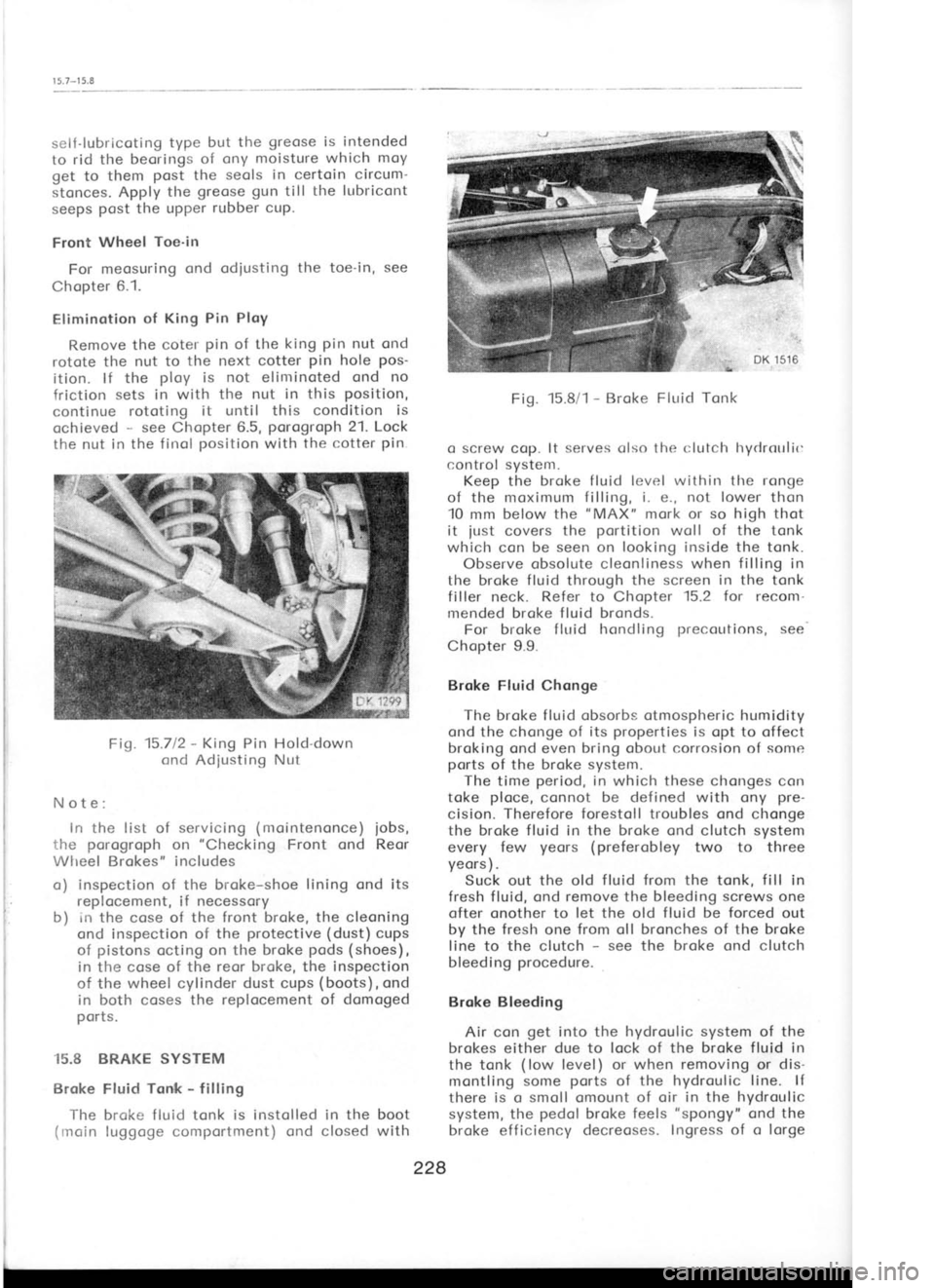
I 5.7*
1
5.8
sell-lubricoting type
but the greose is intended
to rid the beorings of ony moisture which moy
get to them post
the seols in certoin circum-
stonces. Apply the greose
gun
till the lubricont
seeps post
the upper rubber cuP.
Front Wheel Toe-in
For meosuring
ond odiusting the toe-in, see
Chopter 6.1.
Fliminqtion of
King Pin PloY
Remove the coter pin
of the king pin
nut ond
rotote the nut to the next cotter pin
hole pos-
ition. lf the ploy
is not elinrinoted ond no
friction sets in with the nut in this position,
continue rototing it
until this condition is
ochieved -
see Chopter 6.5, porogroph 21. Lock
the nut in the f irrol position
with the cotter pin
Fig. 15.712 -
King Pin Hold-down
cnd Adjusting Ntit
Note: irr the list
of servicing (mointenonce)
iobs,
I,he porogroph on "Checking
Front ond Reor
Wlreel Brokes" includes
o) inspection of the broke-shoe lining ond its
replocement, if necessory
b) in the cose of the front broke, the cleoning
ond inspection of the protective (dust) cups
of pistons octing on the broke pods (shoes),
in the cose of the reor broke, the inspection
of the wheel cylinder dust cups (boots),
ond
in both coses the replocement of domoged
ports.
i5.8 BRAKE SYSTEM
Broke Fluid Tonlk -
filling
The brake f luid tonk is instolled in the boot
{inoin luggcrge comportment)
cnd closed with Fig.
15.8/1 -
Broke Fluid Tonk
o screw cop. lt serves
olso the r:lutclr lryrlrotrlic
control systenr. Keep the brqke fluid level withirr tlre ronge
of the moximum filling, i.
e., not lower
thon
10 mm below the "MAX"
mork or so high thot
it just
covers the pcrtition
woll of the tonk
which con be seen on looking inside the tonk.
Observe obsolute cleonliness when filling
in
the broke fluid through the screen in the tonk
filler neck. Refer to
Chopter 15.2 for recon'r.
mended broke fluid bronds. For broke fluid hondlinq precoutions, see
Chopter 9.9.
Brqke Fluid Chonge
The broke f luid obsorbs otmospheric humidity
ond the chcnge of its properties
is opt to offect
broking ond even bring obout corrosion of some
ports of the broke system.
The time period,
in which these chonges
con
toke ploce,
connot be defined with ony pre-
cision. Therefore forestoll troubles ond chonge
the broke fluid in the broke ond clutch system
every few yeors (preferobley
two to three
yeors ) .
Suck out the old f
luid from
the tonk, fill in
fresh fluid, ond remove the bleeding screws
one
ofter onother to let the old fluid be forced out
by the fresh
one from oll bronches of the broke
line to the clutch -
see the broke ond clutch
bleeding procedure.
Broke Bleeding Air con get
into the hydroulic system
of the
brokes either due to lock
of the broke fluid in
the tonk (low
level) or when removing
or dis-
montling some ports
of the hydroulic line. lf
there is o smoll omount of oir in the hydroulic
system, the pedol broke feels "spongy"
ond the
broke efficiency decreoses. Ingress of o lorge
228
Page 220 of 238

r
5.9-15. r
2
Dismontle the housing, remove
old greose,
cleon the individuol ports,
opply fresh greose,
ond reossemble the housing. Sook the felt rings
on the links (pull-rods)
in engine oil.
15.10 WHEELS AND TYRES, SNOW
CHAINS
Tyre Inflotion, Boloncing
ond lnterchonge
of Wheels
The procedures ore outlined in
Chopters 10.1
through 10.3. Snow
choins ond their use ore
deolt with in Chopter 10.6.
Wheel Toe-in -
see Chopter 16.1.
Shock Absorbers -
see Chopter 8.3 "Shock
Absorbers ".
15.11 ELECTRTCAL EQUTPMENT
Checking electrolyte level ond topping up --
see Chopter 13.2.
Sporking plugs -
electrode gop
odiustment,
etc. -
see Chopter 13.7.
Stqrter motor -
exqminqtion ond renewol of
brushes, etc. -
see Chopters 13.11 through 13.14.
lgnition timing, odiustment of contoct breoker
point gop, distributor lubricotion -
see Chop-
ter 15.3.
15.12 BODYWORK -
UNDERBODY
Woshing ond Mointenonce
The visible ports
of the body qre
f inislred in
o hord synthetic boking vornish, the remoining
ports in synthetic vornish.
The underbody is sproy-cooted
with o plostic
compound -
for detoiled informotion, see Chop-
ter '14.9.
Follow the
usuol procedures
when
woshing, cleoning ond polishing
the cor, ond
observe the specific instructions for
the use of
woshing ond cleoning preporotions,
issued by
their monufocturers.
All lights with the exception
of heodlomps
hove cosings of plostic
moteriols qnd
they
should be cleoned onlywith woteror shompoos.
When hosing down the corr
cover the voltoge
regulotor of the olternotor ond
the ignition coil
to protect
them ogoinst sploshing with woter,
ond do not
sproy woter direct on
the door lock
ond the lid covering the fuel
tonk filler neck.
Woshing ond Core of Underbody
Mechonisms
The underbody mechonisms
ore protected
with o synthetic vornish which stonds
well the
usuol woshing procedures.
Protect oll rubberports
ogoinst direct contoct with speciol chemi-
col solvLnts or limit the durotion of this
contoct
to o minimum before
o complete woshing off of
the solvents with woter (by
hosing down, etc.)'
Keep the oil cooler, if fitted on
the cor, in
cleon'condition. Hose
it down when woshing
the cor, ond if dirt still
sticks to the cooling
surfoces, use some of the detergents.
Bodywork Lubricotion
Routine mointenonce includes the
lubricotion
of door hinges ond limiters, hinges
ond releose
mechonismi of the engine bonnet ond boot lid,
the releose mechonism of
the spore wheel,
ond
the leveroge of windscreen wipers. Lubricotion
of inner dolor mechonisms is
included in
speciol
mqintenonce. Lubricote oll occessible mechcnisms
with
high-quolity greoses which
do not
dry, do not
oxldize, ond protect
the mechonisms ogoinst
corrosion for o long time. Oil is
not suitoble due
to its short-time efJect. Any greose con
be used
to lubricqte the
door limiters ond
the front
seot
slide roils.
Lubricotion of SporeWheel Corrier
Bearings-
Remove the spore wheel,
cleon the hinges, ond
opply oil on iheit
upper sides. In oddition, rub
in greose of ony brond.
Lubricotion of Windscreen Wiper
Leveroge -
Remove the cover of the
ioint (o
plostic cup),
f ill it with greose, lubricote the
ioint, ond
rein-
stoll tlre cover.
The Lubricotion of
Inner Door Mechonisms
is possible only
ofter removing the
door ponel
ond the inner 'door
mechonism. Use
only re-
commended greose brcnds.
Lubricote
the bowden
coble of thJwindow wind-up mechonism
with
Fig.15.1211- Lubricotion
of Windscreen Wiper
Leveroge Joint -
ioint cover
230