light SKODA CITIGO 2013 1.G User Guide
[x] Cancel search | Manufacturer: SKODA, Model Year: 2013, Model line: CITIGO, Model: SKODA CITIGO 2013 1.GPages: 176, PDF Size: 10.54 MB
Page 21 of 176
CAUTIONThe red oil pressure light is not an oil level indicator! One should therefore
check the oil level at regular intervals, preferably after every refuelling stop.
Coolant
First read and observe the introductory information and safety warn-ings
on page 16.
The warning light comes on for a few seconds when the ignition is switched
on.
If the warning light
lights up or flashes, either the coolant temperature is too
high or the coolant level is too low.
An audible signal sounds as a warning tone.
Stop the vehicle, switch off the engine, check the level of the coolant » page 132,
and refill the coolant if necessary » page 133.
Do not continue your journey if for some reason it is not possible to top up the
coolant under the prevailing conditions. This can cause serious engine damage.
Therefore, switch the engine off and seek help from a specialist garage.
If the coolant is within the specified range, the increased temperature may be
caused by an operating problem at the radiator fan. Check the fuse for the radia-
tor fan, replace if necessary » page 156, Fuses in the engine compartment .
Do not continue driving if the warning light
does not go off even though the
coolant level is correct and the fuse for the fan is in working order!
Seek help from a specialist garage.
WARNINGIf you have to stop for technical reasons, then park the vehicle at a safe dis- tance from the traffic, switch off the engine and activate the hazard warning
lights » page 36 .
Power steering
First read and observe the introductory information and safety warn-
ings
on page 16.
The warning light comes on for a few seconds when the ignition is switched
on.
If the warning light after switching on the ignition or when driving lights up con-
tinuously, a fault exists in the electromechanical power steering.
› If the
yellow warning light lights up
, this indicates a partial failure of the
power steering and the steering forces can be greater.
› If the
red warning light lights up
, this indicates a complete failure of the pow-
er steering and the steering assist has failed (significantly higher steering forces).
Further information » page 66.
Note
■
If the yellow warning light goes out after starting the engine again and driv-
ing a short distance, it is not necessary to visit a specialist garage.■
If the vehicle battery has been disconnected and reconnected, the yellow warn-
ing light comes on after switching on the ignition. The warning light should go
out after driving a short distance.
Electronic Stability Control (ESC)
First read and observe the introductory information and safety warn-
ings
on page 16.
The warning light flashes
to show that the ESC is currently operating.
If the warning light
lights up, there is a fault in the ESC.
As the ESC operates in conjunction with the ABS, the ESP warning light will also come on if the ABS system fails.
If the warning light
comes on immediately after starting the engine, the ESC
can be switched off for technical reasons. In this case, the ESC can be switched on again by switching the ignition on and off. If the warning light goes out, the ESC is fully functional again.
Further information » page 80, Electronic Stability Control (ESC) .
18Using the system
Page 22 of 176
NoteIf the vehicle's battery has been disconnected and reconnected, the warning light comes on after switching on the ignition. The warning light should go out after
driving a short distance.
Traction Control System (TC)
First read and observe the introductory information and safety warn-ings
on page 16.
The warning light
comes on for a few seconds when the ignition is switched
on.
The warning light comes on when driving when a control cycle is activated. The warning light illuminates permanently if there is a fault in the TCS.
The fact that the TCS operates together with the ABS means that the TCS warn-ing light will also come on if the ABS system is not operating properly.
If the warning light comes on immediately after starting the engine, the TCS
can be switched off for technical reasons. In this case, the TCS can be switched
on again by switching the ignition on and off. If the warning light goes out, the
TCS is fully functional again.
Further information » page 81, Traction Control System (TCS) .
Note
If the vehicle's battery has been disconnected and reconnected, the warning light
comes on after switching on the ignition. The warning light should go out after
driving a short distance.
Antilock brake system (ABS)
First read and observe the introductory information and safety warn-ings
on page 16.
If the warning light
lights up, there is a fault in the ABS.
The vehicle will only be braked by the normal brake system without the ABS. Seek help from a specialist garage.
Further information » page 81, Antilock Braking System (ABS) .WARNING■
If you have to stop for technical reasons, then park the vehicle at a safe dis-
tance from the traffic, switch off the engine and activate the hazard warning
light system » page 36.■
If the warning light » page 16 is displayed simultaneously with the ABS
warning light , do not continue your journey! Seek help from a specialist
garage.
■
The following guidelines should be observed when opening the bonnet and
checking the brake fluid level » page 127, Engine compartment .
■
A fault to the ABS system or the braking system can increase the vehicle's
braking distance – risk of accident!
The rear fog light
First read and observe the introductory information and safety warn-ings
on page 16.
The warning light
comes on when the rear fog lights are operating » page 35.
Exhaust inspection system
First read and observe the introductory information and safety warn-
ings
on page 16.
If the warning light
lights up, there is a fault in the exhaust inspection system.
The engine control unit allows the vehicle to run in emergency mode.
Seek help from a specialist garage.
EPC fault light
First read and observe the introductory information and safety warn-ings
on page 16.
If the warning light
lights up, there is a fault in the engine control. The engine
control unit allows the vehicle to run in emergency mode.
Seek help from a specialist garage.
19warning lights and instruments
Page 23 of 176
Airbag systemFirst read and observe the introductory information and safety warn-ings
on page 16.
Monitoring the airbag system
The warning light comes on for a few seconds when the ignition is switched
on.
There is a fault in the system if the warning light does not go out or flashes while
driving »
. This also applies if the warning light does not come on when the ig-
nition is switched on.
The operational capability of the airbag system is monitored electronically, includ-
ing when one of the airbags is switched off.
The following situation applies if the front or side airbag or belt tensioner have
been switched off using the vehicle system tester:
› The warning light
lights up for around 4 seconds after switching on the igni-
tion and then flashes approximately another 12 seconds in 2 second intervals.
The following situation applies if the airbag has been switched off using the key switch for the airbag in the front passenger storage compartment:
› The warning light
comes on for a few seconds when the ignition is switched
on;
› The deactivated airbag is indicated by the illumination of the warning light
in the middle of the dash panel » page 102, Deactivating
the front passenger airbag .
WARNINGIf there is a fault, have the airbag system checked immediately by a specialist
garage. Otherwise, there is a risk that the airbag will not be deployed in the event of an accident.
Automated transmission
First read and observe the introductory information and safety warn-
ings
on page 16.
Warning light
Do not continue your journey if the warning light
lights up and an acoustic sig-
nal sounds. Switch off the engine and seek assistance from a specialist garage.
Warning light
If the warning light lights up and no gear can be selected, switch the ignition
on and off. If the warning light lights up after you switch on the ignition, seek as- sistance from a specialist garage.
If the warning light or warning light lights up and an acoustic signal sounds,
this means that the automatic gearbox has overheated. Stop and allow the trans-
mission to cool down or drive more quickly than 20 km/h (12 mph).
If the warning light lights up again, switch off the vehicle, shut off the engine
and allow the gearbox to cool down.
Warning light
If the warning light lights up, operate the brake pedal.
Warning light
If the warning light lights up, operate the handbrake.
Further information » page 71, Automated transmission .WARNINGIf you have to stop for technical reasons, then park the vehicle at a safe dis-
tance from the traffic, switch off the engine and activate the hazard warning
lights » page 36 .
Turn signal system
First read and observe the introductory information and safety warn-ings
on page 16.
Either the left
or right
warning light flashes depending on the position of the
turn signal lever.
If a turn signal light fails, the warning light flashes at twice its normal rate.
Switching off the hazard warning light system is switched on will cause all of the turn signal lights as well as both warning lights to flash.
Further information » page 34, Turn signal and main beam .
20Using the system
Page 24 of 176
Cruise control systemFirst read and observe the introductory information and safety warn-
ings
on page 16.
The warning light comes on when the cruise control is operating » page 83.
Main beam
First read and observe the introductory information and safety warn-ings
on page 16.
The warning light
comes on when the main beam or headlight flasher are se-
lected » page 33 .
/ Safety belt (belt status display) - rear seat
First read and observe the introductory information and safety warn-ings
on page 16.
After switching on the ignition, the belt status warning lights up for the rear
seats in the instrument panel display for 30 seconds and indicates whether any
rear seat passengers have fastened their seat belts. The belt status indicator will
then light up when the passenger on the rear seat fastens or unfastens the seat
belt (when the ignition is switched on or during the journey).
If the warning light
, is switched on, the passenger on the rear seat has their
seat belt on.
If the warning light ,
is switched on, the passenger on the rear seat does not
have their seat belt on.
If a seat belt is unfastened on the rear seat during the journey at a speed of more than 25 km/h, an acoustic signal will sound, and the belt status indicator for the
rear seats will flash for around 30 seconds.
Further information » page 94, Seat belts .
City Safe Drive
First read and observe the introductory information and safety warn-
ings
on page 16.
If the City Safe Drive system is currently slowing the vehicle down automatically,
the warning light will flash quickly .
If the City Safe Drive system is not currently available, or if there is a system fault, the warning light will flash slowly .
When the City Safe Drive system is switched off while the vehicle is travelling at a
speed between 5–30 km/h (3-19 mph), the warning light will light up in the
instrument cluster display.
If the City Safe Drive system is switched on, the warning light in the instrument
cluster display
will light up for around 5 seconds.
Further information » page 86, City Safe Drive .
START STOP
First read and observe the introductory information and safety warn-
ings
on page 16.
If the START STOP system is active, the warning light will light up
.
If the START STOP system is active, but automatic engine shut down is not possi-
ble, the warning light will light up
.
When the warning light flashes
the START STOP system will not be available.
Further information » page 85, START-STOP .
21warning lights and instruments
Page 26 of 176
Replacing the battery in the remote control keyFig. 9
Remote control key: Remove cover/remove battery
First read and observe the introductory information given on page 22.
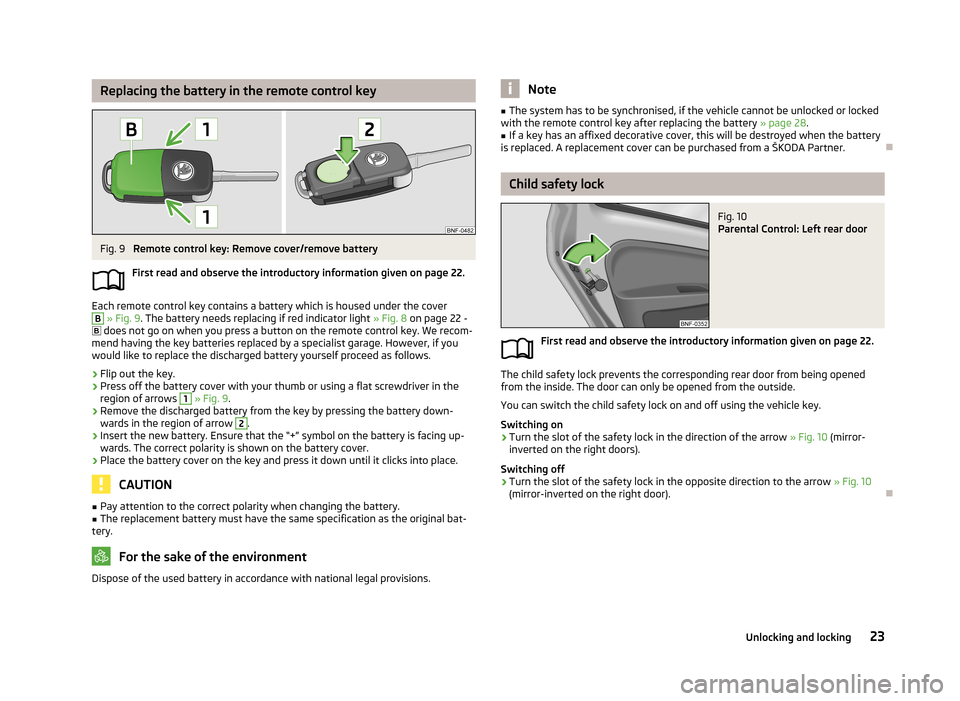
Each remote control key contains a battery which is housed under the cover
B
» Fig. 9 . The battery needs replacing if red indicator light » Fig. 8 on page 22 -
does not go on when you press a button on the remote control key. We recom-
mend having the key batteries replaced by a specialist garage. However, if you
would like to replace the discharged battery yourself proceed as follows.
›
Flip out the key.
›
Press off the battery cover with your thumb or using a flat screwdriver in the region of arrows
1
» Fig. 9 .
›
Remove the discharged battery from the key by pressing the battery down-
wards in the region of arrow
2
.
›
Insert the new battery. Ensure that the “+” symbol on the battery is facing up-wards. The correct polarity is shown on the battery cover.
›
Place the battery cover on the key and press it down until it clicks into place.
CAUTION
■ Pay attention to the correct polarity when changing the battery.■The replacement battery must have the same specification as the original bat-
tery.
For the sake of the environment
Dispose of the used battery in accordance with national legal provisions.Note■ The system has to be synchronised, if the vehicle cannot be unlocked or locked
with the remote control key after replacing the battery » page 28.■
If a key has an affixed decorative cover, this will be destroyed when the battery
is replaced. A replacement cover can be purchased from a ŠKODA Partner.
Child safety lock
Fig. 10
Parental Control: Left rear door
First read and observe the introductory information given on page 22.
The child safety lock prevents the corresponding rear door from being opened from the inside. The door can only be opened from the outside.
You can switch the child safety lock on and off using the vehicle key.
Switching on
›
Turn the slot of the safety lock in the direction of the arrow » Fig. 10 (mirror-
inverted on the right doors).
Switching off
›
Turn the slot of the safety lock in the opposite direction to the arrow » Fig. 10
(mirror-inverted on the right door).
23Unlocking and locking
Page 29 of 176
Safe securing systemFirst read and observe the introductory information and safety warn-
ings
on page 25.
The central locking system is equipped with a safe securing system. The door
locks are blocked automatically if the vehicle is locked from the outside. The warning light flashes for around 2 seconds in quick succession, afterwards it be-gins to flash evenly at longer intervals. It is not possible to open the doors withthe door handle either from the inside or from the outside. This acts as an effec-
tive deterrent against attempts to break into your vehicle.
The safe securing system can be deactivated within 2 seconds by double locking
the vehicle.
If the safe securing system is not operating, the warning light in the driver door flashes for about 2 seconds fast, goes out and starts to flash evenly at longer in-
tervals after about 30 seconds.
The safe securing system is activated again the next time the vehicle is unlocked and locked.
If the vehicle is locked and the safe securing system is deactivated, the door can
be opened from the inside by a single pull on opening lever of the respective
door.
WARNINGIf the vehicle is locked from the outside and the safe securing system is acti-
vated, there must not be any person in the vehicle as it is then no longer pos-
sible to open either a door or a window from the inside. The locked doors
make it more difficult for rescuers to get into the vehicle in an emergency – risk to life!
Note
You will be informed that the safe securing system has been activated after the
vehicle has been locked by means of the message on the instrument clus-
ter display.
Unlocking the vehicle using the keyFig. 14
Left side of the vehicle: Turning
the key for unlocking and lock-
ing the vehicle
First read and observe the introductory information and safety warn- ings on page 25.
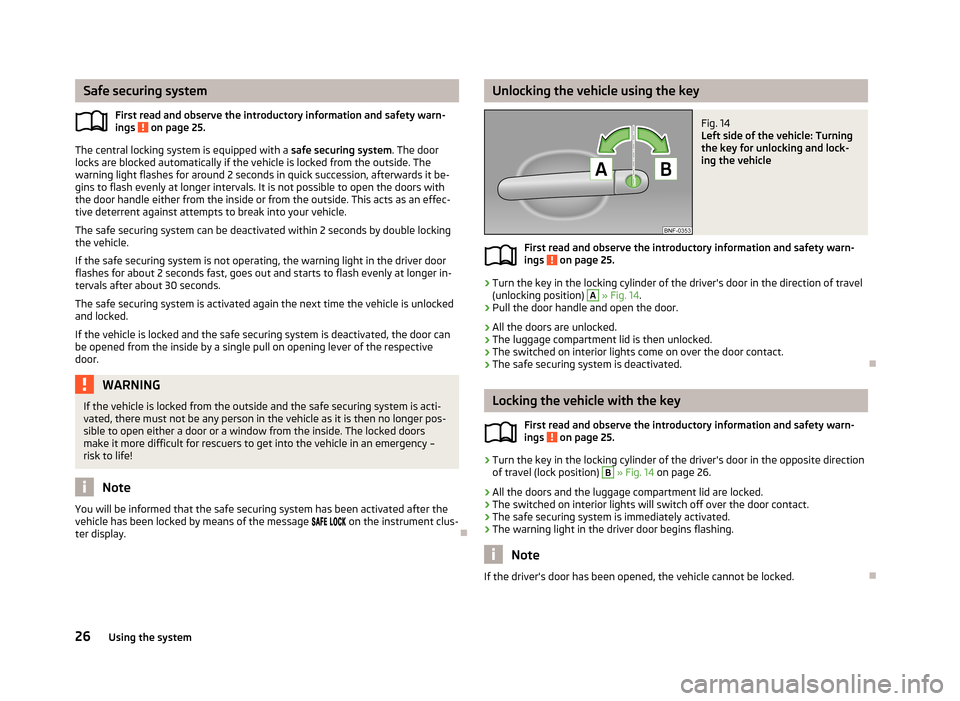
›
Turn the key in the locking cylinder of the driver's door in the direction of travel
(unlocking position)
A
» Fig. 14 .
›
Pull the door handle and open the door.
› All the doors are unlocked.
› The luggage compartment lid is then unlocked.
› The switched on interior lights come on over the door contact.
› The safe securing system is deactivated.
Locking the vehicle with the key
First read and observe the introductory information and safety warn-
ings
on page 25.
›
Turn the key in the locking cylinder of the driver's door in the opposite direction
of travel (lock position)
B
» Fig. 14 on page 26.
› All the doors and the luggage compartment lid are locked.
› The switched on interior lights will switch off over the door contact.
› The safe securing system is immediately activated.
› The warning light in the driver door begins flashing.
Note
If the driver's door has been opened, the vehicle cannot be locked.
26Using the system
Page 30 of 176
Vehicle locking/unlocking from the insideFig. 15
Central locking button
First read and observe the introductory information and safety warn-ings on page 25.
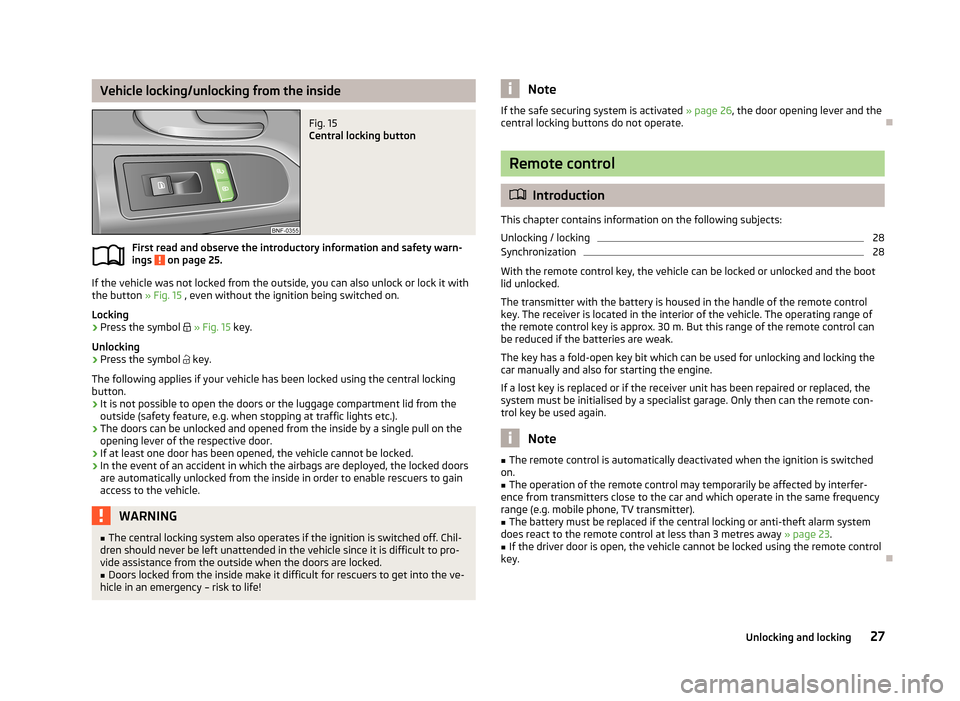
If the vehicle was not locked from the outside, you can also unlock or lock it with
the button » Fig. 15 , even without the ignition being switched on.
Locking
›
Press the symbol
» Fig. 15 key.
Unlocking
›
Press the symbol
key.
The following applies if your vehicle has been locked using the central locking button.
› It is not possible to open the doors or the luggage compartment lid from the
outside (safety feature, e.g. when stopping at traffic lights etc.).
› The doors can be unlocked and opened from the inside by a single pull on the
opening lever of the respective door.
› If at least one door has been opened, the vehicle cannot be locked.
› In the event of an accident in which the airbags are deployed, the locked doors
are automatically unlocked from the inside in order to enable rescuers to gain
access to the vehicle.
WARNING■ The central locking system also operates if the ignition is switched off. Chil-
dren should never be left unattended in the vehicle since it is difficult to pro-
vide assistance from the outside when the doors are locked.■
Doors locked from the inside make it difficult for rescuers to get into the ve-
hicle in an emergency – risk to life!
NoteIf the safe securing system is activated » page 26, the door opening lever and the
central locking buttons do not operate.
Remote control
Introduction
This chapter contains information on the following subjects:
Unlocking / locking
28
Synchronization
28
With the remote control key, the vehicle can be locked or unlocked and the boot
lid unlocked.
The transmitter with the battery is housed in the handle of the remote control
key. The receiver is located in the interior of the vehicle. The operating range of
the remote control key is approx. 30 m. But this range of the remote control can
be reduced if the batteries are weak.
The key has a fold-open key bit which can be used for unlocking and locking the
car manually and also for starting the engine.
If a lost key is replaced or if the receiver unit has been repaired or replaced, thesystem must be initialised by a specialist garage. Only then can the remote con-
trol key be used again.
Note
■ The remote control is automatically deactivated when the ignition is switched
on.■
The operation of the remote control may temporarily be affected by interfer-
ence from transmitters close to the car and which operate in the same frequency
range (e.g. mobile phone, TV transmitter).
■
The battery must be replaced if the central locking or anti-theft alarm system
does react to the remote control at less than 3 metres away » page 23.
■
If the driver door is open, the vehicle cannot be locked using the remote control
key.
27Unlocking and locking
Page 31 of 176
Unlocking / lockingFig. 16
Remote control key
First read and observe the introductory information given on page 27.
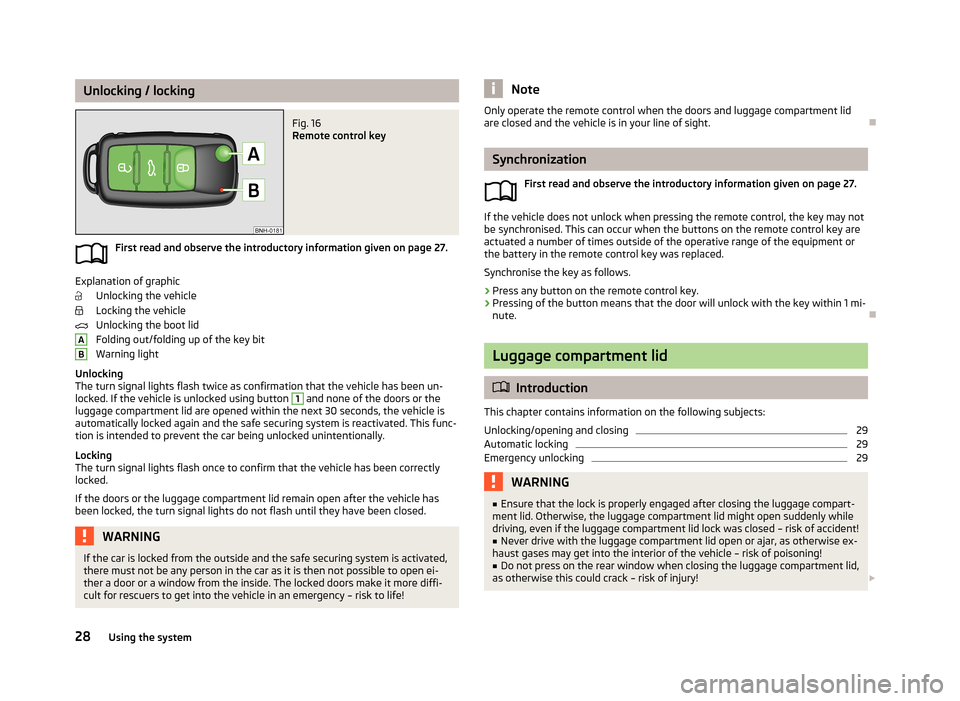
Explanation of graphicUnlocking the vehicle
Locking the vehicle
Unlocking the boot lid
Folding out/folding up of the key bit
Warning light
Unlocking
The turn signal lights flash twice as confirmation that the vehicle has been un-
locked. If the vehicle is unlocked using button
1
and none of the doors or the
luggage compartment lid are opened within the next 30 seconds, the vehicle is
automatically locked again and the safe securing system is reactivated. This func-
tion is intended to prevent the car being unlocked unintentionally.
Locking
The turn signal lights flash once to confirm that the vehicle has been correctly
locked.
If the doors or the luggage compartment lid remain open after the vehicle has
been locked, the turn signal lights do not flash until they have been closed.
WARNINGIf the car is locked from the outside and the safe securing system is activated,
there must not be any person in the car as it is then not possible to open ei-
ther a door or a window from the inside. The locked doors make it more diffi-
cult for rescuers to get into the vehicle in an emergency – risk to life!ABNoteOnly operate the remote control when the doors and luggage compartment lid
are closed and the vehicle is in your line of sight.
Synchronization
First read and observe the introductory information given on page 27.
If the vehicle does not unlock when pressing the remote control, the key may notbe synchronised. This can occur when the buttons on the remote control key are
actuated a number of times outside of the operative range of the equipment or
the battery in the remote control key was replaced.
Synchronise the key as follows.
›
Press any button on the remote control key.
›
Pressing of the button means that the door will unlock with the key within 1 mi-
nute.
Luggage compartment lid
Introduction
This chapter contains information on the following subjects:
Unlocking/opening and closing
29
Automatic locking
29
Emergency unlocking
29WARNING■ Ensure that the lock is properly engaged after closing the luggage compart-
ment lid. Otherwise, the luggage compartment lid might open suddenly while
driving, even if the luggage compartment lid lock was closed – risk of accident!■
Never drive with the luggage compartment lid open or ajar, as otherwise ex-
haust gases may get into the interior of the vehicle – risk of poisoning!
■
Do not press on the rear window when closing the luggage compartment lid,
as otherwise this could crack – risk of injury!
28Using the system
Page 32 of 176
NoteA closed, but not locked luggage compartment lid is locked automatically when
driving off, or when travelling at speeds greater than about 9 km/h. It is unlocked
again after the vehicle stops and the door is opened.
Unlocking/opening and closing
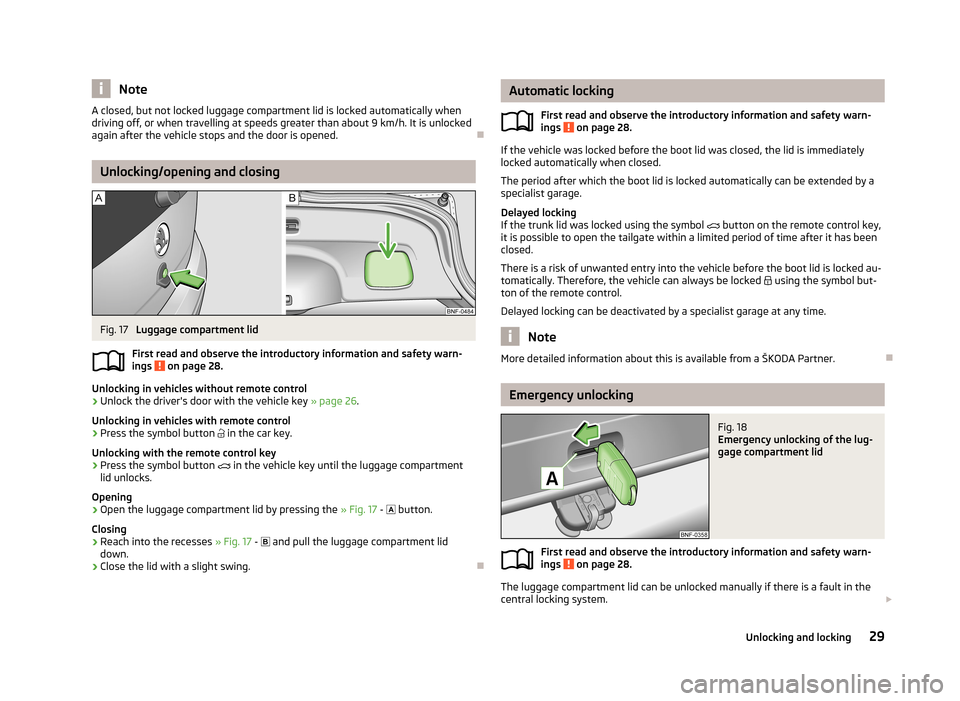
Fig. 17
Luggage compartment lid
First read and observe the introductory information and safety warn-
ings
on page 28.
Unlocking in vehicles without remote control
›
Unlock the driver's door with the vehicle key » page 26.
Unlocking in vehicles with remote control
›
Press the symbol button
in the car key.
Unlocking with the remote control key
›
Press the symbol button
in the vehicle key until the luggage compartment
lid unlocks.
Opening
›
Open the luggage compartment lid by pressing the » Fig. 17 -
button.
Closing
›
Reach into the recesses » Fig. 17 -
and pull the luggage compartment lid
down.
›
Close the lid with a slight swing.
Automatic locking
First read and observe the introductory information and safety warn-
ings
on page 28.
If the vehicle was locked before the boot lid was closed, the lid is immediately
locked automatically when closed.
The period after which the boot lid is locked automatically can be extended by a specialist garage.
Delayed locking
If the trunk lid was locked using the symbol button on the remote control key,
it is possible to open the tailgate within a limited period of time after it has been
closed.
There is a risk of unwanted entry into the vehicle before the boot lid is locked au- tomatically. Therefore, the vehicle can always be locked
using the symbol but-
ton of the remote control.
Delayed locking can be deactivated by a specialist garage at any time.
Note
More detailed information about this is available from a ŠKODA Partner.
Emergency unlocking
Fig. 18
Emergency unlocking of the lug-
gage compartment lid
First read and observe the introductory information and safety warn-
ings on page 28.
The luggage compartment lid can be unlocked manually if there is a fault in the
central locking system.
29Unlocking and locking
Page 33 of 176
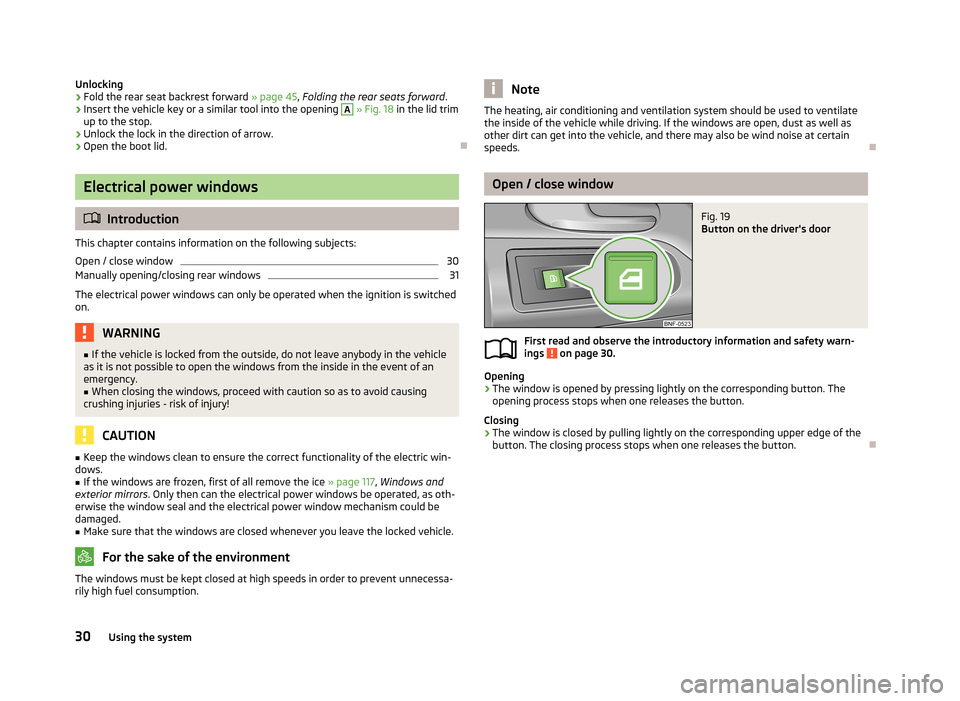
Unlocking›Fold the rear seat backrest forward » page 45, Folding the rear seats forward .›
Insert the vehicle key or a similar tool into the opening
A
» Fig. 18 in the lid trim
up to the stop.
›
Unlock the lock in the direction of arrow.
›
Open the boot lid.
Electrical power windows
Introduction
This chapter contains information on the following subjects:
Open / close window
30
Manually opening/closing rear windows
31
The electrical power windows can only be operated when the ignition is switched
on.
WARNING■ If the vehicle is locked from the outside, do not leave anybody in the vehicle
as it is not possible to open the windows from the inside in the event of an
emergency.■
When closing the windows, proceed with caution so as to avoid causing
crushing injuries - risk of injury!
CAUTION
■ Keep the windows clean to ensure the correct functionality of the electric win-
dows.■
If the windows are frozen, first of all remove the ice » page 117, Windows and
exterior mirrors . Only then can the electrical power windows be operated, as oth-
erwise the window seal and the electrical power window mechanism could be
damaged.
■
Make sure that the windows are closed whenever you leave the locked vehicle.
For the sake of the environment
The windows must be kept closed at high speeds in order to prevent unnecessa-
rily high fuel consumption.NoteThe heating, air conditioning and ventilation system should be used to ventilate
the inside of the vehicle while driving. If the windows are open, dust as well as
other dirt can get into the vehicle, and there may also be wind noise at certain
speeds.
Open / close window
Fig. 19
Button on the driver's door
First read and observe the introductory information and safety warn- ings on page 30.
Opening
›
The window is opened by pressing lightly on the corresponding button. The opening process stops when one releases the button.
Closing
›
The window is closed by pulling lightly on the corresponding upper edge of the
button. The closing process stops when one releases the button.
30Using the system