light SKODA CITIGO 2013 1.G Owner's Guide
[x] Cancel search | Manufacturer: SKODA, Model Year: 2013, Model line: CITIGO, Model: SKODA CITIGO 2013 1.GPages: 176, PDF Size: 10.54 MB
Page 36 of 176
Lights and visibility
Lights
Introduction
This chapter contains information on the following subjects:
Lights and low beam
33
Headlight beam adjustment
34
Daytime running light (DAY LIGHT)
34
Turn signal and main beam
34
Fog lights
35
Rear fog light
35
Hazard warning light system
36
Parking light
36
Unless otherwise stated, the lights only work when the ignition is on.
On models fitted with right-hand steering the position of the controls differs
from that shown in » Fig. 22 on page 33 . The symbols which mark the positions
of the controls are however identical.
WARNING■ The activation of the lights should only be undertaken in accordance with
national legal requirements.■
The driver is always responsible for the correct settings and use of the
lights.
■
Never drive with only the side lights on! The side lights are not bright
enough to light up the road sufficiently in front of you or to be seen by other oncoming traffic. Therefore always switch on the low beam when it is dark or
if visibility is poor.
Note■ The instruments are also illuminated when the side light or low beam light is
switched on.■
The headlights may mist up temporarily. When the driving lights are switched
on, the light outlet surfaces are free from mist after a short period, although the
headlight lenses may still be misted up in the peripheral areas. This mist has no
influence on the life of the lighting system.
Lights and low beam
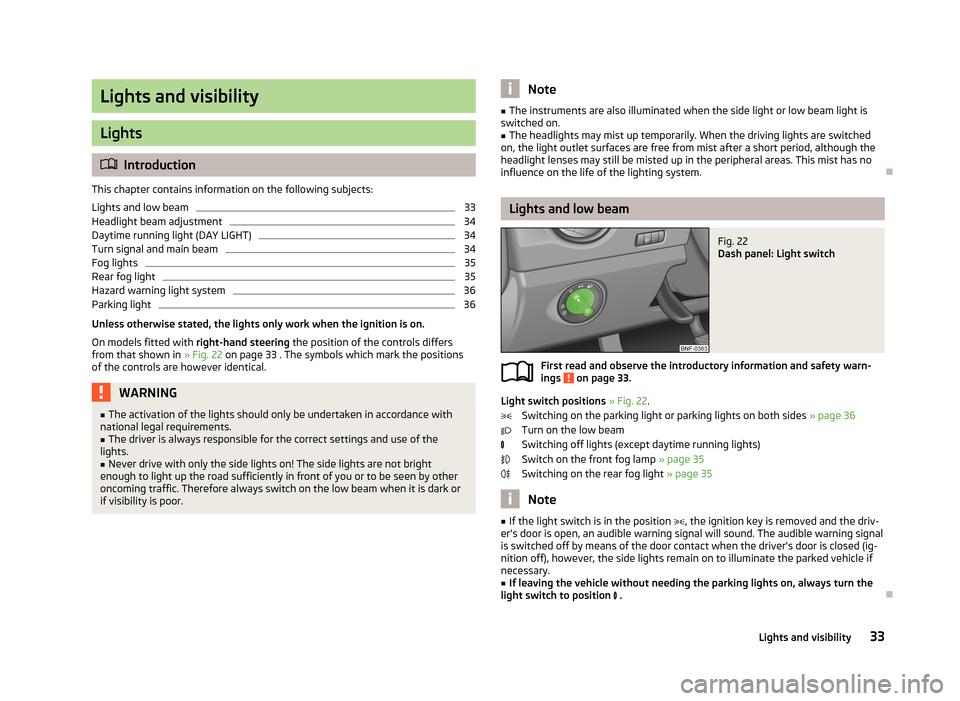
Fig. 22
Dash panel: Light switch
First read and observe the introductory information and safety warn-
ings on page 33.
Light switch positions » Fig. 22 .
Switching on the parking light or parking lights on both sides » page 36
Turn on the low beam
Switching off lights (except daytime running lights)
Switch on the front fog lamp » page 35
Switching on the rear fog light » page 35
Note
■
If the light switch is in the position , the ignition key is removed and the driv-
er's door is open, an audible warning signal will sound. The audible warning signal
is switched off by means of the door contact when the driver's door is closed (ig- nition off), however, the side lights remain on to illuminate the parked vehicle ifnecessary.■
If leaving the vehicle without needing the parking lights on, always turn the
light switch to position .
33Lights and visibility
Page 37 of 176
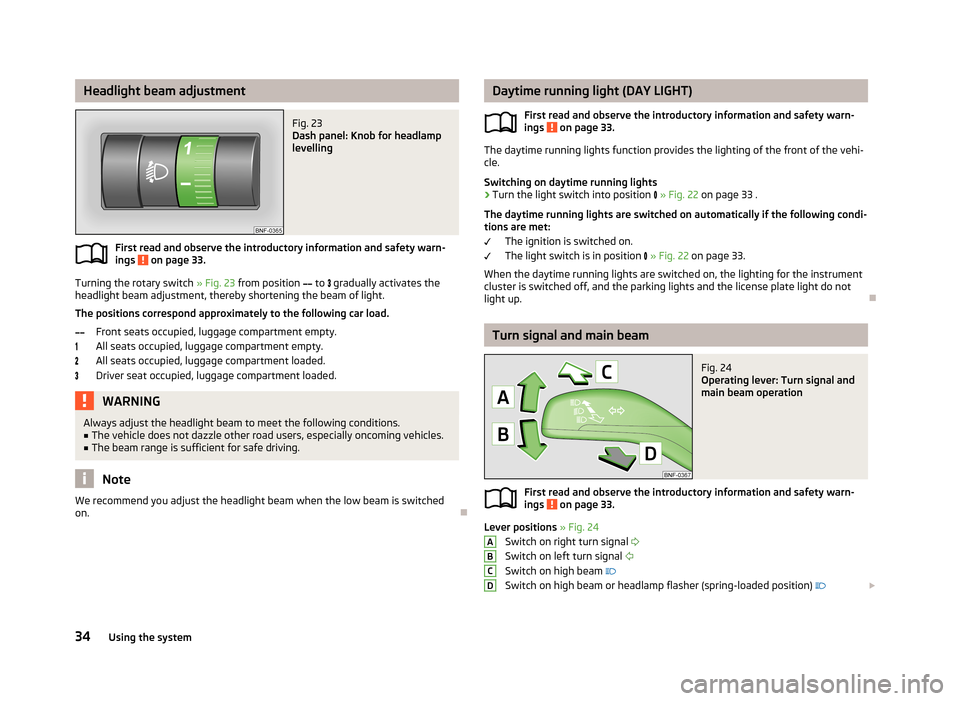
Headlight beam adjustmentFig. 23
Dash panel: Knob for headlamp
levelling
First read and observe the introductory information and safety warn-
ings on page 33.
Turning the rotary switch » Fig. 23 from position
to
gradually activates the
headlight beam adjustment, thereby shortening the beam of light.
The positions correspond approximately to the following car load. Front seats occupied, luggage compartment empty.All seats occupied, luggage compartment empty.All seats occupied, luggage compartment loaded.
Driver seat occupied, luggage compartment loaded.
WARNINGAlways adjust the headlight beam to meet the following conditions.■The vehicle does not dazzle other road users, especially oncoming vehicles.■
The beam range is sufficient for safe driving.
Note
We recommend you adjust the headlight beam when the low beam is switched
on.
Daytime running light (DAY LIGHT)
First read and observe the introductory information and safety warn-ings
on page 33.
The daytime running lights function provides the lighting of the front of the vehi-
cle.
Switching on daytime running lights
›
Turn the light switch into position » Fig. 22 on page 33 .
The daytime running lights are switched on automatically if the following condi- tions are met:
The ignition is switched on.
The light switch is in position
» Fig. 22 on page 33.
When the daytime running lights are switched on, the lighting for the instrument
cluster is switched off, and the parking lights and the license plate light do not light up.
Turn signal and main beam
Fig. 24
Operating lever: Turn signal and
main beam operation
First read and observe the introductory information and safety warn-
ings on page 33.
Lever positions » Fig. 24
Switch on right turn signal
Switch on left turn signal
Switch on high beam
Switch on high beam or headlamp flasher (spring-loaded position)
ABCD34Using the system
Page 38 of 176
When the left or right turn signal is on, the warning light or flashes in the
instrument cluster.
When the high beam or headlight flasher is on, the warning light lights up in
the instrument cluster.
Turn signal for changing lanes - to only flash briefly, only move the lever up or
down to the pressure point and hold it in this position.
Convenience turn signal
If you only wish to flash three times, briefly push the lever to the upper or lower
pressure point and release again.WARNINGOnly turn on the main beam or the headlight flasher if other road users will
not be dazzled.
Note
■ The main beam can only be switched on when the low beam lights are on.■The turn signal only operates if the ignition is switched on.■
The turn signal is automatically cancelled after negotiating a curve.
■
An acoustic warning signal will sound when the driver's door is opened if the
lever is not in the middle position after removing the ignition key from the igni-
tion lock. The acoustic warning signal will stop just as soon as the driver's door is closed.
Fog lights
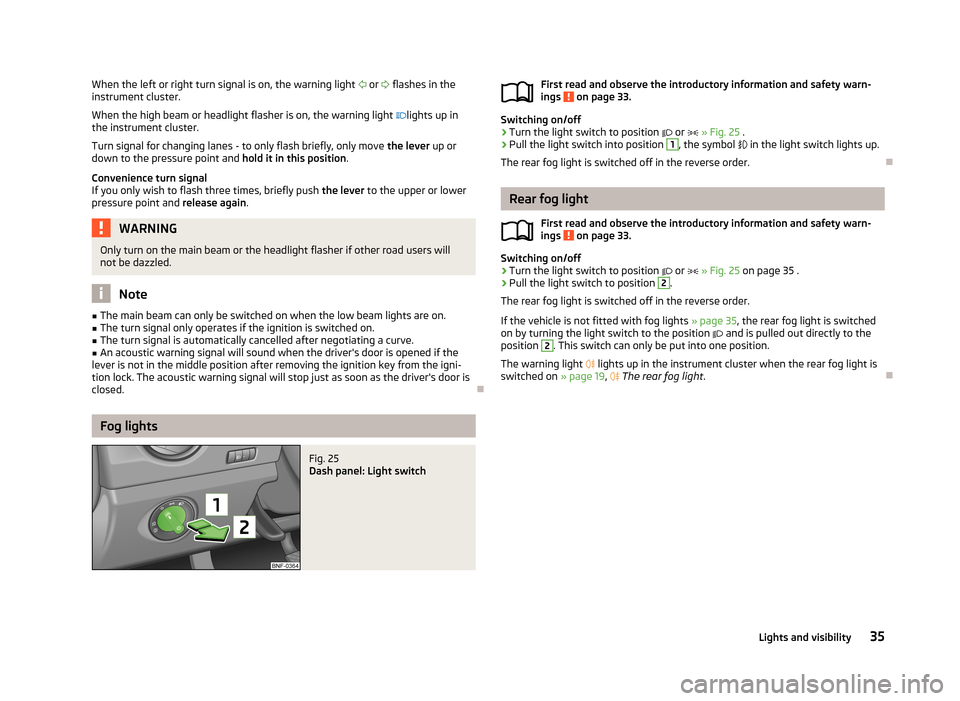
Fig. 25
Dash panel: Light switch
First read and observe the introductory information and safety warn-ings on page 33.
Switching on/off
›
Turn the light switch to position or » Fig. 25 .
›
Pull the light switch into position
1
, the symbol in the light switch lights up.
The rear fog light is switched off in the reverse order.
Rear fog light
First read and observe the introductory information and safety warn-
ings
on page 33.
Switching on/off
›
Turn the light switch to position
or
» Fig. 25 on page 35 .
›
Pull the light switch to position
2
.
The rear fog light is switched off in the reverse order.
If the vehicle is not fitted with fog lights » page 35, the rear fog light is switched
on by turning the light switch to the position
and is pulled out directly to the
position
2
. This switch can only be put into one position.
The warning light
lights up in the instrument cluster when the rear fog light is
switched on » page 19,
The rear fog light .
35Lights and visibility
Page 39 of 176
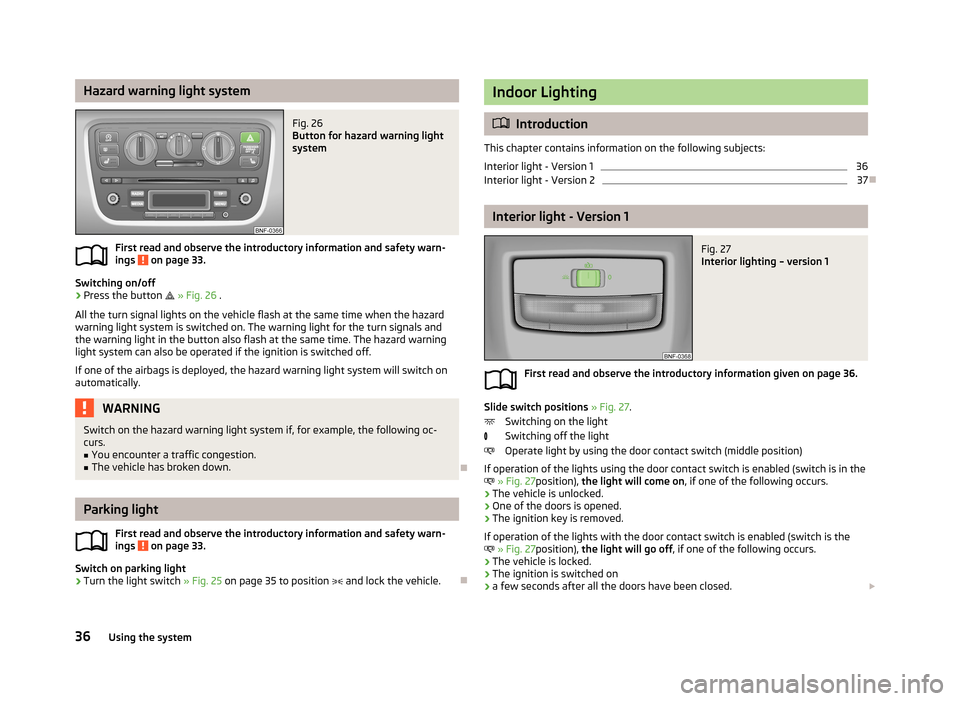
Hazard warning light systemFig. 26
Button for hazard warning light
system
First read and observe the introductory information and safety warn-
ings on page 33.
Switching on/off
›
Press the button
» Fig. 26 .
All the turn signal lights on the vehicle flash at the same time when the hazard
warning light system is switched on. The warning light for the turn signals and
the warning light in the button also flash at the same time. The hazard warning
light system can also be operated if the ignition is switched off.
If one of the airbags is deployed, the hazard warning light system will switch on
automatically.
WARNINGSwitch on the hazard warning light system if, for example, the following oc-
curs.■
You encounter a traffic congestion.
■
The vehicle has broken down.
Parking light
First read and observe the introductory information and safety warn-
ings
on page 33.
Switch on parking light
›
Turn the light switch » Fig. 25 on page 35 to position
and lock the vehicle.
Indoor Lighting
Introduction
This chapter contains information on the following subjects:
Interior light - Version 1
36
Interior light - Version 2
37
Interior light - Version 1
Fig. 27
Interior lighting – version 1
First read and observe the introductory information given on page 36.
Slide switch positions » Fig. 27 .
Switching on the light
Switching off the light
Operate light by using the door contact switch (middle position)
If operation of the lights using the door contact switch is enabled (switch is in the
» Fig. 27 position), the light will come on , if one of the following occurs.
› The vehicle is unlocked.
› One of the doors is opened.
› The ignition key is removed.
If operation of the lights with the door contact switch is enabled (switch is the
» Fig. 27 position), the light will go off , if one of the following occurs.
› The vehicle is locked.
› The ignition is switched on
› a few seconds after all the doors have been closed.
36Using the system
Page 40 of 176
NoteIf the interior light remains switched on when the ignition is switched off or if one
of the doors is open, the light will automatically go out after around 10 minutes.
Interior light - Version 2
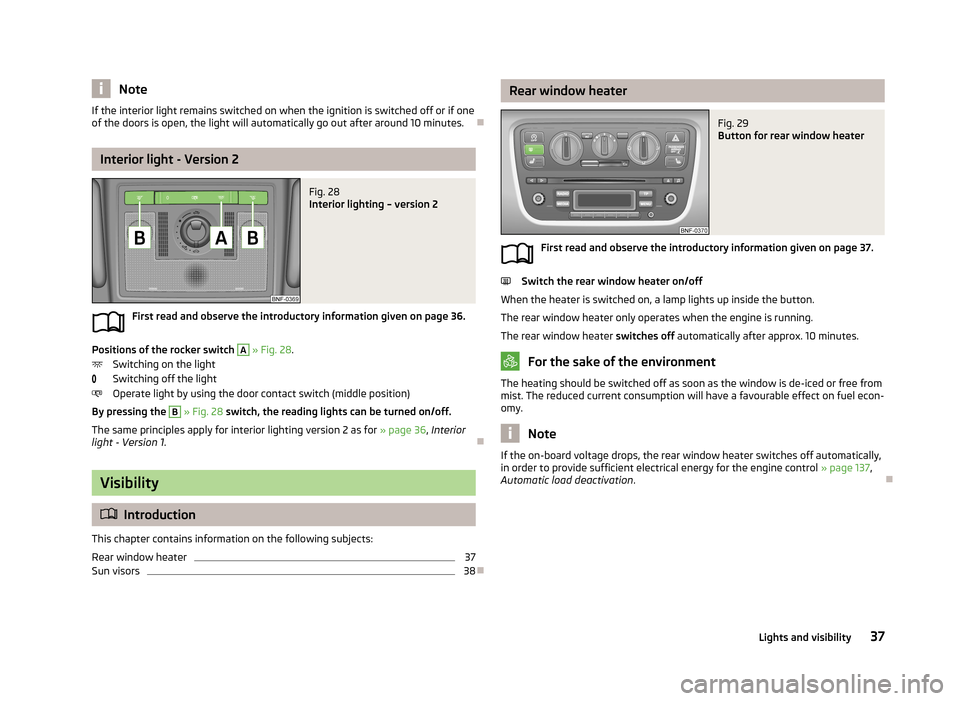
Fig. 28
Interior lighting – version 2
First read and observe the introductory information given on page 36.
Positions of the rocker switch
A
» Fig. 28 .
Switching on the light
Switching off the light
Operate light by using the door contact switch (middle position)
By pressing the
B
» Fig. 28 switch, the reading lights can be turned on/off.
The same principles apply for interior lighting version 2 as for » page 36, Interior
light - Version 1 .
Visibility
Introduction
This chapter contains information on the following subjects:
Rear window heater
37
Sun visors
38
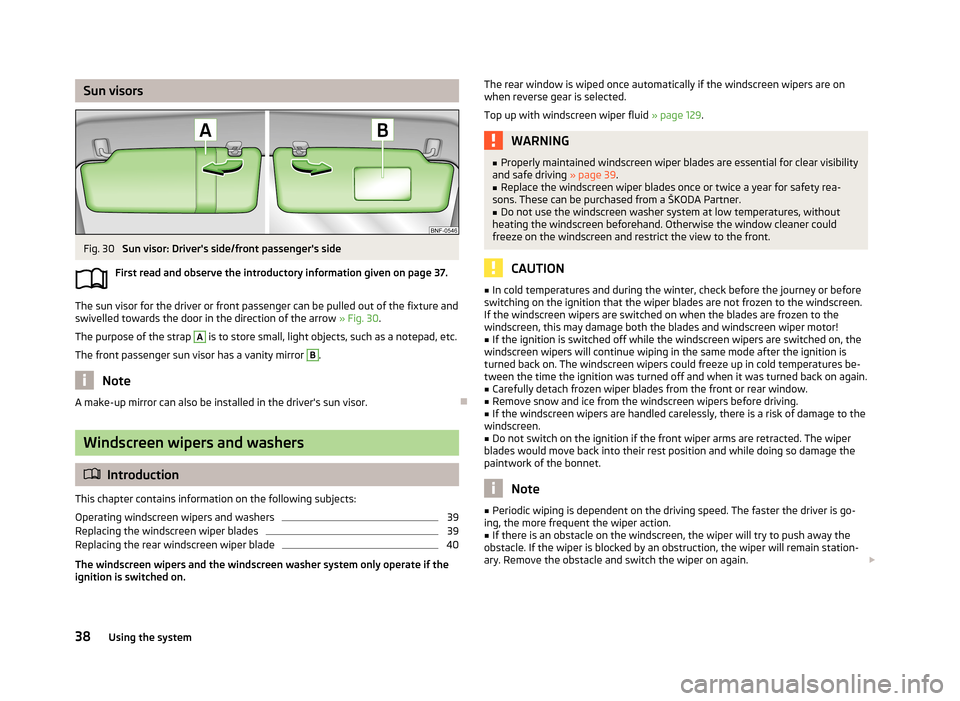
Rear window heaterFig. 29
Button for rear window heater
First read and observe the introductory information given on page 37.
Switch the rear window heater on/off
When the heater is switched on, a lamp lights up inside the button. The rear window heater only operates when the engine is running.
The rear window heater switches off automatically after approx. 10 minutes.
For the sake of the environment
The heating should be switched off as soon as the window is de-iced or free from
mist. The reduced current consumption will have a favourable effect on fuel econ-
omy.
Note
If the on-board voltage drops, the rear window heater switches off automatically,
in order to provide sufficient electrical energy for the engine control » page 137,
Automatic load deactivation .
37Lights and visibility
Page 41 of 176
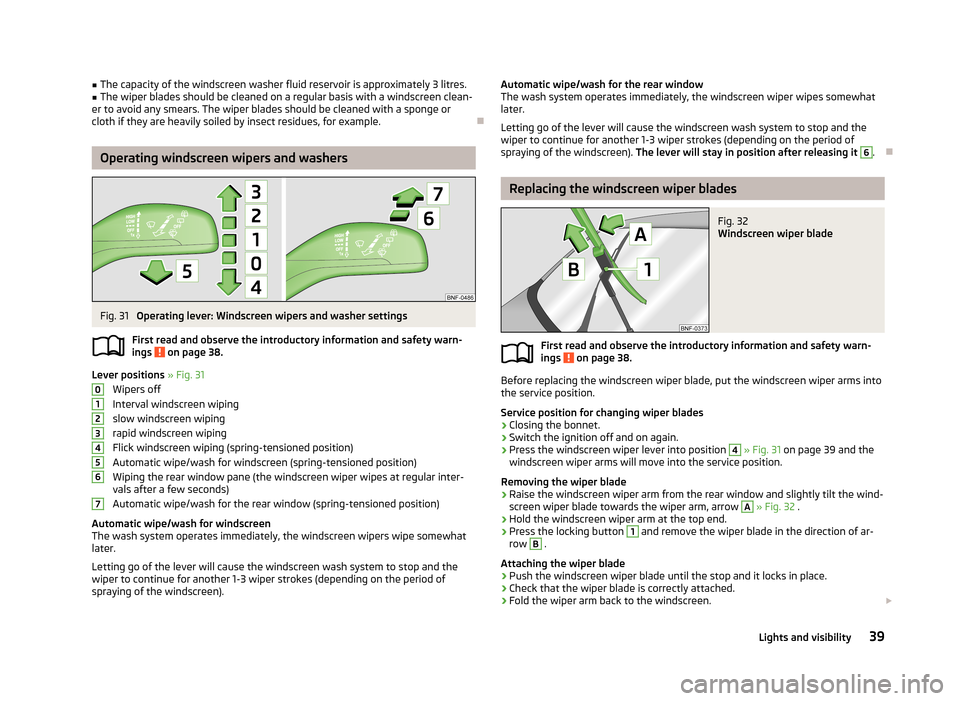
Sun visorsFig. 30
Sun visor: Driver's side/front passenger's side
First read and observe the introductory information given on page 37.
The sun visor for the driver or front passenger can be pulled out of the fixture and
swivelled towards the door in the direction of the arrow » Fig. 30.
The purpose of the strap
A
is to store small, light objects, such as a notepad, etc.
The front passenger sun visor has a vanity mirror
B
.
Note
A make-up mirror can also be installed in the driver's sun visor.
Windscreen wipers and washers
Introduction
This chapter contains information on the following subjects:
Operating windscreen wipers and washers
39
Replacing the windscreen wiper blades
39
Replacing the rear windscreen wiper blade
40
The windscreen wipers and the windscreen washer system only operate if the ignition is switched on.
The rear window is wiped once automatically if the windscreen wipers are on
when reverse gear is selected.
Top up with windscreen wiper fluid » page 129.WARNING■
Properly maintained windscreen wiper blades are essential for clear visibility
and safe driving » page 39.■
Replace the windscreen wiper blades once or twice a year for safety rea-
sons. These can be purchased from a ŠKODA Partner.
■
Do not use the windscreen washer system at low temperatures, without
heating the windscreen beforehand. Otherwise the window cleaner could
freeze on the windscreen and restrict the view to the front.
CAUTION
■ In cold temperatures and during the winter, check before the journey or before
switching on the ignition that the wiper blades are not frozen to the windscreen. If the windscreen wipers are switched on when the blades are frozen to the
windscreen, this may damage both the blades and windscreen wiper motor!■
If the ignition is switched off while the windscreen wipers are switched on, the
windscreen wipers will continue wiping in the same mode after the ignition is
turned back on. The windscreen wipers could freeze up in cold temperatures be- tween the time the ignition was turned off and when it was turned back on again.
■
Carefully detach frozen wiper blades from the front or rear window.
■
Remove snow and ice from the windscreen wipers before driving.
■
If the windscreen wipers are handled carelessly, there is a risk of damage to the
windscreen.
■
Do not switch on the ignition if the front wiper arms are retracted. The wiper
blades would move back into their rest position and while doing so damage the
paintwork of the bonnet.
Note
■ Periodic wiping is dependent on the driving speed. The faster the driver is go-
ing, the more frequent the wiper action.■
If there is an obstacle on the windscreen, the wiper will try to push away the
obstacle. If the wiper is blocked by an obstruction, the wiper will remain station-
ary. Remove the obstacle and switch the wiper on again.
38Using the system
Page 42 of 176
■The capacity of the windscreen washer fluid reservoir is approximately 3 litres.■The wiper blades should be cleaned on a regular basis with a windscreen clean-
er to avoid any smears. The wiper blades should be cleaned with a sponge or
cloth if they are heavily soiled by insect residues, for example.
Operating windscreen wipers and washers
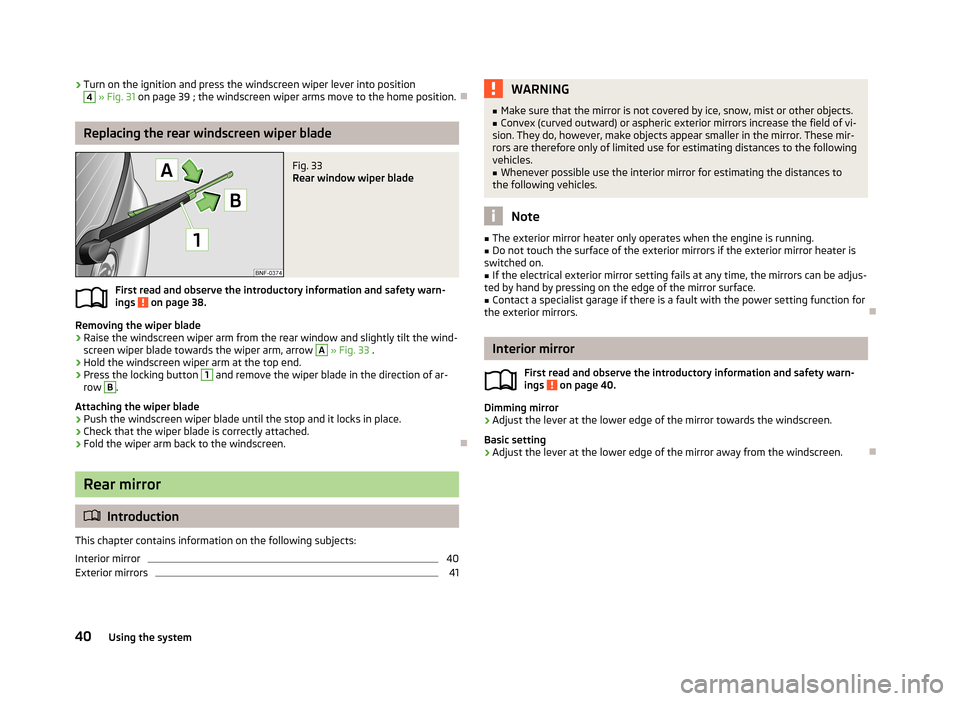
Fig. 31
Operating lever: Windscreen wipers and washer settings
First read and observe the introductory information and safety warn-
ings
on page 38.
Lever positions » Fig. 31
Wipers off
Interval windscreen wiping
slow windscreen wiping
rapid windscreen wiping
Flick windscreen wiping (spring-tensioned position)
Automatic wipe/wash for windscreen (spring-tensioned position) Wiping the rear window pane (the windscreen wiper wipes at regular inter- vals after a few seconds)
Automatic wipe/wash for the rear window (spring-tensioned position)
Automatic wipe/wash for windscreen
The wash system operates immediately, the windscreen wipers wipe somewhat
later.
Letting go of the lever will cause the windscreen wash system to stop and the
wiper to continue for another 1-3 wiper strokes (depending on the period of
spraying of the windscreen).
01234567Automatic wipe/wash for the rear window The wash system operates immediately, the windscreen wiper wipes somewhatlater.
Letting go of the lever will cause the windscreen wash system to stop and the wiper to continue for another 1-3 wiper strokes (depending on the period ofspraying of the windscreen). The lever will stay in position after releasing it 6
.
Replacing the windscreen wiper blades
Fig. 32
Windscreen wiper blade
First read and observe the introductory information and safety warn-
ings on page 38.
Before replacing the windscreen wiper blade, put the windscreen wiper arms into
the service position.
Service position for changing wiper blades
›
Closing the bonnet.
›
Switch the ignition off and on again.
›
Press the windscreen wiper lever into position
4
» Fig. 31 on page 39 and the
windscreen wiper arms will move into the service position.
Removing the wiper blade
›
Raise the windscreen wiper arm from the rear window and slightly tilt the wind-
screen wiper blade towards the wiper arm, arrow
A
» Fig. 32 .
›
Hold the windscreen wiper arm at the top end.
›
Press the locking button
1
and remove the wiper blade in the direction of ar-
row
B
.
Attaching the wiper blade
›
Push the windscreen wiper blade until the stop and it locks in place.
›
Check that the wiper blade is correctly attached.
›
Fold the wiper arm back to the windscreen.
39Lights and visibility
Page 43 of 176
›Turn on the ignition and press the windscreen wiper lever into position4
» Fig. 31 on page 39 ; the windscreen wiper arms move to the home position.
Replacing the rear windscreen wiper blade
Fig. 33
Rear window wiper blade
First read and observe the introductory information and safety warn-
ings on page 38.
Removing the wiper blade
›
Raise the windscreen wiper arm from the rear window and slightly tilt the wind-
screen wiper blade towards the wiper arm, arrow
A
» Fig. 33 .
›
Hold the windscreen wiper arm at the top end.
›
Press the locking button
1
and remove the wiper blade in the direction of ar-
row
B
.
Attaching the wiper blade
›
Push the windscreen wiper blade until the stop and it locks in place.
›
Check that the wiper blade is correctly attached.
›
Fold the wiper arm back to the windscreen.
Rear mirror
Introduction
This chapter contains information on the following subjects:
Interior mirror
40
Exterior mirrors
41WARNING■ Make sure that the mirror is not covered by ice, snow, mist or other objects.■Convex (curved outward) or aspheric exterior mirrors increase the field of vi-
sion. They do, however, make objects appear smaller in the mirror. These mir-
rors are therefore only of limited use for estimating distances to the following
vehicles.■
Whenever possible use the interior mirror for estimating the distances to
the following vehicles.
Note
■ The exterior mirror heater only operates when the engine is running.■Do not touch the surface of the exterior mirrors if the exterior mirror heater is
switched on.■
If the electrical exterior mirror setting fails at any time, the mirrors can be adjus-
ted by hand by pressing on the edge of the mirror surface.
■
Contact a specialist garage if there is a fault with the power setting function for
the exterior mirrors.
Interior mirror
First read and observe the introductory information and safety warn-
ings
on page 40.
Dimming mirror
›
Adjust the lever at the lower edge of the mirror towards the windscreen.
Basic setting
›
Adjust the lever at the lower edge of the mirror away from the windscreen.
40Using the system
Page 44 of 176
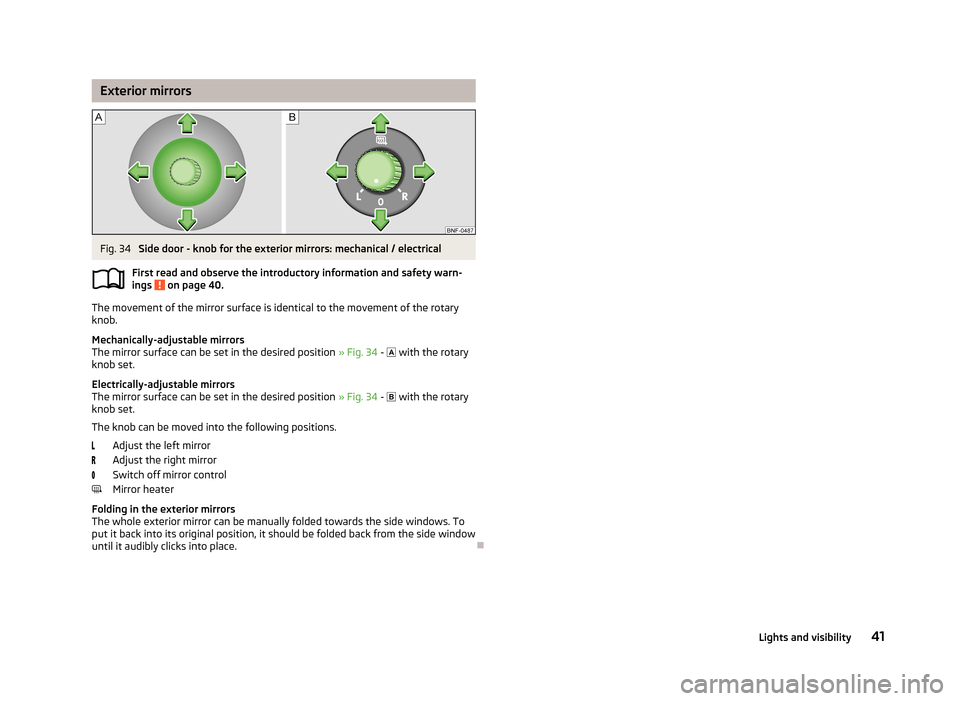
Exterior mirrorsFig. 34
Side door - knob for the exterior mirrors: mechanical / electrical
First read and observe the introductory information and safety warn-
ings
on page 40.
The movement of the mirror surface is identical to the movement of the rotary
knob.
Mechanically-adjustable mirrors
The mirror surface can be set in the desired position » Fig. 34 -
with the rotary
knob set.
Electrically-adjustable mirrors
The mirror surface can be set in the desired position » Fig. 34 -
with the rotary
knob set.
The knob can be moved into the following positions. Adjust the left mirror
Adjust the right mirror
Switch off mirror control
Mirror heater
Folding in the exterior mirrors
The whole exterior mirror can be manually folded towards the side windows. To
put it back into its original position, it should be folded back from the side window
until it audibly clicks into place.
41Lights and visibility
Page 45 of 176
Seats and stowing
Front seats
Introduction
This chapter contains information on the following subjects:
Adjusting the front seats
43
Foldable front passenger seat
43
Front seat heating
44
The driver's seat should be adjusted in such a way that the pedals can be fully
pressed to the floor with slightly bent legs.
The seat backrest on the driver's seat should be adjusted in such a way that the
upper point of the steering wheel can be easily reached with slightly bent arms.
Correct adjustment of the seats is particularly important:
› for safely and quickly reaching the controls;
› for a relaxed body position that reduces fatigue;
› for achieving maximum protection from the seat belts and the airbag system.
WARNINGGeneral information■Caution when adjusting the seat! You may suffer injuries or bruises as a re-
sult of adjusting the seat without paying proper attention.■
The seat backrests must not be tilted too far back when driving, as this will
impair the function of the seat belts and of the airbag system – risk of injury!
■
Never carry more people than the number of seats in the vehicle.
■
Each occupant must correctly fasten the seat belt belonging to the seat.
Children must be fastened » page 103, Transporting children safely with a
suitable restraint system.
■
The front seats and the head restraints must always be adjusted according
to height, so that the occupants can be protected as effectively as possible.
■
Do not carry any objects on the front passenger seat except objects de-
signed for this purpose (e.g. child seat) – risk of accident!
WARNINGInformation for the driver■Only adjust the driver's seat when the vehicle is stationary – risk of accident!■
Maintain a distance of at least 25 cm to the steering wheel. Not maintaining
this minimum distance will mean that the airbag system will not be able to
properly protect you – risk to life!
■
Ensure that there are no objects in the driver's footwell, as these may get
caught in the pedal apparatus when driving or braking. You would then no
longer be able to operate the clutch, brake or acceleration pedals.
WARNINGInformation for the front seat passenger■Maintain a distance of at least 25 cm to the dash panel. Not maintaining this
minimum distance will mean that the airbag system will not be able to proper-
ly protect you – hazard!■
Always keep your feet in the footwell when the car is being driven – never
place your feet on the instrument panel, out of the window or on the surfaces
of the seats. You will be exposed to increased risk of injury if it becomes nec-
essary to apply the brake or in the event of an accident. If an airbag is de-
ployed, you may suffer fatal injuries when adopting an incorrect seated posi-
tion!
Note
After a certain time, play can develop within the adjustment mechanism of the
backrest angle.
42Using the system