seats SKODA CITIGO 2014 1.G Owner's Guide
[x] Cancel search | Manufacturer: SKODA, Model Year: 2014, Model line: CITIGO, Model: SKODA CITIGO 2014 1.GPages: 164, PDF Size: 12.08 MB
Page 61 of 164
WARNINGIf, as an occupant, you have a subdued pain and/or temperature sensitivity,
e.g. through medication, paralysis or because of chronic illness (e.g. diabe-
tes), we recommend you do not use seat heating on the driver or front pas-
senger seat. This can lead to burns on the back, the posterior and the legs
which are difficult to heal. If the seat heating is used, we recommend to
make regular breaks in your journey when driving long distances, so that
the body can recuperate from the stress of the journey. Please consult your
doctor, who can evaluate your specific condition.
CAUTION
■ Do not kneel on the seats or otherwise apply concentrated pressure to them.■The seat heating in the following cases will not turn on - there is a risk of
damaging the seat covers and seat heating. ■The seats are not occupied by people.
■ Items are fastened or stored items on the seats, such as a child seat, a bag
and the like.
■ Additional seat covers or protective covers are fixed to the seats.■
Clean the seat covers » page 102, Seat covers .
Note
If the on-board voltage drops, the seat heater switches off automatically, in or-
der to provide sufficient electrical energy for the engine control » page 116,
Automatic load deactivation .
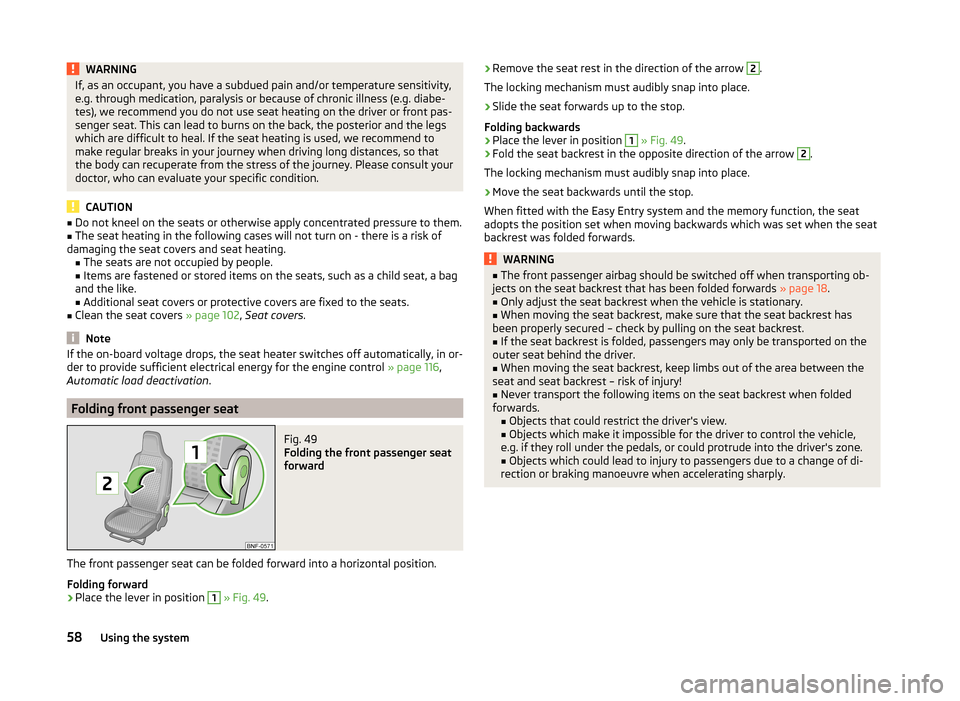
Folding front passenger seat
Fig. 49
Folding the front passenger seat
forward
The front passenger seat can be folded forward into a horizontal position.
Folding forward
›
Place the lever in position
1
» Fig. 49 .
›Remove the seat rest in the direction of the arrow 2.
The locking mechanism must audibly snap into place.›
Slide the seat forwards up to the stop.
Folding backwards
›
Place the lever in position
1
» Fig. 49 .
›
Fold the seat backrest in the opposite direction of the arrow
2
.
The locking mechanism must audibly snap into place.
›
Move the seat backwards until the stop.
When fitted with the Easy Entry system and the memory function, the seat
adopts the position set when moving backwards which was set when the seat
backrest was folded forwards.
WARNING■ The front passenger airbag should be switched off when transporting ob-
jects on the seat backrest that has been folded forwards » page 18.■
Only adjust the seat backrest when the vehicle is stationary.
■
When moving the seat backrest, make sure that the seat backrest has
been properly secured – check by pulling on the seat backrest.
■
If the seat backrest is folded, passengers may only be transported on the
outer seat behind the driver.
■
When moving the seat backrest, keep limbs out of the area between the
seat and seat backrest – risk of injury!
■
Never transport the following items on the seat backrest when folded
forwards. ■Objects that could restrict the driver's view.
■ Objects which make it impossible for the driver to control the vehicle,
e.g. if they roll under the pedals, or could protrude into the driver's zone.
■ Objects which could lead to injury to passengers due to a change of di-
rection or braking manoeuvre when accelerating sharply.
58Using the system
Page 62 of 164
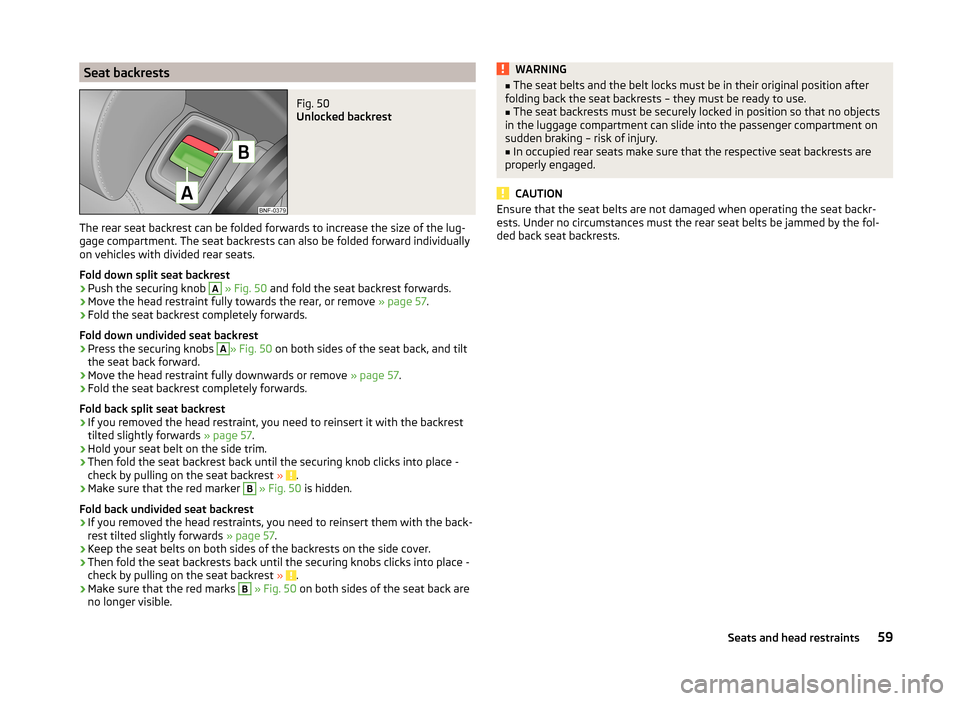
Seat backrestsFig. 50
Unlocked backrest
The rear seat backrest can be folded forwards to increase the size of the lug-
gage compartment. The seat backrests can also be folded forward individually
on vehicles with divided rear seats.
Fold down split seat backrest
›
Push the securing knob
A
» Fig. 50 and fold the seat backrest forwards.
›
Move the head restraint fully towards the rear, or remove » page 57.
›
Fold the seat backrest completely forwards.
Fold down undivided seat backrest
›
Press the securing knobs
A
» Fig. 50 on both sides of the seat back, and tilt
the seat back forward.
›
Move the head restraint fully downwards or remove » page 57.
›
Fold the seat backrest completely forwards.
Fold back split seat backrest
›
If you removed the head restraint, you need to reinsert it with the backrest
tilted slightly forwards » page 57.
›
Hold your seat belt on the side trim.
›
Then fold the seat backrest back until the securing knob clicks into place -
check by pulling on the seat backrest » .
›
Make sure that the red marker
B
» Fig. 50 is hidden.
Fold back undivided seat backrest
›
If you removed the head restraints, you need to reinsert them with the back-
rest tilted slightly forwards » page 57.
›
Keep the seat belts on both sides of the backrests on the side cover.
›
Then fold the seat backrests back until the securing knobs clicks into place -
check by pulling on the seat backrest » .
›
Make sure that the red marks
B
» Fig. 50 on both sides of the seat back are
no longer visible.
WARNING■ The seat belts and the belt locks must be in their original position after
folding back the seat backrests – they must be ready to use.■
The seat backrests must be securely locked in position so that no objects
in the luggage compartment can slide into the passenger compartment on
sudden braking – risk of injury.
■
In occupied rear seats make sure that the respective seat backrests are
properly engaged.
CAUTION
Ensure that the seat belts are not damaged when operating the seat backr-
ests. Under no circumstances must the rear seat belts be jammed by the fol-
ded back seat backrests.59Seats and head restraints
Page 63 of 164
Transporting and practical equipment
Useful equipment
Introduction
This chapter contains information on the following subjects:
Car park ticket holder
60
Storage compartment on the driver's side
60
Storage compartment in the front centre console
61
Cup holders
61
Cigarette lighter
61
Ashtray
62
12-Volt power outlet
62
Multimedia holder
63
Photo holder
63
Storage compartment on the front passenger side - version 1
63
Storage compartment on the passenger side - version 2
64
Foldable hook
64
Clothes hook
64
Net pockets on the front seat rest
65
Stowage compartments in front of the rear seats
65WARNING■ Do not place anything on the dash panel. These objects might slide or fall
down when driving (when accelerating or cornering) and may distract you
from concentrating on the traffic – there is the risk of an accident.■
When driving, ensure that no objects from the centre console or from oth-
er storage compartments can get into the driver's footwell. You would not
be able to brake, operate the clutch pedal or accelerate - danger of causing
an accident!
■
No objects should be placed in the storage compartments nor in the
drinks holders; the vehicle occupants could be endangered if there is sud-
den braking or the vehicle collides with something.
■
Ash, cigarettes, cigars and the like. may only be placed in the ashtray!
Car park ticket holderFig. 51
Parking ticket holder
Read and observe on page 60 first.
The note holder » Fig. 51 is designed e.g. for attaching car park tickets.
WARNINGThe attached note has to always be removed before starting off in order
not to restrict the driver's vision.
Storage compartment on the driver's side
Fig. 52
Storage compartment on the
driver's side
Read and observe on page 60 first.
The open stowage compartment can be found underneath the dash panel on
the driver's side » Fig. 52.
WARNINGNever store hard, heavy or sharp items in an opened stowage compart-
ment.60Using the system
Page 68 of 164
CAUTIONThe maximum permissible load of the hooks is 2 kg.
Net pockets on the front seat rest
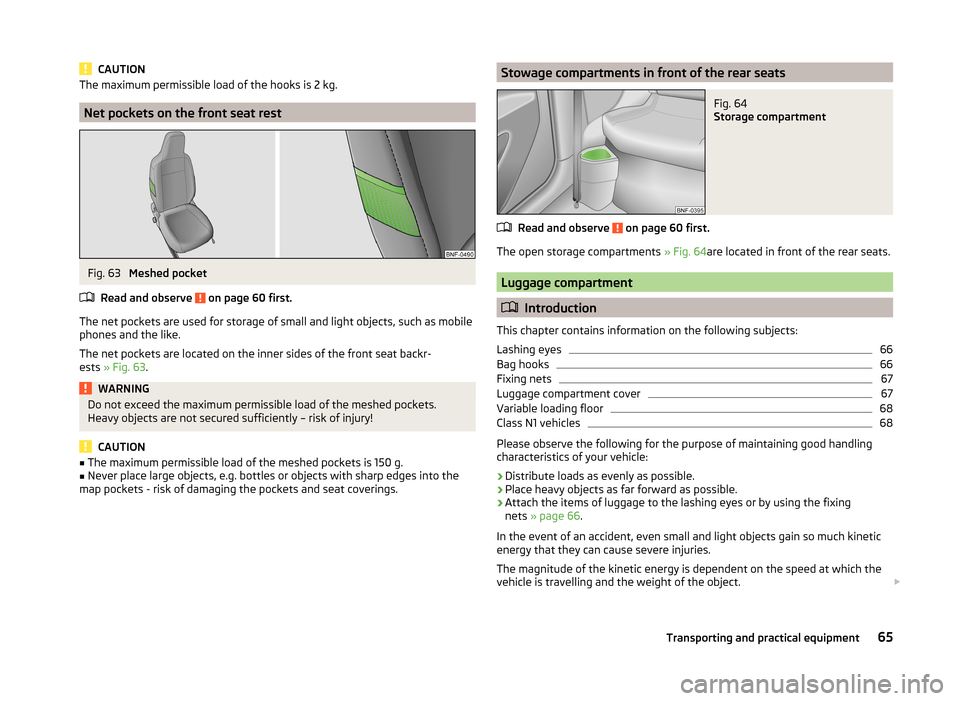
Fig. 63
Meshed pocket
Read and observe
on page 60 first.
The net pockets are used for storage of small and light objects, such as mobile phones and the like.
The net pockets are located on the inner sides of the front seat backr-
ests » Fig. 63 .
WARNINGDo not exceed the maximum permissible load of the meshed pockets.
Heavy objects are not secured sufficiently – risk of injury!
CAUTION
■ The maximum permissible load of the meshed pockets is 150 g.■Never place large objects, e.g. bottles or objects with sharp edges into the
map pockets - risk of damaging the pockets and seat coverings.Stowage compartments in front of the rear seatsFig. 64
Storage compartment
Read and observe on page 60 first.
The open storage compartments » Fig. 64are located in front of the rear seats.
Luggage compartment
Introduction
This chapter contains information on the following subjects:
Lashing eyes
66
Bag hooks
66
Fixing nets
67
Luggage compartment cover
67
Variable loading floor
68
Class N1 vehicles
68
Please observe the following for the purpose of maintaining good handling
characteristics of your vehicle:
›
Distribute loads as evenly as possible.
›
Place heavy objects as far forward as possible.
›
Attach the items of luggage to the lashing eyes or by using the fixing
nets » page 66 .
In the event of an accident, even small and light objects gain so much kinetic
energy that they can cause severe injuries.
The magnitude of the kinetic energy is dependent on the speed at which the
vehicle is travelling and the weight of the object.
65Transporting and practical equipment
Page 69 of 164
Example: In the event of a frontal collision at a speed of 50 km/h, an object
with a weight of 4.5 kg produces an energy, which corresponds to 20 times its
own weight. This means that it results in a weight of approx. 90 kg “ ”.WARNING■ Always store transported objects in the boot and attach them to the lash-
ing eyes.■
Loose objects can be thrown forward during a sudden manoeuvre or in
case of an accident and can injure the occupants or other road users.
■
Loose objects could hit a deployed airbag and injure occupants – danger
of death!
■
Please note that transporting heavy objects alters the handling proper-
ties of the vehicle due to the displacement of the centre of gravity – risk of
accident! The speed and style of driving must be adjusted accordingly.
■
If the items of luggage or objects are attached to the lashing eyes with
unsuitable or damaged lashing straps, injuries can occur in the event of
braking manoeuvres or accidents. To prevent items of luggage from moving
around, always use suitable lashing straps which must be firmly attached
to the lashing eyes.
■
The transported items must be stowed in such a way that no objects are
able to slip forward on sudden driving or braking manoeuvres – risk of in-
jury!
■
When transporting objects in the luggage compartment that has been en-
larged by folding the rear seats forward, ensure the safety of the passen-
gers transported on the other rear seats » page 10, Correct seated position
for the passengers in the rear seats .
■
If the rear seat next to the folded forward seat is occupied, ensure maxi-
mum safety, e.g. by placing the goods to be transported in such a way that
the seat is prevented from folding back in case of a rear collision.
■
Do not drive with the luggage compartment lid fully opened or slightly
ajar otherwise exhaust gases may get into the interior of the vehicle – risk
of poisoning!
■
Do not exceed the permissible axle loads and permissible gross weight of
the vehicle – risk of accident!
■
Do not transport people in the boot!
CAUTION
■ Please ensure that the heating elements for the rear window heater are not
damaged as a result of abrasive objects.■
Tyre pressure must be adjusted to the load » page 118.
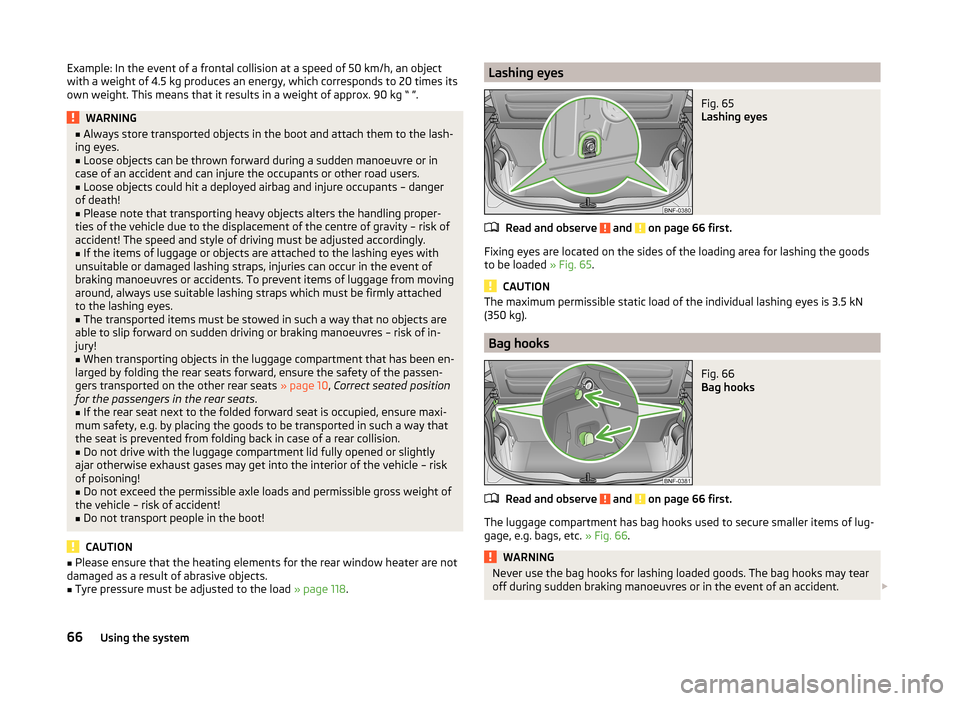
Lashing eyesFig. 65
Lashing eyes
Read and observe and on page 66 first.
Fixing eyes are located on the sides of the loading area for lashing the goods
to be loaded » Fig. 65.
CAUTION
The maximum permissible static load of the individual lashing eyes is 3.5 kN
(350 kg).
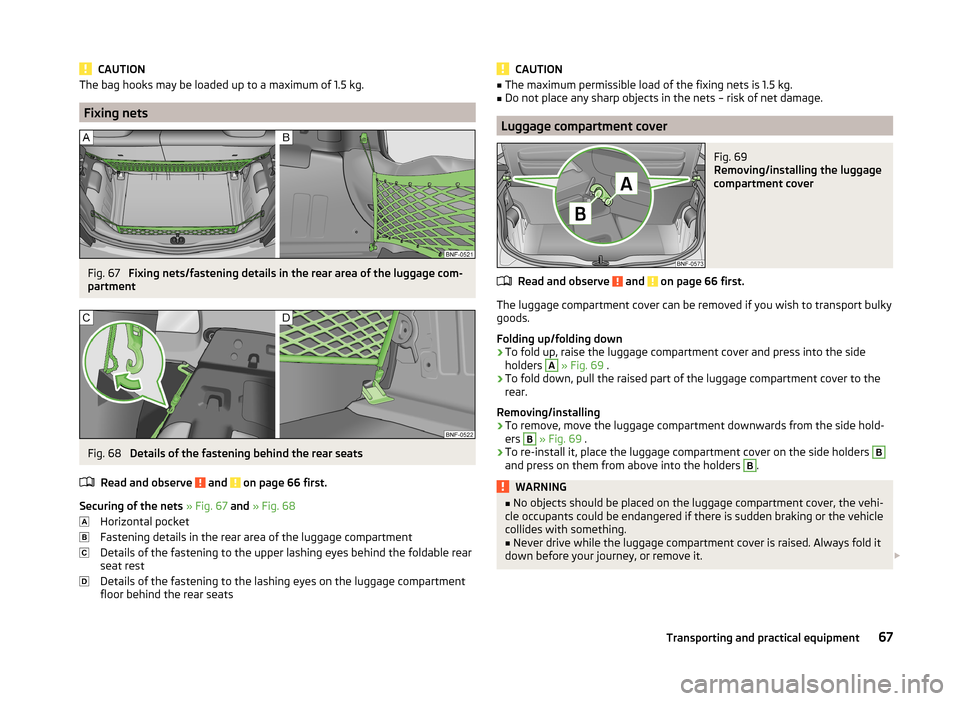
Bag hooks
Fig. 66
Bag hooks
Read and observe and on page 66 first.
The luggage compartment has bag hooks used to secure smaller items of lug- gage, e.g. bags, etc. » Fig. 66.
WARNINGNever use the bag hooks for lashing loaded goods. The bag hooks may tear
off during sudden braking manoeuvres or in the event of an accident. 66Using the system
Page 70 of 164
CAUTIONThe bag hooks may be loaded up to a maximum of 1.5 kg.
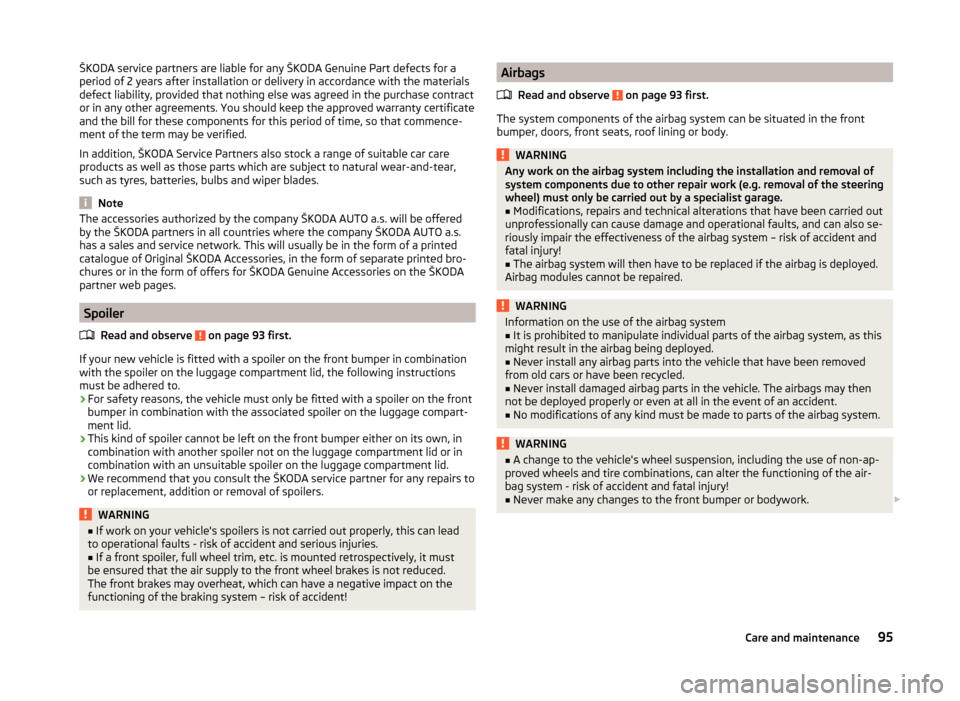
Fixing nets
Fig. 67
Fixing nets/fastening details in the rear area of the luggage com-
partment
Fig. 68
Details of the fastening behind the rear seats
Read and observe
and on page 66 first.
Securing of the nets » Fig. 67 and » Fig. 68
Horizontal pocket
Fastening details in the rear area of the luggage compartment
Details of the fastening to the upper lashing eyes behind the foldable rear
seat rest
Details of the fastening to the lashing eyes on the luggage compartment
floor behind the rear seats
CAUTION■ The maximum permissible load of the fixing nets is 1.5 kg.■Do not place any sharp objects in the nets – risk of net damage.
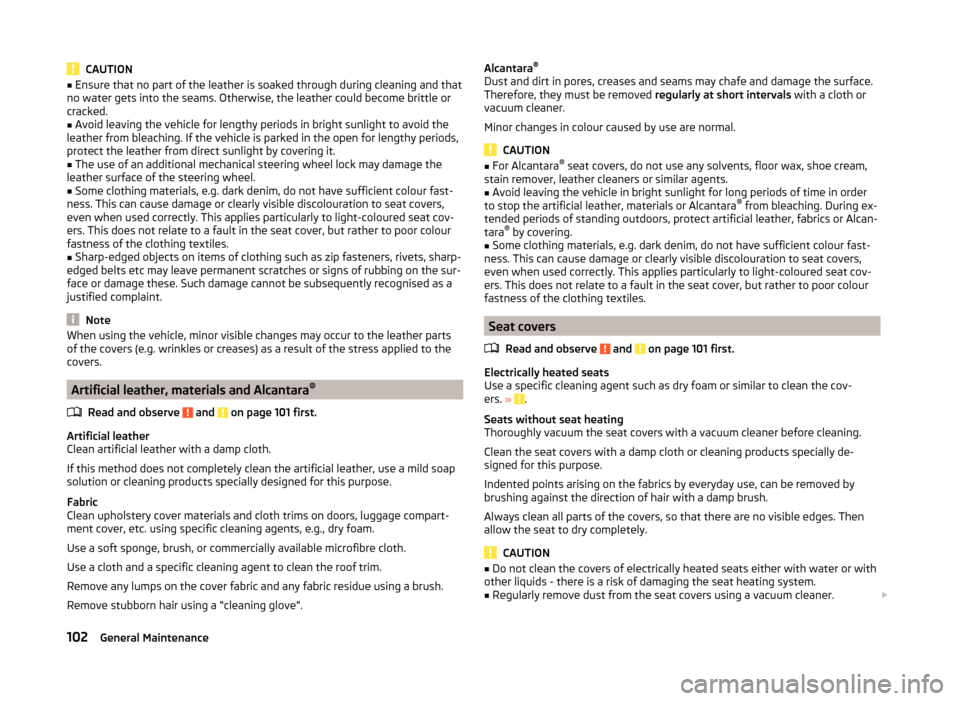
Luggage compartment cover
Fig. 69
Removing/installing the luggage
compartment cover
Read and observe and on page 66 first.
The luggage compartment cover can be removed if you wish to transport bulky
goods.
Folding up/folding down
›
To fold up, raise the luggage compartment cover and press into the side
holders
A
» Fig. 69 .
›
To fold down, pull the raised part of the luggage compartment cover to the
rear.
Removing/installing
›
To remove, move the luggage compartment downwards from the side hold-
ers
B
» Fig. 69 .
›
To re-install it, place the luggage compartment cover on the side holders
B
and press on them from above into the holders
B
.
WARNING■
No objects should be placed on the luggage compartment cover, the vehi-
cle occupants could be endangered if there is sudden braking or the vehicle
collides with something.■
Never drive while the luggage compartment cover is raised. Always fold it
down before your journey, or remove it.
67Transporting and practical equipment
Page 98 of 164
ŠKODA service partners are liable for any ŠKODA Genuine Part defects for aperiod of 2 years after installation or delivery in accordance with the materials
defect liability, provided that nothing else was agreed in the purchase contract
or in any other agreements. You should keep the approved warranty certificate
and the bill for these components for this period of time, so that commence-
ment of the term may be verified.
In addition, ŠKODA Service Partners also stock a range of suitable car care
products as well as those parts which are subject to natural wear-and-tear,
such as tyres, batteries, bulbs and wiper blades.
Note
The accessories authorized by the company ŠKODA AUTO a.s. will be offered
by the ŠKODA partners in all countries where the company ŠKODA AUTO a.s.
has a sales and service network. This will usually be in the form of a printed
catalogue of Original ŠKODA Accessories, in the form of separate printed bro-
chures or in the form of offers for ŠKODA Genuine Accessories on the ŠKODA
partner web pages.
Spoiler
Read and observe
on page 93 first.
If your new vehicle is fitted with a spoiler on the front bumper in combination
with the spoiler on the luggage compartment lid, the following instructions
must be adhered to.
› For safety reasons, the vehicle must only be fitted with a spoiler on the front
bumper in combination with the associated spoiler on the luggage compart-
ment lid.
› This kind of spoiler cannot be left on the front bumper either on its own, in
combination with another spoiler not on the luggage compartment lid or in
combination with an unsuitable spoiler on the luggage compartment lid.
› We recommend that you consult the ŠKODA service partner for any repairs to
or replacement, addition or removal of spoilers.
WARNING■ If work on your vehicle's spoilers is not carried out properly, this can lead
to operational faults - risk of accident and serious injuries.■
If a front spoiler, full wheel trim, etc. is mounted retrospectively, it must
be ensured that the air supply to the front wheel brakes is not reduced.
The front brakes may overheat, which can have a negative impact on the
functioning of the braking system – risk of accident!
Airbags
Read and observe
on page 93 first.
The system components of the airbag system can be situated in the front
bumper, doors, front seats, roof lining or body.
WARNINGAny work on the airbag system including the installation and removal of
system components due to other repair work (e.g. removal of the steering
wheel) must only be carried out by a specialist garage.■
Modifications, repairs and technical alterations that have been carried out
unprofessionally can cause damage and operational faults, and can also se-
riously impair the effectiveness of the airbag system – risk of accident and
fatal injury!
■
The airbag system will then have to be replaced if the airbag is deployed.
Airbag modules cannot be repaired.
WARNINGInformation on the use of the airbag system■It is prohibited to manipulate individual parts of the airbag system, as this
might result in the airbag being deployed.■
Never install any airbag parts into the vehicle that have been removed
from old cars or have been recycled.
■
Never install damaged airbag parts in the vehicle. The airbags may then
not be deployed properly or even at all in the event of an accident.
■
No modifications of any kind must be made to parts of the airbag system.
WARNING■ A change to the vehicle's wheel suspension, including the use of non-ap-
proved wheels and tire combinations, can alter the functioning of the air-
bag system - risk of accident and fatal injury!■
Never make any changes to the front bumper or bodywork.
95Care and maintenance
Page 105 of 164
CAUTION■Ensure that no part of the leather is soaked through during cleaning and that
no water gets into the seams. Otherwise, the leather could become brittle or
cracked.■
Avoid leaving the vehicle for lengthy periods in bright sunlight to avoid the
leather from bleaching. If the vehicle is parked in the open for lengthy periods,
protect the leather from direct sunlight by covering it.
■
The use of an additional mechanical steering wheel lock may damage the
leather surface of the steering wheel.
■
Some clothing materials, e.g. dark denim, do not have sufficient colour fast-
ness. This can cause damage or clearly visible discolouration to seat covers,
even when used correctly. This applies particularly to light-coloured seat cov-
ers. This does not relate to a fault in the seat cover, but rather to poor colour
fastness of the clothing textiles.
■
Sharp-edged objects on items of clothing such as zip fasteners, rivets, sharp-
edged belts etc may leave permanent scratches or signs of rubbing on the sur-
face or damage these. Such damage cannot be subsequently recognised as a
justified complaint.
Note
When using the vehicle, minor visible changes may occur to the leather parts
of the covers (e.g. wrinkles or creases) as a result of the stress applied to the
covers.
Artificial leather, materials and Alcantara ®
Read and observe
and on page 101 first.
Artificial leather
Clean artificial leather with a damp cloth.
If this method does not completely clean the artificial leather, use a mild soap solution or cleaning products specially designed for this purpose.
Fabric
Clean upholstery cover materials and cloth trims on doors, luggage compart-
ment cover, etc. using specific cleaning agents, e.g., dry foam.
Use a soft sponge, brush, or commercially available microfibre cloth.
Use a cloth and a specific cleaning agent to clean the roof trim.
Remove any lumps on the cover fabric and any fabric residue using a brush.
Remove stubborn hair using a “cleaning glove”.
Alcantara ®
Dust and dirt in pores, creases and seams may chafe and damage the surface.
Therefore, they must be removed regularly at short intervals with a cloth or
vacuum cleaner.
Minor changes in colour caused by use are normal.
CAUTION
■ For Alcantara ®
seat covers, do not use any solvents, floor wax, shoe cream,
stain remover, leather cleaners or similar agents.■
Avoid leaving the vehicle in bright sunlight for long periods of time in order
to stop the artificial leather, materials or Alcantara ®
from bleaching. During ex-
tended periods of standing outdoors, protect artificial leather, fabrics or Alcan-
tara ®
by covering.
■
Some clothing materials, e.g. dark denim, do not have sufficient colour fast-
ness. This can cause damage or clearly visible discolouration to seat covers,
even when used correctly. This applies particularly to light-coloured seat cov-
ers. This does not relate to a fault in the seat cover, but rather to poor colour
fastness of the clothing textiles.
Seat covers
Read and observe
and on page 101 first.
Electrically heated seats
Use a specific cleaning agent such as dry foam or similar to clean the cov-
ers. »
.
Seats without seat heating
Thoroughly vacuum the seat covers with a vacuum cleaner before cleaning.
Clean the seat covers with a damp cloth or cleaning products specially de-
signed for this purpose.
Indented points arising on the fabrics by everyday use, can be removed by
brushing against the direction of hair with a damp brush.
Always clean all parts of the covers, so that there are no visible edges. Then
allow the seat to dry completely.
CAUTION
■ Do not clean the covers of electrically heated seats either with water or with
other liquids - there is a risk of damaging the seat heating system.■
Regularly remove dust from the seat covers using a vacuum cleaner.
102General Maintenance
Page 106 of 164
■Electrically heated seats must not be dried after cleaning by switching on the
heater.■
Do not sit on wet seats - risk of seat deformation.
■
Always clean the seats “from seam to seam”.
Safety belts
Read and observe
and on page 101 first.
Wash dirty seat belts with mild soapy water.
Remove coarse dirt with a soft brush.
WARNING■ The seat belts must not be removed for cleaning.■Never clean the seat belts chemically as chemical cleaning products could
destroy the fabric.■
The seat belts must not be allowed to come into contact with corrosive
liquids (e.g. acids).
■
The seat belts must be fully dried before being rolled up.
Inspecting and replenishing
Fuel
Introduction
This chapter contains information on the following subjects:
Petrol Refuelling
104
Lead-free petrol
104
Refuelling CNG (compressed natural gas)
105
CNG
106
The correct fuel grades for your vehicle are specified on the inside of the fuel
filler flap » Fig. 92 on page 104 .
WARNING■
Observe the local regulations regarding fuel handling.■The operating instructions of the refuelling system must always be fol-
lowed.■
Do not smoke when refuelling and do not use a mobile phone.
■
Fuel vapours are explosive - can be fatal!
CAUTION
■ Never drive until the fuel tank is completely empty! The irregular supply of
fuel can cause misfiring, which can result in damage to parts of the engine and
the exhaust system.■
Immediately remove any fuel that has spilled onto the vehicle's paintwork –
risk of paint damage!
■
If the vehicle was not purchased in the country where it was intended to be
operated, you should check whether the fuel specified by the manufacturer is
offered in the country where the vehicle will be operated. You should also per-
haps check whether the manufacturer has recommended a different fuel for
operation of the vehicle in the corresponding country. If no prescribed fuel is
available, then you must check whether it is permitted by the manufacturer to
operate the vehicle with another fuel type.
103Inspecting and replenishing
Page 151 of 164
Index
A
abroad lead-free petrol
104
Abroad Headlights
51
ABS Function
85
Warning light37
Acceptance and recycling of used vehicles96
Accessories93
Adjusting Exterior mirrors
54
head restraints56
Interior mirror54
Seat56
Steering wheel10
Adjusting the seats9
Air-conditioning system Air outlet vents
71
Airbag15
Deactivating18
Deactivating the front passenger airbag18
Deployment15
Front airbag16
Modifications and damage to the airbag system 95
Side airbag Head-Thorax
17
Warning light38
Airbag system15
air conditioning recirculation
72
Air conditioning70
Controls71
Air outlet vents71
Alcantara cleaning
102
Alternator Warning light
34
Anti-theft wheel bolts127
Antilock Braking System85
artificial leather102
Ashtray62
Assistance systems City Safe Drive
90
Assist system ABS
85
Assist systems84
ABS37
Cruise Control System87
EDL85
ESC36, 84
HBA85
HHC85
Parking aid85
START-STOP88
TC85
Traction Control System (TCS)36
Visual parking system86
Audio see radio
4
Auto-computer see multi-function display
30
Automated transmission80
Lever control81
Warning light35
Automatic gearbox Tiptronic
81
Automatic load deactivation116
Automatic transmission Kick-down
82
Starting-off and driving82
B
Bag hooks
66
Battery In the remote control key
133
Belts11
Belt tensioners14
Bonnet Closing
108
Opening108
Boot Class N1 vehicles
68
See Boot lid44
Boot lid automatic locking
44
Closing44
Opening44
Brake booster78
brake fluid specification
113
Brake fluid113
Checking113
Brake pedal - automatic transmission indicator light
38
brakes Driving in
82
Brakes Brake booster
78
Brake fluid113
Braking and stabilisation systems84
Handbrake79
Warning lights34
Brakes and parking77
Braking Information on braking
78
Button in driver's door electric windows
44
C
Car care Jack
100
Care and maintenance93
Car park ticket holder60
Carrier Roof rack
68
148Index