brake SKODA CITIGO 2015 1.G Owner's Guide
[x] Cancel search | Manufacturer: SKODA, Model Year: 2015, Model line: CITIGO, Model: SKODA CITIGO 2015 1.GPages: 160, PDF Size: 23.1 MB
Page 125 of 160
Jack with instruction card
Wheel wrench
Extraction pliers for wheel bolt caps
Breakdown kitWARNINGThe factory-supplied lifting jack is only intended for your model of vehicle.
Under no circumstances attempt to lift heavier vehicles or other loads.
CAUTION
■ Screw the jack back into the starting position before storing in the box with
the tool kit.■
Ensure that the vehicle tool kit is safely secured in the luggage compart-
ment.
■
Ensure that the box is always secured with the strap.
Note
The declaration of conformity is included with the jack or the log folder.
Changing a wheel
Introduction
This chapter contains information on the following subjects:
Preliminary work
123
Removing/stowing the wheel
123
Full wheel trim
124
Wheel bolts
124
Anti-theft wheel bolts
124
Loosening/tightening wheel bolts
125
Raising the vehicle
125
Remove the wheel / fix
126
Follow-up work
126
For your own safety and the safety of the passengers, the following instruc-
tions must be observed before changing a wheel on the road.
Switch on the hazard warning lights system.
Place the warning triangle at the prescribed distance.
Park the vehicle as far away as possible from the flowing traffic.
5678Choose a location with a flat, solid surface.
Have all the occupants get out. The passengers should not stand on the
road (instead they should remain behind a crash barrier, for instance) while
the wheel is being changed.
Preliminary work
Before changing the wheel, the following work must be carried out.
›
Switch off the engine.
›
For vehicles with manual transmission select 1st gear .
›
For vehicles with automated gearbox shift the lever to position D or R.
›
Firmly apply the handbrake.
Removing/stowing the wheel
Fig. 118
Take out the wheel
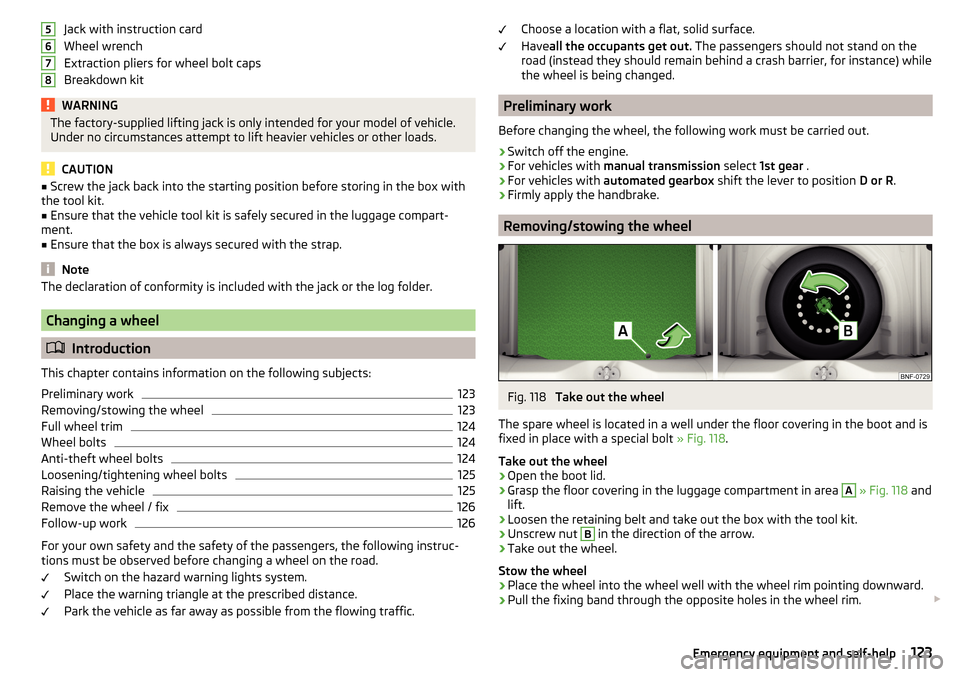
The spare wheel is located in a well under the floor covering in the boot and is
fixed in place with a special bolt » Fig. 118.
Take out the wheel
›
Open the boot lid.
›
Grasp the floor covering in the luggage compartment in area
A
» Fig. 118 and
lift.
›
Loosen the retaining belt and take out the box with the tool kit.
›
Unscrew nut
B
in the direction of the arrow.
›
Take out the wheel.
Stow the wheel
›
Place the wheel into the wheel well with the wheel rim pointing downward.
›
Pull the fixing band through the opposite holes in the wheel rim.
123Emergency equipment and self-help
Page 126 of 160
›Screw in nut Bin the opposite direction to the arrow
» Fig. 118until the
wheel is safely secured.›
Replace the box with the tool kit into the emergency or spare wheel and se-
cure it with the tape.
›
Fold back the floor in the luggage compartment.
›
Close the boot lid.
Full wheel trim
Before removing the wheel bolts, remove the wheel cover.
Pulling off
›
Hook the clamp found in the vehicle tool kit » page 122 into the reinforced
edge of the wheel trim.
›
Push the wheel wrench through the clamp, support on the tyre and pull off
the wheel trim.
Installing
›
Press the wheel trim onto the wheel rim at the designated valve opening.
›
Then press the trim into the wheel rim until its entire circumference locks
correctly in place.
Notes from the factory or from the ŠKODA Original accessory delivered trim.
▶ When using an anti-theft wheel bolt, make sure that this has been fitted ac-
cording to the position marked on the back of the wheel cover position.
▶ On the back of the wheel cover, the position for the anti-theft wheel bolt is
marked by means of a symbol. If the wheel cover is set outside the position
marked for the anti-theft wheel bolt, there is a risk of damaging the wheel
cover.
If wheel trims are fitted, an adequate flow of air must be assured in order to
cool the brake system.
CAUTION
Use the pressure of your hand only, do not strike the full wheel trim. The cover
could be damaged.
Note
We recommend that you use wheel trims from ŠKODA Original Accessories.Wheel boltsFig. 119
Remove the cap
Before removing the wheel bolts, remove the covering caps.
Pulling off
›
Push the extraction pliers » page 122 sufficiently far onto the cap until the
inner catches of the pliers are positioned at the collar of the cap.
›
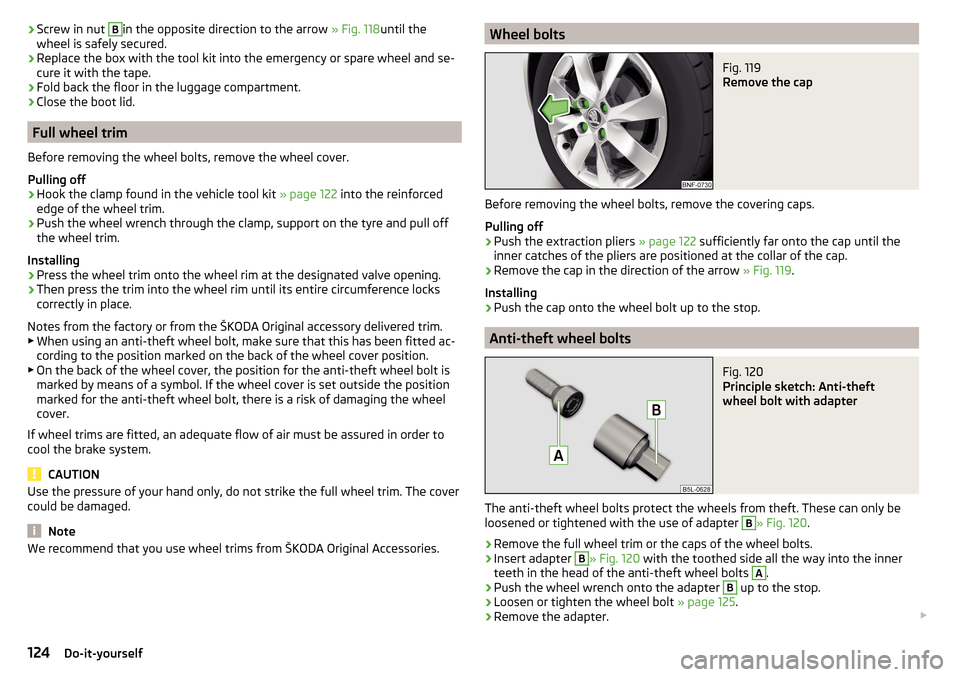
Remove the cap in the direction of the arrow » Fig. 119.
Installing
›
Push the cap onto the wheel bolt up to the stop.
Anti-theft wheel bolts
Fig. 120
Principle sketch: Anti-theft
wheel bolt with adapter
The anti-theft wheel bolts protect the wheels from theft. These can only be
loosened or tightened with the use of adapter
B
» Fig. 120 .
›
Remove the full wheel trim or the caps of the wheel bolts.
›
Insert adapter
B
» Fig. 120 with the toothed side all the way into the inner
teeth in the head of the anti-theft wheel bolts
A
.
›
Push the wheel wrench onto the adapter
B
up to the stop.
›
Loosen or tighten the wheel bolt » page 125.
›
Remove the adapter.
124Do-it-yourself
Page 130 of 160
General informationRead and observe
on page 127 first.
For your own safety and the safety of your passengers, the following instruc-
tions must be observed before carrying out a wheel repair on the road.
Switch on the hazard warning lights system.
Place the warning triangle at the prescribed distance.
Park the vehicle as far away as possible from the flowing traffic.
Choose a location with a flat, solid surface.
Have all the occupants get out. The passengers should not stand on the
road (instead they should remain behind a crash barrier, for instance) while
the wheel is being changed.
The breakdown kit must not be used under the following circumstances. ▶ The rim is damaged.
▶ The outside temperature is below -20 ° C.
▶ The cut or puncture is larger than 4 mm.
▶ The tyre wall is damaged.
▶ After the expiration date (see inflation bottle).
Preparations for using the breakdown kit
Read and observe
on page 127 first.
The following preparatory work must be carried out before using the puncture
repair kit.
›
Switch off the engine.
›
For vehicles with manual transmission select 1st gear .
›
For vehicles with
automated gearbox shift the lever to position D or R.
›
Firmly apply the handbrake.
›
Check that you can carry out the repairs with the breakdown kit » page 127.
›
Remove the breakdown kit from the boot.
›
Stick the sticker
1
» Fig. 124 on page 127 on the dash panel in the driver's
field of view.
›
Unscrew the valve cap.
›
Use the valve remover
2
to unscrew the valve core and place it on a clean
surface (rag, paper, etc.).
Sealing and inflating the tyre
Read and observe
on page 127 first.
Sealing
›
Forcefully shake the tyre inflator bottle
10
» Fig. 124 on page 127 several
times.
›
Firmly screw the inflation hose
3
onto the tyre inflater bottle
10
. The film
on the cap is pierced automatically.
›
Remove the plug from the inflation hose
3
and plug the open end fully onto
the tyre valve.
›
Hold the bottle
10
with the bottom facing upwards and fill all of the sealing
agent from the tyre inflator bottle into the tyre.
›
Remove the filler plug from the tyre valve.
›
Screw the valve core back into the tyre valve using the valve remover
2
.
Inflating
›
Screw the air compressor tyre inflation hose
8
» Fig. 124 on page 127 firmly
onto the tyre valve.
›
For vehicles with manual transmission the lever into the neutral position.
›
For vehicles with automated manual transmission shift the lever to position
N .
›
Check that the air release valve
6
is closed.
›
Start the engine and run it in idle.
›
Plug the connector
4
into 12 volt socket » page 61, 12-Volt power outlet .
›
Switch on the air compressor with the ON and OFF switch
9
.
›
Allow the air compressor to run until a pressure of 2.0 - 2.5 bar is achieved.
Maximum run time of 8 minutes » .
›
Switch off the air compressor.
›
If you cannot reach an air pressure of 2.0 - 2.5 bar, unscrew the tyre inflation
hose
8
from the tyre valve.
›
Drive the vehicle 10 metres forwards or backwards to allow the sealing agent
to “distribute” in the tyre.
›
Firmly screw the tyre inflation hose
8
back onto the tyre valve and repeat
the inflation process.
›
Switch off the air compressor.
›
Remove the tyre inflation hose
8
from the tyre valve.
Once a tyre inflation pressure of 2.0 - 2.5 bar has been achieved, you can con- tinue the journey.
128Do-it-yourself
Page 133 of 160
Please note that the brake servo unit and power steering only operate if the
engine is running. If the engine is not running, significantly more physical force
is required to depress the brake pedal and steer the vehicle.
If using a tow rope, ensure that it is always kept taught.
General information on towing
Both drivers should be familiar with the problems which might occur while a
vehicle is being towed. Unskilled drivers should not attempt to tow in another
vehicle or to be towed in.
The vehicle must be transported on a special breakdown vehicle or trailer if it
is not possible to tow in the vehicle in the way described or if the towing dis-
tance is greater than 50 km.
If the gearbox has no oil, your vehicle must be towed with the front axle raised
clear of the ground or on a breakdown vehicle or trailer.
To protect both vehicles when tow-starting or towing, the tow rope should be elastic. Thus one should only use plastic fibre rope or a rope made out of a
similarly elastic material.
Attach the tow rope or the tow bar only to the towing eye » page 131 .WARNING■
When towing, exercise increased caution.■Do not use spiral rope for towing » Fig. 126- , the towing eye may un-
screw from the vehicle - risk of accident.■
Ensure tow rope is not twisted - risk of accident.
CAUTION
■ Do not start engine by towing - there is a risk of damaging the engine parts.
The battery from another vehicle can be used as a jump-start aid » page 129,
Jump-starting .■
There is always a risk of excessive stresses and damage resulting at the
points to which you attach the tow rope or tow bar when you attempt to tow a
vehicle which is not standing on a paved road.
Note
We recommend using a tow rope from ŠKODA Original Accessories, which is
available from a ŠKODA Partner.Front towing eyeFig. 127
Removing the cap/installing the towing eye
Read and observe
and on page 131 first.
Removing/fitting the cover cap
›
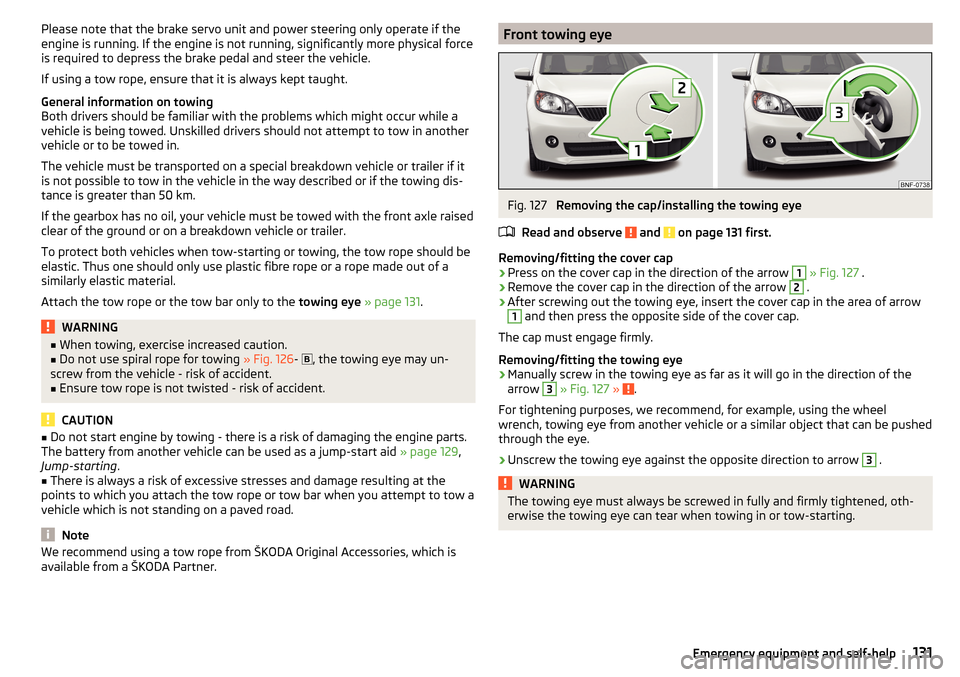
Press on the cover cap in the direction of the arrow
1
» Fig. 127 .
›
Remove the cover cap in the direction of the arrow
2
.
›
After screwing out the towing eye, insert the cover cap in the area of arrow
1
and then press the opposite side of the cover cap.
The cap must engage firmly.
Removing/fitting the towing eye
›
Manually screw in the towing eye as far as it will go in the direction of the
arrow
3
» Fig. 127 » .
For tightening purposes, we recommend, for example, using the wheel
wrench, towing eye from another vehicle or a similar object that can be pushed through the eye.
›
Unscrew the towing eye against the opposite direction to arrow
3
.
WARNINGThe towing eye must always be screwed in fully and firmly tightened, oth-
erwise the towing eye can tear when towing in or tow-starting.131Emergency equipment and self-help
Page 138 of 160
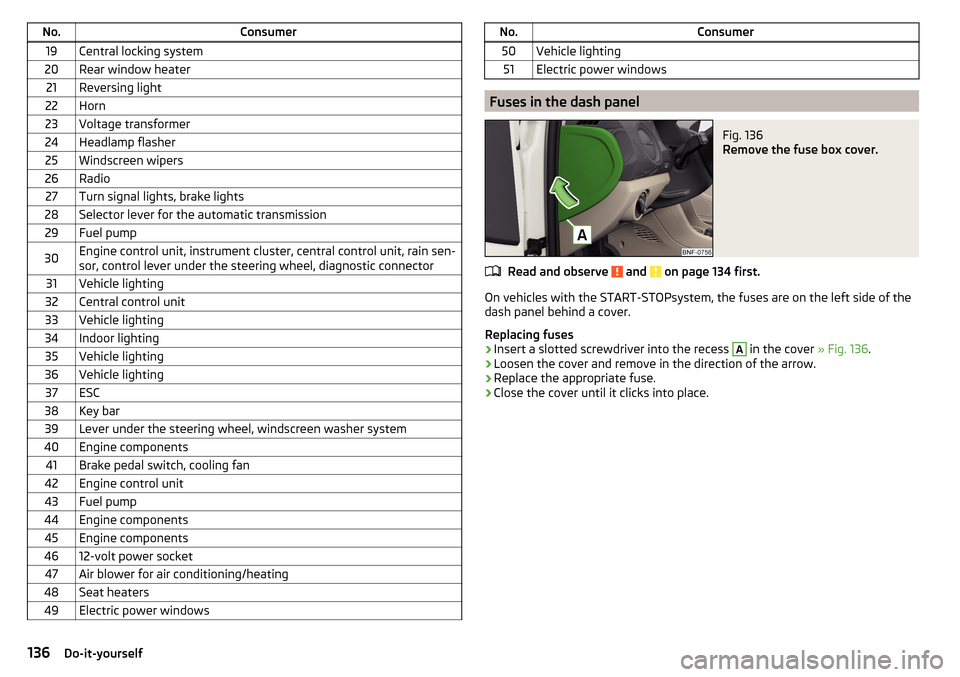
No.Consumer19Central locking system20Rear window heater21Reversing light22Horn23Voltage transformer24Headlamp flasher25Windscreen wipers26Radio27Turn signal lights, brake lights28Selector lever for the automatic transmission29Fuel pump30Engine control unit, instrument cluster, central control unit, rain sen-
sor, control lever under the steering wheel, diagnostic connector31Vehicle lighting32Central control unit33Vehicle lighting34Indoor lighting35Vehicle lighting36Vehicle lighting37ESC38Key bar39Lever under the steering wheel, windscreen washer system40Engine components41Brake pedal switch, cooling fan42Engine control unit43Fuel pump44Engine components45Engine components4612-volt power socket47Air blower for air conditioning/heating48Seat heaters49Electric power windowsNo.Consumer50Vehicle lighting51Electric power windows
Fuses in the dash panel
Fig. 136
Remove the fuse box cover.
Read and observe and on page 134 first.
On vehicles with the START-STOPsystem, the fuses are on the left side of the
dash panel behind a cover.
Replacing fuses
›
Insert a slotted screwdriver into the recess
A
in the cover » Fig. 136.
›
Loosen the cover and remove in the direction of the arrow.
›
Replace the appropriate fuse.
›
Close the cover until it clicks into place.
136Do-it-yourself
Page 149 of 160
Index
A
abroad lead-free petrol
103
Abroad Headlights
50
ABS Operation
85
Warning light36
Acceptance and recycling of used vehicles95
Accessories92
Adjusting Exterior mirrors
53
head restraints54
Seat54
Steering wheel9
Adjusting the seats8
Air-conditioning system Air outlet vents
71
Airbag14
Deactivating17
Deactivating the front passenger airbag18
Deployment15
Front airbag15
Modifications and damage to the airbag system 94
Side airbag Head-Thorax
17
Warning light37
Airbag system14
air conditioning recirculation
70
Air conditioning69
Controls69
Air outlet vents71
Alcantara cleaning
101
Alternator Warning light
35
Anodized partsRefer to vehicle maintenance98
Anti-lock braking system (ABS)85
Anti-theft wheel bolts124
artificial leather101
Ashtray61
Assistance systems City Safe Drive
89
Parking aid86
Assistance Systems ESC
36
Assist systems85
ABS36
Cruise Control System88
Visual parking system87
Auto-computer see multi-function display
31
Automated transmission81
Lever control81
Warning light35
Automatic gearbox Tiptronic
82
Automatic load deactivation115
Automatic transmission Kick-down
82
Starting-off and driving82
Avoiding damage to your vehicle84
B
Bag hooks
65
Battery In the remote control key
132
Belts11
Belt tensioners13
Bonnet Closing
107
Opening107
Boot Class N1 vehicles67
See Boot lid43
Boot lid automatic locking
43
Closing43
Opening43
Brake Assist (HBA)86
Brake booster79
brake fluid specification
112
Brake fluid112
Checking112
Brake pedal - automatic transmission warning light
38
Brakes Brake booster
79
Brake fluid112
Braking and stabilisation systems85
Handbrake79
Running-in83
Warning lights34
Brakes and parking78
Brake system85
Braking Information on braking
78
Button in driver's door electric windows
44
C
Car care Jack
99
Care and maintenance92
Car park ticket holder58
Carrier Roof rack
67
Cavity protection99
Central locking39
problems42
147Index
Page 150 of 160
Central locking button40
Change engine oil
109
Change engine oil
109
Changing Bulb in the tail light
141
Front turn signal bulb139
light bulb in tail light141
Low beam and high beam bulb - halogen head- lights
139
Wheels123
Changing a wheel Follow-up work
126
Preliminary work123
Changing wheels Wheel removal and fix
126
Charging a vehicle battery114
Checking Battery electrolyte level
114
Brake fluid112
Coolant111
Engine oil109
Oil level109
Windscreen washer fluid108
Checks Statutory checks
92
Children and safety19
Child safety Side airbag
21
Child safety lock42
Child seat Classification
21
ISOFIX22
on the front passenger seat20
TOP TETHER24
Use of child seats22
Use of ISOFIX child seats23
Chrome parts Refer to vehicle maintenance
98
Cigarette lighter60
City Safe Drive89
Disable/Enable90
Operation89
warning symbol38
Clean Anodized parts
98
Chrome parts98
Cleaning Alcantara
101
and maintaining belts102
artificial leather101
headlight glasses98
materials101
natural leather100
plastic parts98
seats covers of the electrically heated seats101
wheels99
Cleaning safety belt
102
Cleaning seat covers
101
Cleaning the interior artificial leather
101
Seat covers101
Cleaning the vehicle exterior Cavity protection
99
Decorative films97
Door locking cylinder99
Headlight glasses98
Protective films97
Under-body protection99
Vehicle paintwork97
wheels99
Windows and external mirrors98
Cleaning vehicle95
Cleaning vehicle exterior96
Anodized parts98
Chrome parts98
Plastic parts98
Rubber seals98
Wiper blades100
Clean interior Safety belt
102
Clothes hook63
CNG105
Fuel reserve display29
refuelling104
Refuelling104
Sticker105
Cockpit 12-Volt power outlet
61
Ashtray61
Cigarette lighter60
General view27
Light50
storage compartments58
useful equipment58
compartments58
Components of the puncture repair kits127
Compressed natural gas see CNG
105
Computer see multi-function display
31
Conserving the vehicle paintwork see vehicle care
97
convenience turn signal48
Coolant110
Checking111
Replenishing111
Warning light35
Correct routing of seat belt
12
Correct seated position8
Front passenger10
Rear seats10
Correct seat position Driver
9
Counter for distance driven30
148Index
Page 151 of 160
cruise controloperation88
operation Description88
Cruise control system Warning light
38
Cruise Control System88
Cup holders59
D
DAY LIGHT see Daylight running lights
48
Daylight running lights48
De-icing windows
98
Deactivating an airbag17
Decorative films97
Defrosting rear window51
Delayed locking of the boot lid see boot lid
43
Departure angle145
Digital Clock Time
33
Dimmed headlights47
Dipstick109
Disconnecting and reconnecting vehicle battery
115
Display Service interval
30
Display of fuel reserve
29
Disposal Acceptance and recycling of used vehicles
95
Distance driven30
Door Child safety lock
42
Closing41
Emergency locking132
Opening41
Door opening lever locking of42
unlocking of42
Drive Driving through water
84
Driving Emissions
143
Fuel consumption143
through water84
Top speed146
Trailer operation95
E
Economical driving Tips
83
EDL86
Electric Windows44
Button in driver's door44
Button in the front passenger door44
Electronic Differential Lock (EDL)86
Electronic immobilizer75
Emergency Changing a wheel
123
Hazard warning light system49
Jump-starting129
Locking the door without a locking cylinder132
Towing the vehicle130
Tyre repair127
Emergency equipment Jack
122
Reflective vest122
Vehicle tool kit122
Warning triangle122
Emissions143
Engine Running-in
83
Switch off engine76
Engine compartment106
Brake fluid112
Overview108
Vehicle battery112
Engine number142
engine oil specification
109
Engine oil109
Checking109
Replenishing110
Warning light35
EPC Warning light
37
ESC Operation
85
Warning light36
Exhaust inspection system Warning light
37
F
Films
97
Fog Lights49
Foldable hook63
Footmats80
see footmats80
Force limit Sliding/tilting roof
45
Force limiter Sliding/tilting roof
46
Front airbag15
fuel lead-free petrol
103
Fuel102
CNG105
Fuel reserve display29
refer to Fuel102
Refuelling103
Refuelling - natural gas104
Fuel consumption143
149Index
Page 152 of 160
FusesAssignment134
Assignment of fuses in the dash panel137
Colour coding134
Fuse allocation in the dash panel135
Fuse allocation in the engine compartment137
Replacing134
Fuses in the engine compartment Allocation
137
G
Gear changing Gear stick
80
Gear recommendation30
General view Cockpit
27
Genuine parts93
H
Handbrake
79
Warning light34
Handbrake - automatic transmission Warning light
38
Hazard warning light system49
HBA86
Head-Thorax17
Headlights Bulb arrangement
138
Driving abroad50
Head restraints54
Adjust height54
Headrest, removing and installing
55
Heating69
Controls69
Exterior mirrors53
Rear window51
Seats55
HHC86
Hill Start Assist (HHC)86
Horn27
I
Ice scrapers
98
Ignition lock76
Immobilizer75
Inertia reels13
Instrument cluster28
Counter for distance driven30
Fuel reserve display29
Gear recommendation30
Memory of the multi-function display33
Multi-function display31
Overview28
see instrument cluster28
Service interval display30
Tachometer29
Instruments see instrument cluster
28
Interior care100
Natural leather100
ISOFIX22
J
Jack
122
- fit125
Maintenance99
Jump-starting129
K
Key Lock
40
Start the engine76
Unlock40
L
Labels Airbag
20
Lashing eyes65
Leather Natural leather care
100
Lever Main beam
48
Turn signal48
Wiper52
lever control81
See lever control81
Light Cockpit
50
Dimmed headlights47
Fog Lights49
Headlight range control47
on and off47
Parking light49
Rear fog light49
Sidelights47
Lighting Luggage compartment
64
Light on and off47
Lights47
Daylight running48
Hazard warning light system49
Headlight flasher48
Main beam48
Replacing bulbs138
Turn signal48
Warning lights34
Load143
Loading floor67
Lock Key
40
Lock/unlock steering lock76
Locking Door opening lever
42
Remote control40
Locking and unlocking the vehicle from the in- side
40
150Index
Page 154 of 160
Puncture repair kit127
R
Radiator fan
108
Radio4
Raising the vehicle125
Rear-view mirror Exterior mirrors
53
Rear fog light49
Warning light37
Rear mirror52
Rear view mirror Interior mirror
53
Rear window heating51
Rear windows Closing
45
Opening45
Recirculation70
Refuelling103
Fuel103
Fuel - natural gas104
Regulation Lighting range
47
Remote control Locking
40
Replacing the battery132
Synchronisation process132
Unlocking40
Remote control key Replacing the battery
132
Repairs and technical alterations92
Replace vehicle battery
115
Replace vehicle battery
115
Replacing Bulb for daytime running lights and parkinglights
139
Bulb for the fog light140
Bulb for the licence plate light140
Bulbs138
Fuses134
Fuses in the dash panel135, 136
Fuses in the engine compartment137
Rear window wiper blade134
Windscreen wiper blades133
Replenishing Coolant
111
Engine oil110
Windscreen washer fluid108
Roof Load
68
Roof rack67
mounting points68
Roof load68
Rubber seals98
Running-in Brake linings
83
Engine83
Tyres83
S
SAFE See Safe securing system
41
SAFELOCK See Safe securing system
41
Safe securing system41
Safety8
Child safety19
Child safety seats19
Correct seated position8
Head restraints54
ISOFIX22
TOP TETHER24
Save electrical energy83
Save fuel83
Seals Vehicle care
98
SeatAdjusting54
Seat belt height adjustment
12
Warning icon38
Seat belts11
Belt tensioners13
fastening and unfastening13
Inertia reels13
The physical principle of a frontal collision12
Warning light34
Seat features55
Seats Folding front passenger seat
56
Head restraints54
Heating55
Seat backrests57
Seats and head restraint54
Service93
Service display30
Setting33
Seat belt height12
seats and head restraints54
Settings Interior mirror
53
Setting the33
Shift Gear recommendation
30
Information on the gear changed30
Side airbag17
Sidelights47
Sliding/tilting roof Closing
45
Sliding / tilting roof Malfunction
46
Sliding/tilting roof Opening and tilting
45
Operation45
Sunblind46
Snow chains121
152Index