headlights SKODA CITIGO 2015 1.G Owner's Manual
[x] Cancel search | Manufacturer: SKODA, Model Year: 2015, Model line: CITIGO, Model: SKODA CITIGO 2015 1.GPages: 160, PDF Size: 23.1 MB
Page 29 of 160
Using the system
Cockpit
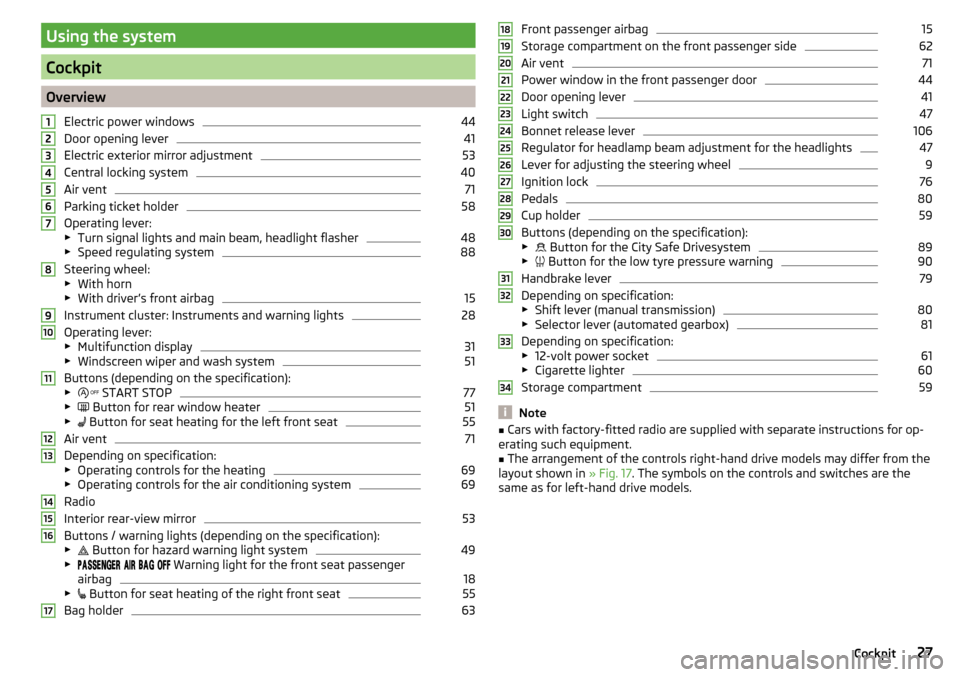
OverviewElectric power windows
44
Door opening lever
41
Electric exterior mirror adjustment
53
Central locking system
40
Air vent
71
Parking ticket holder
58
Operating lever:
▶ Turn signal lights and main beam, headlight flasher
48
▶Speed regulating system
88
Steering wheel:
▶ With horn
▶ With driver’s front airbag
15
Instrument cluster: Instruments and warning lights
28
Operating lever:
▶ Multifunction display
31
▶Windscreen wiper and wash system
51
Buttons (depending on the specification):
▶ START STOP
77
▶
Button for rear window heater
51
▶
Button for seat heating for the left front seat
55
Air vent
71
Depending on specification:
▶ Operating controls for the heating
69
▶Operating controls for the air conditioning system
69
Radio
Interior rear-view mirror
53
Buttons / warning lights (depending on the specification):
▶ Button for hazard warning light system
49
▶
Warning light for the front seat passenger
airbag
18
▶ Button for seat heating of the right front seat
55
Bag holder
631234567891011121314151617Front passenger airbag15
Storage compartment on the front passenger side
62
Air vent
71
Power window in the front passenger door
44
Door opening lever
41
Light switch
47
Bonnet release lever
106
Regulator for headlamp beam adjustment for the headlights
47
Lever for adjusting the steering wheel
9
Ignition lock
76
Pedals
80
Cup holder
59
Buttons (depending on the specification):
▶ Button for the City Safe Drivesystem
89
▶
Button for the low tyre pressure warning
90
Handbrake lever
79
Depending on specification:
▶ Shift lever (manual transmission)
80
▶Selector lever (automated gearbox)
81
Depending on specification:
▶ 12-volt power socket
61
▶Cigarette lighter
60
Storage compartment
59
Note
■Cars with factory-fitted radio are supplied with separate instructions for op-
erating such equipment.■
The arrangement of the controls right-hand drive models may differ from the
layout shown in » Fig. 17. The symbols on the controls and switches are the
same as for left-hand drive models.
181920212223242526272829303132333427Cockpit
Page 49 of 160
Lights and visibility
Lights
Introduction
This chapter contains information on the following subjects:
Operation of the light function
47
Daylight running lights (DAY LIGHT)
48
Turn signal and main beam
48
Front and rear fog light
49
Hazard warning light system
49
Parking light
49
Driving abroad
50
Unless otherwise stated, the lights only work when the ignition is on.
The arrangement of the controls right-hand drive models may differ from the layout shown in » Fig. 40 on page 47 . The symbols which mark the positions
of the controls are identical.
WARNING■ The driver is always responsible for the correct settings and use of the
lights.■
Never drive with only the side lights on! The side lights are not bright
enough to light up the road sufficiently in front of you or to be seen by oth-
er oncoming traffic. Therefore always switch on the low beam when it is
dark or if visibility is poor.
Note
■ The instruments are also illuminated when the side light or low beam light is
switched on.■
The headlights may mist up temporarily. When the driving lights are switched
on, the light outlet surfaces are free from mist after a short period, although
the headlight lenses may still be misted up in the peripheral areas. This mist
has no influence on the life of the lighting system.
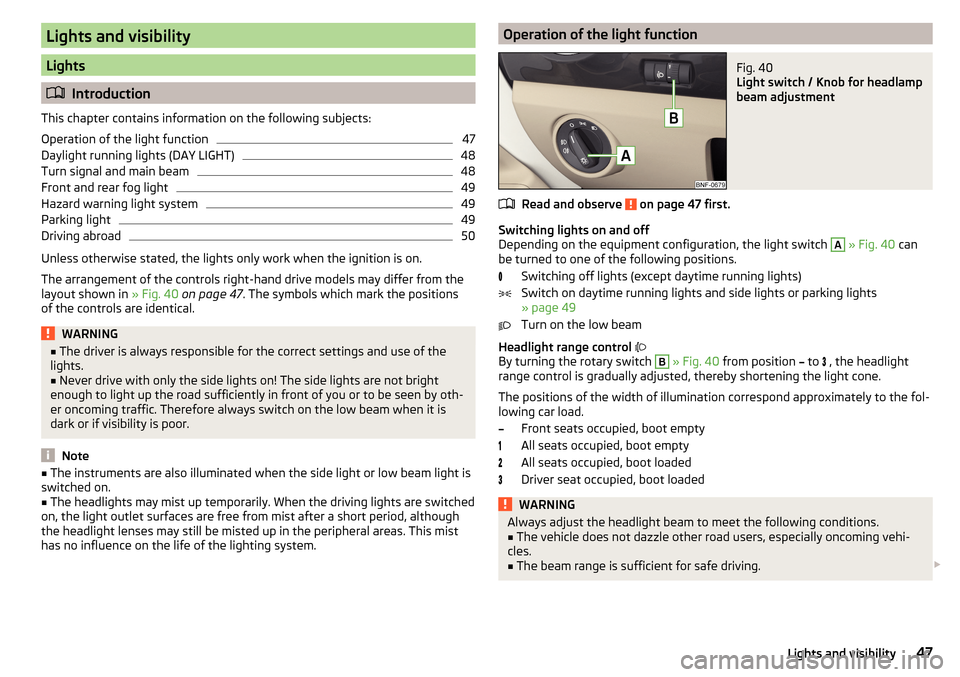
Operation of the light functionFig. 40
Light switch / Knob for headlamp
beam adjustment
Read and observe on page 47 first.
Switching lights on and off
Depending on the equipment configuration, the light switch
A
» Fig. 40 can
be turned to one of the following positions.
Switching off lights (except daytime running lights)
Switch on daytime running lights and side lights or parking lights
» page 49
Turn on the low beam
Headlight range control
By turning the rotary switch
B
» Fig. 40 from position
to
, the headlight
range control is gradually adjusted, thereby shortening the light cone.
The positions of the width of illumination correspond approximately to the fol-
lowing car load.
Front seats occupied, boot empty
All seats occupied, boot empty
All seats occupied, boot loaded
Driver seat occupied, boot loaded
WARNINGAlways adjust the headlight beam to meet the following conditions.■The vehicle does not dazzle other road users, especially oncoming vehi-
cles.■
The beam range is sufficient for safe driving.
47Lights and visibility
Page 52 of 160
Switching on the side light on both sides›Turn the light switch » Fig. 42 on page 49 to position and lock the vehicle.
After pulling out the ignition key and opening the driver's door, an audible
warning sounds. After a few seconds or after closing the driver's door, the au-
dible alarm is turned off, but the parking lights will remain switched on.
CAUTION
Turning on the parking light means the battery is heavily loaded.
Driving abroad
Read and observe
on page 47 first.
When driving in countries with opposing traffic system (traffic on the
left/right), your headlights may dazzle oncoming traffic. In order to avoid this,
the headlights must be adjusted at a specialist garage.
Indoor Lighting
Introduction
This chapter contains information on the following subjects:
Interior light
50
With the ignition off, the light turns off automatically after about 10 minutes.
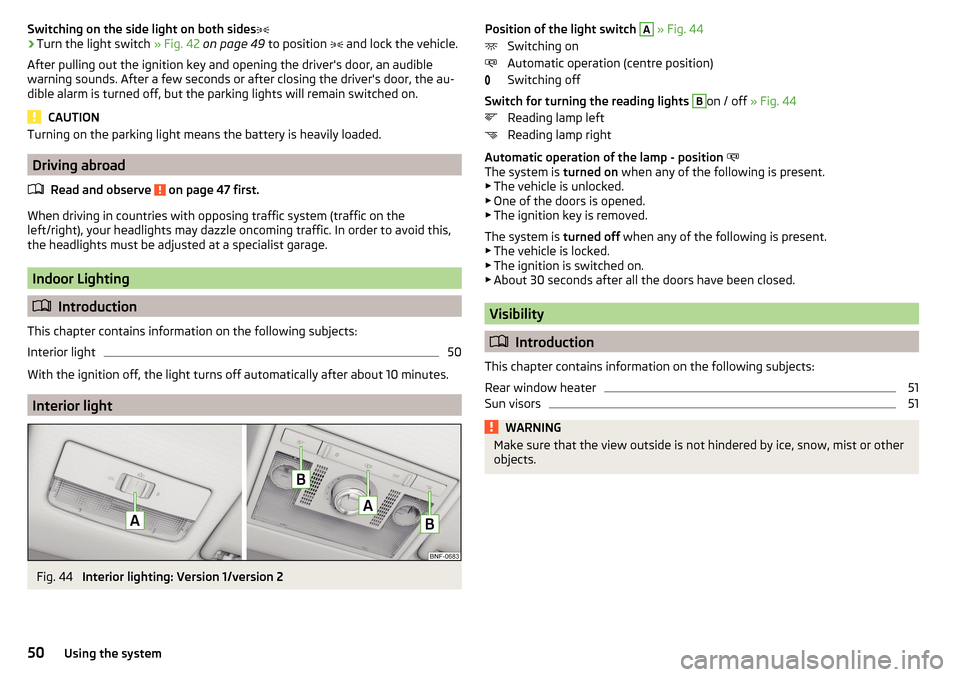
Interior light
Fig. 44
Interior lighting: Version 1/version 2
Position of the light switch A » Fig. 44
Switching on
Automatic operation (centre position)
Switching off
Switch for turning the reading lights B
on / off » Fig. 44
Reading lamp left
Reading lamp right
Automatic operation of the lamp - position
The system is turned on when any of the following is present.
▶ The vehicle is unlocked.
▶ One of the doors is opened.
▶ The ignition key is removed.
The system is turned off when any of the following is present.
▶ The vehicle is locked.
▶ The ignition is switched on.
▶ About 30 seconds after all the doors have been closed.
Visibility
Introduction
This chapter contains information on the following subjects:
Rear window heater
51
Sun visors
51WARNINGMake sure that the view outside is not hindered by ice, snow, mist or other
objects.50Using the system
Page 101 of 160
CAUTION■The headlights are never to be wiped dry - there is a risk of damaging the
protective lacquer and the headlight glass subsequently developing cracks.■
Do not use sharp objects to clean the glasses - there is a risk of damaging
the protective lacquer and the headlight glasses subsequently developing
cracks.
■
Do not use any aggressive cleaning or chemical solvent products to clean the
headlights – risk of damaging the headlight lenses.
Door closing cylinder
Read and observe
and on page 97 first.
Specific products must be used for de-icing door lock cylinders.
CAUTION
Make sure that as little water as possible gets into the locking cylinder when
washing the vehicle - there is a risk of freezing the lock cylinder!
Cavity protection
Read and observe
and on page 97 first.
All the cavities of your vehicle which are at risk from corrosion are protected
for life by a layer of protective wax applied in the factory.
This wax protection does not need to be inspected or re-applied.
If any small amount of wax flow out of the cavities at high temperatures, these
must be removed with a plastic scraper and the stains cleaned using a petrole-
um cleaner.
WARNINGSafety regulations should be observed when using petroleum cleaner to re-
move wax – risk of fire!
Jack
Read and observe
and on page 97 first.
The jack is maintenance-free.
If necessary, the moving parts of the jack should be lubricated with a suitable
lubricant.
Wheels
Read and observe
and on page 97 first.
Wheel rims
Also thoroughly wash the wheel rims when washing the vehicle on a regular
basis.
Regularly remove salt and brake abrasion, otherwise the rim material will be
corroded.
Light alloy wheels
After washing thoroughly and treat the wheel rims with a protective product
for light alloy wheels.
For the treatment of wheel rims do not use products which may cause damage
to the paint on the rims.
CAUTION
■ Damage to the paint layer on the wheel rims must be touched up immediate-
ly.■
Severe layers of dirt on the wheels can also result in wheel imbalance. This
may show itself in the form of a wheel vibration which is transmitted to the
steering wheel which, in certain circumstances, can cause premature wear of
the steering. This means it is necessary to remove the dirt.
Under-body protection
Read and observe
and on page 97 first.
The underside of your vehicle is already permanently protected by the factory
against chemical and mechanical influences.
It is not possible to guarantee that the protective coating will not suffer any
damage as the vehicle is driven.
We recommend having the protective layer underneath the vehicle and the
chassis checked — preferably before the beginning of winter and at the end of
winter.
WARNINGNever use additional underbody protection or anti-corrosion agents for ex-
haust pipes, catalytic converters or heat shields. When the engine reaches
its operating temperature, these substances may ignite - risk of fire!99Care and maintenance
Page 113 of 160
CAUTION■ Do not continue if for some reason it is not possible to fill with coolant un-
der the current circumstances! Switch off the engine and seek assistance from
a specialist garage.■
If the expansion tank is empty, do not top up with coolant. The system could
fill with air - risk of engine damage,
stop driving! Switch off the engine and
seek assistance from a specialist garage.
■
The concentration of coolant additive in the coolant must never be under
40%.
■
Over 60% of coolant additive in the coolant reduces the antifreeze protec-
tion and cooling effect.
■
A coolant additive that does not comply with the correct specification can
significantly reduce the corrosion protection of the cooling system.
■
Any faults resulting from corrosion may cause a loss of coolant and can con-
sequently result in major engine damage.
■
Do not fill the coolant above the mark
A
» Fig. 110 on page 111 .
■
If an error occurs, leading to the engine overheating, the help of a professio-
nal garage is to be sought - there is a risk of serious engine damage occurring.
■
Additional headlights and other attached components in front of the air inlet
impair the cooling efficiency of the coolant.
■
Never cover the radiator - there is a risk of the engine overheating.
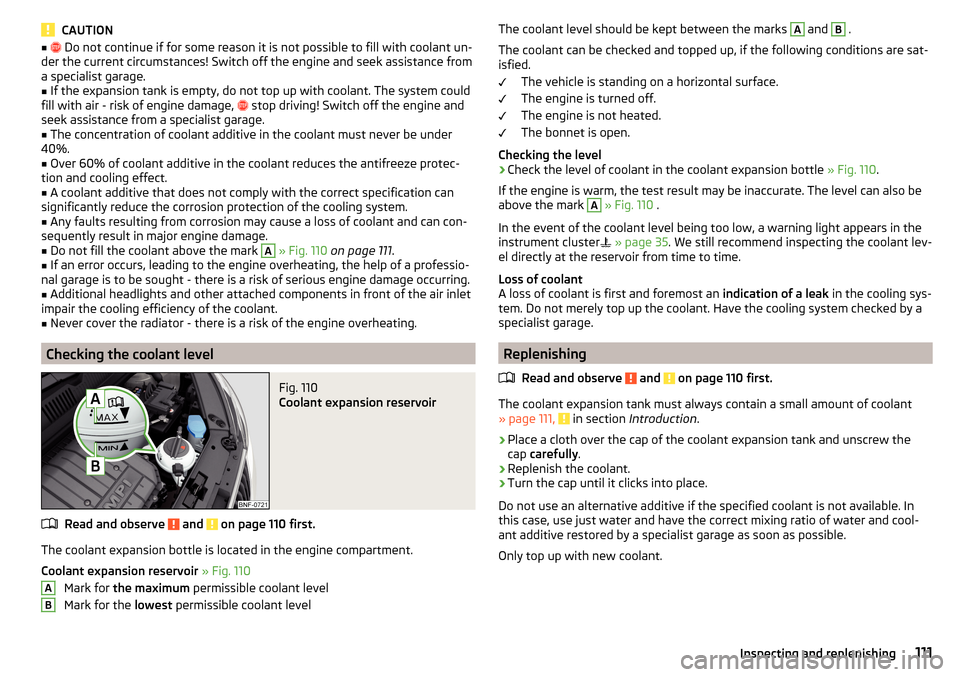
Checking the coolant level
Fig. 110
Coolant expansion reservoir
Read and observe and on page 110 first.
The coolant expansion bottle is located in the engine compartment.
Coolant expansion reservoir » Fig. 110
Mark for the maximum permissible coolant level
Mark for the lowest permissible coolant level
ABThe coolant level should be kept between the marks A and B .
The coolant can be checked and topped up, if the following conditions are sat-
isfied.
The vehicle is standing on a horizontal surface.
The engine is turned off.
The engine is not heated.
The bonnet is open.
Checking the level›
Check the level of coolant in the coolant expansion bottle » Fig. 110.
If the engine is warm, the test result may be inaccurate. The level can also be
above the mark
A
» Fig. 110 .
In the event of the coolant level being too low, a warning light appears in the
instrument cluster
» page 35 . We still recommend inspecting the coolant lev-
el directly at the reservoir from time to time.
Loss of coolant
A loss of coolant is first and foremost an indication of a leak in the cooling sys-
tem. Do not merely top up the coolant. Have the cooling system checked by a
specialist garage.
Replenishing
Read and observe
and on page 110 first.
The coolant expansion tank must always contain a small amount of coolant» page 111, in section Introduction .
›
Place a cloth over the cap of the coolant expansion tank and unscrew the
cap carefully .
›
Replenish the coolant.
›
Turn the cap until it clicks into place.
Do not use an alternative additive if the specified coolant is not available. In
this case, use just water and have the correct mixing ratio of water and cool-
ant additive restored by a specialist garage as soon as possible.
Only top up with new coolant.
111Inspecting and replenishing
Page 140 of 160
No.Consumer3Control unit for radiator fan, ignition4ABS/ESP5Central control unit, battery data module6Ignition lock, starter
Replacing bulbs
Introduction
This chapter contains information on the following subjects:
Bulb arrangement in the headlights
138
Changing the low beam and high beam bulb (halogen headlights)
139
Replacing bulb for daytime running lights and parking lights
139
Changing the front turn signal bulb
139
Replacing the bulb for the fog light
140
Replacing the bulb for the licence plate light
140
Rear Light
141
Changing a bulb in the tail light
141
Some manual skills are required to change a bulb. For this reason, we recom-
mend having bulbs replaced by a specialist garage or seeking other expert help
in the event of any uncertainties.
▶ Switch off the ignition and all of the lights before replacing a bulb.
▶ Faulty bulbs must only be replaced with the same type of bulbs. The designa-
tion is located on the light socket or the glass bulb.
▶ A stowage compartment for replacement bulbs is located in a plastic box in
the spare wheel or underneath the floor covering in the luggage compart-
ment.
Depending on the vehicle design, some vehicles may be equipped with LED
daytime running lights in the front bumper instead of the fog lights.
WARNING■ Always read and observe the warnings before completing any work in the
engine compartment » page 106.■
Accidents can be caused if the road in front of the vehicle is not suffi-
ciently illuminated and the vehicle cannot or can only be seen with difficul-
ty by other road users.
■
The H4 bulb is pressurised and may explode during a bulb replacement -
risk of injury! We therefore recommended wearing gloves and safety
glasses when changing a bulb.
■
Switch off the respective vehicle light when changing the bulb.
CAUTION
Do not take hold of the glass bulb with naked fingers (even the smallest
amount of dirt reduces the working life of the light bulb). Use a clean cloth,
napkin, or similar.
Note
■ This Owner's Manual only describes the replacement of bulbs where it is pos-
sible to replace the bulbs on your own without any complications arising. Other
bulbs must be replaced by a specialist garage.■
We recommend that a box of replacement bulbs always be carried in the ve-
hicle. Replacement bulbs can be purchased from ŠKODAOriginal Accessories.
■
We recommend having the headlight settings checked by a specialist garage
after replacing a bulb in the main beam, low beam or fog lights.
■
If the LED diode is defect visit a specialist garage.
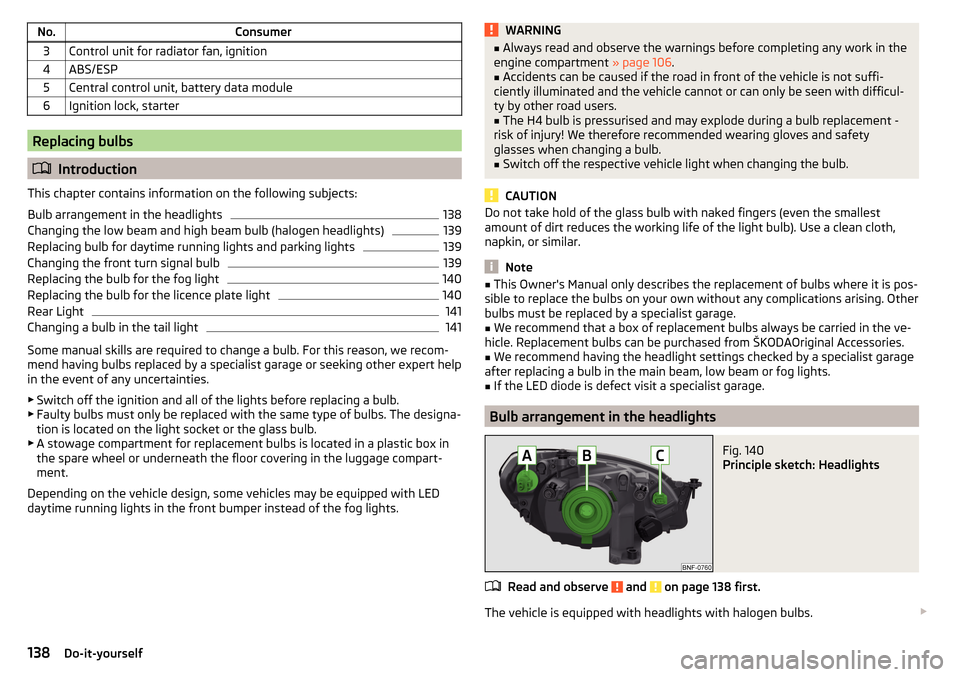
Bulb arrangement in the headlights
Fig. 140
Principle sketch: Headlights
Read and observe and on page 138 first.
The vehicle is equipped with headlights with halogen bulbs.
138Do-it-yourself
Page 141 of 160
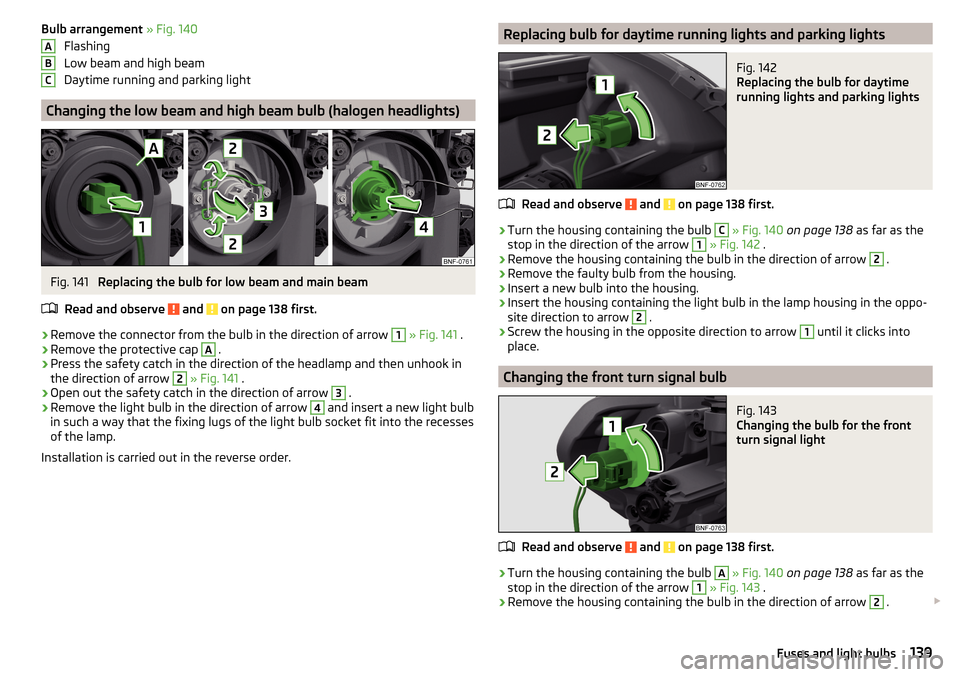
Bulb arrangement » Fig. 140
Flashing
Low beam and high beam
Daytime running and parking light
Changing the low beam and high beam bulb (halogen headlights)
Fig. 141
Replacing the bulb for low beam and main beam
Read and observe
and on page 138 first.
›
Remove the connector from the bulb in the direction of arrow
1
» Fig. 141 .
›
Remove the protective cap
A
.
›
Press the safety catch in the direction of the headlamp and then unhook in
the direction of arrow
2
» Fig. 141 .
›
Open out the safety catch in the direction of arrow
3
.
›
Remove the light bulb in the direction of arrow
4
and insert a new light bulb
in such a way that the fixing lugs of the light bulb socket fit into the recesses
of the lamp.
Installation is carried out in the reverse order.
ABCReplacing bulb for daytime running lights and parking lightsFig. 142
Replacing the bulb for daytime
running lights and parking lights
Read and observe and on page 138 first.
›
Turn the housing containing the bulb
C
» Fig. 140 on page 138 as far as the
stop in the direction of the arrow
1
» Fig. 142 .
›
Remove the housing containing the bulb in the direction of arrow
2
.
›
Remove the faulty bulb from the housing.
›
Insert a new bulb into the housing.
›
Insert the housing containing the light bulb in the lamp housing in the oppo-
site direction to arrow
2
.
›
Screw the housing in the opposite direction to arrow
1
until it clicks into
place.
Changing the front turn signal bulb
Fig. 143
Changing the bulb for the front
turn signal light
Read and observe and on page 138 first.
›
Turn the housing containing the bulb
A
» Fig. 140 on page 138 as far as the
stop in the direction of the arrow
1
» Fig. 143 .
›
Remove the housing containing the bulb in the direction of arrow
2
.
139Fuses and light bulbs
Page 149 of 160
Index
A
abroad lead-free petrol
103
Abroad Headlights
50
ABS Operation
85
Warning light36
Acceptance and recycling of used vehicles95
Accessories92
Adjusting Exterior mirrors
53
head restraints54
Seat54
Steering wheel9
Adjusting the seats8
Air-conditioning system Air outlet vents
71
Airbag14
Deactivating17
Deactivating the front passenger airbag18
Deployment15
Front airbag15
Modifications and damage to the airbag system 94
Side airbag Head-Thorax
17
Warning light37
Airbag system14
air conditioning recirculation
70
Air conditioning69
Controls69
Air outlet vents71
Alcantara cleaning
101
Alternator Warning light
35
Anodized partsRefer to vehicle maintenance98
Anti-lock braking system (ABS)85
Anti-theft wheel bolts124
artificial leather101
Ashtray61
Assistance systems City Safe Drive
89
Parking aid86
Assistance Systems ESC
36
Assist systems85
ABS36
Cruise Control System88
Visual parking system87
Auto-computer see multi-function display
31
Automated transmission81
Lever control81
Warning light35
Automatic gearbox Tiptronic
82
Automatic load deactivation115
Automatic transmission Kick-down
82
Starting-off and driving82
Avoiding damage to your vehicle84
B
Bag hooks
65
Battery In the remote control key
132
Belts11
Belt tensioners13
Bonnet Closing
107
Opening107
Boot Class N1 vehicles67
See Boot lid43
Boot lid automatic locking
43
Closing43
Opening43
Brake Assist (HBA)86
Brake booster79
brake fluid specification
112
Brake fluid112
Checking112
Brake pedal - automatic transmission warning light
38
Brakes Brake booster
79
Brake fluid112
Braking and stabilisation systems85
Handbrake79
Running-in83
Warning lights34
Brakes and parking78
Brake system85
Braking Information on braking
78
Button in driver's door electric windows
44
C
Car care Jack
99
Care and maintenance92
Car park ticket holder58
Carrier Roof rack
67
Cavity protection99
Central locking39
problems42
147Index
Page 151 of 160
cruise controloperation88
operation Description88
Cruise control system Warning light
38
Cruise Control System88
Cup holders59
D
DAY LIGHT see Daylight running lights
48
Daylight running lights48
De-icing windows
98
Deactivating an airbag17
Decorative films97
Defrosting rear window51
Delayed locking of the boot lid see boot lid
43
Departure angle145
Digital Clock Time
33
Dimmed headlights47
Dipstick109
Disconnecting and reconnecting vehicle battery
115
Display Service interval
30
Display of fuel reserve
29
Disposal Acceptance and recycling of used vehicles
95
Distance driven30
Door Child safety lock
42
Closing41
Emergency locking132
Opening41
Door opening lever locking of42
unlocking of42
Drive Driving through water
84
Driving Emissions
143
Fuel consumption143
through water84
Top speed146
Trailer operation95
E
Economical driving Tips
83
EDL86
Electric Windows44
Button in driver's door44
Button in the front passenger door44
Electronic Differential Lock (EDL)86
Electronic immobilizer75
Emergency Changing a wheel
123
Hazard warning light system49
Jump-starting129
Locking the door without a locking cylinder132
Towing the vehicle130
Tyre repair127
Emergency equipment Jack
122
Reflective vest122
Vehicle tool kit122
Warning triangle122
Emissions143
Engine Running-in
83
Switch off engine76
Engine compartment106
Brake fluid112
Overview108
Vehicle battery112
Engine number142
engine oil specification
109
Engine oil109
Checking109
Replenishing110
Warning light35
EPC Warning light
37
ESC Operation
85
Warning light36
Exhaust inspection system Warning light
37
F
Films
97
Fog Lights49
Foldable hook63
Footmats80
see footmats80
Force limit Sliding/tilting roof
45
Force limiter Sliding/tilting roof
46
Front airbag15
fuel lead-free petrol
103
Fuel102
CNG105
Fuel reserve display29
refer to Fuel102
Refuelling103
Refuelling - natural gas104
Fuel consumption143
149Index
Page 152 of 160
FusesAssignment134
Assignment of fuses in the dash panel137
Colour coding134
Fuse allocation in the dash panel135
Fuse allocation in the engine compartment137
Replacing134
Fuses in the engine compartment Allocation
137
G
Gear changing Gear stick
80
Gear recommendation30
General view Cockpit
27
Genuine parts93
H
Handbrake
79
Warning light34
Handbrake - automatic transmission Warning light
38
Hazard warning light system49
HBA86
Head-Thorax17
Headlights Bulb arrangement
138
Driving abroad50
Head restraints54
Adjust height54
Headrest, removing and installing
55
Heating69
Controls69
Exterior mirrors53
Rear window51
Seats55
HHC86
Hill Start Assist (HHC)86
Horn27
I
Ice scrapers
98
Ignition lock76
Immobilizer75
Inertia reels13
Instrument cluster28
Counter for distance driven30
Fuel reserve display29
Gear recommendation30
Memory of the multi-function display33
Multi-function display31
Overview28
see instrument cluster28
Service interval display30
Tachometer29
Instruments see instrument cluster
28
Interior care100
Natural leather100
ISOFIX22
J
Jack
122
- fit125
Maintenance99
Jump-starting129
K
Key Lock
40
Start the engine76
Unlock40
L
Labels Airbag
20
Lashing eyes65
Leather Natural leather care
100
Lever Main beam
48
Turn signal48
Wiper52
lever control81
See lever control81
Light Cockpit
50
Dimmed headlights47
Fog Lights49
Headlight range control47
on and off47
Parking light49
Rear fog light49
Sidelights47
Lighting Luggage compartment
64
Light on and off47
Lights47
Daylight running48
Hazard warning light system49
Headlight flasher48
Main beam48
Replacing bulbs138
Turn signal48
Warning lights34
Load143
Loading floor67
Lock Key
40
Lock/unlock steering lock76
Locking Door opening lever
42
Remote control40
Locking and unlocking the vehicle from the in- side
40
150Index