steering SKODA FABIA 2005 1.G / 6Y Owner's Guide
[x] Cancel search | Manufacturer: SKODA, Model Year: 2005, Model line: FABIA, Model: SKODA FABIA 2005 1.G / 6YPages: 260
Page 140 of 260

Airbag system139
Using the systemSafetyDriving TipsGeneral MaintenanceBreakdown assist-
anceTechnical DataFabia Praktik
Front airbags
Description
The airbag system is not a substitute for the seat belt!
Vehicles with an airbag system for the driver and front passenger* are
recognisable by the lettering “AIRBAG” on the padded centre of the
steering wheel ⇒fig. 113 and on the right hand side of the dash panel
⇒ fig. 114 .
The front airbag system, in combination with three-point safety belts,
offers additional protection for the head and chest area of the driver and
front passenger in the event of a frontal collision of major severity ⇒ in
“Important safety information regarding the front airbag system” on
page 140.
The airbag is not a substitute for the seat belt, but is part of the complete
passive vehicle safety concept. Please note that an airbag can only
offer you optimal protection in combination with a seat belt which is
fastened.
Apart from their normal protective function, a further task of the seat belts
is to also hold the driver and front passenger in a correct seated position
in the event of a frontal collision so as to enable the front airbags to offer
the maximum protection.
You should therefore always fasten ⇒page 129, “Why seat belts?” the
seat belts, not only because this is required by law, but also for safety
reasons and for your own protection.
Note
The dash panel must be replaced after the front passenger airbag has
been deployed.
Fig. 113 Driver airbag
in the steering wheel
Fig. 114 Front
passenger airbag in the
dash panel
sqc.1.book Seite 139 Mittwoch, 13. April 2005 1:09 13
Page 141 of 260

Airbag system
140
Function of the front airbags
Risk of injury to the head and chest area is reduced by fully
inflated airbags.
The airbag system is designed in such a way that the driver and front
passenger airbag* are deployed in the event of a frontal collision of major
severity.
It is also possible under certain special accident situations that the front
as well as the side airbags are deployed.
If the airbags are deployed, the airbags are filled with a propellant gas and
inflated in front of the driver and front passenger ⇒fig. 115 . The airbags
inflate in fractions of a second and at a high speed in order to be able to
offer that additional protection in the event of an accident. The forward
movement of the driver and of the front passenger is cushioned when they
make contact with the fully inflated airbag and the risk of injury to head and
chest is thus reduced. The specially developed airbag allows the gas to flow out of the inflated
airbag in a controlled manner (depending on the load of the particular car
occupant) in order to cushion head and chest areas. The airbag then
deflates subsequently to such an extent, after an accident, to again
provide a clear view forward.
A grey white, non harmful gas is released when airbag is inflated. This is
perfectly normal and is not an indication of a fire in the vehicle.
The airbag develops enormous forces when triggered, which can lead to
injuries if the sitting position or seated position is not correct
⇒ in
“Important safety information regarding the front airbag system”.
Important safety informat ion regarding the front
airbag system
Correct use of the airbag system considerably reduces the
risk of injury!
Fig. 115 Inflated
airbags
Fig. 116 Safe distance
to steering wheel
sqc.1.book Seite 140 Mittwoch, 13. April 2005 1:09 13
Page 142 of 260

Airbag system141
Using the systemSafetyDriving TipsGeneral MaintenanceBreakdown assist-
anceTechnical DataFabia Praktik
WARNING
•Never transport children on the front seat of a vehicle without
using a proper restraint system. If airbags are deployed in the event
of an accident, the child might suffer severe or even fatal injuries!
•For the driver and front passenger it is important to maintain a
distance of at least 25 cm from the steering wheel or dash panel
⇒ page 140, fig. 116 . Not maintaining this minimum distance will
mean that the airbag system will not be able to properly protect you
- hazard! The front seats and the head restraints must always also
be correctly adjusted to match the body size of the occupant.
•It is essential to always switch off ⇒page 144, “Deactivating an
airbag” the front passenger airbag when attaching a child safety
seat on the front passenger seat where the child is seated with its
back facing in direction of travel (in some countries also when the
child is facing the direction of travel). If this is not done, there is a
risk of the child suffering severe or even fatal injuries if the front
passenger airbag is deployed. In certain countries national legal
provisions also require that the side passenger airbags be deacti-
vated. When transporting a child on the front passenger seat,
please comply with the appropriate national regulations regarding
the use of child safety seats.
•There must not by any further persons, animals or objects posi-
tioned between the front seated occupants and the deployment
area of the airbag.
•The steering wheel and the surface of the airbag module in the
dash panel on the passenger side must not be stuck onto, covered
or modified in any other way. These parts should only be cleaned
with a dry cloth or a cloth moistened with water. No objects such as
cup holders, mobile phone mounts, etc. may be attached to the
covers of the airbag modules or be located within the immediate
area.
•No modifications of any kind may be made to parts of the airbag
system. Any work on the airbag system including removing and installing system components because of other repair work (e.g.
removing steering wheel) must only be carried out by a specialist
garage.
•Never carry out changes on the front bumper or on the body.
•Never place any objects on the surface of the front passenger
airbag in the dash panel.
Side airbags*
Description of side airbags
The side airbag increases protection of the passenger
concerned in the case of a side impact.
WARNING (continued)
Fig. 117 Driver seat:
Installation position of
airbag
sqc.1.book Seite 141 Mittwoch, 13. April 2005 1:09 13
Page 145 of 260

Airbag system
144
Deactivating an airbag
Deactivating airbags
If any airbags have been deactivated, switch them on
again as soon as possible so that they are able to again
provide their proper protection.
There is the technical means installed within your vehicle to switch off the
front passenger airbag or side airbag (take out of commission).
This is why you should have the deactivation of the airbags carried out by
a specialist garage.
On vehicles equipped with the switch for deactivation of the airbags, you
can deactivate the front passenger airbag or passenger side airbag by
means of this switch ⇒page 145.
Deactivation of airbags is envisaged only for particular instances,
such as if:
•you must in exceptional cases use a child seat on the front
passenger seat where the child has its back to the direction of travel of the
vehicle (in some countries this must be in the direction of travel due to
other legal regulations applying) ⇒page 147, “Important safety informa-
tion on using child safety seats”,
•you are not able to maintain the distance of at least 25 cm between
middle of steering wheel and chest, despite the driver seat being correctly
adjusted,
•special attachments are required in the area of the steering wheel
because of a physical disability,
•you have installed other seats (e.g. orthopaedic seats without side
airbags). Monitoring the airbag system
The functionality of the airbag system is also monitored electronically,
when one airbag has been switched off
If the airbag was switched off using diagnostic equipment:
•The airbag indicator light in the instrument cluster lights up for about 3
seconds after switching on the ignition and then flashes after that for about
12 seconds.
Front passenger airbags switched off using the switch for front
passenger airbags* in stowage compartment on the front passenger
side:
•The airbag warning light comes on in the instrument cluster for about
3 seconds each time the ignition is switched on.
•Switching off airbags is indicated in the middle of the dash panel by the
lighting up of the indicator light ⇒ page 145, fig. 120 .
Note
Your Škoda dealer will be able to advise you whether national legislation
in your country allows airbags in your vehicle to be deactivated, and which
ones.
sqc.1.book Seite 144 Mittwoch, 13. April 2005 1:09 13
Page 158 of 260

Intelligent Technology157
Using the systemSafetyDriving TipsGeneral MaintenanceBreakdown assist-
anceTechnical DataFabia Praktik
Driving Tips
Intelligent Technology
Electronic stability programme (ESP)*
General
General
The ESP aids you maintain control of your vehicle in situations in border-
line driving situations such as when negotiating a curve too fast. The risk
of skidding is reduced and your car thus offers greater driving stability
depending on the conditions of the road surface. This occurs at all speeds.
The following systems are integrated into the electronic stability
programme:
•Electronic Differential Lock (EDL),
•Traction control system (TCS),
•Antilock brake system (ABS),
•Brake Assist.
Operating principle
The ESP switches on automatically when the engine is started and then
conducts a self-test. The ESP control unit processes data from the indi-
vidual systems. It also processes additional measurement data which are
supplied by highly sensitive sensors: the rotational velocity of the vehicle
about its vertical axis, the lateral acceleration of the vehicle, the braking
pressure and the steering angle.
The direction which the driver wishes to take is determined based on the
steering angle and the speed of the vehicle and is constantly compared
with the actual behaviour of the vehicle. If differences exist, such as the
car beginning to skid, the ESP will automatically brake the appropriate
wheel.
The car is stabilised again by the forces which take effect when the wheel
is braked. Intervention into the brake system takes place primarily on the
outer front wheel of a vehicle which tends to oversteer (tendency for the
rear of the vehicle to break away) while occurs this is on the inner rear
wheel of a vehicle which tends to understeer (tendency to shift out of the
curve). This braking control cycle is accompanied by noises.
The ESP operates in combination with the ABS ⇒page 161, “Antilock
brake system (ABS)*”. If there is a fault in the ABS system, the ESP also
does not operate.
Fig. 130 ESP switch
sqc.1.book Seite 157 Mittwoch, 13. April 2005 1:09 13
Page 162 of 260

Intelligent Technology161
Using the systemSafetyDriving TipsGeneral MaintenanceBreakdown assist-
anceTechnical DataFabia Praktik
Low brake fluid level
An insufficient level of brake fluid may result in problems in the brake
system. The level of the brake fluid is monitored electronically
⇒page 36,
“Brake system ”.
WARNING
•Only apply the brakes for the purpose of drying and cleaning the
brake discs if the traffic conditions permit this. Do not place any
other road users in jeopardy.
•When retrospectively mounting a front spoiler, solid wheel hubs
etc. one must ensure that the air supply to the front wheel brakes
is not reduced otherwise the braking system could run too hot.
•Allow for the fact that new brake pads do not achieve their full
braking efficiency until approximately 200 kilometres. New brake
pads must be first “run in” before they develop their optimal fric-
tion force. You can, however, compensate for this slightly reduced
braking force by increasing the pressure on the brake pedal. This
guideline also applies to any new brake pads installed at a future
date.
Caution
•Never allow the brakes to rub by applying slight pressure if you do not
wish to brake the vehicle. This causes the brakes to overheat and can also
result in a longer braking distance and excessive wear.
•Before negotiating a steep downhill section, please reduce your
speed, shift down into the next lower gear (manual gearbox) or select a
lower driving stage (automatic gearbox). This enables you to make full use
of the braking power of the vehicle and reduces the strain on the brakes.
Any additional braking should be done intermittently, not continuously.
Brake booster
The braking force boosts the pressure which you generate with the brake
pedal. The necessary pressure is only generated when the engine is
running.
WARNING
•Never switch off the engine before the vehicle is stationary.
•The brake booster only operates when the engine is running.
Greater physical effort for braking is required when engine is
switched off. Because if you do not stop as normal, this can cause
an accident and severe injuries.
Antilock brake system (ABS)*
ABS prevents the wheels locking when braking.
General
The ABS contributes significantly to enhancing the active safety of your
vehicle. Compared to a car not fitted with the ABS brake system, you are
able to retain optimal steering ability even during a full brake application
on a slippery road surface because the wheels do not lock up.
You must not expect, however, that the braking distance will be shorter
under all circumstances as a result of the ABS. The braking distance for
example on gravel and fresh snow, when you should anyway be driving
slowly and cautiously, will be longer.
sqc.1.book Seite 161 Mittwoch, 13. April 2005 1:09 13
Page 164 of 260

Intelligent Technology163
Using the systemSafetyDriving TipsGeneral MaintenanceBreakdown assist-
anceTechnical DataFabia Praktik
•The increased safety offered by the Brake Assist must not tempt
you to take a greater safety risk than otherwise.
Power steering*
The power steering enables you to steer the vehicle with less physical
force.
The steering characteristics can be changed by a specialist garage.
You will place great stresses on the power steering system if the steering
is turned to full lock when the vehicle is stationary. Turning the steering to
full lock in such a situation will be accompanied by noises.
It is still possible to fully steer the vehicle if the power steering fails or if the
engine is not running (vehicle being towed in). The only difference is that
greater physical effort is required.
It is possible that the hydraulic pump of the power steering will not run due
to the low vehicle network voltage if the battery has gone flat and the
engine must started with the help off jump leads. This condition will be
indicated by lighting up of the warning light.
The power steering operates again if the battery is charged to a specific
range when engine is running. It also operates again, if the engine can be
started with its own battery.
Caution
Do not leave the steering at full lock for more than 15 seconds when the
engine is running - risk of damaging the power steering!
Note
Have the steering inspected as soon as possible by a specialist garage if
there is a leak or fault in the system.
WARNING (continued)
sqc.1.book Seite 163 Mittwoch, 13. April 2005 1:09 13
Page 183 of 260

Care and cleaning
182
WARNING
One should remember when cleaning the wheels that moisture, ice
and road salt may adversely affect braking efficiency - risk of an
accident!
Note
Severe layers of dirt on the wheels can also result in wheel imbalance.
This may show itself in the form of a wheel vibration which is transmitted
to the steering wheel which, in certain circumstances, can cause prema-
ture wear of the steering. This means it is necessary to remove the dirt.
Underbody protection
The underside of your vehicle is protected for life against chemical and
mechanical influences.
One cannot, however, completely rule out damage to the protective layer
when driving so we recommend that you inspect the protective layer on
the underside of your vehicle and on the chassis at certain intervals - this
is best done at the beginning and end of the winter - and to touch up any
damaged areas.
Škoda dealers have suitable spray products available as well as the
necessary equipment and are familiar with the instructions for its use. We
therefore recommend to have repairs and additional corrosion protection
measures preferably carried out by a Škoda dealer.
WARNING
Never use additional underbody protection or corrosion-protection
agents for the exhaust pipes, catalytic converters or heat shields.
Such substances might ignite when driving - risk of fire!
Protection of hollow spaces
All the cavities of your vehicle which are at risk from corrosion are
protected for life by a layer of protective wax applied in the factory.
This wax protection does not require to be inspected or re-treated. Please
remove any small amount of wax which flows out of the cavities at high
temperatures with a plastic scraper and clean the spot using petroleum
cleaner.
WARNING
Safety and environmental protection regulations should observed
when using petroleum cleaner to remove wax - a risk of fire!
Engine compartment
Good corrosion protection is very important, particularly in winter when
one often drives over its salt-strewn roads. One should therefore clean the
whole engine compartment and the radiator tank before and after the salt
spreading period and treat with preservative in order to prevent the salt
from being destructive.
Škoda dealers have the cleaning agents and preservatives recommended
by the manufacturer and also the required equipment.
WARNING
•It is necessary to observe the guidelines given in the chapter
before working on the engine compartment ⇒page 191.
•Let the engine cool down before cleaning the engine compart-
ment.
sqc.1.book Seite 182 Mittwoch, 13. April 2005 1:09 13
Page 200 of 260
Inspecting and Replenishing199
Using the systemSafetyDriving TipsGeneral MaintenanceBreakdown assist-
anceTechnical DataFabia Praktik
Caution
Do not continue your journey if fo r some reason it is not possible
under the conditions prevailing to top up with coolant. Switch the
engine off and obtain professional assistance from a specialist garage,
otherwise it could lead to severe engine damage.
For the sake of the environment
Do not re-use coolant if it is necessary to drain the coolant in the system.
It should be collected and disposed of in compliance with environmental
protection regulations.
The radiator fan
The radiator fan may switch on suddenly.
The radiator fan is driven by an electric motor and controlled by a thermo-
stat according to the coolant temperature.
The radiator fan may continue running for up to 10 minutes after the
engine has been switched off - even if the ignition is also off. It may also
switch on suddenly after a certain time, if
•the coolant temperature has risen because of an accumulation of heat
or
•the warm engine compartment is heated up additionally by strong
sunlight.
WARNING
You must therefore be aware when working in the engine compart-
ment that the fan may switch on suddenly - risk of injury!
Brake fluid
Inspecting the brake fluid level
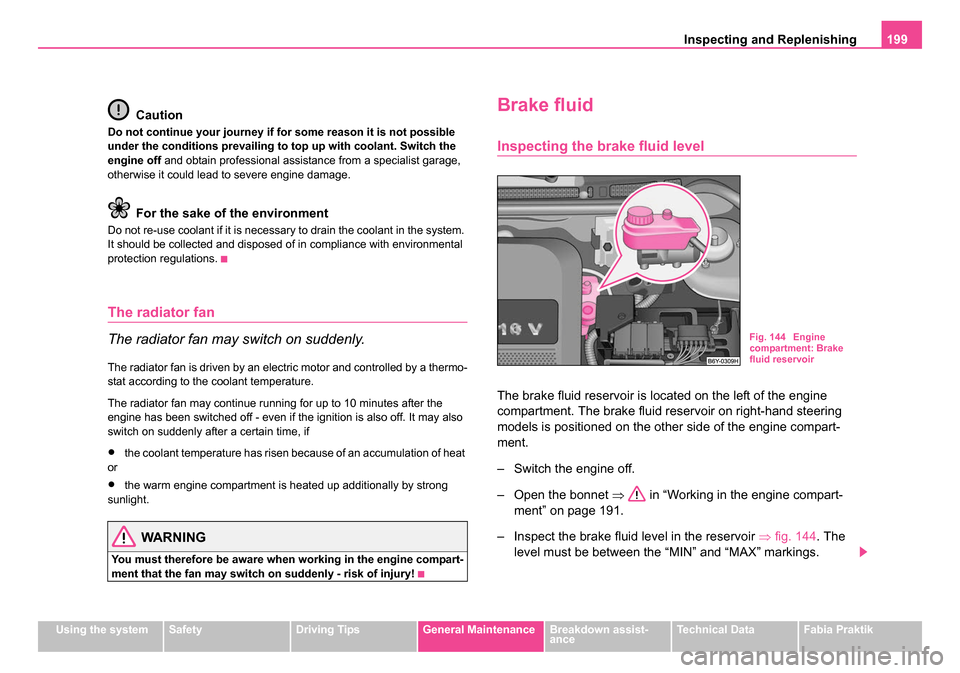
The brake fluid reservoir is located on the left of the engine
compartment. The brake fluid reservoir on right-hand steering
models is positioned on the other side of the engine compart-
ment.
– Switch the engine off.
– Open the bonnet ⇒ in “Working in the engine compart-
ment” on page 191.
– Inspect the brake fluid level in the reservoir ⇒fig. 144. The
level must be between the “MIN” and “MAX” markings.
Fig. 144 Engine
compartment: Brake
fluid reservoir
sqc.1.book Seite 199 Mittwoch, 13. April 2005 1:09 13
Page 210 of 260

Wheels and Tyres209
Using the systemSafetyDriving TipsGeneral MaintenanceBreakdown assist-
anceTechnical DataFabia Praktik
Tyre life
The life of your tyres very much depends on the following points:
Tyre pressure
The working life of tyres will be shortened considerably if the tyres are
insufficiently or over-inflated and this will have an adverse effect on the
handling of your vehicle.
Correctly inflated tyres are of particular importance when travelling at high
speeds . It is therefore good to check the pressure at least once a month
and also before setting off on a long trip. Please do not forget the spare
wheel when checking the tyres.
The tyre inflation pressures for summer tyres are indicated on the inside
of the fuel filler flap ⇒fig. 150 . The inflation pressures for winter tyres are
20 kPa (0.2 bar) higher than those for summer tyres ⇒page 213.
The tyre pressure should be at the highest pressure specified for your
vehicle at all times. Always check the inflation pressure of tyres when cold. Do not reduce the
higher pressure of warm tyres. Adapt the inflation pressure of the tyres
accordingly if your vehicle is carrying a significantly higher payload.
Driving style
Fast cornering, sharp acceleration and braking (squealing tyres) increase
wear-and-tear on your tyres.
Balancing wheels
The wheels of a new vehicle are balanced. There are a wide range of influ-
ences when driving which may result in an imbalance and which makes
themselves felt through vibration in the steering.
You should have the wheels rebalanced since any imbalance increases
wear-and-tear on the steering, the suspension and tyres. A wheel must
also be rebalanced when a new tyre is fitted and each time a tyre is
repaired.
Wheel alignment errors
Incorrect wheel alignment at the front and rear will not only increase wear-
and-tear on the tyres but will also has an adverse effect on vehicle safety.
Contact your specialist garage if you notice any unusual tyre wear.
WARNING
•If the inflation pressure is too low, the tyre must perform a
greater flexing work. At higher speeds the tyre will warm up as a
result of this. This can result in tread separation and even a tyre
blowout.
•Immediately replace the damaged rims or tyres.
For the sake of the environment
Tyres which are insufficiently inflated increase your fuel consumption.
Fig. 150 An opened
fuel filler flap with the
tyre inflation pressure
table
sqc.1.book Seite 209 Mittwoch, 13. April 2005 1:09 13