seats SKODA FABIA 2005 1.G / 6Y Service Manual
[x] Cancel search | Manufacturer: SKODA, Model Year: 2005, Model line: FABIA, Model: SKODA FABIA 2005 1.G / 6YPages: 260
Page 144 of 260
Airbag system143
Using the systemSafetyDriving TipsGeneral MaintenanceBreakdown assist-
anceTechnical DataFabia Praktik
Important safety informat ion on the side airbag
Correct use of the airbag system considerably reduces the
risk of injury!
WARNING
•It is essential to always switch off ⇒page 144, “Deactivating an
airbag” the front passenger airbag when attaching a child safety
seat on the front passenger seat where the child is seated with its
back facing in direction of travel (in some countries also when the
child is facing the direction of travel). If this is not done, there is a
risk of the child suffering severe or even fatal injuries if the front
passenger airbag is deployed. In certain countries national legal
provisions also require that the side passenger airbags be deacti-
vated. When transporting a child on the front passenger seat,
please comply with the appropriate national regulations regarding
the use of child safety seats.
•Your head should never be positioned in the deployment area of
the side airbag. You might suffer severe injuries in the event of an
accident. This applies in particular to children who are transported
without using a suitable child safety seat ⇒page 150, “Child safety
and side airbags*”.
•If children adopt an incorrect seated position when travelling,
they may be exposed to an increased risk of injury in the event of
an accident. This can result in serious injuries ⇒page 147, “What
you should know about transporting children!”.
•There must not be any further persons, animals as well as
objects positioned between the occupants and the deployment
area of the airbag. There must also be no accessories such as cup
holders, attached to the doors to enable the side airbags to activate
properly.
•Only hang light items of clothing on the clothes hooks to the
vehicle. Never leave any heavy or sharp-edged objects in the
pockets of the items of clothing.
•Ensure that there are no excessive forces, such as violent
knocks, kicks etc., impact on the backrests of the seats otherwise
the system may be damaged. The side airbags would not be
deployed in such a case!
•Any seat or protective covers which you fit to the driver or front
passenger seats must only be of the type expressly authorized by
Škoda Auto. In view of the fact that the airbag inflates out of the
backrest of the seat, use of non-approved seat or protective covers
would considerably impair the protective function of the side
airbag.
•Any damage to the original seat covers in the area of the side
airbag module must be repaired without delay by your specialist
garage.
•The airbag modules in the front seats must not display any
damage, cracks or deep scratches. It is not permissible to use force
in order to open the modules.
•Any work on the side airbag system including removing and
installing system components because of other repair work (e.g.
removing seats) must only be carried out by a specialist garage.
WARNING (continued)
sqc.1.book Seite 143 Mittwoch, 13. April 2005 1:09 13
Page 145 of 260
Airbag system
144
Deactivating an airbag
Deactivating airbags
If any airbags have been deactivated, switch them on
again as soon as possible so that they are able to again
provide their proper protection.
There is the technical means installed within your vehicle to switch off the
front passenger airbag or side airbag (take out of commission).
This is why you should have the deactivation of the airbags carried out by
a specialist garage.
On vehicles equipped with the switch for deactivation of the airbags, you
can deactivate the front passenger airbag or passenger side airbag by
means of this switch ⇒page 145.
Deactivation of airbags is envisaged only for particular instances,
such as if:
•you must in exceptional cases use a child seat on the front
passenger seat where the child has its back to the direction of travel of the
vehicle (in some countries this must be in the direction of travel due to
other legal regulations applying) ⇒page 147, “Important safety informa-
tion on using child safety seats”,
•you are not able to maintain the distance of at least 25 cm between
middle of steering wheel and chest, despite the driver seat being correctly
adjusted,
•special attachments are required in the area of the steering wheel
because of a physical disability,
•you have installed other seats (e.g. orthopaedic seats without side
airbags). Monitoring the airbag system
The functionality of the airbag system is also monitored electronically,
when one airbag has been switched off
If the airbag was switched off using diagnostic equipment:
•The airbag indicator light in the instrument cluster lights up for about 3
seconds after switching on the ignition and then flashes after that for about
12 seconds.
Front passenger airbags switched off using the switch for front
passenger airbags* in stowage compartment on the front passenger
side:
•The airbag warning light comes on in the instrument cluster for about
3 seconds each time the ignition is switched on.
•Switching off airbags is indicated in the middle of the dash panel by the
lighting up of the indicator light ⇒ page 145, fig. 120 .
Note
Your Škoda dealer will be able to advise you whether national legislation
in your country allows airbags in your vehicle to be deactivated, and which
ones.
sqc.1.book Seite 144 Mittwoch, 13. April 2005 1:09 13
Page 148 of 260
Transporting children safely 147
Using the systemSafetyDriving TipsGeneral MaintenanceBreakdown assist-
anceTechnical DataFabia Praktik
Transporting children safely
What you should know about
transporting children!
An introduction to the subject
Accident statistics have revealed that children are gener-
ally more safely transported on the rear seats than on the
front passenger seat.
Children younger than 12 years of age should normally travel on the rear
seat of the vehicle (take note of any national legal provisions which differ
from this). They should be secured there by means of a child restraint
system or by using the existing seat belts depending on their age, body
size and weight. The child seat should be mounted behind the front
passenger seat for safety reasons.
The physical principle of an accident does, of course, also apply to chil-
dren ⇒page 130, “The physical principle of a frontal collision”. They differ
from adults in that their muscles and bone structure of children are not yet
fully developed. Thus children are exposed to increased risk of injury.
Children should be transported by using special child safety seats in order
to reduce this risk of injury.
Only use child safety seats which are officially approved, suitable for chil-
dren and which comply with the ECE-R 44 standard, which classifies child
safety seats into 5 groups ⇒page 151, “Classification of child seats into
groups”. Child restraint systems which have been tested for conformity
with ECE-R 44 have a non-detachable test seal (a large E within a circle
and below this the test number) attached to the seat. We recommend that you use child safety seats from the Škoda genuine
accessories. These child seats were developed and also tested for use in
Škoda vehicles. They fulfil the standard ECE-R 44.
WARNING
Always comply with national lega
l provisions and instructions
from the relevant child safety seat manufacturer when installing
and using a child seat ⇒ in “Important safety information on
using child safety seats”.
Note
Any national legal provisions which vary from the information contained in
this Owner's Manual take precedence over the information contained
herein.
Important safety informat ion on using child safety
seats
Correct use of child safety seats considerably reduces the
risk of injury!
WARNING
•All the occupants of the car - in particular children - must wear
a seat belt when the car is moving!
•Children less than 1.50 m in height or younger than 12 years
must not use a normal seat belt without a child restraint system
sqc.1.book Seite 147 Mittwoch, 13. April 2005 1:09 13
Page 149 of 260
Transporting children safely
148
otherwise this may result in injuries to the stomach and neck areas.
Comply with the nation al legal requirements.
•One should never carry children, and also not babies! - on one's
lap.
•You can transport a child safely in a suitable child safety seat
⇒ page 151, “Child seat”!
•Only one child may be fastened with a seat belt into a child
safety seat.
•Never leave the child sitting unattended in the seat.
•Certain outside climatic conditions can cause life-threatening
temperatures in the vehicle.
•Never allow your child to be transported in a vehicle without the
use of a suitable restraint system.
•Children should also never stand up in a vehicle or kneel on the
seats when the vehicle is moving. In the event of an accident the
child will be thrown through the ve hicle and may as a result suffer
fatal injuries, and also injure other occupants.
•Children are exposed to an increased risk of injury in the event
of an accident if they lean forward or adopt an incorrect seated
position when the vehicle is movi ng. This particularly applies to
children who are transported on the front passenger seat if the
airbag system deploys in the event of an accident. This can result
in severe or even fatal injuries.
•It is important that the belt webbing is properly routed if the seat
belts are to offer their maximum protection ⇒page 132, “How are
seat belts correctly fastened?”. Pay particular attention to the infor-
mation provided by the manufacturer of the child safety seat
regarding correct routing of the belt. Seat belts which are not
correctly adjusted can themselves cause injuries even in minor
accidents.
•Safety belts must be checked to ensure that they are running
properly. One should also ensure that the belt is not damaged by
sharp-edged fittings.
•It is essential to always switch off ⇒page 144 the front
passenger airbag when attaching a child safety seat on the front
passenger seat where the child is seated with its back facing in
direction of travel (in some countri es also when the child is facing
the direction of travel). If this is not done, there is a risk of the child
suffering severe or even fatal injuries if the front passenger airbag
is deployed. In certain countries national legal provisions also
require that the side passenger airbags be deactivated. When
transporting a child on the front passenger seat, please comply
with the appropriate national regulations regarding the use of child
safety seats.
WARNING (continued)WARNING (continued)
sqc.1.book Seite 148 Mittwoch, 13. April 2005 1:09 13
Page 150 of 260
Transporting children safely 149
Using the systemSafetyDriving TipsGeneral MaintenanceBreakdown assist-
anceTechnical DataFabia Praktik
Use of child safety seats on the front passenger seat
Child safety seats should always be attached to the rear
seats.
We recommend, for safety reasons, that you always mount a child
restraint systems on the rear seats whenever possible. If you still decide,
however, to use a child safety seat on the front passenger seat then you
must pay attention to the following warnings in connection with the use of
the airbag system on the front passenger seat.
WARNING
•Warning - particular hazard! Never use a child safety seat on the
front passenger seat in which the child is seated with its back
facing the direction of travel. This child safety seat is positioned in
the deployment area of the front passenger airbag. The airbag may
cause the child severe, or even fatal injuries, in the event of it being
deployed.
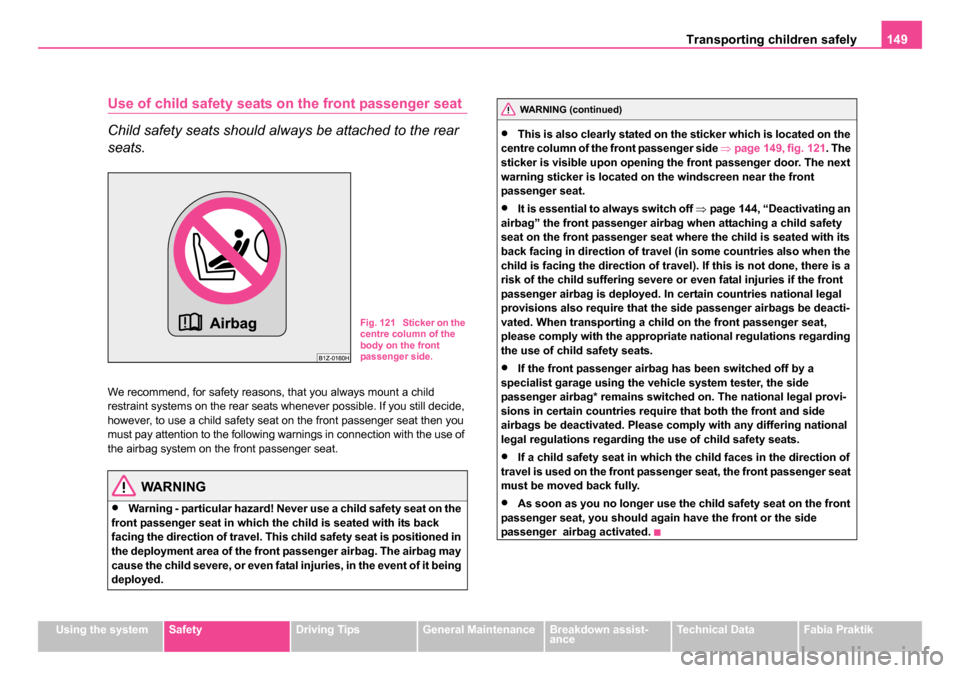
•This is also clearly stated on the sticker which is located on the
centre column of the front passenger side ⇒page 149, fig. 121 . The
sticker is visible upon opening the front passenger door. The next
warning sticker is located on the windscreen near the front
passenger seat.
•It is essential to always switch off ⇒page 144, “Deactivating an
airbag” the front passenger airbag when attaching a child safety
seat on the front passenger seat where the child is seated with its
back facing in direction of travel (in some countries also when the
child is facing the direction of travel). If this is not done, there is a
risk of the child suffering severe or even fatal injuries if the front
passenger airbag is deployed. In certain countries national legal
provisions also require that the side passenger airbags be deacti-
vated. When transporting a child on the front passenger seat,
please comply with the appropriate national regulations regarding
the use of child safety seats.
•If the front passenger airbag has been switched off by a
specialist garage using the vehicle system tester, the side
passenger airbag* remains switched on. The national legal provi-
sions in certain countries require that both the front and side
airbags be deactivated. Please comply with any differing national
legal regulations regarding the use of child safety seats.
•If a child safety seat in which the child faces in the direction of
travel is used on the front passenger seat, the front passenger seat
must be moved back fully.
•As soon as you no longer use the child safety seat on the front
passenger seat, you should again have the front or the side
passenger airbag activated.
Fig. 121 Sticker on the
centre column of the
body on the front
passenger side.
WARNING (continued)
sqc.1.book Seite 149 Mittwoch, 13. April 2005 1:09 13
Page 151 of 260

Transporting children safely
150
Child safety and side airbags*
Children must never be seated in the deployment area of
side airbags.Side airbags* offer the vehicle occupants enhanced protection in the
event of a collision from the side.
The side airbags are inflated in fractions of a second in order to be able to
provide this protection ⇒page 142, “Function of the side airbags”.
An airbag inflating develops such a strong force that an occupant who has
not adopted a correct seated position may suffer injuries. Also exposed
objects which are located within the area of the side airbag can cause inju-
ries.
This applies particularly to children if they are not transported in
accordance with legal requirements.
The child is protected when seated in a child safety seat matching its age.
Adequate room is available between the child and the deployment area of
the side airbag and head airbag. The airbag offers optimal protection.
WARNING
•It is essential to always switch off ⇒page 144 the front
passenger airbag when attaching a child safety seat on the front
passenger seat where the child is seated with its back facing in
direction of travel (in some countri es also when the child is facing
the direction of travel). If this is not done, there is a risk of the child
suffering severe or even fatal injuries if the front passenger airbag
is deployed. In certain countries national legal provisions also
require that the side passenger airbags be deactivated. When
transporting a child on the front passenger seat, please comply
with the appropriate national regulations regarding the use of child
safety seats.
•When transporting a child on the front passenger seat, please
comply with the appropriate national regulations regarding the use
of child safety seats.
•Children must never be seated with their head in the deploy-
ment area of the side airbag - risk of injury!
Fig. 122 Seated posi-
tion of an unprotected
child at risk from side
airbag
Fig. 123 Child properly
protected by safety
seat
sqc.1.book Seite 150 Mittwoch, 13. April 2005 1:09 13
Page 152 of 260

Transporting children safely 151
Using the systemSafetyDriving TipsGeneral MaintenanceBreakdown assist-
anceTechnical DataFabia Praktik
•Do not place any objects within th e deployment area of the side
airbag - risk of injury!
Child seat
Classification of child seats into groups
Only child safety seats which have an official approval and
are suitable for the child, may be used.
ECE-R 44 standard applies to child safety seats. ECE-R means:
Economic Commission of Europe - Regulation.
Child safety seats which have been tested for conformity with ECE-R 44
have a non-detachable test seal (a large E within a circle and below this
the test number) attached to the seat.
Child safety seats are classified in 5 groups:
Children of more than 150 cm in height may use the seat belts fitted to the
vehicle without a seat bolster.
Use of child seats
An overview of the usefulness of child seats on each of the seats
according to the EG guidelines 77/541 and ECE 44 standard:
Universal category - seat is suitable for all approved types of child
safety seats.
The seat can be fitted with fixing eyes for the “ ISOFIX”system*.
GroupWeight
00 - 10 kg⇒ page 152
0+up to 13 kg⇒page 152
19 - 18 kg⇒page 152
215 - 25 kg⇒page 153
322 - 36 kg⇒page 154
WARNING (continued)
Child seat
according to groupFront passenger
seatRear seat outsideRear seat middle
0
0+
1
2 and 3
AUAUA+AU
AUAUA+AU
AUAUA+AU
AUAUAU
AU
A+
sqc.1.book Seite 151 Mittwoch, 13. April 2005 1:09 13
Page 153 of 260

Transporting children safely
152
Child seats of group 0/0+
The optimal solution for babies of up to about 9 months old weighing up
to 10 kg or babies up to about 18 months old weighing up to 13 kg is a
child safety seat which can be adjusted into the reclining position
⇒ fig. 124 .
Child seats in which th e child is facing with its back towards the
direction of travel should not be used on the front passenger seat
when the vehicle is fitted with a front passenger airbag ⇒ page 149,
“Use of child safety seats on the front passenger seat”.
WARNING
² It is essential to always switch off ⇒page 145 the front
passenger airbag (airbags) at a specialist garage or with the switch
for front passenger airbag(s)* when attaching in exceptional
circumstances a child safety seat on the front passenger seat
where the child is seated with its back facing in direction of travel (in some countries also when the child is facing the direction of
travel).
•The national legal provisions in certain countries require that
both the front and side passenger airbags be deactivated. Please
comply with any differing national legal regulations regarding the
use of child safety seats.
•If this is not done, a child seated on the front passenger seat
may suffer severe or even fatal injuries if the front passenger airbag
or airbags are deployed.
•You should have the front passenger airbag (or airbags) reacti-
vated by your Škoda dealer just as soon as you no longer use a
child safety seat on the front passenger seat.
Child safety seats in Group 1
Fig. 124 Child seats of
group 0/0+
WARNING (continued)
Fig. 125 Child seat
with padded table in
Group 1 installed on
rear seat bench facing
the direction of travel
sqc.1.book Seite 152 Mittwoch, 13. April 2005 1:09 13
Page 154 of 260

Transporting children safely 153
Using the systemSafetyDriving TipsGeneral MaintenanceBreakdown assist-
anceTechnical DataFabia Praktik
Child seats in Group 1 are for babies and small children up to 4 years of
age with a weight of between 9 and 18 kilograms. It is best for children in
the lower range of this group, to use a child seat which allows the child to
sit with its back to the direction of travel. It is best for children in the upper
range of the Group 0+, to use a child seat which allows the child to sit
⇒
fig. 125 in the direction of travel.
Child seats in which the child is facing with its back towards the
direction of travel should not be used on the front passenger seat
when the vehicle is fitted with a front passenger airbag ⇒ page 149,
“Use of child safety seats on the front passenger seat”.
WARNING
•It is essential to always switch off the front passenger airbag
(airbags) at a specialist garage or with the switch for front
passenger airbag(s)* when attaching in exceptional circumstances
a child safety seat on the front passenger seat where the child is
seated with its back facing in direction of travel (in some countries
also when the child is facing the direction of travel) ⇒page 145.
•The national legal provisions in certain countries require that
both the front and side passenger airbags be deactivated. Please
comply with any differing national legal regulations regarding the
use of child safety seats.
•If this is not done, a child seated on the front passenger seat
may suffer severe or even fatal injuries if the front passenger airbag
or airbags are deployed.
•You should have the front passenger airbag (or airbags) reacti-
vated by your Škoda dealer just as soon as you no longer use a
child safety seat on the front passenger seat.
Child safety seats in Group 2
For children up to about 7 years of age weighing between 15 and 25 kg
the optimal solution is a child safety seat in combination with the three-
point seat belt ⇒fig. 126 .
WARNING
•When transporting a child on the front passenger seat, please
comply with the appropriate national regulations regarding the use
of child safety seats. Switch off the front passenger airbag if neces-
sary at a specialist garage or switch it off with the switch for front
passenger airbag(s)* ⇒page 145.
•The shoulder part of the seat belt must run approximately
across the middle of the shoulder and fit snugly against the chest.
It must on no account run across the neck. The lap part of the seat
belt must run across the pelvis and fits snugly; it must not run over
the belly. Tighten the belt webbing over your hip if necessary.
Fig. 126 Child seat in
Group 2 installed on
the rear seat facing the
direction of travel
sqc.1.book Seite 153 Mittwoch, 13. April 2005 1:09 13
Page 155 of 260

Transporting children safely
154
•Please comply with any differ ing national legal regulations
regarding the use of child safety seats.
Child safety seats in Group 3
For children of about 7 years of age weighing between 22 and 36 kg and
of a height of less than 150 cm, the optimal solution is a child safety seat
(seat bolster) in combination with the three-point seat belt ⇒fig. 127 .
Children of more than 150 cm in height may use the seat belts fitted to the
vehicle without a seat bolster.
WARNING
•When transporting a child on the front passenger seat, please
comply with the appropriate national regulations regarding the use of child safety seats. Switch off the front passenger airbag if neces-
sary at a specialist garage or switch it off with the switch front front
passenger airbag(s)*
⇒page 145.
•The shoulder part of the seat belt must run approximately
across the middle of the shoulder and fit snugly against the chest.
It must on no account run across the neck. The lap part of the seat
belt must run across the pelvis and fits snugly; it must not run over
the belly. Tighten the belt webbing over your hip if necessary.
•Please comply with any differ ing national legal regulations
regarding the use of child safety seats.
WARNING (continued)
Fig. 127 Child seat in
Group 3 installed on
the rear seat facing the
direction of travel
WARNING (continued)
sqc.1.book Seite 154 Mittwoch, 13. April 2005 1:09 13