tow SKODA FABIA 2005 1.G / 6Y Service Manual
[x] Cancel search | Manufacturer: SKODA, Model Year: 2005, Model line: FABIA, Model: SKODA FABIA 2005 1.G / 6YPages: 260
Page 109 of 260
Starting-off and Driving
108
Parking aid*
The parking aid provides a warning of obstacles behind
the vehicle.
The audible parking aid determines the distance between the rear bumper
and an obstacle located behind the vehicle with the aid of ultrasound
sensors. The sensors are integrated in the rear bumper.
Range of sensors
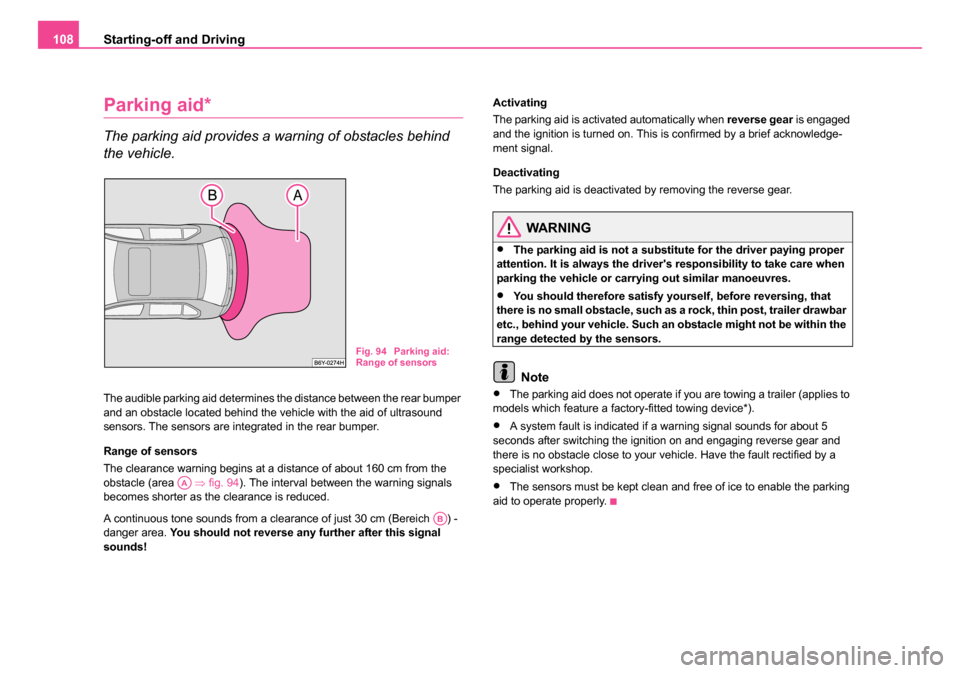
The clearance warning begins at a distance of about 160 cm from the
obstacle (area ⇒ fig. 94). The interval between the warning signals
becomes shorter as the clearance is reduced.
A continuous tone sounds from a clearance of just 30 cm (Bereich ) -
danger area. You should not reverse any further after this signal
sounds! Activating
The parking aid is activated automatically when
reverse gear is engaged
and the ignition is turned on. This is confirmed by a brief acknowledge-
ment signal.
Deactivating
The parking aid is deactivated by removing the reverse gear.
WARNING
•The parking aid is not a substitute for the driver paying proper
attention. It is always the driver's responsibility to take care when
parking the vehicle or carrying out similar manoeuvres.
•You should therefore satisfy yourself, before reversing, that
there is no small obstacle, such as a rock, thin post, trailer drawbar
etc., behind your vehicle. Such an obstacle might not be within the
range detected by the sensors.
Note
•The parking aid does not operate if you are towing a trailer (applies to
models which feature a factory-fitted towing device*).
•A system fault is indicated if a warning signal sounds for about 5
seconds after switching the ignition on and engaging reverse gear and
there is no obstacle close to your vehicle. Have the fault rectified by a
specialist workshop.
•The sensors must be kept clean and free of ice to enable the parking
aid to operate properly.
Fig. 94 Parking aid:
Range of sensors
AA
AB
sqc.1.book Seite 108 Mittwoch, 13. April 2005 1:09 13
Page 117 of 260

Automatic gearbox*
116
down at higher engine speeds than is the case for the economy-oriented
programmes.
Selecting the most appropriate driving programme for the particular style
of driving is a continuous process. Irrespective of this it is, however,
possible to switch into a sporty driving programme by depressing the
accelerator rapidly. The gearbox shifts down into a lower gear matching
the speed of the car and this allows you to accelerate rapidly (e.g. when
overtaking) without having to depress the accelerator pedal fully into the
kickdown range. The original programme will be reactivated to match your
particular style of driving once the gearbox has shifted up again.
When driving in hilly regions, the gears are selected to match uphill and
downhill sections. This avoids the gearbox frequently shifting up and down
when negotiating an uphill stretch. Depressing the brake pedal while
driving downhill causes the gearbox to shift down into the next lower gear.
This makes it possible for you to exploit the engine braking power without
the need for shifting gears manually.
Emergency programme
An emergency programme exists in the event of a fault in
the system.
The gearbox operates in a corresponding emergency programme if there
are functional faults in the gearbox electronics. This is indicated by all of
the segments in the display lighting up or going out.
•The gearbox still switches automaticallly but stronger switching shocks
are noticeable.
•The gearbox does not switch anymore automatically. The gearbox can
now only be switched manually but there are only 3 gears available over
the selector lever positions namely D, 3 and 2. The 1st gear and reverse
are available as before over the selector lever positions 1 and R. If the gearbox has switched over to emergency mode, drive to the
nearest specialist garage in order to have the fault rectified.
Tow-starting and towing vehicle
Tow-starting a vehicle
It is not possible to tow-start vehicles fitted with automatic gearbox
⇒
page 228.
you can use jump-start cables connected to the battery of another vehicle
for starting your car if the vehicle battery is flat ⇒page 226.
Towing a vehicle
Please pay attention to the following information if it comes necessary to
tow-in your car ⇒page 228.
sqc.1.book Seite 116 Mittwoch, 13. April 2005 1:09 13
Page 130 of 260

Seat belts129
Using the systemSafetyDriving TipsGeneral MaintenanceBreakdown assist-
anceTechnical DataFabia Praktik
Seat belts
Why seat belts?
It is a proven fact that seat belts offer good protection in accidents
⇒fig. 104 . Thus wearing a seat belt is a legal requirement in most coun-
tries.
Seat belts which have been correctly fastened and adjusted hold the
occupants of the car in the correct seated position ⇒fig. 104 . The belts
reduce the kinetic energy (energy of motion) to a considerable extent.
They also prevent uncontrolled movements which, in turn, may well result
in severe injuries.
The occupants of a vehicle who have fastened and correctly adjusted their
seat belt, profit to a major extent from the fact that the kinetic energy is
optimally absorbed by the belts. The structure of the front end of the
vehicle and other passive safety measures, such as the airbag system, also contribute to reducing the kinetic energy. The energy produced is
thus absorbed and there is less risk of injury.
Accident statistics prove that seat belts which are fastened and properly
adjusted reduce the risk of an injury and enhance the chance of survival
in a major accident
⇒page 130.
It is important that you pay attention to safety measures, particularly when
transporting children in the vehicle ⇒page 147, “Transporting children
safely”.
WARNING
•Fasten your seat belt each time before setting off, also when
driving in town! This also applies to the people seated at the rear -
risk of injury!
•Expectant women must also always wear a seat belt. This is the
only way of ensuring optimal protection for the unborn child
⇒ page 132, “Fastening a three-point seat belt”.
•It is important for the belt webbing to be properly routed if the
seat belts are to offer the maximum protection. You can see a
description of how safety belts should be fitted properly on the next
pages.
Note
Please comply with any differing legal requirements when using the seat
belts.
Fig. 104 Driver
wearing seat belt
sqc.1.book Seite 129 Mittwoch, 13. April 2005 1:09 13
Page 136 of 260

Seat belts135
Using the systemSafetyDriving TipsGeneral MaintenanceBreakdown assist-
anceTechnical DataFabia Praktik
WARNING
•The pelvic belt must always sit firmly across the pelvis; tighten
the belt webbing if necessary.
•An unused pelvic belt should be stowed away together with the
lock for safety reasons.
Note
The vehicles of the group N1 are not equipped with the third seat belt on
the rear seats. The vehicle is only approved for four persons!
Three-point safety belt for the middle rear seat*
It is used in the same way as the normal three-point seat belts on the left
and right (at front and rear). The three-point seat belt for the rear middle
seat must be put on first to allow the pelvic part of the belt to run between
the belt lock for the right three-point seat belt and the backrest, while
avoiding crossing the belt webbing of the right and middle seat belts.
WARNING
The three-point safety belt for the rear middle seat can only fulfil its
function reliably when the backrests are correctly locked into posi-
tion ⇒page 71.
Note
The vehicles of the group N1 are not equipped with the third seat belt on
the rear seats. The vehicle is only approved for four persons!
Belt tensioners
Safety for the driver and front passenger wearing their seat belts is
enhanced by the belt tensioners fitted to the inertia reels of the front three-
point seat belts.
The fastened three-point seat belts are automatically tensioned in the
event of a frontal collision of a certain severity. On vehicles fitted with side
airbags, a seat belt which is not fastened is also tensioned.
The belt tensioner is deployed in the event of a frontal collision of major
severity. A powder charge is ignited in the inertia reels during deployment.
The belt webbing is pulled into the inertia reels by a mechanical system
and the belt is tensioned.
Belt tensioners are not activated in the event of minor frontal collisions,
side and rear-end collisions, in the case of a rollover and also not in acci-
dents in which no major forces are produced from the front.
WARNING
•The service life of seat belts and belt tensioners is 15 years from
the date of manufacture of the vehicle. It is then necessary to have
the seat belts replaced by a specialist garage.
•Any work on the belt tightener system, including removal and
installation of system components because of other repair work,
must only be carried out by a specialist garage.
•The protective function of the system is only adequate for a
single accident. If the belt tensioners have been deployed, it is then
necessary to replace the entire system.
•The Owner's Manual must also be handed over to the new
owner if the vehicle is sold.
sqc.1.book Seite 135 Mittwoch, 13. April 2005 1:09 13
Page 145 of 260
Airbag system
144
Deactivating an airbag
Deactivating airbags
If any airbags have been deactivated, switch them on
again as soon as possible so that they are able to again
provide their proper protection.
There is the technical means installed within your vehicle to switch off the
front passenger airbag or side airbag (take out of commission).
This is why you should have the deactivation of the airbags carried out by
a specialist garage.
On vehicles equipped with the switch for deactivation of the airbags, you
can deactivate the front passenger airbag or passenger side airbag by
means of this switch ⇒page 145.
Deactivation of airbags is envisaged only for particular instances,
such as if:
•you must in exceptional cases use a child seat on the front
passenger seat where the child has its back to the direction of travel of the
vehicle (in some countries this must be in the direction of travel due to
other legal regulations applying) ⇒page 147, “Important safety informa-
tion on using child safety seats”,
•you are not able to maintain the distance of at least 25 cm between
middle of steering wheel and chest, despite the driver seat being correctly
adjusted,
•special attachments are required in the area of the steering wheel
because of a physical disability,
•you have installed other seats (e.g. orthopaedic seats without side
airbags). Monitoring the airbag system
The functionality of the airbag system is also monitored electronically,
when one airbag has been switched off
If the airbag was switched off using diagnostic equipment:
•The airbag indicator light in the instrument cluster lights up for about 3
seconds after switching on the ignition and then flashes after that for about
12 seconds.
Front passenger airbags switched off using the switch for front
passenger airbags* in stowage compartment on the front passenger
side:
•The airbag warning light comes on in the instrument cluster for about
3 seconds each time the ignition is switched on.
•Switching off airbags is indicated in the middle of the dash panel by the
lighting up of the indicator light ⇒ page 145, fig. 120 .
Note
Your Škoda dealer will be able to advise you whether national legislation
in your country allows airbags in your vehicle to be deactivated, and which
ones.
sqc.1.book Seite 144 Mittwoch, 13. April 2005 1:09 13
Page 153 of 260

Transporting children safely
152
Child seats of group 0/0+
The optimal solution for babies of up to about 9 months old weighing up
to 10 kg or babies up to about 18 months old weighing up to 13 kg is a
child safety seat which can be adjusted into the reclining position
⇒ fig. 124 .
Child seats in which th e child is facing with its back towards the
direction of travel should not be used on the front passenger seat
when the vehicle is fitted with a front passenger airbag ⇒ page 149,
“Use of child safety seats on the front passenger seat”.
WARNING
² It is essential to always switch off ⇒page 145 the front
passenger airbag (airbags) at a specialist garage or with the switch
for front passenger airbag(s)* when attaching in exceptional
circumstances a child safety seat on the front passenger seat
where the child is seated with its back facing in direction of travel (in some countries also when the child is facing the direction of
travel).
•The national legal provisions in certain countries require that
both the front and side passenger airbags be deactivated. Please
comply with any differing national legal regulations regarding the
use of child safety seats.
•If this is not done, a child seated on the front passenger seat
may suffer severe or even fatal injuries if the front passenger airbag
or airbags are deployed.
•You should have the front passenger airbag (or airbags) reacti-
vated by your Škoda dealer just as soon as you no longer use a
child safety seat on the front passenger seat.
Child safety seats in Group 1
Fig. 124 Child seats of
group 0/0+
WARNING (continued)
Fig. 125 Child seat
with padded table in
Group 1 installed on
rear seat bench facing
the direction of travel
sqc.1.book Seite 152 Mittwoch, 13. April 2005 1:09 13
Page 154 of 260

Transporting children safely 153
Using the systemSafetyDriving TipsGeneral MaintenanceBreakdown assist-
anceTechnical DataFabia Praktik
Child seats in Group 1 are for babies and small children up to 4 years of
age with a weight of between 9 and 18 kilograms. It is best for children in
the lower range of this group, to use a child seat which allows the child to
sit with its back to the direction of travel. It is best for children in the upper
range of the Group 0+, to use a child seat which allows the child to sit
⇒
fig. 125 in the direction of travel.
Child seats in which the child is facing with its back towards the
direction of travel should not be used on the front passenger seat
when the vehicle is fitted with a front passenger airbag ⇒ page 149,
“Use of child safety seats on the front passenger seat”.
WARNING
•It is essential to always switch off the front passenger airbag
(airbags) at a specialist garage or with the switch for front
passenger airbag(s)* when attaching in exceptional circumstances
a child safety seat on the front passenger seat where the child is
seated with its back facing in direction of travel (in some countries
also when the child is facing the direction of travel) ⇒page 145.
•The national legal provisions in certain countries require that
both the front and side passenger airbags be deactivated. Please
comply with any differing national legal regulations regarding the
use of child safety seats.
•If this is not done, a child seated on the front passenger seat
may suffer severe or even fatal injuries if the front passenger airbag
or airbags are deployed.
•You should have the front passenger airbag (or airbags) reacti-
vated by your Škoda dealer just as soon as you no longer use a
child safety seat on the front passenger seat.
Child safety seats in Group 2
For children up to about 7 years of age weighing between 15 and 25 kg
the optimal solution is a child safety seat in combination with the three-
point seat belt ⇒fig. 126 .
WARNING
•When transporting a child on the front passenger seat, please
comply with the appropriate national regulations regarding the use
of child safety seats. Switch off the front passenger airbag if neces-
sary at a specialist garage or switch it off with the switch for front
passenger airbag(s)* ⇒page 145.
•The shoulder part of the seat belt must run approximately
across the middle of the shoulder and fit snugly against the chest.
It must on no account run across the neck. The lap part of the seat
belt must run across the pelvis and fits snugly; it must not run over
the belly. Tighten the belt webbing over your hip if necessary.
Fig. 126 Child seat in
Group 2 installed on
the rear seat facing the
direction of travel
sqc.1.book Seite 153 Mittwoch, 13. April 2005 1:09 13
Page 161 of 260

Intelligent Technology
160
which is being braked. The vehicle can continue to be driven and has the
same characteristics as a vehicle not fitted with EDL.
The EDL switches on again automatically as soon as the brake has cooled
down.
WARNING
•Depress the accelerator carefully when accelerating on
uniformly slippery road surfaces, such as ice and snow. The driven
wheels might still spin despite the EDL and affect the stability of the
vehicle - risk of an accident!
•You should always adapt your style of driving to the condition
of road surface and to the traffic situation even when your vehicle
is fitted with EDL. The increased safety offered must not tempt you
to take greater risks than otherwise - risk of an accident!
Note
•If the ABS or TCS or ESP warning li ght comes on, this may also indi-
cate a fault in the EDL. Please have the car inspected as soon as possible
by a specialist garage.
•Changes to vehicle (e.g. on engine, on the brakes, on chassis or other
assignment of tyres and wheels) can influence the function of the EDL
⇒ page 215, “Accessories, changes and replacement of parts”.
Brakes
What has a negative effect on braking efficiency?
Wear-and-tear
Wear-and-tear to the brake pads is greatly dependent on the operating
conditions of the vehicle and your style of driving. Particularly if you drive a great deal in towns and over short distances or if you adopt a sporty style
of driving, it may be necessary to have the thickness of the brake pads
inspected at a specialist garage between the service inspections.
Wet roads or road salt
There may be a certain delay before the brakes take full effect under
certain conditions such as when driving through water, during heavy rain
showers or after the vehicle has been washed in an automatic vehicle
wash, since the brake discs and brake pads may be moist or even have a
coating of ice on them in winter. You should dry the brakes as soon as
possible (by applying and releasing the brakes several times, if the road
conditions and the traffic situation allows it).
There also may be a certain delay before the full braking efficiency is avail-
able when driving on roads which have been treated with road salt if you
have not used the brakes for some considerable time beforehand. The
layer of salt on the brake discs and brake pads must first be rubbed off
when you apply the brakes.
Corrosion
Corrosion on the brake discs and dirt on the bake pads occur if the vehicle
has been parked for a long period and if you do not make much use of the
braking system.
We recommend cleaning the brake discs by firmly applying the brakes at
a fairly high speed if you do not make much use of the braking system or
if surface corrosion is present
⇒.
Faults in the brake surface
If you notice that the braking distance has suddenly become longer and
that the brake pedal can be depressed further, it is possible that a brake
circuit of the dual-circuit brake system has failed. Drive, in such cases, to
the nearest specialist garage without delay in order to have the problem
rectified. Drive at a reduced speed while on your way to the dealer and
adapt your style of driving to the higher brake pedal pressure required.
sqc.1.book Seite 160 Mittwoch, 13. April 2005 1:09 13
Page 164 of 260

Intelligent Technology163
Using the systemSafetyDriving TipsGeneral MaintenanceBreakdown assist-
anceTechnical DataFabia Praktik
•The increased safety offered by the Brake Assist must not tempt
you to take a greater safety risk than otherwise.
Power steering*
The power steering enables you to steer the vehicle with less physical
force.
The steering characteristics can be changed by a specialist garage.
You will place great stresses on the power steering system if the steering
is turned to full lock when the vehicle is stationary. Turning the steering to
full lock in such a situation will be accompanied by noises.
It is still possible to fully steer the vehicle if the power steering fails or if the
engine is not running (vehicle being towed in). The only difference is that
greater physical effort is required.
It is possible that the hydraulic pump of the power steering will not run due
to the low vehicle network voltage if the battery has gone flat and the
engine must started with the help off jump leads. This condition will be
indicated by lighting up of the warning light.
The power steering operates again if the battery is charged to a specific
range when engine is running. It also operates again, if the engine can be
started with its own battery.
Caution
Do not leave the steering at full lock for more than 15 seconds when the
engine is running - risk of damaging the power steering!
Note
Have the steering inspected as soon as possible by a specialist garage if
there is a leak or fault in the system.
WARNING (continued)
sqc.1.book Seite 163 Mittwoch, 13. April 2005 1:09 13
Page 165 of 260

Driving and the Environment
164
Driving and the Environment
The first 1 500 kilometres and then
afterwards
A new engine
The engine has to be run in during the first 1 500 kilome-
tres.
Up to 1 000 kilometres
– Do not drive faster than 3/4 of the mamimum speed of the gear
in use, that is 3/4 of the maximum permissible engine speed.
– Do not use full throttle.
– Avoid high engine revolutions.
– Do not tow a trailer.
From 1 000 up to 1 500 kilometres
– Increase the power output of the engine gradually up to the
full speed of the gear engaged, that is up to the maximum
permissible engine revolutions.
During the first operating hours the engine has higher internal friction than
later until all of the moving parts have harmonized. The driving style which
you adopt during the first approx.1 500 kilometres plays a decisive part in
the success of running in your car.
You should not drive at unnecessarily high engine revolutions even after
the running-in period is complete. The maximum permissible engine speed is marked by the beginning of the red zone on the scale of the revo-
lutions counter. Shift up into the next higher gear on a vehicle fitted with
manual gearbox before the red zone is reached.
Extremely high engine
revolutions are automatically governed, by the way.
For a vehicle fitted with a manual gearbox the converse situation also
applies: Do not drive at engine revolutions which are too low. Shift down
as soon as the engine is no longer running smoothly.
Caution
All the speed and engine revolution figures apply only when the engine is
at its normal operating temperature. Never rev up an engine which is cold,
neither when the vehicle is stationary nor when driving in individual gears.
For the sake of the environment
Not driving at unnecessarily high engine revolutions and shifting to a
higher gear as early as possible are ways to minimise fuel consumption
and operating noise levels and protects the environment.
New tyres
New tyres have to be “run in” since they do not offer optimal grip at first.
You should take account of this fact for the first 500 kilometres and drive
particularly carefully.
sqc.1.book Seite 164 Mittwoch, 13. April 2005 1:09 13