engine SKODA FABIA 2006 2.G / 5J Workshop Manual
[x] Cancel search | Manufacturer: SKODA, Model Year: 2006, Model line: FABIA, Model: SKODA FABIA 2006 2.G / 5JPages: 258, PDF Size: 44.86 MB
Page 178 of 258
Driving and the Environment177
Using the systemSafetyDriving TipsGeneral MaintenanceBreakdown assistanceTechnical Data
Reducing idling
Idling also costs fuel.
It is worthwhile switching off the engine in a traffic jam or when waiting at a level crossing or at traffic lights with a le ngthy red phase. Even after just 30 - 40 seconds you will have saved more fuel th an that is needed when you start the engine up again.
If an engine is only idling it takes much longer for it to reach its normal operating temperature. Wear-and-tear and pollutant emissions, though, are particularly high in the warming-up phase. This is why you should drive off right after starting the engine. Do avoid high engi ne revolutions at this time, however.
Regular servicing
A poorly tuned engine consum es an unnecessarily high
amount of fuel.
Having your vehicle serviced regularly at a specialist garge enables you to satisfy one of the requirements for economical motoring even before you set off on your journey. Keeping your vehicle prop erly serviced not only has a positive effect on the safety of your vehicle and maintaining its value, but also saves on fuel .
A poorly tuned engine can result in a fuel consumption which is 10% higher than normal.
The foreseen maintenance work should be undertaken exactly according to the Service schedule by a specialist garage.
Also check the oil level after refueling. Oil consumption is dependent to a considerable extent on the load and speed of the engine. Oil consumption could be as high as 0.5 litres/1 000 km depending on your style of driving.
It is quite normal that a new engine ha s a higher oil consumption at first, and reaches its lowest level only after a certain running in time. It is therefore not possible to correctly assess the oil cons umption of a new vehicle until after you have driven about 5 000 km.
For the sake of the environment
•You can achieve addi tional improvements in your fuel economy by using high-lubricity oils.
•Check the ground below your car at regular intervals to detect any leakages in good time. Please have your vehicle inspected by a specialist garge if you find any stains caused by oil or other fluids on the floor.
Avoid driving short distances
Short distances result in an above-average high fuel
consumption.
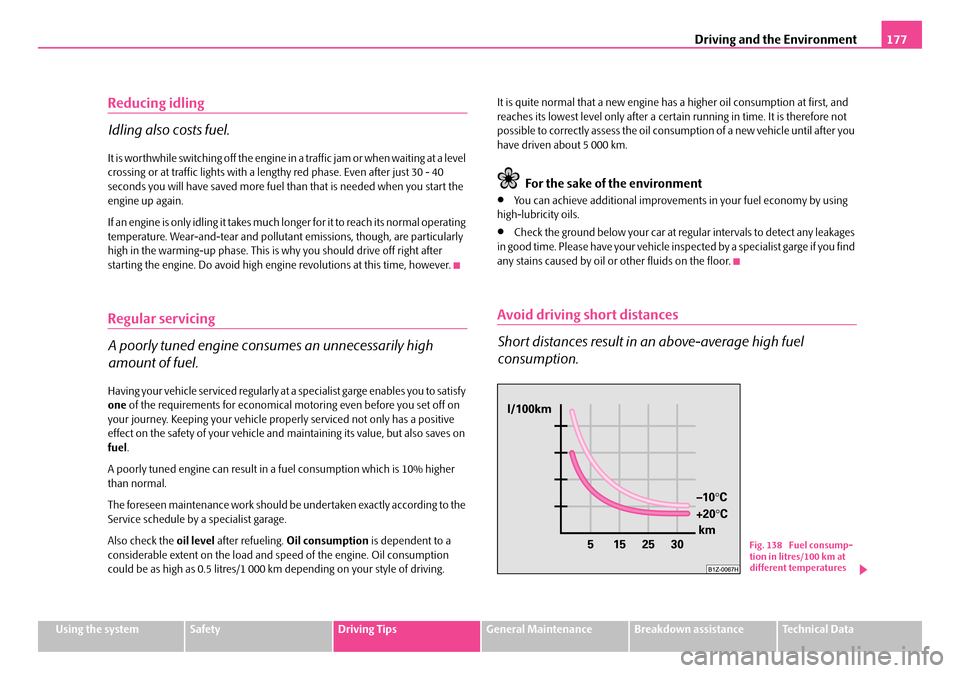
Fig. 138 Fuel consump- tion in litres/100 km at different temperatures
NKO A05Fabia 20.book Page 177 Tuesday, September 26, 2006 8:38 AM
Page 179 of 258
Driving and the Environment178
– Avoid driving a distance of no more than 4 km if the engine is cold.
The engine and catalytic converter must first have reached their optimal oper- ating temperature in order to effectively reduce fuel consumption and pollutant emissions.
The cold engine vehicle consumes approx. 15 - 20 litres/100 km of fuel imme- diately after starting. Fuel consumption drops to 10 litres/100 km after just 1 kilometre. The engine reaches its operating temperature (outside temperature and engine dependent) only after about 4 to 10 kilometres and the fuel consumption then stabilizes. You should therefore avoid driving short distances whenever possible.
An important factor in this connection is also the ambient temperature. The ⇒ page 177, fig. 138 shows the different fuel consumptions for the same distance, on the one hand at +20°C an d on the other hand at -10°C. Your vehicle has a higher fuel consum ption in winter than in summer.
Checking tyre inflation pressures
Tyres which are correctly inflated save fuel.
Always ensure that your tyres are inflated to the correct pressure at all times. The rolling resistance will be increased if the tyre filling pressure is too low. This will not only increase fuel consumptio n but also tyre wear and the driving behaviour will worsen.
Always check the inflation pr essure of the tyres when cold.
Do not drive with winter tyres all year round for this costs about 10 % more fuel. Winter tyres are also louder.
No unnecessary ballast
Transporting ballast costs fuel.
The fact that every kilogram of extra weight increases your fuel consumption means that it is worth taking a look in the luggage compartment to avoid trans- porting any unnecessary ballast.
It is particularly in town traffic, when one is accelerating quite often, that the vehicle weight will have a significant effe ct upon the fuel consumption. A rule of thumb here is that an increase in weight of 100 kilograms will cause an increase in fuel consumption of about 1 litre/100 kilometres.
You may frequently also leave a roof rack fitted on just out of convenience, although you no longer need it. The incr eased aerodynamic drag of your vehicle causes it to use about 1 l more fuel th an normal at a speed of 100 - 120 km/h, even when you are not carrying a load on the roof.
Saving electricity
Generating electricity costs fuel.
– Switch off electrical components as soon as you no longer need
them.
When the engine is running, the alternator generates and supplies electrical power. If more electrical components are switched on, more fuel is needed to operate the alternator.
NKO A05Fabia 20.book Page 178 Tuesday, September 26, 2006 8:38 AM
Page 181 of 258
Driving and the Environment180
Unleaded petrol
A vehicle fitted with a petrol engine must always be refuelled with unleaded petrol ⇒page 174. The automobile associations can provide you with informa- tion regarding the locations of fillin g stations which offer unleaded petrol.
Headlights
The low beam of your headlights is set asymmetrically. It illuminates the side of the road on which you are driving to a gr eater extent. If you drive abroad on the other side of the road, you will dazzle oncoming traffic.
It is necessary in order to avoid dazzling oncoming traffic to stick a sticker over a certain part of the headlights.
Headlight stickers can be obtained as a spare part from the Skoda Service Part- ners.
Headlights with module are designed for dr iving in countries with traffic on the right or on the left. Have this done always at a Škoda Service Partner.
Note
You can obtain further information rega rding masking over or converting the headlights from your Škoda Service Partner.
Avoiding damage to your vehicle
When driving on poor roads and lanes or when driving over kerbstones, steep ramps etc., you must pay particular atte ntion to ensuring that any low-slung parts of the vehicle, such as spoiler an d exhaust, do not touch the ground and get damaged.
This particularly applies to models with a lowered suspension (sport suspen- sion) and also when your vehicle is fully laden.
NKO A05Fabia 20.book Page 180 Tuesday, September 26, 2006 8:38 AM
Page 183 of 258
Towing a trailer182
Exterior mirrors
You have to have addi tional exterior mirrors fitted if you are not able to see the traffic behind the trailer with the standard rear-view mirrors. Both exterior mirrors should be attached to folding arms. Adjust the mirrors so that they provide you with an adequate field of view to the rear.
Headlights
Before starting off with a hitched trailer, also check the setting of the headlights. Alter the setting as necessary with th e aid of the headlight beam adjuster ⇒ page 59.
Detachable ball head
The ball rod is detachable on vehicles with towing device and suppliable from Škoda original accessories. It is stowed together with separate fitting instruc- tions in the spare wheel well in the luggage compartment of the vehicle.
Note
•We recommend that you also have yo ur vehicle inspected between service intervals if you tow a trailer frequently.
•The handbrake on the towing vehicle must be put on when coupling and decoupling the trailer.
•Keep the mechanism of the ball head of the towing device clean and take proper care of it with a suitable preservative.
Driving Tips
Particular caution is required when towing a trailer.
– Do not, as far as possible, drive with your vehicle unladen and the
trailer laden.
– Do not make full use of the lega l maximum speeds. This applies in
particular to downhill sections.
– Apply the brakes in good time.
– Keep a check on the coolant temperature gauge if the outside
temperature is high.
Distribution of weight
The distribution of the weight is very poor if your vehicle is unladen and the trailer is laden. Maintain a particularly low speed if you cannot avoid driving with this combination.
Driving speed
Do not drive faster than 80 km/hour for safety reasons. This also applies for countries in which higher speeds are allowed.
The fact that the driving stability of the vehicle + trailer combination reduces with increasing speed means that the legally allowed speed should not be used when there are unfavourable road, weat her or wind conditions, particularly near accident black spots.
You must always reduce your speed imme diately as soon as you detect even just the slightest swaying of the trailer. On no account attempt to stop the trailer from “swaying ” by accelerating.
Apply the brakes in good time! If the trailer is fitted with a trailer brake, apply the brakes gently at first and then brake firmly. This will avoid brake jolts resulting from the trailer wheels locking. Shift down gears in good time before negotiating a downhill section to allow the engine to also act as a brake.
Engine overheating
Please keep a check on the coolant temperature gauge if you have to negotiate a lengthy slope in a low gear at a high engine speed when the outside temper- ature is very high ⇒page 14.
NKO A05Fabia 20.book Page 182 Tuesday, September 26, 2006 8:38 AM
Page 184 of 258
Towing a trailer183
Using the systemSafetyDriving TipsGeneral MaintenanceBreakdown assistanceTechnical Data
If the needle of the coolant temperatur e gauge moves into the right-hand area or even the red area of the scale, reduce your speed immediately. Stop and switch off the engine if the warning light in the instrument cluster begins flashing. Wait a few minutes and check th e level of coolant in the coolant expan- sion bottle ⇒page 204, “Inspecting the coolant level”.
Please refer to the following guidelines ⇒page 30, “Coolant tempera- ture/coolant level ”.
The coolant temperature can be reduced by switching on the heating.
Any increase in the cooling effect of the coolant fan through shifting down a gear and increasing the engine speed is not possible since the fan speed is inde- pendent of the engine speed. One should also not drop a gear for this reason when towing a trailer as long as the engine can manage the slope without any drop in speed.
NKO A05Fabia 20.book Page 183 Tuesday, September 26, 2006 8:38 AM
Page 191 of 258
Taking care of your vehicle and cleaning the vehicle190
Underbody protection
The underside of your vehicle is protected for life against chemical and mechanical influences.
One cannot, however, complete ly rule out damage to the protective layer when driving so we recommend that you inspect the protective layer on the underside of your ve hicle and on the chassis at certain intervals - this is best done at the beginning and end of the winter - and to touch up any damaged areas.
Škoda Service Partne rs have suitable spray products available as well as the necessary equipment and are familiar with the instructions for use. We there- fore recommend to have repairs and addi tional corrosion protection measures preferably carried out by a Škoda Service Partner.
WARNING
Never use additional underbody protection or corrosion-protection agents for the exhaust pipes, catalytic converters or heat shields. Such substances might ignite when driving - risk of fire!
Protection of hollow spaces
All the cavities of your vehicle which are at risk from corrosion are protected for life by a layer of protective wax applied in the factory.
This wax protection does not require to be inspected or re-treated. Please remove any small amount of wax which flow s out of the cavities at high temper- atures with a plastic scraper and cl ean the spot using petroleum cleaner.
WARNING
Safety and environmental protection regulations should observed when using petroleum cleaner to remove wax - a risk of fire!
Engine compartment
Good corrosion protection is very import ant, particularly in winter when one often drives over its salt-strewn roads. One should therefore clean the entire engine compartment before and after the salt spreading period, in order to prevent the salt from being destructive.
Škoda Service Partners have the cleani ng agents recommended by the manu- facturer and also the required equipment.
WARNING
•It is necessary to observe the guid elines given in the chapter before working on the engine compartment ⇒page 198.
•Let the engine cool down before cleaning the engine compartment.
Caution
•Engine cleaning may be only be undertaken when the ignition is off.
•It is recommended to cover the generator before washing the engine compartment.
For the sake of the environment
The dirty water produced by washing the engine has washed away petrol, and residues of grease and oil and should therefore be cleaned by an oil separator. This is why engine washing should only be undertaken in a garage or at a fueling station (when these are fitted with the required equipment).
NKO A05Fabia 20.book Page 190 Tuesday, September 26, 2006 8:38 AM
Page 194 of 258
Fuel193
Using the systemSafetyDriving TipsGeneral MaintenanceBreakdown assistanceTechnical Data
Fuel
Petrol
Grades of petrol
There are various grades of petrol. Please read the brochure “Technical Data” in order to know which grade of petrol your vehicle requires. You will also find the same information affixed to the inside of the fuel filler flap of your vehicle ⇒ page 195, fig. 140.
A distinction is made between unleaded and leaded petrol. All Škoda vehicles with petrol engines are equipped with a catalytic converter and must therefore be only driven with unleaded petrol. Unleaded petrol complies with the standard EN 228 .
The individual grades of petrol are distinguished by their octane number (RON). Please adopt the following procedure if the grade of petrol which you normally use is not be availabl e in exceptional circumstances:
•Engines which need unleaded premium petrol 95 RON can also be run on unleaded regular petrol 91 RON. This does, however, result in a slight loss in performance.
•Engines which need unleaded premium plus petrol 98 RON can also be run on unleaded regular petrol 95 RON. Th is does, however, result in a slight loss in performance. You can in exceptional circumstances also use unleaded regular petrol of 91 RON in the event that neither unleaded premium petrol of 98 RON nor 95 RON is available. Refuel as soon as possible with unleaded premium plus of 98 RON or unleaded premium petrol of 95 RON.
If, in an emergency, the only fuel av ailable is one which has a lower octane number than that required by the engine then only drive at medium engine speeds and lower engine loadings.
You can make unlimited use of fuel which has a higher octane number than that required by the engine. There will, however, be no advantages gained by this in terms of engine performance and fuel consumption!
The handling, performance and life of yo ur engine are determined to a signifi- cant extent by the quality of the fu el. Do not use any petrol additives. Use a fuel complying with the standard.
You can find further info rmation on refuelling ⇒page 195.
Caution
•Filling the tank even only once with leaded petrol will result in the catalytic converter being destroyed.
•Operating the engine with petrol of a low octane number than that required can result in engine damage at high revolutions or severe engine loading.
Diesel
Diesel fuel
Your vehicle can be operated with diesel fuel, which complies with the standard EN 590.
It is prohibited to use biofuel (RME) and diesel fuel mixture.
Fuel additives
You must not use fuel additives, so-called “flow improvers” (petrol and similar products) in diesel fuel.
NKO A05Fabia 20.book Page 193 Tuesday, September 26, 2006 8:38 AM
Page 195 of 258
Fuel194
If the quality of the diesel fuel is poor, it is then necessary to drain the fuel filter more often than stated in the Service schedule.
You can find information on refuelling ⇒page 195, “Refuelling”.
Caution
•Use a fuel which complies with the standard EN 590. Filling the tank even only once, which does not comply with th is standard, can result in damage to the fuel system.
•Water which has collected in the fuel fi lter can result in engine problems.
Operation in winter
Winter-grade diesel fuel
A different grade of diesel fuel is available at filling stations in winter than during the summer. Using “summer-grade diesel fuel” at temperatures below 0°C can result in operational problems because the diesel becomes viscous as a result of paraffin separation.
It is therefore the case that EN 590 prescribes diesel fuel class for certain periods of the year which can also be purchase d at the corresponding time during the year. “Winter-grade diesel fuel” will still operate properly even at a temperature of -20°C.
It is often the case in countries with diff erent climatic conditions that diesel fuels available have a different temperature characteristic. Škoda Service Partners and filling stations in the country concer ned will be able to provide you with information regarding the diesel fuels available.
Prewarming fuel
The vehicle is fitted with a fuel filter prewarming system. This secures operation of a vehicle using diesel fuel down to an environmental temperature of -25°C.
Caution
It is not permitted to add the various fuel additives on the market, including petrol, to diesel fuel in order to improve its flow properties.
NKO A05Fabia 20.book Page 194 Tuesday, September 26, 2006 8:38 AM
Page 196 of 258
Fuel195
Using the systemSafetyDriving TipsGeneral MaintenanceBreakdown assistanceTechnical Data
Refuelling
Opening the fuel filler cap
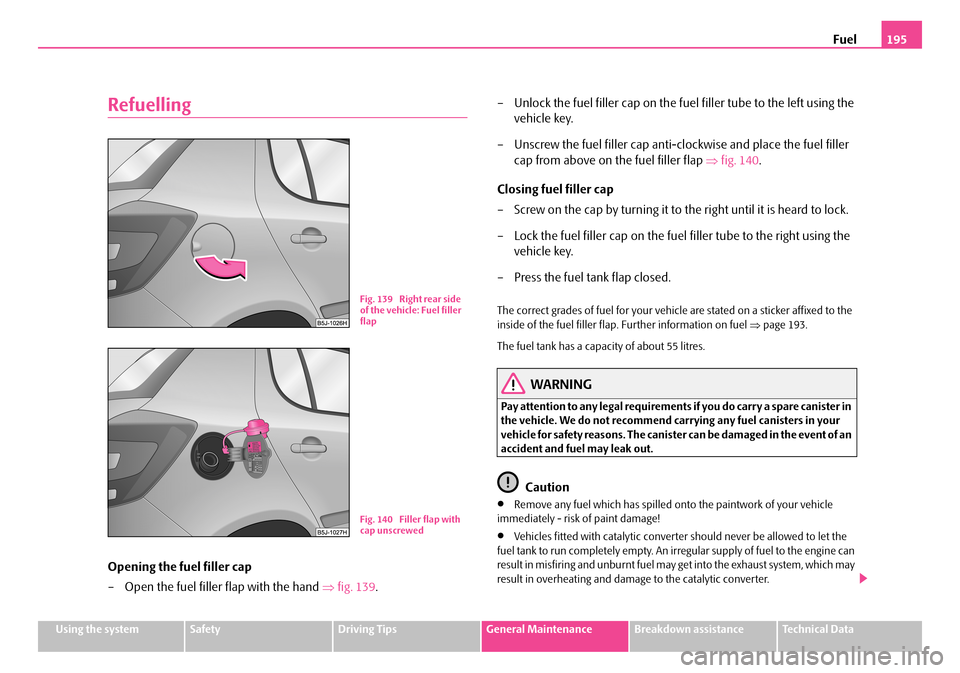
– Open the fuel filler flap with the hand ⇒fig. 139.
– Unlock the fuel filler cap on the fuel filler tube to the left using the
vehicle key.
– Unscrew the fuel filler cap anti-clockwise and place the fuel filler
cap from above on the fuel filler flap ⇒fig. 140.
Closing fuel filler cap
– Screw on the cap by turning it to the right until it is heard to lock.
– Lock the fuel filler cap on the fuel filler tube to the right using the
vehicle key.
– Press the fuel tank flap closed.
The correct grades of fuel for your vehicl e are stated on a sticker affixed to the inside of the fuel filler flap. Further information on fuel ⇒page 193.
The fuel tank has a capa city of about 55 litres.
WARNING
Pay attention to any legal requirements if you do carry a spare canister in the vehicle. We do not recommend ca rrying any fuel canisters in your vehicle for safety reasons. The canister can be damaged in the event of an accident and fuel may leak out.
Caution
•Remove any fuel which has spilled onto the paintwork of your vehicle immediately - risk of paint damage!
•Vehicles fitted with cata lytic converter should never be allowed to let the fuel tank to run completely empty. An irregular supply of fuel to the engine can result in misfiring and unburnt fuel ma y get into the exhaust system, which may result in overheating and dama ge to the catalytic converter.
Fig. 139 Right rear side of the vehicle: Fuel filler flap
Fig. 140 Filler flap with cap unscrewed
NKO A05Fabia 20.book Page 195 Tuesday, September 26, 2006 8:38 AM
Page 198 of 258
Inspecting and Replenishing197
Using the systemSafetyDriving TipsGeneral MaintenanceBreakdown assistanceTechnical Data
Inspecting and Replenishing
Engine compartment
Bonnet remote release
Bonnet remote release
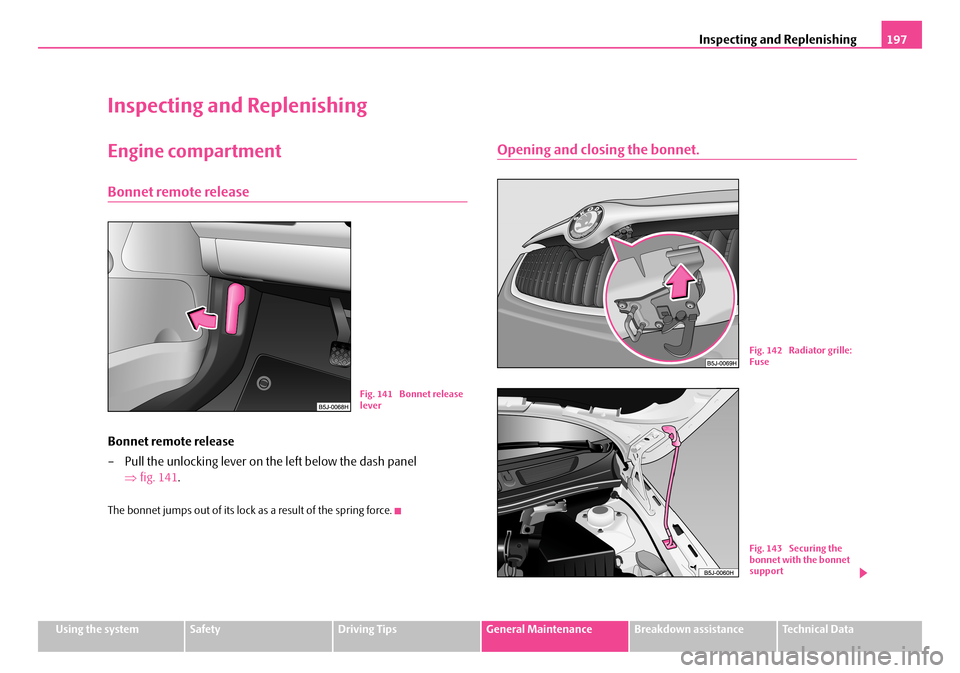
– Pull the unlocking lever on the left below the dash panel
⇒ fig. 141.
The bonnet jumps out of its lock as a result of the spring force.
Opening and closing the bonnet.
Fig. 141 Bonnet release lever
Fig. 142 Radiator grille: Fuse
Fig. 143 Securing the bonnet with the bonnet support
NKO A05Fabia 20.book Page 197 Tuesday, September 26, 2006 8:38 AM