check engine light SKODA FABIA 2010 2.G / 5J User Guide
[x] Cancel search | Manufacturer: SKODA, Model Year: 2010, Model line: FABIA, Model: SKODA FABIA 2010 2.G / 5JPages: 244, PDF Size: 29.53 MB
Page 92 of 244

Starting-off and Driving
91
Using the system
Safety
Driving Tips
General Maintenance
Breakdown assistance
Technical Data
Avoid high engine revolutions, full throttle and high engine loads as long as the
engine has not yet reached its normal oper
ating temperature - risk of damaging the
engine!
Vehicles which are fitted with an exhaust gas catalytic converter should not be tow-
started over a distance of more than 50 metres.
For the sake of the environment
Never warm up the engine when the vehicle is standing. Drive off right away. When driving the engine reaches its operating te
mperature more rapidly and the pollutant
emissions are lower.Petrol enginesThese engines are fitted with a starter system which selects the correct fuel-air mixture for every external air temperature.
Do not operate accelerator before and when starting engine.
Interrupt the attempt at starting after 10
seconds if the engine does not start right
awayand wait for about 30 seconds before repeating the attempt.
It is possible that the fuse on the electric
al fuel pump is defect if the engine still
does not start. Check the fuse and replace it if necessary
page 195.
If the engine does not start, contact the nearest specialist garage to obtain profes-
sional assistance. It may be necessary, if the engine is
very hot
, to slightly depress the accelerator after
the engine has started.Diesel enginesGlow plug system Diesel engines are equipped with a glow
plug system, the preglow period being
controlled automatically in line with the coolant temperature and outside tempera- ture. The preglow indicator light
comes on after the ignition has been switched on.
You should not switch on any major electrical components during the heating period otherwise the vehicle battery will be drained unnecessarily.
You should start the engine immediately after the glow plug warning light
has
gone out.
The glow plug warning light will come on for about one second if the engine is at a
normal operating temperature or if the outside temperature is above +5°C. This means that you can start the engine
right away
.
Interrupt the attempt at starting after 10 seconds if the engine does not start right
awayand wait for about 30 seconds before repeating the attempt.
It is possible that the fuse
on the diesel preglow system is defect if the engine still
does not start. Check the fuse and replace it if necessary
page 195.
Contact the nearest specialist garage to obtain professional assistance.
Starting the engine after fuel tank has run dry It may take longer than normal to start the
engine after refuelling if the fuel tank has
run completely dry - up to one minute. This is
because the fuel system must first of all
be filled while the attempting to start the engine.Switching off the engine– The engine can be switched off by turnin
g the ignition key from position into
page 89, fig. 94
.
WARNING
Never switch off the engine before the ve
hicle is stationary - risk of accident!
The brake booster only operates when the engine is running. Greater phys-
ical effort for braking is required when en
gine is switched off.
Because if you do
not stop as normal, this can cause an accident and severe injuries.
Caution
you should not switch the engine off right away at the end of your journey after the engine has been operated for a lengthy period
at high loads but should be allowed it
to run at idling speed for about 2 minutes.
This prevents any accumulation of heat
when the engine is switched off.
A1
s3j8.a.book Page 91 Tuesday, April 20, 2010 1:10 PM
Page 144 of 244
Intelligent Technology
143
Using the system
Safety
Driving Tips
General Maintenance
Breakdown assistance
Technical Data
If the warning light
does not go out after the basic setting, there is a fault in the
system. Have the vehicle inspected by your nearest specialist garage. Functional description After the basic setting of the system the “adaptation” of the tyre inflation pressures and then the tyre pressure control in the individual tyres are performed. Warning light
lights up
If the tyre inflation pressure of at least one wheel is insufficiently inflated in comparison to the stored basic value, the warning light
lights up. Inflate all tyres to the
specified inflation pressure
page 178, “Tyre life” and then perform a basic setting of
the system. Warning light
flashes
If the warning light flashes, there is a system fault. Have the vehicle inspected by your nearest specialist garage.
WARNING
When the warning light
lights up, immediately reduce the speed and
avoid sudden steering and brake manoeuvr
es. Please stop the vehicle without
delay at the nearest possible stop and in
spect the tyres and their inflation pres-
sures.
The driver is responsible
for the correct tyre inflation pressures. For this
reason, the tyre inflation pressu
res must be checked regularly.
Under certain circumstances (e.g. sporty style of driving, wintry or unpaved
roads) the warning light
can be delayed or does not light up at all.
The tyre pressure monitoring system does not take away the responsibility
from the driver for the correct tyre inflation pressure.
Note
The tyre pressure monitoring system:
does not replace the regular tyre inflatio
n pressure control, because the system
cannot detect an even pressure loss;
cannot warn in case of very rapid tyre inflation pressure loss, e.g. in case of sudden
tyre damage. In this case ca
refully bring the vehicle to a standstill without sudden
steering movements and without sharp braking.Diesel particle filter* (diesel engine)In the diesel particle filter the resu
lting soot particles are collected and
burnt during the combustion of diesel fuel.Code
7GG
, 7MB
or 7MG
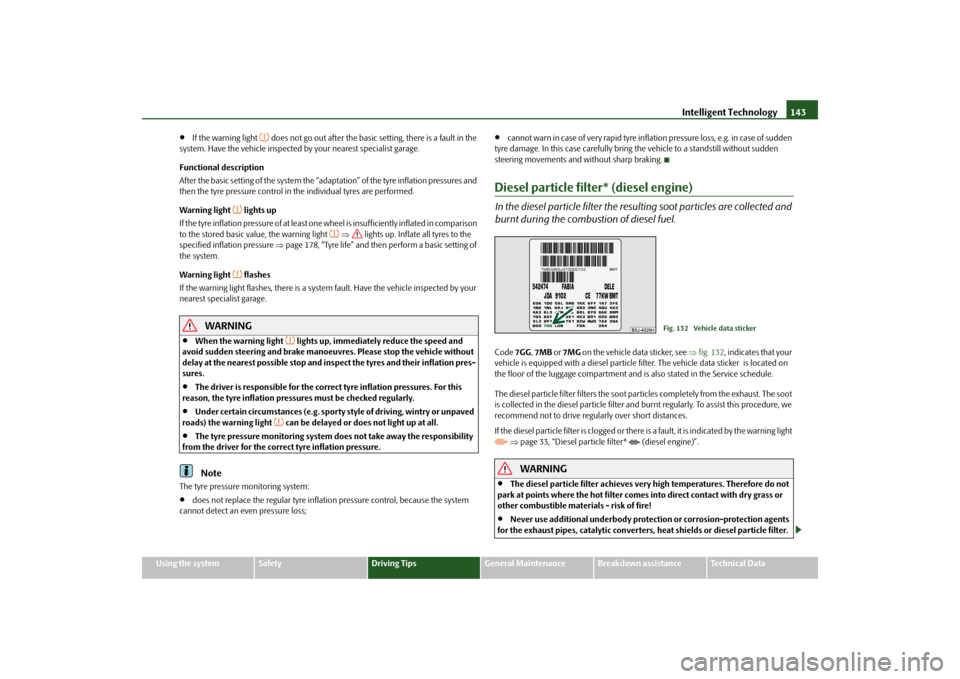
on the vehicle data sticker, see
fig. 132
, indicates that your
vehicle is equipped with a diesel particle fi
lter. The vehicle data st
icker is located on
the floor of the luggage compartment and is
also stated in the Service schedule.
The diesel particle filter filters the soot particles completely from the exhaust. The soot is collected in the diesel particle filter and
burnt regularly. To assist this procedure, we
recommend not to drive regu
larly over short distances.
If the diesel particle filter is clogged or there is a fault, it is indicated by the warning light
page 33, “Diesel particle filter*
(diesel engine)”.
WARNING
The diesel particle filter
achieves very high temp
eratures. Therefore do not
park at points where the hot filter comes into direct contact with dry grass or other combustible materials - risk of fire!
Never use additional underbody protection or corrosion-protection agents
for the exhaust pipes, catalytic converters,
heat shields or diesel particle filter. Fig. 132 Vehicle data sticker
s3j8.a.book Page 143 Tuesday, April 20, 2010 1:10 PM
Page 149 of 244
Driving and the Environment
148
Reducing idling Idling also costs fuel.It is worthwhile switching off the engine in
a traffic jam or when waiting at a level
crossing or at traffic lights with a lengthy red phase. Even after just 30 - 40 seconds you will have saved more fuel th
an that is needed when you start the engine up again.
If an engine is only idling it takes much
longer for it to reach its normal operating
temperature. Wear-and-tear and pollutant emis
sions, though, are particularly high in
the warming-up phase. This is why you should drive off right after starting the engine. Do avoid high engine revolu
tions at this time, however.
Regular servicing A poorly tuned engine consumes an unnecessarily high amount of fuel.Having your vehicle serviced regularly at a specialist garge enables you to satisfy
one
of the requirements for economical motoring even before you set off on your journey. Keeping your vehicle properly serviced not on
ly has a positive effect on the safety of
your vehicle and maintaining its value, but also saves on
fuel
.
A poorly tuned engine can result in a fu
el consumption which
is 10% higher than
normal. The foreseen maintenance work should be
undertaken exactly according to the
Service schedule by a specialist garage. Also check the
oil level
after refueling.
Oil consumption
is dependent to a consider-
able extent on the load and speed of the en
gine. Oil consumption co
uld be as high as
0.5 litres/1 000 km depending on your style of driving. It is quite normal that a new engine has a
higher oil consumption
at first, and reaches
its lowest level only after a certain running in time. It is therefore not possible to correctly assess the oil consumption of a new
vehicle until after yo
u have driven about
5 000 km.
For the sake of the environment
You can achieve additional
improvements in your fuel economy by using high-
lubricity oils.
Check the ground below your vehicle at regular intervals to detect any leakages in
good time. Please have your vehicle inspec
ted by a specialist garge if you find any
stains caused by oil or other fluids on the floor.Avoid driving short distances Short distances result in an above-average high fuel consumption.– Avoid driving a distance of no more
than 4 km if th
e engine is cold.
The engine and catalytic converter mu
st first have reached their optimal
operating
temperature
in order to effectively reduce fuel consumption and pollutant emissions.
The cold engine vehicle cons
umes approx. 15 - 20 litres/100 km of fuel immediately
after starting. Fuel co
nsumption drops to 10 litres/100
km after just 1 kilometre. The
engine reaches its operating temperat
ure (outside temperature and engine
dependent) only after about
4 to 10
kilometres and the fuel consumption then stabi-
lizes. You should therefore avoid driving short distances whenever possible. An important factor in this connection is also the
ambient temperature
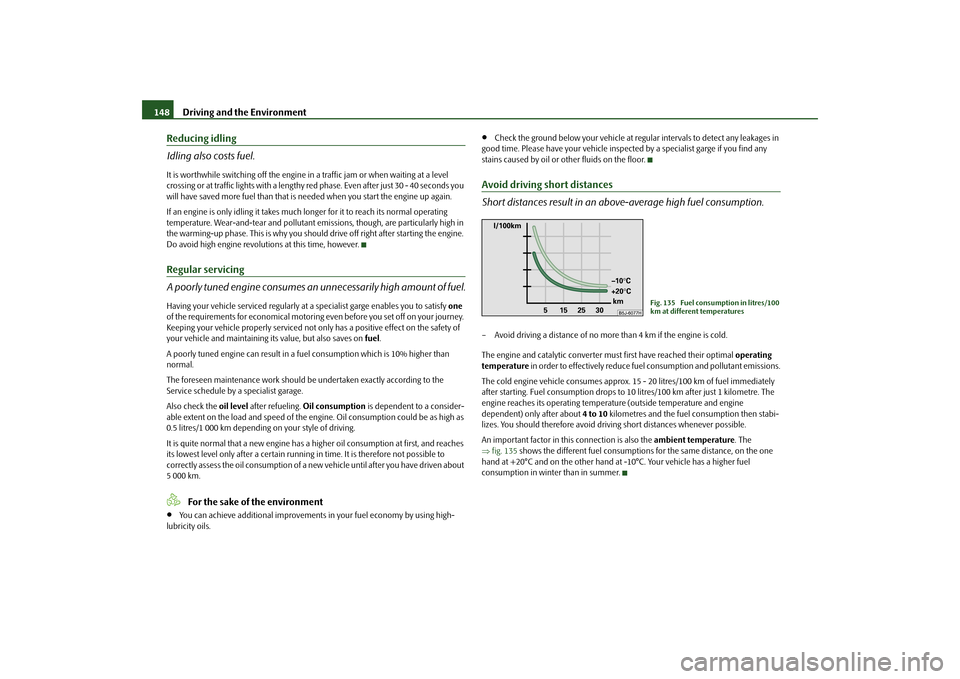
. The
fig. 135
shows the different fuel consumptions for the same distance, on the one
hand at +20°C and on the other hand at
-10°C. Your vehicle has a higher fuel
consumption in winter than in summer.
Fig. 135 Fuel consumption in litres/100 km at different temperatures
s3j8.a.book Page 148 Tuesday, April 20, 2010 1:10 PM
Page 153 of 244
Towing a trailer
152
Towing a trailerTo w i n g a t r a i l e rTechnical requirements The towing device must satisfy certain technical requirements.Your vehicle is designed primarily for tr
ansporting persons and luggage. It can,
however, also be used for towing a traile
r - provided certain technical equipment is
fitted. If your vehicle has been eq
uipped with a towing device
from Škoda Original Accesso-
ries, then the towing device satisfies all technical and legal requirements. Your vehicle is fitted with a 13-pin power so
cket for the electrical connection between
the vehicle and trailer. If the tr
ailer which you wish to tow has a
7-pin connector
, you
can use a suitable adapter
12) from Škoda original accessories.
This work must be carried out in accordance
with the manufacturer's specifications if
a towing device is retrofitted. Specialist garages are familiar with details re
lating to retrofitting a towing device and
for any necessary modifications to the cooling system.
WARNING
We recommend that you have the towing device from Škoda original accesso-ries installed by a specialist garage. He
is familiar with all the relevant details
relating to retrofitting such equipment. There is a risk of an accident if the towing device is not properly fitted!General Maintenance There are a number of points to pay attention to when towing a trailer.Trailer load The permissible trailer load must
on no account be exceeded.
You can negotiate appropriately steeper inclin
es and descents if you do not make full
use of the permissible trailer load. The trailer loads specified only apply for
altitudes
up to 1 000 metres above mean sea
level. On petrol engines without forced indu
ction, the engine power output drops with
increasing height due to a lowering of air pr
essure and thus the ability to climb, this
means that the trailer load must be reduced by 10% for every further increase of 1 000 metres in height above sea le
vel. The towed weight is the weight of the (laden) vehicle
and the (laden) trailer together. One should ta
ke this into account before driving up to
higher altitudes. Petrol engines with forced induction use an air pressure correction method, so that their power output does
not depend on the he
ight above sea level.
The trailer and drawbar load information on the type plate of the towing device are merely test data for the towing device
The data relating to your vehicle, which
is often less than this test data, can be found in your vehicle registration docu- ments. Distribution of the load Distribute the load in the trailer in such a
way that any heavy items are located as close
as possible to the axle. Secure th
e items to preven
t them slipping.
Tyre pressure Correct the tyre inflation pressure on yo
ur vehicle for that of “fully laden”,
page 178.
The inflation pressure of the tyres fitted to
the trailer adjust in accordance with the
manufacturer's recommendation. Exterior mirrors You have to have additional ex
terior mirrors fitted if you are not able to see the traffic
behind the trailer with the standard rear-view mirrors. Both exterior mirrors should be attached to folding arms. Adjust the mirrors so that they provide you with an adequate field of view to the rear. Headlights Before starting off with a hitched trailer, al
so check the setting of the headlights. Alter
the setting as necessary with the aid of the headlight beam adjuster
page 51.
12)In some countries the adapter is supplied with the towing device.s3j8.a.book Page 152 Tuesday, April 20, 2010 1:10 PM
Page 154 of 244

Towing a trailer
153
Using the system
Safety
Driving Tips
General Maintenance
Breakdown assistance
Technical Data
Detachable ball head The ball rod is detachable on
vehicles with towing devi
ce and suppliable from Škoda
original accessories. It is stowed together with separate fitting instructions in the spare wheel well in the luggage compartment of the vehicle.
Note
We recommend that you also have your
vehicle inspected between service inter-
vals if you tow a trailer frequently.
The handbrake on the towing vehicle must be put on when coupling and decou-
pling the trailer.
Keep the mechanism of the ball head of
the towing device clean and take proper
care of it with a suitable preservative.Driving Tips Particular caution is required when towing a trailer.– Do not, as far as possible, drive with
your vehicle unladen and the trailer laden.
– Do not make full use of the legal maximum speeds. This applies in particular to
downhill sections.
– Apply the brakes in good time.– Keep a check on the coolant temperature gauge if the outside temperature is high. Distribution of weight The distribution of the weight
is very poor if your vehicle
is unladen and the trailer is
laden. Maintain a particularly low speed if you cannot avoid driving with this combina- tion. Driving speed Do not drive faster than 80 km/h for safety
reasons. This also a
pplies for countries in
which higher speeds are allowed. The fact that the driving stability of the
vehicle + trailer comb
ination reduces with
increasing speed means that the legally allo
wed speed should not be used when there
are unfavourable road, weather or wind cond
itions as well as on downhill sections.
You must always reduce your speed immediat
ely as soon as you detect even just the
slightest swaying
of the trailer. On no account attempt to stop the trailer from
“swaying” by accelerating. Apply the brakes in good time! If
the trailer is fitted with a
trailer brake
, apply the
brakes gently at first and then brake firmly. This will avoid brake jolts resulting from the trailer wheels locking. Shift down gears in good time before negotiating a downhill section to allow the engine to also act as a brake. Engine overheating Please keep a check on the coolant temperature gauge if you have to negotiate a lengthy slope in a low gear at a high engi
ne speed when the outside temperature is
very high
page 16.
If the needle of the coolant temperature gauge moves into the right-hand area or even the red area of the scale, reduce your speed immediately. Stop and switch off the engine if the warning light
in the instrument cluster begins flashing. Wait a few
minutes and check the level of coolant in the coolant expansion bottle
page 170,
“Inspecting the coolant level”. Please refer to the following guidelines
page 29, “Coolant temperature/coolant
quantity
”.
The coolant temperature can be reduced by switching on the heating.Any increase in the cooling effect of the coolant fan through shifting down a gear and increasing the engine speed is not possible
since the fan speed is independent of the
engine speed. One should also not drop a gear
for this reason when towing a trailer as
long as the engine can manage th
e slope without any drop in speed.
s3j8.a.book Page 153 Tuesday, April 20, 2010 1:10 PM
Page 166 of 244
Inspecting and replenishing
165
Using the system
Safety
Driving Tips
General Maintenance
Breakdown assistance
Technical Data
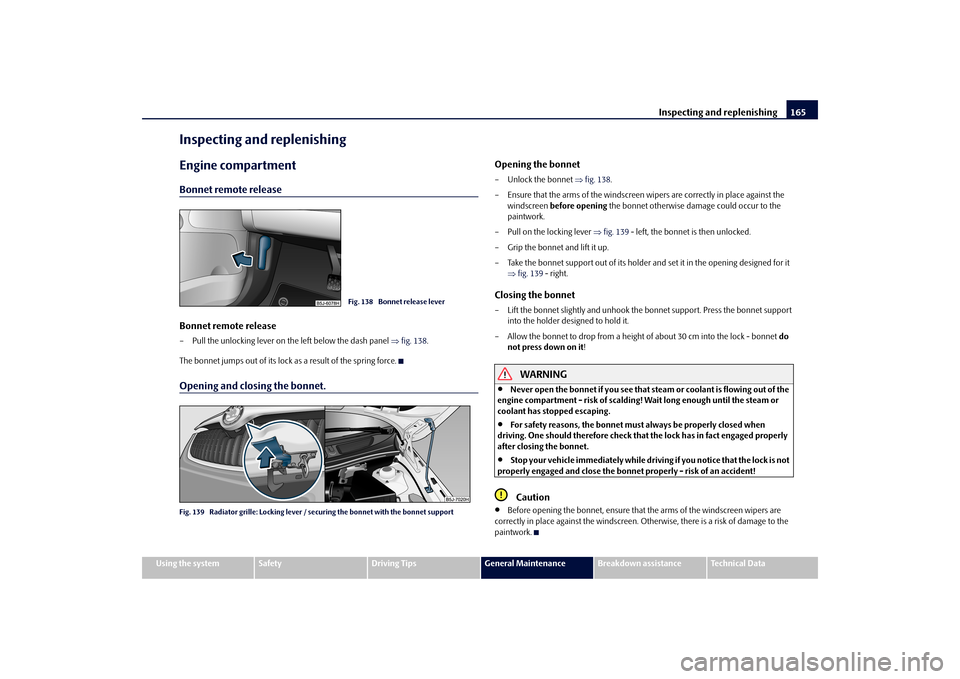
Inspecting and replenishingEngine compartmentBonnet remote releaseBonnet remote release– Pull the unlocking lever on the left below the dash panel
fig. 138
.
The bonnet jumps out of its lock as a result of the spring force.Opening and closing the bonnet.Fig. 139 Radiator grille: Locking lever / se
curing the bonnet with the bonnet support
Opening the bonnet– Unlock the bonnet
fig. 138
.
– Ensure that the arms of the windscreen wipers are correctly in place against the
windscreen
before opening
the bonnet otherwise damage could occur to the
paintwork.
– Pull on the locking lever
fig. 139
- left, the bonnet is then unlocked.
– Grip the bonnet and lift it up.– Take the bonnet support out of its holder and set it in the opening designed for it
fig. 139
- right.
Closing the bonnet– Lift the bonnet slightly and unhook the bonnet support. Press the bonnet support
into the holder designed to hold it.
– Allow the bonnet to drop from a height
of about 30 cm into the lock - bonnet
do
not press down on it
!
WARNING
Never open the bonnet if you see that steam or coolant is flowing out of the
engine compartment - risk of scalding!
Wait long enough until the steam or
coolant has stopped escaping.
For safety reasons, the bonnet must always be properly closed when
driving. One should therefore check that
the lock has in fact engaged properly
after closing the bonnet.
Stop your vehicle immediately while driving if you notice that the lock is not
properly engaged and close the bonnet
properly - risk of an accident!
Caution
Before opening the bonnet, ensure that the arms of the windscreen wipers are
correctly in place against the windscreen. Othe
rwise, there is a risk of damage to the
paintwork.
Fig. 138 Bonnet release lever
s3j8.a.book Page 165 Tuesday, April 20, 2010 1:10 PM
Page 169 of 244
Inspecting and replenishing
168
It is normal for the engine to consume oil.
The oil consumption may be as much as 0.5
l/1 000 km depending on your style of driving and the conditions under which you operate your vehicle. The oil
consumption may be slightly hi
gher than this during the
first 5 000 kilometres. One should therefore check the oil level at regular intervals, preferably every time after the fuel tank is filled or after driving for long stretches. We recommend maintaining the oil level within the range if the engine has been operating at high loads, for example duri
ng a lengthy motorway trip during the
summer months, towing a trailer or
negotiating a high mountain pass,
but not above
this
.
The warning light in the instrument cluster* will indicate
page 29 whether the oil
level is too low. In this case, check the oil
level as soon as possible. Top up with an
appropriate quantity of oil.
WARNING
Read and observe the warning notes
page 166, “Working in the engine
compartment” before working in the engine compartment.
Caution
Always check the oil level on vehicles with engine 1.2 ltr./44 kW when the engine is
cold, on other vehicles when the engine is warm. Otherwise the measuring result is incorrect und oil could be incorrectly
replenished - risk of engine damage!
The oil level must on no account extend
beyond the range . Danger of damaging
the catalytic converter.
Do not continue your journey
if for some reason it is not possible under the
conditions prevailing to top up with oil.
Switch the engine off
and obtain professional
assistance from a specialist garage, otherwise it could lead to severe engine damage.Replenishing engine oil– Inspect the oil level
page 167.
– Unscrew the cap of the engine oil filler opening.
– Wipe off the oil from the sealing surface of the cover and on the counterpart using
a clean cloth.
– Pour in a suitable grade of oi
l in portions of 0.5 litres
page 210.
– Inspect the oil level
page 167.
– Carefully screw on the cap of the filler opening and push the dipstick in fully.
WARNING
Avoid dripping oil onto hot parts of the engine when topping up will oil - a
risk of fire!
Read and observe the warning notes
page 166, “Working in the engine
compartment” before working in the engine compartment.
For the sake of the environment
The oil level must on no account be above the range
page 167. Oil will otherwise
be drawn in through the cr
ankcase ventilation and may
pass through the exhaust
system to atmosphere. The oil may combust
in the catalytic conv
erter and damage it.
Changing engine oilThe engine oil must be changed at the intervals stated in the Service schedule or according to the service interval indicator
page 17.
WARNING
Only carry out the engine oil change, if you have the required professional
knowledge!
Read and observe the warning notes
page 166, “Working in the engine
compartment” before working in the engine compartment.
First of all, let the engine cool down, we
ar an eye protection and gloves - risk
of caustic burns due to hot oil.
AaAa
Aa
s3j8.a.book Page 168 Tuesday, April 20, 2010 1:10 PM
Page 171 of 244
Inspecting and replenishing
170
Any faults or problems resulting from corrosion may cause a loss of coolant
and, as a consequence of this,
result in major engine damage.
Inspecting the coolant levelThe coolant expansion bottle
is located in the engine compartment on the right.
– Switch the engine off.– Open the bonnet
in “Working in the engine compartment” on page 166.
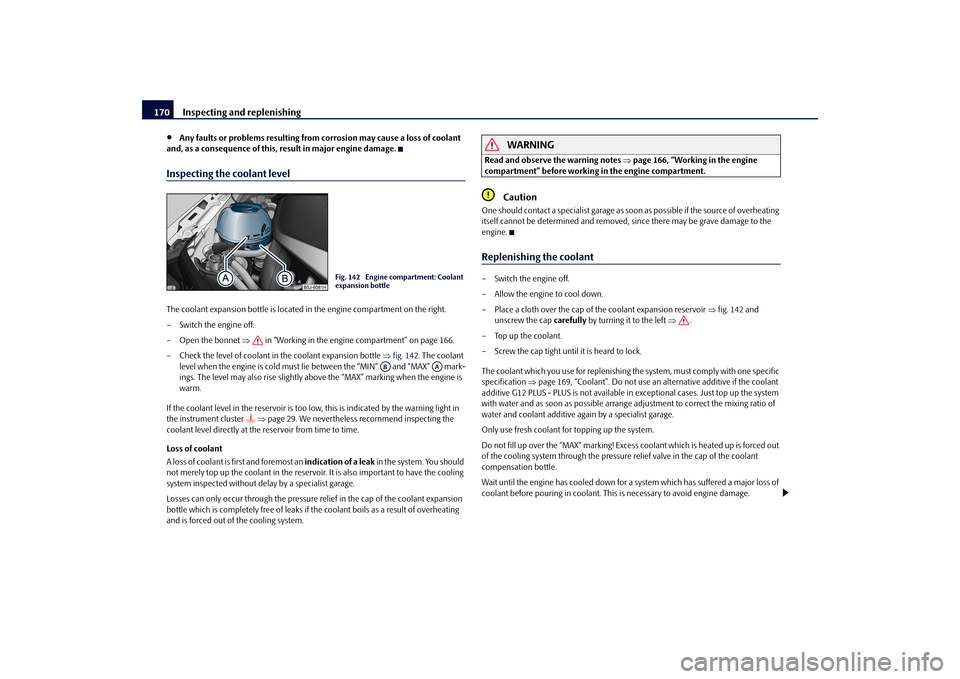
– Check the level of coolant in the coolant expansion bottle
fig. 142
. The coolant
level when the engine is cold must lie between the “MIN” and “MAX” mark- ings. The level may also rise slightly ab
ove the “MAX” marking when the engine is
warm.
If the coolant level in the reservoir is too lo
w, this is indicated by the warning light in
the instrument cluster
page 29. We nevertheless recommend inspecting the
coolant level directly at the reservoir from time to time. Loss of coolant A loss of coolant is first and foremost an
indication of a leak
in the system. You should
not merely top up the coolant in the reservoir.
It is also important to have the cooling
system inspected without delay by a specialist garage. Losses can only occur through
the pressure relief in the cap of the coolant expansion
bottle which is completely free of leaks if
the coolant boils as a
result of overheating
and is forced out of the cooling system.
WARNING
Read and observe the warning notes
page 166, “Working in the engine
compartment” before working in the engine compartment.
Caution
One should contact a specialist garage as s
oon as possible if the source of overheating
itself cannot be determined and removed,
since there may be grave damage to the
engine.Replenishing the coolant– Switch the engine off. – Allow the engine to cool down.– Place a cloth over the cap of the coolant expansion reservoir
fig. 142
and
unscrew the cap
carefully
by turning it to the left
.
–Top up the coolant.– Screw the cap tight until it is heard to lock. The coolant which you use for replenishing the system, must comply with one specific specification
page 169, “Coolant”. Do not use an al
ternative additive if the coolant
additive G12 PLUS - PLUS is not available in
exceptional cases. Just top up the system
with water and as soon as possible arrange
adjustment to correct
the mixing ratio of
water and coolant additive again by a specialist garage. Only use fresh coolant for topping up the system.Do not fill up over the “MAX” marking! Excess
coolant which is heated up is forced out
of the cooling system through the pressure relief valve in the cap of the coolant compensation bottle. Wait until the engine has cooled down for a
system which has suffered a major loss of
coolant before pouring in coolant. This
is necessary to avoid engine damage.
Fig. 142 Engine compartment: Coolant expansion bottle
AB
AA
s3j8.a.book Page 170 Tuesday, April 20, 2010 1:10 PM
Page 177 of 244
Inspecting and replenishing
176
Caution
On vehicles with the “START/STOP” system,
the pole terminal of the charger must not
be connected directly to the negative termin
al of the vehicle battery, but only to the
engine earth
page 192, fig. 158
.
Disconnecting and reconnecting the batteryOn disconnecting and reconnecting the batt
ery the following functions are initially
deactivated or are no longer able to operate fault-free. We recommend having the vehicle checked by a specialist garage to ensure full func- tionality of all electrical systems.Replacing the batteryYou should only replace a battery with a ne
w battery of the same
capacity, voltage (12
V), amperage and of the same size. Specialist garages have a range of suitable batteries available. We recommend that you only have an old ba
ttery disposed of by a specialist garage
since it does require special disposal.
For the sake of the environment
Batteries contain poisonous substances such
as sulphuric acid and lead. They must be
disposed of in accordance with local environmental protection regulations and on no account as domestic waste.
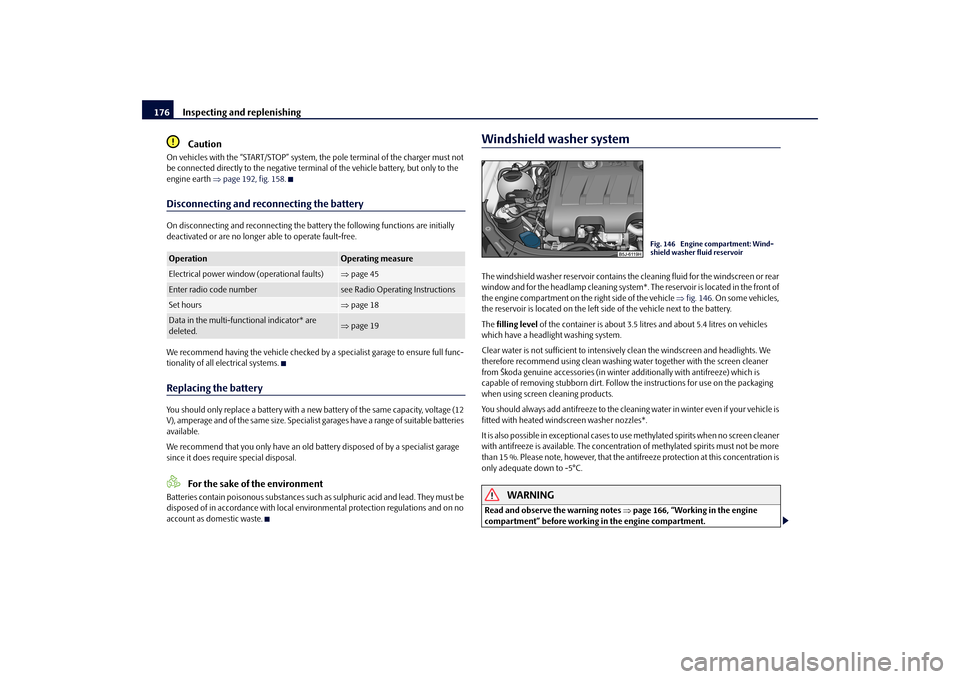
Windshield washer systemThe windshield washer reservoir contains the
cleaning fluid for the
windscreen or rear
window and for the headlamp cleaning system*.
The reservoir is located in the front of
the engine compartment on the right side of the vehicle
fig. 146
. On some vehicles,
the reservoir is located on the left si
de of the vehicle next to the battery.
The
filling level
of the container is about 3.5 litres and about 5.4 litres on vehicles
which have a headlight washing system. Clear water is not sufficient to intensivel
y clean the windscreen and headlights. We
therefore recommend using clean washing water together with the screen cleaner from Škoda genuine accessories (in winter additionally with antifreeze) which is capable of removing stubborn
dirt. Follow the instructions for use on the packaging
when using screen cleaning products. You should always add antifreeze to the cleani
ng water in winter even
if your vehicle is
fitted with heated wind
screen washer nozzles*.
It is also possible in exceptional cases to use methylated spirits when no screen cleaner with antifreeze is available. The concentration of methylated spirits must not be more than 15 %. Please note, however, that the anti
freeze protection at this concentration is
only adequate down to -5°C.
WARNING
Read and observe the warning notes
page 166, “Working in the engine
compartment” before working in the engine compartment.
Operation
Operating measure
Electrical power window
(operational faults)
page 45
Enter radio code number
see Radio Operat
ing Instructions
Set hours
page 18
Data in the multi-functional indicator* are deleted.
page 19
Fig. 146 Engine compartment: Wind- shield washer fluid reservoir
s3j8.a.book Page 176 Tuesday, April 20, 2010 1:10 PM
Page 188 of 244
Breakdown assistance
187
Using the system
Safety
Driving Tips
General Maintenance
Breakdown assistance
Technical Data
Changing a wheelPreliminary workThe following steps should be carried ou
t before actually changing the wheel.
– If it is necessary to change a wheel, park
the vehicle as far aw
ay as possible from
the traffic flow. The place you choose should be
level
.
– Have all the occupants
get out
. While changing a wheel, the occupants of the
vehicle should not stand on the ro
ad (e.g. behind a crash barrier).
– Apply the
handbrake
firmly.
–Engage
1st gear
or if your vehicle is fitted with
an automatic gearbox, position the
selector lever into position P
.
– If a trailer is coupled, uncouple it.– Take the
vehicle tool kit
and the
spare wheel*
page 185 out of the luggage
compartment.
WARNING
If you find yourself in flowing traffic switch on the hazard warning lights
system and place the warning triangle on
the side of the road at the prescribed
distance from your vehicle while observing all national legal provisions. In this way you are protecting not only yourself but also other road users.
Never start the engine with the vehicle si
tting on the raised
jack - danger of
suffering injury.
Caution
If you have to change a wheel on a slope first block the opposite wheel with a stone or similar object in order to secure the
vehicle from unexpectedly rolling away.
Note
Comply with the national legal regulations.
Changing a wheelAlways change a wheel on a level surface as far as possible. – Take off the full wheel trim*
page 188 or the caps
page 188.
– Slacken the wheel bolts
page 189.
– Jack up the vehicle until the wheel to
be changed is clear of the ground
page 189.
– Unscrew the wheel bolts and place them
on a clean surface (cloth, paper etc.).
– Take off the wheel.– Fit on the spare wheel* and tighten the wheel bolts slightly.– Lower the car.– Tighten the wheel bolts firmly, alternatel
y and diagonally using the wrench (cross-
wise)
page 189.
– Mount the full wheel trim/wheel trim cap or the caps.
Note
All bolts must be clean and must turn easily.
You must never grease or oil the wheel bolts!
When fitting on unidirectiona
l tyres, ensure that the tyres rotate in the correct
direction
page 178.
Subsequent stepsAfter changing the wheel, you mu
st perform the following steps.
– Stow the vehicle tool kit in the space provided.– Stow the replaced wheel in the luggage compartment.–
Check
the
tyre pressure
on the spare wheel just mounted as soon as possible.
– Have the
tightening torque
of the wheel bolts
checked
with a torque wrench as
soon as possible. Steel and light alloy wheels must be tightened to a tightening torque of
120 Nm
.
s3j8.a.book Page 187 Tuesday, April 20, 2010 1:10 PM