maintenance SKODA FABIA 2014 3.G / NJ Owner's Guide
[x] Cancel search | Manufacturer: SKODA, Model Year: 2014, Model line: FABIA, Model: SKODA FABIA 2014 3.G / NJPages: 216, PDF Size: 30.7 MB
Page 161 of 216
WARNINGThere is a risk of injuries, poisoning, chemical burns, explosions or fire
when carrying out any work on the battery and on the electrical system. It
is essential to comply with the generally applicable rules of safety as well
as the warning instructions outlined below.■
Keep the vehicle battery away from people who are not completely inde-
pendent, especially children.
■
Do not tilt the battery otherwise battery electrolyte may flow out of the
battery vent openings. Protect your eyes by wearing safety glasses or a
face shield – there is a risk of being blinded.
■
Always wear protective gloves, eye and skin protection when handling
the vehicle battery.
■
The battery acid is strongly corrosive and must, therefore, be handled
with the greatest of care.
■
Corrosive fumes in the air irritate the air passages and lead to conjunctivi-
tis and inflammation of the air passages in the lungs.
■
Battery acid corrodes dental enamel and creates deep wounds on contact
with the skin which take a long time to heal.
■
If any battery electrolyte comes into contact with your eyes, rinse the
eyes immediately with clear water for several minutes - consult a doctor
immediately.
■
Splashes of acid on your skin or clothes should be neutralised as soon as
possible using soap suds and then rinsed with plenty of water.
■
Seek immediate medical assistance if you swallow battery acid.
WARNING■ The use of open flames and light should be avoided.■Smoking and radio triggering activities should be avoided.■
Never use a damaged vehicle battery – there is a risk of explosion.
■
Never charge a frozen or thawed vehicle battery – there is a risk of explo-
sion and caustic burns.
■
Replace a frozen vehicle battery.
■
Never jump-start vehicle batteries with an electrolyte level that is too low
– risk of explosion and caustic burns.
CAUTION
■ Improper handling of the vehicle battery may cause damage.■Ensure that battery acid does not come into contact with the bodywork –
there is a risk of damage to the paintwork.■ If the vehicle has not been driven for more than 3 to 4 weeks, the battery will
discharge. Prevent the battery from discharging by disconnecting the battery's
negative terminal
or continuously charging the battery with a very low
charging current.■
Do not place the battery in direct daylight in order to protect the vehicle bat-
tery housing from the effects of ultra-violet light.
■
If the vehicle is frequently used for making short trips, the vehicle battery
will not have time to charge up sufficiently and may discharge.
For the sake of the environment
A vehicle battery that has been removed is a special type of hazardous waste.
These must be disposed of in accordance with national legal regulations.
Note
■ We recommend having all work on the vehicle battery carried out by a spe-
cialist garage.■
You should replace batteries older than 5 years.
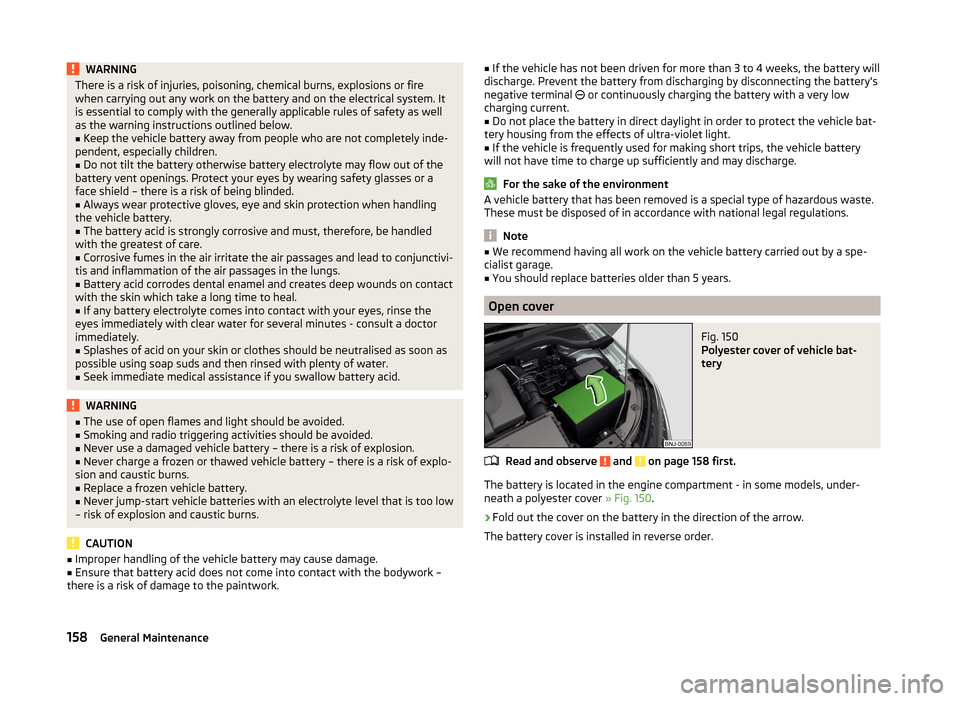
Open cover
Fig. 150
Polyester cover of vehicle bat-
tery
Read and observe and on page 158 first.
The battery is located in the engine compartment - in some models, under-
neath a polyester cover » Fig. 150.
›
Fold out the cover on the battery in the direction of the arrow.
The battery cover is installed in reverse order.
158General Maintenance
Page 163 of 216
WARNING■When you charge a battery, hydrogen is released, and a highly explosive
gas mixture is also produced. An explosion can be caused through sparkling
over during unclamping or loosening of the cable plug while the ignition is
on.■
Creating a bridge between the poles on the battery (e.g. with metal ob-
jects - cables) creates a short circuit - risk of damage to the battery, explo-
sion and burning of the battery, jets of acid spurting out.
■
Avoid creating sparks when working with cables and electrical devices.
Strong sparking represents a risk of injury.
■
Before carrying out any work on the electrical system, switch off the en-
gine, the ignition and all electrical consumers and disconnect the negative
terminal
.
■
“Quick-charging” the vehicle battery is dangerous and requires a special
charger and specialist knowledge.
■
We therefore recommend that vehicle batteries be “rapidly charged” by a
specialist garage.
CAUTION
On vehicles with the START/STOP system or additional heating (auxiliary heat-
ing), the pole terminal of the charger must not be connected directly to the
negative terminal of the vehicle battery, but only to the engine earth
» page 176 .
Replacing
Read and observe
and on page 158 first.
The new vehicle battery must have the same capacity, voltage, current and the
same size as the original battery. Suitable vehicle battery types can be pur-
chased from a specialist garage.
We recommend that the battery is replaced by a specialist garage, where the
new vehicle battery will be installed properly and the original battery will be
disposed of in accordance with national regulations.
Disconnecting or reconnecting
Read and observe
and on page 158 first.
Disconnecting
›
Switch off the ignition.
›First, disconnect the negative terminal
first, then the positive terminal
of the battery.
Connecting›
First, connect the positive
first, then the negative
battery terminal.
After disconnecting and re-connecting the vehicle battery, the following func-
tions or devices are partially or completely inoperative.
Function / deviceOperating measureElectric window levers» page 58RadioEnter code » operating instruc-
tions for the Infotainment dis-
play radioTime settings» page 33
CAUTION
■ Disconnect the vehicle battery only with the ignition turned off - there is a
risk of damaging the electrical system of the vehicle.■
Under no circumstances must the battery cables be connected incorrectly –
risk of a cable fire.
Note
■ After disconnecting and re-connecting the vehicle battery, we recommend
having the vehicle checked by a specialist to ensure that the full functionality
of all electrical systems is guaranteed.■
The data of the multi-function display will be reset.
Automatic load deactivation
Read and observe
and on page 158 first.
The vehicle voltage control unit automatically prevents the battery from dis-
charging when the battery is subjected to heavy loads. This may be noticed
from the following.
› The idling speed is raised to allow the generator to deliver more electricity to
the electrical system.
› Where appropriate large convenience consumers, e.g. seat heaters, rear win-
dow heaters, have their power limited or shut off completely if necessary.
160General Maintenance
Page 165 of 216
Tyre storage
Mark the tyres as you remove them so that you are able to refit them to run in
the same direction.
Always store wheels or tyres in a cool, dry and, where possible, dark place.
Tyres which are not fixed to a wheel trim should be stored upright.
Tyre age
Tyres age losing their original characteristics, even if they are not used. The
service life of the tyres is 6 years. Therefore, we recommend not using tyres
older than 6 years.
Wheel bolts
Wheels and wheel bolts are matched to each other in terms of design. There-
fore we recommend that you use wheel rims and wheel bolts from ŠKODA
Original Accessories.WARNINGNever use tyres if you do not know anything about the condition and age.
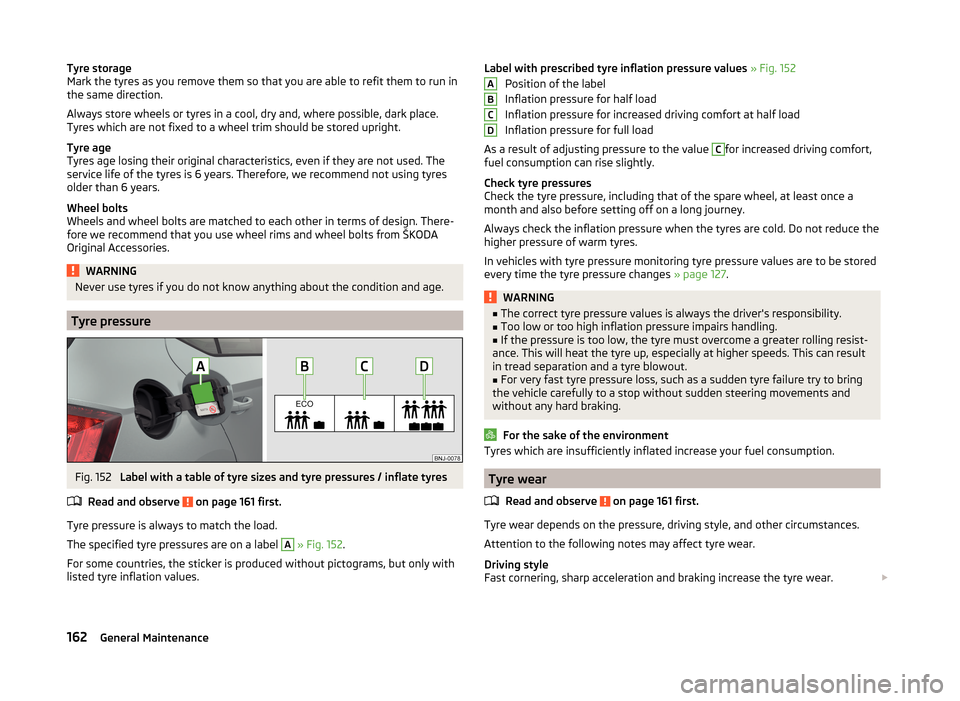
Tyre pressure
Fig. 152
Label with a table of tyre sizes and tyre pressures / inflate tyres
Read and observe
on page 161 first.
Tyre pressure is always to match the load.
The specified tyre pressures are on a label
A
» Fig. 152 .
For some countries, the sticker is produced without pictograms, but only with
listed tyre inflation values.
Label with prescribed tyre inflation pressure values » Fig. 152
Position of the label
Inflation pressure for half load
Inflation pressure for increased driving comfort at half load
Inflation pressure for full load
As a result of adjusting pressure to the value C
for increased driving comfort,
fuel consumption can rise slightly.
Check tyre pressures
Check the tyre pressure, including that of the spare wheel, at least once a
month and also before setting off on a long journey.
Always check the inflation pressure when the tyres are cold. Do not reduce the
higher pressure of warm tyres.
In vehicles with tyre pressure monitoring tyre pressure values are to be stored
every time the tyre pressure changes » page 127.
WARNING■
The correct tyre pressure values is always the driver's responsibility.■Too low or too high inflation pressure impairs handling.■
If the pressure is too low, the tyre must overcome a greater rolling resist-
ance. This will heat the tyre up, especially at higher speeds. This can result
in tread separation and a tyre blowout.
■
For very fast tyre pressure loss, such as a sudden tyre failure try to bring
the vehicle carefully to a stop without sudden steering movements and
without any hard braking.
For the sake of the environment
Tyres which are insufficiently inflated increase your fuel consumption.
Tyre wear
Read and observe
on page 161 first.
Tyre wear depends on the pressure, driving style, and other circumstances.
Attention to the following notes may affect tyre wear.
Driving style
Fast cornering, sharp acceleration and braking increase the tyre wear.
ABCD162General Maintenance
Page 167 of 216
Unidirectional tyresRead and observe
on page 161 first.
The direction of rotation of the tyres is marked by arrows on the wall of the
tyre .
The direction of rotation indicated must be complied with to obtain the best
benefits from the characteristics of these tyres.
These characteristics are principally the following.
› Increased driving stability.
› Reduced risk of aquaplaning.
› Reduced tyre noise and reduced tyre wear.
Manufacturer-approved tyre variants
Introduction
This chapter contains information on the following subjects:
Explanation of the tire labelling
164
Manufacturer-approved tyre variants
165
Authorised tyre variants are to be selected according to the engine size of your
vehicle » page 165 , Manufacturer-approved tyre variants .
Only fit radial tyres of the same type, size (rolling circumference) and the same
tread pattern on one axle on all four wheels.
When mounting new tyres the tyres have to be replaced axle by axle.
The information listed in the table corresponds to the information available at the time of going to press.
The approved tyre / rim combinations for your car are given on the sales and
technical vehicle documentation.
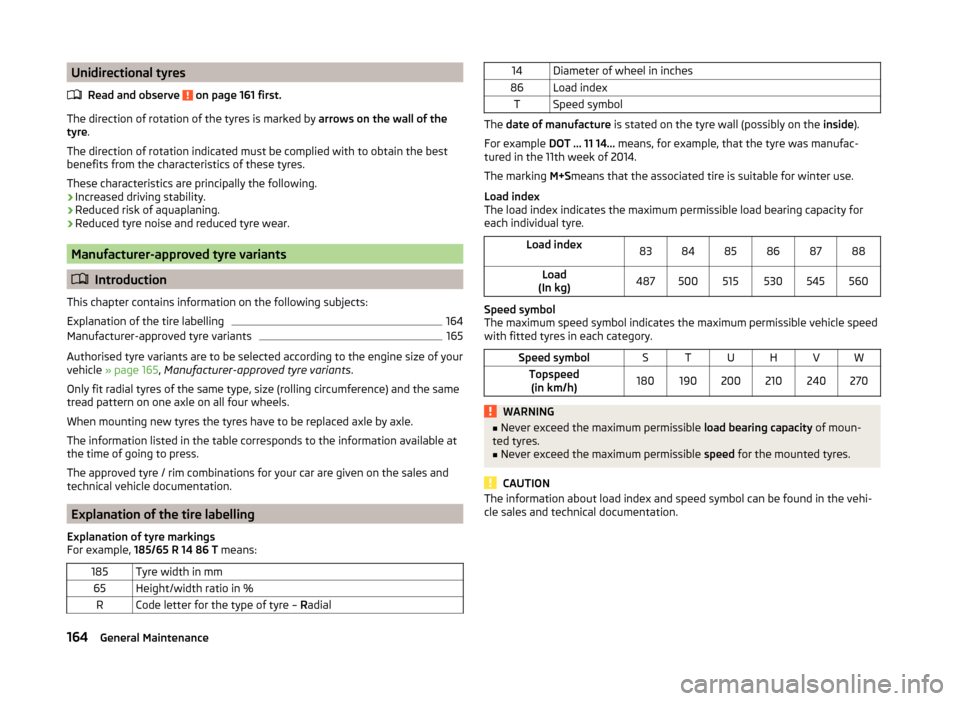
Explanation of the tire labelling
Explanation of tyre markings
For example, 185/65 R 14 86 T means:
185Tyre width in mm65Height/width ratio in %RCode letter for the type of tyre – Radial14Diameter of wheel in inches86Load indexTSpeed symbol
The date of manufacture is stated on the tyre wall (possibly on the inside).
For example DOT ... 11 14... means, for example, that the tyre was manufac-
tured in the 11th week of 2014.
The marking M+Smeans that the associated tire is suitable for winter use.
Load index
The load index indicates the maximum permissible load bearing capacity for
each individual tyre.
Load index838485868788Load
(In kg)487500515530545560
Speed symbol
The maximum speed symbol indicates the maximum permissible vehicle speed
with fitted tyres in each category.
Speed symbolSTUHVWTopspeed (in km/h)180190200210240270WARNING■ Never exceed the maximum permissible load bearing capacity of moun-
ted tyres.■
Never exceed the maximum permissible speed for the mounted tyres.
CAUTION
The information about load index and speed symbol can be found in the vehi-
cle sales and technical documentation.164General Maintenance
Page 169 of 216
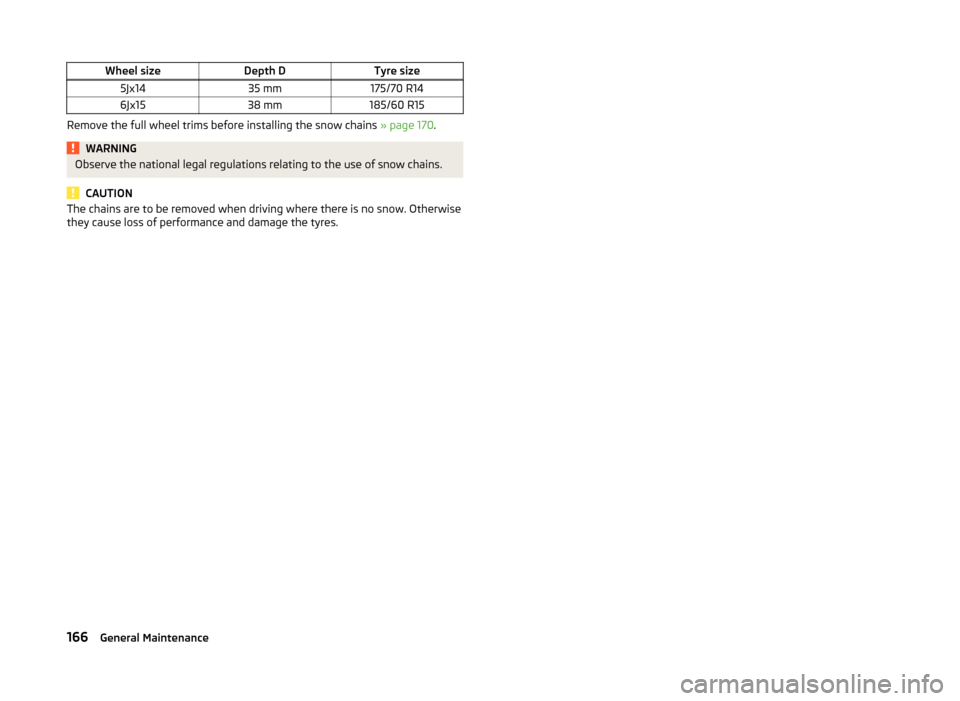
Wheel sizeDepth DTyre size5Jx1435 mm175/70 R146Jx1538 mm185/60 R15
Remove the full wheel trims before installing the snow chains » page 170.
WARNINGObserve the national legal regulations relating to the use of snow chains.
CAUTION
The chains are to be removed when driving where there is no snow. Otherwise
they cause loss of performance and damage the tyres.166General Maintenance
Page 205 of 216
BootClass N1 vehicles89
Hooks86
See Boot lid56
Boot lid automatic locking
56
Closing56
Opening56
Brake booster108
brake fluid specification
157
Brake fluid156
Checking157
Information messages34
Brake pedal (automatic transmission) Indicator light
38
brakes Driving in
113
Brakes Brake booster
108
Brake fluid157
Braking and stabilisation systems115
Handbrake108
Information messages34
Warning light34
Brakes and parking107
Braking Information for braking
107
Breakdown kit173
Break recommendation See Fatigue detection
126
Bulbs Replacing
186
Button CAR see Infotainment
4
C
Car care Jack
144
Car computersee multifunction display45
Care and maintenance137
Car park109
Car park ticket holder76
Carrier Roof rack
93
Cavity protection144
Central locking49
Problems54
Central locking button53
Central warning light Indicator light
34
Change Bulb for daytime running lights (halogen spot-light)
189
Bulb for indicator (halogen headlight)188
Engine oil153
Light bulb in tail light192
Changing Fuses
182
Fuses in the dash panel183
Fuses in the engine compartment185
Licence plate light bulb191
Wheels170
Changing a wheel Preparation
170
Removing and fitting a wheel171
Subsequent steps171
Charging a vehicle battery159
Check Fit ball head properly
132
Checking Battery electrolyte level
159
Brake fluid157
Coolant level156
Engine oil154
Oil level154
Windscreen washer fluid153
Checks Statutory checks137
Children and safety22
Child safety Side airbag
24
Child safety lock54
Child safety seat Use of child safety seats
24
child seat Use of ISOFIX child seats
25
Child seat Classification
24
ISOFIX25
on the front passenger seat23
TOP TETHER26
Chrome parts see vehicle care
143
Cigarette lighter78
cleaning chrome parts
143
Cleaning Alcantara
146
and maintaining belts147
artificial leather146
headlight glasses144
materials146
natural leather146
plastic parts142
seats covers of the electrically heated seats147
wheels144
Cleaning safety belt
147
Cleaning seat covers
147
Cleaning the interior artificial leather
146
Seat covers147
Cleaning the outside of the vehicle Decorative films
143
202Index
Page 208 of 216
HBA116
Head airbag19
Headlight cleaning system Headlight cleaning system
69
Headlights Bulb arrangement
186
Driving abroad65
Headlight cleaning system69
Headrests72
Adjust height72
Headrest, removing and installing
73
heater Rear window
66
Heater Recirculated air mode
96
Heating95
Control elements97
Exterior mirrors70
Seats73
HHC116
Hill Hold Control (HHC)116
Hitch129
Drawback load129
Hooks86
Horn28
Hydraulic Brake Assist (HBA)116
I
Ice scrapers
143
Ignition lock104
Immobilizer103
Individual settings Locking
53
Unlocking53
Inertia reel15
Information system43
Door warning44
Gear recommendation44
MAXI DOT display45
Multifunction display45
Operation43
Outside temperature44
Service interval display48
Infotainment4
Instrument cluster29
Auto-check control44
Counter for distance driven32
Display31
Fuel gauge32
Overview30
Revolution counter30
Speedometer31
Temperature gauge31
Viewing the charge level of the vehicle battery 33
Warning icons
38
Warning lights33
Interior care145
Natural leather146
interior light Front
65
Interior monitor55
ISOFIX25
J
Jack
168
Maintenance144
Jacking points Raise vehicle
172
Jump-starting176
K
KESSY Locking
52
Unlocking52
Key Locking
50
Start the engine104
Stopping the engine104
Switch off the ignition104
Switch on the ignition104
Unlocking50
Keys in the door Power windows
56
L
Lamp failure Indicator symbol
41
Lamps Indicator symbol
41
Leather Natural leather care
146
LEAVING HOME63
Lever Main beam
62
Turn signal62
Levers Windscreen wipers
68
Light Cockpit
65
COMING HOME / LEAVING HOME63
Fog lights with CORNER function63
Lighting Luggage compartment
84
Lights60
Automatic driving lamp control62
Daylight running61
Fog lights63
Hazard warning light system64
Headlight flasher62
Headlight range adjustment60
Low beam60
Main beam62
parking lights60
Parking lights65
Rear fog light63
Replacing bulbs186
Switching on and off60
205Index
Page 209 of 216
Turn signal62
Warning lights33
Lock / unlock steering lock Key
103
Lock / unlock the steering lock Starter button
105
Locking Individual settings
53
KESSY52
Key50
Remote control50
Locking and unlocking the vehicle from the in- side
53
Locking the door without a locking cylinder Emergency
180
Low beam60
Luggage compartment84
Cover87
Emergency unlocking181
Fastening elements85
Fixing nets85
Flexible storage compartment89
Lighting84
Storage compartments under the floor88
Unlocking the tailgate181
Variable loading floor89
Luggage compartment cover87
Other positions87
Roll-up cover88
Luggage Storage 12-volt power outlet
79
Roll-up cover88
Storage compartments86
M
Main beam
62
Warning light38
Maintenance see vehicle care
142
Manual air conditioningOperating elements98
Recirculated air mode96
Manual gear changing see Gear changing
109
MAXI DOT display45
Operation43
MAXI DOT see MAXI DOT display
45
Maximum permissible weights
194
Maximum speed198
Mechanical windows59
Opening and closeing59
Media see Infotainment
4
Memory46
Mirror Exterior mirrors
70
Make-up67
Mirror Link see Infotainment
4
Mirrors Interior mirror
70
Modifications137
Modifications and technical alterations Service
138
Motor Information messages
40
Motor oil Indicator symbol
40
Multi-collision brake116
Multifunction display Functions
45
Information46
Memory46
Operation43
Multimedia holder80
N
N1
89
Nameplate194
Nets85
Notes for driving with tyre repaired175
Notes on using wheels161
O
Oil Information messages
40
see Engine oil154
Oil pressure Information messages
40
Onboard computer see multifunction display
45
Operating weight195
Operation in winter Diesel fuel
150
Vehicle battery159
Original accessories138
Outside temperature44
Overview Engine compartment
152
Warning icons38
Warning lights33
P
Parking
109
Parking aid117
Automatic system activation when moving for- ward
118
Function117
parking lights60
Park the vehicle see Parking
109
Part replacement137
206Index
Page 212 of 216

Taking care of your vehicleAutomatic car wash system141
High-pressure cleaner141
Washing by hand141
Wash system141
TCS Operation
115
Warning light35
Technical data194
Tiptronic112
Tools168
TOP TETHER26
Towing177
Towing a trailer135
Towing device Accessories
133
Description129
Operation and maintenance145
Towing eye Front
178
Rear179
Towing protection55
Traction Control System (TCS)115
Trailer134
13-pin socket 134
connect and disconnect134
Loading135
Safety eye134
Towing a trailer135
Trailer operation129
Transmission Warning messages
39
Transport Luggage compartment
84
Roof rack93
Transporting76
Transporting children safely22
Triangle167
Turning signal system Warning light37
Turn signal62
Turn signal system Warning light
37
Tyre Damage
163
Explanation of the labelling164
see wheels164
Tyre load-bearing capacity see Wheels
164
Tyre pressure162
Warning light37
Tyre pressure monitor refer to the tyre pressure monitoring
127
Tyre pressure monitoring127
Display37
Infotainment display128
Save tyre pressure values127
Save tyre pressure values - button128
Save tyre pressure values - Infotainment128
Tyre repair General notes
174
Preparations175
Pressure test175
Sealing and inflating the tyre175
Tyres161
new113
Tyre pressure162
Wear and tear162
Wear indicators163
Tyre size164, 165
see wheels164, 165
U
Under-body Vehicle care
145
Under-body protection145
Unlocking Individual settings53
KESSY52
Key50
Remote control50
Unlocking and locking49
Used vehicles Acceptance and recycling
140
Useful equipment Ashtray
79
Car park ticket holder76
Cigarette lighter78
Clothes hook82
Cup holders78
Glasses compartment81
Multimedia holder80
Storage compartment76
Useful Features 12-volt power outlet
79
Using the information system43
Using the selector lever111
V
Variable loading floor
89
Inserting90
Lower position90
Removing90
Upper position89
Vehicle battery Automatic load deactivation
160
Charge level indicator33
Charging159
Checking the battery electrolyte level159
Cover158
Disconnecting and reconnecting160
Operation in winter159
Replacing160
Safety instructions157
Warning icon39
209Index
Page 213 of 216

vehicle carechrome parts143
Vehicle care Alcantara
146
Artificial leather146
Cavity protection144
Cleaning vehicle exterior141
Cleaning wheels144
Decorative films143
Door locking cylinder144
Headlight glasses144
Interior care145
Maintenance142
Materials146
Natural leather146
Plastic parts142
Polishing vehicle paint work142
Rubber seals143
Safety belt147
Seat covers147
Under-body protections145
washing140
Vehicle condition see Auto-check control
44
Vehicle data sticker194
Vehicle data sticker and nameplate Vehicle data sticker and nameplate
194
Vehicle dimensions196
Vehicle height196
Vehicle Identification Number (VIN)194
Vehicle length196
Vehicle tool kit168
Vehicle width196
Vest Placement of the reflective vest
167
VIN Vehicle Identification Number
194
Visibility66
Visors see front sun visors
67
W
Warning at excessive speeds
47
Warning icons38
Warning indicator of a low temperature Warning symbol
42
Warning lights33
Warning symbols see Warning lights
33
see Warning symbols38
Warning triangle167
Washing Automatic car wash system
141
by hand141
High-pressure cleaner141
Washing vehicles140
Waste container80
Water Driving through
113
Weather conditions137
Wheel bolts Anti-theft wheel bolts
173
Caps171
Loosening and tightening172
wheels spare wheel
169
Wheels Age of wheels
161
Changing170
Driving style162
Full trim170
General information161
Load index164
Snow chains165
Speed symbol164
Storage of wheels161
Tyre damage163
Tyre pressure162
Tyre size164, 165
Tyre wear162
Tyre wear indicator163
Unidirectional tyres164
Wheel balance162
Wheels exchange163
Winter tyres165
Wi-Fi Password
101
Settings101
Website101
Window wiper Replacing the rear window wiper blade
182
Windscreen washer fluid Checking
153
Replenishing153
Warning icon42
Winter153
Windscreen washers Windscreen washers
68
Windscreen washer system153
Windscreen wipers operation
68
Replacing the windscreen wipers181
Windscreen washer fluid153
Windscreen wipers and washers67
Winter operation De-icing windows
143
Snow chains165
Winter tyres See Wheels
165
Winter use165
Winter tyres165
Wiper blades145
Service position of the windscreen wiper arms 181
Wiper interval
68
Wipers Maintaining wiper blades
145
X
XDS
116
210Index