key battery SKODA OCTAVIA 2006 Owner´s Manual
[x] Cancel search | Manufacturer: SKODA, Model Year: 2006, Model line: OCTAVIA, Model: SKODA OCTAVIA 2006Pages: 218, PDF Size: 5.48 MB
Page 95 of 218
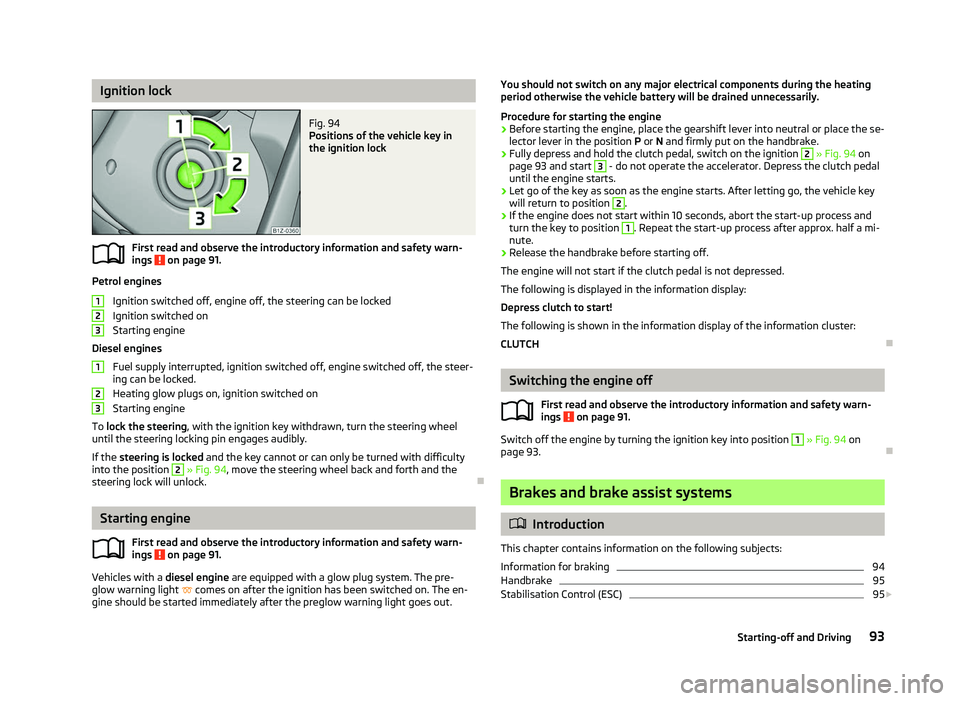
Ignition lock
Fig. 94
Positions of the vehicle key in
the ignition lock
First read and observe the introductory information and safety warn-
ings on page 91.
Petrol engines
Ignition switched off, engine off, the steering can be locked
Ignition switched on
Starting engine
Diesel engines Fuel supply interrupted, ignition switched off, engine switched off, the steer-
ing can be locked.
Heating glow plugs on, ignition switched on
Starting engine
To lock the steering , with the ignition key withdrawn, turn the steering wheel
until the steering locking pin engages audibly.
If the steering is locked and the key cannot or can only be turned with difficulty
into the position 2
» Fig. 94, move the steering wheel back and forth and the
steering lock will unlock. ÐStarting engine
First read and observe the introductory information and safety warn-
ings on page 91.
Vehicles with a diesel engine are equipped with a glow plug system. The pre-
glow warning light comes on after the ignition has been switched on. The en-
gine should be started immediately after the preglow warning light goes out.
ä 1
2
3
1
2
3
ä You should not switch on any major electrical components during the heating
period otherwise the vehicle battery will be drained unnecessarily.
Procedure for starting the engine
› Before starting the engine, place the gearshift lever into neutral or place the se-
lector lever in the position P or N and firmly put on the handbrake.
› Fully depress and hold the clutch pedal, switch on the ignition 2
» Fig. 94 on
page 93 and start 3
- do not operate the accelerator. Depress the clutch pedal
until the engine starts.
› Let go of the key as soon as the engine starts. After letting go, the vehicle key
will return to position 2
.
› If the engine does not start within 10
seconds, abort the start-up process and
turn the key to position 1
. Repeat the start-up process after approx. half a mi-
nute.
› Release the handbrake before starting off.
The engine will not start if the clutch pedal is not depressed.
The following is displayed in the information display:
Depress clutch to start!
The following is shown in the information display of the information cluster:
CLUTCH Ð Switching the engine off
First read and observe the introductory information and safety warn-
ings on page 91.
Switch off the engine by turning the ignition key into position 1
» Fig. 94
on
page 93. Ð Brakes and brake assist systems
ä
Introduction
This chapter contains information on the following subjects:
Information for braking 94
Handbrake 95
Stabilisation Control (ESC) 95
£
ä
93
Starting-off and Driving
Page 103 of 218
Conditions for the automatic engine shut down (stop phase):
›
The gearshift lever is in Neutral.
› The clutch pedal is not depressed.
› The driver has fastened the seat belt.
› The driver's door is closed.
› The bonnet is closed.
› The vehicle is at a standstill.
› The factory-fitted towing device is not electrically connected to a trailer.
› The engine is at operating temperature.
› The charge state of the vehicle battery is sufficient.
› The stationary vehicle is not on a steep slope or a steep downhill section.
› The engine speed is less than 1
200 rpm.
› The temperature inside the vehicle battery is not too low or too high.
› There is sufficient pressure in the braking system.
› The difference between the outdoor- and the set temperature in the interior is
not too great.
› The vehicle speed since the last time the engine was switched off was greater
than 3 km/h.
› No cleaning of the diesel particle filter takes place
» page 23.
› The front wheels are not turned excessively (the steering angle is less than 3/4
of a steering wheel revolution).
Conditions for an automatic restart (start phase):
› The clutch pedal is depressed.
› The max./min. temperature is set.
› The defrost function for the windscreen is switched on.
› A high blower stage has been selected.
› The START STOP button is pressed.
Conditions for an automatic restart without driver intervention: › The vehicle moves at a speed of more than 3 km/h.
› The difference between the outdoor- and the set temperature in the interior is
too great.
› The charge state of the vehicle battery is not sufficient.
› There is insufficient pressure in the braking system.
If the driver's seat belt is removed for more than 30 seconds or the driver's door is
opened during stop mode, the engine must be started manually with the key. The
following messages in the instrument cluster display must be observed. Messages in the instrument cluster display (valid for vehicles without
Information display)
ERROR START STOP Error in the START-STOP system
START STOP NOT POSSIBLE Automatic engine shut down is not
possible.
START STOP ACTIVE Automatic engine shut down (stop
phase)
SWITCH OFF IGNITION Switch off the ignition.
START MANUALLY Start the engine manually. WARNING
■ The brake servo unit and power steering only operate if the engine is run-
ning.
■ Never let the vehicle roll with the engine switched off. CAUTION
Deactivate the START-STOP system before driving through water on the
street » page 144. Note
■ Changes to the outdoor temperature can have an effect on the internal temper-
ature of the vehicle battery even after several hours. If the vehicle remains out-
doors for a long time in minus temperatures or in direct sunlight, it can take sev-
eral hours until the internal temperature of the vehicle battery reaches a suitable
temperature for proper operation of the
START STOP system.
■ If the Climatronic is running in automatic mode, under certain conditions, the
engine may not switch off automatically. Ð 101
Starting-off and Driving
Page 213 of 218
Manual dimming interior mirror 51
Vanity 47
Mobile phone 107, 109, 112
Connecting to the hands-free system 110, 113
Multifunction display Functions 12
Memory 12
Operation 13
Multimedia 118
AUX-IN 119
MDI 119
N
Net partition 65
O
Oil refer to Engine oil 161
Onboard computer see Multifunction display 12
Operation in winter De-icing windows 151
Diesel fuel 158
Vehicle battery 167
Outside temperature 13
Overview Engine compartment 160
Warning lights 18
P
Paint see Paint damage 150
Paint damage 150
Parking Parking aid 98
Parking ticket holder 77
Passive Safety 121
Periodic wiping 49Petrol
refer to Fuel 156
Polishing the paintwork refer to Taking care of your vehicle 150
Power steering 92
Power windows Button in the driver's door 35
Button in the front passenger door 36
Button in the rear doors 36
Operational faults 37
Preservation refer to Taking care of your vehicle 150
R
Radiator fan 164
Radio reception Aerial 151
Functional fault 151
Raise vehicle 181
Rear mirror Automatic dimming interior mirror 52
Exterior mirror 52
Manual dimming interior mirror 51
Recirculated air mode Climatronic 86
Manual air conditioning system 84
Recommended gear 11
Refuelling 155
Fuel 155
Regulation Headlight beam 44
Remote control 30
Synchronisation process 31
Remote control key Replacing the battery 26
Removable through-loading bag 76
Removing the seats 59
Replacement of parts 177Replacing
Bulbs 191
Fuses 189
Vehicle battery 168
Windscreen wiper blade 51
Replenishing Coolant 163
Engine oil 161
Windscreen washer fluid 165
Roof luggage rack Attachment points 67
Roof rack system Roof load 67
Running in Brake pads 139
Engine 139
The first 1
500 km 139
Tyres 139
S
Safe securing system 28
Safety 121
Child safety 135
Child safety seats 135
Head restraints 58
ISOFIX 137
TOP TETHER 137
Save electrical energy 140
Seat Adjusting 55
Seat belt Warning light 19
Seat belt height adjuster 128
Seat belts Belt tensioners 128
Cleaning 154
fastening and unfastening 127
Height adjustment 128
211
Index
Page 214 of 218
Seats
folding forward 59
Head restraints 58
Heating 57
Selector lever see selector lever positions 103
Selector lever positions 103
Service display 10
Setting Automatic dimming interior mirror 52
Manual air conditioning system 84
Manual dimming interior mirror 51
Steering wheel 92
Setting temperature Heating 81
Setting the clock 11
Shifting Diving economically 140
Gearshift lever 97
Side airbag 131
Sliding/tilting roof see Electric sliding/tilting roof 37
Snow chains 176
Spare wheel 173
Speedometer 9
START/STOP Function 100
Starting and stopping the engine 91
Starting engine Jump-starting 185
START STOP Jump-starting 186
Steering active support 95
Steering force assistance 92
Steering wheel 92
Storage 70
Storage compartment Lighting 46
Storage compartments 70Sun visors 47
Switching lights on and off 40
T
Taking care of the vehicle Artificial leather 153
Material coverings 153
Materials 153
Natural leather 153
Seat belts 154
Taking care of your vehicle 148
Automatic car wash system 149
Chrome parts 150
Cleaning the wheels 152
Door lock cylinders 151
Headlight lenses 151
High-pressure cleaner 149
Plastic parts 150
Polishing the paintwork 150
Preservation 150
Rubber seals 151
Washing 149
Washing by hand 149
Wash system 149
TCS 96
Warning light 21
Technical data 197
Telephone 109, 112
Through-loading channel 75
Tilting roof see Electric sliding/tilting roof 37
Tiptronic 102
see automatic gearbox 104
Tool 179
TOP TETHER 137
Towing 186
Towing a trailer 145
Towing eye 187
Towing protection monitoring 32
Traction control system TCS 96Trailer 145
Towing a trailer 145
Transport Boot 60
Roof rack system 66
Transporting children safely 135
Two-way radio systems 107
Type plate 197
Tyre repair 182
Tyres see Wheels and tyres 172
U
Underbody protection 152
unlock Central locking system 28
Unlocking Remote control 30
Uphill start assist 95
V
Vehicle battery Automatic load deactivation 169
Charging 168
Checking the electrolyte level 167
Operation in winter 167
Replacing 168
Safety instructions 165
Vehicle condition see Auto Check Control 17
Vehicle data sticker 197
Vehicle dimensions 198
Vehicle key 26
Vehicle tool kit 179
Visors 47
212 Index