engine SKODA OCTAVIA 2007 1.G / (1U) Owner's Guide
[x] Cancel search | Manufacturer: SKODA, Model Year: 2007, Model line: OCTAVIA, Model: SKODA OCTAVIA 2007 1.G / (1U)Pages: 288, PDF Size: 15.19 MB
Page 37 of 288

Unlocking and locking
36
– Take the used battery out of the housing cover.
– Insert the new battery. Ensure that the “+” symbol on the battery is facing downwards. The correct polarity is also shown on the cover of
the transmitter housing.
– Insert cover with battery in place at the rear of the transmitter housing
and press both parts together.
– Insert the transmitter housing into the front part of the key so that the two parts lock into each other.
For the sake of the environment
Dispose of an old battery in accord ance with environmental regulations.
Note
•The replacement battery must have the same specification as the original
battery.
•If it is still not be possible to unlock or lock the vehicle with the remote control
even after replacing the battery this means that the system has to be synchronised
⇒ page 43.
Electronic immobiliser
The electronic immobiliser prevents the vehicle being operated by an
unauthorised person.
An electronic chip is integrated in the he ad of the key. The immobiliser is deacti-
vated with the aid of this chip when the key is inserted in the ignition lock. The elec-
tronic immobiliser is automatically activated when you withdraw the ignition key
from the lock.
Note
It is only possible to start the engine of your car with a Genuine Škoda key with the
matching code ⇒page 26.
Child safety lock
The child safety lock prevents the rear door from being opened from
the inside.
The rear doors are equipped with a child safety lock. You can switch the
child safety lock on and off using the vehicle key.
Switching child safety lock on
– Use the vehicle key to turn the slit in the rear door to the left in the
direction of the arrow ⇒fig. 25 .
Switching child safety lock off
– Use the vehicle key to turn the slit to the right against the direction of
the arrow.
Fig. 25 Child safety locks
on the rear doors
NKO A5 20 MR08.book Page 36 Wednesday, April 11, 2007 2:54 PM
Page 43 of 288
Unlocking and locking
42
The transmitter with the battery is housed in the handle of the master key. The
receiver is located in the interior of th e car. The operating range of the remote
control is 10 metres but this range can be reduced if the batteries are weak.
The master key has a fold-open key bit whic h can be used for unlocking and locking
the car manually and also for starting the engine.
If a lost key is replaced or if the rece iver unit has been repaired or a new unit
installed, it is then necessary for a Škoda Dealer to initialise the system. Only after
this is it possible to again use the remote control.
Note
•The remote control is automatically deac tivated when the ignition is switched
on.
•The operation of the remote control may temporarily be affected by interfer-
ence from transmitters close to the car and which operate in the same frequency
range (e.g. mobile phone, TV transmitter).
•The battery must be replaced, ideally by a Škoda Service Partner, if the central
locking or anti-theft alarm system does re act to the remote control at less than 3
metres away.
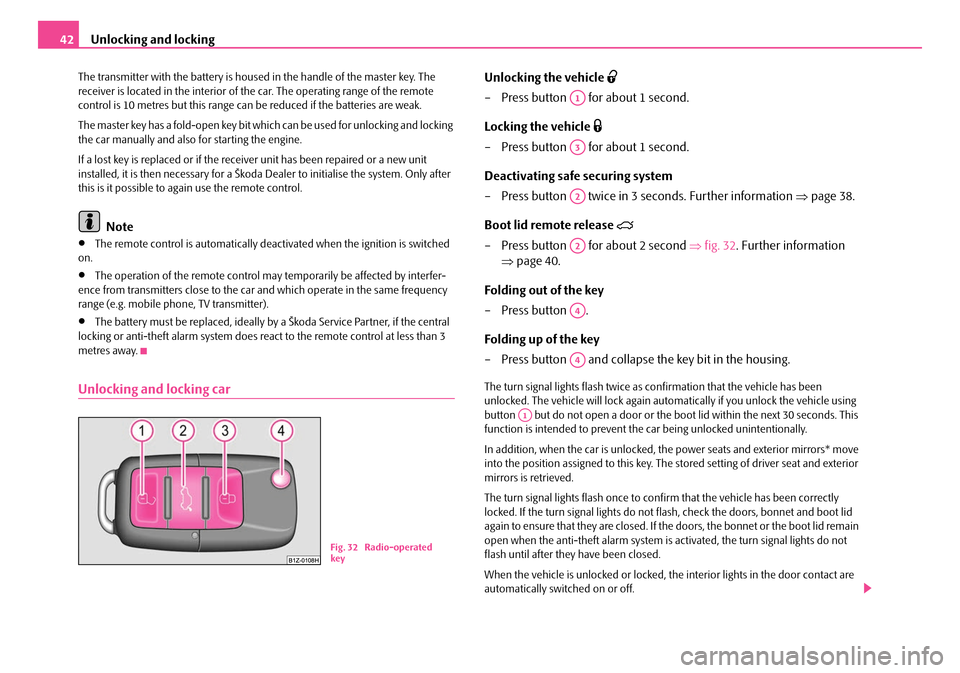
Unlocking and locking car
Unlocking the vehicle
– Press button for about 1 second.
Locking the vehicle
– Press button for about 1 second.
Deactivating safe securing system
– Press button twice in 3 seconds. Further information ⇒page 38.
Boot lid remote release
– Press button for about 2 second ⇒fig. 32 . Further information
⇒ page 40.
Folding out of the key
– Press button .
Folding up of the key
– Press button and collapse the key bit in the housing.
The turn signal lights flash twice as confirmation that the vehicle has been
unlocked. The vehicle will lock again auto matically if you unlock the vehicle using
button but do not open a door or the b oot lid within the next 30 seconds. This
function is intended to prevent th e car being unlocked unintentionally.
In addition, when the car is unlocked, the power seats and exterior mirrors* move
into the position assigned to this key. The stored setting of driver seat and exterior
mirrors is retrieved.
The turn signal lights flash once to co nfirm that the vehicle has been correctly
locked. If the turn signal lights do not fl ash, check the doors, bonnet and boot lid
again to ensure that they are closed. If th e doors, the bonnet or the boot lid remain
open when the anti-theft alarm system is activated, the turn signal lights do not
flash until after they have been closed.
When the vehicle is unlocked or locked, the interior lights in the door contact are
automatically switched on or off.
Fig. 32 Radio-operated
key
A1
A3
A2
A2
A4
A4
A1
NKO A5 20 MR08.book Page 42 Wednesday, April 11, 2007 2:54 PM
Page 60 of 288
Lights and Visibility59
Using the systemSafetyDriving TipsGeneral MaintenanceBreakdown assistanceTechnical Data
Visibility
Rear window heater
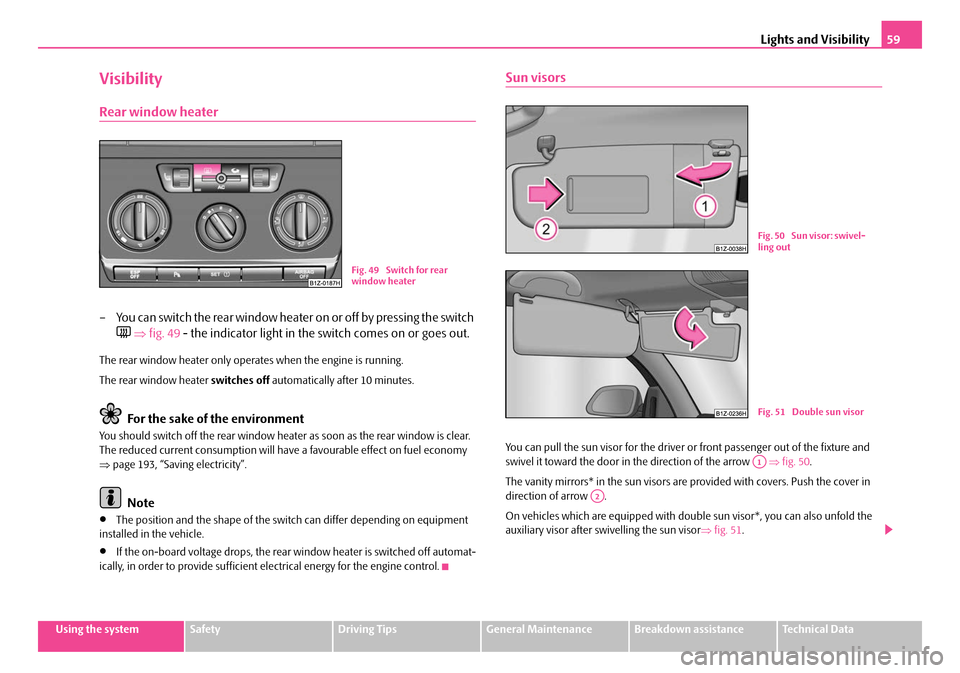
– You can switch the rear window heater on or off by pressing the switch
⇒ fig. 49 - the indicator light in the switch comes on or goes out.
The rear window heater only oper ates when the engine is running.
The rear window heater switches off automatically after 10 minutes.
For the sake of the environment
You should switch off the rear window heater as soon as the rear window is clear.
The reduced current consumption will have a favourable effect on fuel economy
⇒ page 193, “Saving electricity”.
Note
•The position and the shape of the switch can differ depending on equipment
installed in the vehicle.
•If the on-board voltage drops, the rear window heater is switched off automat-
ically, in order to provide sufficient electrical energy for the engine control.
Sun visors
You can pull the sun visor for the driver or front passenger out of the fixture and
swivel it toward the door in the direction of the arrow ⇒fig. 50 .
The vanity mirrors* in the sun visors are provided with covers. Push the cover in
direction of arrow .
On vehicles which are equipped with do uble sun visor*, you can also unfold the
auxiliary visor after swivelling the sun visor ⇒fig. 51 .
Fig. 49 Switch for rear
window heater
Fig. 50 Sun visor: swivel-
ling out
Fig. 51 Double sun visor
A1
A2
NKO A5 20 MR08.book Page 59 Wednesday, April 11, 2007 2:54 PM
Page 66 of 288
Lights and Visibility65
Using the systemSafetyDriving TipsGeneral MaintenanceBreakdown assistanceTechnical Data
Switching off the automatic dimming
– Press again the button - the warning light goes out .
If the automatic dimming is switched on, the mirror dims automatically
depending on the light striking the mirror from the rear. The mirror has no lever on
the bottom edge of the mirror. When the interior lights are switched on or the
reverse gear is engaged, the mirror alwa ys moves back into the basic position.
Note
•Automatic mirror dimming operates only pr operly if the sun screen* for the rear
window is not in use or the light striking the rear of the interior rear-view mirror is
not affected by other objects.
•Do not affix any stickers in front of the light sensor, so that you do not impair the
automatic dimming function or put it out of operation.
•If you switch off the automatic dimming interior rear-view mirror, also the exte-
rior mirror dimming is switched off.
Exterior mirror
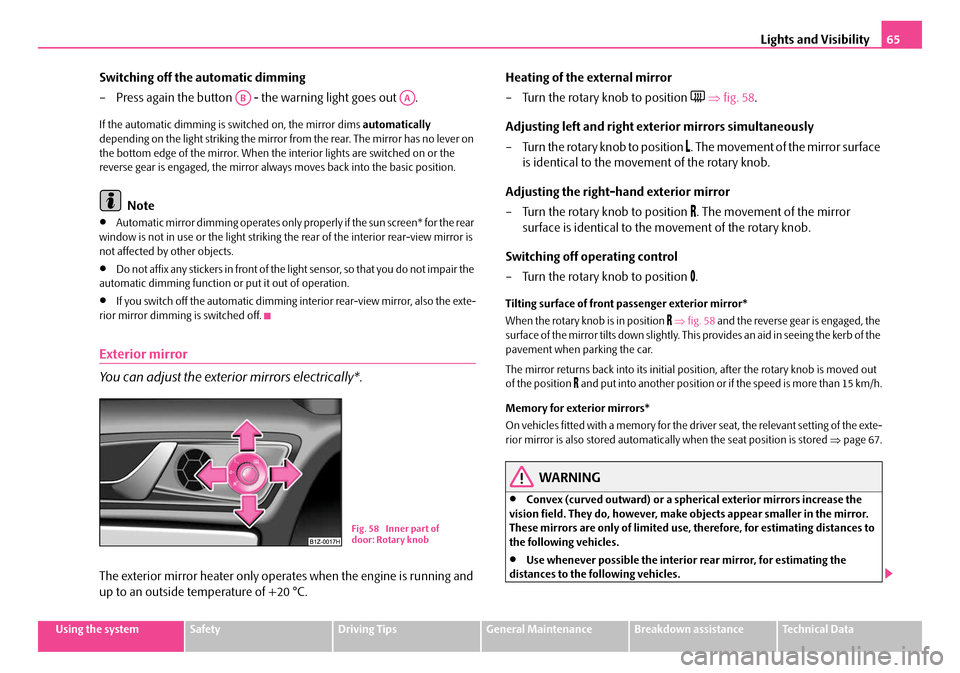
You can adjust the exterior mirrors electrically*.
The exterior mirror heater only oper ates when the engine is running and
up to an outside temperature of +20 °C. Heating of the external mirror
– Turn the rotary knob to position
⇒ fig. 58 .
Adjusting left and right exterior mirrors simultaneously
– Turn the rotary knob to position
. The movement of the mirror surface
is identical to the movement of the rotary knob.
Adjusting the right-hand exterior mirror
– Turn the rotary knob to position
. The movement of the mirror
surface is identical to the movement of the rotary knob.
Switching off operating control
– Turn the rotary knob to position
.
Tilting surface of front pa ssenger exterior mirror*
When the rotary knob is in position
⇒ fig. 58 and the reverse gear is engaged, the
s ur fa ce o f t h e m i rro r t i l ts d o w n s l i g h t l y. T h i s p ro v i d e s a n a i d i n s e e i n g th e ke r b o f t h e
pavement when parking the car.
The mirror returns back into its initial po sition, after the rotary knob is moved out
of the position
and put into another position or if the speed is more than 15 km/h.
Memory for exterior mirrors*
On vehicles fitted with a memory for the driver seat, the relevant setting of the exte-
rior mirror is also stored automatica lly when the seat position is stored ⇒page 67.
WARNING
•Convex (curved outward) or a spherical exterior mirrors increase the
vision field. They do, however, make objects appear smaller in the mirror.
These mirrors are only of limited use, therefore, for estimating distances to
the following vehicles.
•Use whenever possible the interior rear mirror, for estimating the
distances to the following vehicles.
ABAA
Fig. 58 Inner part of
door: Rotary knob
NKO A5 20 MR08.book Page 65 Wednesday, April 11, 2007 2:54 PM
Page 76 of 288
Seats and Stowage75
Using the systemSafetyDriving TipsGeneral MaintenanceBreakdown assistanceTechnical Data
Seat heaters*
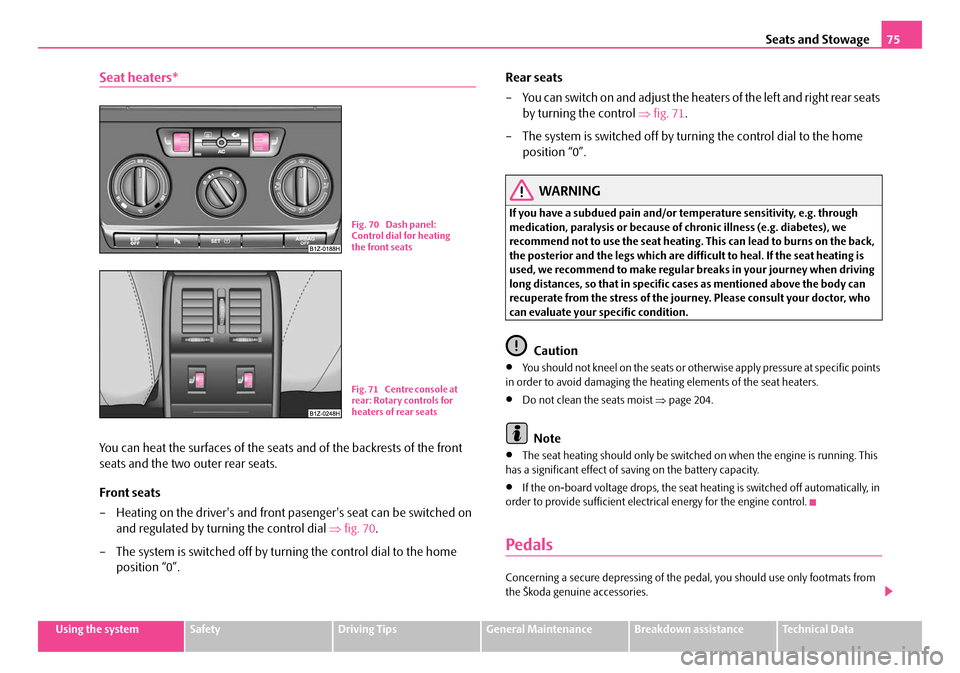
You can heat the surfaces of the seats and of the backrests of the front
seats and the two outer rear seats.
Front seats
– Heating on the driver's and front pasenger's seat can be switched on
and regulated by turning the control dial ⇒fig. 70 .
– The system is switched off by turning the control dial to the home position “0”. Rear seats
– You can switch on and adjust the heaters of the left and right rear seats
by turning the control ⇒fig. 71 .
– The system is switched off by turning the control dial to the home position “0”.
WARNING
If you have a subdued pain and/or te mperature sensitivity, e.g. through
medication, paralysis or because of ch ronic illness (e.g. diabetes), we
recommend not to use the seat heating. This can lead to burns on the back,
the posterior and the legs which are difficult to he al. If the seat heating is
used, we recommend to make regular breaks in your journey when driving
long distances, so that in specific cases as mentioned above the body can
recuperate from the stress of the journey. Please consult your doctor, who
can evaluate your specific condition.
Caution
•You should not kneel on the seats or othe rwise apply pressure at specific points
in order to avoid damaging the heating elements of the seat heaters.
•Do not clean the seats moist ⇒page 204.
Note
•The seat heating should only be switched on when the engine is running. This
has a significant effect of sa ving on the battery capacity.
•If the on-board voltage drops, the seat heating is switched off automatically, in
order to provide sufficient electrical energy for the engine control.
Pedals
Concerning a secure depressing of the pe dal, you should use only footmats from
the Škoda genuine accessories.
Fig. 70 Dash panel:
Control dial for heating
the front seats
Fig. 71 Centre console at
rear: Rotary controls for
heaters of rear seats
NKO A5 20 MR08.book Page 75 Wednesday, April 11, 2007 2:54 PM
Page 90 of 288

Seats and Stowage89
Using the systemSafetyDriving TipsGeneral MaintenanceBreakdown assistanceTechnical Data
Using the power socket
– Take out the cigarette lighter.
– Insert the plug of the electrical a ppliance into the socket of the ciga-
rette lighter.
The 12 volt power socket can also be used to supply power to electrical accessories
with a power uptake up to 180 watts.
WARNING
•Take care when using the cigarette li ghter! Not paying proper attention
or incorrect use the cigarette lighter in an uncontrolled manner may result in
burns.
•The cigarette lighter and the power so cket also operates when the igni-
tion is switched off or the ignition key withdrawn. You should therefore
never leave children unattended in the vehicle.
Caution
Always use matching plugs to av oid damaging the power sockets.
Note
•Connecting electrical components when the engine is not running will
drain the battery of the vehicl e - risk of battery draining!
•Further information ⇒page 229, “Accessories, chan ges and replacement of
parts”.
Power socket in the luggage compartment (estate car)
– Open the cover of the power socket ⇒fig. 98 .
– Connect the plug of the electrical appliance to the socket.
You can only use the power socket for the connection of approved electrical acces-
sories with a power uptake up to 180 watt s. The vehicle battery will be discharged
in the process if the engine is stationary.
The same remarks apply here as for ⇒page 88.
Further information ⇒page 229, “Accessories, changes and replacement of
parts”.
Storage compartments
Overview
You will find the following storag e facilities in your vehicle:
Storage compartment on the front passenger side⇒page 90
Storage compartment on the driver's side⇒page 91
Storage compartment on the dash panel⇒page 91
Fig. 98 Luggage
compartment: Power
socket
NKO A5 20 MR08.book Page 89 Wednesday, April 11, 2007 2:54 PM
Page 101 of 288
Heating and air conditioning system
100
Heating and air conditioning system
Heating
Using the system
The heating system delivers air into the interior of the vehicle and
warms it as required.
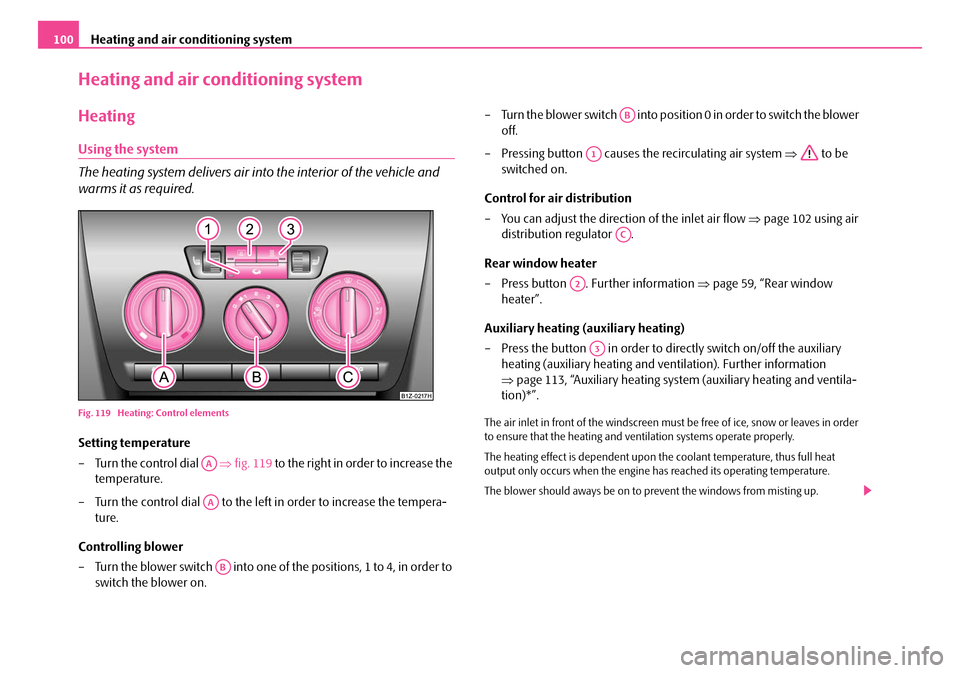
Fig. 119 Heating: Control elements
Setting temperature
– Turn the control dial ⇒fig. 119 to the right in order to increase the
temperature.
– Turn the control dial to the left in order to increase the tempera- ture.
Controlling blower
– Turn the blower switch into one of the positions, 1 to 4, in order to switch the blower on. – Turn the blower switch into positi
on 0 in order to switch the blower
off.
– Pressing button causes the recirculating air system ⇒ to be
switched on.
Control for air distribution
– You can adjust the direction of the inlet air flow ⇒page 102 using air
distribution regulator .
Rear window heater
– Press button . Further information ⇒page 59, “Rear window
heater”.
Auxiliary heating (auxiliary heating)
– Press the button in order to directly switch on/off the auxiliary heating (auxiliary heating and ve ntilation). Further information
⇒ page 113, “Auxiliary heating system (auxiliary heating and ventila-
tion)*”.
The air inlet in front of the windscreen must be free of ice, snow or leaves in order
to ensure that the heating and ventilation systems operate properly.
The heating effect is dependent upon th e coolant temperature, thus full heat
output only occurs when the engine has reached its operating temperature.
The blower should aways be on to prevent the windows from misting up.
AA
AA
AB
AB
A1
AC
A2
A3
NKO A5 20 MR08.book Page 100 Wednesday, April 11, 2007 2:54 PM
Page 104 of 288
Heating and air conditioning system103
Using the systemSafetyDriving TipsGeneral MaintenanceBreakdown assistanceTechnical Data
Redirecting air flow
– Swivel upward or downward the grille of the vents in order to change
the direction of the air flow using the vertically arranged thumbwheel.
– Turn the horizontal thumbwheel on the v e n t t o t h e r i g h t o r l e f t i n o rd e r
to change the air flow to the appropriate side.
You can set the air supply to the individual air outlet vents using the control dial
⇒ page 100, fig. 119 . Air outlet vents 3, 4 ⇒ page 102, fig. 120 and 6 ⇒ page 102,
fig. 121 can also be opened or closed individually.
The air outlet vents 6 are only fitted on vehicles with higher centre console.
Unwarmed or cooled air will flow out of the opened air outlet vents according to
the setting of the control dial ⇒page 100, fig. 119 and according to outer
atmospheric conditions.
Note
The air outlet vents 2 ensure in the ventilation mode for a comfortable (no-draught)
ventilation of the interior of the vehicle, also if the air outlet vents 4 are closed.
Climatic* (semi-automatic air conditioning system)
Description
The Climatic is a combined coolin g and heating system. It makes it
possible to optimally control the air temperature at any season of the
year.
Description of the Climatic
It is important for your safety and for your driving comfort that the Climatic is oper-
ating properly.
The cooling only operates if button ⇒page 104, fig. 122 is pressed, and the
following conditions are met:
•engine running,
•outside temperature above +2 °C and
•blower switch switched on (positions 1 to 4).
If the cooling system is switched on, th e temperature and air humidity drops in the
vehicle. The wellbeing of the occupants of the car is enhanced as a result of this
particularly at high outside temperatur es and a high air humidity. The system
prevents the windows misting up during the cold season of the year.
The heating effect is dependent upon th e coolant temperature, thus full heat
output only occurs when the engine has reached its operating temperature.
It is possible to briefly activate recirc ulated air mode in order to enhance the
cooling effect ⇒.
Air at a temperature of about 5°C may flow out of the vents under certain circum-
stances when the cooling system is operating. Lengthy and uneven distribution of
the air flow out of the vents (in particular at the leg area) and large differences in
temperature, for example when getting out of the vehicle, can result in chills in
sensitive persons.
The air inlet in front of the windscreen must be free of ice, snow or leaves in order
to ensure that the heating and cooling systems operate properly.
After switching on the cooling Condensation from the evaporator of the air condi-
tioning may drip down and form a puddle below the vehicle. This is quite normal
and not an indication of a leak!
WARNING
•For your own safety and that of other road users, ensure that all the
windows are free of ice, snow and mistin g. Please familiarize yourself about
how to correctly operate th e heating and ventilation systems, how to demist
and defrost the windows, as well as with the cooling mode.
•You should not leave recirculated air mode on over a longer period of
time, as “stale” air may result in fatigue in the driver and occupants, divert
your attention and also cause the windows to mist up. The risk of having an
accident increases. Switch recirculated air mode off as soon as the windows
begin misting up.
AC
AA
ACA1
NKO A5 20 MR08.book Page 103 Wednesday, April 11, 2007 2:54 PM
Page 108 of 288
Heating and air conditioning system107
Using the systemSafetyDriving TipsGeneral MaintenanceBreakdown assistanceTechnical Data
Air outlet vents
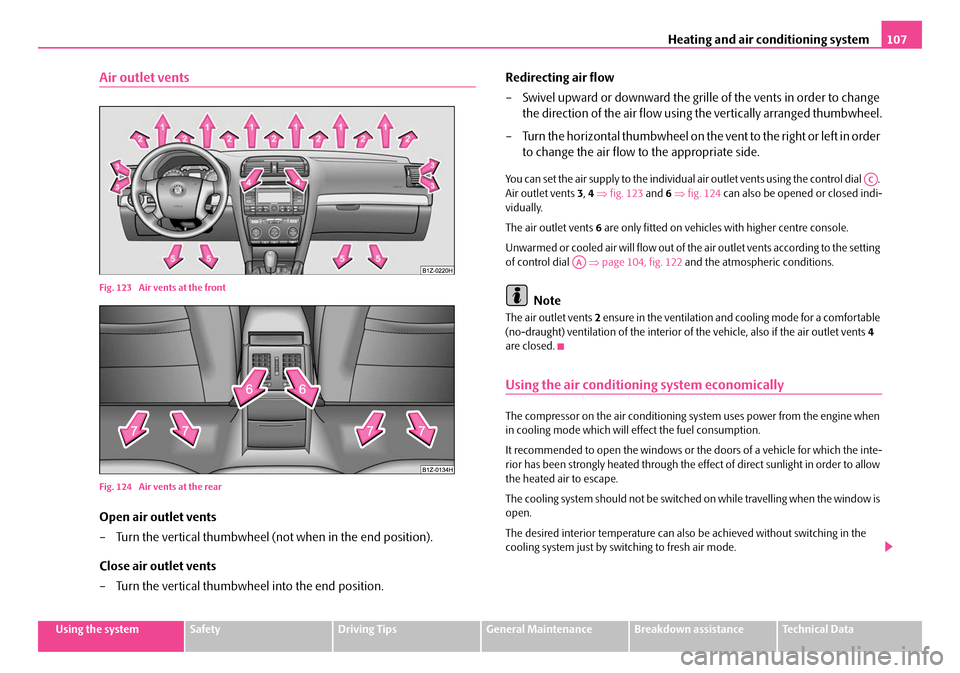
Fig. 123 Air vents at the front
Fig. 124 Air vents at the rear
Open air outlet vents
– Turn the vertical thumbwheel (not when in the end position).
Close air outlet vents
– Turn the vertical thumbwheel into the end position. Redirecting air flow
– Swivel upward or downward the grille of the vents in order to change
the direction of the air flow using the vertically arranged thumbwheel.
– Turn the horizontal thumbwheel on the vent to the right or left in order to change the air flow to the appropriate side.
You can set the air supply to the individual air outlet vents using the control dial .
Air outlet vents 3, 4 ⇒ fig. 123 and 6 ⇒ fig. 124 can also be opened or closed indi-
vidually.
The air outlet vents 6 are only fitted on vehicles with higher centre console.
Unwarmed or cooled air will flow out of the air outlet vents according to the setting
of control dial ⇒page 104, fig. 122 and the atmosphe ric conditions.
Note
The air outlet vents 2 ensure in the ventilation and cooling mode for a comfortable
(no-draught) ventilation of the interior of the vehicle, also if the air outlet vents 4
are closed.
Using the air conditioning system economically
The compressor on the air conditioning sy stem uses power from the engine when
in cooling mode which will effect the fuel consumption.
It recommended to open the windows or the doors of a vehicle for which the inte-
rior has been strongly heated through the effect of di rect sunlight in order to allow
the heated air to escape.
The cooling system should not be switched on while travelling when the window is
open.
The desired interior temperature can also be achieved without switching in the
cooling system just by sw itching to fresh air mode.
AC
AA
NKO A5 20 MR08.book Page 107 Wednesday, April 11, 2007 2:54 PM
Page 109 of 288
Heating and air conditioning system
108
For the sake of the environment
When you economize on fuel, you also reduce pollutant emissions.
Operational problems
If the cooling system does not operate at outside temperatures higher than +5 °C,
there is a problem in the system. The reasons for this may be:
•The fuse on the air conditioning system has blown. Check the fuse, replace it if
necessary ⇒page 243.
•The cooling system has switched off auto matically for a short time because the
coolant temperature of the engine is too hot ⇒ page 11.
If you are not able to rectify the operat ional problem yourself, or if the cooling
capacity decreases, switch the cooling system off. Contact a specialist garage.
Climatronic* (automatic air conditioning)
Description
The Climatronic system is a combin ation of an automatic heating,
fresh air and cooling system which provides optimal comfort for the
occupants of the car.
The Climatronic maintains a constant temperature fully automatically, once it has
been set. This is achieved by automa tically varying the temperature of the
outflowing air, the blower stages and the air distribution. The system also takes into
account bright sunlight which eliminates the need to alter the settings manually.
The automatic mode ⇒ page 110 ensures maximum wellbeing of the occupants
at all times of the year.
Description of Climatronic system
The cooling operates only if the following conditions are met:
•engine running,
•outside temperature above +2 °C,
•the button is not pressed.
If the cooling system is switched on, the temperature and air humidity drops in the
vehicle. The wellbeing of the occupants of the car is enhanced as a result of this
particularly at high outside temperatures and a high air humidity. The system
prevents the windows misting up during the cold season of the year.
The heating effect is dependent upon th e coolant temperature, thus full heat
output only occurs when the engine has reached its operating temperature.
It is possible to briefly activate recirculated air mode in order to enhance the
cooling effect ⇒.
The air inlet in front of the windscreen must be free of ice, snow or leaves in order
to ensure that the heating and cooling systems operate properly.
The AC compressor is switched off at a high coolant temperature in order to provide
cooling at a high load of the engine.
After switching on the cooling Condensation from the evaporator of the air condi-
tioning may drip down and form a puddle below the vehicle. This is quite normal
and not an indication of a leak!
Recommended setting for al l periods of the year:
•Set the temperature to 22 °C (72 °F).
•Press the button ⇒page 109, fig. 125 .
•Move the air outlet vents 3 and 4 so that the air flow is directed slightly upwards
⇒ page 112, fig. 126 .
Switching over between degrees Celsius and degrees Fahrenheit
Press and hold the buttons and ⇒page 109, fig. 125 . The informa-
tion in the desired temperature measuring unit appears in the display.
WARNING
•For your own safety and that of other road users, ensure that all the
windows are free of ice, snow and mist ing. Please familiarize yourself about
how to correctly operate the heating an d ventilation systems, how to demist
and defrost the windows, as well as with the cooling mode.
ECON
AUTO
ECONAUTO
NKO A5 20 MR08.book Page 108 Wednesday, April 11, 2007 2:54 PM