fuel consumption SKODA OCTAVIA 2011 2.G / (1Z) Owner's Guide
[x] Cancel search | Manufacturer: SKODA, Model Year: 2011, Model line: OCTAVIA, Model: SKODA OCTAVIA 2011 2.G / (1Z)Pages: 248, PDF Size: 3.79 MB
Page 179 of 248

Biofuel Ethanol E85
Ethanol E85 Only valid for vehicles with 1.6/75°kW MultiFuel engine.
Biofuel Ethanol E85 consists of 85 % bioethanol and 15 % unleaded petrol com-
plying with the standard (DIN) EN°228.
Biofuel Ethanol E85 in accordance with the standard (DIN) EN 228 can be mixed in
any desired ratio with unleaded petrol.
Drive the vehicle for at least 5 minutes without interruption, if biofuel Ethanol E85
has been refuelled, so that the engine control unit can determine the share of the
biofuel in the fuel. During this period do not drive at top speed of your vehicle or
high engine speeds and not at full throttle. During this process decrease the idling
speed. WARNING
Pay attention to any legal requirements if you do carry a spare canister in the
vehicle. We do not recommend carrying any fuel canisters in your vehicle for
safety reasons. The canister can be damaged in the event of an accident and
fuel may leak out. CAUTION
● Even inadvertently filling the fuel tank with another biofuel such as Ethanol
°E85 can result in damage to the fuel system.
● If you park your vehicle for a lengthy period, fill with petrol complying with
(DIN) EN°228, because Ethanol E85 can contain low quantities of impurities, which
can lead to corrosion. For the sake of the environment
If you use Ethanol E85, the CO 2 emission of your vehicle is lowered up to 5 %. Note
● When operating with Ethanol E85, the fuel consumption increases by approx
33 %, as a lower quantity of energy is contained in the bioethanol than in unlea-
ded petrol.
● Biofuel Ethanol E85 contains only a low quantity of additives in contrast to un-
leaded petrol. Therefore we recommend to fill up the tank with unleaded petrol
complying with EN 228 every 15 000 km (e.g. before the oil change) and run it
empty, so that the engine remains clean. Make sure not to use the whole content
of the tank ⇒ page 178, Refuelling
.
● The interval of 15 000 km applies for the oil change.
Operation in winter Fig. 146 MultiFuel - power socket
If you use biofuel Ethanol E85 at very low temperatures, it is necessary to preheat
the engine before an engine start.
The power socket for the engine preheating is located in the front bumper next to
the fog light ⇒
fig. 146 . The outside temperature Duration of engine preheating
lower than -10
℃ We recommend up to 1 hour
lower than -15
℃ at least 1 hours.
lower than -25
℃ at least 2 hours.
If an engine preheating is not possible at outside temperatures lower than -10 °C,
the share of unleaded petrol complying with EN 228 must be as high as possible.
Thus the cold start property of the engine is clearly improved.
If there is biofuel Ethanol E85 in the tank and the engine is not preheated, it can
lead at temperatures below -15 °C to very poor or no starting of the engine. £ 177
Fuel Using the system Safety Driving Tips General Maintenance Breakdown assistance Technical data
Page 180 of 248

For the sake of the environment
The use of engine preheating at temperatures below -10 °C has a positive effect
on the fuel consumption and thus on the environment. Note
An extension cable used for connecting to the electrical network is located in the
luggage compartment.
Diesel Diesel fuel Your vehicle can only be operated with
diesel fuel, which complies with the stand-
ard EN 590 (standard DIN 51628 in Germany, standard ÖNORM
C 1590 in Austria,
GOST R 52368-2005/EN 590:2004 in Russia).
Fuel additives
You must not use fuel additives, so-called “flow improvers” (petrol and similar
products) in diesel fuel.
You can find information on refuelling ⇒ page 178, Refuelling. CAUTION
● Your vehicle can only be operated with diesel fuel, which complies with the
standard EN 590 (standard DIN 51628 in Germany, standard ÖNORM
C 1590 in
Austria, GOST R 52368-2005/EN 590:2004 in Russia). Filling the tank even only
once with diesel fuel which does not comply with the standard, can result in dam-
age to the engine parts, the lubrication system, the fuel and exhaust system.
● If by mistake you have refuelled with a different fuel other than the diesel fuel
which complies to the above mentioned standards (e.
g. petrol), do not start the
engine or switch on the ignition! Severe damage damage is possible! Contact a
specialist garage and have the fuel system of the engine cleaned.
● Water which has collected in the fuel filter can result in engine problems.
● Your vehicle is not adapted for use of biofuel (RME), therefore this fuel must
not be refuelled and driven. The use of biofuel (RME) can lead to damage to the
engine or the fuel system. Operation in winter Winter-grade diesel fuel
A different grade of diesel fuel is available at filling stations in winter than during
the summer. Using
“summer-grade diesel fuel” at temperatures below 0 °C can re-
sult in operational problems because the diesel becomes viscous as a result of
paraffin separation.
It is therefore the case that the standard EN 590 (standard DIN 51628 in Germany,
standard ÖNORM C 1590 in Austria, GOST R 52368-2005/EN 590:2004 in Russia)
is the diesel fuel class prescribed for certain periods of the year which can also be
purchased at the corresponding time during the year. “Winter-grade diesel fuel”
will still operate properly even at a temperature of -20 °C.
It is often the case in countries with different climatic conditions that diesel fuels
available have a different temperature characteristic. The authorised ŠKODA Serv-
ice Partners and filling stations in the country concerned will be able to provide
you with information regarding the diesel fuels available.
Preheating fuel
The vehicle is fitted with a fuel filter preheating system. This secures operation of
a vehicle using diesel fuel down to an environmental temperature of -25 °C. CAUTION
It is not permitted to add the various fuel additives on the market, including pet-
rol, to diesel fuel in order to improve its flow properties.
Refuelling Fig. 147 Right rear side of the vehicle: Open fuel filler flap/fuel filler flap with cap unscrewed
£178
Fuel
Page 185 of 248

It is normal for the engine to consume oil. The oil consumption may be as much as
0.5 l/1 000 km depending on your style of driving and the conditions under which
you operate your vehicle. The oil consumption may be slightly higher than this
during the first 5 000 kilometres.
One should therefore check the oil level at regular intervals, preferably every time
after the fuel tank is filled or after driving for long stretches.
We recommend maintaining the oil level within the range A - but not above this
,
if the engine has been operating at high loads, for example during a lengthy mo-
torway trip during the summer months, towing a trailer or negotiating a high
mountain pass.
The warning light in the instrument cluster will indicate whether the oil level is
too low ⇒ page 25, Engine oil pressure . In this case, check the oil level as soon
as possible. Top up with an appropriate quantity of oil. CAUTION
● The oil level must on no account extend beyond the range A . Danger of dam-
aging the catalytic converter.
● Do not continue your journey if for some reason it is not possible under the
conditions prevailing to top up with oil. Switch the engine off and obtain profes-
sional assistance from a specialist garage, otherwise it could lead to severe en-
gine damage. Note
Engine oil specifications ⇒ page 221, Technical data.
Replenishing engine oil –
Inspecting the engine oil level ⇒
page 182.
– Unscrew the cap of the engine oil filler opening.
– Pour in a suitable grade of oil in portions of 0.5 litres ⇒ page 224, Engine oil
specifications.
– Inspect the oil level ⇒ page 182
.
– Carefully screw on the cap of the filler opening and push the dipstick in fully. WARNING
● Avoid dripping oil onto hot parts of the engine when topping up will oil - a
risk of fire!
● Read and observe the warning notes ⇒
page 181, Working in the engine
compartment before working in the engine compartment. For the sake of the environment
The oil level must on no account extend beyond the range A ⇒
page 182. Oil will
otherwise be drawn in through the crankcase ventilation and may pass through
the exhaust system to atmosphere. The oil may combust in the catalytic converter
and damage it.
Changing engine oil The engine oil must be changed at the intervals stated in the Service schedule or
according to the service interval indicator
⇒ page 12, Service reminder indicator
. WARNING
● Only carry out the engine oil change, if you have the required professional
knowledge!
● Read and observe the warning notes ⇒
page 181, Working in the engine
compartment before working in the engine compartment.
● First of all, let the engine cool down, wear an eye protection and gloves -
risk of caustic burns due to hot oil. CAUTION
You must not pour any additives into the engine oil - risk of engine damage! Dam-
age, which results from such product, are excluded from the warranty. For the sake of the environment
● You must on no account pour oil into the ground or into the sewage system.
● In view of the problems involved in properly disposing of old oil, the necessary
special tools and the knowledge required for such work, we recommend that you
have the oil and oil filter change carried out by an authorised
ŠKODA Service Part-
ner. £ 183
Inspecting and Replenishing Using the system Safety Driving Tips General Maintenance Breakdown assistance Technical data
Page 195 of 248

The tyre inflation pressure for tyres of the tyre size 205/50 R17, which are inten-
ded to be used with snow chains, is identical to the tyre inflation pressure for
tyres of the tyre size 225/45
R17, see ⇒ fig. 157.
The tyre pressure should be at the highest pressure specified for your vehicle at
all times.
The tyre inflation pressure of the emergency spare wheel R 18 is 420 kPa
(4.2 bar).
Always check the inflation pressure of tyres when cold. Do not reduce the higher
pressure of warm tyres. Adapt the inflation pressure of the tyres accordingly if
your vehicle is carrying a significantly higher payload.
Driving style
Fast cornering, sharp acceleration and braking (squealing tyres) increase wear-
and-tear on your tyres.
Balancing wheels
The wheels of a new vehicle are balanced. There are a wide range of influences
when driving which may result in an imbalance and which makes themselves felt
through vibration in the steering.
You should have the wheels rebalanced since any imbalance increases wear-and-
tear on the steering, the suspension and tyres. A wheel must also be rebalanced
when a new tyre is fitted and each time a tyre is repaired.
Wheel alignment errors
Incorrect wheel alignment at the front and rear will not only increase wear-and-
tear on the tyres but will also has an adverse effect on vehicle safety. Contact
your specialist garage if you notice any unusual tyre wear. WARNING
● If the inflation pressure is too low, the tyre must perform a higher rolling
resistance. At higher speeds the tyre will warm up as a result of this. This can
result in tread separation and even a tyre blowout.
● Immediately replace the damaged rims or tyres.
● Tyres which are 6 years old or more should only be fitted in exceptional ca-
ses and when adopting an appropriately cautious style of driving. For the sake of the environment
Tyres which are insufficiently inflated increase your fuel consumption. Wear indicators
Fig. 158 Tyre tread with wear indicators
The base of the tread of the original tyres has wear indicators 1.6 mm high, instal-
led at right angles to the direction of travel. These wear indicators are located at 6
- 8 points depending on the make and are evenly spaced around the circumfer-
ence of the tyre ⇒ fig. 158 . Markings on the walls of the tyres through the letters
“TWI”, triangular symbols or other symbols identify the position of the wear indi-
cators.
A remaining tread of just 1.6 mm, measured in the grooves of the tread next to the
wear indicators, means that your tyres have reached their legally permissible mini-
mum tread depth. WARNING
● You must have your tyres replaced with new ones at the latest when the
wear indicators have been worn down. The legally permissible minimum tread
depth should be observed.
● Worn tyres do not provide the necessary adhesion to the road surface at
high speeds on wet roads. One could experience “
aquaplaning” (uncontrolled
movements of the vehicle - “swimming” on a wet road surface). 193
Wheels and Tyres Using the system Safety Driving Tips General Maintenance Breakdown assistance Technical data
Page 198 of 248

You can fit winter tyres of a lower speed category to your vehicle provided that
you also do not drive faster than the permissible maximum speed for such tyres,
even if the possible maximum speed of your vehicle is higher. The corresponding
tyre category can damage the tyres when exceeding the permissible maximum
speed.
Please pay attention to the notes if you decide to fit winter tyres
⇒
page 192.
You can also fit so-called “all-year tyres” instead of winter tyres.
Please contact your specialist garage if there are any points which are not clear
who will be able to provide you with information regarding the maximum speed
for your tyres. WARNING
You must on no account drive your car at more than the permissible maximum
speed for your winter tyres - risk of an accident resulting from tyre damage
and loss of control over your car. For the sake of the environment
Fit your summer tyres on again in good time since summer tyres offer you better
grip and handling on roads which are free of snow and ice as well as ar tempera-
tures below 7 °C - the braking distance is shorter, there is less tyre noise, tyre
wear is reduced and fuel consumption is reduced. Note
Please observe the various differing legal requirements regarding tyres.
Unidirectional tyres The direction of rotation of the tyres is marked by arrows on the wall of the tyre
.
This indicates the direction of rotation of the tyre, and it is essential that the tyres
are fitted on to run in this direction. Only then are the tyres able to provide the
optimal properties in terms of grip, low noise, wear-and-tear and aquaplaning.
Should it be necessary to fit on a spare wheel in exceptional cases with a tyre not
dedicated to the running direction or in opposite running direction, please adopt a
cautious style of driving as the tyre is no longer able to provide optimal grip and
handling in such a situation. This particularly important on wet roads. Pay atten-
tion to the following points ⇒
page 199, Spare wheel.
You should have the defective tyre replaced as soon as possible and restore the
correct direction of rotation on all tyres Snow chains Snow chains must only be mounted on the front wheels.
When driving on wintry roads, snow chains improve not only traction, but also the
braking performance.
For technical reasons, it is only permissible to fit snow chains with the following
wheel/tyre combinations. Wheel size Depth (D) Tyre size
6J x 15
a) 47 mm 195/65
6.5J x 15
a) 50 mm 195/65
6J x 16
a) 50 mm 205/55
6J x 17
b) 45 mm 205/50
a)
Only fit snow chains with links and locks not larger than 15 mm.
b) Only fit snow chains with links and locks not larger than 9 mm.
Remove the full wheel trims before installing the snow chains.
Observe the different national legal regulations relating to the use of snow chains
and the maximum vehicle speed with snow chains. WARNING
Please pay attention to the information in the supplied fitting instructions of
the snow chain manufacturer. CAUTION
You must take the chains off as soon as you drive on roads which are free of
snow. They adversely affect the handling of your vehicle, damage the tyres and
are rapidly destroyed. Note
We recommend that you use snow chains from ŠKODA Original Accessories. 196
Wheels and Tyres
Page 224 of 248
Permissible gross weight
The permissible overall weight of the vehicle/trailer combination when the
vehicle is being operated with a trailer
Maximum permissible front axle load
Maximum permissible rear axle load
The type plate is fixed to the lower part of the columns on the driver's side, be-
tween the front and rear doors. WARNING
Do not exceed the permissible overall weight - risk of accident and damage to
the vehicle.
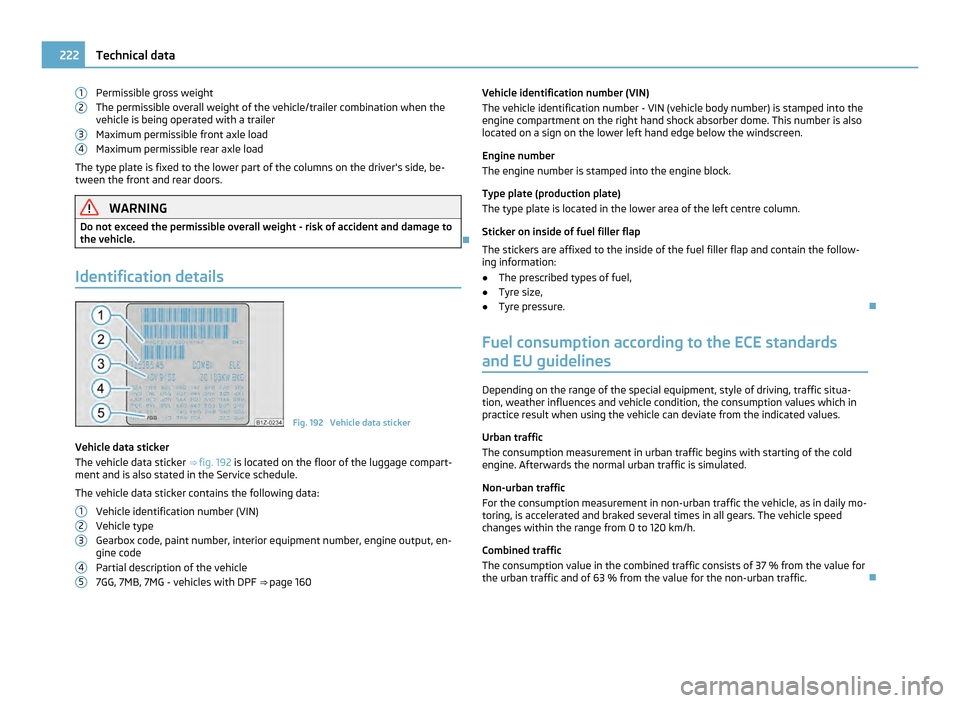
Identification details Fig. 192 Vehicle data sticker
Vehicle data sticker
The vehicle data sticker ⇒ fig. 192 is located on the floor of the luggage compart-
ment and is also stated in the Service schedule.
The vehicle data sticker contains the following data:
Vehicle identification number (VIN)
Vehicle type
Gearbox code, paint number, interior equipment number, engine output, en-
gine code
Partial description of the vehicle
7GG, 7MB, 7MG - vehicles with DPF ⇒ page 160
1 2
3
4
1
2
3
4
5 Vehicle identification number (VIN)
The vehicle identification number - VIN (vehicle body number) is stamped into the
engine compartment on the right hand shock absorber dome. This number is also
located on a sign on the lower left hand edge below the windscreen.
Engine number
The engine number is stamped into the engine block.
Type plate (production plate)
The type plate is located in the lower area of the left centre column.
Sticker on inside of fuel filler flap
The stickers are affixed to the inside of the fuel filler flap and contain the follow-
ing information:
● The prescribed types of fuel,
● Tyre size,
● Tyre pressure.
Fuel consumption according to the ECE standards
and EU guidelines Depending on the range of the special equipment, style of driving, traffic situa-
tion, weather influences and vehicle condition, the consumption values which in
practice result when using the vehicle can deviate from the indicated values.
Urban traffic
The consumption measurement in urban traffic begins with starting of the cold
engine. Afterwards the normal urban traffic is simulated.
Non-urban traffic
For the consumption measurement in non-urban traffic the vehicle, as in daily mo-
toring, is accelerated and braked several times in all gears. The vehicle speed
changes within the range from 0 to 120 km/h.
Combined traffic
The consumption value in the combined traffic consists of 37 % from the value for
the urban traffic and of 63 % from the value for the non-urban traffic. 222
Technical data
Page 228 of 248
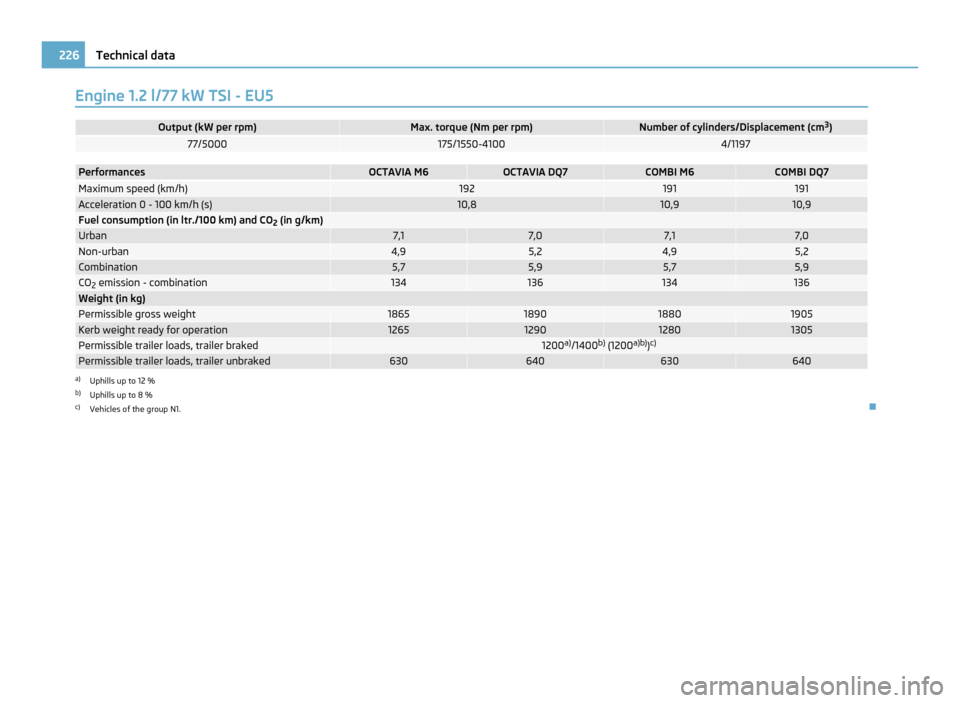
Engine 1.2 l/77 kW TSI - EU5
Output (kW per rpm) Max. torque (Nm per rpm) Number of cylinders/Displacement (cm
3
) 77/5000 175/1550-4100 4/1197
Performances OCTAVIA M6 OCTAVIA DQ7 COMBI M6 COMBI DQ7
Maximum speed (km/h) 192 191 191
Acceleration 0 - 100 km/h (s) 10,8 10,9 10,9
Fuel consumption (in ltr./100 km) and CO
2 (in g/km) Urban 7,1 7,0 7,1 7,0
Non-urban 4,9 5,2 4,9 5,2
Combination 5,7 5,9 5,7 5,9
CO
2 emission - combination 134 136 134 136
Weight (in kg)
Permissible gross weight 1865 1890 1880 1905
Kerb weight ready for operation 1265 1290 1280 1305
Permissible trailer loads, trailer braked 1200
a)
/1400 b)
(1200 a) b)
)c) Permissible trailer loads, trailer unbraked 630 640 630 640
a)
Uphills up to 12 %
b) Uphills up to 8 %
c) Vehicles of the group N1. 226
Technical data
Page 229 of 248

Engine 1.4 l/59 kW - EU4, EU5
Output (kW per rpm) Max. torque (Nm per rpm) Number of cylinders/Displacement (cm
3
) 59/5000 132/3800 4/1390
Performances OCTAVIA EU4 OCTAVIA EU5 COMBI EU4 COMBI EU5
Maximum speed (km/h) 173 174 172 173
Acceleration 0 - 100 km/h (s) 14,2 14,3 14,3 14,4
Fuel consumption (in ltr./100 km) and CO
2 (in g/km) Urban 9,6 8,5 9,6 8,5
Non-urban 5,6 5,1 5,6 5,1
Combination 7,0 6,4 7,0 6,4
CO
2 emission - combination 167 149 167 149
Weight (in kg)
Permissible gross weight 1855 1750 1870 1755
Unloaden weight ready for work 1255 1255 1270 1270
Permissible trailer loads, trailer braked 900
a)
/1100 b) 900
a)
/1100 b)
(900 a) b)
)c) 900
a)
/1100 b) Permissible trailer loads, trailer unbraked 620
a)
Uphills up to 12 %
b) Uphills up to 8 %
c) Vehicles of the group N1. 227
Technical data Using the system Safety Driving Tips General Maintenance Breakdown assistance Technical data
Page 230 of 248

Engine 1.4 l/90 kW TSI - EU5
Output (kW per rpm) Max. torque (Nm per rpm) Number of cylinders/Displacement (cm
3
) 90/5000 200/1500-4000 4/1390
Performances OCTAVIA M6 OCTAVIA DQ7 COMBI M6 COMBI DQ7
Maximum speed (km/h) 203/205
a) 202 202/204
a) 201
Acceleration 0 - 100 km/h (s) 9,7/9,8
a) 9,7 9,8/9,9
a) 9,8
Fuel consumption (in ltr./100 km) and CO
2 (in g/km) Urban 8,5/7,2
a) 8,0 8,5/7,2
a) 8,0
Non-urban 5,0/4,9
a) 5,3 5,0/4,9
a) 5,3
Combination 6,3/5,8
a) 6,3 6,3/5,8
a) 6,3
CO
2 emission - combination 148/134
a) 147 148/134
a) 147
Weight (in kg)
Permissible gross weight 1910/1925
a) 1930 1925/1940
a) 1945
Unloaden weight ready for work 1310/1325
a) 1330 1325/1340
a) 1345
Permissible trailer loads, trailer braked 1300
b)
/1500 c)
(1300 b)c)
)d) Permissible trailer loads, trailer unbraked 650 660 650 660
a)
The value corresponds to the status with SPORT package.
b) Uphills up to 12 %
c) Uphills up to 8 %
d) Vehicles of the group N1. 228
Technical data
Page 231 of 248

Engine 1.6 l/75 kW - EU2, EU4, EU5
Output (kW per rpm) Max. torque (Nm per rpm) Number of cylinders/Displacement (cm
3
) 75/5600 148/3800 4/1595
Performances OCTAVIA M5
EU4 OCTAVIA M5
EU4 OCTAVIA M5
MultiFuel OCTAVIA AG6 COMBI M5 EU4 COMBI M5 EU5 COMBI M5
MultiFuel COMBI AG6
Maximum speed (km/h) 190 184 188 189 188 184
Acceleration 0 - 100 km/h (s) 12,3 14,1 12,4 12,4 12,4 14,2
Fuel consumption (in ltr./100 km) and CO
2 (in g/km) Urban 10,0 9,6 9,4/13,0
a) 11,2 10,0 9,7 9,6/13,2
a) 11,2
Non-urban 5,8 5,5 5,5/7,5
a) 6,1 5,8 5,6 5,7/7,7
a) 6,1
Combination 7,4 7,1 7,0/9,5
a) 7,9 7,4 7,2 7,2/9,7
a) 7,9
CO
2 emission - combination 176 166 162/157
a) 188 176 168 167/162
a) 188
Weight (in kg)
Permissible gross weight 1880 1915 1895 1930
Unloaden weight ready for
work
1280 1315 1295 1330
Permissible trailer loads, trail-
er braked
1200
b)
/1400 c)
(1200 b)c)
)d) Permissible trailer loads, trail-
er unbraked
630 650 630 650
a)
Biofuel Ethanol E85
b) Uphills up to 12 %
c) Uphills up to 8 %
d) Vehicles of the group N1. 229
Technical data Using the system Safety Driving Tips General Maintenance Breakdown assistance Technical data