engine coolant SKODA OCTAVIA 2013 3.G / (5E) User Guide
[x] Cancel search | Manufacturer: SKODA, Model Year: 2013, Model line: OCTAVIA, Model: SKODA OCTAVIA 2013 3.G / (5E)Pages: 287, PDF Size: 18.55 MB
Page 176 of 287
The engine output falls as the height increases, as does the ability to climb.
Therefore, for every additional 1000 m in height (or part), the maximum permissi- ble towed weight must be reduced by 10%.
The towed weight is made up of the actual weights of the loaded towing vehicleand the loaded trailer.
The trailer and drawbar load information on the type plate of the towing device are merely test data for the towing device. The vehicle-specific values are de-
tailed in the vehicle documents.WARNING■ Do not exceed the maximum permissible axle and drawbar load and the
maximum permissible total or towed weight of the vehicle and the trailer –
risk of accident and serious injury.■
Slipping loads can significantly impair the stability and safety of the vehicle/
trailer combination – risk of accident and serious injury.
Driving with a trailer
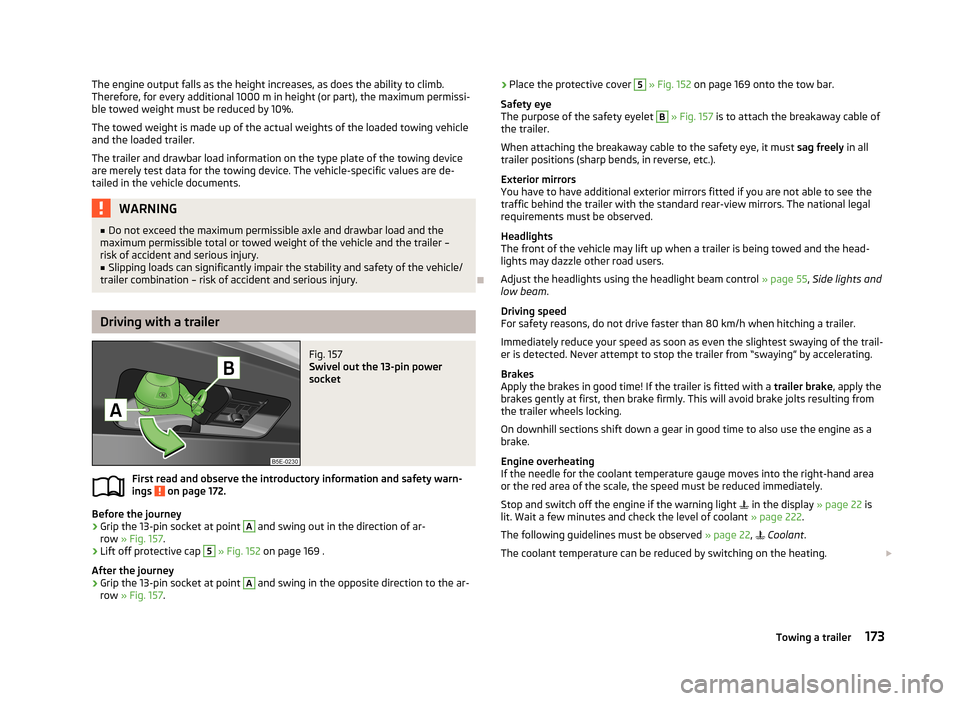
Fig. 157
Swivel out the 13-pin power
socket
First read and observe the introductory information and safety warn- ings on page 172.
Before the journey
›
Grip the 13-pin socket at point
A
and swing out in the direction of ar-
row » Fig. 157 .
›
Lift off protective cap
5
» Fig. 152 on page 169 .
After the journey
›
Grip the 13-pin socket at point
A
and swing in the opposite direction to the ar-
row » Fig. 157 .
›Place the protective cover 5
» Fig. 152 on page 169 onto the tow bar.
Safety eye
The purpose of the safety eyelet B
» Fig. 157 is to attach the breakaway cable of
the trailer.
When attaching the breakaway cable to the safety eye, it must sag freely in all
trailer positions (sharp bends, in reverse, etc.).
Exterior mirrors
You have to have additional exterior mirrors fitted if you are not able to see the
traffic behind the trailer with the standard rear-view mirrors. The national legal requirements must be observed.
Headlights
The front of the vehicle may lift up when a trailer is being towed and the head-
lights may dazzle other road users.
Adjust the headlights using the headlight beam control » page 55, Side lights and
low beam .
Driving speed
For safety reasons, do not drive faster than 80 km/h when hitching a trailer.
Immediately reduce your speed as soon as even the slightest swaying of the trail- er is detected. Never attempt to stop the trailer from “swaying” by accelerating.
Brakes
Apply the brakes in good time! If the trailer is fitted with a trailer brake, apply the
brakes gently at first, then brake firmly. This will avoid brake jolts resulting from
the trailer wheels locking.
On downhill sections shift down a gear in good time to also use the engine as a
brake.
Engine overheating
If the needle for the coolant temperature gauge moves into the right-hand area
or the red area of the scale, the speed must be reduced immediately.
Stop and switch off the engine if the warning light
in the display » page 22 is
lit. Wait a few minutes and check the level of coolant » page 222.
The following guidelines must be observed » page 22,
Coolant .
The coolant temperature can be reduced by switching on the heating.
173Towing a trailer
Page 218 of 287
CAUTION■Just filling the tank once with diesel fuel that does not comply with the stand-
ard, can cause severe damage to parts of the engine, the fuel and exhaust sys-
tem!■
If a different fuel other than diesel fuel, which complies to the above mentioned
standards (e.g. petrol) is used by mistake do not start the engine or switch on the
ignition! Extensive damage to engine parts can occur! We recommend that you
have the fuel system cleaned by a specialist garage.
■
Water which has collected in the fuel filter can cause engine faults.
CAUTION
■ Your vehicle cannot be operated with biofuel RME, therefore this fuel must not
be refuelled and driven. The use of biofuel RME can cause considerable damage
to parts of the engine or fuel system.■
Do not mix any fuel additives, so-called “flow improvers” (petrol and similar
agents) into the diesel. This can result in considerable damage to parts of the en-
gine or the exhaust system.
Engine compartment
Introduction
This chapter contains information on the following subjects:
Opening and closing the bonnet
217
Engine compartment overview
218
Radiator fan
218
Windscreen washer system
218WARNINGWhen working in the engine compartment, injuries, scolding, accident or fire
hazards may arise. For this reason, it is essential to comply with the warning
instructions stated below and with the general applicable rules of safety. The
engine compartment of your car is a hazardous area!WARNINGBefore beginning work in the engine compartment, please read the following
advice.■
Turn off the engine and withdraw the ignition key.
■
Firmly apply the handbrake.
■
If the vehicle is fitted with a manual gearbox, move the gearshift lever into
Neutral, or if the vehicle is fitted with an automatic gearbox, move the selec-
tor lever into position P.
■
Allow the engine to cool.
■
Never open the bonnet if you can see steam or coolant flowing out of the
engine compartment – risk of scalding! Wait until the steam or coolant has
stopped escaping.
WARNINGWhile working in the engine compartment, please read the following advice.■Keep children clear of the engine compartment.■
Never touch the radiator fan while the engine is still warm. The fan might
suddenly start running!
■
Do not touch any hot engine parts – risk of burns!
■
The coolant additive and thus all of the coolant is harmful to your health.
■
Avoid contact with the coolant.
■
Coolant vapours are harmful to health.
■
Never open the end cover of the coolant expansion reservoir while the en-
gine is still warm. The cooling system is pressurized!
■
When opening the end cover of the coolant expansion reservoir, cover it
with a cloth to protect your face, hands and arms from hot steam or hot cool-
ant.
■
If any coolant splashes into your eyes, immediately rinse out your eyes with
clear water and contact a doctor as soon as possible.
■
Always safely store the coolant additive in its original container out of the
reach of children – risk of poisoning!
■
If coolant is swallowed, consult a doctor immediately.
■
Do not leave any items (e.g. cloths or tools) in the engine compartment.
■
Never spill fluids on the hot engine. Such fluids (e.g. the antifreeze con-
tained in the coolant) may ignite!
215Inspecting and replenishing
Page 221 of 287
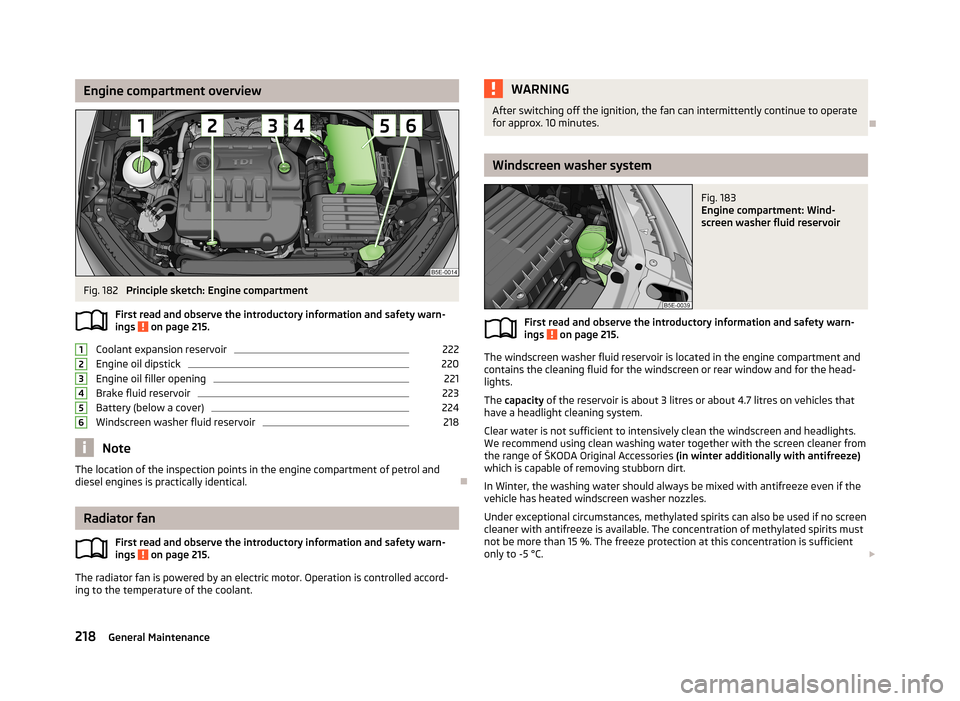
Engine compartment overviewFig. 182
Principle sketch: Engine compartment
First read and observe the introductory information and safety warn- ings
on page 215.
Coolant expansion reservoir
222
Engine oil dipstick
220
Engine oil filler opening
221
Brake fluid reservoir
223
Battery (below a cover)
224
Windscreen washer fluid reservoir
218
Note
The location of the inspection points in the engine compartment of petrol and
diesel engines is practically identical.
Radiator fan
First read and observe the introductory information and safety warn-
ings
on page 215.
The radiator fan is powered by an electric motor. Operation is controlled accord-
ing to the temperature of the coolant.
123456WARNINGAfter switching off the ignition, the fan can intermittently continue to operate
for approx. 10 minutes.
Windscreen washer system
Fig. 183
Engine compartment: Wind-
screen washer fluid reservoir
First read and observe the introductory information and safety warn- ings on page 215.
The windscreen washer fluid reservoir is located in the engine compartment and
contains the cleaning fluid for the windscreen or rear window and for the head-
lights.
The capacity of the reservoir is about 3 litres or about 4.7 litres on vehicles that
have a headlight cleaning system.
Clear water is not sufficient to intensively clean the windscreen and headlights.
We recommend using clean washing water together with the screen cleaner from
the range of ŠKODA Original Accessories (in winter additionally with antifreeze)
which is capable of removing stubborn dirt.
In Winter, the washing water should always be mixed with antifreeze even if the
vehicle has heated windscreen washer nozzles.
Under exceptional circumstances, methylated spirits can also be used if no screen
cleaner with antifreeze is available. The concentration of methylated spirits must
not be more than 15 %. The freeze protection at this concentration is sufficient
only to -5 °C.
218General Maintenance
Page 224 of 287
ReplenishingFirst read and observe the introductory information and safety warn-
ings
on page 219.
›
Check the oil level » page 220.
›
Unscrew the cap of the engine oil filler opening » Fig. 182 on page 218.
›
Replenish the oil in portions of 0.5 litres in accordance with the correct specifi-
cations » page 219 .
›
Check the oil level » page 220.
›
Carefully screw on the oil filler opening cap and push the dipstick in fully.
Changing
First read and observe the introductory information and safety warn-ings
on page 219.
The engine oil must be changed according to prescribed service inter-vals » page 198 or according to the service interval display » page 33.
Coolant
Introduction
This chapter contains information on the following subjects:
Capacity
222
Checking the coolant level
222
Replenishing
222
The coolant consists of water with a concentration of coolant additive. This mix-
ture guarantees antifreeze protection, protects the cooling/heater system
against corrosion and prevents the formation of scale.
Vehicles exported to countries with a mild climate are already factory-filled with
a coolant which offers antifreeze protection down to about -25 ℃. In these coun-
tries the concentration of coolant additive should be at least 40 %.
Vehicles exported to countries with a cold climate are already factory-filled with a
coolant which offers antifreeze protection down to about -35 °C. In these coun-
tries the concentration of coolant additive should be at least 50 %.
If a higher concentration of antifreeze is required for climatic reasons, the amount
of coolant additive can only be increased up to a maximum of 60 % (antifreeze
protection down to approx. -40 °C).
When refilling, only use antifreeze with the name specified on the coolant expan-
sion tank » Fig. 185 on page 222.WARNING■
The engine compartment of your car is a hazardous area. While working in
the engine compartment, be sure to observe the following warn- ings » page 215 .■
Do not continue your journey, if for some reason it is not possible to top
up the coolant under the prevailing conditions! Switch off the engine and seek
assistance from a specialist garage.
CAUTION
■ The amount of coolant additive in the coolant must never be allowed to be less
than 40 %.■
Over 60 % of coolant additive in the coolant reduces the antifreeze protection
and coolant effectiveness.
■
A coolant additive that does not comply with the correct specifications can sig-
nificantly reduce the corrosion protection.
■
Any faults resulting from corrosion may cause a loss of coolant and can conse-
quently result in major engine damage!
■
Do not fill the coolant above the mark
A
» Fig. 185 on page 222.
■
If a fault causes the engine to overheat, we recommend visiting a specialist ga-
rage, as otherwise serious engine damage may occur.
221Inspecting and replenishing
Page 225 of 287
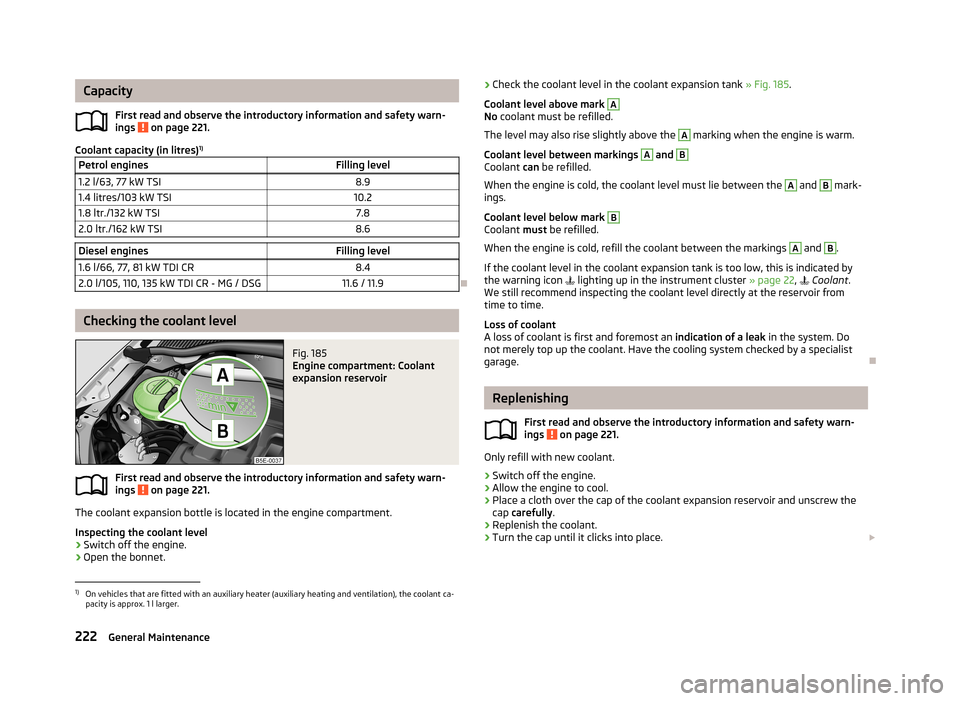
CapacityFirst read and observe the introductory information and safety warn-
ings
on page 221.
Coolant capacity (in litres) 1)
Petrol enginesFilling level1.2 l/63, 77 kW TSI8.91.4 litres/103 kW TSI10.21.8 ltr./132 kW TSI7.82.0 ltr./162 kW TSI8.6Diesel enginesFilling level1.6 l/66, 77, 81 kW TDI CR8.42.0 l/105, 110, 135 kW TDI CR - MG / DSG11.6 / 11.9
Checking the coolant level
Fig. 185
Engine compartment: Coolant
expansion reservoir
First read and observe the introductory information and safety warn-
ings on page 221.
The coolant expansion bottle is located in the engine compartment.
Inspecting the coolant level
›
Switch off the engine.
›
Open the bonnet.
› Check the coolant level in the coolant expansion tank
» Fig. 185.
Coolant level above mark A
No coolant must be refilled.
The level may also rise slightly above the
A
marking when the engine is warm.
Coolant level between markings
A
and
B
Coolant can be refilled.
When the engine is cold, the coolant level must lie between the
A
and
B
mark-
ings.
Coolant level below mark
B
Coolant must be refilled.
When the engine is cold, refill the coolant between the markings
A
and
B
.
If the coolant level in the coolant expansion tank is too low, this is indicated by
the warning icon
lighting up in the instrument cluster » page 22,
Coolant .
We still recommend inspecting the coolant level directly at the reservoir from
time to time.
Loss of coolant
A loss of coolant is first and foremost an indication of a leak in the system. Do
not merely top up the coolant. Have the cooling system checked by a specialist
garage.
Replenishing
First read and observe the introductory information and safety warn-
ings
on page 221.
Only refill with new coolant.
›
Switch off the engine.
›
Allow the engine to cool.
›
Place a cloth over the cap of the coolant expansion reservoir and unscrew the cap carefully .
›
Replenish the coolant.
›
Turn the cap until it clicks into place.
1)
On vehicles that are fitted with an auxiliary heater (auxiliary heating and ventilation), the coolant ca-
pacity is approx. 1 l larger.
222General Maintenance
Page 226 of 287
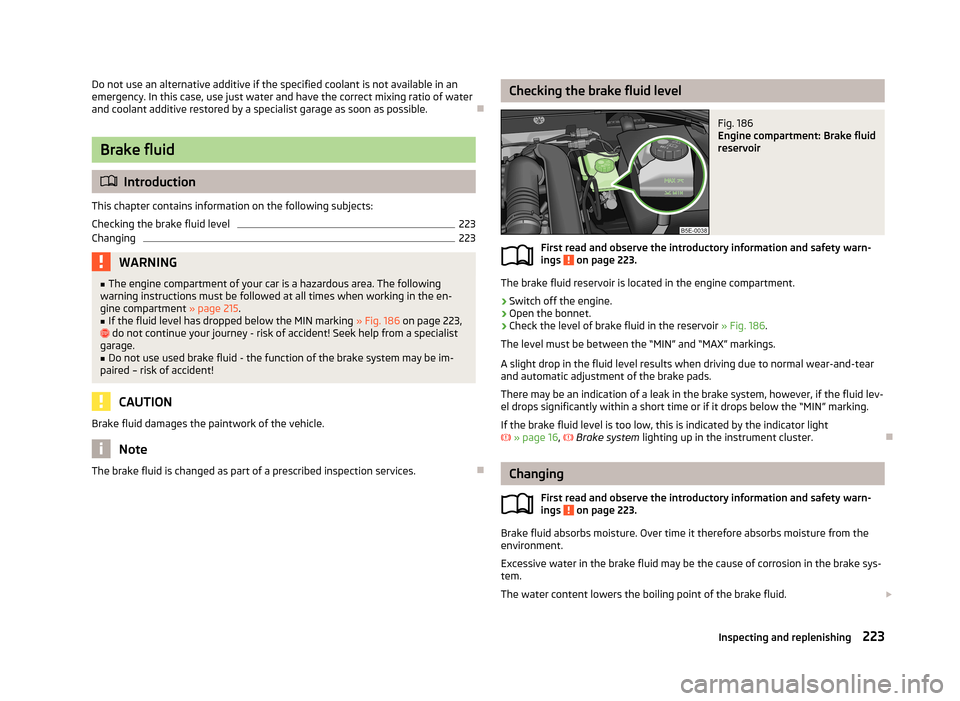
Do not use an alternative additive if the specified coolant is not available in anemergency. In this case, use just water and have the correct mixing ratio of waterand coolant additive restored by a specialist garage as soon as possible.
Brake fluid
Introduction
This chapter contains information on the following subjects:
Checking the brake fluid level
223
Changing
223WARNING■ The engine compartment of your car is a hazardous area. The following
warning instructions must be followed at all times when working in the en-
gine compartment » page 215.■
If the fluid level has dropped below the MIN marking » Fig. 186 on page 223,
do not continue your journey - risk of accident! Seek help from a specialist
garage.
■
Do not use used brake fluid - the function of the brake system may be im-
paired – risk of accident!
CAUTION
Brake fluid damages the paintwork of the vehicle.
Note
The brake fluid is changed as part of a prescribed inspection services.
Checking the brake fluid levelFig. 186
Engine compartment: Brake fluid
reservoir
First read and observe the introductory information and safety warn-
ings on page 223.
The brake fluid reservoir is located in the engine compartment.
›
Switch off the engine.
›
Open the bonnet.
›
Check the level of brake fluid in the reservoir » Fig. 186.
The level must be between the “MIN” and “MAX” markings.
A slight drop in the fluid level results when driving due to normal wear-and-tear and automatic adjustment of the brake pads.
There may be an indication of a leak in the brake system, however, if the fluid lev-
el drops significantly within a short time or if it drops below the “MIN” marking.
If the brake fluid level is too low, this is indicated by the indicator light » page 16 ,
Brake system lighting up in the instrument cluster.
Changing
First read and observe the introductory information and safety warn-ings
on page 223.
Brake fluid absorbs moisture. Over time it therefore absorbs moisture from the
environment.
Excessive water in the brake fluid may be the cause of corrosion in the brake sys-
tem.
The water content lowers the boiling point of the brake fluid.
223Inspecting and replenishing
Page 257 of 287
No.Power consumer45Control unit for control of seat adjustment46230-Volt power socket47Rear window wiper48Not assigned49Coil on starter relay, clutch pedal switch50Not assigned51Belt tensioner - front passenger side52Not assigned53Relay for rear window heater
Fuses in the engine compartment
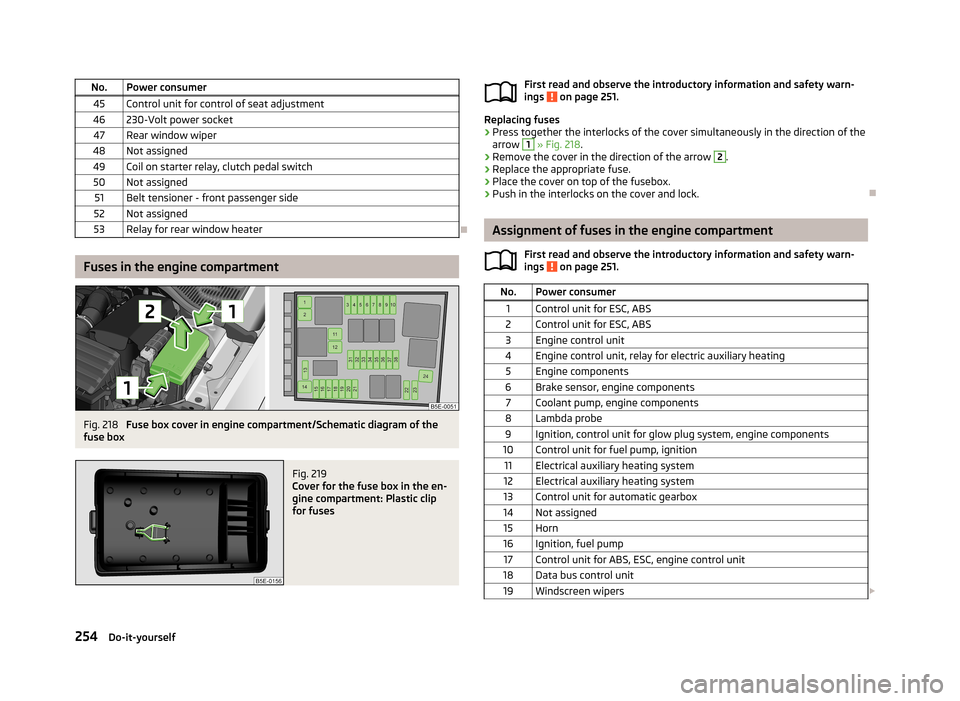
Fig. 218
Fuse box cover in engine compartment/Schematic diagram of the
fuse box
Fig. 219
Cover for the fuse box in the en-
gine compartment: Plastic clip
for fuses
First read and observe the introductory information and safety warn-
ings on page 251.
Replacing fuses
›
Press together the interlocks of the cover simultaneously in the direction of the
arrow
1
» Fig. 218 .
›
Remove the cover in the direction of the arrow
2
.
›
Replace the appropriate fuse.
›
Place the cover on top of the fusebox.
›
Push in the interlocks on the cover and lock.
Assignment of fuses in the engine compartment
First read and observe the introductory information and safety warn-ings
on page 251.
No.Power consumer1Control unit for ESC, ABS2Control unit for ESC, ABS3Engine control unit4Engine control unit, relay for electric auxiliary heating5Engine components6Brake sensor, engine components7Coolant pump, engine components8Lambda probe9Ignition, control unit for glow plug system, engine components10Control unit for fuel pump, ignition11Electrical auxiliary heating system12Electrical auxiliary heating system13Control unit for automatic gearbox14Not assigned15Horn16Ignition, fuel pump17Control unit for ABS, ESC, engine control unit18Data bus control unit19Windscreen wipers 254Do-it-yourself
Page 276 of 287
Avoiding damage to the vehicleDriving through water135
Avoiding damage to your vehicle135
B
Ball head Check fitting
171
Ball rod installing
170
Ready position170
removing171
Battery In the remote control key
247
iReplace the remote control of the auxiliary heat- er (parking heater)
247
Belts180
Belt tensioners183
Bonnet Closing
217
Opening217
Boot Class N1 vehicles
92
See Boot lid44
Boot lid Automatic locking
44
Closing44
Opening44
Brake information messages
16
warning light16
Brake booster125
Brake fluid223
Changing223
Checking223
information messages16
Brake linings warning light
20
Brakes Brake assist systems
137
Brake booster125
Brake fluid223
Handbrake125
Running in131
Braking Information on braking
125
Breakdown kit241
Break recommendation See Fatigue detection
168
Bulbs Replacing
255
Button in the driver's door Electrical power windows
47
C
Car computer see multifunction display
29
Cargo element98
Car park ticket holder80
Carrier103
Cavity protection208
Central locking button39
Change bulb for additional parking light
257
Changing Brake fluid
223
Engine oil221
Wheels237
Changing a wheel Follow-up tasks
238
Preparation237
Removing and refitting a wheel238
Charging a vehicle battery226
Check Fit ball head properly
171
Checking Battery electrolyte level
226
Brake fluid223
Coolant222
Engine oil220
Oil level220
Windscreen washer fluid218
Children and safety193
Child safety Side airbag
195
Child safety lock40
Child safety seat Use of child safety seats
195
Child seat Classification
195
ISOFIX196
on the front passenger seat194
TOP TETHER197
Use of ISOFIX child seats196
Chrome parts refer to Taking care of your vehicle
206
Cigarette lighter83
Cleaning198
Alcantara210
Artificial leather210
cloths210
Covers of electrically heated seats210
Headlight lenses207
Natural leather209
Plastic parts206
Wheels208
Climatronic112
Air recirculation114
automatic mode113
Control elements112
Controlling blower114
Cooling system113
Defrosting windscreen115
Setting temperature113
Clothes hook88
Cockpit 12-volt power outlet
84
Ashtray83
Cigarette lighter83
General view9
Lighting61
273Index
Page 278 of 287
Hazard warning light system61
Jump-starting243
Locking the driver's door248
Start engine - KESSY124
Switching off the ignition –KESSY124
Towing the using the tow hitch246
Towing the vehicle244
Tyre repair240
Unlocking the driver's door248
Unlocking the tailgate249
Emergency equipment Fire extinguisher
236
First aid kit235
Jack236
Vehicle tool kit236
Warning triangle235
Emissions263
Engine Running in
130
Engine compartment215
Brake fluid223
Coolant222
Overview218
Vehicle battery224
Engine oil219
Capacity219
Changing221
Checking220
indicator symbol23
Replenishing221
Specifications219
Warning icon23
Environment131
Environmental compatibility134
Environmentally friendly driving131
EPC Warning light
19
ESC Function
137
Warning light18
Exhaust inspection system Warning light19
F
Fastening elements
92
Fatigue detection168
Function168
Information messages168
Films206
Fire extinguisher236
First aid kit235
Floor covering Fixing
94
Fog lights59
Warning light21
Fog lights with CORNER function59
Footmats126
see footmats126
Force limit Power windows
49
Force limiter electric luggage compartment lid (Octavia Estate) 44sliding/tilting roof (Octavia Estate)
52
sliding/tilting roof (Octavia)50
Front airbag187
Front Assist154
Activating/deactivating157
City emergency braking157
Information messages158
Instructions and Information155
Operation156
Radar sensor155
Front door warning light63
Fuel212
Diesel214
Fuel gauge13
refer to Fuel212
Refuelling212
Unleaded petrol213
Warning icon25
Fuel consumption131
fuel filter warning messages
25
Fuses Assignment
251
Assignment of fuses in the dash panel253
Colour coding251
Fuse assignment in the engine compartment254
Plastic clip254
Replacing251
G
Gear change Gear recommendation
27
Information on the selected gear27
Gear changing Gear stick
126
General view Cockpit
9
Glasses storage box86
Glow plug system Warning light
19
H
Handbrake
125
Warning light16
Hazard warning light system61
HBA139
Head airbag189
Headlight assist58
Warning icon25
Headlight cleaning system Headlight cleaning system
67
Headlights Bulb arrangement
256
Driving abroad136
Headlight cleaning system67
Head restraint73
275Index
Page 281 of 287
Park assist142
Finding a parking space143
Information messages145
Parking144
Parking Automatic brake assist
145
Manoeuvring out of a parallel parking space145
Park assist142
Parking aid140
Parking aid140
Automatic system activation when moving for-
ward
142
Function141
Road display142
Parking vehicle41
Part replacement200
Passive safety Before setting off
176
Driving safety177
Safety equipment176
Passive Safety176
Pedals126
Footmats126
Petrol refer to Fuel
213
Polishing the paintwork See Taking care of your vehicle
205
Power outlet 12 V
84
Power sockets 230 V
89
Power steering119
Warning light17
Power windows Button in the front passenger door
48
Practical features79
Storage compartment in rear centre console88
Storage compartment on the passenger side87
Storage compartment under the passenger seat87
Storage pockets on the front seats88
Waste container85
Practical Features Storage compartment in the front center console
- not lockable
82
ProActive passenger protection163
Function163
warning light19
R
Radiator fan
218
Radio remote control Auxiliary heating
116
Raise vehicle239
Rear interior light
62, 63
Rear-view mirror Exterior mirrors
69
Rear fog light60
Warning light19
Rear mirror68
Interior mirror69
Rear window - heater64
Recirculated air mode Manual air conditioning
111
Refuelling212
Fuel212
Remote control Locking
37
Replacing the battery247
Synchronisation process247
Unlocking37
Remote control key Replacing the battery
247
Removable ski bag90
Repairs and technical alterations200
Replacing Bulb for daytime running lights and parking lights
257
Bulb for main beam and daytime running lights256
Bulb for the fog lights258
Bulb for the licence plate light258
Bulb in rear light (Octavia Estate)262
Bulbs255
Bulbs in rear light (Octavia)260
Fuses251
Fuses – engine compartment254
Fuses – LHD252
Fuses – RHD252
Low beam bulb256
Rear window wiper blade250
Vehicle battery227
windscreen wiper blades250
Replenishing Coolant
222
Engine oil221
Windscreen washer fluid218
Revolutions counter12
Roof luggage rack Attachment points
104
Roof rack system103
Roof load105
Running-in the first 1500 km
130
Running in Brake pads
131
Engine130
Tyres130
S
SAFE See Safe securing system
38
SAFELOCK See Safe securing system
38
Safe securing system38
Safety176
Child safety193
Child safety seats193
Correct seated position177
Head restraints73
ISOFIX196
TOP TETHER197
278Index