Service SKODA OCTAVIA 2013 3.G / (5E) Owner's Guide
[x] Cancel search | Manufacturer: SKODA, Model Year: 2013, Model line: OCTAVIA, Model: SKODA OCTAVIA 2013 3.G / (5E)Pages: 287, PDF Size: 18.55 MB
Page 166 of 287
Note■The Eco driving mode is not available when towing a trailer. When the vehicle is
connected electrically to a trailer and is in the Eco driving mode, the Normal driv-
ing mode is configured automatically.■
The maximum vehicle acceleration (kickdown function) is possible also in driving
mode Eco.
Individualmode
First read and observe the introductory information and safety warn-
ings
on page 161.
In mode Individual you can select between Normal, Sport and Eco for each system
separately » Operating instructions for Infotainment , chapter Vehicle settings .
ProActive passenger protection
Introduction
This chapter contains information on the following subjects:
Function
163WARNINGAdjust the speed and driving style to the current visibility, weather, road and
traffic conditions. The increased safety by ProActive passenger protection must not tempt you to take greater risks than otherwise – risk of accident!
Note
■ If the front passenger front airbag is deactivated » page 191 the belt tension-
ing function for the front passenger seat is switched off.■
The system component service life is monitored electronically. Further informa-
tion » page 19 , Security Systems .
Function
First read and observe the introductory information and safety warn-ings
on page 163.
ProActive passenger protection (From here on referred to only as system) increa-
ses passenger protection in the front seats in situations that could lead to vehicle
impact or overturning.
The system is ready to intervene automatically in the following conditions. The ignition is switched on.
The vehicle moves at a speed of more than 30 km/h.
In critical driving situations (e.g. during emergency braking or a sudden change in
direction), the following steps can be taken separately or combined in order to re-
duce the risk of serious injury.
› The front passenger's and driver's seatbelts, if worn, are automatically
ten-
sioned closely over the body.
› The windows in the side doors (if open) are automatically closed up to a gap of
about 5 cm from the edge.
› The sliding/tilting roof is closed.
Once the critical driving situation has passed, the tension on the seatbelts will be
released again.
The system operates at two levels of protection.
The first level of protection
The system already intervenes in situations that may occur during dynamic driv-
ing. As a result, this primarily helps to keep the driver and the passenger in the
correct seated position.
The first level of protection can be deactivated by one of the following measures. › Deactivation of the system in Infotainment
» Operating instructions for Info-
tainment , chapter Vehicle settings (CAR button) .
› Deactivation of TCS
» page 138.
› Selecting the driving mode Sport
» page 161.
The second level of protection
The system intervenes only if the situation is evaluated as critical, such as in pan-
ic braking at high speeds.
This level of protection cannot be deactivated.
163Assist systems
Page 175 of 287

CAUTION■If the lever is held firm and not pushed downwards as far as it can go, it will go
back up after the ball rod is removed and will not latch into the ready position.
The ball rod then needs to be brought into this position before the next time it is installed.■
Stow the ball head in the ready position with the key inserted in the box. When
doing so, make the side opposite to the inserted key face downwards – there is a
risk of damaging the key.
■
Do not use excessive force when handling the operating lever (e.g. do not climb
on it)!
Note
■ We recommend putting the protective cover onto the ball head before removing
the tow bar.■
Remove any dirt from the ball rod before stowing it away in the box with the
vehicle tool kit.
Use and care
First read and observe the introductory information and safety warn-
ings
on page 169.
Seal the mounting recess with the cap to prevent any ingress of dirt.
Always check the ball head before hitching a trailer. Use a suitable lubricating grease where necessary.
Include the protective cap when stowing away the ball rod to protect the boot
from getting contaminated.
In the event of dirt, clean the surfaces of the mounting recess and treat with a
suitable preservative.
CAUTION
Apply lubricating grease to the upper part of the mounting recess. Make sure you
do not remove any grease.
Trailer
Introduction
This chapter contains information on the following subjects:
Loading a trailer
172
Driving with a trailer
173
Trailer stabilisation
174
Anti-theft alarm system
174WARNINGAlways drive particularly carefully with the trailer.
Loading a trailer
First read and observe the introductory information and safety warn-
ings
on page 172.
The vehicle/trailer combination must be balanced. whereby the maximum permis-
sible drawbar load must be utilised. If the drawbar load is too low, it jeopardises the performance of the vehicle/trailer combination.
Distribution of the load
Distribute the load in the trailer in such a way that heavy items are located as close to the axle as possible. Secure the items from slipping.
The distribution of the weight is very poor if your vehicle is unladen and the trail-
er is laden. Drive at a particularly low speed if you cannot avoid driving with this
combination.
Tyre pressure
Correct the tyre inflation pressure on your vehicle for a “full load” » page 229,
Service life of tyres .
Trailer load
The permissible trailer load must not be exceeded under any circumstan-
ces » page 263 , Technical data .
The trailer loads specified apply only to altitudes up to 1000 metres above mean
sea level.
172Driving
Page 177 of 287
WARNING■Never use the safety eye to tow a vehicle!■Adapt your speed to the conditions of the road surface and to the traffic sit-
uation.■
Improper or incorrectly connected electric cables can energise the trailer and
cause functional faults to the vehicle's entire electrical system as well as acci-
dents and severe injuries.
■
Work on the electrical system must only be carried out by specialist garages.
■
Never directly connect the trailer's electrical system with the electrical con-
nections for the tail lights or other current sources.
Note
■ After coupling the trailer and connecting up the power socket, check the rear
lights on the trailer to ensure they work.■
If there is an error in the trailer lighting system, check the fuses in the fuse box
in the dashboard » page 253.
■
Contact between the breakaway cable and the safety eye can result in mechan-
ical wear on the protective surface of the eye. Such wear does not impair the
functioning of the safety eye and is not a fault. It is excluded from the warranty
coverage.
■
If you tow a trailer frequently, have your car inspected between service inter-
vals too.
■
The handbrake on the towing vehicle must be put on when coupling and decou-
pling the trailer.
Trailer stabilisation
First read and observe the introductory information and safety warn-
ings
on page 172.
The trailer stabilisation is an extension of the stabilisation control that works in
conjunction with the counter-steering assistance to reduce the amount the trail-
er "sways".
After turning on the ignition, the ESC warning light
in the instrument cluster
lights up for about 2 seconds longer than the ABS warning light.
Function requirements for trailer stabilisation.
The trailer was shipped from the factory or purchased from the ŠKODA genu-
ine accessories.
The ESC system is active. (The warning light is lit up in the instrument clus-
ter or not ).
The trailer is electrically connected to the towing vehicle by means of the
trailer socket.
The speed is higher than approx. 60 km/h.
The trailer has a rigid drawbar.WARNINGThe increased safety offered by the trailer stabilisation must not tempt you to take greater risks than otherwise.
CAUTION
■ The trailer stabilisation need not be able to correctly detect all of driving situa-
tions.■
Trailers that sway slightly may not always be detected by the trailer stabilisa-
tion and are thus not stabilised accordingly.
■
Release the pressure on the accelerator pedal if the system is being regulated.
■
Avoid abrupt and sudden driving/braking manoeuvres.
Note
The trailer stabilisation works for both braked and unbraked trailers.
Anti-theft alarm system
First read and observe the introductory information and safety warn-
ings
on page 172.
If the vehicle is locked, the alarm is activated when the electrical connection to
the trailer is interrupted.
Always switch off the anti-theft alarm system before a trailer is coupled or uncou- pled » page 42 .
174Driving
Page 187 of 287

Note■Smoke is generated when the belt tensioners are deployed. This is not an indi-
cation of a fire in the vehicle.■
When disposing of the vehicle or parts of the belt tensioner system, it is impor-
tant to comply with national legal requirements. ŠKODA service partners are fa-
miliar with these regulations and will be able to provide you with detailed infor-
mation.
184Safety
Page 192 of 287
The load of the occupants is cushioned when plunging into the fully inflated air-
bag and the risk of injury to the entire upper body (chest, stomach and pelvis) is
reduced on the side facing the door.WARNINGObserve the following instructions for the proper seated position.■Your head should never be positioned in the deployment area of the side
airbag. You might suffer severe injuries in the event of an accident. This ap- plies in particular to children who are transported without using a suitable
child safety seat » page 195, Child safety and side airbag .■
There must not be any further persons, animals as well as objects posi-
tioned between the occupants and the deployment area of the airbag. No ac-
cessories, such as cup holders, should be attached to the doors.
■
If children adopt an incorrect seated position when travelling, they may be
exposed to an increased risk of injury in the event of an accident. This can re-
sult in serious injuries » page 193, Child seat .
WARNINGThe airbag control unit operates using pressure sensors located in the front
doors. For this reason, no adjustments may be carried out to the doors or door
panels (e.g. installation of additional loudspeakers). Resulting damage can have a negative impact on the function of the airbag system. Any work on thefront doors and door panels must be carried out by a specialist garage. The
following guidelines must be observed.■
Never drive with inner door panels removed.
■
Never drive if parts of the inner door panel have been removed and the re-
sulting openings have not been properly sealed.
■
Never drive if the loudspeakers in the doors have been removed, unless the
loudspeaker openings have been properly sealed.
■
Always make sure that the openings are covered or filled if additional loud-
speakers or other equipment parts have been installed in the inner door pan-
els.
■
Always have work carried out by a ŠKODA service partner or a professional
specialist garage.
WARNING■ Only hang light items of clothing on the hooks fitted in the vehicle. Never
leave any heavy or sharp-edged objects in the pockets of the items of cloth-
ing.■
Ensure that there are no excessive forces, such as violent knocks, kicks etc.,
impact on the backrests of the seats otherwise the system may be damaged.
The side airbags would not be deployed in such a case!
■
Any seat or protective covers which you fit to the driver or front passenger
seats must only be of the type expressly authorized by ŠKODA. In view of the
fact that the airbag inflates out of the backrest of the seat, use of non-ap-
proved seat or protective covers would considerably impair the protective
function of the side airbag.
■
Any damage to the original seat covers in the area of the side airbag module
must be repaired immediately by a specialist garage.
■
The airbag modules in the front seats must not display any damage, cracks
or deep scratches. It is not permissible to use force in order to open the mod-
ules.
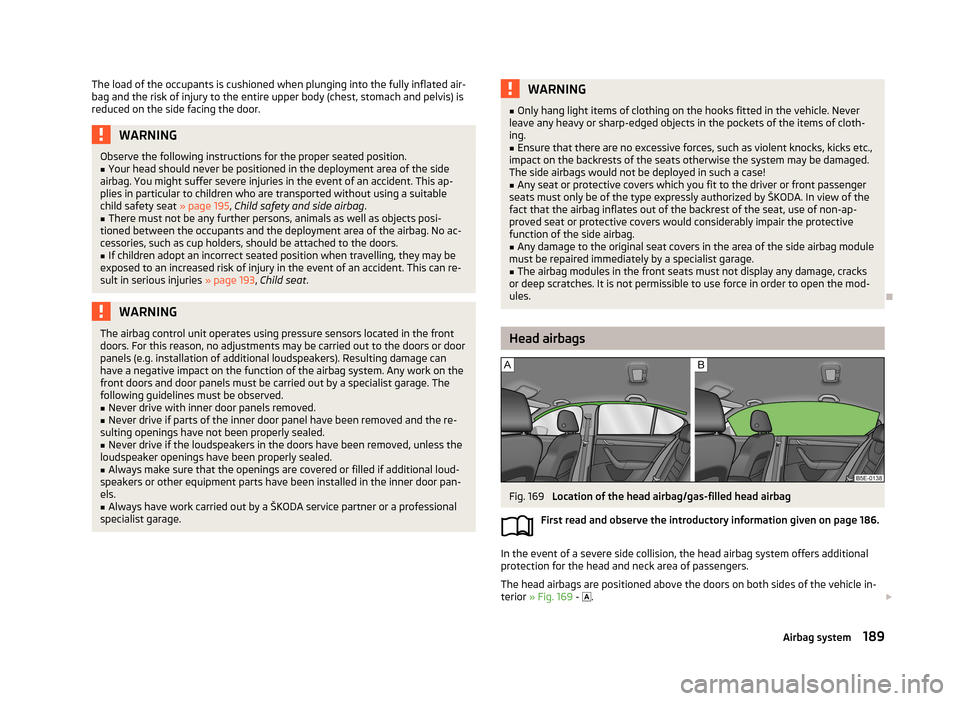
Head airbags
Fig. 169
Location of the head airbag/gas-filled head airbag
First read and observe the introductory information given on page 186.
In the event of a severe side collision, the head airbag system offers additional
protection for the head and neck area of passengers.
The head airbags are positioned above the doors on both sides of the vehicle in-terior » Fig. 169 -
.
189Airbag system
Page 193 of 287
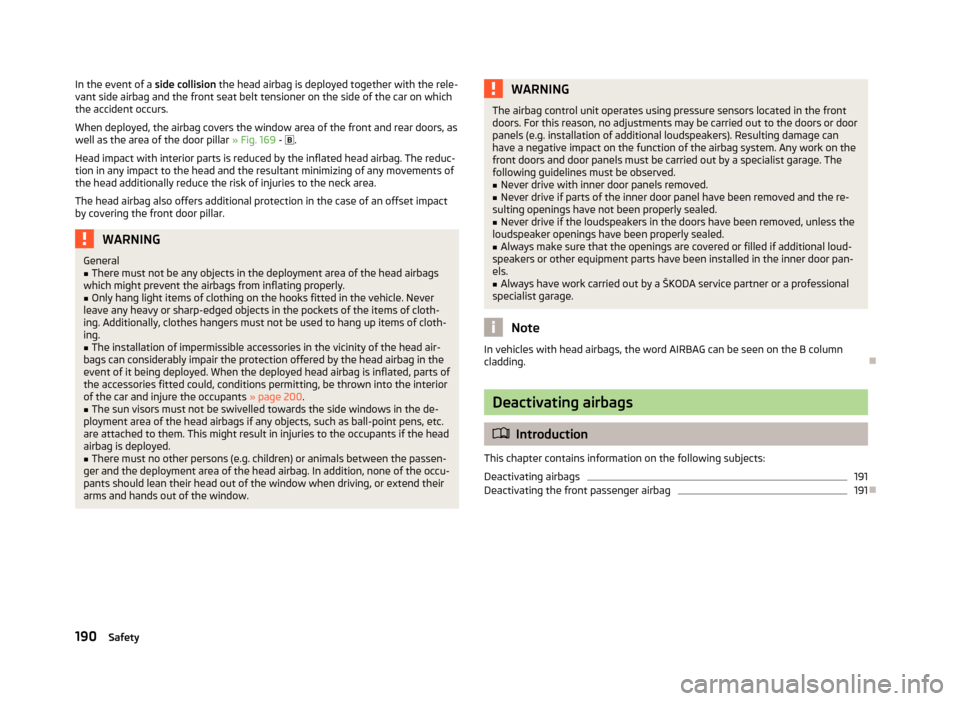
In the event of a side collision the head airbag is deployed together with the rele-
vant side airbag and the front seat belt tensioner on the side of the car on which
the accident occurs.
When deployed, the airbag covers the window area of the front and rear doors, as well as the area of the door pillar » Fig. 169 - .
Head impact with interior parts is reduced by the inflated head airbag. The reduc- tion in any impact to the head and the resultant minimizing of any movements of
the head additionally reduce the risk of injuries to the neck area.
The head airbag also offers additional protection in the case of an offset impact by covering the front door pillar.WARNINGGeneral■There must not be any objects in the deployment area of the head airbags
which might prevent the airbags from inflating properly.■
Only hang light items of clothing on the hooks fitted in the vehicle. Never
leave any heavy or sharp-edged objects in the pockets of the items of cloth-
ing. Additionally, clothes hangers must not be used to hang up items of cloth-
ing.
■
The installation of impermissible accessories in the vicinity of the head air-
bags can considerably impair the protection offered by the head airbag in the
event of it being deployed. When the deployed head airbag is inflated, parts of
the accessories fitted could, conditions permitting, be thrown into the interior
of the car and injure the occupants » page 200.
■
The sun visors must not be swivelled towards the side windows in the de-
ployment area of the head airbags if any objects, such as ball-point pens, etc.
are attached to them. This might result in injuries to the occupants if the head
airbag is deployed.
■
There must no other persons (e.g. children) or animals between the passen-
ger and the deployment area of the head airbag. In addition, none of the occu-
pants should lean their head out of the window when driving, or extend their
arms and hands out of the window.
WARNINGThe airbag control unit operates using pressure sensors located in the front
doors. For this reason, no adjustments may be carried out to the doors or door
panels (e.g. installation of additional loudspeakers). Resulting damage can have a negative impact on the function of the airbag system. Any work on thefront doors and door panels must be carried out by a specialist garage. The
following guidelines must be observed.■
Never drive with inner door panels removed.
■
Never drive if parts of the inner door panel have been removed and the re-
sulting openings have not been properly sealed.
■
Never drive if the loudspeakers in the doors have been removed, unless the
loudspeaker openings have been properly sealed.
■
Always make sure that the openings are covered or filled if additional loud-
speakers or other equipment parts have been installed in the inner door pan-
els.
■
Always have work carried out by a ŠKODA service partner or a professional
specialist garage.
Note
In vehicles with head airbags, the word AIRBAG can be seen on the B column
cladding.
Deactivating airbags
Introduction
This chapter contains information on the following subjects:
Deactivating airbags
191
Deactivating the front passenger airbag
191
190Safety
Page 194 of 287
Deactivating airbagsFirst read and observe the introductory information given on page 190.
Deactivating an airbag should be considered in cases such as the ones outlined
below.
› If using a rear-facing child seat on the front passenger seat (due to different le-
gal regulations, the airbag must be deactivated if using a forward-facing child
seat in some countries) » page 193, Transporting children safely .
› If not being able to maintain a distance of at least 25 cm between the middle of
the steering wheel and chest, despite the driver's seat being correctly adjusted.
› If special attachments are required in the area of the steering wheel because of
a physical disability.
› If other seats have been installed (e.g. orthopaedic seats without side airbags).
The front passenger airbag can be switched off with the key-operated
switch » page 191 , Deactivating the front passenger airbag .
We recommend that you ask a ŠKODA service partner to deactivate any other air-
bags as appropriate.
Monitoring the airbag system
The functionality of the airbag system is monitored electronically even if one of
the airbags is switched off.
Airbag was switched off using diagnostic equipment › The warning light
lights up for approx. 4 seconds after switching on the igni-
tion and then flashes again for approx. 12 seconds.
Front passenger airbag switched off with the key switch in the storage com-
partment
› The warning light
comes on for about 4 seconds after the ignition has been
switched on.
› The indicator light
3
» Fig. 170 on page 191 lights up after the ignition is
switched on.
Note
■ The national regulations for switching off airbags must be observed.■A ŠKODA service partner will be able to inform you which, if any, of your vehi-
cle's airbags can or must be deactivated.
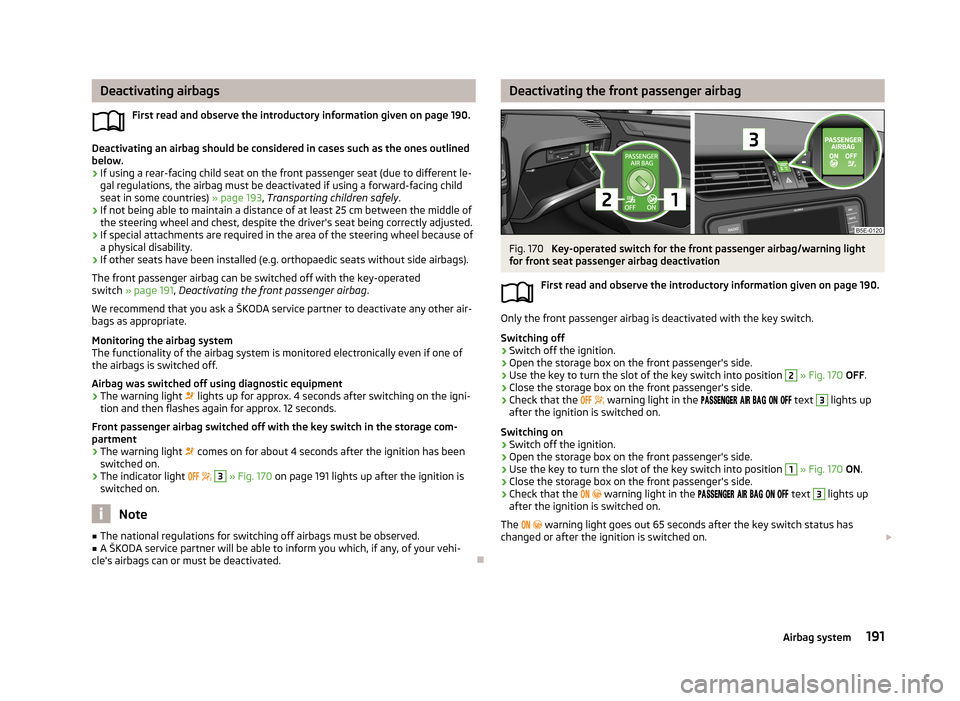
Deactivating the front passenger airbagFig. 170
Key-operated switch for the front passenger airbag/warning light
for front seat passenger airbag deactivation
First read and observe the introductory information given on page 190.
Only the front passenger airbag is deactivated with the key switch.
Switching off
›
Switch off the ignition.
›
Open the storage box on the front passenger's side.
›
Use the key to turn the slot of the key switch into position
2
» Fig. 170 OFF .
›
Close the storage box on the front passenger's side.
›
Check that the
warning light in the
text
3
lights up
after the ignition is switched on.
Switching on
›
Switch off the ignition.
›
Open the storage box on the front passenger's side.
›
Use the key to turn the slot of the key switch into position
1
» Fig. 170 ON .
›
Close the storage box on the front passenger's side.
›
Check that the
warning light in the
text
3
lights up
after the ignition is switched on.
The
warning light goes out 65 seconds after the key switch status has
changed or after the ignition is switched on.
191Airbag system
Page 201 of 287
General Maintenance
Vehicle care
Service intervals
Introduction
This chapter contains information on the following subjects:
Overview of service intervals
198
Fixed service intervals QI1 - QI4
199
Variable service interval QI6
199
Information about the ŠKODA service
199
The service interval display in the instrument cluster will remind you to carry out every service stipulated by the manufacturer at the right time in order to prevent you from forgetting any.
Timely and proper performance of servicing works is one of the requirements for the settlement of potential warranty claims.
The completion of services can be verified by the validated service certificate and the corresponding receipts.
The specified service intervals are tailored to normal operating conditions.
In the case of difficult operating conditions, it is necessary to have some service
work performed before the date of the next service or between the specified
service intervals. This applies mainly to the cleaning or the replacement of the air
filter insert in regions with heavy dust pollution as well as checking and replacing
the toothed belt, but also to vehicles with diesel particle filters, which can put
greater strain on the engine oil.
These difficult conditions are: › Fuel with sulphur content;
› Frequent short trips;
› Longer periods of engine idling (e.g. taxis);
› Operation in areas with heavy dust pollution;
› Frequent trailer operation;
›
Predominantly stop-and-go traffic as is often the case in city driving, for exam-
ple;
› Operation predominantly during winter.
A service consultant at the specialist garage will tell you whether the operating conditions of your vehicle may make it necessary for service work to be carried
out between the normal service intervals.
Different service charges may apply from the particular scope of work required,
depending on the vehicle type and equipment and the status of your vehicle.
Note
■ The customer is responsible for covering the cost of all services including
changing or replenishing the oil, even during the warranty period, unless stated otherwise in the ŠKODA AUTO a.s. warranty terms or other agreements.■
You will be informed about the current service scopes for the particular service
work by the specialist garage.
Overview of service intervals
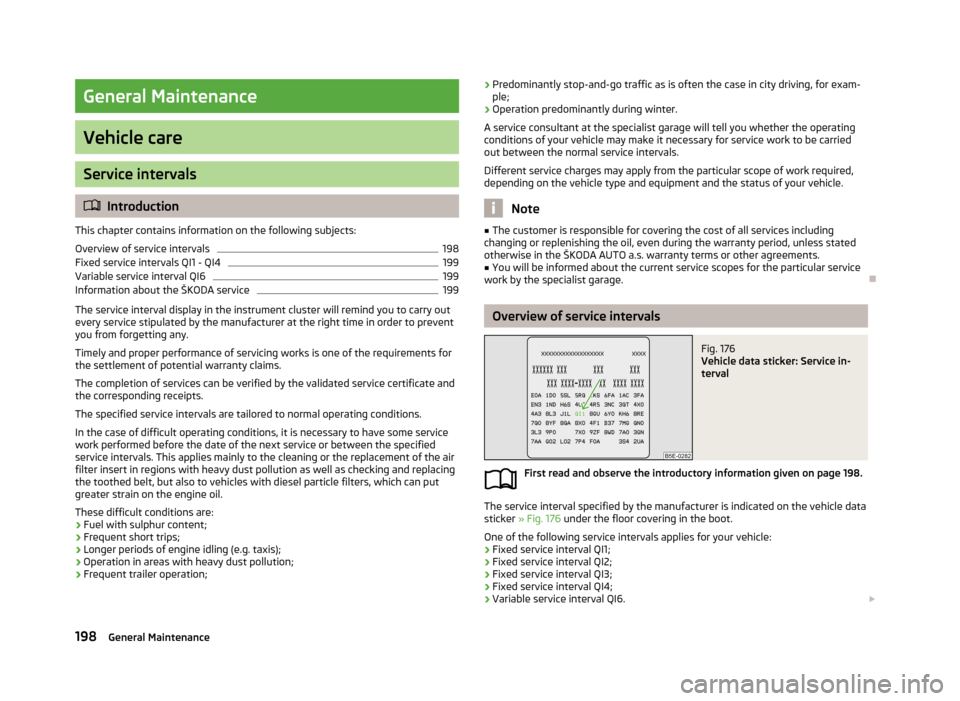
Fig. 176
Vehicle data sticker: Service in-
terval
First read and observe the introductory information given on page 198.
The service interval specified by the manufacturer is indicated on the vehicle data sticker » Fig. 176 under the floor covering in the boot.
One of the following service intervals applies for your vehicle: › Fixed service interval QI1;
› Fixed service interval QI2;
› Fixed service interval QI3;
› Fixed service interval QI4;
› Variable service interval QI6.
198General Maintenance
Page 202 of 287
In order to operate a vehicle with a variable service interval, it must only be fil-
led and topped up with the prescribed engine oil.
If this engine oil is not available, the oil change is subject to a fixed service inter-
val. In this case, the vehicle must be changed to the fixed service interval.
Note
■
The corresponding motor oil specifications » page 219.■A specialist garage can perform the changeover from the variable service inter-
val to the fixed service interval, or from the fixed service interval to the variable
service interval.
Fixed service intervals QI1 - QI4
First read and observe the introductory information given on page 198.
InspectionQI1 - QI4
After the first 30,000 km or 2 years a)
, then every
30,000 km or every 1 year a)
.Every 15,000 km or every 1 year a)
(applies to Rus-
sia).
Oil change service
QI1Every 5,000 km or every 1 year a)
.QI2Every 7,500 km or every 1 year a)
.QI3Every 10,000 km or every 1 year a)
.QI4Every 15,000 km or every 1 year a)
.Brake fluid
change First change after 3 years, then every 2 yearsa)
(whichever comes first).
WARNINGThe brake fluid must always be changed after the first 3 years and then every
2 years. Longer intervals between changing the brake fluid can cause vapour
bubbles to form in the brake system on sharp braking. This can impair the effi- ciency of the brakes – risk of accident!NoteFor diesel operation with a high sulphur content, the oil must be changed every
7500 km. Ask your specialist garage for information on the countries where diesel fuel has a high sulphur content.
Variable service interval QI6
First read and observe the introductory information given on page 198.
The service intervals depend on the intensity at which the vehicle is driven and
the local conditions in which the vehicle is used. For example, your vehicle is sub-
jected to different loads when driven over short distances than when driven over
long distances. The service intervals are therefore variable.
InspectionAfter the first 30,000 km or 2 years a)
, then every 30,000 km
or every 1 year a)
.Oil change serviceAccording to the service interval display (at the latest after
30,000 km or 2 years a)
).Brake fluid
changeFirst change after 3 years, then every 2 yearsa)
(whichever comes first).
WARNINGThe brake fluid must always be changed after the first 3 years and then every
2 years. Longer intervals between changing the brake fluid can cause vapour
bubbles to form in the brake system on sharp braking. This can impair the effi- ciency of the brakes – risk of accident!
Information about the ŠKODA service
First read and observe the introductory information given on page 198.
You have access to an extensive servicing network of ŠKODA Service Partners for
the maintenance of your vehicle.
199Vehicle care
Page 203 of 287
ŠKODA Service Partners feature modern, specially developed tools and equip-
ment. Here, trained specialists have a comprehensive range of ŠKODA Genuine Parts and ŠKODA Genuine Accessories at their disposal.
All ŠKODA Service Partners operate in accordance with the latest manufacturerguidelines and instructions. All service work is therefore carried out on time and
in accordance with the quality standards. Adhering to these instructions and
guidelines helps ensure road safety and helps keep your vehicle in a good techni-
cal condition.
The ŠKODA Service Partners also offer a wide range of other services. ŠKODA Service Partners are therefore properly prepared to service your vehicleand to provide quality work. We therefore recommend that you have your vehicle
maintained by a ŠKODA Service Partner.
Service work, adjustments and technical alterations
Introduction
This chapter contains information on the following subjects:
Tests required by law
201
ŠKODA Service Partners
201
ŠKODA Genuine Parts
201
ŠKODA Genuine Accessories
202
Spoiler
202
Component protection
202
Airbags
203
The instructions and guidelines from ŠKODA AUTO a.s. must be observed when
carrying out any modifications, repairs or technical alterations to your vehicle.
Adhering to these instructions and guidelines helps ensure road safety and helps
keep your vehicle in a good technical condition. After carrying out modifications,
repairs or technical alterations, the vehicle will comply with German road trans-
port regulations (StVZO)
Always consult a ŠKODA Partner » page 201before buying accessories or parts,
or before carrying out any modifications, repairs or technical alterations to your
vehicle.
WARNING■ If work on your vehicle is not carried out properly, this can lead to operation-
al faults - risk of accident and serious injuries.■
We recommend only having these modifications and technical alterations
carried out by a specialist garage.
■
Interference on the electronic components and their software can lead to
operational faults. This interference can also impair not directly affected sys-
tems because of the networking of the electronic components. The operation- al safety of the vehicle may be at significant risk and can lead to increased
wear of parts.
■
The ŠKODA Partner accepts no liability for products that have not been ap-
proved by ŠKODA AUTO a.s. even though these may be products with an op-
erational approval or that have been approved by a government testing insti-
tute.
WARNING■ We advise you only to use ŠKODA Original Accessories and ŠKODA Original
Parts which have been expressly approved for use on your vehicle. Reliability,
safety and suitability for your vehicle are guaranteed with these.■
ŠKODA Original Accessories and ŠKODA Original Parts can be purchased
from ŠKODA Partners, who will also perform the professional assembly of the purchased parts.
For the sake of the environment
Technical documents regarding changes carried out on the vehicle must be kept
by the vehicle user, in order to be handed over to the recyclers later. This ensures
that vehicle recycling is in accordance with environmental regulations.
Note
Any damage caused by technical alterations made without the approval of the
manufacturer is excluded from the warranty.
200General Maintenance