warning SKODA OCTAVIA 2013 3.G / (5E) Repair Manual
[x] Cancel search | Manufacturer: SKODA, Model Year: 2013, Model line: OCTAVIA, Model: SKODA OCTAVIA 2013 3.G / (5E)Pages: 287, PDF Size: 18.55 MB
Page 85 of 287
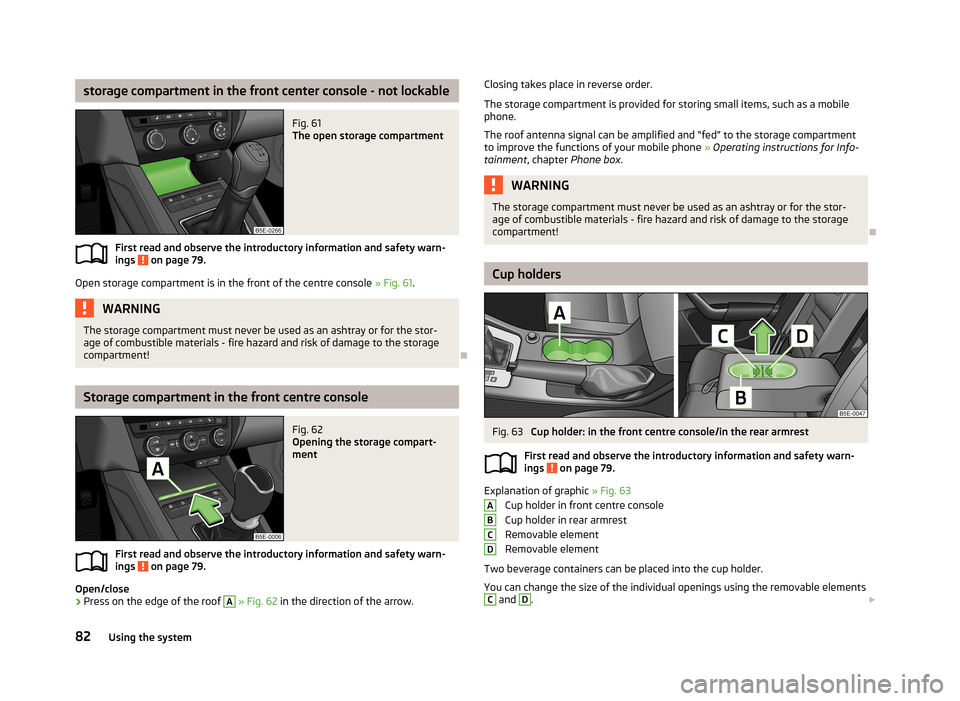
storage compartment in the front center console - not lockableFig. 61
The open storage compartment
First read and observe the introductory information and safety warn-
ings on page 79.
Open storage compartment is in the front of the centre console » Fig. 61.
WARNINGThe storage compartment must never be used as an ashtray or for the stor-
age of combustible materials - fire hazard and risk of damage to the storage
compartment!
Storage compartment in the front centre console
Fig. 62
Opening the storage compart-
ment
First read and observe the introductory information and safety warn-
ings on page 79.
Open/close
›
Press on the edge of the roof
A
» Fig. 62 in the direction of the arrow.
Closing takes place in reverse order.
The storage compartment is provided for storing small items, such as a mobile phone.
The roof antenna signal can be amplified and “fed” to the storage compartment
to improve the functions of your mobile phone » Operating instructions for Info-
tainment , chapter Phone box.WARNINGThe storage compartment must never be used as an ashtray or for the stor-
age of combustible materials - fire hazard and risk of damage to the storage
compartment!
Cup holders
Fig. 63
Cup holder: in the front centre console/in the rear armrest
First read and observe the introductory information and safety warn- ings
on page 79.
Explanation of graphic » Fig. 63
Cup holder in front centre console
Cup holder in rear armrest
Removable element
Removable element
Two beverage containers can be placed into the cup holder.
You can change the size of the individual openings using the removable elements
C
and
D
.
ABCD82Using the system
Page 86 of 287
WARNING■Never put hot beverage containers in the cup holder. If the vehicle moves,
they may spill – risk of scalding!■
Do not use any cups or beakers which are made of brittle material (e.g. glass,
porcelain). This could lead to injuries in the event of an accident.
CAUTION
Do not leave open beverage containers in the cup holder during the journey.
There is a risk of spilling e.g. when braking which may cause damage to the elec-
trical components or seat upholstery.
Cigarette lighter
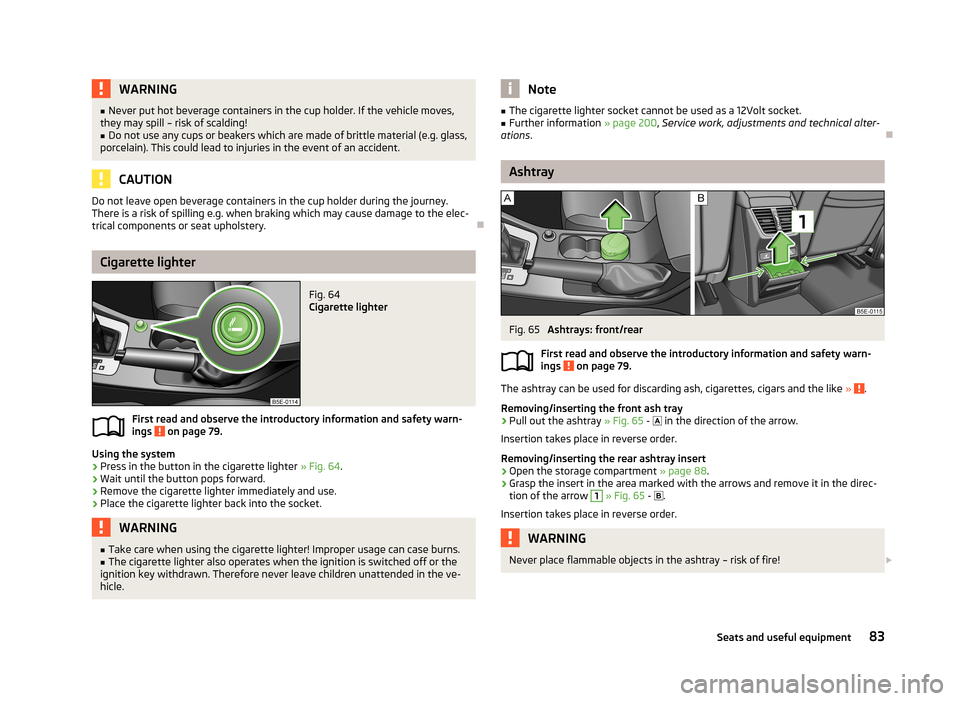
Fig. 64
Cigarette lighter
First read and observe the introductory information and safety warn-
ings on page 79.
Using the system
›
Press in the button in the cigarette lighter » Fig. 64
.
›
Wait until the button pops forward.
›
Remove the cigarette lighter immediately and use.
›
Place the cigarette lighter back into the socket.
WARNING■
Take care when using the cigarette lighter! Improper usage can case burns.■The cigarette lighter also operates when the ignition is switched off or the
ignition key withdrawn. Therefore never leave children unattended in the ve-
hicle.Note■ The cigarette lighter socket cannot be used as a 12Volt socket.■Further information » page 200, Service work, adjustments and technical alter-
ations .
Ashtray
Fig. 65
Ashtrays: front/rear
First read and observe the introductory information and safety warn- ings
on page 79.
The ashtray can be used for discarding ash, cigarettes, cigars and the like » .
Removing/inserting the front ash tray
›
Pull out the ashtray » Fig. 65 -
in the direction of the arrow.
Insertion takes place in reverse order.
Removing/inserting the rear ashtray insert
›
Open the storage compartment » page 88
.
›
Grasp the insert in the area marked with the arrows and remove it in the direc-
tion of the arrow
1
» Fig. 65 -
.
Insertion takes place in reverse order.
WARNINGNever place flammable objects in the ashtray – risk of fire! 83Seats and useful equipment
Page 87 of 287
CAUTIONWhen removing do not hold the ashtray at the cover on the front – risk of break-
age.
12-volt power outlet
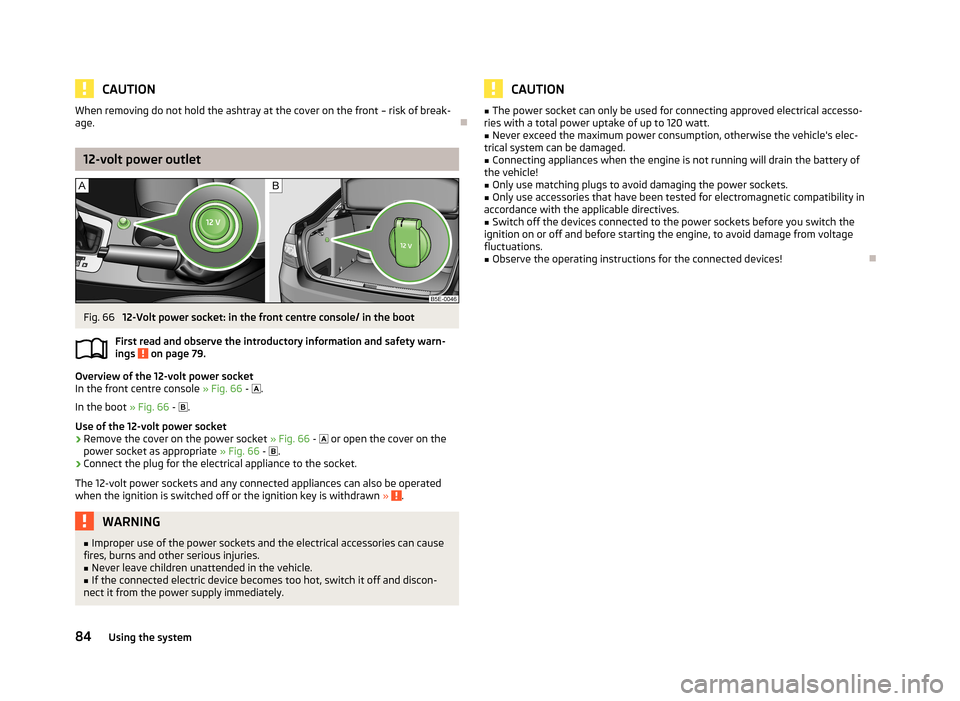
Fig. 66
12-Volt power socket: in the front centre console/ in the boot
First read and observe the introductory information and safety warn- ings
on page 79.
Overview of the 12-volt power socket
In the front centre console » Fig. 66 -
.
In the boot » Fig. 66 -
.
Use of the 12-volt power socket
›
Remove the cover on the power socket » Fig. 66 -
or open the cover on the
power socket as appropriate » Fig. 66 -
.
›
Connect the plug for the electrical appliance to the socket.
The 12-volt power sockets and any connected appliances can also be operated when the ignition is switched off or the ignition key is withdrawn »
.
WARNING■
Improper use of the power sockets and the electrical accessories can cause
fires, burns and other serious injuries.■
Never leave children unattended in the vehicle.
■
If the connected electric device becomes too hot, switch it off and discon-
nect it from the power supply immediately.
CAUTION■ The power socket can only be used for connecting approved electrical accesso-
ries with a total power uptake of up to 120 watt.■
Never exceed the maximum power consumption, otherwise the vehicle's elec-
trical system can be damaged.
■
Connecting appliances when the engine is not running will drain the battery of
the vehicle!
■
Only use matching plugs to avoid damaging the power sockets.
■
Only use accessories that have been tested for electromagnetic compatibility in
accordance with the applicable directives.
■
Switch off the devices connected to the power sockets before you switch the
ignition on or off and before starting the engine, to avoid damage from voltage
fluctuations.
■
Observe the operating instructions for the connected devices!
84Using the system
Page 88 of 287
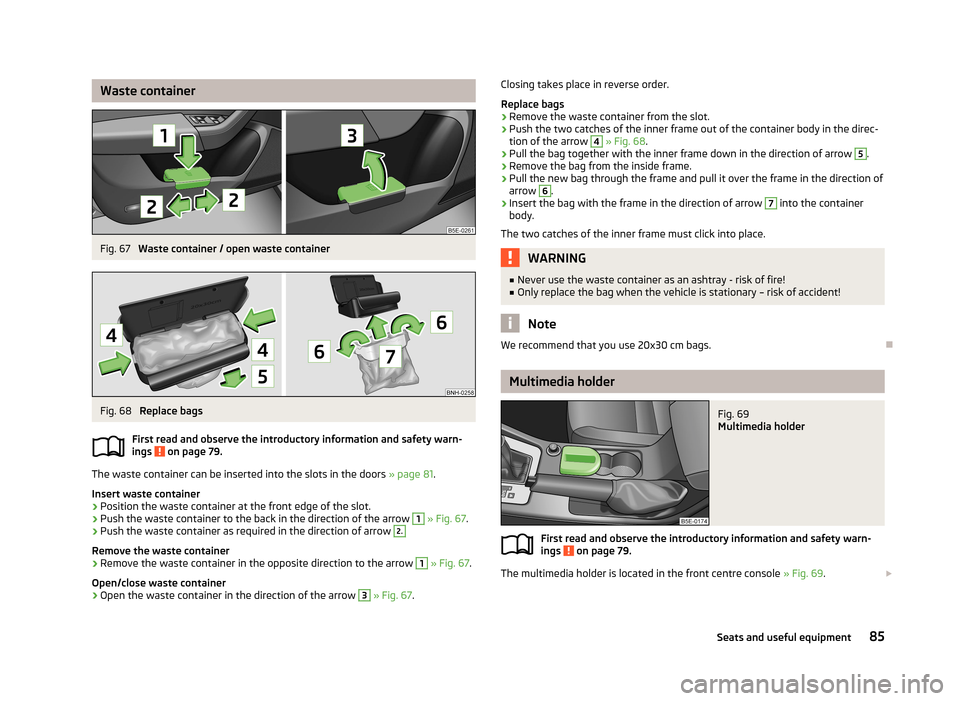
Waste containerFig. 67
Waste container / open waste container
Fig. 68
Replace bags
First read and observe the introductory information and safety warn-
ings
on page 79.
The waste container can be inserted into the slots in the doors » page 81.
Insert waste container
›
Position the waste container at the front edge of the slot.
›
Push the waste container to the back in the direction of the arrow
1
» Fig. 67 .
›
Push the waste container as required in the direction of arrow
2.
Remove the waste container
›
Remove the waste container in the opposite direction to the arrow
1
» Fig. 67 .
Open/close waste container
›
Open the waste container in the direction of the arrow
3
» Fig. 67 .
Closing takes place in reverse order.
Replace bags›
Remove the waste container from the slot.
›
Push the two catches of the inner frame out of the container body in the direc-
tion of the arrow
4
» Fig. 68 .
›
Pull the bag together with the inner frame down in the direction of arrow
5
.
›
Remove the bag from the inside frame.
›
Pull the new bag through the frame and pull it over the frame in the direction of
arrow
6
.
›
Insert the bag with the frame in the direction of arrow
7
into the container
body.
The two catches of the inner frame must click into place.
WARNING■ Never use the waste container as an ashtray - risk of fire!■Only replace the bag when the vehicle is stationary – risk of accident!
Note
We recommend that you use 20x30 cm bags.
Multimedia holder
Fig. 69
Multimedia holder
First read and observe the introductory information and safety warn-
ings on page 79.
The multimedia holder is located in the front centre console » Fig. 69.
85Seats and useful equipment
Page 89 of 287
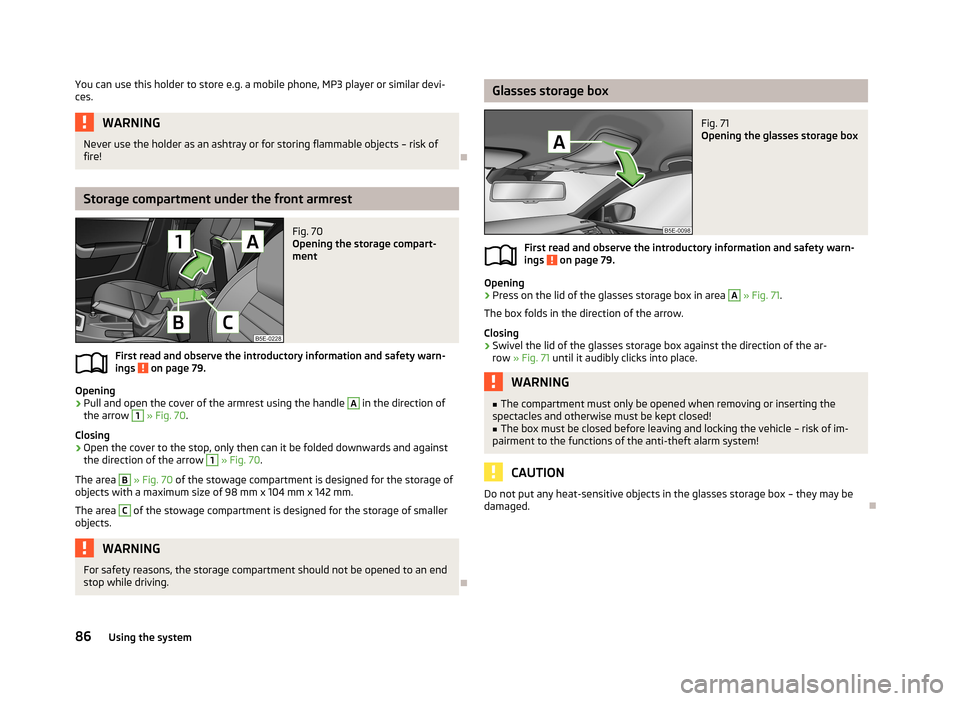
You can use this holder to store e.g. a mobile phone, MP3 player or similar devi-
ces.WARNINGNever use the holder as an ashtray or for storing flammable objects – risk of
fire!
Storage compartment under the front armrest
Fig. 70
Opening the storage compart-
ment
First read and observe the introductory information and safety warn- ings on page 79.
Opening
›
Pull and open the cover of the armrest using the handle
A
in the direction of
the arrow
1
» Fig. 70 .
Closing
›
Open the cover to the stop, only then can it be folded downwards and against the direction of the arrow
1
» Fig. 70 .
The area
B
» Fig. 70 of the stowage compartment is designed for the storage of
objects with a maximum size of 98 mm x 104 mm x 142 mm.
The area
C
of the stowage compartment is designed for the storage of smaller
objects.
WARNINGFor safety reasons, the storage compartment should not be opened to an end
stop while driving.
Glasses storage boxFig. 71
Opening the glasses storage box
First read and observe the introductory information and safety warn- ings on page 79.
Opening
›
Press on the lid of the glasses storage box in area
A
» Fig. 71 .
The box folds in the direction of the arrow.
Closing
›
Swivel the lid of the glasses storage box against the direction of the ar- row » Fig. 71 until it audibly clicks into place.
WARNING■
The compartment must only be opened when removing or inserting the
spectacles and otherwise must be kept closed!■
The box must be closed before leaving and locking the vehicle – risk of im-
pairment to the functions of the anti-theft alarm system!
CAUTION
Do not put any heat-sensitive objects in the glasses storage box – they may be
damaged.
86Using the system
Page 90 of 287
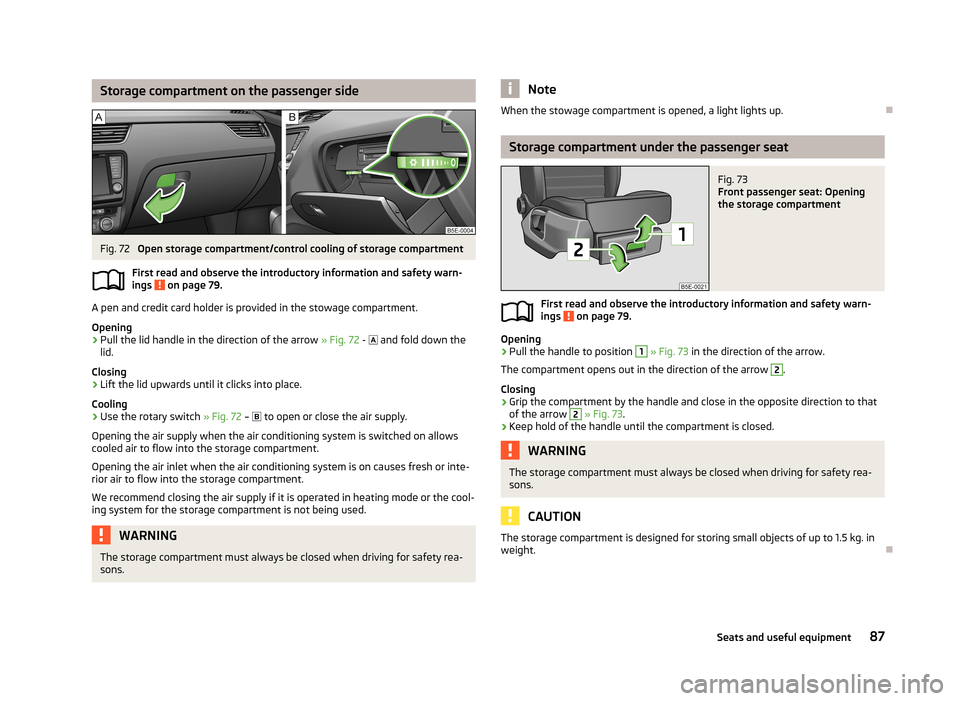
Storage compartment on the passenger sideFig. 72
Open storage compartment/control cooling of storage compartment
First read and observe the introductory information and safety warn-
ings
on page 79.
A pen and credit card holder is provided in the stowage compartment.
Opening
›
Pull the lid handle in the direction of the arrow » Fig. 72 -
and fold down the
lid.
Closing
›
Lift the lid upwards until it clicks into place.
Cooling
›
Use the rotary switch » Fig. 72 –
to open or close the air supply.
Opening the air supply when the air conditioning system is switched on allows cooled air to flow into the storage compartment.
Opening the air inlet when the air conditioning system is on causes fresh or inte-rior air to flow into the storage compartment.
We recommend closing the air supply if it is operated in heating mode or the cool-ing system for the storage compartment is not being used.
WARNINGThe storage compartment must always be closed when driving for safety rea-
sons.NoteWhen the stowage compartment is opened, a light lights up.
Storage compartment under the passenger seat
Fig. 73
Front passenger seat: Opening
the storage compartment
First read and observe the introductory information and safety warn-
ings on page 79.
Opening
›
Pull the handle to position
1
» Fig. 73 in the direction of the arrow.
The compartment opens out in the direction of the arrow
2
.
Closing
›
Grip the compartment by the handle and close in the opposite direction to that
of the arrow
2
» Fig. 73 .
›
Keep hold of the handle until the compartment is closed.
WARNINGThe storage compartment must always be closed when driving for safety rea-
sons.
CAUTION
The storage compartment is designed for storing small objects of up to 1.5 kg. in
weight.
87Seats and useful equipment
Page 91 of 287
Clothes hookFirst read and observe the introductory information and safety warn-ings
on page 79.
The clothes hooks are located on the middle door pillars of the vehicle and on the
handle of the headliner above each of the rear doors.
WARNING■ Only hang light items of clothing on the hooks. Never leave any heavy or
sharp-edged objects in the pockets of the items of clothing.■
Do not use clothes hangers for hanging up items of clothing otherwise this
may reduce the effectiveness of head airbags.
■
Ensure that any clothes hanging from the hooks do not impair your vision to
the rear.
CAUTION
The maximum permissible load of the hooks is 2 kg.
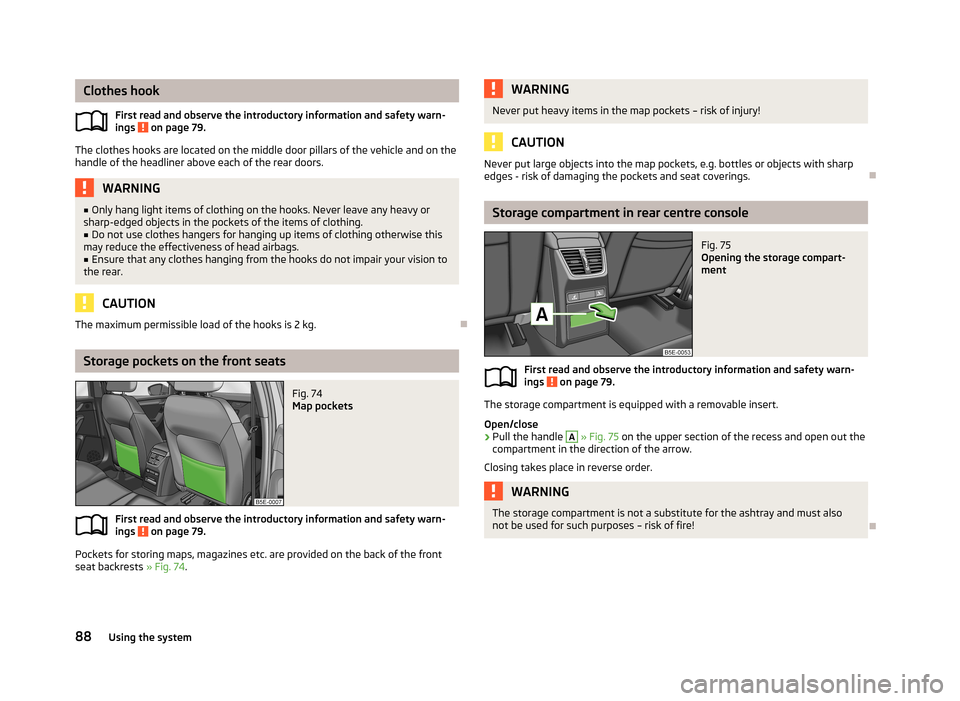
Storage pockets on the front seats
Fig. 74
Map pockets
First read and observe the introductory information and safety warn-
ings on page 79.
Pockets for storing maps, magazines etc. are provided on the back of the front
seat backrests » Fig. 74.
WARNINGNever put heavy items in the map pockets – risk of injury!
CAUTION
Never put large objects into the map pockets, e.g. bottles or objects with sharp
edges - risk of damaging the pockets and seat coverings.
Storage compartment in rear centre console
Fig. 75
Opening the storage compart-
ment
First read and observe the introductory information and safety warn-
ings on page 79.
The storage compartment is equipped with a removable insert.
Open/close
›
Pull the handle
A
» Fig. 75 on the upper section of the recess and open out the
compartment in the direction of the arrow.
Closing takes place in reverse order.
WARNINGThe storage compartment is not a substitute for the ashtray and must also
not be used for such purposes – risk of fire!
88Using the system
Page 92 of 287
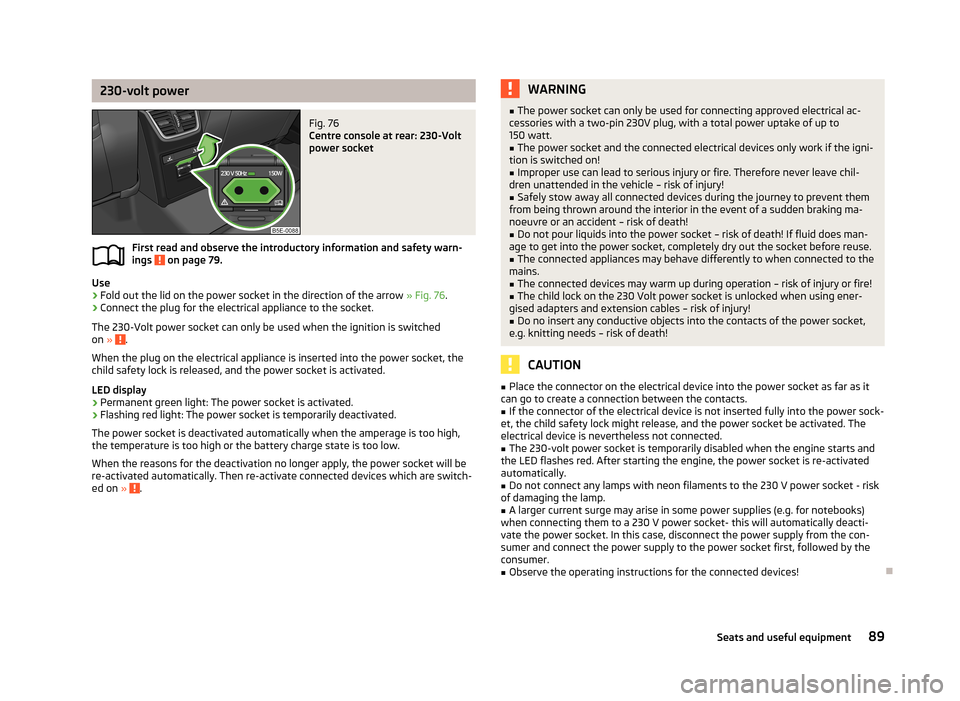
230-volt powerFig. 76
Centre console at rear: 230-Volt
power socket
First read and observe the introductory information and safety warn-
ings on page 79.
Use
›
Fold out the lid on the power socket in the direction of the arrow » Fig. 76.
›
Connect the plug for the electrical appliance to the socket.
The 230-Volt power socket can only be used when the ignition is switched on »
.
When the plug on the electrical appliance is inserted into the power socket, the
child safety lock is released, and the power socket is activated.
LED display › Permanent green light: The power socket is activated.
› Flashing red light: The power socket is temporarily deactivated.
The power socket is deactivated automatically when the amperage is too high, the temperature is too high or the battery charge state is too low.
When the reasons for the deactivation no longer apply, the power socket will be
re-activated automatically. Then re-activate connected devices which are switch-
ed on »
.
WARNING■
The power socket can only be used for connecting approved electrical ac-
cessories with a two-pin 230V plug, with a total power uptake of up to 150 watt.■
The power socket and the connected electrical devices only work if the igni-
tion is switched on!
■
Improper use can lead to serious injury or fire. Therefore never leave chil-
dren unattended in the vehicle – risk of injury!
■
Safely stow away all connected devices during the journey to prevent them
from being thrown around the interior in the event of a sudden braking ma- noeuvre or an accident – risk of death!
■
Do not pour liquids into the power socket – risk of death! If fluid does man-
age to get into the power socket, completely dry out the socket before reuse.
■
The connected appliances may behave differently to when connected to the
mains.
■
The connected devices may warm up during operation – risk of injury or fire!
■
The child lock on the 230 Volt power socket is unlocked when using ener-
gised adapters and extension cables – risk of injury!
■
Do no insert any conductive objects into the contacts of the power socket,
e.g. knitting needs – risk of death!
CAUTION
■ Place the connector on the electrical device into the power socket as far as it
can go to create a connection between the contacts.■
If the connector of the electrical device is not inserted fully into the power sock-
et, the child safety lock might release, and the power socket be activated. The
electrical device is nevertheless not connected.
■
The 230-volt power socket is temporarily disabled when the engine starts and
the LED flashes red. After starting the engine, the power socket is re-activated
automatically.
■
Do not connect any lamps with neon filaments to the 230 V power socket - risk
of damaging the lamp.
■
A larger current surge may arise in some power supplies (e.g. for notebooks)
when connecting them to a 230 V power socket- this will automatically deacti-
vate the power socket. In this case, disconnect the power supply from the con-
sumer and connect the power supply to the power socket first, followed by the
consumer.
■
Observe the operating instructions for the connected devices!
89Seats and useful equipment
Page 93 of 287
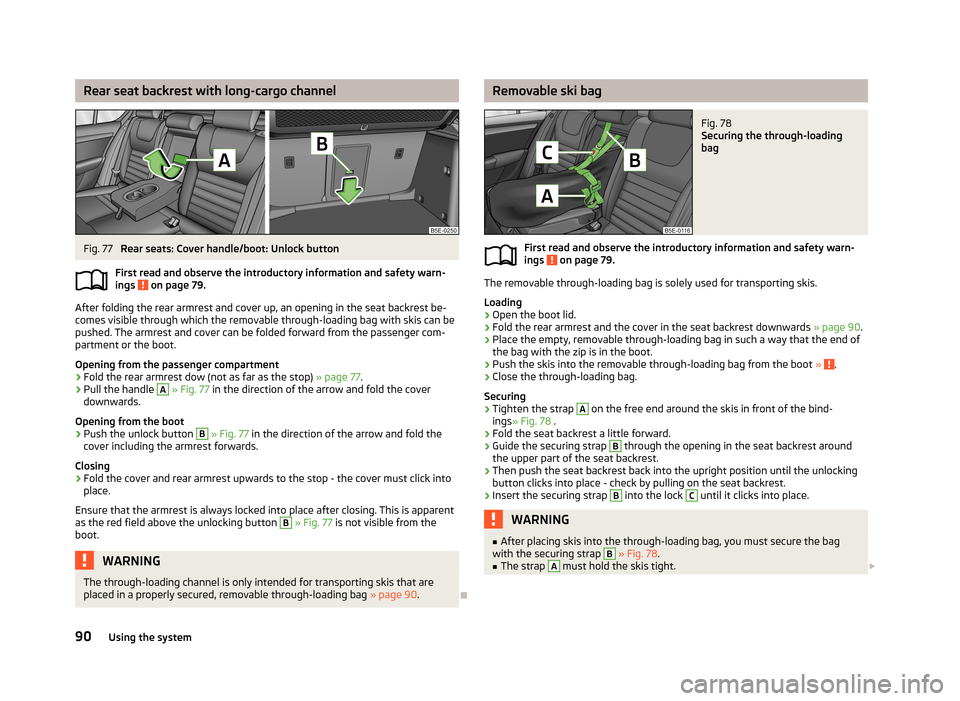
Rear seat backrest with long-cargo channelFig. 77
Rear seats: Cover handle/boot: Unlock button
First read and observe the introductory information and safety warn-
ings
on page 79.
After folding the rear armrest and cover up, an opening in the seat backrest be-
comes visible through which the removable through-loading bag with skis can be
pushed. The armrest and cover can be folded forward from the passenger com-
partment or the boot.
Opening from the passenger compartment
›
Fold the rear armrest dow (not as far as the stop) » page 77.
›
Pull the handle
A
» Fig. 77 in the direction of the arrow and fold the cover
downwards.
Opening from the boot
›
Push the unlock button
B
» Fig. 77 in the direction of the arrow and fold the
cover including the armrest forwards.
Closing
›
Fold the cover and rear armrest upwards to the stop - the cover must click into place.
Ensure that the armrest is always locked into place after closing. This is apparent
as the red field above the unlocking button
B
» Fig. 77 is not visible from the
boot.
WARNINGThe through-loading channel is only intended for transporting skis that are
placed in a properly secured, removable through-loading bag » page 90.
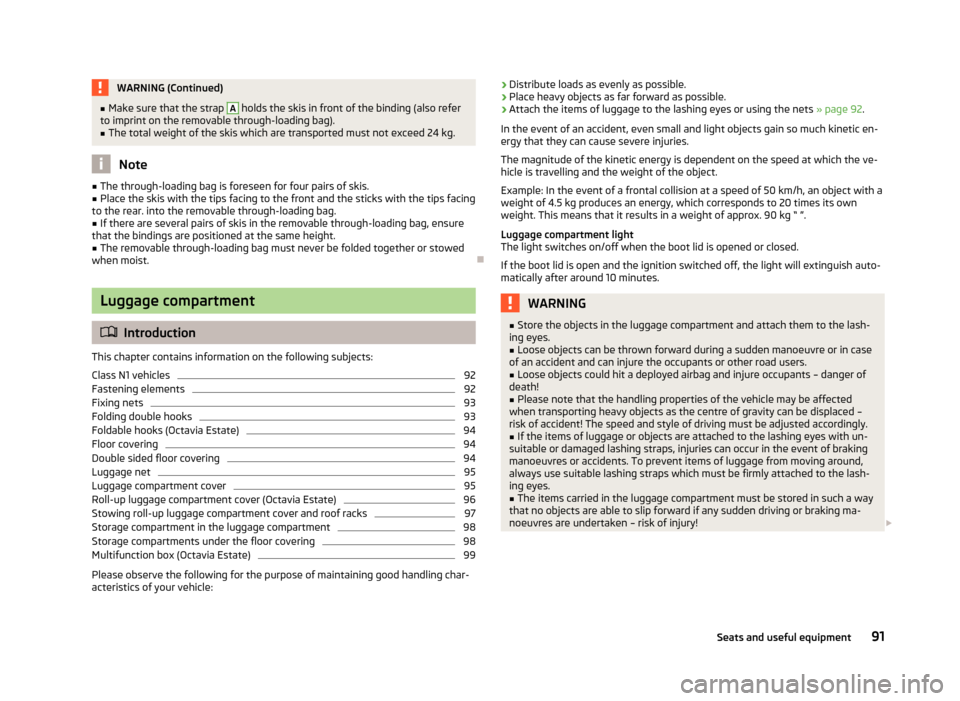
Removable ski bagFig. 78
Securing the through-loading
bag
First read and observe the introductory information and safety warn-
ings on page 79.
The removable through-loading bag is solely used for transporting skis.
Loading
›
Open the boot lid.
›
Fold the rear armrest and the cover in the seat backrest downwards » page 90.
›
Place the empty, removable through-loading bag in such a way that the end of
the bag with the zip is in the boot.
›
Push the skis into the removable through-loading bag from the boot » .
›
Close the through-loading bag.
Securing
›
Tighten the strap
A
on the free end around the skis in front of the bind-
ings » Fig. 78 .
›
Fold the seat backrest a little forward.
›
Guide the securing strap
B
through the opening in the seat backrest around
the upper part of the seat backrest.
›
Then push the seat backrest back into the upright position until the unlocking button clicks into place - check by pulling on the seat backrest.
›
Insert the securing strap
B
into the lock
C
until it clicks into place.
WARNING■ After placing skis into the through-loading bag, you must secure the bag
with the securing strap B » Fig. 78 .■
The strap
A
must hold the skis tight. 90Using the system
Page 94 of 287
WARNING (Continued)■Make sure that the strap A holds the skis in front of the binding (also refer
to imprint on the removable through-loading bag).■
The total weight of the skis which are transported must not exceed 24 kg.
Note
■ The through-loading bag is foreseen for four pairs of skis.■Place the skis with the tips facing to the front and the sticks with the tips facing
to the rear. into the removable through-loading bag.■
If there are several pairs of skis in the removable through-loading bag, ensure
that the bindings are positioned at the same height.
■
The removable through-loading bag must never be folded together or stowed
when moist.
Luggage compartment
Introduction
This chapter contains information on the following subjects:
Class N1 vehicles
92
Fastening elements
92
Fixing nets
93
Folding double hooks
93
Foldable hooks (Octavia Estate)
94
Floor covering
94
Double sided floor covering
94
Luggage net
95
Luggage compartment cover
95
Roll-up luggage compartment cover (Octavia Estate)
96
Stowing roll-up luggage compartment cover and roof racks
97
Storage compartment in the luggage compartment
98
Storage compartments under the floor covering
98
Multifunction box (Octavia Estate)
99
Please observe the following for the purpose of maintaining good handling char-
acteristics of your vehicle:
› Distribute loads as evenly as possible.›Place heavy objects as far forward as possible.›
Attach the items of luggage to the lashing eyes or using the nets
» page 92.
In the event of an accident, even small and light objects gain so much kinetic en-
ergy that they can cause severe injuries.
The magnitude of the kinetic energy is dependent on the speed at which the ve-
hicle is travelling and the weight of the object.
Example: In the event of a frontal collision at a speed of 50 km/h, an object with a
weight of 4.5 kg produces an energy, which corresponds to 20 times its own
weight. This means that it results in a weight of approx. 90 kg “ ”.
Luggage compartment light
The light switches on/off when the boot lid is opened or closed.
If the boot lid is open and the ignition switched off, the light will extinguish auto-
matically after around 10 minutes.
WARNING■ Store the objects in the luggage compartment and attach them to the lash-
ing eyes.■
Loose objects can be thrown forward during a sudden manoeuvre or in case
of an accident and can injure the occupants or other road users.
■
Loose objects could hit a deployed airbag and injure occupants – danger of
death!
■
Please note that the handling properties of the vehicle may be affected
when transporting heavy objects as the centre of gravity can be displaced –
risk of accident! The speed and style of driving must be adjusted accordingly.
■
If the items of luggage or objects are attached to the lashing eyes with un-
suitable or damaged lashing straps, injuries can occur in the event of braking
manoeuvres or accidents. To prevent items of luggage from moving around,
always use suitable lashing straps which must be firmly attached to the lash-
ing eyes.
■
The items carried in the luggage compartment must be stored in such a way
that no objects are able to slip forward if any sudden driving or braking ma-
noeuvres are undertaken – risk of injury!
91Seats and useful equipment