boot SKODA OCTAVIA 2014 3.G / (5E) Owner's Guide
[x] Cancel search | Manufacturer: SKODA, Model Year: 2014, Model line: OCTAVIA, Model: SKODA OCTAVIA 2014 3.G / (5E)Pages: 280, PDF Size: 35.53 MB
Page 110 of 280

The luggage net is located on the underside of the luggage compartment cov-
er » Fig. 104 .WARNINGOnly store soft objects with a total weight of 1.5 kg in the net. Heavy ob-
jects are not secured sufficiently – risk of injury!
CAUTION
Do not place any sharp objects into the net – risk of net damage.
Luggage compartment cover
Fig. 105
Removing/installing the luggage compartment cover
Fig. 106
Luggage compartment cover
stowed behind the rear seats
Read and observe and on page 103 first.
The boot cover can be removed if you want to transport bulky goods.
Removing
›
Unhook the retaining straps
A
of the flap in the direction of arrow
1
» Fig. 105 .
›On the underside of the cover, in the area of the holders, press C.›Remove the cover in the direction of the arrow 2.
The removed boot cover can be stowed behind the seat backrest » Fig. 106.
Installing›
Place the cover on the contact surfaces of the side trim panel.
›
Place the recesses
B
» Fig. 105 on the cover of the
C
brackets on the side
cover.
›
Press on the upper side of the cover so that the mounts fully interlock in the
holders.
›
Insert the retaining bands
A
opposite to the direction of arrow
1
on the
boot lid.
WARNINGNo objects should be placed on the boot cover, the vehicle occupants could
be endangered if there is sudden braking or the vehicle collides with some-
thing.
CAUTION
■ When closing the boot lid, jamming and damage to the luggage compartment
cover or the side trim panel can occur if handled in an unprofessional way. The
following guidelines must be observed. ■ The recesses in the cover B
» Fig. 105 must lock in the holders in the side
trim panel
C
.
■ The items which are transported must not exceed the height of the lug-
gage compartment cover. ■ The cover must not be jammed in the surrounding seal of the luggage com-
partment lid when it is in the opened position.
■ There must be no object in the gap between the opened cover and the rear
backrest.
Note
If the support straps A » Fig. 105 are attached to the boot, then the boot cov-
er will rise as well when the luggage compartment is opened.107Transporting and practical equipment
Page 111 of 280
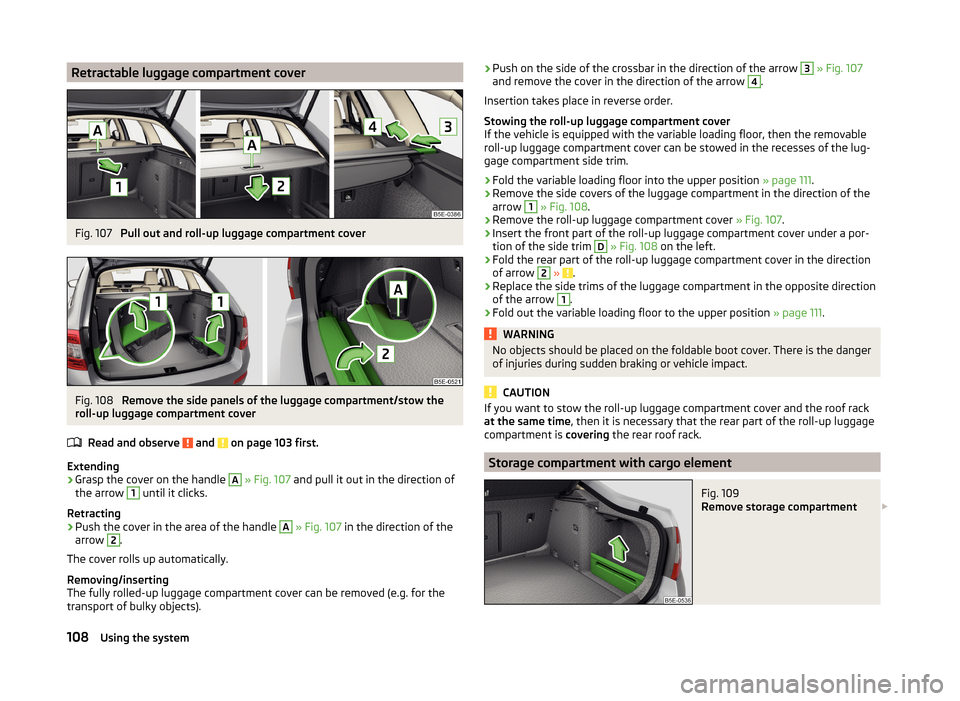
Retractable luggage compartment coverFig. 107
Pull out and roll-up luggage compartment cover
Fig. 108
Remove the side panels of the luggage compartment/stow the
roll-up luggage compartment cover
Read and observe
and on page 103 first.
Extending
›
Grasp the cover on the handle
A
» Fig. 107 and pull it out in the direction of
the arrow
1
until it clicks.
Retracting
›
Push the cover in the area of the handle
A
» Fig. 107 in the direction of the
arrow
2
.
The cover rolls up automatically.
Removing/inserting
The fully rolled-up luggage compartment cover can be removed (e.g. for the
transport of bulky objects).
› Push on the side of the crossbar in the direction of the arrow 3
» Fig. 107
and remove the cover in the direction of the arrow 4.
Insertion takes place in reverse order.
Stowing the roll-up luggage compartment cover
If the vehicle is equipped with the variable loading floor, then the removable roll-up luggage compartment cover can be stowed in the recesses of the lug-
gage compartment side trim.›
Fold the variable loading floor into the upper position » page 111.
›
Remove the side covers of the luggage compartment in the direction of the
arrow
1
» Fig. 108 .
›
Remove the roll-up luggage compartment cover » Fig. 107.
›
Insert the front part of the roll-up luggage compartment cover under a por-
tion of the side trim
D
» Fig. 108 on the left.
›
Fold the rear part of the roll-up luggage compartment cover in the direction
of arrow
2
» .
›
Replace the side trims of the luggage compartment in the opposite direction
of the arrow
1
.
›
Fold out the variable loading floor to the upper position » page 111.
WARNINGNo objects should be placed on the foldable boot cover. There is the danger
of injuries during sudden braking or vehicle impact.
CAUTION
If you want to stow the roll-up luggage compartment cover and the roof rack
at the same time , then it is necessary that the rear part of the roll-up luggage
compartment is covering the rear roof rack.
Storage compartment with cargo element
Fig. 109
Remove storage compartment
108Using the system
Page 115 of 280
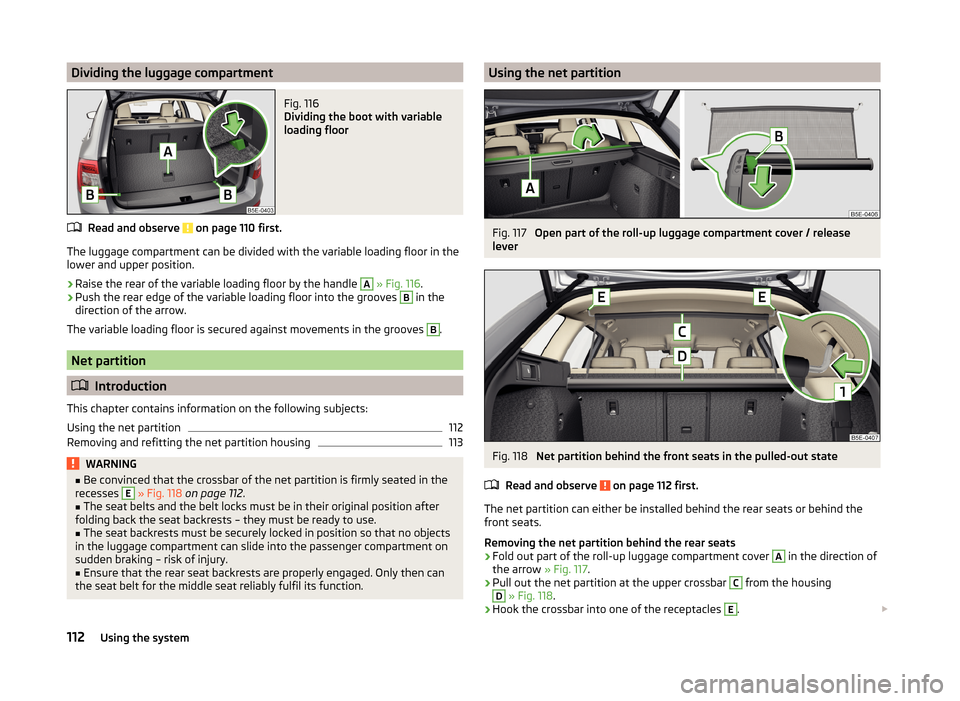
Dividing the luggage compartmentFig. 116
Dividing the boot with variable
loading floor
Read and observe on page 110 first.
The luggage compartment can be divided with the variable loading floor in the lower and upper position.
›
Raise the rear of the variable loading floor by the handle
A
» Fig. 116 .
›
Push the rear edge of the variable loading floor into the grooves
B
in the
direction of the arrow.
The variable loading floor is secured against movements in the grooves
B
.
Net partition
Introduction
This chapter contains information on the following subjects:
Using the net partition
112
Removing and refitting the net partition housing
113WARNING■ Be convinced that the crossbar of the net partition is firmly seated in the
recesses E » Fig. 118 on page 112 .■
The seat belts and the belt locks must be in their original position after
folding back the seat backrests – they must be ready to use.
■
The seat backrests must be securely locked in position so that no objects
in the luggage compartment can slide into the passenger compartment on
sudden braking – risk of injury.
■
Ensure that the rear seat backrests are properly engaged. Only then can
the seat belt for the middle seat reliably fulfil its function.
Using the net partitionFig. 117
Open part of the roll-up luggage compartment cover / release
lever
Fig. 118
Net partition behind the front seats in the pulled-out state
Read and observe
on page 112 first.
The net partition can either be installed behind the rear seats or behind the front seats.
Removing the net partition behind the rear seats
›
Fold out part of the roll-up luggage compartment cover
A
in the direction of
the arrow » Fig. 117.
›
Pull out the net partition at the upper crossbar
C
from the housing
D
» Fig. 118 .
›
Hook the crossbar into one of the receptacles
E
.
112Using the system
Page 128 of 280
NoteUp to four devices can be connected to SmartGate at any one time.
Smart Gate websiteRead and observe
on page 124 first.
There is a special website for the SmartGate system.
The following address must be entered in the web browser of the connected device.
HTTP://192.168.123.1
This website contains information about the vehicle, the Wi-Fi connection and
SmartGate.
The Wi-Fi connection settings can be adjusted in the Configuration area.
Saving the adjusted settings
The setting changes are only applied after performing the following steps.
› The changes are saved by pressing the “Save” button.
› SmartGate is restarted by pressing the “Reboot ”button.
Password management
Read and observe
on page 124 first.
Password management can be carried out in the connected device on the
SmartGate website » page 125, Smart Gate website .
The changes are applied after saving and restarting SmartGate » page 125,
Saving the adjusted settings .
Changing the password
›
Enter a new password in the Configuration area in menu option WPA/WPA2 key.
The password must be 8-17 characters without diacritics or special characters
(e.g. -, /, etc.).
Connection option without entering a password
›
In the Configuration area set the value Open in the menu item Security .
Forgotten password
If you have forgotten your password, SmartGate must be reset to factory set-
tings by a specialist garage.
125Communication
Page 176 of 280
WARNINGNever remove the tow bar while the trailer is still coupled.
Note
We recommend putting the protective cover onto the ball head before remov-
ing the tow bar.
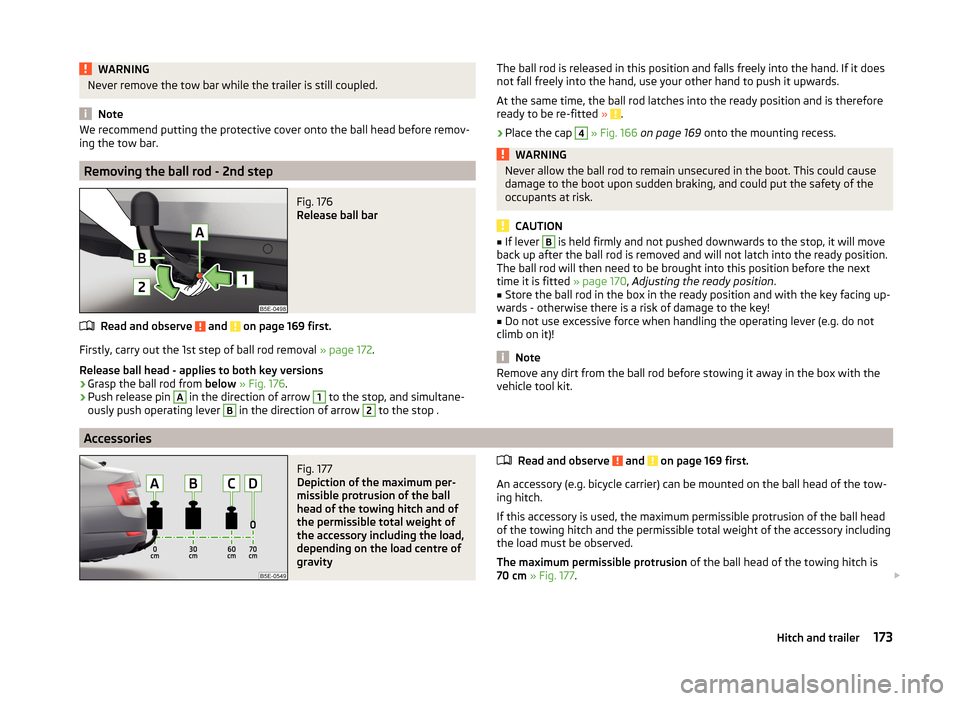
Removing the ball rod - 2nd step
Fig. 176
Release ball bar
Read and observe and on page 169 first.
Firstly, carry out the 1st step of ball rod removal » page 172.
Release ball head - applies to both key versions
›
Grasp the ball rod from below » Fig. 176 .
›
Push release pin
A
in the direction of arrow
1
to the stop, and simultane-
ously push operating lever
B
in the direction of arrow
2
to the stop .
The ball rod is released in this position and falls freely into the hand. If it does not fall freely into the hand, use your other hand to push it upwards.
At the same time, the ball rod latches into the ready position and is therefore
ready to be re-fitted »
.
›
Place the cap
4
» Fig. 166 on page 169 onto the mounting recess.
WARNINGNever allow the ball rod to remain unsecured in the boot. This could cause
damage to the boot upon sudden braking, and could put the safety of the
occupants at risk.
CAUTION
■ If lever B is held firmly and not pushed downwards to the stop, it will move
back up after the ball rod is removed and will not latch into the ready position.
The ball rod will then need to be brought into this position before the next
time it is fitted » page 170, Adjusting the ready position .■
Store the ball rod in the box in the ready position and with the key facing up-
wards - otherwise there is a risk of damage to the key!
■
Do not use excessive force when handling the operating lever (e.g. do not
climb on it)!
Note
Remove any dirt from the ball rod before stowing it away in the box with the
vehicle tool kit.
Accessories
Fig. 177
Depiction of the maximum per-
missible protrusion of the ball
head of the towing hitch and of
the permissible total weight of
the accessory including the load,
depending on the load centre of
gravity
Read and observe and on page 169 first.
An accessory (e.g. bicycle carrier) can be mounted on the ball head of the tow- ing hitch.
If this accessory is used, the maximum permissible protrusion of the ball head
of the towing hitch and the permissible total weight of the accessory including
the load must be observed.
The maximum permissible protrusion of the ball head of the towing hitch is
70 cm » Fig. 177 .
173Hitch and trailer
Page 188 of 280
WheelsRead and observe
and on page 182 first.
Wheel rims
Also thoroughly wash the wheel rims when washing the vehicle on a regular
basis.
Regularly remove salt and brake abrasion, otherwise the rim material will be
corroded.
Light alloy wheels
After washing thoroughly and treat the wheel rims with a protective product
for light alloy wheels.
For the treatment of wheel rims do not use products which may cause damage
to the paint on the rims.
CAUTION
■ Damage to the paint layer on the wheel rims must be touched up immediate-
ly.■
Severe layers of dirt on the wheels can also result in wheel imbalance. This
may show itself in the form of a wheel vibration which is transmitted to the
steering wheel which, in certain circumstances, can cause premature wear of
the steering. This means it is necessary to remove the dirt.
Towing hitch and mounting recess
Read and observe
and on page 182 first.
Seal the mounting recess with the cap to prevent any ingress of dirt.
In the event of dirt, clean the interior surfaces of the mounting recess and
treat with a suitable preservative.
Always check the ball head before attaching a trailer. Apply suitable grease
where necessary.
Include the protective cap when stowing away the ball rod to protect the boot
from getting contaminated.
CAUTION
Apply grease to the inner part of the mounting recess. Make sure you do not
remove any grease.Under-body protection
Read and observe
and on page 182 first.
The underside of your vehicle is already permanently protected by the factory
against chemical and mechanical influences.
It is not possible to guarantee that the protective coating will not suffer any
damage as the vehicle is driven.
We recommend having the protective coating underneath the vehicle and the
chassis checked — preferably before the beginning of winter and at the end of
winter.
WARNINGNever use additional underbody protection or anti-corrosion agents for ex-
haust pipes, catalytic converters, diesel particle filters or heat shields.
When the engine reaches its operating temperature, these substances
might ignite - risk of fire!
Wiper blades
Read and observe
and on page 182 first.
Clean the wiper blades regularly with a glass cleaner. The wiper blades should
be cleaned with a sponge or cloth if they are heavily soiled by insect residues,
for example.
The wiper blades can become soiled with wax residues after washing in auto-
matic vehicle wash systems for example » page 181.
Interior care
Introduction
This chapter contains information on the following subjects:
Natural leather
186
Artificial leather, materials and Alcantara ®
187
Seat covers
187
Safety belts
187
185Care and maintenance
Page 195 of 280
WARNING■When refuelling, never get into the vehicle. If you have to get into your
vehicle in exceptional cases, touch a metal surface before you touch the
filling coupling again. This will avoid electrostatic discharges, which may
generate sparks. Sparks can cause a fire during refuelling.■
Natural gas is highly explosive and highly flammable.
Note
During the filling process sounds are heard which are harmless. If you are un-
sure which service station staff to use, ask the petrol station staff.
CNG
Fig. 183
Position of the CNG label(s).
Read and observe
and on page 188 first.
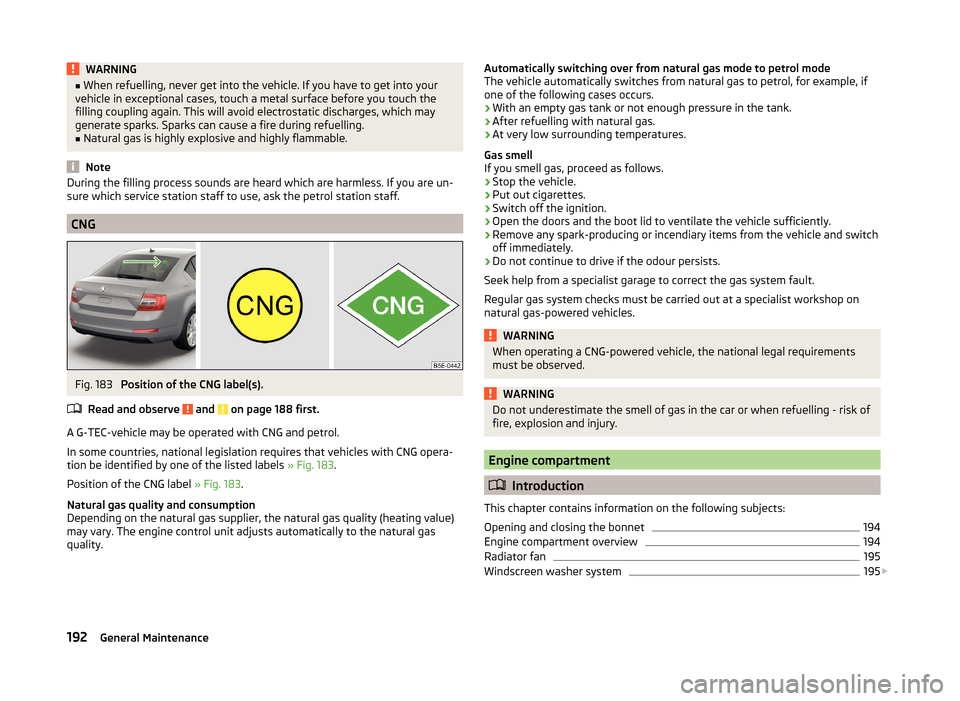
A G-TEC-vehicle may be operated with CNG and petrol.
In some countries, national legislation requires that vehicles with CNG opera-
tion be identified by one of the listed labels » Fig. 183.
Position of the CNG label » Fig. 183.
Natural gas quality and consumption
Depending on the natural gas supplier, the natural gas quality (heating value)
may vary. The engine control unit adjusts automatically to the natural gas
quality.
Automatically switching over from natural gas mode to petrol mode
The vehicle automatically switches from natural gas to petrol, for example, if
one of the following cases occurs.
› With an empty gas tank or not enough pressure in the tank.
› After refuelling with natural gas.
› At very low surrounding temperatures.
Gas smell
If you smell gas, proceed as follows.
› Stop the vehicle.
› Put out cigarettes.
› Switch off the ignition.
› Open the doors and the boot lid to ventilate the vehicle sufficiently.
› Remove any spark-producing or incendiary items from the vehicle and switch
off immediately.
› Do not continue to drive if the odour persists.
Seek help from a specialist garage to correct the gas system fault.
Regular gas system checks must be carried out at a specialist workshop on natural gas-powered vehicles.WARNINGWhen operating a CNG-powered vehicle, the national legal requirements
must be observed.WARNINGDo not underestimate the smell of gas in the car or when refuelling - risk of
fire, explosion and injury.
Engine compartment
Introduction
This chapter contains information on the following subjects:
Opening and closing the bonnet
194
Engine compartment overview
194
Radiator fan
195
Windscreen washer system
195
192General Maintenance
Page 197 of 280
Opening and closing the bonnetFig. 184
Open the bonnet
Read and observe
and on page 193 first.
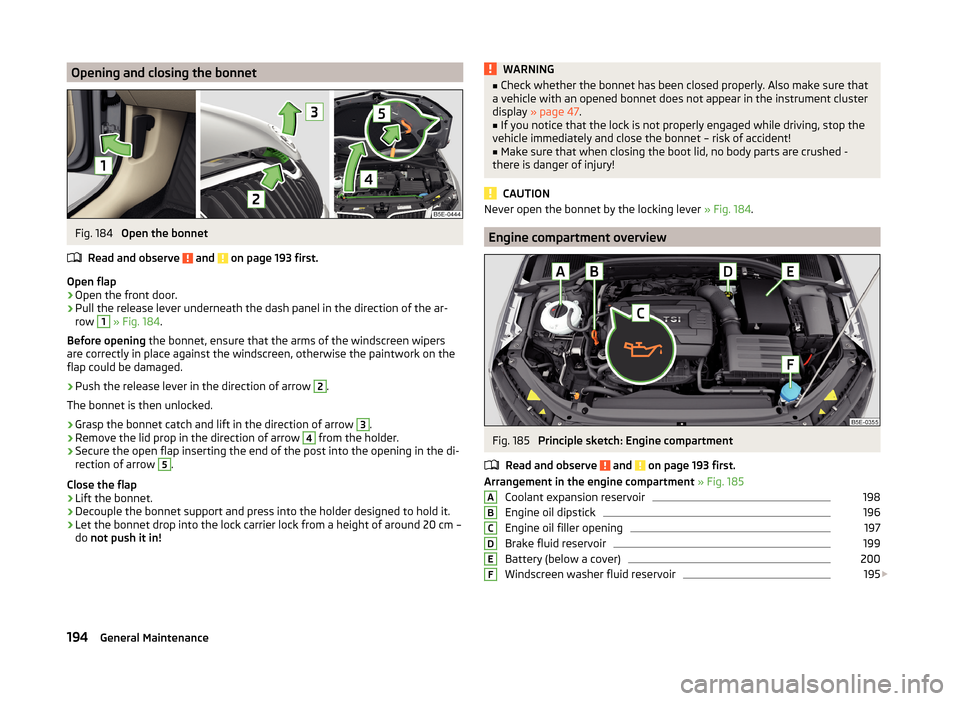
Open flap
›
Open the front door.
›
Pull the release lever underneath the dash panel in the direction of the ar-
row
1
» Fig. 184 .
Before opening the bonnet, ensure that the arms of the windscreen wipers
are correctly in place against the windscreen, otherwise the paintwork on the
flap could be damaged.
›
Push the release lever in the direction of arrow
2
.
The bonnet is then unlocked.
›
Grasp the bonnet catch and lift in the direction of arrow
3
.
›
Remove the lid prop in the direction of arrow
4
from the holder.
›
Secure the open flap inserting the end of the post into the opening in the di-
rection of arrow
5
.
Close the flap
›
Lift the bonnet.
›
Decouple the bonnet support and press into the holder designed to hold it.
›
Let the bonnet drop into the lock carrier lock from a height of around 20 cm – do not push it in!
WARNING■
Check whether the bonnet has been closed properly. Also make sure that
a vehicle with an opened bonnet does not appear in the instrument cluster
display » page 47 .■
If you notice that the lock is not properly engaged while driving, stop the
vehicle immediately and close the bonnet – risk of accident!
■
Make sure that when closing the boot lid, no body parts are crushed -
there is danger of injury!
CAUTION
Never open the bonnet by the locking lever » Fig. 184.
Engine compartment overview
Fig. 185
Principle sketch: Engine compartment
Read and observe
and on page 193 first.
Arrangement in the engine compartment » Fig. 185
Coolant expansion reservoir
198
Engine oil dipstick
196
Engine oil filler opening
197
Brake fluid reservoir
199
Battery (below a cover)
200
Windscreen washer fluid reservoir
195
ABCDEF194General Maintenance
Page 216 of 280

CAUTION■Screw the jack back into the starting position before storing in the box with
the vehicle tool kit.■
Ensure that the vehicle tool kit is safely secured in the luggage compart-
ment.
■
Ensure that the box is always secured with the strap.
Note
The declaration of conformity is included with the jack or the log folder.
Reserve and temporary spare
Introduction
This chapter contains information on the following subjects:
Removing/storing the wheel
213
Spare wheel
213
When using an emergency or spare wheel make sure to fit a wheel with the
appropriate dimensions and design as soon as possible.
After changing the spare wheel, the tyre pressure must be adjusted. In vehi-
cles with tyre pressure monitoring, tyre pressure values must be
saved » page 167 .
WARNING■
If the spare tyre with a non-specific or opposite direction of rotation has
to be fitted in the event of a puncture, then drive carefully. The tyre no lon-
ger retains its optimal characteristics in this situation.■
If the dimensions or design of the spare wheel differ from the tyres fitted
to the vehicle (e.g. winter tyres or low-profile tyres), it must only be used
briefly in the event of a puncture and if an appropriately cautious style of
driving is adopted.
■
If the dimensions or design of the temporary spare wheel differ from the
fitted tyres, never drive faster than 80 km/h (or 50 mph).
■
Never use the temporary spare wheel if it is damaged.
Removing/storing the wheelFig. 198
Removing the wheel
Read and observe on page 213 first.
The wheel is located in a well under the floor covering in the boot and is fixed in place with special bolt
B
» Fig. 198 .
Take out wheel
›
Open the boot lid.
›
Raise the floor covering in the boot » page 106.
›
Remove the box with the tool kit.
›
Remove locking
A
in the direction of arrow
1
» Fig. 198 .
›
Unscrew nut
B
in the direction of arrow
2
.
›
Remove the wheel.
Store wheel away
›
Place the wheel into the spare wheel well with the wheel rim pointing down-
ward.
›
Screw in nut
B
in the opposite direction to arrow
2
» Fig. 198 .
›
Insert locking
A
in the opposite direction to which arrow
1
is pointing.
›
Place the box with the tool kit back into the spare wheel and secure it with
the tape.
›
Fold back the floor covering in the boot » page 110.
›
Shut the boot lid.
Spare wheel
Read and observe
on page 213 first.
A yellow warning label is displayed on the rim of the temporary spare wheel.
213Emergency equipment, and self-help
Page 217 of 280
Please note the following if you intend to use the temporary spare wheel.› The warning label must not be covered after installing the wheel.
› Be specially attentive when driving.
› The emergency spare is inflated to the maximum inflation pressure for the
vehicle » page 204 .
› The tyre inflation pressure of the spare wheel R 18 is 420 kPa.
› Only use this emergency spare wheel to reach the nearest specialist garage,
as it is not intended for permanent use.WARNING■ Never drive with more than one temporary spare wheel mounted!■Only use the temporary spare wheel when absolutely necessary.■
Avoid accelerating at full throttle, sharp braking and fast cornering.
■
The snow chains cannot be used on the temporary spare wheel.
■
Observe instructions on the warning sign of the emergency wheel.
Changing a wheel
Introduction
This chapter contains information on the following subjects:
Preparation
214
Full wheel trim
214
Wheel bolts
215
Changing a wheel
215
Follow-up tasks
215
Loosening/tightening wheel bolts
216
Raising the vehicle
216
Anti-theft wheel bolts
217
For your own safety and the safety of your passengers, the following instruc-
tions must be observed before carrying out a wheel change on the road.
Switch on the hazard warning light.
The warning triangle must be set up at the prescribed distance - observe
the national legal provisions when doing so.
Park the vehicle as far away as possible from the flow of traffic.
Choose a location with a flat, solid surface.
Have all the occupants get out of the vehicle. While changing a tyre, the
occupants of the vehicle should not stand on the road (they should in-
stead remain behind a crash barrier).
If the vehicle is subsequently fitted with tyres which are different from those it
was fitted with at the works, follow these guidelines » page 207, Explanation
of the tyre labelling .
The national legal requirements must be observed when changing a wheel.
Preparation
Before changing the wheel, the following work must be carried out.
›
Switch off the engine.
›
Engage first gear or place the selector lever of the automatic transmission
into the P position .
›
Firmly apply the handbrake.
›
Uncouple any trailers.
›
Remove the vehicle tool kit » page 212 and the spare wheel » page 213 from
the boot.
Full wheel trim
Before removing the wheel bolts, remove the full wheel trim.
Extracting
›
Hook the clamp found in the vehicle tool kit » page 212 into the reinforced
edge of the wheel trim.
›
Push the wheel wrench through the clamp, support on the tyre and pull off
the wheel trim.
Installing
›
Press the wheel trim onto the wheel rim at the designated valve open-
ing » .
›
Then press the trim into the wheel rim until its entire circumference locks
correctly in place.
CAUTION
Notes on wheel trims supplied at the factory or from ŠKODAOriginal Accesso-
ries.■
When using an anti-theft wheel bolt, make sure that this has been fitted ac-
cording to the position marked on the back of the wheel cover position.
■
On the back of the wheel cover, the position for the anti-theft wheel bolt is
marked by means of a symbol. If the wheel cover is set outside the position
marked for the anti-theft wheel bolt, there is a risk of damaging the wheel
cover.
214Do-it-yourself