ESP SKODA OCTAVIA 2014 3.G / (5E) Repair Manual
[x] Cancel search | Manufacturer: SKODA, Model Year: 2014, Model line: OCTAVIA, Model: SKODA OCTAVIA 2014 3.G / (5E)Pages: 280, PDF Size: 35.53 MB
Page 210 of 280
Manufacturer-approved tyre variants
Introduction
This chapter contains information on the following subjects:
Explanation of the tyre labelling
207
Octavia
208
Octavia GreenLine
208
Octavia G-TEC
209
Octavia Scout
209
Octavia RS
209
Approved tyre variants must be selected firstly for the model variant (Octavia
GreenLine, Octavia Scout etc.) and then according to the engine size of your
vehicle. If the model variant of your vehicle cannot be found in a separate
module, then the approved tyre variants must be selected according to the en-
gine size of your vehicle in module » page 208, Octavia .
Only fit radial tyres of the same type, size (rolling circumference) and the same
tread pattern on one axle on all 4 wheels.
When fitting new tyres, the tyres must be replaced axle by axle.
The information listed in the table corresponds to the information available at
the time of going to press.
The approved tyre/rim combinations for your vehicle can be found in the sales
and technical vehicle documentation.
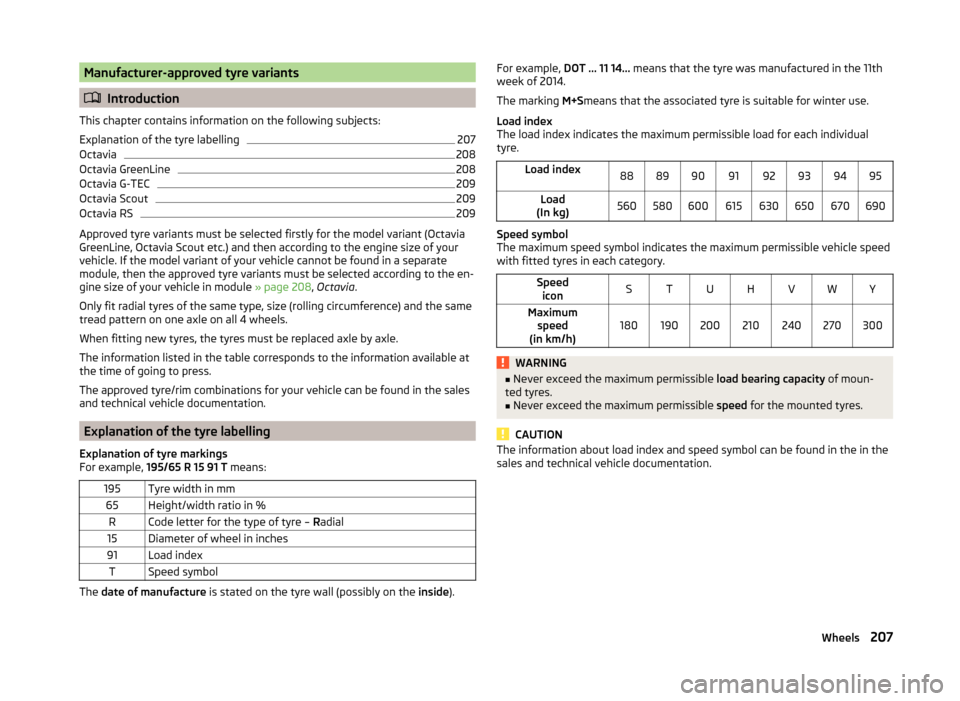
Explanation of the tyre labelling
Explanation of tyre markings
For example, 195/65 R 15 91 T means:
195Tyre width in mm65Height/width ratio in %RCode letter for the type of tyre – Radial15Diameter of wheel in inches91Load indexTSpeed symbol
The date of manufacture is stated on the tyre wall (possibly on the inside).
For example, DOT ... 11 14... means that the tyre was manufactured in the 11th
week of 2014.
The marking M+Smeans that the associated tyre is suitable for winter use.
Load index
The load index indicates the maximum permissible load for each individual
tyre.Load index8889909192939495Load
(In kg)560580600615630650670690
Speed symbol
The maximum speed symbol indicates the maximum permissible vehicle speed
with fitted tyres in each category.
Speed iconSTUHVWYMaximum speed
(in km/h)180190200210240270300WARNING■ Never exceed the maximum permissible load bearing capacity of moun-
ted tyres.■
Never exceed the maximum permissible speed for the mounted tyres.
CAUTION
The information about load index and speed symbol can be found in the in the
sales and technical vehicle documentation.207Wheels
Page 212 of 280
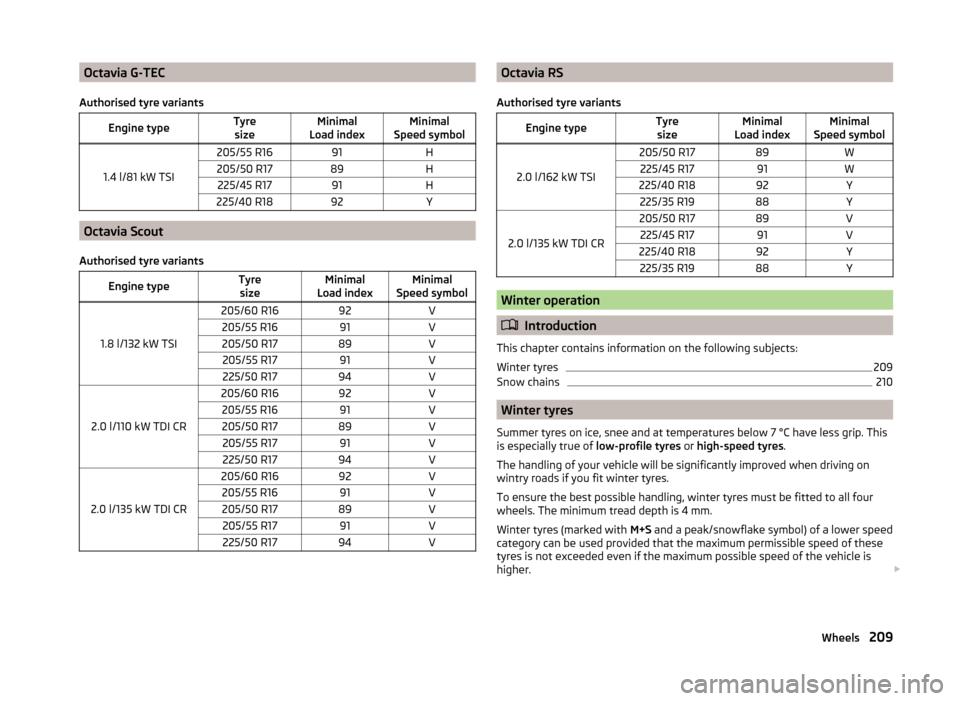
Octavia G-TEC
Authorised tyre variantsEngine typeTyre sizeMinimal
Load indexMinimal
Speed symbol
1.4 l/81 kW TSI
205/55 R1691H205/50 R1789H225/45 R1791H225/40 R1892Y
Octavia Scout
Authorised tyre variants
Engine typeTyre sizeMinimal
Load indexMinimal
Speed symbol
1.8 l/132 kW TSI
205/60 R1692V205/55 R1691V205/50 R1789V205/55 R1791V225/50 R1794V
2.0 l/110 kW TDI CR
205/60 R1692V205/55 R1691V205/50 R1789V205/55 R1791V225/50 R1794V
2.0 l/135 kW TDI CR
205/60 R1692V205/55 R1691V205/50 R1789V205/55 R1791V225/50 R1794VOctavia RS
Authorised tyre variantsEngine typeTyre sizeMinimal
Load indexMinimal
Speed symbol
2.0 l/162 kW TSI
205/50 R1789W225/45 R1791W225/40 R1892Y225/35 R1988Y
2.0 l/135 kW TDI CR
205/50 R1789V225/45 R1791V225/40 R1892Y225/35 R1988Y
Winter operation
Introduction
This chapter contains information on the following subjects:
Winter tyres
209
Snow chains
210
Winter tyres
Summer tyres on ice, snee and at temperatures below 7 °C have less grip. This
is especially true of low-profile tyres or high-speed tyres .
The handling of your vehicle will be significantly improved when driving on
wintry roads if you fit winter tyres.
To ensure the best possible handling, winter tyres must be fitted to all four
wheels. The minimum tread depth is 4 mm.
Winter tyres (marked with M+S and a peak/snowflake symbol) of a lower speed
category can be used provided that the maximum permissible speed of these
tyres is not exceeded even if the maximum possible speed of the vehicle is
higher.
209Wheels
Page 225 of 280
Vehicles with manual transmission may be towed in with a tow bar or a tow
rope or with the front or rear wheels raised.
Vehicles with automatic transmission may be towed in with a tow bar or a tow
rope or with the front wheels raised. If the vehicle is raised at rear, the auto-
matic gearbox is damaged!
Driver of the tow vehicle›
Engage the clutch gently when starting off or depress the accelerator partic-
ularly gently if the vehicle is fitted with an automatic gearbox.
›
Only then approach correctly when the rope is taut.
The maximum towing speed is 50 km/h.
Driver of the towed vehicle
›
Switch on the ignition so that the steering wheel is not locked and so that
the turn signal lights, windscreen wipers and windscreen washer system can
be used.
›
Take the vehicle out of gear or move the selector lever into position N if the
vehicle is fitted with an automatic gearbox.
Please note that the brake servo unit and power steering only operate if the
engine is running. If the engine is not running, significantly more physical force
is required to depress the brake pedal and steer the vehicle.
If using a tow rope, ensure that it is always kept taught.
Both drivers should be familiar with the problems which might possibly occur while a vehicle is being towed. Unskilled drivers should not attempt to tow in
another vehicle or to be towed in.
The vehicle must be transported on a special breakdown vehicle or trailer if it
is not possible to tow in the vehicle in the way described or if the towing dis-
tance is greater than 50 km.
WARNING■ When towing, respect the national legal provisions, especially those
which relate to the identification of the towing vehicle and the vehicle be-
ing towed.■
When towing, exercise increased caution.
■
Spiral tow ropes must not be used for towing » Fig. 207-
, the towing
eye may unscrew out of the vehicle - risk of accident.
■
The tow rope should not be twisted - risk of accident.
CAUTION■ Do not tow start the engine – there is a risk of damaging the engine and the
catalytic converter. The battery from another vehicle can be used as a jump-
start aid » page 220 , Jump-starting .■
If the gearbox no longer contains any oil, your vehicle must only be towed
with the front axle raised clear of the ground or on a breakdown vehicle or
trailer.
■
To protect both vehicles when tow-starting or towing, the tow rope should
be elastic. Thus one should only use plastic fibre rope or a rope made out of a
similarly elastic material.
■
There is always a risk of excessive stresses and damage resulting at the
points to which you attach the tow rope or tow bar when you attempt to tow a
vehicle which is not standing on a paved road.
■
Attach the tow rope or the tow bar to the towing eyes » page 222
or » page 223 to the detachable ball head of the towing equip-
ment » page 169 .
Note
We recommend using a tow rope from ŠKODA Original Accessories available
from a ŠKODA Partner.
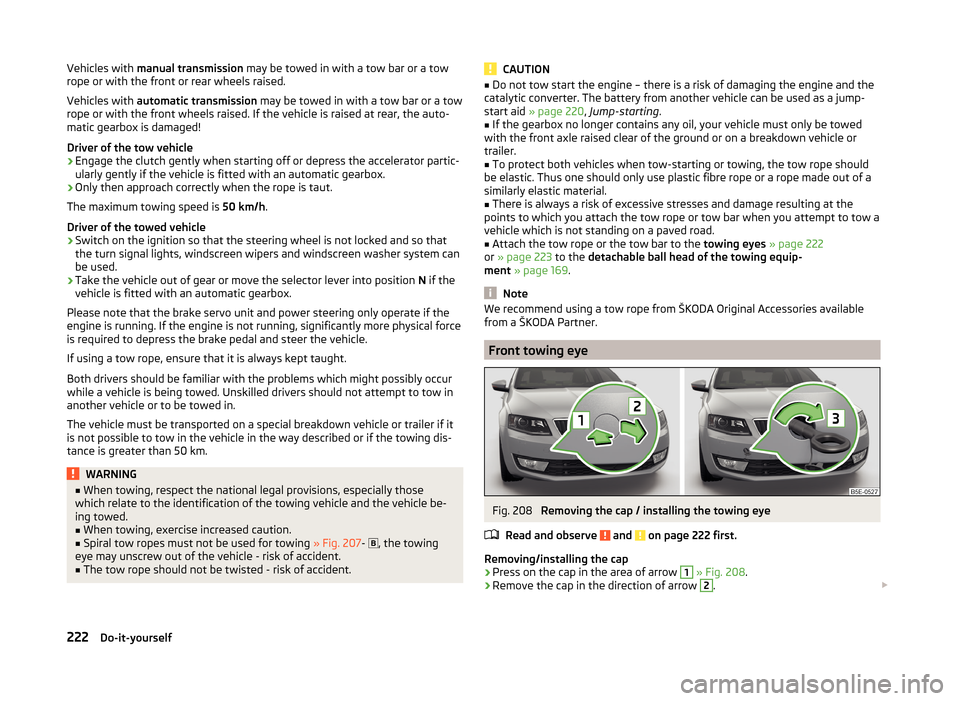
Front towing eye
Fig. 208
Removing the cap / installing the towing eye
Read and observe
and on page 222 first.
Removing/installing the cap
›
Press on the cap in the area of arrow
1
» Fig. 208 .
›
Remove the cap in the direction of arrow
2
.
222Do-it-yourself
Page 231 of 280
Fuses and light bulbs
Fuses
Introduction
This chapter contains information on the following subjects:
Fuses in the dash panel – LHD
228
Fuses in the dash panel – RHD
229
Assignment of the fuses in the dash panel
229
Fuses in the engine compartment
230
Assignment of fuses in the engine compartment
231
Individual electrical circuits are protected by fuses.
Switch off the ignition and the corresponding power consuming device before
replacing a fuse.
Find out which fuse belongs to the component that is not operat-
ing » page 229 , Assignment of the fuses in the dash panel or » page 231 , As-
signment of fuses in the engine compartment .
Electrically adjustable seats are protected by automatic circuit breakers, which
switch on again automatically after a few seconds after the overload has been
eliminated.
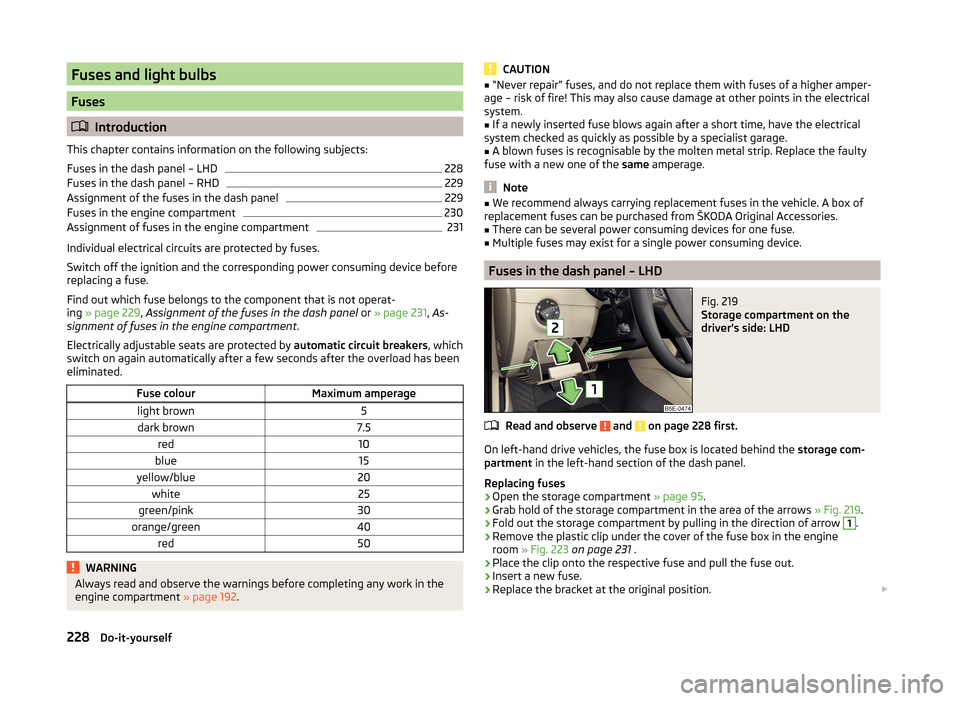
Fuse colourMaximum amperagelight brown5dark brown7.5red10blue15yellow/blue20white25green/pink30orange/green40red50WARNINGAlways read and observe the warnings before completing any work in the
engine compartment » page 192.CAUTION■
“Never repair” fuses, and do not replace them with fuses of a higher amper-
age – risk of fire! This may also cause damage at other points in the electrical
system.■
If a newly inserted fuse blows again after a short time, have the electrical
system checked as quickly as possible by a specialist garage.
■
A blown fuses is recognisable by the molten metal strip. Replace the faulty
fuse with a new one of the same amperage.
Note
■
We recommend always carrying replacement fuses in the vehicle. A box of
replacement fuses can be purchased from ŠKODA Original Accessories.■
There can be several power consuming devices for one fuse.
■
Multiple fuses may exist for a single power consuming device.
Fuses in the dash panel – LHD
Fig. 219
Storage compartment on the
driver's side: LHD
Read and observe and on page 228 first.
On left-hand drive vehicles, the fuse box is located behind the storage com-
partment in the left-hand section of the dash panel.
Replacing fuses
›
Open the storage compartment » page 95.
›
Grab hold of the storage compartment in the area of the arrows » Fig. 219.
›
Fold out the storage compartment by pulling in the direction of arrow
1
.
›
Remove the plastic clip under the cover of the fuse box in the engine
room » Fig. 223 on page 231 .
›
Place the clip onto the respective fuse and pull the fuse out.
›
Insert a new fuse.
›
Replace the bracket at the original position.
228Do-it-yourself
Page 232 of 280
›Fold back the storage compartment by pressing into the secured position in
the dash panel in the direction of the arrow 2.›
Close the storage compartment.
Fuses in the dash panel – RHD
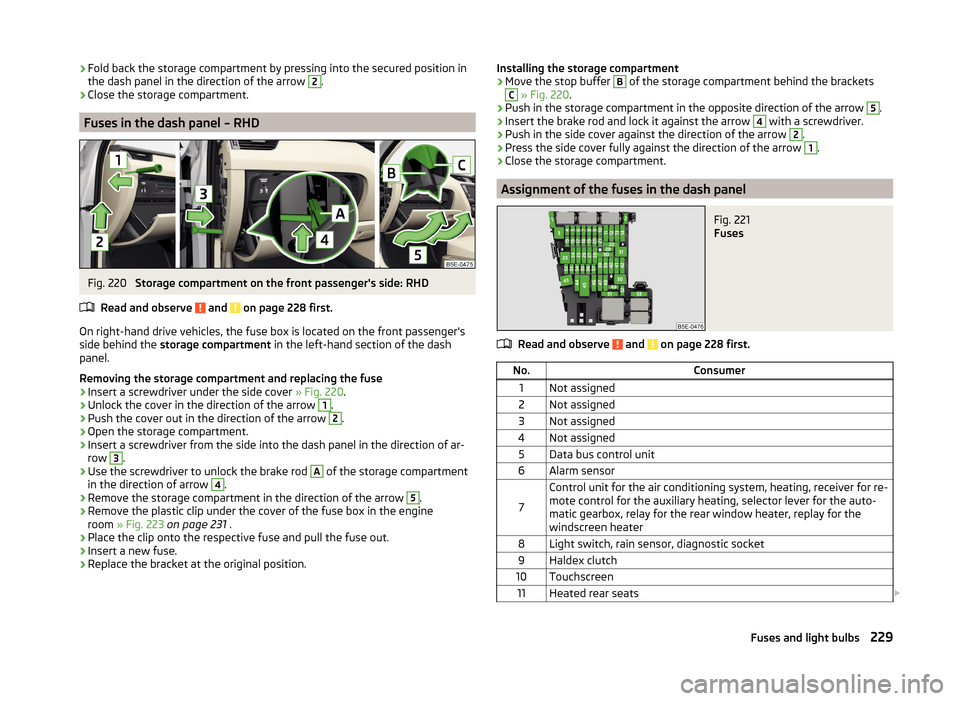
Fig. 220
Storage compartment on the front passenger's side: RHD
Read and observe
and on page 228 first.
On right-hand drive vehicles, the fuse box is located on the front passenger's
side behind the storage compartment in the left-hand section of the dash
panel.
Removing the storage compartment and replacing the fuse
›
Insert a screwdriver under the side cover » Fig. 220.
›
Unlock the cover in the direction of the arrow
1
.
›
Push the cover out in the direction of the arrow
2
.
›
Open the storage compartment.
›
Insert a screwdriver from the side into the dash panel in the direction of ar-
row
3
.
›
Use the screwdriver to unlock the brake rod
A
of the storage compartment
in the direction of arrow
4
.
›
Remove the storage compartment in the direction of the arrow
5
.
›
Remove the plastic clip under the cover of the fuse box in the engine
room » Fig. 223 on page 231 .
›
Place the clip onto the respective fuse and pull the fuse out.
›
Insert a new fuse.
›
Replace the bracket at the original position.
Installing the storage compartment›Move the stop buffer B of the storage compartment behind the bracketsC
» Fig. 220 .
›
Push in the storage compartment in the opposite direction of the arrow
5
.
›
Insert the brake rod and lock it against the arrow
4
with a screwdriver.
›
Push in the side cover against the direction of the arrow
2
.
›
Press the side cover fully against the direction of the arrow
1
.
›
Close the storage compartment.
Assignment of the fuses in the dash panel
Fig. 221
Fuses
Read and observe and on page 228 first.
No.Consumer1Not assigned2Not assigned3Not assigned4Not assigned5Data bus control unit6Alarm sensor
7
Control unit for the air conditioning system, heating, receiver for re-
mote control for the auxiliary heating, selector lever for the auto-
matic gearbox, relay for the rear window heater, replay for the
windscreen heater8Light switch, rain sensor, diagnostic socket9Haldex clutch10Touchscreen11Heated rear seats 229Fuses and light bulbs
Page 235 of 280
Change bulb for long-distance, daytime running lights and parking light
switch233
Change bulb for additional parking light
233
Change bulb for fog light switch - Variant 1
234
Change bulb for fog light switch - Variant 2
234
Replacing the bulb for the licence plate light
235
Rear Light
235
Replacing bulbs in the rear light - Variant 1
236
Replacing bulbs in the rear light - Variant 2
237
Some manual skills are required to change a bulb. For this reason, we recom-
mend having bulbs replaced by a specialist garage or seeking other expert help
in the event of any uncertainties.
› Switch off the ignition and all of the lights before replacing a bulb.
› Faulty bulbs must only be replaced with the same type of bulbs. The designa-
tion is located on the light socket or the glass bulb.
› A stowage compartment for replacement bulbs is located in a plastic box in
the spare wheel or underneath the floor covering in the luggage compart-
ment.
WARNING■ Always read and observe the warnings before completing any work in the
engine compartment » page 192.■
Accidents can be caused if the road in front of the vehicle is not suffi-
ciently illuminated and the vehicle cannot or can only be seen with difficul-
ty by other road users.
■
Bulbs H7 H8 and H15 are pressurised and may burst when changing the
bulb - risk of injury! We therefore recommended wearing gloves and safety
glasses when changing a bulb.
■
Gas discharge bulbs (xenon bulbs) operate with a high voltage, professio-
nal knowledge is required – risk of death!
■
Switch off the respective vehicle light when changing the bulb.
CAUTION
Do not take hold of the glass bulb with naked fingers (even the smallest
amount of dirt reduces the working life of the light bulb). Use a clean cloth,
napkin, or similar.Note■ This Owner's Manual only describes the replacement of bulbs where it is pos-
sible to replace the bulbs on your own without any complications arising. Other
bulbs must be replaced by a specialist garage.■
We recommend that a box of replacement bulbs always be carried in the ve-
hicle. Replacement bulbs can be purchased from ŠKODAOriginal Accessories.
■
We recommend having the headlight settings checked by a specialist garage
after replacing a bulb in the main beam, low beam or fog lights.
■
In case of failure of a xenon gas discharge lamp or an LED diode, visit a spe-
cialist garage.
Bulb arrangement in the headlights
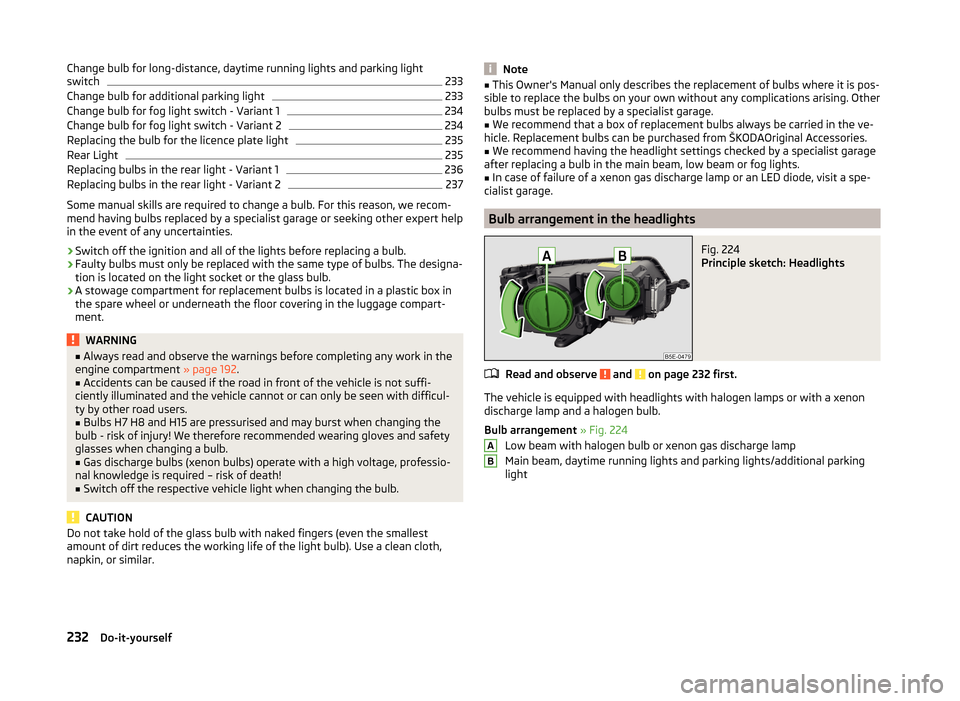
Fig. 224
Principle sketch: Headlights
Read and observe and on page 232 first.
The vehicle is equipped with headlights with halogen lamps or with a xenon
discharge lamp and a halogen bulb.
Bulb arrangement » Fig. 224
Low beam with halogen bulb or xenon gas discharge lamp
Main beam, daytime running lights and parking lights/additional parking
light
AB232Do-it-yourself
Page 239 of 280
›Press together the interlocks on the connector 1)
in the direction of arrow 3.›Carefully remove the connector from the tail lamp assembly in the direction
of the arrow 4
.
Fitting
›
Insert the bulb holder in the light.
The locks on the plug must be inserted securely.
›
Insert the lamp with the pin
A
» Fig. 232 on page 236 into the recesses
C
» Fig. 231 in the body.
›
Carefully push the cover in » .
›
Screw the tail lamp into place and install the cover.
The cover must engage securely.
CAUTION
■ Ensure that the cable bundle does not become pinched between the body
and the lamp when it is being refitted – risk of damage to the electrical instal-
lation and risk of water ingress.■
If you are not sure whether the cable bundle has become pinched, we recom-
mend that you have the light connection checked by a specialist garage.
■
Ensure that the vehicle paintwork and the tail lamp are not damaged when
removing and installing the tail lamp.
Replacing bulbs in the rear light - Variant 1
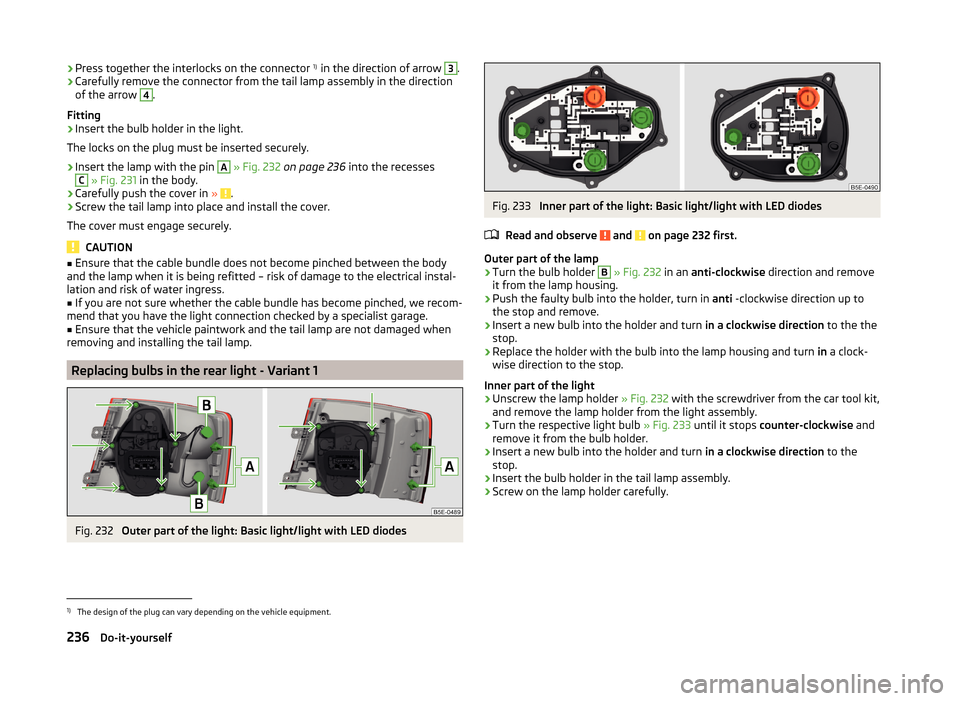
Fig. 232
Outer part of the light: Basic light/light with LED diodes
Fig. 233
Inner part of the light: Basic light/light with LED diodes
Read and observe
and on page 232 first.
Outer part of the lamp
›
Turn the bulb holder
B
» Fig. 232 in an anti-clockwise direction and remove
it from the lamp housing.
›
Push the faulty bulb into the holder, turn in anti -clockwise direction up to
the stop and remove.
›
Insert a new bulb into the holder and turn in a clockwise direction to the the
stop.
›
Replace the holder with the bulb into the lamp housing and turn in a clock-
wise direction to the stop.
Inner part of the light
›
Unscrew the lamp holder » Fig. 232 with the screwdriver from the car tool kit,
and remove the lamp holder from the light assembly.
›
Turn the respective light bulb » Fig. 233 until it stops counter-clockwise and
remove it from the bulb holder.
›
Insert a new bulb into the holder and turn in a clockwise direction to the
stop.
›
Insert the bulb holder in the tail lamp assembly.
›
Screw on the lamp holder carefully.
1)
The design of the plug can vary depending on the vehicle equipment.
236Do-it-yourself
Page 242 of 280
Operating weight and payload
Operating weight
This value represents the minimum operating weight without additional
weight-increasing equipment such as air conditioning system, spare wheel, or
trailer hitch.
The specified operating weight is for orientation purposes only.
The operating weight also contains the weight of the driver (75 kg), the weight
of the operating fluids, the tool kit, and a fuel tank filled to 90 % capacity.
Operating weight of the vehicle » page 246, Vehicle-specific information de-
pending on engine type .
Payload
It is possible to calculate the approximate maximum payload from the differ-
ence between the permissible total weight and the operating weight.
The payload consists of the following weights.
› The weight of the passengers.
› The weight of all items of luggage and other loads.
› The weight of the roof, including the roof rack system.
› The weight of the equipment that is excluded from the operating weight.
› The trailer drawbar load with trailer operation (max. 75 kg or 80 kg for vehi-
cles with 4-wheel drive or 56 kg for G-TEC vehicles).
Note
If required, you can find out the precise weight of your vehicle at a specialist
garage.
Measurement of fuel consumption and CO 2 emissions according to
ECE Regulations and EU Directives
The data on fuel consumption and CO 2 emissions were not available at the
time of going to press.
The data on fuel consumption and CO 2 emissions are given on the ŠKODA
websites or in the sales and technical vehicle documentation.
The measurement of the intra-urban cycle begins with a cold start of the en-
gine. Afterwards urban driving is simulated.
In the extra-urban driving cycle, the vehicle is accelerated and decelerated in
all gears, corresponding to daily routine driving conditions. The driving speed
varies between 0 and 120 km/h.
The calculation of the combined fuel consumption considers a weighting of
about 37 % for the intra-urban cycle and 63 % for the extra-urban cycle.
Note
■ The fuel consumption and emission levels given on the ŠKODA websites or in
the commercial and technical vehicle documentation have been established in
accordance with rules and under conditions that are set out by legal or techni-
cal rules for the determination of operational and technical data of motor vehi-
cles.■
Depending on the extent of the equipment, the driving style, traffic condi-
tions, weather influences and vehicle condition, consumption values can in
practice result in fuel economy figures in the use of the vehicle that differ from
the fuel consumption values listed on the ŠKODA websites or in the commer-
cial and technical vehicle documentation.
239Technical data
Page 247 of 280

Departure angle - OctaviaFig. 238
Principle sketch: Departure an-
gle
Angle » Fig. 238
Departure angle, front
Departure angle, rear
Departure angle
The values shown indicate the maximum incline of an embankment on which the vehicle can drive at a slow speed without collision of the bumper or under-
body.
The values listed correspond to the maximum front or rear axle loadABDeparture angle (°)» Fig. 238OctaviaOctavia 4x4Octavia RSABABABBasic dimension1412.314.112.4--Vehicles with off-road package.15.11315.312.2--Vehicles with SPORT package12.912.5--12.912.4244Technical data
Page 248 of 280

Departure angle - Octavia CombiFig. 239
Schematic diagram: Departure
angle
Angle » Fig. 239
Departure angle, front
Departure angle, rear
Departure angle
The values shown indicate the maximum incline of an embankment on which the vehicle can drive at a slow speed without collision of the bumper or under-
body.
The values listed correspond to the maximum front or rear axle loadABDeparture angle (°)» Fig. 239Octavia EstateOCTAVIA Estate 4x4OCTAVIA Estate RSOCTAVIA Estate SCOUTABABABABBasic dimension13.912.214.212.5----Vehicles with off-road package.14.913.215.312.4--16.713.8Vehicles with SPORT package12.812.4--12.812.3--245Technical data