fuel consumption SKODA OCTAVIA TOUR 2010 2.G / (1Z) User Guide
[x] Cancel search | Manufacturer: SKODA, Model Year: 2010, Model line: OCTAVIA TOUR, Model: SKODA OCTAVIA TOUR 2010 2.G / (1Z)Pages: 199, PDF Size: 12.09 MB
Page 122 of 199
Driving and the Environment121
Using the system
Safety
Driving Tips
General Maintenance
Breakdown assistance
Technical Data
Reducing idling
Idling also costs fuel.It is worthwhile switching off the engine in a traffic jam or when waiting at a level
crossing or at traffic lights with a lengthy red phase. Even after just 30 - 40 seconds you
will have saved more fuel th an that is needed when you start the engine up again.
If an engine is only idling it takes much longer for it to reach its normal operating
temperature. Wear-and-tear an d pollutant emissions, though, are particularly high in
the warming-up phase. This is why you should drive off right after starting the engine.
Do avoid high engine revolu tions at this time, however.Regular servicing
A poorly tuned engine consumes an unnecessarily high amount of fuel.Having your vehicle serviced regularly at a specialist garge enables you to satisfy one
of the requirements for economical motoring even before you set off on your journey.
Keeping your vehicle properly serviced not on ly has a positive effect on the safety of
your vehicle and maintaining its value, but also saves on fuel.
A poorly tuned engine can result in a fu el consumption which is 10 % higher than
normal.
The foreseen maintenance work should be undertaken exactly according to the
Service schedule by a specialist garage.
Also check the oil level after refuelling. Oil consumption is dependent to a consider-
able extent on the load and speed of the en gine. Oil consumption could be as high as
0.5 litres/1 000 km depending on your style of driving.
It is quite normal that a new engine has a higher oil consumption at first, and reaches
its lowest level only after a certain running in time. It is therefore not possible to
correctly assess the oil consum ption of a new vehicle until after you have driven about
5 000 km.
For the sake of the environment
You can achieve additional improvements in your fuel economy by using high-
lubricity oils.
Check the ground below your vehicle at regu lar intervals to detect any leakages in
good time. Please have your vehicle inspected by a specialist garge if you find any
stains caused by oil or other fluids on the floor.
Avoid driving short distances
Short distances result in an above-average high fuel consumption.– Avoid driving a distance of no more than 4 km if the engine is cold.
The engine and catalytic converter mu st first have reached their optimal operating
temperature in order to effectively reduce fuel consumption and pollutant emissions.
The cold engine vehicle cons umes approx. 15 - 20 litres/100 km of fuel immediately
after starting. Fuel co nsumption drops to 10 litres/100 km after just 1 kilometre. The
engine reaches its operating temperat ure (outside temperature and engine
dependent) only after about 4 to 10 kilometres and the fuel consumption then stabi-
lizes. You should therefore avoid driving short distances whenever possible.
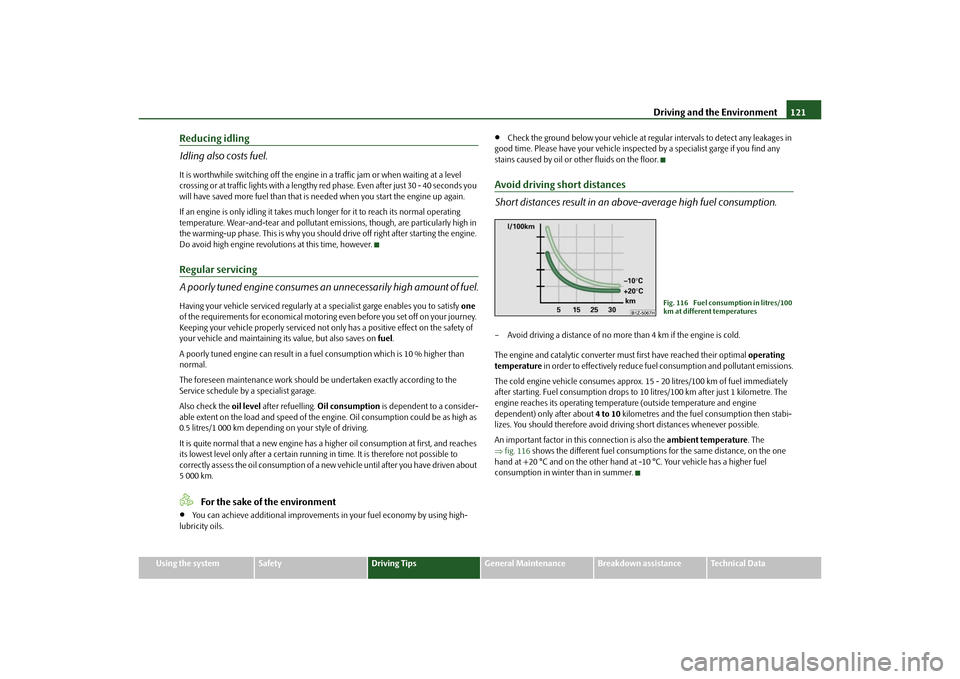
An important factor in this connection is also the ambient temperature. The
fig. 116 shows the different fuel consumptions for the same distance, on the one
hand at +20 °C and on the other hand at -10 °C. Your vehicle has a higher fuel
consumption in winter than in summer.
Fig. 116 Fuel consumption in litres/100
km at different temperatures
s2bs.2.book Page 121 Monday, September 27, 2010 9:53 AM
Page 123 of 199

Driving and the Environment
122
Checking tyre inflation pressures
Tyres which are correctly inflated save fuel.Always ensure that your tyres are inflated to the correct pressure at all times. The rolling
resistance will be increased if the inflation pressure is too low. This will not only
increase fuel consumption but also tyre we ar and the driving behaviour will worsen.
Always check the inflation pr essure of the tyres when cold.
Do not drive with winter tyres all year round for this costs about 10 % more fuel.
Winter tyres are also louder.No unnecessary ballast
Transporting ballast costs fuel.The fact that every kilogram of extra weight increases your fuel consumption means
that it is worth taking a look in the lu ggage compartment to avoid transporting any
unnecessary ballast.
It is particularly in town traffic, when one is accelerating quite often, that the vehicle
weight will have a significant effect upon the fuel consumption. A rule of thumb here
is that an increase in weight of 100 kilogr ams will cause an increase in fuel consump-
tion of about 1 litre/100 kilometres.
You may frequently also leave a roof rack fitted on just out of convenience, although
you no longer need it. The increased aerodyna mic drag of your vehicle causes it to use
about 10 % more fuel than normal at a speed of 100 - 120 km/h, even when you are
not carrying a load on the roof.Saving electricity
Generating electricity costs fuel.– Switch off electrical components as soon as you no longer need them.
When the engine is running, the alternator generates and supplies electrical power.
The greater the load on the alternator as a result of having a large number of electrical
components switched on, the more fuel will be consumed for operating the
alternator.
Keeping a log of your fuel consumptionIf you really wish to keep a close check on your fuel consumption, it is best to enter
the figures in a logbook. This does not take much time but is a very worthwhile exer-
cise. It enables you to detect any change (p ositive and negative) at an early stage and
to take any appropriate action.
If you find that your fuel consumption is too high, you should reflect on how, where
and in what conditions you have driven the vehicle since you last refuelled.Environmental compatibilityEnvironmental protection has played a major role in the design, selection of materials
and manufacture of your new Škoda. Particular emphasis has been paid to a number
of aspects, including:
Design measures
Joints designed to be easily detached.
Simplified disassembly due to the modular structure system.
Improved purity of differ ent classes of materials.
Identification of all plastic parts in accordance with VDA Recommendation°260.
Reduced fuel consumption and exhaust emission CO
2.
Minimum fuel leakage during accidents.
Reduced noise.
Choice of materials
Extensive use of recyclable material.
Air conditioning filled wi th CFC-free refrigerant.
No cadmium.
No asbestos.
Reduction in the “vaporisation” of plastics.
Manufacture
Solvent-free cavity protection.
s2bs.2.book Page 122 Monday, September 27, 2010 9:53 AM
Page 137 of 199

Fuel
136
FuelPetrolGrades of petrolYour vehicle can only be operated with unleaded petrol, which complies with the
standard EN 228. The individual grades of petrol are distinguished by their octane
number (RON). On the inside of the fuel filler flap, you will find the information
regarding the octane number required by your engine page 137, fig. 119 - right.
Prescribed types of fuel - unleaded petrol RON 95/91
Use unleaded petrol 95 RON. You can also use unleaded RON 91. However some loss
of power is to be expected when doing so.
If, in an emergency, the only fuel availa ble is one which has a lower octane number
than that required by the engine then only drive at medium engine speeds and
minimal engine load. Driving at high engine speeds or heavy engine loads can lead to
serious engine damage! Refuel with petrol with the specified octane number as often
as possible.
Prescribed fuel - unleaded petrol min. 95 RON
Use unleaded petrol 95 RON.
If unleaded RON 95 is not available, you ca n refuel with unleaded RON 91 in an emer-
gency. After refuelling, co ntinue driving at medium engine speeds and minimum
engine load. Driving at high engine speeds or heavy engine loads can lead to serious
engine damage! Refuel with petrol with the specified octane number as often as
possible.
Fuel with a lower octane number than RON 91 must not be used even in an emer-
gency. Otherwise you can ca use serious engine damage!
You can find further information on refuelling page 137, “Refuelling”.
Prescribed types of fuel - unleaded petrol RON 98/(95)
Use unleaded petrol 98 RON. You can also use unleaded RON 95. However some loss
of power is to be expected when doing so. If unleaded RON
98 or RON 95 is not available, you ca n refuel with unleaded RON 91
in an emergency. After refuelling, conti nue driving at medium engine speeds and
minimum engine load. Driving at high engine speeds or heavy engine loads can lead
to serious engine damage! Refuel with pe trol with the specified octane number as
often as possible.
Fuel with a lower octane number than RON 91 must not be used even in an emer-
gency. Otherwise you can ca use serious engine damage!
You can find further info rmation on refuelling page 137, “Refuelling”.
Unleaded petrol with a higher octane number
You can use unleaded petrol which has a higher octa ne number than the one
prescribed without restriction.
On vehicles with prescribed unleaded petrol RON 95/91, the use of petrol with a
higher octane number than 95 does not result in a noticeable power increase or a
lower fuel consumption.
On vehicles with prescribed unleaded petrol RON 95/91, the use of petrol with a
higher octane number than 95 does not result in a noticeable power increase or a
lower fuel consumption.
Caution
All Škoda vehicles with petrol engines are equipped with a catalytic converter and
must be only driven with unleaded petrol. Fi lling the tank even only once with leaded
petrol will result in the cata lytic converter being destroyed!
Only use unleaded petrol which complies with the standard EN 228.
Operating the engine with petrol of a lo wer octane number than that prescribed
can result in serious engine damage.
s2bs.2.book Page 136 Monday, September 27, 2010 9:53 AM
Page 143 of 199
Inspecting and replenishing
142
It is normal for the engine to consume oil. The oil consumption may be as much as 0.5
l/1 000 km depending on your style of driving and the conditions under which you
operate your vehicle. The oil consumption may be slightly hi gher than this during the
first 5000 kilometres.
One should therefore check the oil level at regular intervals, preferably every time after
the fuel tank is filled or after driving for long stretches.
We recommend maintaining the oil level within the range - but not above this, if
the engine has been operating at high load s, for example during a lengthy motorway
trip during the summer months, towing a tr ailer or negotiating a high mountain pass.
The warning light in the instrument cluster* will indicate page 25, “Engine oil pres-
sure ” whether the oil level is too low. In this case, check the oil level as soon as
possible. Top up with an appropriate quantity of oil.
Caution
The oil level must on no account extend beyond the range . Danger of damaging
the catalytic converter.
Do not continue your journey if for some reason it is not possible under the
conditions prevailing to top up with oil. Switch the engine off and obtain professional
assistance from a specialist garage, otherwise it could lead to severe engine damage.Note
Engine oil specifications page 179, “Technical Data”.Replenishing engine oil– Inspecting the engine oil level page 141.
– Unscrew the cap of the engine oil filler opening.
– Pour in a suitable grade of oil in portions of 0.5 litres page 180, “Engine oil spec-
ifications”.
– Inspect the oil level page 141.
– Carefully screw on the cap of the filler opening and push the dipstick in fully.
WARNING
Avoid dripping oil onto hot parts of the engine when topping up will oil - a
risk of fire!
Read and observe the warning notes page 140, “Working in the engine
compartment” before working in the engine compartment.For the sake of the environment
The oil level must on no acco unt extend beyond the range page 141. Oil will
otherwise be drawn in through the crankc ase ventilation and may pass through the
exhaust system to atmosphere. The oil ma y combust in the catalytic converter and
damage it.Changing engine oilThe engine oil must be changed at the intervals stated in the Service schedule or
according to the service interval indicator page 17, “Service Interval Display”.
WARNING
Only carry out the engine oil change, if you have the required professional
knowledge!
Read and observe the warning notes page 140, “Working in the engine
compartment” before working in the engine compartment.
First of all, let the engine cool down, we ar an eye protection and gloves - risk
of caustic burns due to hot oil.Caution
You must not pour any additives into the engine oil - risk of engine damage! Damage,
which results from such product, are excluded from the warranty.
For the sake of the environment
You must on no account pour oil into the ground or into the sewage system.
AAAA
AA
s2bs.2.book Page 142 Monday, September 27, 2010 9:53 AM
Page 153 of 199

Wheels and Tyres
152
The tyre inflation pressures for tyres of the tyre size 205/50 R17, which are intended to
be used with snow chains, is identical to the pressures for tyres of the tyre size
225/45 R17, see page 151, fig. 129 .
The tyre pressure should be at the highest pressure specified for your vehicle at all
times.
The tyre inflation pressure of the emergency spare wheel R 18 is 420 kPa (4.2 bar).
Always check the inflation pressure of tyres when cold. Do not reduce the higher pres-
sure of warm tyres. Adapt the inflation pressure of the tyres accordingly if your vehicle
is carrying a significantly higher payload.
Driving style
Fast cornering, sharp acceleration and brak ing (squealing tyres) increase wear-and-
tear on your tyres.
Balancing wheels
The wheels of a new vehicle are balanced. There are a wide range of influences when
driving which may result in an imbalance and which makes themselves felt through
vibration in the steering.
You should have the wheels rebalanced si nce any imbalance increases wear-and-tear
on the steering, the suspension and tyres. A wheel must also be rebalanced when a
new tyre is fitted and each time a tyre is repaired.
Wheel alignment errors
Incorrect wheel alignment at the front and re ar will not only increase wear-and-tear on
the tyres but will also has an adverse effect on vehicle safety. Contact your specialist
garage if you notice any unusual tyre wear.
WARNING
If the inflation pressure is too low, the tyre must perform a greater flexing
work. At higher speeds the tyre will warm up as a result of this. This can result
in tread separation and even a tyre blowout.
Immediately replace the damaged rims or tyres.
Tyres which are 6 years old or more should only be fitted in exceptional
cases and when adopting an approp riately cautious style of driving.
For the sake of the environment
Tyres which are insufficiently inflated increase your fuel consumption.Wear indicatorsThe base of the tread of the original tyres has wear indicators 1.6 mm high, installed at
right angles to the direction of travel. These wear indicators are located at 6 - 8 points
depending on the make and are evenly spaced around the circumference of the tyre
fig. 130 . Markings on the walls of the tyres through the letters “TWI”, triangular
symbols or other symbols identify th e position of the wear indicators.
A re m a i n i n g t re a d o f j u s t 1 .6 m m , m e a s u re d i n t h e g ro o v e s o f t he tre a d n e x t t o th e w e a r
indicators, means that your tyres have reached their legally permissible minimum
tread depth.
WARNING
You must have your tyres replaced with new ones at the latest when the
wear indicators have been worn down . The legally permissible minimum tread
depth should be observed.
Worn tyres do not provide the necessary adhesion to the road surface at
high speeds on wet roads. One could experience “aquaplaning” (uncontrolled
movements of the vehicle - “swimming” on a wet road surface).
Fig. 130 Tyre tread with wear indicators
s2bs.2.book Page 152 Monday, September 27, 2010 9:53 AM
Page 156 of 199
Wheels and Tyres155
Using the system
Safety
Driving Tips
General Maintenance
Breakdown assistance
Technical Data
Winter tyresThe handling of your vehicle will be signif icantly improved when driving on wintry
roads if you fit winter tyres. Summer tyres do not offer the same grip on ice, snow and
at temperatures below 7 °C because of thei r construction (width, rubber blend, tread
pattern). This particularly applies to vehicles which are equipped with low-profile
tyres or high-speed tyres (code index H or V on wall of tyre).
Winter tyres must be mounted on all four wheels to obtain the best handling charac-
teristics.
You must only fit those types of winter tyre which are approved for your vehicle. The
permissible sizes of winter tyres are stated in your vehicle documents. Approvals may
differ because of na tional legislation.
Please remember that the tyres should be inflated to 20 kPa (0.2 bar) more than is the
case for summer tyres page 151.
Winter tyres no longer offer the same winter performance once the tyre tread has
worn down to a depth of about 4 mm.
Ageing also causes winter tyres to lose most of their winter performance properties -
even in cases where the remaining tread depth is still clearly more than 4 mm.
Speed restrictions apply to winter tyres as well as to summer tyres page 153,
.
You can fit winter tyres of a lower speed catego ry to your vehicle provided that you also
do not drive faster than the permissible maximum speed for such tyres, even if the
possible maximum speed of your vehicle is higher. The corresponding tyre category
can damage the tyres when exceeding the permissible maximum speed.
Please pay attention to the notes if you decide to fit winter tyres page 151.
You can also fit so-called “all-year tyres” instead of winter tyres.
Please contact your specialist garage if there are any points which are not clear who will
be able to provide you with information regarding the maximum speed for your tyres.
WARNING
You must on no account drive your car at more than the permissible maximum
speed for your winter tyres - risk of an accident resulting from tyre damage and
loss of control over your car.
For the sake of the environment
Fit your summer tyres on again in good time since summer tyres offer you better grip
and handling on roads which are free of snow and ice as well as are temperatures
below 7 °C - the braking distance is shorter, there is less tyre noise, tyre wear is reduced
and fuel consumption is reduced.
Note
Please observe the various differing legal requirements regarding tyres.Unidirectional tyres*The direction of rotation of the tyres is marked by arrows on the wall of the tyre. This
indicates the direction of rotation of the tyre, and it is essential that the tyres are fitted
on to run in this direction. Only then are the tyres able to provide the optimal proper-
ties in terms of grip, low nois e, wear-and-tear and aquaplaning.
Should it be necessary to fit on a spare wheel in exceptional cases with a tyre not dedi-
cated to the running direction or in oppo site running direction, please adopt a
cautious style of driving as the tyre is no longer able to provide optimal grip and
handling in such a situation. This particular ly important on wet roads. Please refer to
the notes page 160, “Spare wheel*”.
You should have the defective tyre replaced as soon as possible and restore the correct
direction of rotation on all tyresSnow chainsSnow chains must only be mounted on the front wheels.
When driving on wintry roads, snow chains improve not only traction, but also the
braking performance.
For technical reasons, it is only permissi ble to fit snow chains with the following
wheel/tyre combinations:
s2bs.2.book Page 155 Monday, September 27, 2010 9:53 AM
Page 181 of 199

Technical Data
180
Vehicle identification number (VIN)
The vehicle identification num ber - VIN (chassis number) is stamped into the engine
compartment on the right hand shock absorb er dome. This number is also located on
a sign on the lower left hand edge below the windscreen.
Engine number
The engine number is stam ped into the engine block.
Type plate (production plate)
The type plate is located in the lowe r area of the left centre column.
Sticker on inside of fuel filler flap
The stickers are affixed to the inside of the fuel filler flap and contain the following
information:
The prescribed types of fuel,
Ty re s i z e ,
Tyre pressure.
Fuel consumption based on ECE regulations and EC guidelinesDepending on the range of the special equipment, style of driving, traffic situation,
weather influences and vehicl e condition, the consumption values which in practice
result when using the vehicle can deviate from the indicated values.
Urban traffic
The consumption measurement in urban traffic begins with starting of the cold engine.
Afterwards the normal ur ban traffic is simulated.
Non-urban traffic
For the consumption measurement in non-ur ban traffic the vehicle, as in daily
motoring, is accelerated and braked severa l times in all gears. The vehicle speed
changes within the range from 0 to 120 km/h. Combined traffic
The consumption value in the combined traffic consists of 37 % from the value for the
urban traffic and of 63 % from th
e value for the non-urban traffic.
DimensionsDimensions (mm)Engine oil specificationsThe grade of engine oil should be selected in accordance with precise
specifications.The engine of your vehicle has been factory-filled with a high-grade oil which you can
use throughout the year - except in extreme climatic regions.
You can mix various oils together with each ot her when refilling with oil. This does not,
however, apply for models with flexible service intervals (QG1).
Engine oils are, of course, undergoing continuous further development. Thus the
information stated in this Owner's Manual is only correct at the time of publication.
OCTAVIA
COMBI
Length
4572
4572
Width
1769
1769
Width including exterior mirror
2018
2018
Height
1462
1485
a)
a)The value corresponds to the status with rough road package.
1468
1490
a)
Clearance
140
164a)
140
164a)
Wheel base
2578
2578
Tr a c k g a u g e f r o n t / r e a r
1541/1514
1541/1514
s2bs.2.book Page 180 Monday, September 27, 2010 9:53 AM
Page 183 of 199

Technical Data
182
1.4 ltr./59 kW - EU5Engine
Performances
Fuel consumption (in ltr./100 km) and CO
2 emission (in g/km)
Power output
kW per rpm
59/5000
Maximum torque
Nm per rpm
132/3800
Number of cylinders/Displacement (cm
3)
4/1390
OCTAVIA
CO M B I
Maximum speed
km/h
174
172
Acceleration 0 - 100 km/h
s
14,3
14,4
OCTAVIA
COMBI
Urban
8,5
8,5
Ex-urban
5,1
5,1
combined
6,4
6,4
CO2 emissions combined
149
149
s2bs.2.book Page 182 Monday, September 27, 2010 9:53 AM
Page 185 of 199

Technical Data
184
1.6ltr./75kW - EU4, EU2Engine
Performances
Fuel consumption (in ltr./100 km) and CO
2 emission (in g/km)
Power output
kW per rpm
75/5600
Maximum torque
Nm per rpm
148/3800
Number of cylinders/Displacement (cm
3)
4/1595
OCTAVIA
COMBI
Maximum speed
km/h
190
189
Acceleration 0 - 100 km/h
s
12,3
12,4
OCTAVIA
COMBI
Urban
9,6/10,0
a)
a)EU4, EU2
9,7/10,0
a)
Ex-urban
5,5/5,8
a)
5,6/5,8
a)
combined
7,1/7,4
a)
7,2/7,4
a)
CO2 emissions combined
166/176
a)
168/176
a)
s2bs.2.book Page 184 Monday, September 27, 2010 9:53 AM
Page 187 of 199

Technical Data
186
2.0 l/81 kW TDI CR EU4Engine
Performances
Fuel consumption (in ltr./100 km) and CO
2 emission (in g/km)
Power output
kW per rpm
81/4200
Maximum torque
Nm per rpm
250/1500-2500
Number of cylinders/Displacement (cm
3)
4/1968
OCTAVIA
COMBI
Maximum speed
km/h
195
194
Acceleration 0 - 100 km/h
s
11,0
11,1
Urban
6,5
Ex-urban
4,3
combined
5,0
CO2 emissions combined
132
s2bs.2.book Page 186 Monday, September 27, 2010 9:53 AM