ECU SKODA RAPID 2013 1.G User Guide
[x] Cancel search | Manufacturer: SKODA, Model Year: 2013, Model line: RAPID, Model: SKODA RAPID 2013 1.GPages: 226, PDF Size: 15.16 MB
Page 70 of 226
Luggage compartment coverFig. 63
Secure luggage compartment cover
First read and observe the introductory information and safety warn- ings
on page 64.
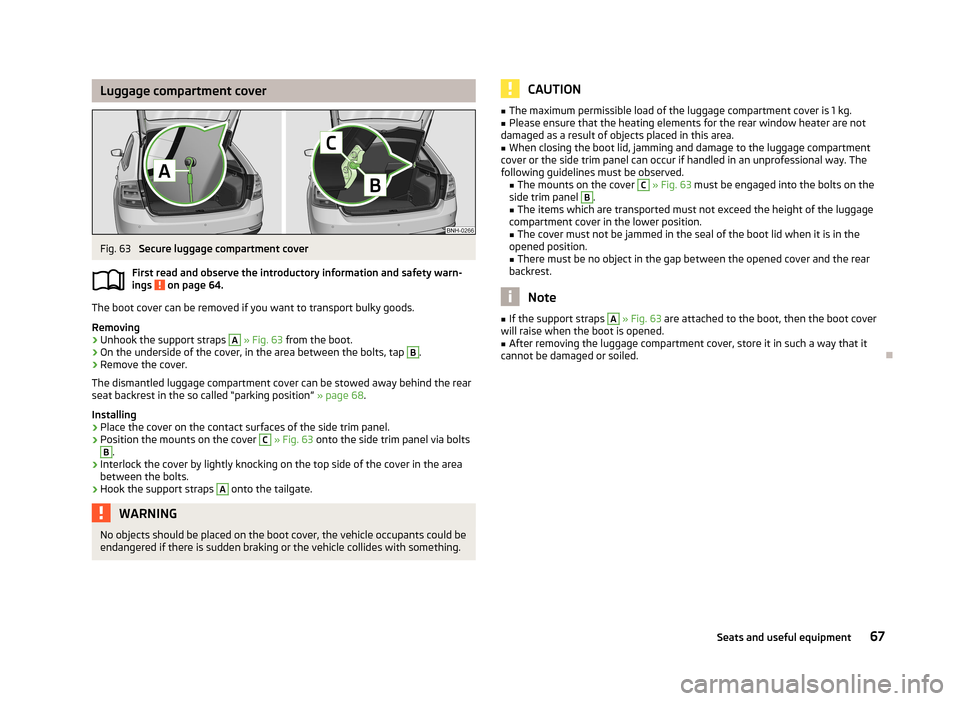
The boot cover can be removed if you want to transport bulky goods.
Removing
›
Unhook the support straps
A
» Fig. 63 from the boot.
›
On the underside of the cover, in the area between the bolts, tap
B
.
›
Remove the cover.
The dismantled luggage compartment cover can be stowed away behind the rear
seat backrest in the so called “parking position” » page 68.
Installing
›
Place the cover on the contact surfaces of the side trim panel.
›
Position the mounts on the cover
C
» Fig. 63 onto the side trim panel via bolts
B
.
›
Interlock the cover by lightly knocking on the top side of the cover in the area
between the bolts.
›
Hook the support straps
A
onto the tailgate.
WARNINGNo objects should be placed on the boot cover, the vehicle occupants could be
endangered if there is sudden braking or the vehicle collides with something.CAUTION■ The maximum permissible load of the luggage compartment cover is 1 kg.■Please ensure that the heating elements for the rear window heater are not
damaged as a result of objects placed in this area.■
When closing the boot lid, jamming and damage to the luggage compartment
cover or the side trim panel can occur if handled in an unprofessional way. The
following guidelines must be observed. ■ The mounts on the cover
C
» Fig. 63 must be engaged into the bolts on the
side trim panel
B
.
■ The items which are transported must not exceed the height of the luggage
compartment cover in the lower position.
■ The cover must not be jammed in the seal of the boot lid when it is in the
opened position. ■ There must be no object in the gap between the opened cover and the rear
backrest.
Note
■ If the support straps A » Fig. 63 are attached to the boot, then the boot cover
will raise when the boot is opened.■
After removing the luggage compartment cover, store it in such a way that it
cannot be damaged or soiled.
67Seats and useful equipment
Page 77 of 226
CAUTION■The variable loading floor can only be set to the “parking position” when in the
lower position.■
If the variable loading floor is in the “parking position”, the “parking position” on
the luggage compartment cover cannot be set » page 68.
Roof rack system
Introduction
This chapter contains information on the following subjects:
Attachment points
74
Roof load
75WARNING■ The transported items on the roof rack must be securely attached – risk of
accident!■
Always secure the load with appropriate and undamaged lashing straps or
tensioning straps.
■
Distribute the load evenly over the roof rack system.
■
When transporting heavy objects or objects which take up a large area on
the roof rack system, handling of the car may change as a result of the dis-
placement of the centre of gravity. The style of driving and speed must there-
fore be adapted to the current circumstances.
■
Avoid abrupt and sudden driving/braking manoeuvres.
■
Adjust the speed and driving style to the visibility, weather, road and traffic
conditions.
■
The permissible roof load, permissible axle loads and permissible total vehi-
cle weight must not be exceeded under any circumstance – risk of accident!
CAUTION
■ Only use roof rack systems approved by ŠKODA AUTO a.s.■When dealing with roof rack systems, the installation instructions supplied with
the roof luggage rack system must be observed.■
On models fitted with a power sliding/tilting roof, ensure that the extended
sliding/tilting roof does not hit any items of luggage transported on the roof.
■
Ensure that the boot lid does not hit the roof load when opened.
■ The height of the vehicle changes after mounting a roof luggage rack system
and the load that is secured to it. Compare the vehicle height with available clear- ances, such as underpasses and garage doors.■
Always remove the roof luggage rack system before entering an automated car
wash.
■
Ensure the roof aerial is not impaired by the secured load.
For the sake of the environment
The increased aerodynamic drag results in a higher fuel consumption.
Attachment points
Fig. 76
Attachment points for roof bars
First read and observe the introductory information and safety warn- ings
on page 74.
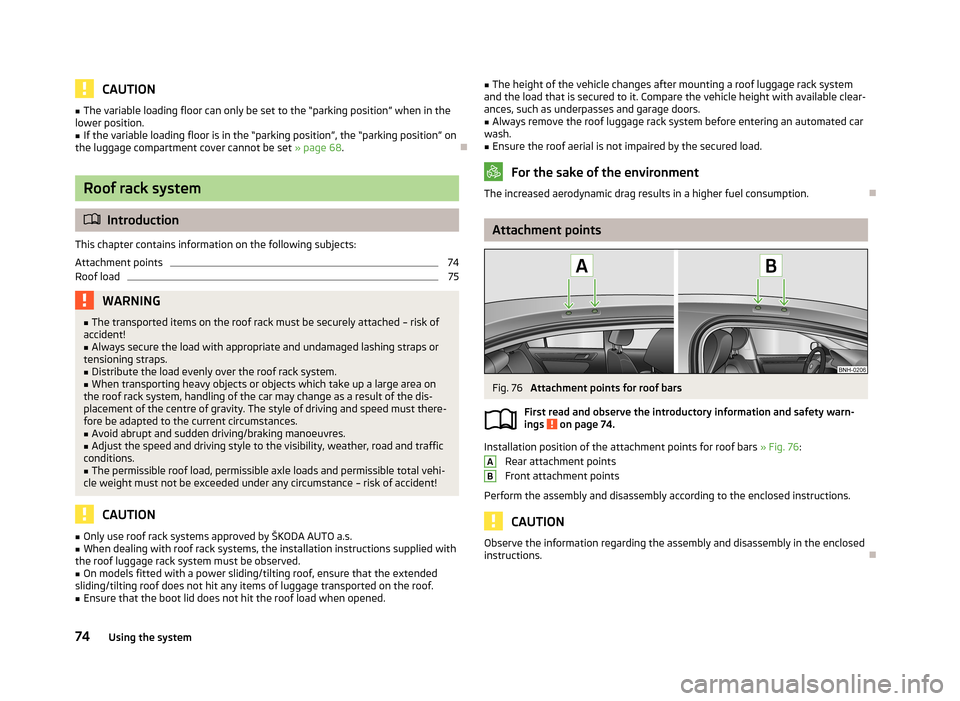
Installation position of the attachment points for roof bars » Fig. 76:
Rear attachment points
Front attachment points
Perform the assembly and disassembly according to the enclosed instructions.
CAUTION
Observe the information regarding the assembly and disassembly in the enclosed
instructions.
AB74Using the system
Page 122 of 226
Towing a trailer
Towing device
Introduction
This chapter contains information on the following subjects:
Description
119
Adjusting the ready position
120
Fitting the ball head
121
Check proper fitting
121
Removing the ball head
122
Use and care
122
If your vehicle has already been factory-fitted with a towing device or is fitted
with a towing device from ŠKODA Original Accessories, then it meets all of the
technical requirements and national legal regulations for towing a trailer.
Your vehicle is fitted with a 13-pin power socket for the electrical connection be-
tween the vehicle and trailer. If the trailer that is to be towed has a 7-pin connec-
tor , you can use a suitable adapter from ŠKODA Original Accessories.
The maximum trailer drawbar load is 50 kg.
WARNING■
Check that the tow bar is seated correctly and is secured in the mounting
recess before the start of every journey.■
Do not use the tow bar if it is not correctly inserted and secured in the
mounting recess.
■
Do not use the towing device if it is damaged or if there are parts missing.
■
Do not modify or adapt the towing device in any way.
■
Never release the tow bar while the trailer is still coupled.
CAUTION
Take care when handling the tow bar so as to avoid damaging the paintwork on
the bumper.
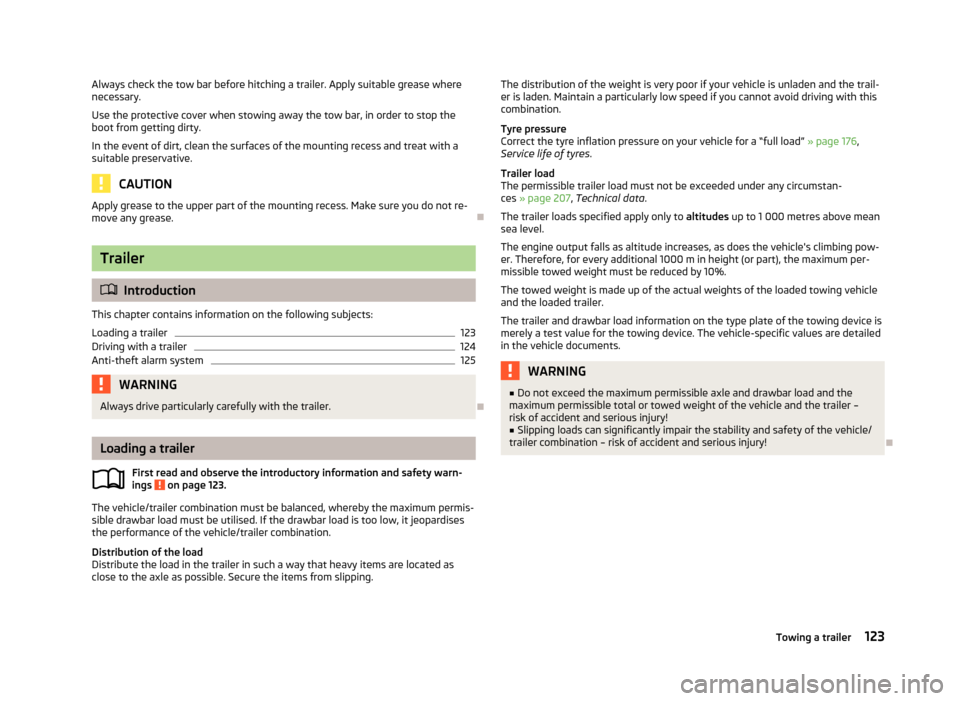
DescriptionFig. 104
Carrier for the towing device/tow bar
First read and observe the introductory information and safety warn-
ings
on page 119.
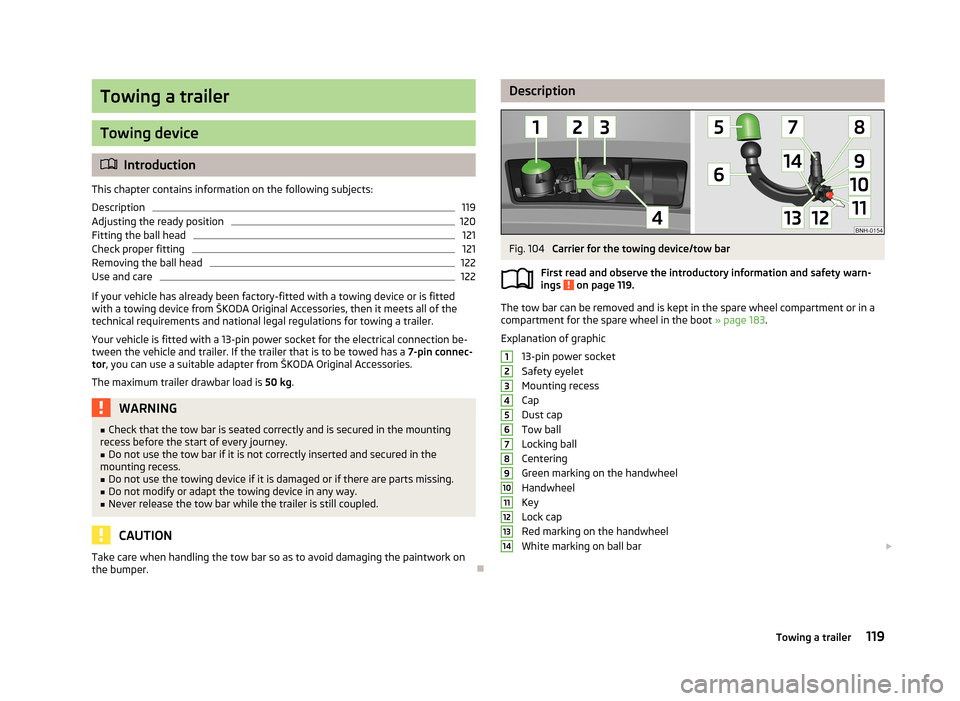
The tow bar can be removed and is kept in the spare wheel compartment or in a
compartment for the spare wheel in the boot » page 183.
Explanation of graphic 13-pin power socket
Safety eyelet
Mounting recess
Cap
Dust cap
Tow ball
Locking ball
Centering
Green marking on the handwheel
Handwheel
Key
Lock cap
Red marking on the handwheel
White marking on ball bar
1234567891011121314119Towing a trailer
Page 124 of 226
Fitting the ball headFig. 107
Insert the ball bar/lock the lock and remove the key
Fig. 108
Fit the lock cap
First read and observe the introductory information and safety warn-
ings on page 119.
›
Remove the cover for the mounting recess
4
» Fig. 104 on page 119 in a down-
wards direction.
›
Put the tow bar in the ready position » page 120.
›
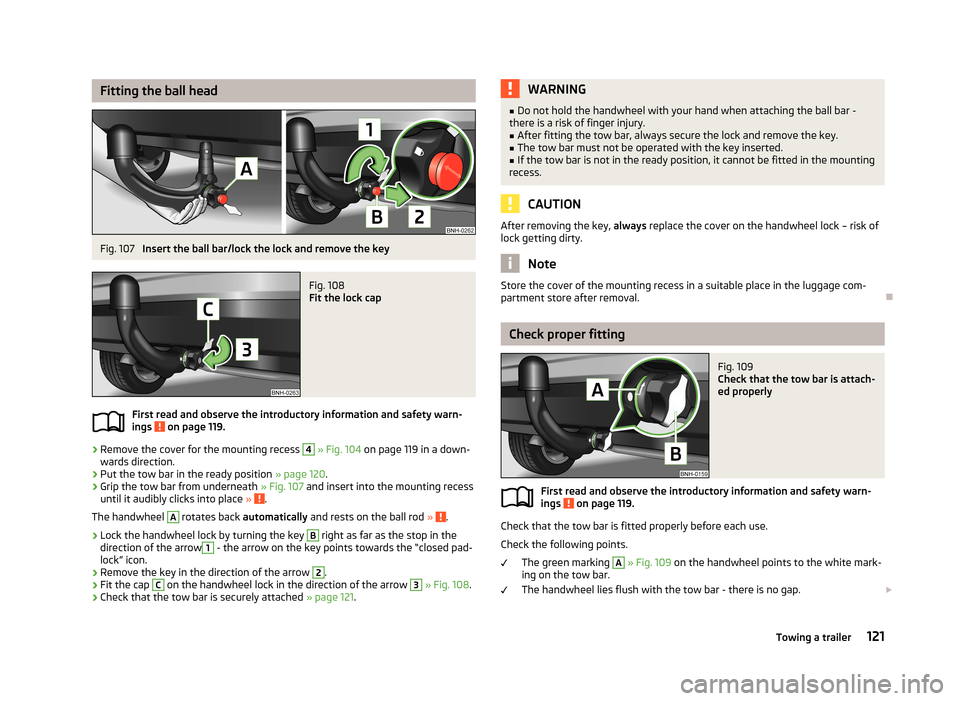
Grip the tow bar from underneath » Fig. 107 and insert into the mounting recess
until it audibly clicks into place » .
The handwheel
A
rotates back automatically and rests on the ball rod » .
›
Lock the handwheel lock by turning the key
B
right as far as the stop in the
direction of the arrow
1
- the arrow on the key points towards the “closed pad-
lock” icon.
›
Remove the key in the direction of the arrow
2
.
›
Fit the cap
C
on the handwheel lock in the direction of the arrow
3
» Fig. 108 .
›
Check that the tow bar is securely attached » page 121.
WARNING■
Do not hold the handwheel with your hand when attaching the ball bar -
there is a risk of finger injury.■
After fitting the tow bar, always secure the lock and remove the key.
■
The tow bar must not be operated with the key inserted.
■
If the tow bar is not in the ready position, it cannot be fitted in the mounting
recess.
CAUTION
After removing the key, always replace the cover on the handwheel lock – risk of
lock getting dirty.
Note
Store the cover of the mounting recess in a suitable place in the luggage com-
partment store after removal.
Check proper fitting
Fig. 109
Check that the tow bar is attach-
ed properly
First read and observe the introductory information and safety warn-
ings on page 119.
Check that the tow bar is fitted properly before each use.
Check the following points. The green marking
A
» Fig. 109 on the handwheel points to the white mark-
ing on the tow bar.
The handwheel lies flush with the tow bar - there is no gap.
121Towing a trailer
Page 125 of 226
The handwheel is locked and the key is removed.
The cap B
is on the handwheel.
The tow bar does not come out of the mounting recess even after heavy
“shaking”.WARNINGDo not use the towing device unless the tow bar has been properly locked!
Removing the ball head
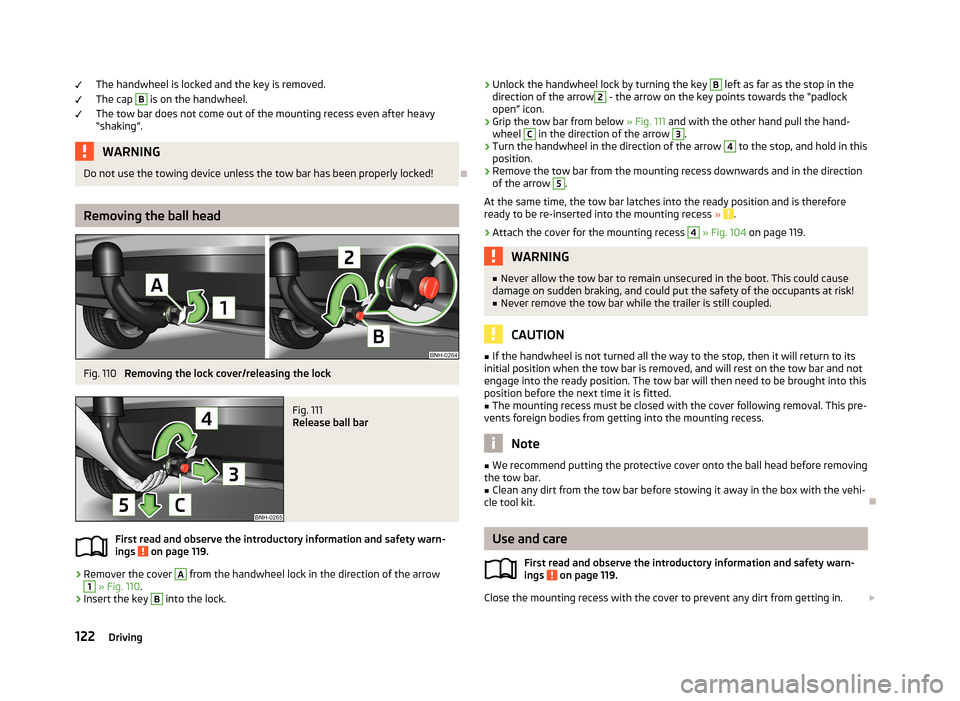
Fig. 110
Removing the lock cover/releasing the lock
Fig. 111
Release ball bar
First read and observe the introductory information and safety warn-
ings on page 119.
›
Remover the cover
A
from the handwheel lock in the direction of the arrow
1
» Fig. 110 .
›
Insert the key
B
into the lock.
›
Unlock the handwheel lock by turning the key B left as far as the stop in the
direction of the arrow2 - the arrow on the key points towards the “padlock
open” icon.›
Grip the tow bar from below » Fig. 111 and with the other hand pull the hand-
wheel
C
in the direction of the arrow
3
.
›
Turn the handwheel in the direction of the arrow
4
to the stop, and hold in this
position.
›
Remove the tow bar from the mounting recess downwards and in the direction
of the arrow
5
.
At the same time, the tow bar latches into the ready position and is therefore
ready to be re-inserted into the mounting recess »
.
›
Attach the cover for the mounting recess
4
» Fig. 104 on page 119.
WARNING■
Never allow the tow bar to remain unsecured in the boot. This could cause
damage on sudden braking, and could put the safety of the occupants at risk!■
Never remove the tow bar while the trailer is still coupled.
CAUTION
■ If the handwheel is not turned all the way to the stop, then it will return to its
initial position when the tow bar is removed, and will rest on the tow bar and not
engage into the ready position. The tow bar will then need to be brought into this position before the next time it is fitted.■
The mounting recess must be closed with the cover following removal. This pre-
vents foreign bodies from getting into the mounting recess.
Note
■ We recommend putting the protective cover onto the ball head before removing
the tow bar.■
Clean any dirt from the tow bar before stowing it away in the box with the vehi-
cle tool kit.
Use and care
First read and observe the introductory information and safety warn-
ings
on page 119.
Close the mounting recess with the cover to prevent any dirt from getting in.
122Driving
Page 126 of 226
Always check the tow bar before hitching a trailer. Apply suitable grease where
necessary.
Use the protective cover when stowing away the tow bar, in order to stop the
boot from getting dirty.
In the event of dirt, clean the surfaces of the mounting recess and treat with a
suitable preservative.
CAUTION
Apply grease to the upper part of the mounting recess. Make sure you do not re-
move any grease.
Trailer
Introduction
This chapter contains information on the following subjects:
Loading a trailer
123
Driving with a trailer
124
Anti-theft alarm system
125WARNINGAlways drive particularly carefully with the trailer.
Loading a trailer
First read and observe the introductory information and safety warn-
ings
on page 123.
The vehicle/trailer combination must be balanced, whereby the maximum permis-
sible drawbar load must be utilised. If the drawbar load is too low, it jeopardises the performance of the vehicle/trailer combination.
Distribution of the load
Distribute the load in the trailer in such a way that heavy items are located as close to the axle as possible. Secure the items from slipping.
The distribution of the weight is very poor if your vehicle is unladen and the trail-
er is laden. Maintain a particularly low speed if you cannot avoid driving with this
combination.
Tyre pressure
Correct the tyre inflation pressure on your vehicle for a “full load” » page 176,
Service life of tyres .
Trailer load
The permissible trailer load must not be exceeded under any circumstan- ces » page 207 , Technical data .
The trailer loads specified apply only to altitudes up to 1 000 metres above mean
sea level.
The engine output falls as altitude increases, as does the vehicle's climbing pow-
er. Therefore, for every additional 1000 m in height (or part), the maximum per-
missible towed weight must be reduced by 10%.
The towed weight is made up of the actual weights of the loaded towing vehicle
and the loaded trailer.
The trailer and drawbar load information on the type plate of the towing device is
merely a test value for the towing device. The vehicle-specific values are detailed
in the vehicle documents.WARNING■ Do not exceed the maximum permissible axle and drawbar load and the
maximum permissible total or towed weight of the vehicle and the trailer –
risk of accident and serious injury!■
Slipping loads can significantly impair the stability and safety of the vehicle/
trailer combination – risk of accident and serious injury!
123Towing a trailer
Page 129 of 226
Safety
Passive Safety
General information
Introduction
This chapter contains information on the following subjects:
Safety equipment
126
Before setting off
126
What influences the driving safety?
127
In this section you will find important information, tips and notes on the subject
of passive safety in your vehicle.
We have combined everything here which you should be familiar with, for exam- ple, regarding seat belts, airbags, child seats and safety of children.
WARNING■ This chapter contains important information on how to use the vehicle for
the driver and his occupants.■
You can find further information on safety concerning you and those travel-
ling with you in the following chapters of this owner's manual.
■
The complete on-board literature should always be in the vehicle. This ap-
plies in particular, if you rent out or sell the vehicle.
Safety equipment
First read and observe the introductory information and safety warn-ings
on page 126.
The following list contains only part of the safety equipment in your vehicle.
› Three-point seat belts for all the seats.
› Belt force limiters for the front seats.
› Belt tensioners for the front seats.
› Seat belt height adjusters for the front seats.
› Front airbag for the driver and the front passenger.
› Side airbags.
› Head airbags.
› Anchoring points for child seats using the ISOFIX system.
› Anchoring points for child seats using the TOP TETHER system.
› Head restraints adjustable for height 1)
.
› Adjustable steering column.
The specified safety equipment works together, in order to optimally protect you and those travelling with you in accident situations.
The safety equipment does not protect you or the people travelling with you, if
you or your occupants adopt an incorrect seated position or the equipment is not
correctly adjusted or used.
If the seat belt is not fastened properly, this may result in injuries if an airbag is
activated in the event of an accident.
Before setting off
First read and observe the introductory information and safety warn-
ings
on page 126.
For your own safety and the safety of the people travelling with you, please pay
attention to the following points before setting off.
› Ensure that the lighting and the turn signal system are functioning properly.
› Check the tyre inflation pressure.
› Ensure that all of the windows offer good visibility to the outside.
› Secure all items of luggage
» page 64.
› Ensure that no objects can obstruct the pedals.
1)
Not valid for sports seat.
126Safety
Page 134 of 226
WARNINGObserve the following instructions for the proper use of the seat belts.■Never use one seat belt to secure two persons (including children). The
seatbelt must not be placed over a child who is sitting on the lap of another
passenger.■
The lock tongue should only be inserted into the lock which is the correct
one for your seat. Wrong use of the safety belt will reduce its capacity to pro-
tect and the risk of injury increases.
■
The slot of the belt tongue must not be blocked, otherwise the belt tongue
will not lock in place properly.
■
Many layers of clothing and loose clothing (e. g. a winter coat over a jacket)
do not allow you to be correctly seated and impairs proper operation of the
seat belts.
■
It is prohibited to use clamps or other objects to adjust seat belts (e. g. for
shortening the belts for smaller persons).
■
The seat belts for the rear seats can only fulfil their function reliably when
the seat backrests are correctly locked into position » page 55.
WARNINGObserve the following instructions for proper maintenance of the seat belts.■The belt webbing must always be kept clean. Soiled belt webbing may im-
pair proper operation of the inertia reel » page 159.■
The seat belts must not be removed or changed in any way. Do not attempt
to repair the seat belts yourself.
■
Check the condition of all the seat belts on a regular basis. If any damage to
the seat belts, seat belt connections, inertia reel or the lock is detected, the
relevant seat belt must be replaced by a specialist garage.
■
Damaged seat belts which have been subjected to stress in an accident and
were therefore stretched, must be replaced – this is best done by a specialist
garage. The anchorage points of the belts must also be inspected. The an-
chorage points for the belts should also be checked.
Note
The national legal requirements must be observed when using seat belts.
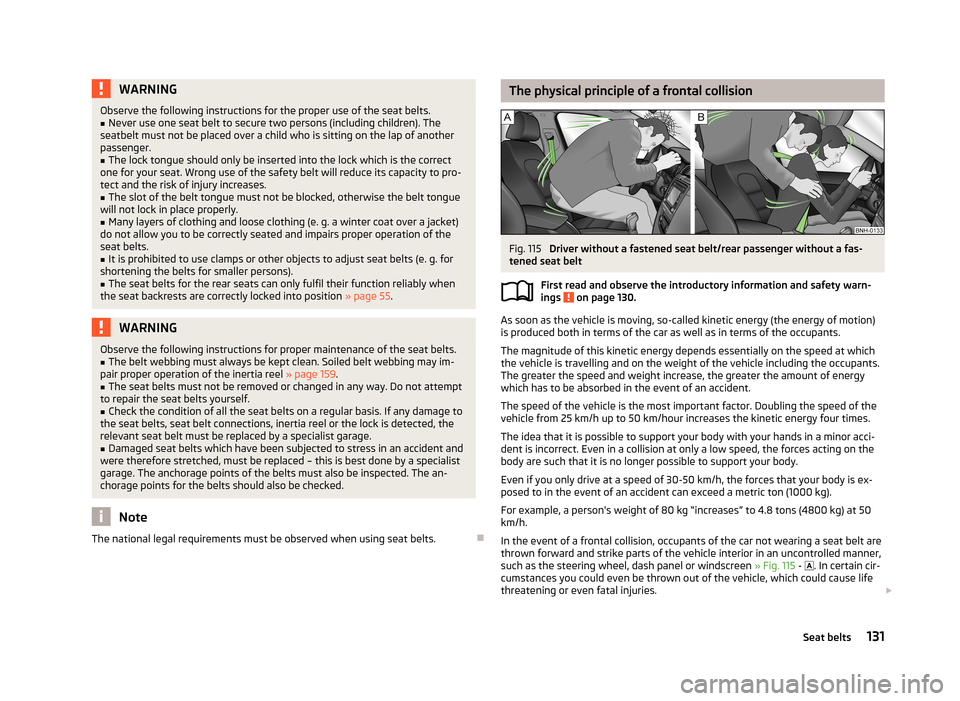
The physical principle of a frontal collisionFig. 115
Driver without a fastened seat belt/rear passenger without a fas-
tened seat belt
First read and observe the introductory information and safety warn-ings
on page 130.
As soon as the vehicle is moving, so-called kinetic energy (the energy of motion)
is produced both in terms of the car as well as in terms of the occupants.
The magnitude of this kinetic energy depends essentially on the speed at which
the vehicle is travelling and on the weight of the vehicle including the occupants.
The greater the speed and weight increase, the greater the amount of energy
which has to be absorbed in the event of an accident.
The speed of the vehicle is the most important factor. Doubling the speed of the
vehicle from 25 km/h up to 50 km/hour increases the kinetic energy four times.
The idea that it is possible to support your body with your hands in a minor acci-dent is incorrect. Even in a collision at only a low speed, the forces acting on the
body are such that it is no longer possible to support your body.
Even if you only drive at a speed of 30-50 km/h, the forces that your body is ex-
posed to in the event of an accident can exceed a metric ton (1000 kg).
For example, a person's weight of 80 kg “increases” to 4.8 tons (4800 kg) at 50
km/h.
In the event of a frontal collision, occupants of the car not wearing a seat belt are thrown forward and strike parts of the vehicle interior in an uncontrolled manner,such as the steering wheel, dash panel or windscreen » Fig. 115 -
. In certain cir-
cumstances you could even be thrown out of the vehicle, which could cause life
threatening or even fatal injuries.
131Seat belts
Page 145 of 226
Transporting children safely
Child seat
Introduction
This chapter contains information on the following subjects:
Use of a child seat on the front passenger seat
143
Child safety and side airbag
144
Classification of child seats
144
Use of child seats fastened with a seat belt
144
Children are generally safer on the rear seats than on the front passenger seat.
In contrast to adults, the muscles and bone structure of children are not yet fully developed. Thus children are exposed to increased risk of injury.
Children should be transported in accordance with the relevant statutory provi-sions.
Child seats complying with the ECE-R 44 standard must be used. ECE-R stands
for: Economic Commission for Europe – Regulation.
Child seats that comply with the ECE-R 44 standard are identified with a testmark that cannot be removed: a large E within a circle with the test number be-
low.
WARNING■ The national legal requirements must be observed when using child seats.■One should never carry children, and also not babies! - on one's lap.■
Never leave children unattended in the vehicle. Certain outside climatic con-
ditions can cause life-threatening temperatures in the vehicle.
■
The child must be secured in the vehicle during the entire journey! Other-
wise, the child would be thrown through the vehicle in the event of an acci-
dent, causing fatal injuries to both the child and other occupants.
WARNING (Continued)■ Children are exposed to an increased risk of injury in the event of an acci-
dent if they lean forward or adopt an incorrect seated position when the vehi-
cle is moving. This particularly applies to children who are transported on the
front passenger seat as they can suffer severe, or even fatal injuries if the air-
bag system is deployed!■
Pay particular attention to the information provided by the manufacturer of
the child safety seat regarding the correct routing of the belt. Seat belts which are not correctly adjusted can themselves cause injuries even in minor
accidents.
■
Safety belts must be checked to ensure that they are running properly. One
should also ensure that the belt is not damaged by sharp-edged fittings.
■
The front passenger airbag must be deactivated if using a rear-facing child
seat on the front passenger seat. Further information » page 143, Use of a
child seat on the front passenger seat .
CAUTION
When installing a child seat in which the child faces forward, adjust the head re-
straints so that they are as high as possible.
Note
We recommend that you use child seats from ŠKODA Original Accessories. Thesechild seats were developed and also tested for use in ŠKODA vehicles. They meet
the ECE-R 44 standard.
142Safety
Page 146 of 226
Use of a child seat on the front passenger seat
Never use a backwards-facing child restraint system on a seat that is protected by an active airbag installed in front of it. This could cause the child severe injury
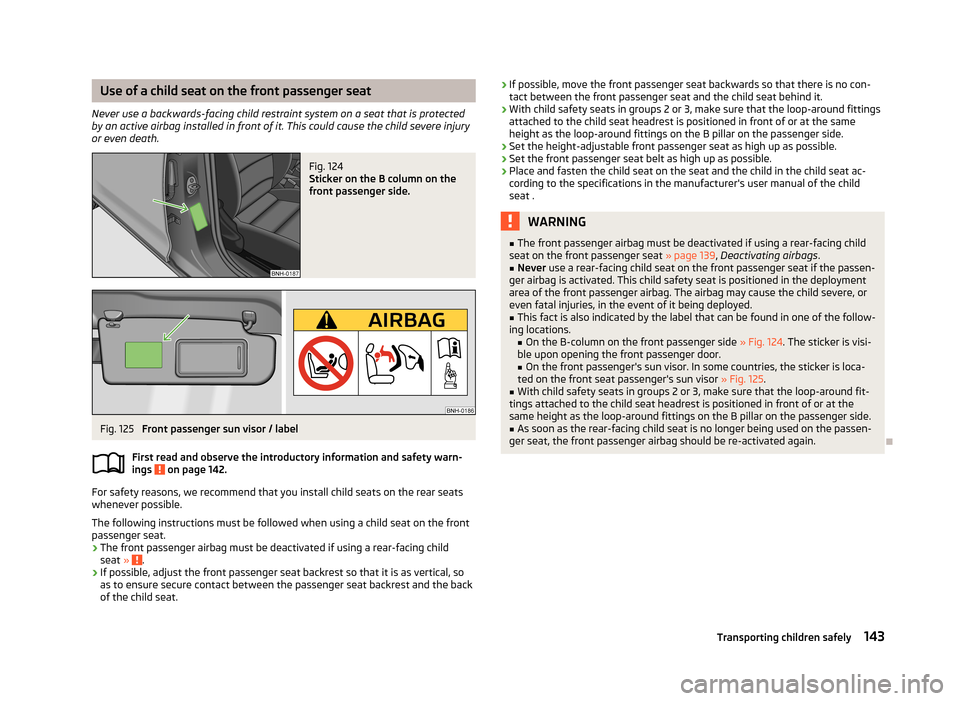
or even death.Fig. 124
Sticker on the B column on the
front passenger side.
Fig. 125
Front passenger sun visor / label
First read and observe the introductory information and safety warn-
ings
on page 142.
For safety reasons, we recommend that you install child seats on the rear seats
whenever possible.
The following instructions must be followed when using a child seat on the front passenger seat.
› The front passenger airbag must be deactivated if using a rear-facing child
seat »
.
› If possible, adjust the front passenger seat backrest so that it is as vertical, so
as to ensure secure contact between the passenger seat backrest and the back of the child seat.
› If possible, move the front passenger seat backwards so that there is no con-
tact between the front passenger seat and the child seat behind it.
› With child safety seats in groups 2 or 3, make sure that the loop-around fittings
attached to the child seat headrest is positioned in front of or at the same
height as the loop-around fittings on the B pillar on the passenger side.
› Set the height-adjustable front passenger seat as high up as possible.
› Set the front passenger seat belt as high up as possible.
› Place and fasten the child seat on the seat and the child in the child seat ac-
cording to the specifications in the manufacturer's user manual of the child seat .WARNING■ The front passenger airbag must be deactivated if using a rear-facing child
seat on the front passenger seat » page 139, Deactivating airbags .■
Never use a rear-facing child seat on the front passenger seat if the passen-
ger airbag is activated. This child safety seat is positioned in the deployment
area of the front passenger airbag. The airbag may cause the child severe, or
even fatal injuries, in the event of it being deployed.
■
This fact is also indicated by the label that can be found in one of the follow-
ing locations. ■ On the B-column on the front passenger side » Fig. 124. The sticker is visi-
ble upon opening the front passenger door. ■ On the front passenger's sun visor. In some countries, the sticker is loca-
ted on the front seat passenger's sun visor » Fig. 125.
■
With child safety seats in groups 2 or 3, make sure that the loop-around fit-
tings attached to the child seat headrest is positioned in front of or at the
same height as the loop-around fittings on the B pillar on the passenger side.
■
As soon as the rear-facing child seat is no longer being used on the passen-
ger seat, the front passenger airbag should be re-activated again.
143Transporting children safely