cooling SKODA RAPID 2013 1.G User Guide
[x] Cancel search | Manufacturer: SKODA, Model Year: 2013, Model line: RAPID, Model: SKODA RAPID 2013 1.GPages: 226, PDF Size: 15.16 MB
Page 85 of 226
Climatronic (automatic air conditioning system)
Introduction
This chapter contains information on the following subjects:
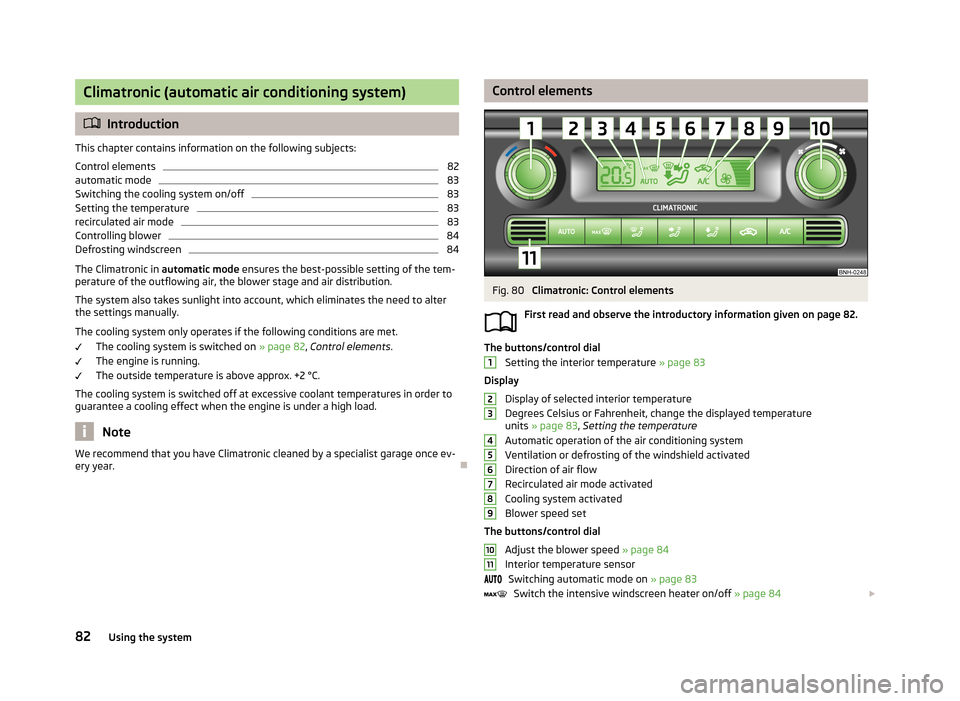
Control elements
82
automatic mode
83
Switching the cooling system on/off
83
Setting the temperature
83
recirculated air mode
83
Controlling blower
84
Defrosting windscreen
84
The Climatronic in automatic mode ensures the best-possible setting of the tem-
perature of the outflowing air, the blower stage and air distribution.
The system also takes sunlight into account, which eliminates the need to alterthe settings manually.
The cooling system only operates if the following conditions are met. The cooling system is switched on » page 82, Control elements .
The engine is running.
The outside temperature is above approx. +2 °C.
The cooling system is switched off at excessive coolant temperatures in order to guarantee a cooling effect when the engine is under a high load.
Note
We recommend that you have Climatronic cleaned by a specialist garage once ev-
ery year.Control elementsFig. 80
Climatronic: Control elements
First read and observe the introductory information given on page 82.
The buttons/control dial Setting the interior temperature » page 83
Display
Display of selected interior temperature
Degrees Celsius or Fahrenheit, change the displayed temperature units » page 83 , Setting the temperature
Automatic operation of the air conditioning system Ventilation or defrosting of the windshield activated
Direction of air flow
Recirculated air mode activated
Cooling system activated
Blower speed set
The buttons/control dial Adjust the blower speed » page 84
Interior temperature sensor Switching automatic mode on » page 83
Switch the intensive windscreen heater on/off » page 84
123456789101182Using the system
Page 86 of 226
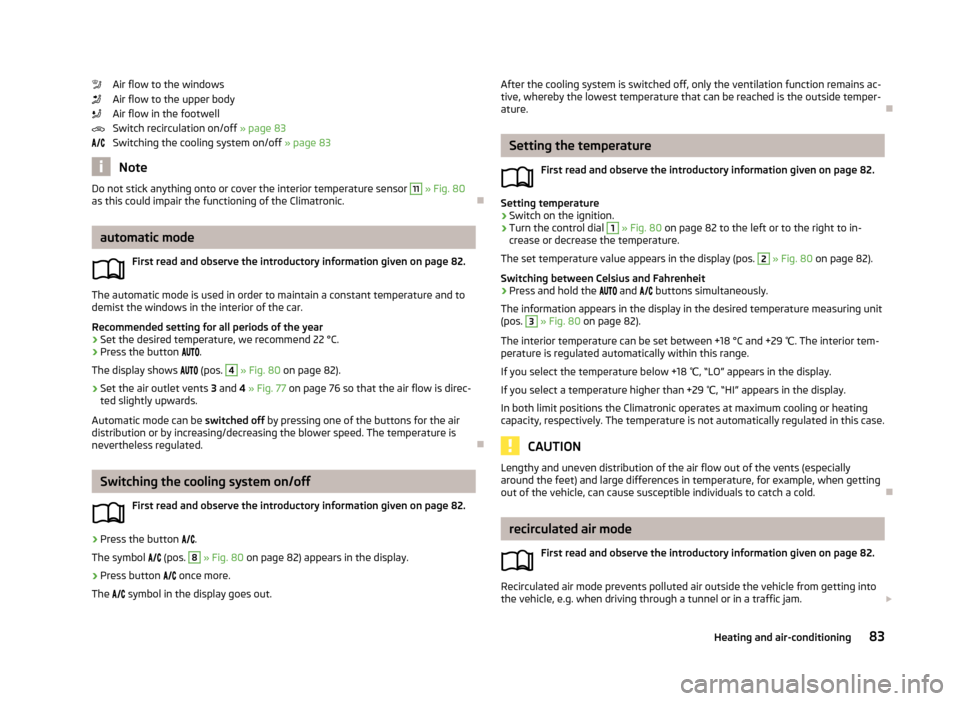
Air flow to the windows
Air flow to the upper body
Air flow in the footwell
Switch recirculation on/off » page 83
Switching the cooling system on/off » page 83
Note
Do not stick anything onto or cover the interior temperature sensor 11 » Fig. 80
as this could impair the functioning of the Climatronic.
automatic mode
First read and observe the introductory information given on page 82.
The automatic mode is used in order to maintain a constant temperature and to
demist the windows in the interior of the car.
Recommended setting for all periods of the year
›
Set the desired temperature, we recommend 22 °C.
›
Press the button
.
The display shows
(pos.
4
» Fig. 80 on page 82).
›
Set the air outlet vents 3 and 4 » Fig. 77 on page 76 so that the air flow is direc-
ted slightly upwards.
Automatic mode can be switched off by pressing one of the buttons for the air
distribution or by increasing/decreasing the blower speed. The temperature is
nevertheless regulated.
Switching the cooling system on/off
First read and observe the introductory information given on page 82.
›
Press the button
.
The symbol
(pos.
8
» Fig. 80 on page 82) appears in the display.
›
Press button
once more.
The
symbol in the display goes out.
After the cooling system is switched off, only the ventilation function remains ac-
tive, whereby the lowest temperature that can be reached is the outside temper- ature.
Setting the temperature
First read and observe the introductory information given on page 82.
Setting temperature
›
Switch on the ignition.
›
Turn the control dial
1
» Fig. 80 on page 82 to the left or to the right to in-
crease or decrease the temperature.
The set temperature value appears in the display (pos.
2
» Fig. 80 on page 82).
Switching between Celsius and Fahrenheit
›
Press and hold the
and
buttons simultaneously.
The information appears in the display in the desired temperature measuring unit
(pos.
3
» Fig. 80 on page 82).
The interior temperature can be set between +18 °C and +29 ℃. The interior tem-
perature is regulated automatically within this range.
If you select the temperature below +18 ℃, “LO” appears in the display.
If you select a temperature higher than +29 ℃, “HI” appears in the display.
In both limit positions the Climatronic operates at maximum cooling or heating
capacity, respectively. The temperature is not automatically regulated in this case.
CAUTION
Lengthy and uneven distribution of the air flow out of the vents (especially
around the feet) and large differences in temperature, for example, when getting
out of the vehicle, can cause susceptible individuals to catch a cold.
recirculated air mode
First read and observe the introductory information given on page 82.
Recirculated air mode prevents polluted air outside the vehicle from getting into
the vehicle, e.g. when driving through a tunnel or in a traffic jam.
83Heating and air-conditioning
Page 166 of 226
WARNINGInjuries or scolding or risks of accident or fire may occur when working in the
engine compartment. For this reason, it is essential to comply with the warn- ing instructions outlined below and with the general applicable safety rules.
The engine compartment of your car is a hazardous area!WARNINGThe following instructions must be followed before starting work in the en-
gine compartment.■
Turn off the engine and withdraw the ignition key.
■
Firmly apply the handbrake.
■
If the vehicle is fitted with a manual gearbox, move the gearshift lever into
Neutral, or if the vehicle is fitted with an automatic gearbox, move the selec-
tor lever into position P.
■
Allow the engine to cool.
■
Never open the bonnet if you can see steam or coolant escaping from the
engine compartment – risk of scalding! Wait until no more steam or coolant is escaping.
WARNINGThe following instructions must be followed when working in the engine com-
partment.■
Keep children clear of the engine compartment.
■
Never touch the radiator fan while the engine is still warm. The fan might
suddenly start running!
■
Do not touch any hot engine parts – risk of burns!
■
The coolant additive and thus all of the coolant is harmful to your health.
■
Avoid contact with the coolant.
■
Coolant vapours are harmful to health.
■
Never open the end cover of the coolant expansion reservoir while the en-
gine is still warm. The cooling system is pressurized!
■
When opening the end cover of the coolant expansion reservoir, cover it
with a cloth to protect your face, hands and arms from hot steam or hot cool-
ant.
■
If any coolant splashes into your eyes, immediately rinse out your eyes with
clear water and contact a doctor as soon as possible.
WARNING (Continued)■ Always store the coolant additive securely in its original container, and in
particular out of the reach of children – risk of poisoning!■
If coolant is swallowed, consult a doctor immediately.
■
Do not leave any items (e.g. cloths or tools) in the engine compartment.
■
Never spill fluids on the hot engine. Such fluids (e.g. the antifreeze con-
tained in the coolant) may ignite!
WARNINGThe following warning instructions must be observed at all times when work-
ing in the engine compartment while the engine is running.■
Pay particular attention to rotating engine parts (e.g. V-ribbed belt, genera-
tor, radiator fan) and the high-voltage ignition system – risk to life!
■
Never touch the electric wiring on the ignition system.
■
Avoid short circuits in the electrical system – particularly on the vehicle's
battery.
■
Always make sure that no jewellery, loose clothing or long hair can get
caught in rotating engine parts – risk to life! Always remove any jewellery, tie
back long hair and wear tight fitting clothing before completing any work.
WARNINGThe following warning instructions must be observed if work has to be carried
out on the fuel or electrical systems.■
Always disconnect the vehicle battery from the electrical system.
■
Do not smoke.
■
Never work near open flames.
■
Always have a functioning fire extinguisher nearby.
WARNING■ Read and observe the information and warning instructions on the fluid con-
tainers.■
Keep fluids in their original containers and keep securely out of the reach of
children!
163Inspecting and replenishing
Page 171 of 226
Oil level within range CThe engine must be topped up with oil so that the oil level at least reaches the
range B
.
The engine consumes a little oil. The oil consumption may be as much as 0.5 l/
1 000 km depending on your style of driving and the conditions under which you
operate your vehicle. Consumption may be slightly higher than this during the
first 5 000 kilometres.
The oil level must be checked at regular intervals. We recommend after each time
you refuel or prior to making a long journey.
We recommend maintaining the oil level within the range
A
, but not above , if
the engine has been operating at high loads, for example, during a lengthy motor-
way trip during the summer months, towing a trailer or negotiating a high moun- tain pass.
If the oil level is too low, this will be indicated by an indicator light in the instru- ment cluster » page 16,
Engine Oil . Check the oil level using the dipstick as
soon as possible. Add oil accordingly.
CAUTION
The oil level must not exceed level A » Fig. 136 - risk of damaging the exhaust
system!
Replenishing
First read and observe the introductory information and safety warn-
ings
on page 166.
›
Check the oil level » page 167.
›
Unscrew the cap of the engine oil filler opening » Fig. 134
on page 165.
›
Replenish the oil in portions of 0.5 litres in accordance with the correct specifi-
cations » page 167 .
›
Check the oil level » page 167.
›
Carefully screw on the oil filler opening cap and push the dipstick in fully.
Changing
First read and observe the introductory information and safety warn-ings
on page 166.
The engine oil must be changed according to prescribed service inter-
vals » page 147 or according to the service interval display » page 28, Service in-
terval display .
Coolant
Introduction
This chapter contains information on the following subjects:
Capacity
169
Checking the coolant level
169
Replenishing
170
The coolant consists of water with coolant additive. This mixture guarantees anti- freeze protection, protects the cooling/heater system against corrosion and pre-
vents lime formation.
Vehicles exported to countries with a mild climate are already factory-filled with
a coolant which offers antifreeze protection down to about -25 ℃. In these coun-
tries, the concentration of coolant additive should be at least 40%.
Vehicles exported to countries with a cold climate are already factory-filled with a
coolant which offers antifreeze protection down to about -35 °C. In these coun-
tries, the concentration of coolant additive should be at least 50%.
If a higher concentration of antifreeze is required for climatic reasons, the con-centration of coolant additive can be increased up to a maximum of 60% (anti-
freeze protection down to approx. -40 °C).
When refilling, only use antifreeze with the name specified on the coolant expan- sion tank » Fig. 137 on page 169.
168General Maintenance
Page 172 of 226
WARNING■The engine compartment of your car is a hazardous area. The following
warning instructions must be followed at all times when working in the en-
gine compartment » page 162.■
Do not continue your journey if for some reason it is not possible to fill with
coolant under the current circumstances . Switch off the engine and seek
assistance from a specialist garage.
CAUTION
■ The concentration of coolant additive in the coolant must never be under 40%.■Over 60% of coolant additive in the coolant reduces the antifreeze protection
and cooling effect.■
A coolant additive that does not comply with the correct specifications can sig-
nificantly reduce the corrosion protection.
■
Any faults resulting from corrosion may cause a loss of coolant and can conse-
quently result in major engine damage!
■
Do not fill the coolant above the mark
A
» Fig. 137 on page 169.
■
If a fault causes the engine to overheat, we recommend visiting a specialist ga-
rage, as otherwise serious engine damage may occur.
Capacity
First read and observe the introductory information and safety warn-
ings
on page 168.
Coolant capacity (in litres)
Petrol enginesFilling level1.2 l/55 kW4.21.2 l/63, 77 kW TSI7.01.4 l/90 kW TSI7.01.6 l/77 kW4.5Diesel engineFilling level1.6 l/66, 77 kW TDI CR6.5
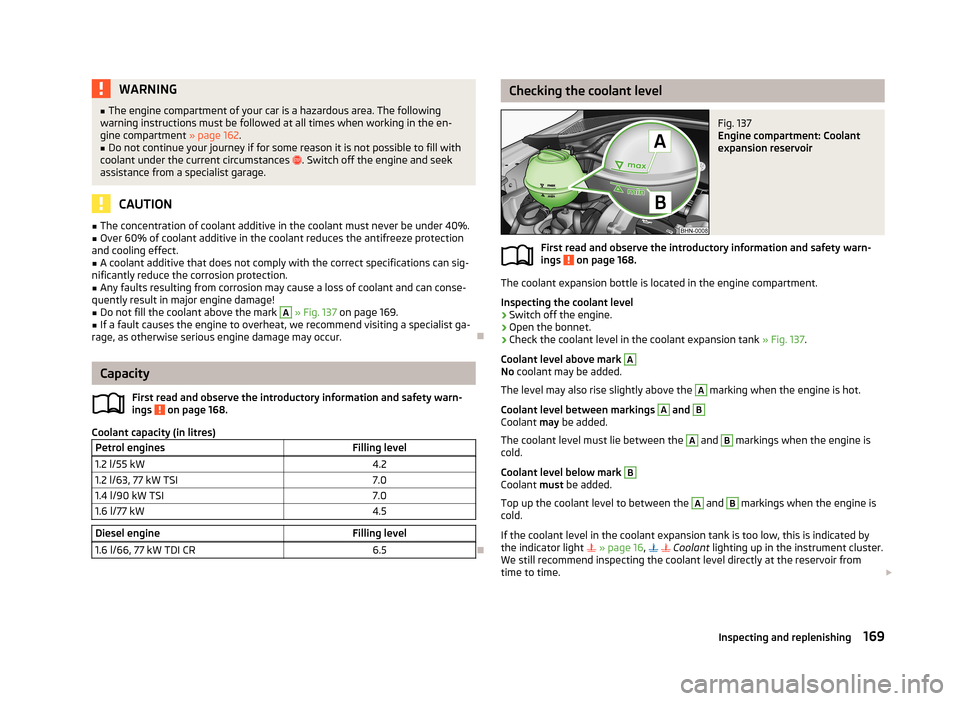
Checking the coolant levelFig. 137
Engine compartment: Coolant
expansion reservoir
First read and observe the introductory information and safety warn-
ings on page 168.
The coolant expansion bottle is located in the engine compartment.
Inspecting the coolant level
›
Switch off the engine.
›
Open the bonnet.
›
Check the coolant level in the coolant expansion tank » Fig. 137.
Coolant level above mark
A
No coolant may be added.
The level may also rise slightly above the
A
marking when the engine is hot.
Coolant level between markings
A
and
B
Coolant may be added.
The coolant level must lie between the
A
and
B
markings when the engine is
cold.
Coolant level below mark
B
Coolant must be added.
Top up the coolant level to between the
A
and
B
markings when the engine is
cold.
If the coolant level in the coolant expansion tank is too low, this is indicated by
the indicator light
» page 16 ,
Coolant lighting up in the instrument cluster.
We still recommend inspecting the coolant level directly at the reservoir from
time to time.
169Inspecting and replenishing
Page 173 of 226
Loss of coolant
A loss of coolant is first and foremost an indication of a leak in the system. Do
not merely top up the coolant. Have the cooling system checked by a specialist
garage.
Replenishing
First read and observe the introductory information and safety warn-
ings
on page 168.
Only top up with new coolant.
›
Switch off the engine.
›
Allow the engine to cool.
›
Place a cloth over the cap of the coolant expansion tank and unscrew the cap carefully .
›
Replenish the coolant.
›
Turn the cap until it clicks into place.
Do not use an alternative additive if the specified coolant is not available in an emergency. In this case, use just water and have the correct mixing ratio of waterand coolant additive restored by a specialist garage as soon as possible.
Brake fluid
Introduction
This chapter contains information on the following subjects:
Checking the brake fluid level
170
Changing
171WARNING■ The engine compartment of your car is a hazardous area. The following
warning instructions must be followed at all times when working in the en-
gine compartment » page 162.■
If the fluid level has dropped below the MIN marking » Fig. 138 on page 170,
do not continue your journey - risk of accident! Seek help from a specialist
garage.
■
Do not use used brake fluid - the function of the brake system may be im-
paired – risk of accident!
CAUTION
Brake fluid damages the paintwork of the vehicle.
Note
The brake fluid is changed as part of a compulsory inspection service.
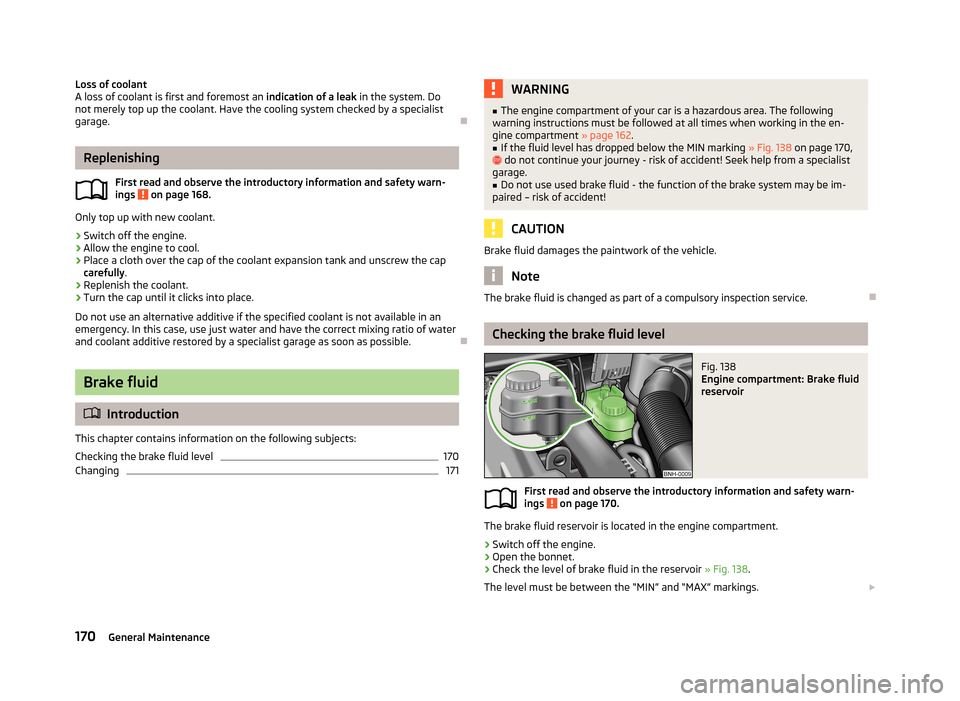
Checking the brake fluid level
Fig. 138
Engine compartment: Brake fluid
reservoir
First read and observe the introductory information and safety warn-
ings on page 170.
The brake fluid reservoir is located in the engine compartment.
›
Switch off the engine.
›
Open the bonnet.
›
Check the level of brake fluid in the reservoir » Fig. 138.
The level must be between the “MIN” and “MAX” markings.
170General Maintenance
Page 201 of 226
›Reinsert the cover into the dash panel in the opposite direction to the arrow
such that the guide pins are guided into the dash panel openings.
Carefully push the cover in.
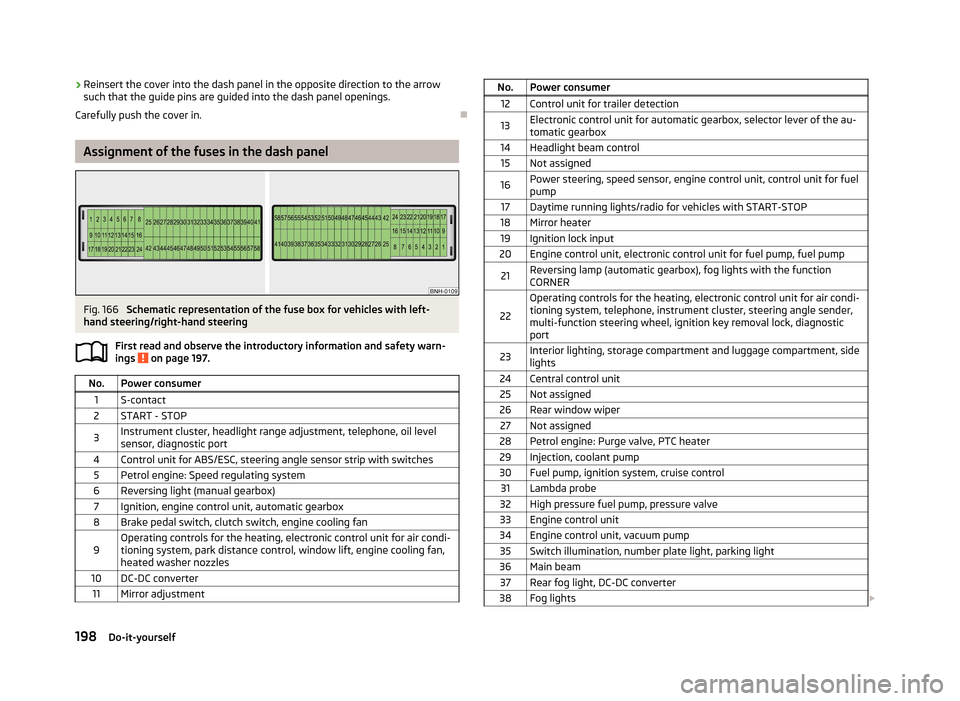
Assignment of the fuses in the dash panel
Fig. 166
Schematic representation of the fuse box for vehicles with left-
hand steering/right-hand steering
First read and observe the introductory information and safety warn-ings
on page 197.
No.Power consumer1S-contact2START - STOP3Instrument cluster, headlight range adjustment, telephone, oil level
sensor, diagnostic port4Control unit for ABS/ESC, steering angle sensor strip with switches5Petrol engine: Speed regulating system6Reversing light (manual gearbox)7Ignition, engine control unit, automatic gearbox8Brake pedal switch, clutch switch, engine cooling fan9Operating controls for the heating, electronic control unit for air condi-
tioning system, park distance control, window lift, engine cooling fan, heated washer nozzles10DC-DC converter11Mirror adjustmentNo.Power consumer12Control unit for trailer detection13Electronic control unit for automatic gearbox, selector lever of the au-tomatic gearbox14Headlight beam control15Not assigned16Power steering, speed sensor, engine control unit, control unit for fuel
pump17Daytime running lights/radio for vehicles with START-STOP18Mirror heater19Ignition lock input20Engine control unit, electronic control unit for fuel pump, fuel pump21Reversing lamp (automatic gearbox), fog lights with the function
CORNER
22
Operating controls for the heating, electronic control unit for air condi- tioning system, telephone, instrument cluster, steering angle sender,
multi-function steering wheel, ignition key removal lock, diagnostic
port23Interior lighting, storage compartment and luggage compartment, side
lights24Central control unit25Not assigned26Rear window wiper27Not assigned28Petrol engine: Purge valve, PTC heater29Injection, coolant pump30Fuel pump, ignition system, cruise control31Lambda probe32High pressure fuel pump, pressure valve33Engine control unit34Engine control unit, vacuum pump35Switch illumination, number plate light, parking light36Main beam37Rear fog light, DC-DC converter38Fog lights 198Do-it-yourself
Page 203 of 226
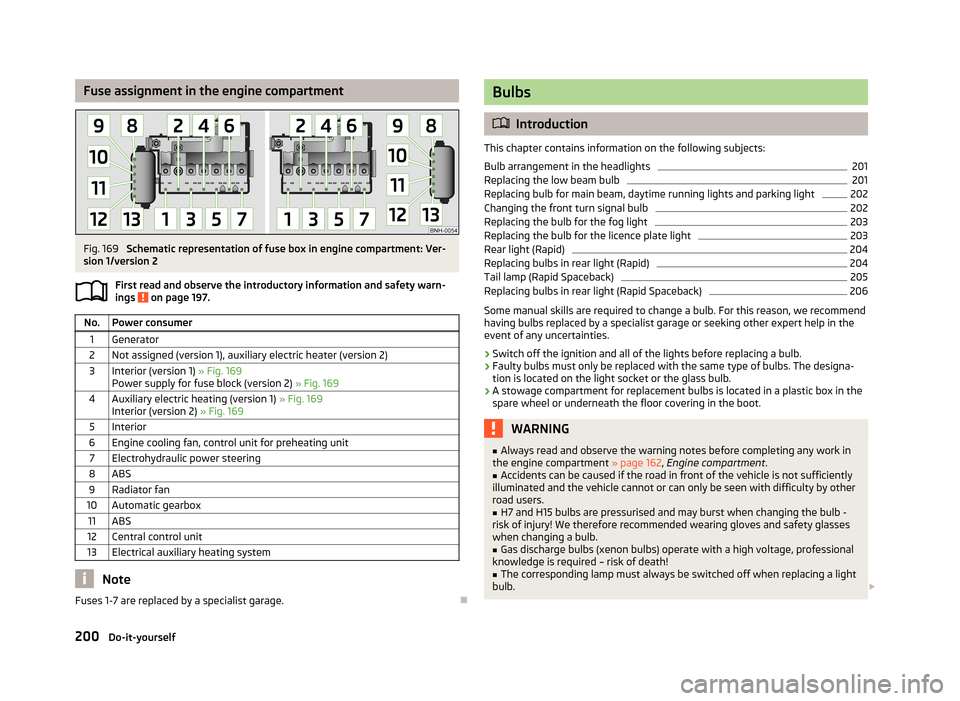
Fuse assignment in the engine compartmentFig. 169
Schematic representation of fuse box in engine compartment: Ver-
sion 1/version 2
First read and observe the introductory information and safety warn-
ings
on page 197.
No.Power consumer1Generator2Not assigned (version 1), auxiliary electric heater (version 2)3Interior (version 1) » Fig. 169
Power supply for fuse block (version 2) » Fig. 1694Auxiliary electric heating (version 1) » Fig. 169
Interior (version 2) » Fig. 1695Interior6Engine cooling fan, control unit for preheating unit7Electrohydraulic power steering8ABS9Radiator fan10Automatic gearbox11ABS12Central control unit13Electrical auxiliary heating system
Note
Fuses 1-7 are replaced by a specialist garage.
Bulbs
Introduction
This chapter contains information on the following subjects:
Bulb arrangement in the headlights
201
Replacing the low beam bulb
201
Replacing bulb for main beam, daytime running lights and parking light
202
Changing the front turn signal bulb
202
Replacing the bulb for the fog light
203
Replacing the bulb for the licence plate light
203
Rear light (Rapid)
204
Replacing bulbs in rear light (Rapid)
204
Tail lamp (Rapid Spaceback)
205
Replacing bulbs in rear light (Rapid Spaceback)
206
Some manual skills are required to change a bulb. For this reason, we recommend
having bulbs replaced by a specialist garage or seeking other expert help in the
event of any uncertainties.
› Switch off the ignition and all of the lights before replacing a bulb.
› Faulty bulbs must only be replaced with the same type of bulbs. The designa-
tion is located on the light socket or the glass bulb.
› A stowage compartment for replacement bulbs is located in a plastic box in the
spare wheel or underneath the floor covering in the boot.
WARNING■ Always read and observe the warning notes before completing any work in
the engine compartment » page 162, Engine compartment .■
Accidents can be caused if the road in front of the vehicle is not sufficiently
illuminated and the vehicle cannot or can only be seen with difficulty by other
road users.
■
H7 and H15 bulbs are pressurised and may burst when changing the bulb -
risk of injury! We therefore recommended wearing gloves and safety glasses
when changing a bulb.
■
Gas discharge bulbs (xenon bulbs) operate with a high voltage, professional
knowledge is required – risk of death!
■
The corresponding lamp must always be switched off when replacing a light
bulb.
200Do-it-yourself
Page 216 of 226
Indicator light15
Running in105
Braking Information on braking
100
Breakdown kit188
Bulb failure Indicator light
18
Bulbs Indicator light
18
Replacing200
Tail lamp (Rapid Spaceback)205
Button in the driver's door Electrical power windows
38
C
Car computer See multifunction display
25
Car park ticket holder56
Carrier74
Cavity protection156
Central locking button34
Changing Brake fluid
171
Engine oil168
Front turn signal bulb202
Wheels184
Changing a wheel Follow-up work
185
Preliminary work184
Remove and attaching a wheel185
Charging a vehicle battery173
Check Fit ball head properly
121
Checking Battery electrolyte level
173
Brake fluid170
Coolant169
Engine oil167
Oil level167
Windscreen washer fluid165
Children and safety142
Child safety Side airbag
144
Child safety lock35
Child seat Classification
144
ISOFIX145
on the front passenger seat143
TOP TETHER146
Use of child seats144
Use of ISOFIX child seats145
Chrome parts refer to Taking care of your vehicle
155
Cigarette lighter59
Cleaning147
Alcantara158
Artificial leather158
cloths158
Covers of electrically heated seats159
Headlight lenses156
Natural leather158
Plastic parts154
Wheels156
Climatronic82
automatic mode83
Control elements82
Controlling blower84
Cooling system83
Defrosting windscreen84
recirculated air mode83
Setting the temperature83
Clock13
Clothes hook63
Cockpit 12-volt power outlet
60
Ashtray59
Cigarette lighter59
General view9
Lights45
Practical equipment56
Storage compartments56
Compartments56
Computer See multifunction display
25
Coolant168
Checking169
Indicator light16
Information messages16
Replenishing170
Temperature gauge11
CORNER See Fog lights with CORNER function
43
Correct seated position127
Driver128
Front passenger128
Instructions129
Rear seats128
Counter for distance driven12
Cruise control system Activating/deactivating
115
Changing the stored speed115
Indicator light21
Storing and maintaining speed115
Switching off temporarily115
Cruise Control System114
Cup holders58
D
DAY LIGHT See Daytime running lights
42
Daytime running lights42
Deactivating an airbag140
Decorative films155
Defrsoting rear window47
Delayed locking of the boot lid see Boot lid
38
Diesel refer to Fuel
162
Diesel fuel Operation in winter
162
213Index