rims SKODA RAPID 2013 1.G User Guide
[x] Cancel search | Manufacturer: SKODA, Model Year: 2013, Model line: RAPID, Model: SKODA RAPID 2013 1.GPages: 226, PDF Size: 15.16 MB
Page 184 of 226
Winter tyresFirst read and observe the introductory information given on page 180.
Fitting winter tyres will significantly improve the handling of your vehicle whendriving in wintry road conditions. Summer tyres have less grip on ice, snow and attemperatures below 7 °C. This is especially true of vehicles fitted with wide tyres
or high-speed tyres .
In order to achieve the best possible handling properties, winter tyres must be fit-
ted on all four wheels, the minimum tread depth must be 4 mm and tyres must be
no older than 4 years.
Winter tyres of a lower speed category can be used provided that the permissible
maximum speed of these tyres is not exceeded even if the possible maximum
speed of the vehicle is higher.
The speed limit for winter tyres can be set in the MAXI DOT display in the menu
item Winter tyres » page 28 .
For the sake of the environment
Fit the summer tyres on again in good time as they provide better handling prop-
erties, a shorter braking distance, less tyre noise, and reduced tyre wear on roadswhich are free of snow and ice as well as at temperatures above 7 °C. The fuel
consumption is also lower.
Snow chains
First read and observe the introductory information given on page 180.
When driving in wintry road conditions, snow chains improve not only traction,but also the braking performance.
Snow chains must only be mounted on the front wheels.
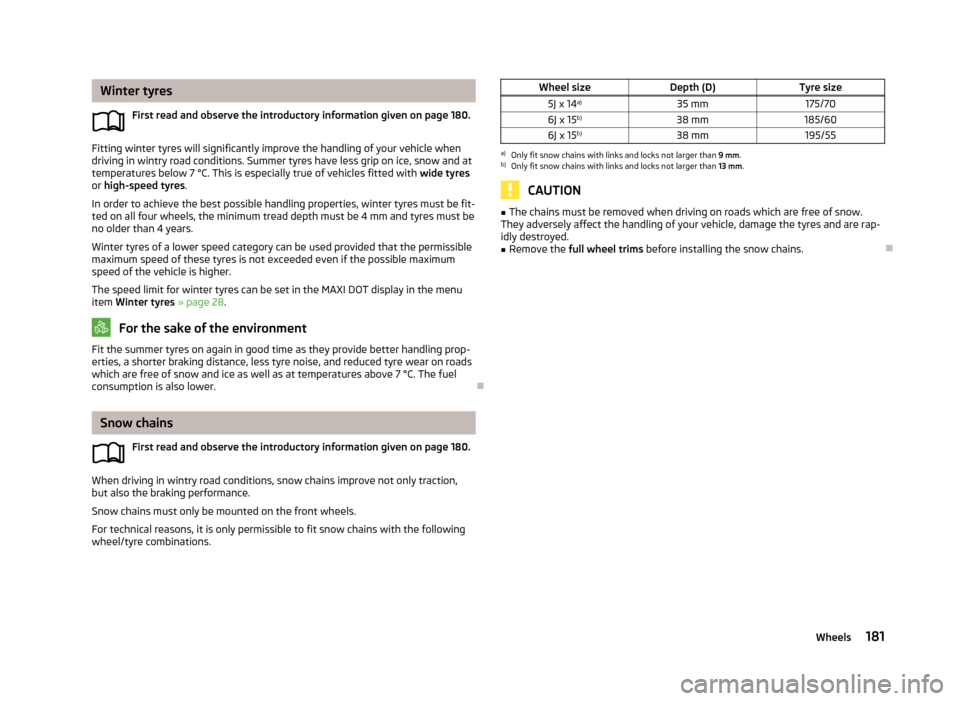
For technical reasons, it is only permissible to fit snow chains with the following wheel/tyre combinations.
Wheel sizeDepth (D)Tyre size5J x 14 a)35 mm175/706J x 15 b)38 mm185/606J x 15b)38 mm195/55a)
Only fit snow chains with links and locks not larger than
9 mm.
b)
Only fit snow chains with links and locks not larger than 13 mm.
CAUTION
■
The chains must be removed when driving on roads which are free of snow.
They adversely affect the handling of your vehicle, damage the tyres and are rap-
idly destroyed.■
Remove the full wheel trims before installing the snow chains.
181Wheels
Page 186 of 226
fire extinguisherFig. 148
Fire extinguisher
First read and observe the introductory information given on page 182.
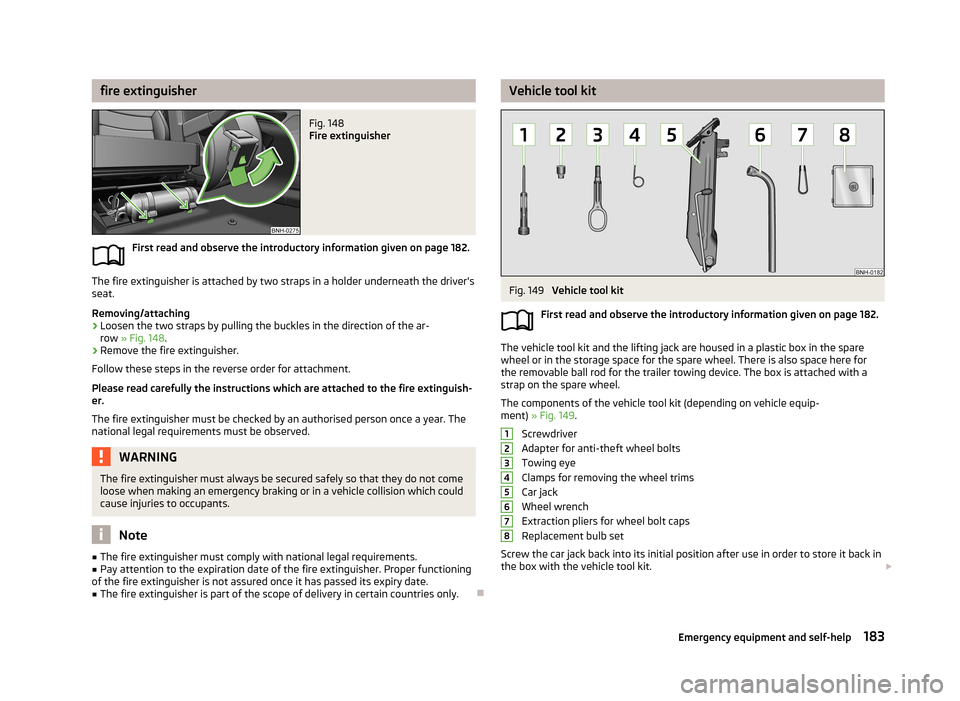
The fire extinguisher is attached by two straps in a holder underneath the driver's
seat.
Removing/attaching
›
Loosen the two straps by pulling the buckles in the direction of the ar- row » Fig. 148 .
›
Remove the fire extinguisher.
Follow these steps in the reverse order for attachment.
Please read carefully the instructions which are attached to the fire extinguish-
er.
The fire extinguisher must be checked by an authorised person once a year. The
national legal requirements must be observed.
WARNINGThe fire extinguisher must always be secured safely so that they do not come loose when making an emergency braking or in a vehicle collision which could
cause injuries to occupants.
Note
■ The fire extinguisher must comply with national legal requirements.■Pay attention to the expiration date of the fire extinguisher. Proper functioning
of the fire extinguisher is not assured once it has passed its expiry date.■
The fire extinguisher is part of the scope of delivery in certain countries only.
Vehicle tool kitFig. 149
Vehicle tool kit
First read and observe the introductory information given on page 182.
The vehicle tool kit and the lifting jack are housed in a plastic box in the spare
wheel or in the storage space for the spare wheel. There is also space here for
the removable ball rod for the trailer towing device. The box is attached with a
strap on the spare wheel.
The components of the vehicle tool kit (depending on vehicle equip-
ment) » Fig. 149 .
Screwdriver
Adapter for anti-theft wheel bolts
Towing eye
Clamps for removing the wheel trims
Car jack
Wheel wrench
Extraction pliers for wheel bolt caps
Replacement bulb set
Screw the car jack back into its initial position after use in order to store it back in the box with the vehicle tool kit.
12345678183Emergency equipment and self-help
Page 187 of 226
WARNING■The factory-supplied lifting jack is only intended for your model of vehicle.
Under no circumstances use it to lift heavier vehicles or other loads – risk of
injury!■
Ensure that the vehicle tool kit is safely secured in the boot.
■
Ensure that the box is always secured with the strap.
Changing a wheel
Introduction
This chapter contains information on the following subjects:
Preliminary work
184
Changing a wheel
185
Follow-up work
185
Loosening/tightening wheel bolts
185
Raising the vehicle
186
Securing wheels against theft
186WARNING■ If you are in flowing traffic, switch on the hazard warning light system and
set up the warning triangle at the prescribed distance! The national legal re-
quirements must be observed.■
Park the vehicle as far away as possible from the flow of traffic. Park on as
flat and firm a surface as possible.
■
The following instructions must be followed if the vehicle is subsequently
fitted with tyres or rims that differ from the factory-fitted ones » page 177,
New tyres .
WARNINGObserve the following instructions for lifting the vehicle.■If the wheel has to be changed on a slope, first of all block the opposite
wheel with a stone or similar object to prevent the vehicle from unexpectedly
rolling away.■
Secure the base plate of the lifting jack with suitable means to prevent pos-
sible moving. A soft and slippery ground under the base plate may move the lifting jack, causing the vehicle to fall down. It is therefore always necessary to
place the lifting jack on a solid surface or use a wide and stable base. Use a non-slip base (e.g. a rubber foot mat) if the surface is smooth, such as cobbled
stones, tiled floor, etc.
■
Only attach the lifting jack to the attachment points provided for this pur-
pose.
■
Always raise the vehicle with the doors closed.
■
Never position any body parts, such as arms or legs under the vehicle, while
the vehicle is raised with a lifting jack.
■
Never start the engine when the vehicle is raised – risk of injury.
CAUTION
■ The prescribed tightening torque of the wheel bolts for steel and light alloy
wheels is 120 Nm.■
If the wheel bolts are fastened too tightly, this can cause damage to the anti-
theft wheel bolt or the adapter.
Note
The national legal requirements must be observed when changing a wheel.
Preliminary work
First read and observe the introductory information and safety warn-ings
on page 184.
Always change a wheel on a level surface as far as possible.
The following steps must be carried out before actually changing the wheel:
›
Have all of the occupants get out of the vehicle. While changing a tyre, the oc-
cupants of the vehicle should not stand on the road (they should instead remain
behind a crash barrier).
184Do-it-yourself
Page 206 of 226
Replacing the bulb for the fog lightFig. 174
Front bumper: Protective grille/removing the fog light
Fig. 175
Replacing the light bulb
First read and observe the introductory information and safety warn-
ings on page 200.
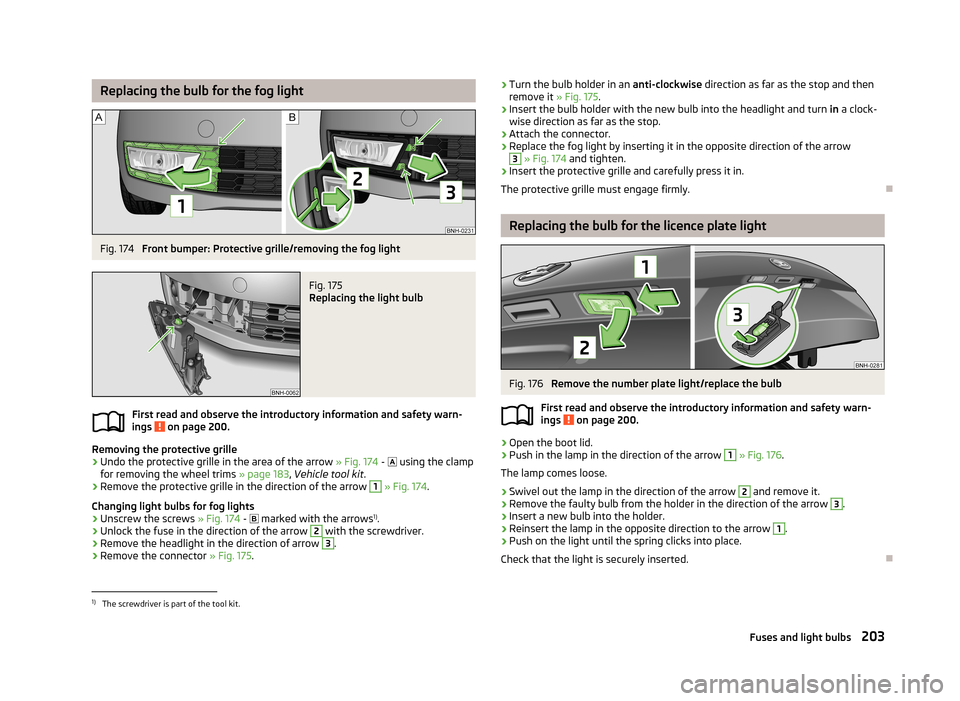
Removing the protective grille
›
Undo the protective grille in the area of the arrow » Fig. 174 -
using the clamp
for removing the wheel trims » page 183, Vehicle tool kit .
›
Remove the protective grille in the direction of the arrow
1
» Fig. 174 .
Changing light bulbs for fog lights
›
Unscrew the screws » Fig. 174 -
marked with the arrows 1)
.
›
Unlock the fuse in the direction of the arrow
2
with the screwdriver.
›
Remove the headlight in the direction of arrow
3
.
›
Remove the connector » Fig. 175.
›Turn the bulb holder in an
anti-clockwise direction as far as the stop and then
remove it » Fig. 175.›
Insert the bulb holder with the new bulb into the headlight and turn in a clock-
wise direction as far as the stop.
›
Attach the connector.
›
Replace the fog light by inserting it in the opposite direction of the arrow
3
» Fig. 174 and tighten.
›
Insert the protective grille and carefully press it in.
The protective grille must engage firmly.
Replacing the bulb for the licence plate light
Fig. 176
Remove the number plate light/replace the bulb
First read and observe the introductory information and safety warn-
ings
on page 200.
›
Open the boot lid.
›
Push in the lamp in the direction of the arrow
1
» Fig. 176 .
The lamp comes loose.
›
Swivel out the lamp in the direction of the arrow
2
and remove it.
›
Remove the faulty bulb from the holder in the direction of the arrow
3
.
›
Insert a new bulb into the holder.
›
Reinsert the lamp in the opposite direction to the arrow
1
.
›
Push on the light until the spring clicks into place.
Check that the light is securely inserted.
1)
The screwdriver is part of the tool kit.
203Fuses and light bulbs
Page 207 of 226
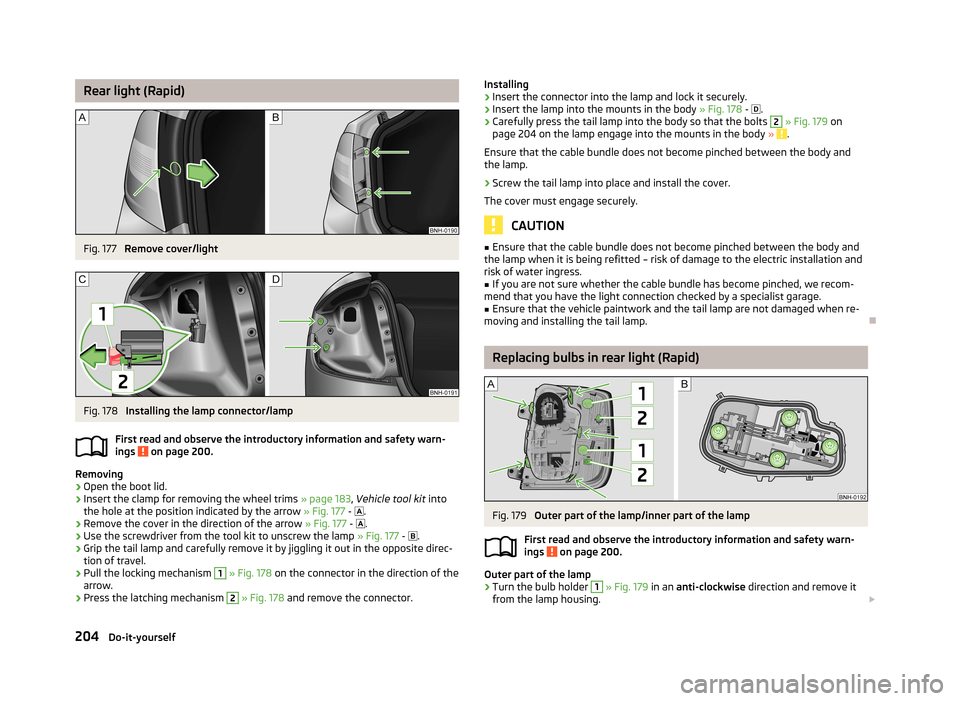
Rear light (Rapid)Fig. 177
Remove cover/light
Fig. 178
Installing the lamp connector/lamp
First read and observe the introductory information and safety warn-
ings
on page 200.
Removing
›
Open the boot lid.
›
Insert the clamp for removing the wheel trims » page 183, Vehicle tool kit into
the hole at the position indicated by the arrow » Fig. 177 -
.
›
Remove the cover in the direction of the arrow » Fig. 177 -
.
›
Use the screwdriver from the tool kit to unscrew the lamp » Fig. 177 -
.
›
Grip the tail lamp and carefully remove it by jiggling it out in the opposite direc-
tion of travel.
›
Pull the locking mechanism
1
» Fig. 178 on the connector in the direction of the
arrow.
›
Press the latching mechanism
2
» Fig. 178 and remove the connector.
Installing›Insert the connector into the lamp and lock it securely.›
Insert the lamp into the mounts in the body » Fig. 178 - .
›
Carefully press the tail lamp into the body so that the bolts
2
» Fig. 179 on
page 204 on the lamp engage into the mounts in the body » .
Ensure that the cable bundle does not become pinched between the body and
the lamp.
›
Screw the tail lamp into place and install the cover.
The cover must engage securely.
CAUTION
■ Ensure that the cable bundle does not become pinched between the body and
the lamp when it is being refitted – risk of damage to the electric installation and risk of water ingress.■
If you are not sure whether the cable bundle has become pinched, we recom-
mend that you have the light connection checked by a specialist garage.
■
Ensure that the vehicle paintwork and the tail lamp are not damaged when re-
moving and installing the tail lamp.
Replacing bulbs in rear light (Rapid)
Fig. 179
Outer part of the lamp/inner part of the lamp
First read and observe the introductory information and safety warn-
ings
on page 200.
Outer part of the lamp
›
Turn the bulb holder
1
» Fig. 179 in an anti-clockwise direction and remove it
from the lamp housing.
204Do-it-yourself
Page 208 of 226
›Replace the bulb, reinsert the holder with the bulb into the lamp housing and
turn to the stop in a clockwise direction.
Inner part of the lamp›
Unlock the bulb holder using the locking latches marked with arrows » Fig. 179 -
and remove the bulb holder from the tail lamp.
›
Turn the bulb holder to the stop » Fig. 179 - in an anti-clockwise direction and
remove it from the lamp housing.
›
Replace the bulb, reinsert the holder with the bulb into the lamp housing and turn to the stop in a clockwise direction.
›
Insert the bulb holder in the tail lamp assembly.
All locking mechanisms must audibly snap into place.
Tail lamp (Rapid Spaceback)
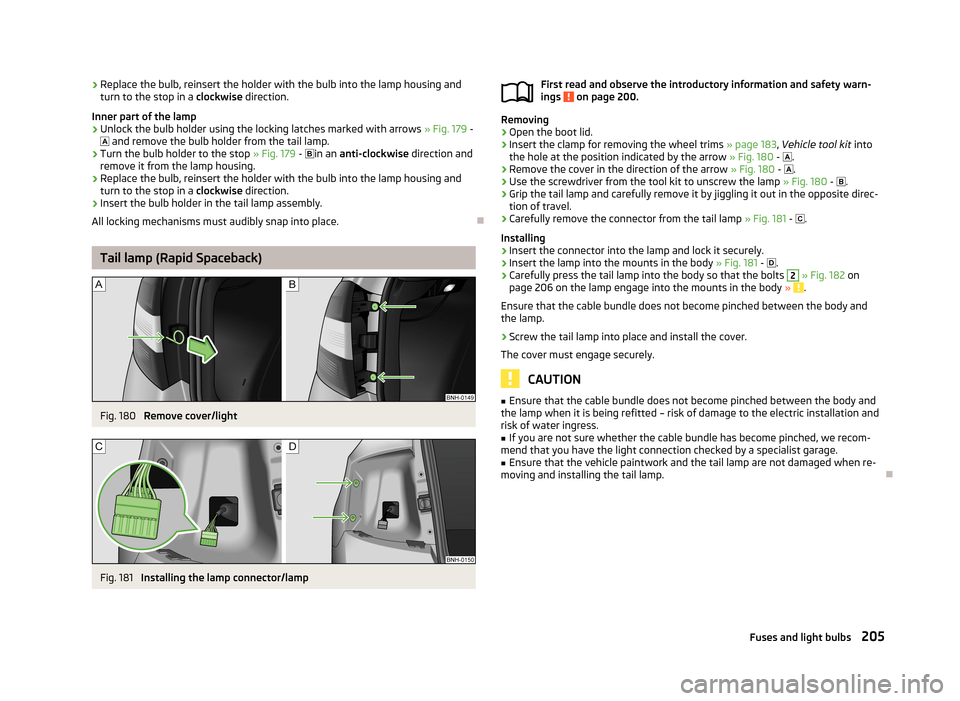
Fig. 180
Remove cover/light
Fig. 181
Installing the lamp connector/lamp
First read and observe the introductory information and safety warn-
ings on page 200.
Removing
›
Open the boot lid.
›
Insert the clamp for removing the wheel trims » page 183, Vehicle tool kit into
the hole at the position indicated by the arrow » Fig. 180 - .
›
Remove the cover in the direction of the arrow » Fig. 180 - .
›
Use the screwdriver from the tool kit to unscrew the lamp » Fig. 180 - .
›
Grip the tail lamp and carefully remove it by jiggling it out in the opposite direc-
tion of travel.
›
Carefully remove the connector from the tail lamp » Fig. 181 - .
Installing
›
Insert the connector into the lamp and lock it securely.
›
Insert the lamp into the mounts in the body » Fig. 181 -
.
›
Carefully press the tail lamp into the body so that the bolts
2
» Fig. 182 on
page 206 on the lamp engage into the mounts in the body » .
Ensure that the cable bundle does not become pinched between the body and
the lamp.
›
Screw the tail lamp into place and install the cover.
The cover must engage securely.
CAUTION
■ Ensure that the cable bundle does not become pinched between the body and
the lamp when it is being refitted – risk of damage to the electric installation and risk of water ingress.■
If you are not sure whether the cable bundle has become pinched, we recom-
mend that you have the light connection checked by a specialist garage.
■
Ensure that the vehicle paintwork and the tail lamp are not damaged when re-
moving and installing the tail lamp.
205Fuses and light bulbs
Page 211 of 226
The operating weight also contains the weight of the driver (75 kg), the weight ofthe operating fluids, the tool kit, and a fuel tank filled to 90 % capacity.
It is possible to calculate the approximate loading capacity from the differencebetween the permissible total weight and the operating weight »
.
The payload consists of the following components: › Passengers
› All items of luggage and other loads
› Roof load including roof rack system
› Equipment not included in the operating weight
› Trailer drawbar load when towing a trailer (max. 50 kg).
Fuel consumption and CO 2 emissions according to ECE regulations and EU
directives
The measurement of the intra-urban cycle begins with a cold start of the engine. Afterwards standard urban driving is simulated.
In the extra-urban driving cycle, the vehicle is accelerated and decelerated in all
gears, corresponding to daily routine driving conditions. The driving speed varies
between 0 and 120 km/h.
The calculation of the combined fuel consumption considers a weighting of about 37 % for the intra-urban cycle and 63 % for the extra-urban cycle.
WARNINGDo not exceed the specified maximum permissible weights – risk of accident
and damage!
Note
■ If required, you can find out the precise weight of your vehicle at a specialist ga-
rage.■
The fuel consumption and emission values have been determined in accordance
with rules and under conditions set out by legal or technical requirements for de-
termining operational and technical data for motor vehicles.
■
Depending on the range of equipment, style of driving, traffic situation, weather
influences and vehicle condition, consumption values may deviate from the indi-
cated values.
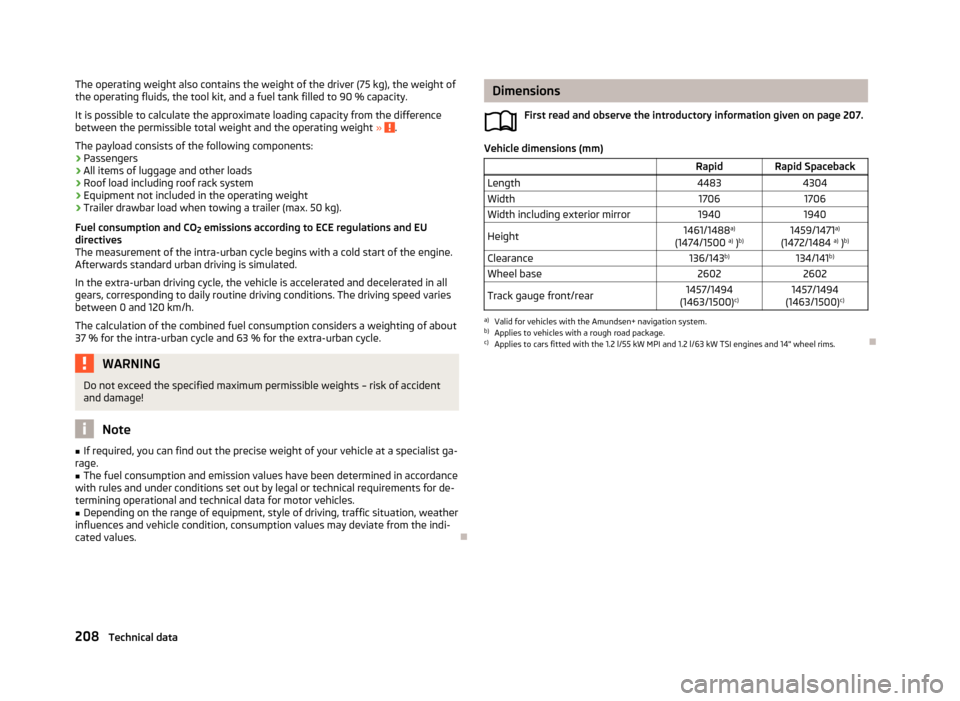
Dimensions
First read and observe the introductory information given on page 207.
Vehicle dimensions (mm)
RapidRapid SpacebackLength44834304Width17061706Width including exterior mirror19401940Height1461/1488 a)
(1474/1500 a)
) b)1459/1471 a)
(1472/1484 a)
) b)Clearance136/143 b)134/141b)Wheel base26022602Track gauge front/rear1457/1494
(1463/1500) c)1457/1494
(1463/1500) c)a)
Valid for vehicles with the Amundsen+ navigation system.
b)
Applies to vehicles with a rough road package.
c)
Applies to cars fitted with the 1.2 l/55 kW MPI and 1.2 l/63 kW TSI engines and 14" wheel rims.
208Technical data
Page 222 of 226
UnlockingIndividual settings34
Key32
Remote control33
Vehicle key32
Unlocking and locking31
USB95
Useful equipment 12-volt power outlet
60
Ashtray59
Car park ticket holder56
Cigarette lighter59
Clothes hook63
Cup holders58
Glasses storage box62
Holder for reflective vest57
Multimedia holder61
Storage compartment in the front arm rest62
Storage compartments in the doors57
Using the information system22
Using the selector lever102
V
Variable loading floor
70
Folding up73
Inserting72
Lower position72
Parking position73
Removing72
Upper position71
Vehicle battery Automatic load deactivation
174
charging173
Checking the battery electrolyte level173
Cover172
Operation in winter173
Replacing174
Safety instructions171
Vehicle care147
Alcantara158
Artificial leather158
Cloths158
Vehicle Condition See Auto Check Control
13
Vehicle data sticker207
Vehicle dimensions208
Vehicle height208
vehicle identification number - VIN207
Vehicle key Locking
32
Unlocking32
Vehicle length208
Vehicle tool kit183
Vehicle width208
Vest Holder for reflective vest
57
Visibility46
Visors see Sun visors
47
W
Warning at excessive speeds
27
Warning triangle182
Warranty5
Washing147
Automatic car wash system153
by hand152
Chrome parts155
High-pressure cleaner153
Waste container60
Water Driving through
109
Wax treatment See Taking care of your vehicle
154
Weights207
Wheel bolts Anti-theft wheel bolt186
Caps180
Loosening and tightening185
Wheel rims175
Wheels Bolts
180
Changing184
Full trim180
General information175
Load index177
Replacing wheels176
Service life of tyres176
Snow chains181
Spare wheel179
Speed symbol178
Storing wheels176
Temporary spare wheel179
Tyre pressure176
Tyre sizes176
Tyre wear indicator176
Unidirectional tyres178
Winter tyres181
Window Interior mirror
50
Windows De-icing
155
See Electrical power windows38
Windscreen washer fluid Checking
165
Replenishing165
Warning light20
Winter165
Windscreen washer system165
Windscreen wipers49
Windscreen wiper Replacing the front windscreen wiper blades
195
Service position195
219Index